====================
A homily offered by the Rev. Dr. C. Eric Funston on All Saints Sunday, November 6, 2016, to the people of St. Paul’s Episcopal Church, Medina, Ohio, where Fr. Funston is rector.
(The lessons for the day are from the Revised Common Lectionary for All Saints Day in Year C: Daniel 7:1-3,15-18; Psalm 149; Ephesians 1:11-23; and St. Luke 6:20-31. These lessons can be read at The Lectionary Page.)
====================
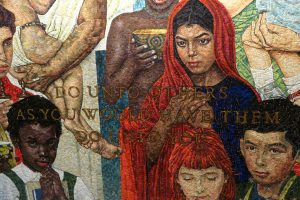 Tuesday was the Feast of All Saints (which we are commemorating today, as is permitted by tradition, by translating the feast to the following Sunday). Traditionally, All Saints Day (or All Saints Sunday) commemorates the departed members of the Christian church who are believed to have attained heaven (it is not limited to those officially canonized by a church hierarchy).
It recognizes the reality that:
Our ancestors are sacred and their resting place is hallowed ground. *** Our religion is the traditions of our ancestors – the dreams of our old men, given them in solemn hours of the night . . . and the visions of our [sages], and is written in the hearts of our people. (Chief Seattle, Native American)
It looks to and gives thanks for the example of those who knew that “it is easy enough to be friendly to one’s friends but to befriend one who regards himself as your enemy is the quintessence of true religion.” (M.K. Gandhi, Hindu) And it is underscored by the Christian community’s certainty “that in the religion of Love there are no believers and unbelievers. Love embraces all.” (Rumi, Sufi Muslim)
It is a Christian holy day, but I have just described it in three quotes from notable sages none of whom were Christians. The description of our ancestors as sacred and of religion as written on the hearts of the people is from Chief Seattle, the 19th Century leader of Suquamish and Duwamish nations of the northwest, a man who followed the religion of his ancestors. The observation about befriending one’s enemies is from Mohandas K. “Mahatma” Gandhi, a Hindu from India. And the statement about the religion of love is from Jal?l ad-D?n Muhammad R?m?, a 13th Century Muslim Sufi mystic and poet.
I quote from these three men because I’ve come to believe that in our commemoration of all the saints, we should include those who are recognized as “holy” or “saintly” in other religious traditions, as well. There is, I believe, nothing in what these saintly men said that could be disagreed with by anyone of any differing religious or philosophical background. Nonetheless, I am sure that there are some (perhaps many) who would reject their words entirely, with little or no thought, as a sort of knee-jerk reaction simply because they were not Christian, despite the wisdom, morality, and generosity of spirit which they displayed.
Such is the world and the nation in which we celebrate All Saints Day this year, two days before the voters of the United States will select a new chief executive for our country. We are a society divided, polarized, and given to knee-jerk reactions. It is in this context that our Lectionary today asks us to read and consider a portion of the Book of Daniel, the only piece of apocalyptic literature in the Hebrew Scriptures, a book which focuses the reader’s attention on “the relationship between earthly and heavenly rule, emphasizing that the sovereign authority of earthly [rulers] depends upon the will of God.” (Portier-Young)
In the vision shown to Daniel, God gave sovereignty to “one like a Son of Man,” one like a human being in response to the suffering of God’s people under the domination of the Persian, Median, Macedonian, Seleucid, and Ptolemaic empires. Professor Anathea Portier-Young of Duke Divinity School argues that in so doing, God sought to free the oppressed from political domination, state terror, and persecution, to empower them to exercise authority and participate willingly in the political systems in which they live, and to inaugurate just rule on earth as in heaven. (Ibid.)
The culmination of Daniel’s vision is the handing of the earthly over to “the holy ones of the Most High.” Historically, these “holy ones” may have been understood as divine beings, but from the perspective of the Christian Gospel, the “holy ones of God” are those good people who were deeply engagement in the power struggles of their day and time, those divided, polarized, and knee-jerk reactive struggles that threatened to change to course of history. (Davidson) The “holy ones of the Most High” are those who, in the midst of a highly troubled and dangerous world, know that God is present and that God is more powerful than all the unjust empires and political systems human beings can devise. The saints, of whatever religious tradition, know that God loves and nourishes us, and gives us hope and meaning, life and salvation, gives us “the kingdom [to] possess . . . for ever – for ever and ever.” (Gaiser)
In our context, we have been given not a kingdom, but a participative democracy in which we have the same obligation as the saints of old to be deeply engaged in the struggle for justice to which Jesus calls us in today’s reading from the Gospel according to Luke, the blessings and woes from the Sermon on the Plain. We are to remember the poor and the hungry, those who weep, and those who are hated, reviled, and excluded. We are to love our enemies, do good to those who hate us, bless those who curse us, and pray for those who abuse us. We are to follow what has come to be called “the Golden Rule:” “Do to others as you would have them do to you.” These are not merely good ideas to be followed sometimes; they are moral imperatives which are to inform every activity of our lives, including our participation – wisely, morally, and with generosity of spirit – in the democracy we have been given.
As I wrote in our parish newsletter this month, I believe that voting is more than a privilege, more than a right; it is, I believe, an ethical, moral obligation. It is, for me as a Christian, an exercise in stewardship. We have been given this country and its governance by our forebears – and even, if Daniel’s vision is true (and I believe it is), by God – and we have the obligation to participate in its democratic processes, preserve it, and pass it on to our children, grandchildren, and more distant descendants.
We have heard too much cynicism in this election season. We have been told again and again how the candidates nominated by our two major parties are both deeply disliked and deeply distrusted by the electorate. On November 1, All Saints Day itself, the United Kingdom’s Independent newspaper reported that 60 per cent of likely voters view Mrs. Clinton negatively and a similar percentage dislike Mr. Trump. In a pastoral letter to his flock last weekend, the Most Rev. Paul S. Coakley, Roman Catholic Archbishop of Oklahoma, wrote, “Our major party candidates are both deeply flawed.” (Patheos)
Well, I have some news for the Archbishop: that is just the way people, all people, are. He might just as well have written, “Our major party candidates are both human beings.” When the Roman Catholic Church began the process to canonize Pope John Paul II as a Capital-S Saint, the popular Jesuit author James Martin wrote an article responding to those who objected because they felt the late pope was insufficiently perfect to warrant it. Martin wrote of the saints:
[E]ven after their decisions to amend their lives, the saints remained stubbornly imperfect. In other words: human. And the history of sinful saints begins right at the start of Christianity. St. Peter, traditionally described as the “first pope,” denied knowing Jesus three times before the Crucifixion.
After cataloguing the indiscretions of several well-known saints, Martin commented:
All these men and women were holy, striving to devote their lives to God. They were also human. And they knew it, too. Of all people, the saints were the most cognizant of their flawed humanity, which served as a reminder of their reliance on God. (Slate)
Yes, our candidates are deeply flawed human beings. But to slightly misquote Jesus, “Let the one who is without sin cast the first ballot.” (See John 8:7)
I believe Archbishop Coakley was correct in writing that “what we most need is a renewed commitment to the pursuit of virtue, to seek the good and adhere to the truth as inscribed in our hearts by our Creator” and that “[v]oting is a moral act. It ought to be guided by prayer and an evaluation not only of the political, but also the moral implications of our decisions.” (Patheos)
In today’s reading from Paul’s letter to the church in Ephesus, the Apostle writes of the church and the Christian faith being “an inheritance” for which the saints are to praise God. As I have said, I believe this nation and our participative democracy are likewise an inheritance. As Paul prayed for the Ephesians, so I pray for all of us, especially this week, that God may give us a spirit of wisdom and revelation, that the eyes of our hearts may be enlightened, and that we may know what is the hope to which God has called us. None of us, not our candidates, not our neighbors, not our fellow voters, and especially not ourselves . . . none of us is perfect; we are all deeply flawed human beings. But we are also saints like the saints of old whom we commemorate today and like them we have been given the kingdom, on earth as in heaven, to possess and to participate in for ever – for ever and ever.
It is a saintly obligation. May we exercise it wisely, morally, and will generosity of spirit.
Let us pray:
Almighty God, to whom we must account for all our powers and privileges: Guide the people of the United States in the election of officials and representatives; that, by faithful administration and wise laws, the rights of all may be protected and our nation be enabled to fulfill your purposes; through Jesus Christ our Lord. Amen. (BCP Page 822)
====================
Father Funston is the rector of St. Paul’s Episcopal Church, Medina, Ohio.
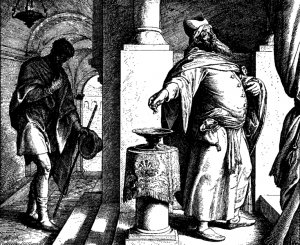 For the past couple of weeks in the Daily Office lectionary and today in the Sunday lectionary we are reading from the Wisdom of Yeshua ben Sira, some times called Sirach, sometimes called Ecclesiasticus, one of the books of the Apocrypha, those books recognized by the Roman and Eastern Orthodox churches as canonical, but rejected by Protestants. Anglicans steer a middle course and accept them for moral teaching, but not as the basis for religious doctrine. The text is a late example of what is called “wisdom literature,” instruction in ethics and proper social behavior for young men, especially those likely to take a role in governance.
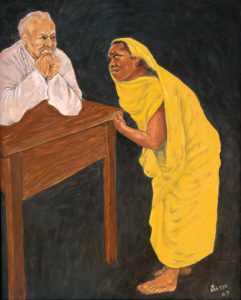 The story of the “unjust judge” has to be one of the most confusing of Jesus’ parables related in any of the Gospels. In every bible study group I have ever been a part of someone will want to know how the “unjust judge” could possibly represent God . . . .
  For ten months, since the First Sunday of Advent 2015, we have been in Lectionary Year C, during which we’ve been following texts from the Gospel according to Luke. Luke’s Gospel , after telling of his birth and infancy, sets out Jesus’ original mission statement, which he adopted from the Prophet Isaiah and proclaimed in his hometown synagogue:
![Dives and Lazarus. Psalter (Munich Golden Psalter). England [Gloucester?], 1st quarter of the 13th century.](http://thefunstons.com/wp-content/uploads/2016/09/Lazarus-and-Dives-300x264.jpg) We could, I suppose, spiritualize the story of Lazarus and the rich man. We could, but if we did we would be twisting it out of shape. This is not a spiritual story. This is a bare-knuckled street-brawl of a story about wealth, about money and possessions, about someone who had plenty and about someone who had none. If we are going to honor the biblical text, we cannot spiritualize this tale; we have to deal with it as it is given us, as a story about money.
We could, I suppose, spiritualize the story of Lazarus and the rich man. We could, but if we did we would be twisting it out of shape. This is not a spiritual story. This is a bare-knuckled street-brawl of a story about wealth, about money and possessions, about someone who had plenty and about someone who had none. If we are going to honor the biblical text, we cannot spiritualize this tale; we have to deal with it as it is given us, as a story about money. I’d like you all to take your Prayer Books in hand and turn with me to page 855 which is way in the back of the book in the section called The Catechism or Outline of the Faith. At the top of the page are three questions about the mission of the church and the answers to those questions that we as Episcopalians teach. I’m going to read the questions; I’d like you to read the answers:
 “Whoever comes to me and does not hate father and mother, wife and children, brothers and sisters, yes, and even life itself, cannot be my disciple. * * * None of you can become my disciple if you do not give up all your possessions.”
 Our first lesson today is from a book with the wholly amazing title The Book of the All-Virtuous Wisdom of Joshua ben Sira, usually (and mercifully) shortened to Sirach. It is accepted as part of the Christian biblical canon by Roman Catholics, the Eastern Orthodox, and most of the Oriental Orthodox churches. In our Anglican tradition, it is not accepted as canonical, but we do read it “for example of life and instruction of manners;” however, it cannot be used to establish any doctrine. (Article VI of the Articles of Religion, 1801) The book is in the tradition known as “wisdom literature;” basically, it is a collection of ethical teachings closely resembling the canonical Book of Proverbs, and serving the same function.
 Our reading from the Book of Isaiah today is the second half of chapter 58, a chapter which begins with God ordering the prophet to “Shout out,” to “do not hold back,” to “lift up [his] voice like a trumpet” with God’s answer to a question asked by the people of Jerusalem: “Why do we fast, but you do not see? Why humble ourselves, but you do not notice?” (Isaiah 58:1,3a)
 In philosophy and theology there is an exercise named by the Greek word deiknumi. The word simply translated means “occurrence” or “evidence,” but in philosophy it refers to a “thought experiment,” a sort of meditation or exploration of a hypothesis about what might happen if certain facts are true or certain situations experienced. It’s particularly useful if those situations cannot be replicated in a laboratory or if the facts are in the past or future and cannot be presently experienced. St. Paul uses the word only once in his epistles: in the last verse of chapter 12 of the First Letter to the Corinthians, he uses the verbal form when he admonishes his readers to “strive for the greater gifts. And I will show you [deiknuo, ‘I will give you evidence of’] a still more excellent way.” It is the introduction to his famous treatise on agape, divine love, a thought experiment (if you will) about the best expression, the “still more excellent” expression of the greatest of the virtues.

