Occasional thoughts of an Anglican Episcopal priest

Category: Worship (Page 46 of 107)

Horizontal Faith – From the Daily Office – June 16, 2014

From the Letter to the Romans:

For I am longing to see you so that I may share with you some spiritual gift to strengthen you — or rather so that we may be mutually encouraged by each other’s faith, both yours and mine.

(From the Daily Office Lectionary – Romans 1:11-12 (NRSV) – June 16, 2014)

Wooden CrossConfession: For years I have found Paul’s writing tedious. I read it because the early church reached consensus that his letters would be considered divinely inspired and the contemporary church has mandated that we read his stuff in the Daily Office and Eucharistic lectionaries. But I read it carelessly, not paying much attention.

Only since taking on the discipline of writing these daily meditations on some part of the daily readings have I really read Paul. And I am impressed with his stated reason for wanting to visit the Romans! “That we may be mutually encouraged by each other’s faith.” That’s solid.

That is, in fact, what I think Christianity is all about. It’s about mutually encouraging and supporting one another. It’s about sustaining interpersonal relationships. It’s about community. It must be by design that these lessons show up the day after Trinity Sunday when we celebrate the paradigm complete and perfect community which is the Triune Godhead.

So much of modern Christianity seems to focus solely on the individual’s devotion to God in Christ to the exclusion of the faith’s social aspect. Many Christians seem to have forgotten that the cross has two members: a vertical, which represents that earth-to-heaven, human-to-God aspect; and a horizontal, which represents the relationships of human-to-human. Christianity is as much a horizontal faith as it is a vertical one. A prayer for mission in the Daily Office focuses on the horizontal:

Lord Jesus Christ, you stretched out your arms of love on the hard wood of the cross that everyone might come within the reach of your saving embrace: So clothe us in your Spirit that we, reaching forth our hands in love, may bring those who do not know you to the knowledge and love of you; for the honor of your Name. Amen.

I usually reserve this prayer for Fridays, but following Paul’s hope in the horizontality of faith, “that we may be mutually encouraged by each other’s faith,” I said it today.

====================

A request to my readers: I’m trying to build the readership of this blog and I’d very much appreciate your help in doing so. If you find something here that is of value, please share it with others. If you are on Facebook, “like” the posts on your page so others can see them. If you are following me on Twitter, please “retweet” the notices of these meditations. If you have a blog of your own, please include mine in your links (a favor I will gladly reciprocate). Many thanks!

====================

Father Funston is the rector of St. Paul’s Episcopal Church, Medina, Ohio.

I Arise Today: Sermon for Trinity Sunday – RCL, Year A – June 15, 2014

====================

On Trinity Sunday, the First Sunday after Pentecost, June 15, 2014, this sermon was offered to the people of St. Paul’s Episcopal Church, Medina, Ohio, where Fr. Funston is rector.

(The lessons for the day were: Genesis 1:1-2:4a; Canticle 13 (Song of the Three Young Men 29-34); 2 Corinthians 13:11-13; and Matthew 28:16-20. These lessons can be read at The Lectionary Page.)

====================

Triquetra

I arise today
Through a mighty strength, the invocation of the Trinity
Through belief in the Threeness
Through confession of the Oneness
Towards the Creator.

Although he probably didn’t actually write it, tradition credits St. Patrick of Ireland with the poetic charm called a “lorica” or “breastplate” which begins with these words, an invocation of the One, Holy, Blessed, and Glorious Trinity whom we today celebrate. Since the time of St. Thomas a Becket, the first Sunday after the Feast of Pentecost has been set aside as day of special veneration of the Triune nature of the Godhead. Becket was consecrated Archbishop of Canterbury on the Sunday after Pentecost, and his first act was to decree that the anniversary of his consecration should be commemorated each year in honor of the Holy Trinity. This observance spread from Canterbury throughout the whole of the western church.

Patrick continues:

I arise today
Through the strength of Christ with his baptism,
Through the strength of his crucifixion with his burial,
Through the strength of his resurrection with his ascension
Through the strength of his descent for the Judgment of doom.

Our Gospel lesson today is the end of Matthew’s Gospel. In it Christ on the mount of the ascension, just before going up into heaven, gives the eleven remaining Apostles what has come to be known as “The Great Commission”:

Go therefore and make disciples of all nations, baptizing them in the name of the Father and of the Son and of the Holy Spirit, and teaching them to obey everything that I have commanded you.

For Matthew mountains are what Celtic Christianity refers to as “thin places,” those places where the separation between the spiritual realm and the physical realm is narrowest, where the veil which separates heaven from earth is nearly transparent so that we have the feeling we could reach out and touch, even enter, the holy presence.

On a mountain, in such a place, Jesus calls his followers to a new beginning. The Eleven, standing proxy for all the followers of Jesus then and now, for you and for me, are called to be people moving in mission. It is important for us to note that this mountain is in Galilee, the place where Jesus began his ministry, the place from which he went forth but to which he returned, the place where he was grounded and rooted. The disciples, too, are from this place and their grounding in the Christian story is this same country where their journey began. Like them, we are called to claim our origins, to be rooted in the place where we entered the Christian story, not to be permanently bound there, but to draw strength from it as we venture out in mission into the wider world beyond. The place where we began as members of the community of Christ is, to each of us, an important place of foundation and also, perhaps, a thin place where we encounter the Triune God.

Patrick’s lorica continues:

I arise today
Through the strength of the love of Cherubim
In obedience to the Angels,
In the service of the Archangels,
In hope of resurrection to meet with reward,
In prayers of patriarchs,
In predictions of prophets,
In preaching of Apostles,
In faith of confessors,
In innocence of Holy Virgins,
In deeds of righteous [people].

Here, St. Patrick claims membership in the Christian community as his source of strength, as his foundation, as the community in which his mission is grounded and from which it is nurtured.

In a few moments, we will do something we have not done since Lent . . . join together in the General Confession, jointly and publically acknowledging that as individuals and as a community we have failed to live up to our obligations, that we have sinned “by what we have done, and by what we have left undone.” And we will be forgiven that failure by God’s absolution which reconciles us and restores us to the community and fellowship of the Church. When, as presiding priest, I pronounce the words of absolution, I speak not on my own behalf but for the whole church to which Jesus gave what is called “the power of the keys” when he said to the Apostles, “I will give you the keys of the kingdom of heaven, and whatever you bind on earth will be bound in heaven, and whatever you loose on earth will be loosed in heaven.” (Mt 16:19; cf. 18:18)

The words of absolution, which I speak as much to myself as to anyone, loose our sins, but also bind us into the beloved community:

Almighty God have mercy on you, forgive you all your sins through our Lord Jesus Christ, strengthen you in all goodness, and by the power of the Holy Spirit keep you in eternal life.

The community with which we are reconciled through confession and absolution is the community of the Trinity.

In the Triune Godhead all Christian community begins and finds its perfect expression. Humankind, as our Genesis reading reminded us, was and is created in the image of God. Thus, we are blessed with reason and skill; we are capable of experiencing emotion; and, like God, we have individual will and freedom of action. To be created in God’s likeness also means that we have the possibility of attaining holiness and immortality. To be created in God’s likeness further means that we are created to experience, participate in, and share interrelationship with others, for we are made in the image of the Holy Trinity.

The Doctrine of the Trinity is not a static principal of faith; it is the way in which the church, through the revelation of God, has come to appreciate and express of the significantly dynamic nature of God in the relationship of the Father, the Son, and the Holy Spirit. If we have been created in the image of God and if God is Trinity then at the deepest level of our being, we are communitarian, created not for ourselves, but for one another, for relationship with each other and with God.

Many look at the mystery of the Trinity as if it were a problem in differential calculus. They seem to have the attitude that if one solves the equation, they will have figured out God and earned their entry into heaven. But, as Benedictine poet Killian McDonnell writes, God is not a problem to be solved:

God is not a problem
I need to solve, not an
algebraic polynomial equation
I find complete before me,

with positive and negative numbers
I can add, subtract, multiply.
God is not a fortress
I can lay siege to and reduce.

God is not a confusion
I can place in order by my logic.
God’s boundaries cannot be set,
like marking trees to fell.

God is the presence in which
I live, where the line between
what is in me and what
before me is real, but only God

can draw it. God is the mystery
I meet on the street, but cannot
lay hold of from the outside,
for God is my situation,

the condition I cannot stand
beyond, cannot view from a distance,
the presence I cannot make an object,
only enter on my knees.

Which brings us back to confession, to reconciliation, and to community.

The community to which and in which we are to be reconciled is not only that of the church or that of the human commonwealth, it is the community of the whole of creation. This is why our round of readings from Sacred Scripture bids us on Trinity Sunday to hear the long lesson from Genesis recounting the days of creation as each part of the natural order is ordained by God and pronounced good. This is the community that Matthew’s Jesus claims when he asserts that “all authority in heaven and on earth has been given to me.” “Heaven and earth” is a figure of speech called a merism, a manner of speaking by which the whole of something is referenced by enumerating its constituents or traits. In the Genesis creation story, heaven and earth comprise a single entity — God’s whole creation. We are a part of that community of creation and it is to that universal community that Patrick next looks in his lorica:

I arise today
Through the strength of heaven:
Light of sun
Brilliance of moon
Splendor of fire
Speed of lightning
Swiftness of wind
Depth of sea
Stability of earth
Firmness of rock.

The whole of nature comprises the foundational community of strength and support upon which a follower of Jesus may depend, because this community finds its strength and support in paradigm community of the Holy Trinity by whom it was creation.

Genesis insists that there is one God, who is sovereign and powerful. Unlike the gods of other peoples in the ancient Middle East, the God of Israel had no specified area of competence. The creation in the first chapter of Genesis is, as one commentator has said, “fiercely monotheistic,” yet even in its insistence on the one God, not limited in space or time, Genesis reveals the Trinity. From this god, the God, a wind, the Holy Spirit, came forth and spread across the void. This god, the God, created everything. This god, the God, simply spoke the Word (“in the beginning was the Word,” said John of Jesus) and creation happened. It is to this god, the God that Patrick looks for strength and protection:

I arise today
Through God’s strength to pilot me:
God’s might to uphold me,
God’s wisdom to guide me
God’s eye to look before me,
God’s ear to hear me,
God’s word to speak for me,
God’s hand to guard me,
God’s way to lie before me,
God’s host to secure me
against snares of devils
against temptations of vices
against inclinations of nature
against everyone who shall wish me ill,
afar and anear,
alone and in a crowd.

But we are never truly alone, nor are we ever really beset by these and the many other spiritual and physical dangers that Patrick goes on to list. St. Paul blessed and reminded his readers, “the grace of the Lord Jesus Christ, the love of God, and the communion of the Holy Spirit” are with us all. Jesus promised and reminded the Eleven (and through them, us), “I am with you always, to the end of the age.”

These are not mere blessings or simple an appeals to get along with one another; these are exhortations to be the new creation that the Spirit of God equips us to be, a foundational community patterned on the Holy Trinity. Just as the Persons of the Divine Trinity are never alone, human beings are created with a need for one another, a need to communicate with one another. Our thirst to communicate ourselves to others, to be in authentic relationship with each other is never exhausted. The only difference between our community and that of the Trinity is that God’s Triune relationship is perfect and total whereas in our human reality communication and relationship are imperfect and partial. Paul’s appeal for the presence of Christ’s grace, God’s love, and the Spirit’s fellowship is an appeal to enter more to the divine love that creates and sustains the church, that perfects and completes our relationships. The Trinity is the very source of our life in Christ, and in Christ we are a new creation with whom Christ promises always to stay.

So in the lorica, Patrick extols the totality of Christ’s presence, the inescapabilty of Jesus’ promise, “I am with you always, to the end of the age.” Patrick writes:

Christ with me,
Christ before me,
Christ behind me,
Christ in me,
Christ beneath me,
Christ above me,
Christ on my right,
Christ on my left,
Christ where I lie,
Christ where I sit,
Christ where I arise,
Christ in the heart of every [person] who thinks of me,
Christ in the mouth of every [person] who speaks of me,
Christ in every eye that sees me,
Christ in every ear that hears me.

Patrick concludes as he began, invoking the One, Holy, Blessed, and Glorious Trinity whom we today celebrate:

I arise today
Through a mighty strength, the invocation of the Trinity,
Through belief in the Threeness,
Through confession of the Oneness
Towards the Creator.

“The grace of our Lord Jesus Christ, and the love of God, and the fellowship of the Holy Spirit, be with us all evermore. Amen.” (2 Cor 13:14 as used to conclude the Daily Office in The Book of Common Prayer, page 102)

====================

A request to my readers: I’m trying to build the readership of this blog and I’d very much appreciate your help in doing so. If you find something here that is of value, please share it with others. If you are on Facebook, “like” the posts on your page so others can see them. If you are following me on Twitter, please “retweet” the notices of these meditations. If you have a blog of your own, please include mine in your links (a favor I will gladly reciprocate). Many thanks!

====================

Father Funston is the rector of St. Paul’s Episcopal Church, Medina, Ohio.

Handwriting – From the Daily Office – June 14, 2014

From the Letter to the Galatians:

See what large letters I make when I am writing in my own hand!

(From the Daily Office Lectionary – Galatians 6:11 (NRSV) – June 14, 2014)

Writing HandI sort of remember something from New Testament class at seminary that Paul would compose his letters by dictation to a secretary and then add greetings in his own handwriting. What I can’t remember is whether this verse (which seems such a strange intrusion into the text of the letter to the Galatians) in which he comments on the quality of his penmanship is taken by scholars to be proof of genuine Pauline authorship or as evidence that the letter wasn’t truly written by him. I know it’s one or the other. Whatever . . . it’s in the accepted canon of the New Testament.

When I was a kid I remember that one of the attractions at county fairs in the Kansas town where my grandparents lived was a handwriting analysis booth. You would write out in cursive something like “The quick brown fox jumped over the lazy white dog” or “She sells sea shells by the sea shore” and then sign your name. The graphologist (as the analyst was called) would then tell you about your character traits and sometimes predict your future.

I always wanted to have my handwriting analyzed but my grandfather, who was a Palmer method penmanship instructor, would never allow it. He did, however, insist that his grandchildren learn proper cursive penmanship so in addition to going to the fair each summer we also had to practice writing things out and making evenly sized, evenly spaced letters and loops. His handwriting was beautiful, rather more Spencerian than Palmer; mine, while passable, never achieved the fluid beauty of his.

As an adult just finished with college and then a 12-week summer course in paralegal studies, I went to work for a law firm in Las Vegas, Nevada. The firm was then providing office space and occasionally support personnel for the attorneys trying to prove the validity of the so-called “Mormon will,” the alleged handwritten testament of Howard Hughes. From time to time I would be called on to deliver documents to their off-site location elsewhere in Las Vegas and, each time I was there, the lead attorney would delight in showing me the latest in their analysts’ charts and comparisons of the will to other exemplars of Hughes’s handwriting.

All of those things come to mind whenever I read Paul’s comments about this handwriting. (Although he doesn’t comment on the quality of his penmanship, he also makes note of a greeting being “in my own hand” in the first letter to Corinth. 1 Cor 16:21)

Handwriting is a lost art. Some schools have even discontinued instruction in cursive penmanship. I think there’s something sad about that. While what is written is clearly of more import than how it is written — the same thoughts will be conveyed whether written out, lettered, typewritten, or recorded by some electronic method — there is (as the county fair graphologists insisted) a personality to cursive penmanship. There is an investment of one’s self in the handwritten text. Time must be taken and care invested in what is written.

When I finally entered into law practice as an attorney several years after those days of running errands for the Mormon will lawyers, I got into the habit of handwriting the initial drafts of my court briefs and legal arguments. I found I could work with blocks of text, with aggregations of ideas, with turns of phrase and different phrasing more effectively by doing so. Today, when I make my feeble attempts to write poetry, I work initially with pen and paper. I find the act of writing my thoughts and images out makes them somehow more malleable than when they are simply input to the computer screen (as I am now “writing”).

Handwriting and hand-lettering were the means of transmission of information — of data, of lore, of stories, of sacred language, of everything — for millennia until the late 19th Century and the invention of the typewriter. Today, inspired by Paul’s commentary on his penmanship, I give thanks for the untold number of scribes who wrote down their own words or those of others, for Paul with his large letters and for Tertius who took his dictation (Rom 16:22), for monks and other calligraphers who copied holy texts, for poets and story tellers who played with words with pen and ink, and for my grandfather who taught me to value the English word written with the human hand.

====================

A request to my readers: I’m trying to build the readership of this blog and I’d very much appreciate your help in doing so. If you find something here that is of value, please share it with others. If you are on Facebook, “like” the posts on your page so others can see them. If you are following me on Twitter, please “retweet” the notices of these meditations. If you have a blog of your own, please include mine in your links (a favor I will gladly reciprocate). Many thanks!

====================

Father Funston is the rector of St. Paul’s Episcopal Church, Medina, Ohio.

Reality of Death – From the Daily Office – June 13, 2014

From Ecclesiastes:

Remember your creator in the days of your youth, before the days of trouble come, and the years draw near when you will say, “I have no pleasure in them”; before the sun and the light and the moon and the stars are darkened and the clouds return with the rain; on the day when the guards of the house tremble, and the strong men are bent, and the women who grind cease working because they are few, and those who look through the windows see dimly; when the doors on the street are shut, and the sound of the grinding is low, and one rises up at the sound of a bird, and all the daughters of song are brought low; when one is afraid of heights, and terrors are in the road; the almond tree blossoms, the grasshopper drags itself along and desire fails; because all must go to their eternal home, and the mourners will go about the streets; before the silver cord is snapped, and the golden bowl is broken, and the pitcher is broken at the fountain, and the wheel broken at the cistern, and the dust returns to the earth as it was, and the breath returns to God who gave it.

(From the Daily Office Lectionary – Ecclesiastes 12:1-7 (NRSV) – June 13, 2014)

Old Irish VillageI was listening to the radio yesterday. A golf club president was being interviewed about a professional golfer who had been killed in an air craft incident. I don’t golf or follow the game, so I have no idea who was being profiled, and that’s not relevant here. What is relevant is that the person being interviewed used the euphemism “he passed” to reference the golfer’s death.

This is a usage of the verb “to pass” that has become very prevalent in recent years. I don’t recall hearing it before the 1990s. “Passed away,” yes. Simple “passed,” no. And I find it interesting, but also disturbing and objectionable. Using “he passed” in this way is symptomatic of the modern denial of the reality of death. People don’t “pass.” They die! Unless killed by disease, accident, or misfortune, they grow old and die. And although our faith teaches us that “for [God’s] faithful people . . . life is changed, not ended,” it also acknowledged that “our mortal bodies will lie in death.” (Preface for a Eucharist in Commemoration of the Dead, BCP 1979, page 381) Modern culture, however, seems not to want to admit this, the truth and physical reality of death: according to contemporary society, human beings don’t die – they “pass.”

The refusal to face death was parodied by Monty Python’s Flying Circus in what has come to be know as The Pet Shop Sketch or The Dead Parrot Sketch in which John Cleese tries to return a deceased bird to a pet store run by Michael Palin, who denies that the bird is dead. When Palin tries to argue that the parrot is “pining,” an exasperated Cleese runs through several euphemisms for death:

‘E’s not pinin’! ‘E’s passed on! This parrot is no more! He has ceased to be! ‘E’s expired and gone to meet ‘is maker! ‘E’s a stiff! Bereft of life, ‘e rests in peace! If you hadn’t nailed ‘im to the perch ‘e’d be pushing up the daisies! ‘Is metabolic processes are now ‘istory! ‘E’s off the twig! ‘E’s kicked the bucket, ‘e’s shuffled off ‘is mortal coil, run down the curtain and joined the bleedin’ choir invisibile!!He’s f*ckin’ snuffed it!….. THIS IS AN EX-PARROT!!

Qoheleth demonstrates the difference between poetry and euphemism in this marvelous metaphoric description of old age and decline. This is a man who knows the decline of age, who has seen death up close. Rather than euphemize it and sanitize it and avoid it, he confronts it, describes it, embraces it, almost caresses it in the same way one would a spouse, a lover, an old friend. “The strong men are bent . . . the daughters of song are brought low . . . the grasshopper drags itself along and desire fails . . . the silver cord is snapped, and the golden bowl is broken.” No “passing” here; this language faces the reality of death.

When I read this passage, I see in my mind’s eye a village in decline; in truth, I see the village portrayed in the Irish television (RTE) movie version of Máirtín Ó Cadhain’s 1947 Irish-language play Cré na Cille (“Graveyard Clay”). The village, like the people in it, is old and tired; once vibrant life is slowed and winding down. Eventually, it will die as many of its residents have died. Like them, it is honestly facing (perhaps even looking forward to) its demise. (The play is narrated by the conversations of the dead beneath the soil of the cemetery. It’s a very imaginative piece of stagecraft and I do wish someone with an excellent understanding of Irish would translate it into English!)

Contemporary society seems to have lost the willingness to honestly face decline and death, to look forward to old age, to anticipate without dread the time when “the dust returns to the earth as it was, and the breath returns to God who gave it.” Instead of caring for our elderly at home, we warehouse old folks in nursing homes. When they die, we probably aren’t even there. Their bodies are shrouded and taken out a side door so the other nursing home residents can’t see what is happening. We pay “funeral home” employees to handle the washing of dead bodies and their preparation for burial, a task that used to be done by family members. We have sanitized and euphemized death into invisibility.

And, having done so, I wonder if that is why it is so easy for us as a country to send young soldiers into war. I wonder if that is why we glorify guns and violent games, and do practically nothing to prevent the school, work place, and church shootings which plague us. By avoiding the reality of death, have we made death a more present part of our reality?

====================

A request to my readers: I’m trying to build the readership of this blog and I’d very much appreciate your help in doing so. If you find something here that is of value, please share it with others. If you are on Facebook, “like” the posts on your page so others can see them. If you are following me on Twitter, please “retweet” the notices of these meditations. If you have a blog of your own, please include mine in your links (a favor I will gladly reciprocate). Many thanks!

====================

Father Funston is the rector of St. Paul’s Episcopal Church, Medina, Ohio.

Bread on Water – From the Daily Office – June 12, 2014

From Ecclesiastes:

Send out your bread upon the waters, for after many days you will get it back.

(From the Daily Office Lectionary – Ecclesiastes 11:1 (NRSV) – June 12, 2014)

A Mass of Feeding CarpI have to admit that on first reading this, I had no idea what Qoheleth is saying here! Not the slightest.
So I looked at a few commentaries and they all seem to agree (a) that “casting bread on the waters” was an ancient Israelite metaphor for wastefulness, something to be avoided and (b) that the preacher is using turning this metaphor on its head and encouraging generosity to the poor and unfortunate.

OK, so far — I’m enough of an aging hippie that “bread” as slang (“metaphoric language”) for wealth makes sense. “Waters” as a reference to the poor is new to me, but I suppose it works (although I’m rather more familiar with Edward Bulwer-Lyton’s opposite connotation phrase “the great unwashed”).

The “after many days you will get it back” is where I get caught up. This must be a spiritual return, not a monetary return, because there’s no way that that bread is every coming back. Not in this world!

Thinking about throwing bread onto water, I remember the Lake Mead Marina in Nevada. Throw a piece of bread in the water there and the surface becomes a roiling, boiling, thrashing mass of carp! And the bread . . . gone instantly, torn apart by gluttonous fish.

As a vision of what happens to one’s gifts of charity, it’s not very edifying. And pretty much kills any notion that “after many days you will get it back.”

But then . . . Jesus, contrary to Qoheleth, made it pretty clear that that’s not a valid consideration! It’s not a consideration at all. “Return on investment” is irrelevant. Yesterday was the feast of St. Barnabas the Apostle and, at the Eucharist, the Gospel lesson was from Matthew, the sending out of the Twelve in which Jesus instructs them, “You received without payment; give without payment.” (Mt 10:8b) Similarly, in the Sermon on Plain, he told the crowds, “Love your enemies, do good, and lend, expecting nothing in return.” (Lk 6:35) Now, Jesus did promise that those who were thus generous would be rewarded: “Give, and it will be given to you. A good measure, pressed down, shaken together, running over, will be put into your lap; for the measure you give will be the measure you get back.” (Lk 6:38)

There will be a return. We’re just supposed to not expect it, which Qoheleth seems to encourage.

That’s the hard part for me. The “not expecting” part. How can I not expect what I am told will happen? How can I not anticipate that and take it into consideration?

And that’s where Qoheleth’s “bread on the waters” metaphor is helpful. I just think about those hungry carp . . . and, nope, no expectation of return. Not one!

====================

A request to my readers: I’m trying to build the readership of this blog and I’d very much appreciate your help in doing so. If you find something here that is of value, please share it with others. If you are on Facebook, “like” the posts on your page so others can see them. If you are following me on Twitter, please “retweet” the notices of these meditations. If you have a blog of your own, please include mine in your links (a favor I will gladly reciprocate). Many thanks!

====================

Father Funston is the rector of St. Paul’s Episcopal Church, Medina, Ohio.

Internal Polling – From the Daily Office – June 11, 2014

From Ecclesiastes:

Again I saw that under the sun the race is not to the swift, nor the battle to the strong, nor bread to the wise, nor riches to the intelligent, nor favor to the skillful; but time and chance happen to them all. For no one can anticipate the time of disaster. Like fish taken in a cruel net, and like birds caught in a snare, so mortals are snared at a time of calamity, when it suddenly falls upon them.

(From the Daily Office Lectionary – Ecclesiastes 9:11-12 (NRSV) – June 11, 2014)

Meaningless Bar GraphWe got up this morning to the startling news that a major political figure had been defeated in his party’s primary by a candidate supported by what I would call an extremist fringe element of the party, a group which has gained more say and more influence in the party than it should have. I didn’t write a lectionary reflection until late in the day because, political news junkie that I am, I spent the morning listening to the radio pundits and perusing the on-line publications. Over and over I found the commentators using hyperbolic metaphors — earthquake, tornado, disaster, calamity — and asserting that the defeat was entirely unforeseen. “Wow!” I thought, “They sound like Qoheleth in today’s reading from Ecclesiastes!”

One of the reasons given for the failure of the losing politician and his handlers to have foreseen the potential (now actual) loss was that they relied (to quote one news source) “on their own internal polling.” When I heard those words I remembered the last presidential election. In that election, the losing candidate and his party also were supremely confident of victory based on their “own internal polling.” One of his operatives went so far as to argue with a supportive news organization when its analysts came to the (accurate) conclusion that the current president was the winner.

It occurs to me that reliance on one’s “own internal polling” is a dangerous thing. The words “own internal polling” might be code for “self-deluding fantasy.”

We have much better predictive abilities now than in the time of King Solomon of Israel (who is reputed to have been the preacher who authored Ecclesiastes). We have a reasonable ability to foretell the weather, although tornadoes still surprise us. Hurricanes and major weather fronts, storm surges of the sea, and dry hot winds that fan forest fires can all be tracked and prepared for. Earthquakes and volcanic eruptions are beyond our prophetic capabilities, though scientists seem to be closing in on ways to prognosticate seismic activity.

We have a better ability to prepare for calamities and disasters — better means of food preservation, faster ways to evacuate potentially affected areas, swifter communication. We can prevent plagues and epidemics through vaccination, and we can treat them with antibiotics and other medications.

What we seem no better at doing is avoiding self-delusion. We still (all of us, not just politicians) rely a too much on our “own internal polling.” And when we do, we get overtaken by surprise, by events that seem to be (or, at least, are described as) disastrous and calamitous. Perhaps we should be listening to more than those internal polls?

It seems to me that those losing politicians might have been better served by taking a look at the polling numbers of independent opinion surveys and not relying so heavily on their “own internal polling.” They may not have been able to change the outcome, but at least they would have been better prepared for it; it would not have been such a surprise, such a “disaster” or “calamity.”

A few days ago, I was in conversation with a bible study group considering the question “How do you know you are responding to God’s call?” Nearly everyone’s initial response was, “Well, when it feels right,” but after discussion we came to the realization that our internal feelings, our “own internal polling,” aren’t often accurate. A better barometer of God’s call to us, of God’s will for us, is the discernment of the community. Checking one’s feelings with others turned out to be our consensus as to how to know whether we are answering that call, checking some independent rather than internal polling.

Qoheleth concludes today’s reverie with a couple of proverbs, one of which is political: “The quiet words of the wise are more to be heeded than the shouting of a ruler among fools.” (v. 17) Given today’s political news, we might say that the quiet words of others are more to be heeded than one’s “own internal polling.”

====================

A request to my readers: I’m trying to build the readership of this blog and I’d very much appreciate your help in doing so. If you find something here that is of value, please share it with others. If you are on Facebook, “like” the posts on your page so others can see them. If you are following me on Twitter, please “retweet” the notices of these meditations. If you have a blog of your own, please include mine in your links (a favor I will gladly reciprocate). Many thanks!

====================

Father Funston is the rector of St. Paul’s Episcopal Church, Medina, Ohio.

A Share in All that Happens – From the Daily Office – June 10, 2014

From Ecclesiastes:

There is a vanity that takes place on earth, that there are righteous people who are treated according to the conduct of the wicked, and there are wicked people who are treated according to the conduct of the righteous. I said that this also is vanity. So I commend enjoyment, for there is nothing better for people under the sun than to eat, and drink, and enjoy themselves, for this will go with them in their toil through the days of life that God gives them under the sun.

(From the Daily Office Lectionary – Ecclesiastes 8:14-15 (NRSV) – June 10, 2014)

Cane Back Dining ChairMy stepfather was a good man with faults. That is probably a description that could apply to millions of people, probably most people — good with faults. Whether he would be classed by Qoheleth as “righteous” or as “wicked” — or perhaps somewhere in between — I have no idea. What I do know is that he enjoyed himself.

Most of my life as his stepson he worked as a tool-and-die man. In later life, he and a neighbor together invented an emergency chlorine gas shut-off system for municipal water chlorination systems. There was a market for this device and their company made a good deal of money, which they plowed right back into the business. My stepsister, my brother’s children, and I received a monthly stipend from the company for five years when, in accord with the stockholders’ agreement, we sold his interest to the other shareholders at his death.

He was always doing something. Gardening, restoring old furniture, “flipping” houses (I would swear my parents invented flipping!), making jewelry. If there was ever anybody in my life who followed the advice in Ecclesiastes to “eat, and drink, and enjoy [yourself],” it was my stepfather.

We now have some of the furniture he restored in our home, including a cane-back chair in our dining room. Several weeks ago I started writing a poem about that chair and, as it developed, it turned into a sonnet. However, I couldn’t finish it. I couldn’t come up with the final couplet. Today, the lines wrote themselves as I was reading the Daily Office.

I don’t know what, if anything, it has to do with today’s lessons . . . but it’s where my thoughts are, so it’s what I’ll record here. I think I’ll title this Veils Unveil:

The caning on the chair is beginning to come undone,
the caning my stepfather did; yes, you know the one.
We put it in the dining room about a year ago
and no one ever uses it; it’s only there for show.

Truth be told, the dining room is seldom ever used.
It’s where we did our taxes, and often leave our shoes.
The cats sit on that old chair and watch the world go by;
they look out through the caning and I often wonder why.

Standing in the kitchen, and looking through the door,
I’m looking through that caning, like a cat, and seeing more
than grass and plants and rocks and things, and passing automobiles.
What unhindered vision blocks, the veil of caning clear reveals.

Imagination and remembrance, hidden meaning all around,
Veils unveil and shadows light; lost memories are found.

Qoheleth can be depressing! Later in today’s lesson he writes of the dead, “Their love and their hate and their envy have already perished; never again will they have any share in all that happens under the sun.” But I don’t believe that’s so! My stepfather’s handiwork sits in my dining room and I remember him fondly when I see it, when I look through the caning on the back of that chair. Just as the preacher admonished, “whatever his hand found to do, he did with his might,” and through that restored old antique chair, he still has a “share in all that happens” in our family life. And in that, I think, is a reminder of the Christian hope and promise that (as The Book of Common Prayer asserts) we will be “reunited with those who have gone before.” (Burial of the Dead, Rite Two, page 493)

====================

A request to my readers: I’m trying to build the readership of this blog and I’d very much appreciate your help in doing so. If you find something here that is of value, please share it with others. If you are on Facebook, “like” the posts on your page so others can see them. If you are following me on Twitter, please “retweet” the notices of these meditations. If you have a blog of your own, please include mine in your links (a favor I will gladly reciprocate). Many thanks!

====================

Father Funston is the rector of St. Paul’s Episcopal Church, Medina, Ohio.

Partial Truths and Hamster Wheels – From the Daily Office – June 9, 2014

From the Letter to the Galatians:

Have I now become your enemy by telling you the truth?

(From the Daily Office Lectionary – Galatians 4:16 (NRSV) – June 9, 2014)

Hamster in a Wheel“What is truth?” asked Pilate. (Jn 18:38)

“The truth will set you free,” said Jesus. (Jn 8:32)

“You can’t handle the truth,” shouted Col. Nathan R. Jessup (Jack Nicholson’s character in A Few Good Men).

“Partial truths or half-truths are often more insidious than total falsehoods,” wrote political scientist Samuel P. Huntington (Reconsidering Immigration, November 2000).

Poor Paul! He’s just telling the Galatians the truth and they hate him for it. Thank heaven he didn’t say some post-modern nonsense about “what is true for you isn’t necessarily true for me!” But in his correspondence with these Gentile Christians, is the good apostle communicating the whole truth, or a partial truth? I’m not asking if Paul is being dishonest; I’m asking if, as a rhetorician making a point, is he constructing a narrative with some, but not all, of the pertinent facts. It’s hard to tell from his letter and it’s even harder to determine because we have only his side of the correspondence. But, I suggest, it’s a very valid inquiry because partial truths can create (or exacerbate) discord and enmity.

Recently on our local NPR station, a panel of journalists were discussing a bill recently passed by the Ohio legislature. One insightfully noted that each side of the debate over the bill presented facts in support of its position; each constructed a narrative from easily verifiable data; and each arrived at a “truth” that was convincing to its followers. The “truths” they presented, however, were diametrically opposite in the conclusion to which they led as to whether or not to support the legislation. Why? Because each was partial, each conveniently overlooked facts contradictory to its narrative, and each was partisan. Neither was factually inaccurate, but neither was entirely true.

Fully investigating and fully presenting all the facts of any situation takes time, effort, and resources, and might lead to some conclusion other than that which a partisan is trying to argue. And, anyway, it is much easier to simply go with a few critical facts supporting a partial truth; it lends itself to brevity of argument and to sound-bite news coverage. Furthermore, partial truths are inflammatory; they excite people, rally the troops, and build the cadre of (ill-informed?) supporters. Partial truths do not set free; they entrap and they entangle.

Partial truths make enemies (or, at least, opponents). And this is where we seem to be in American politics and society at the moment. We are in a battle of partial truths. Jon Stewart on The Daily Show recently made the point that partial truths about the Second Amendment have brought us to an intersection “of Open Carry Road and Stand Your Ground Place. * * * You have a right to carry a weapon that may cause a reasonable person to believe they are in danger of great bodily injury, and they have a right, if they feel that way, to respond with deadly force. It’s a perpetual violence machine.” And, I would suggest, the same is true in many other areas of our political and social life. Competing partial truths trap us in perpetual cycles preventing any advance; society ends up like a hamster in an exercise wheel, running to beat the band but going nowhere.

If the truth is really going to set us free, if we are going to be able to handle the truth, we must first determine what it is. In any discussion, listening to any news report, reading any newspaper, one should ask whether important facts have been left out or not, particularly if the report is inflammatory or clearly partisan. It is always wise to pause and consider that not all the facts may be given and that some additional data is likely to change the story significantly. This is worth the effort.

What is truth? It is more than few carefully chosen facts and a well-constructed narrative. The whole truth can set us free and, I believe, we can handle it. We have to make the choice, however, to get out of the hamster wheel and get all the facts.

====================

A request to my readers: I’m trying to build the readership of this blog and I’d very much appreciate your help in doing so. If you find something here that is of value, please share it with others. If you are on Facebook, “like” the posts on your page so others can see them. If you are following me on Twitter, please “retweet” the notices of these meditations. If you have a blog of your own, please include mine in your links (a favor I will gladly reciprocate). Many thanks!

====================

Father Funston is the rector of St. Paul’s Episcopal Church, Medina, Ohio.

Shoes for Your Feet – From the Daily Office – June 7, 2014

From the Letter to the Ephesians:

Put on the whole armor of God, so that you may be able to stand against the wiles of the devil. * * * As shoes for your feet put on whatever will make you ready to proclaim the gospel of peace.

(From the Daily Office Lectionary – Ephesians 6:11,15 (NRSV) – June 7, 2014)

Spit-Polished Military OxfordsPaul’s military armaments metaphor for facing the powers of sin and death is very well known; it’s quite popular with preachers and commentators. In the sixth chapter of the letter to the church in Ephesus we find him going on and on about the belt of truth, the breastplate of righteousness, the shield of faith, the helmet of righteousness, and the sword of the spirit. You can tell he’s really getting into this image; he’s having fun with it. My favorite bit of the whole thing is our shoes are to be “whatever will make you ready to proclaim the gospel of peace.” (v. 15)
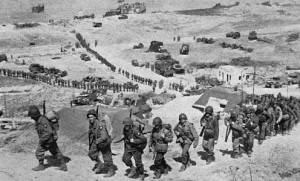
However, even with that, I’ve never been a big fan of the military armaments metaphor. This is especially so today as we continue to remember the horrors of World War II and the heroic actions of the D-Day liberators of Normandy, as well as witness the public (and, in my opinion, extremely silly but deeply divisive) debate about the return of Afghan War prisoner Sgt. Bowe Bergdahl from Taliban captivity.

The major issue I have with the metaphor is the way it is commonly preached — from an individualist perspective. But Paul does not apply the metaphor to single persons. This is not a call to individual spiritual bravery, an exhortation to individual Christians to become “prayer warriors” (a term often used in sermons based on this passage). Paul very clearly and very pointedly (in the original Greek, anyway) uses the plural “you,” not the singular. The metaphor does not apply to individual believers; it applies to the church as a whole. This is not a description of a singular prayer warrior; it is a portrait of the community of the church, the church militant.

The individualist preaching of this passage, in addition to disregarding the plural “you,” also ignores the passage’s context. The letter to the Ephesians is a treatise on the nature of the church as community. The military armaments metaphor is simply one of several which treat the church as a corporate entity. This is the epistle in which we find three other prominent Pauline metaphors: the church as the body of Christ (1:22-23), the church as a spiritual building (2:19-21), and the church as the bride of Christ (5:25-32). Paul’s concern in the letter to the Ephesian church is the church, not the individual believer.

So all this talk of the armaments and armor of warfare is not for the singular Christian. It is for the entire community, the church envisioned as a cosmic warrior. To treat it in the usual individualistic way betrays both the text and, I believe, the service of real warriors, the soldiers who fought and sacrificed on Normandy’s beaches, in Europe’s fields, in Vietnam’s jungles, in Afghan’s rugged terrain, in Iraq’s deserts, and many, many other places. As important to our individual and corporate well-being as prayer is, it is not the same as risking life and limb in battle. Understanding this metaphor in an individualistic way draws that equation, and it’s wrong. Just wrong. Whatever a “prayer warrior” may be, he or she is not a soldier facing the grim reality of death, his or her own or that of the opposing soldier he or she may encounter.

And that’s the issue with many (if not all) metaphors. They can be misapplied and extended too far; to use another, a metaphor misused often falls off a cliff into an abyss of confusion and misunderstanding, betraying the very purpose of a metaphor which is to clarify and enlighten. In the individual understanding of Paul’s military armaments metaphor, his colorful and imaginative language is misapplied and taken to places Paul never intended. Let’s walk it back from that precipice.

Which brings me back to the shoes — “As shoes for your feet put on whatever will make you ready to proclaim the gospel of peace.” (v. 15) I have a suggestion. Let the church put on scholarship and education for its shoes! More than Sunday School for children is an imperative for the church. We need real, in-depth, wide-spread, formal training in understanding the Scriptures, the theology, and the traditions of the church for all Christians. These will help our people avoid the peril of misused and overextended metaphors, strengthen church members reasoned faith, and make the church “ready to proclaim the gospel of peace.”

====================

A request to my readers: I’m trying to build the readership of this blog and I’d very much appreciate your help in doing so. If you find something here that is of value, please share it with others. If you are on Facebook, “like” the posts on your page so others can see them. If you are following me on Twitter, please “retweet” the notices of these meditations. If you have a blog of your own, please include mine in your links (a favor I will gladly reciprocate). Many thanks!

====================

Father Funston is the rector of St. Paul’s Episcopal Church, Medina, Ohio.

March Forth – From the Daily Office – June 6, 2014

From the Prophet Jeremiah:

I will put my law within them, and I will write it on their hearts; and I will be their God, and they shall be my people. No longer shall they teach one another, or say to each other, “Know the Lord”, for they shall all know me, from the least of them to the greatest, says the Lord; for I will forgive their iniquity, and remember their sin no more.

(From the Daily Office Lectionary – Jeremiah 31:33b-34 (NRSV) – June 6, 2014)

Troops marching at Omaha BeachCan the finite ever truly know the infinite? Can the human mind ever fully grasp the knowledge of God? We have the assurance of Jeremiah’s prophecy, the consolation of God spoken through “the weeping prophet” that it can. And Jeremiah is not alone.

Whenever I read a verse of scripture that speaks of the knowledge of God, I remember a favorite hymn of the rector under whom I served as curate, God Is Working His Purpose Out, sung to the tune Purpose. A repeating text in the hymn, not quite a chorus, is “the earth shall be filled with the glory of God as the waters cover the sea.” It is based on a verse from the prophet Habakkuk: “The earth will be filled with the knowledge of the glory of the Lord, as the waters cover the sea.” (Hab 2:14)

Like Jeremiah, Habakkuk assures us that the time will come when finite human beings will know the infinite Lord. Habakkuk focuses on the overwhelming universality of this knowledge, “as the waters cover the sea,” while Jeremiah focuses on its intimacy, “I will write it on their hearts.” It is Jeremiah’s intimacy that is echoed by Paul in his famous essay on love in the thirteenth chapter of the first letter to the Church in Corinth where we find yet another assurance that despite our limitations we will come to full knowledge of God:

For we know only in part, and we prophesy only in part; but when the complete comes, the partial will come to an end. When I was a child, I spoke like a child, I thought like a child, I reasoned like a child; when I became an adult, I put an end to childish ways. For now we see in a mirror, dimly, but then we will see face to face. Now I know only in part; then I will know fully, even as I have been fully known. And now faith, hope, and love abide, these three; and the greatest of these is love. (1 Cor 13:9-13)

Paul links knowledge of God to love using the Greek word agape, that word so poorly translated by our English word “love.” Agape is unconditional, non-judging love which places demands not on the beloved, but on the lover; it requires the lover (as Nazarene theologian Thomas Oord has noted) to act intentionally to promote well-being even, or perhaps especially, when responding to that which creates ill-being. Linking universal but intimate knowledge of God to agape, Paul places a burden on every follower of Christ.

The prophets’ assurance that all will know God, that the universal but intimate knowledge of the Almighty will cover the earth and also be written on individual hearts begs the question of how. Paul’s linkage answers that question: through the ministry of the members of the church. As the Episcopal Catechism says, “The mission of the Church is to restore all people to unity with God and each other in Christ” through the ministry of God’s people. My old boss’s favorite hymn says it more poetically:

What can we do to work God’s work,
to prosper and increase
the brotherhood of all mankind —
the reign of the Prince of Peace?
What can we do to hasten the time —
the time that shall surely be,
when the earth shall be filled
with the glory of God
as the waters cover the sea.

March we forth in the strength of God,
with the banner of Christ unfurled,
that the light of the glorious gospel of truth
may shine throughout the world:
fight we the fight with sorrow and sin
to set their captives free,
that earth may filled
with the glory of God
as the waters cover the sea.

On this 70th anniversary of D-Day, marching forth under the banner of Christ fighting sorrow and sin and setting captives free seems an appropriate metaphor for our ministry. God’s instrument for flooding the world with knowledge, for writing it on the hearts of human beings, is the Church, whose members are called “to bear witness to him wherever they may be; and, according to the gifts given them, to carry on Christ’s work of reconciliation in the world.” (BCP 1979, page 855) March forth, Church, march forth!

====================

A request to my readers: I’m trying to build the readership of this blog and I’d very much appreciate your help in doing so. If you find something here that is of value, please share it with others. If you are on Facebook, “like” the posts on your page so others can see them. If you are following me on Twitter, please “retweet” the notices of these meditations. If you have a blog of your own, please include mine in your links (a favor I will gladly reciprocate). Many thanks!

====================

Father Funston is the rector of St. Paul’s Episcopal Church, Medina, Ohio.

« Older posts Newer posts »