Occasional thoughts of an Anglican Episcopal priest

Category: Worship (Page 49 of 107)

Lust and Sepulchres – From the Daily Office – May 16, 2014

From Matthew’s Gospel:

Jesus said, “You have heard that it was said, ‘You shall not commit adultery.’ But I say to you that everyone who looks at a woman with lust has already committed adultery with her in his heart.”

(From the Daily Office Lectionary – Matthew 5:27-28 (NRSV) – May 16, 2014)
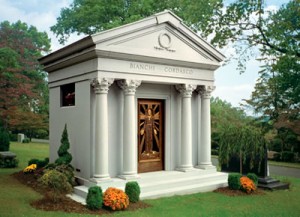
Private MausoleumIt has been almost 40 years since presidential candidate Jimmy Carter admitted to Playboy magazine, “I’ve looked on many women with lust. I’ve committed adultery in my heart many times. God knows I will do this and forgives me.” Caused quite a stir and, some say, marked the beginning of the erosion of presidential privacy, the start of an era of leadership toxicity in American politics when partisan reporters feel free to reveal any fact or rumor, no matter how irrelevant, if it will hurt a politician of the opposite party or position. I’m not sure that that’s the case; a good argument can be made that the current polarized, hyper-partisan atmosphere started building during the Nixon, or even Johnson, years. That, however, is not what I’m thinking about this morning.

I’m thinking about the impossibility of Jesus’ hyperbolic morality! To be honest, I think Mr. Carter was overstating the “looking with lust” thing. As I understand the Greek used here, epithumeo, what Jesus is talking about is passionate, heated, covetous desire. I can’t imagine that just looking at someone other than one’s life partner, appreciating their attractiveness, and acknowledging one’s own attraction (even with a little wistful wondering….) would rise to the level of “lust.” If it does, then I guess we’re all in trouble, because no one can live up to such a standard.

That Jesus is being hyperbolic is made clear by the fact that he goes on to counsel his followers to cut off their hands and pluck out their eyes if those members cause them to sin! I mean — come on, folks! — does anyone not suffering from a mental illness think Jesus was doing anything more than making a rhetorical point? I certainly don’t. But his rhetorical point, hyperbolic though it may be, needs to be taken seriously.

Thoughts and attitudes are as important as actions, for even if they do not directly control our actions they give them flavor and nuance. A husband may not often be “lustful” towards other women, one may never be unfaithful, but a regular habit of giving thought to the notion is a form of disrespect for one’s wife and may lead to more outright, more visible, and more damaging forms of disrespect. Further, such a regular habit and the attitude from which it springs cheapen the intimacy between spouses. Motives and motivations, and their authenticity, give substance and meaning to our actions; spousal intimacy that is not truly respectful of the spouse has little substance or meaning.

One of my favorite of Jesus’ similes is spoken to the scribes and the Pharisees later in Matthew’s Gospel, and I like it best in the Authorized translation: “Woe unto you, scribes and Pharisees, hypocrites! for ye are like unto whited sepulchres, which indeed appear beautiful outward, but are within full of dead men’s bones, and of all uncleanness.” (Mt 23:27, KJV) When inner motivation and outward action are not in harmony, when the action is inauthentic because the motivation dishonest, the action . . . no, the actor is a “whited sepulchre,” lovely in outward appearance but filled with rot.

I believe that Jesus’ hyperbolic language about lust makes the same point, and it applies not just to marriages, but to all human interactions and relationships. It may be hyperbole and it may be (indeed, it is) impossible to live up to it. Nonetheless, we must examine our thoughts and attitudes, our motives and motivations; we must look inside and work on our mindset so that our outward actions are authentic. Why? Well, one reason, as Jesus will shortly remind his listeners in a different context, is that our Father “who is in secret . . . sees in secret.” (Mt 6) A more important reason, however, is that anything less violates the second of the two great commandments: “You shall love your neighbor as yourself.” (Mt 22:39)

====================

A request to my readers: I’m trying to build the readership of this blog and I’d very much appreciate your help in doing so. If you find something here that is of value, please share it with others. If you are on Facebook, “like” the posts on your page so others can see them. If you are following me on Twitter, please “retweet” the notices of these meditations. If you have a blog of your own, please include mine in your links (a favor I will gladly reciprocate). Many thanks!

====================

Father Funston is the rector of St. Paul’s Episcopal Church, Medina, Ohio.

Howling and Prowling – From the Daily Office – May 15, 2014

From the Book of Psalms:

Each evening they come back, howling like dogs and prowling about the city.

(From the Daily Office Lectionary – Psalm 59:6 (NRSV) – May 15, 2014)

Feral Dog PackI usually prefer the Prayer Book Psalter to the NRSV translation of the Psalms, but in today’s readings I find the latter rather more compelling. The NRSV makes it clear who the “they” is in this verse (which is repeated again at verse 14). “They” are “the nations,” which in the Hebrew bible always refers to ethnic groups other than the tribes of Israel. The BCP version refers to “the ungodly,” which is decidedly unclear; it could refer to individuals and, further, could refer even to persons from within the Jewish people, neither of which understandings would be accurate.
With regard to this specific verse (which is numbered 7 or 16 in the BCP), the notion of returning late in the day from some unspecified and perhaps unknown other location is lost: “They go to and fro in the evening; they snarl like dogs and run about the city.” They (whoever they are) could have been at rest within the city during the day, but the Hebrew shuwb ‘ereb is clear: “They return at sunset.” The nations have been somewhere else during the light of day, but where is unknown (at least, it is not stated in the psalm).

The NRSV text is also much more poetic than the BCP version (which is something of a surprise, frankly). The evocative rhyming of “howling . . . and prowling” is so much more effective than “snarl . . . and run about.” It casts a disturbing vision of a dog pack roaming, possibly hunting, through the darkened city streets.

Dogs, of course, are considered unclean in Judaism. They are scavengers which will eat any sort of refuse and carrion, even excrement. Although mothers do tenderly care for their young, dogs do not pair bond and have no sexual loyalty. They urinate and defecate wherever they wish. Left on their own and untrained, dogs are pretty unsavory characters!

They also have a social order that is decidedly not a human one. 21st Century research into the organization of packs of both canis lupus (wolves) and canis familiaris (dogs) has demonstrated that the “alpha male” aggression-dominance model of pack behavior is nothing more than a human projection. Dog packs are (I use the word very loosely) organized in a much more fluid and changing way, a way not easily appreciated by human observers. For all intents and purposes, dog packs mostly appear to us to be disorganized mobs.

So these are the ungodly (to use the BCP’s word): gone when it is light, showing up in the darkness, decidedly unclean in their habits, leaderless, disorganized, and dangerous. They are like feral, untamed dogs. And, yet, dogs have shown themselves not only willing but eager to give up these ways! Dogs are more than happy to associate with humans, to acknowledge humans as their leaders, to behave in ways humans deem acceptable. And we have been happy to accept them on those terms as pets, as friends, and as co-workers.

Last Sunday’s Gospel lesson was from John — Jesus declaring himself to be the good shepherd. Shepherds are nearly always assisted by dogs to whom none of the negative characteristics implicit in this psalm could be ascribed. My pastoral theology instructor (as I told my congregation in my extemporaneous children’s sermon) objected to the word pastor as a descriptor of clergy; pastor, he pointed out, means “shepherd” and there is only one shepherd. Clergy, he insisted, should be thought of as sheepdogs.

The good shepherd made a few other claims for himself. “I am the light of the world,” for example, and “I am the way.” (Jn 9:5, 14:6) For those who are leaderless, living in darkness, howling and prowling the night-time streets, Jesus offers an alternative of light and direction.

Years ago, when I was a college student in southern California, my friends and I would visit the border towns of northern Mexico. There always seemed to be plenty of ownerless, feral dogs running about. From time to time, I would notice that a feral dog would gingerly approach and befriend (possibly another human projection) a domesticated dog and, with and through that dog, would approach its owner. More often than not they were kicked and shooed away, but occasionally the human would be willing to share some food; perhaps this was the beginning of a longer relationship — I don’t know; I never stuck around or went back to find out.

Remembering those wild dogs seeking, through a domestic dog, the friendship and protection of a human being . . . thinking about the picture of dogs set out in the psalm today . . . and putting meat on the bones of my theology professor’s objection to pastor, I think there is a lesson for me and my fellow sheepdogs here. Or, more correctly, there is a question: are we in the right place?

Are we (and the flocks we are tending) in the places where the howling and prowling, the wild and feral, the leaderless, those in darkness and hunger, can gingerly approach and possibly, through us, meet the good shepherd?

====================

A request to my readers: I’m trying to build the readership of this blog and I’d very much appreciate your help in doing so. If you find something here that is of value, please share it with others. If you are on Facebook, “like” the posts on your page so others can see them. If you are following me on Twitter, please “retweet” the notices of these meditations. If you have a blog of your own, please include mine in your links (a favor I will gladly reciprocate). Many thanks!

====================

Father Funston is the rector of St. Paul’s Episcopal Church, Medina, Ohio.

God’s Butt – From the Daily Office – May 14, 2014

From the Book of Exodus:

The Lord said to Moses, “I will do the very thing that you have asked; for you have found favor in my sight, and I know you by name.” Moses said, “Show me your glory, I pray.” And he said, “I will make all my goodness pass before you, and will proclaim before you the name, ‘The Lord’; and I will be gracious to whom I will be gracious, and will show mercy on whom I will show mercy. But,” he said, “you cannot see my face; for no one shall see me and live.” And the Lord continued, “See, there is a place by me where you shall stand on the rock; and while my glory passes by I will put you in a cleft of the rock, and I will cover you with my hand until I have passed by; then I will take away my hand, and you shall see my back; but my face shall not be seen.”

(From the Daily Office Lectionary – Exodus 33:17-23 (NRSV) – May 14, 2014)

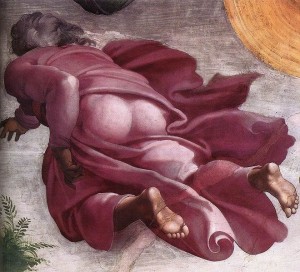
Detail of Sistine Chapel - God's backsideThe translators of the NRSV are a bunch of prudes; a better translation of the last verse of this section would be “. . . you shall see my butt.”

The term “my back” is a translation of the Hebrew term ‘achowr which, incidentally, is a plural noun; when this is used of an animal, the translation is usually “hindquarters” or something of that nature, which apparently is inappropriate with respect to God. In the 3rd Century Greek translation of the Old Testament, the Septuagint, it is translated into the odd construction ta hopiso mou, “the behinds of me.” When St. Jerome translated the Vulgate Latin version in the 4th Century, he also retained the plural, posteriora mea, “my posteriors.” The translators of the Authorized version of 1611 did so, as well, “my back parts.” In other words, my backside, my ass end, my buttocks!

So the NRSV editors are just a bunch of prudes! Or maybe they are just being prudish for a contemporary American audience which has become obsessed with . . . what? sex? nudity? titillation?

Recently there was a news article about an attractive 17-year-old young woman who was expelled from a homeschoolers’ prom event because, although her dress met the dress code requirements, it was considered to titillating for the fathers watching the dancers from the balcony! I hesitate to say that this event was billed as a dance for “Christian” homeschoolers, because the published reports reveal a good deal of unchristian behavior from the leering of the fathers to the disrespect shown the young lady and her escort by the chief chaperone of the event. (The Cleveland Plain Dealer‘s report yesterday of the incident is here.)

And the question of respect is really what this episode between Moses and God raises for me.

I’m not sure when the “look at God’s face and die” notion arose among the Hebrews, but it isn’t there in the earliest stories of the bible. Adam and Eve seem to carry on face-to-face conversations with God with no ill effect and, when God shows up in the guise of three strangers at the oaks of Mamre, Abraham sits and talks with them over a lamb dinner and does not succumb. But, in any event, the Hebrews somehow got the idea that one shows greatest respect for God by averting one’s gaze and thus this story and, later, Isaiah’s fear that he will die because of his experience in seeing a vision of God in the heavenly throne room: “Woe is me! I am lost, for I am a man of unclean lips, and I live among a people of unclean lips; yet my eyes have seen the King, the Lord of hosts!” (Isa 6:5)

Human cultures differ on how to show respect to elders. Some adopt this averted-gaze position; others (my forebears among them) insist on looking people in the eyes. I can remember quite vividly both of my grandfathers forcefully insisting that I look them squarely in the face when in conversation; looking away even briefly was considered either as disrespect or as possible evidence of untruthfulness.

What this suggests to me is that we humans don’t actually know how to respect one another! The story of the really (in my opinion) bad treatment of the young woman at the prom is simply more evidence of that. And, if we don’t know how to respect another human being, we certainly do not know how to respect God.

Respect requires maturity; showing proper respect to another person, human or god, is a mark of adulthood. Perhaps that is the point of today’s story of Moses and God, neither Moses nor the Hebrews (nor, for that matter, any of humanity) were yet mature enough to have a respectful face-to-face relationship with the Almighty, so God did what God could.

Moses is permitted to see God’s butt because God was lowering God’s self to develop a relationship with Moses and, through him and the Hebrews, with all humanity, a relationship that hopefully would grow and mature. In giving Moses this vision, God revealed both a special affection for his favorite and a hope for the eventual adulthood of the human race. The gaze of those lustful old men in the balcony focused on the young prom-goer’s butt suggests we still have a long way to go!

The indecorous nature of God’s backside reveals the extent to which God is willing to humble God’s self out of respect for human beings; someday, perhaps, we’ll learn to show respect as well.

====================

A request to my readers: I’m trying to build the readership of this blog and I’d very much appreciate your help in doing so. If you find something here that is of value, please share it with others. If you are on Facebook, “like” the posts on your page so others can see them. If you are following me on Twitter, please “retweet” the notices of these meditations. If you have a blog of your own, please include mine in your links (a favor I will gladly reciprocate). Many thanks!

====================

Father Funston is the rector of St. Paul’s Episcopal Church, Medina, Ohio.

I Don’t Know – From the Daily Office – May 13, 2014

From the Book of Exodus:

Moses said to Aaron, “What did this people do to you that you have brought so great a sin upon them?” And Aaron said, “Do not let the anger of my lord burn hot; you know the people, that they are bent on evil. They said to me, ‘Make us gods, who shall go before us; as for this Moses, the man who brought us up out of the land of Egypt, we do not know what has become of him.’ So I said to them, ‘Whoever has gold, take it off ‘; so they gave it to me, and I threw it into the fire, and out came this calf!”

(From the Daily Office Lectionary – Exodus 32:21-24 (NRSV) – May 13, 2014)

Golden Calf“I threw it into the fire, and out came this calf!”

I chuckle every time I read this story and get to this point. In fact, when the story of the golden calf has been read in church and the reader gets to Aaron’s disclamation of responsibility, I’ve been known to laugh out loud.

Once, years ago, in a bible study group reading Exodus, I asked, “How old was Aaron?” No one knew, but we were all pretty certain that Moses and his brother were not young children at the time of this story. Nonetheless, a young child is exactly what Aaron sounds like: “I threw the gold in the fire, and out came this calf!” No mention of his forming the mold, pouring the molten the gold, breaking the mold, polishing the casting, and all the rest that goes into the making of a metal statue. The calf just “came out.”

There was a phantom in our house when my children were very young. We’d find that someone had opened the orange juice and not only taken some, but also spilled a good deal on the kitchen counter and floor. “Who did this?” we would ask. “I don’t know,” would be the answer. The contents of my wife’s purse were spilled there was lipstick smeared on things. “Who did this?” we demanded of the little girl with red all over her face. “I don’t know,” she told us. Someone once tried to make sand castles in the cat box. “Who did this?” we asked the little boy with sand fingers. With a straight face he replied, “I don’t know.”

We never caught I Don’t Know doing any of these things (or many others), but there was plenty of evidence of his (or was it “her”?) existence. I Don’t Know was a very active sprite! Apparently, I Don’t Know was much older than we thought. He or she appears to have been with the Hebrews in the desert. — “Who made this golden calf?” — “I don’t know. I threw the gold in the fire and out came this calf!”

In the modern adult world, I Don’t Know has gotten more adapt at hiding his or her identity. “Who made that decision?” we ask. The answer is often one of I Don’t Know‘s alter egos: a committee, the vestry, the (unnamed) higher-ups, the council, management, the administration. Could it be that I Don’t Know is being scapegoated?

Imaginary friends are a healthy part of maturing. Research shows that children with imaginary companions tend to be less fearful, laugh more, smile more, engage more with peers, and are better able to imagine how someone else might think. An imaginary friend can aid a child to handle fear, explore ideas, or gain a sense of competence, but children with imaginary friends will sometimes blame them for misbehavior in an attempt to dodge the displeasure of adult authority. I Don’t Know is not exactly an imaginary friend, but disclaiming responsibility and deflecting blame is certainly child-like (if not childish) behavior.

“When I was a child, I spoke like a child,” wrote St. Paul, “I thought like a child, I reasoned like a child; when I became an adult, I put an end to childish ways.” (1 Cor 13:11) Jesus once told a story about someone who decided to stop blaming I Don’t Know. The man in the story “put an end to childish ways” and said to himself, “I will get up and go to my father, and I will say to him, ‘Father, I have sinned against heaven and before you.'” (Lk 15:18)

We human beings of all ages when challenged still seem invoke I Don’t Know to avoid personal responsibility on a pretty regular basis. Christian maturity, coming (as Paul said) “to the measure of the full stature of Christ,” (Eph 4:13) no longer laying things at the feet of I Don’t Know is something for which we all need to strive. We need to give up being like Aaron; we need to put an end to childish ways.

Is that going to happen on a general basis any time soon?

I could answer, “I don’t know.” But the truth is, I think I do.

====================

A request to my readers: I’m trying to build the readership of this blog and I’d very much appreciate your help in doing so. If you find something here that is of value, please share it with others. If you are on Facebook, “like” the posts on your page so others can see them. If you are following me on Twitter, please “retweet” the notices of these meditations. If you have a blog of your own, please include mine in your links (a favor I will gladly reciprocate). Many thanks!

====================

Father Funston is the rector of St. Paul’s Episcopal Church, Medina, Ohio.

Wrestling in Prayer – From the Daily Office – May 12, 2014

From the Letter to the Colossians:

Epaphras, who is one of you, a servant of Christ Jesus, greets you. He is always wrestling in his prayers on your behalf, so that you may stand mature and fully assured in everything that God wills.

(From the Daily Office Lectionary – Colossians 4:12 (NRSV) –May 12, 2014)

Hercules and Diomedes by Vincenzo de Rossi“Wrestling in his prayers” seems such an odd turn of phrase! Aren’t prayers supposed to be peaceful? The image of prayer as athletic competition (and vigorous, muscular, and very personal competition, at that) just seems contradictory. But the contradiction calls to mind two thoughts.
The first is that I remembered Jacob: “Jacob was left alone; and a man wrestled with him until daybreak. When the man saw that he did not prevail against Jacob, he struck him on the hip socket; and Jacob’s hip was put out of joint as he wrestled with him.” (Gen 32:24-25)

Doing early morning study of Koine Greek is probably a mistake . . . but I wondered, “Does Paul use the same word to describe Epaphras as the Septuagint uses to describe Jacob?” Short answer — no. Long answer — In Genesis, the wrestling contest is described using the word palaío; in Colossians, the word is agonizomai. The former is specific; the latter refers in general to athletic competition and may also mean “to struggle” or “to labor.”

Nonetheless, I wonder if Paul is calling Jacob’s late-night wrestling match with God to mind. If Jacob’s dream-time contest is a metaphor for prayer (and I think it is), then there is a striking contrast between first-party prayer (petition) which leaves the supplicant limping, and third-party prayer (intercession) which permits the subject to “stand mature and fully assured.” I don’t know what to make of this. Is there a suggestion that the prayers of others are more effective for our well-being than our own?

An Indian guru once said, “Prayer is not asking. It is a longing of the soul. It is daily admission of one’s weakness.” Was Jacob’s hip put out of joint by his encounter with God? Or was it always out of joint and the encounter merely led to a recognition or an admission of that fact? Prayer for oneself always does, in my experience, bring one up face-to-face with one’s own inadequacies. And, I have to say, I rely much more upon the prayers and prayerful support of others than upon my own. So perhaps there is something in the contrast Paul may be making.

The second, unrelated thought, is how often I struggle to find the “right words” with which to pray, both in private meditation and in public worship. As a priest, I am often asked to pray in public and, when that happens, I am grateful that, as an Episcopalian, I have been steeped in the language and cadences of The Book of Common Prayer. When I cannot think of anything original to say, I can rely on the prayerful words of generations of Anglicans and, from memory of the prayer book’s beautiful phrases, cobble something quickly together.

It is not always so in my private devotions. But that same Indian guru said of prayer, “It is better in prayer to have a heart without words than words without a heart.” So if my struggle to find the right words is unsuccessful, I just let it go and sit quietly, sure that God will understand me.

====================

A request to my readers: I’m trying to build the readership of this blog and I’d very much appreciate your help in doing so. If you find something here that is of value, please share it with others. If you are on Facebook, “like” the posts on your page so others can see them. If you are following me on Twitter, please “retweet” the notices of these meditations. If you have a blog of your own, please include mine in your links (a favor I will gladly reciprocate). Many thanks!

====================

Father Funston is the rector of St. Paul’s Episcopal Church, Medina, Ohio.

Grandparental Nicknames – From the Daily Office – May 10, 2014

From Matthew’s Gospel:

As he walked by the Sea of Galilee, he saw two brothers, Simon, who is called Peter, and Andrew his brother, casting a net into the lake — for they were fishermen.

(From the Daily Office Lectionary – Matthew 4:18 (NRSV) –May 10, 2014)

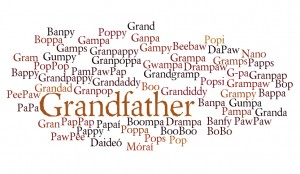
Grandfather NicknamesSometime this fall, probably during October, my wife and I will become grandparents for the first time. Last night, a friend asked, “What will you be called?” Because the question came out of the blue (we hadn’t been discussing children or grandchildren), I didn’t know what he was asking — and my face must have shown it. “As grandfather,” he clarified, “what will you be called as a grandparent?”

Good question. Is it really up to me? Do I get to say, “I want to be called [something]”? If so, I’d like to be called by one of the Irish nicknames: “Daideó” (pronounced “DAH-doe”) or “Móraí” (pronounced “MO-ree”) or “Papaí” (pronounced “PAH-pee”). The actual word for “grandfather” in Irish is seanathair which means “old father” or (in older Irish) “wise father”; an alternative is athair mór which means “great father” (“great” here is more akin to “big” than to “wonderful”).

But is it really up to me? Families have long-running traditions about naming grandparents, I think. Every grandmother (for the three generations I have known) on both sides of my family was known as “Grammy” — my mother called hers “Grammy Buss” and “Grammy Sargent”; mine were “Grammy Grace” and “Grammy Edna” (we were a less formal generation, I guess), and my mother was “Grammy Betty” to our children.

Grandfathers were less uniformly addressed. I don’t know what my greatgrandfathers were called; both were long dead when I was born. My maternal grandfather, Richard Sargent, was “Daddy Rich” (a combination of what my mother and grandmother called him); my paternal grandfather was “C.E.” (what everyone called him) or, less frequently, “Granddad.” My father was deceased when his grandchildren were born, so if he was referred to at all it was as “your grandfather, York”; my stepfather, Stan Shivers, was called “GrandStan” by my niece and nephew and my children.

One thing I’ve noticed is that the first-born grandchildren get to make the decision. My brother was nearly ten years older than me, and I had two older paternal cousins, so by the time I came along grandparental names were pretty much cast in stone. We have nieces and nephews several years older than our own children, so they had settled the issue on both sides long before our kids had a say.

All of this comes to mind this morning because of “Simon, who is called Peter.” It was Jesus who gave him that name: “I tell you, you are Peter, and on this rock I will build my church.” (Mt 16:18) For many years, I wondered why Jesus gave Simon this nickname and thought it was simply out of affection — it’s nearly the equivalent of “Rocky” and since Simon Peter often seems as dense as a bag of rocks, that made sense.

But I’ve come recently (while studying the prophets with an Education for Ministry group) to believe that Jesus is following in the tradition of Isaiah and, since he has no son to name, he is giving Simon a symbolic prophetic nickname in the same way that prophet named his children. Isaiah named his sons Shear-jashub, which means “the remnanet shall return,” and Maher-shalal-hash-baz, which means “he has hurried to plunder,” as signs against Judah and Jerusalem. I think Jesus gave Simon the new name Peter in a similar way, as a prophetic sign to the church.

Shear-jashub, Maher-shalal-has-baz, and Simon Peter had no say in the matter. So I still wonder with respect to this question of grandparental naming, is it really up to me?

And I wonder if grandparental naming is a prophetic activity. Does the name chosen shape the relationship? Does it portend what the relationship will be? Certainly, one would suspect that if a child is taught to call its grandfather “Grandfather,” that relationship will be rather different than that of a child who calls his or her grandfather “Grampa.” But do “Granddad” or “Papaí” or “Nano” shape the bond differently? And, if so, how?

This matter of choosing a grandparental nickname is serious stuff . . . assuming it really is up to me.

====================

A request to my readers: I’m trying to build the readership of this blog and I’d very much appreciate your help in doing so. If you find something here that is of value, please share it with others. If you are on Facebook, “like” the posts on your page so others can see them. If you are following me on Twitter, please “retweet” the notices of these meditations. If you have a blog of your own, please include mine in your links (a favor I will gladly reciprocate). Many thanks!

====================

Father Funston is the rector of St. Paul’s Episcopal Church, Medina, Ohio.

The Sacrament of Money – From the Daily Office – May 9, 2014

From the Book of Exodus:

The Lord said to Moses: Tell the Israelites to take for me an offering; from all whose hearts prompt them to give you shall receive the offering for me. This is the offering that you shall receive from them: gold, silver, and bronze, blue, purple, and crimson yarns and fine linen, goats’ hair, tanned rams’ skins, fine leather, acacia wood, oil for the lamps, spices for the anointing-oil and for the fragrant incense, onyx stones and gems to be set in the ephod and for the breastpiece. And have them make me a sanctuary, so that I may dwell among them.

(From the Daily Office Lectionary – Exodus 25:1-8 (NRSV) – May 9, 2014.)

Gold silver and bronze barsADDED LATER: Oops!!! I just realized late on May 9 that I had read the lessons for May 10 one day ahead of time. This lesson is actually for the next day . . . . mea culpa, mea culpa, mea maxima culpa! Apologies, faithful readers!

It occurred to me as I read this passage this morning that God is ordering Moses to conduct the first capital campaign.

In 24 years of ordained ministry I have been involved in three major capital campaigns in as many parishes. Each time, the parish leadership turned to professional fundraising consultants to assist them and each consultant told us the same thing: capital campaigns do not impact regular financial stewardship because people give to the operating budget out of income, but they give to the capital campaign out of wealth. In other words, our regular weekly support of our churches comes from our paychecks, but what we give to capital projects we take from savings and investments.

How is it that the Hebrews have all this wealth? These people are wandering around Sinai not carrying enough food to feed themselves — hence the manna and the quail in Exodus 16 — and yet they have gold, silver, bronze, spices, incense, and precious stones? That raises all sorts of issues for me about human priorities and the spirituality of possessions and wealth.

So, too, does Tuesday’s report that the 25 highest-earning hedge fund managers in the United States took home a total of $21.15 billion in compensation last year! That’s an average annual take-home for those investment advisors of $860 million each! That kind of compensation blurs the distinction between “income” and “wealth.” I would argue that this is not “income;” it is, rather, transfer of “wealth.”

In my most recent experience of capital campaigning, our goal was $500,000; we didn’t quite make it – we raised about 76% of the goal in five-year pledges. Because the work we were undertaking could not be postponed, our governing board made the “leap of faith” decision to finance the rest. For us, this was a difficult and painful decision. For any of those 25 hedge fund managers, it would have meant spending less than 6/10 of one percent of their annual compensation.

It has been suggested that money is a sacrament: it is a sign of the work we do, a symbol of our sweat and toil, an indicator of our values. I think I would refine that argument, however, to say that income is a sacrament of these things. Which then raises the question, of what is wealth a sacrament? Our security? Our faith in the future? Our faith in God? And just how sacramental (either as income or wealth) is a transfer of more millions of dollars than most people can even imagine, or an expenditure of less than one percent of our compensation?

I figured it out. 6/10 of one percent of my wife’s and my combined annual income is almost exactly what I spent a couple of days ago on a tankful of gasoline. That purchase was not a gut-wrenching decision; it required no thought at all, no spiritual or emotional investment, no “leap of faith” like the vestry’s decision to go forward with our recent capital improvement project. One of those hedge fund managers could have paid for that project with as little thought or spiritual reflection as I spent pumping gas into my car.

And, I suggest, that lack of thought and reflection about income and wealth permeates our society. A confession: This is the second time in a few months that I’ve read this passage of Exodus. The first was in the context of a bible study group at church. The first time the question of what the Hebrews were doing carting around that sort of wealth as they wandered the desert for forty years never occurred to me. It didn’t occur to me until it was juxtaposed with the report of hedge fund manager compensation and the inordinate wealth transfer it represents. But it should have. I should have, we all should have a spirituality of money, a theology of wealth and income.

And a theology of money, at the very least, should demand that we pause and engage in at least a bit of thought and spiritual reflection on what we do routinely — filling our tanks, buying books for leisure reading or study, letting the bank automatically pay our internet access fees. It requires us to get some perspective, to step back and think about the course we are charting, to consider what our spending says about us, what our saving says about us. What is money as a sacrament saying? What are the gold, silver, bronze, spices, incense, and precious gems we cart around our particular deserts saying about us?

====================

A request to my readers: I’m trying to build the readership of this blog and I’d very much appreciate your help in doing so. If you find something here that is of value, please share it with others. If you are on Facebook, “like” the posts on your page so others can see them. If you are following me on Twitter, please “retweet” the notices of these meditations. If you have a blog of your own, please include mine in your links (a favor I will gladly reciprocate). Many thanks!

====================

Father Funston is the rector of St. Paul’s Episcopal Church, Medina, Ohio.

Pain – From the Daily Office – May 8, 2014

From the Letter to the Colossians:

I am now rejoicing in my sufferings for your sake, and in my flesh I am completing what is lacking in Christ’s afflictions for the sake of his body, that is, the church.

(From the Daily Office Lectionary – Colossians 1:24 (NRSV) – May 8, 2014.)

Hip PainToday, the Feast of Dame Julian of Norwich, is the 24th anniversary of my ordination to the diaconate. I am spending it, at least the morning, in the company of several fellow presbyters and a few deacons at a clergy conference. I am also spending it in some discomfort because yesterday morning I slipped and fell in the hotel bath; I wrenched my back and it appears I did something (only soft-tissue-ish, I hope) to my right hip.

I am also discomfited by Paul who “rejoiced” in his suffering and claims in this verse to do something I really don’t think needed to be done nor was (nor is) possible to do: “complete what is lacking in Christ’s afflictions.” In fact, I’m not even sure I understand what he is trying to say by that phrase and I find it so annoying I’m not even sure I can! Just who does Paul think he is? Who is he to suggest that something is “lacking” in the afflictions of the Lord? Who is he to think he can “complete” them?

It has been argued that this verse is more rhetorical than substantive. Paul, it is suggested, is not implying that Christ’s suffering and death failed in some way or fell short. Rather, he is simply submitting that Christ left work for us (Paul and all subsequent disciples through the ages) to do, and that whatever suffering Paul has been put through is a part of that work. OK . . . maybe so. I don’t have as much confidence in Paul’s humility as the commentator who made that argument seems to have had, but I’ll be charitable and give Paul the benefit of the doubt.

Does that mean I can claim my hip and back pain, the result of taking part in a clergy conference, are also contributing in some manner to the work of the church, to the world’s salvation? I certainly hope so, although I would never really make that claim. But perhaps my brother and sister clergy and I can make that claim about the deep-seated pain we often feel as we go about our ministry, the misery and turmoil we feel as we empathize with and enter into the pains of our parishioners, the doubt and conflict we feel about whether what we do and how we are doing it make any difference at all, the soul sickness we feel when we know that we have failed in some way to address the needs of those among whom we minister, the anger (and then the remorse and spiritual malaise) we feel when the expectations of the church are unwarranted and unreasonable. Perhaps some of that pain is salvific.

I love being a priest. There is great joy in ordained ministry. That was what I expected when I was made a transitional deacon 24 years ago and a priest a year later. I thought I knew there would be discomfort; I had no idea it would be as frequent or as painful as it has been. I wish there were a way to convey to ordinands that that is going to be the way it is, but I don’t think that can be done. You have to live through standing at a bedside with a family “pulling the plug” on a beloved parent or child, leaving the hospital convinced that everything you did and said was hopelessly inadequate. You have to live through watching an active parishioner abandon your congregation because of some stupid, silly thing you did or said. You have to live through being treated badly by people you thought were friends and being excluded from the social events and parties of parishioners who didn’t think you were. You have to live through shrinking budgets, declining attendance, and cold shoulders. You have to live through the pains of ordained ministry. Being told about them just isn’t enough.

After I’d been in parish ministry as a priest for about seven years, I started working with a spiritual director who was also a parish rector and had been in ministry for many years. When I would bemoan the pains of ministry (like making that list in previous paragraph), he’d ask, “And how did they treat Jesus?” and give me a look that fairly shouted, “And you expect them to treat you any better?” It was therapeutic. With his guidance, I came to believe that that pain is actually hope. It’s hopeful caring. I once broke down in tears telling my late mother about the difficulties I had experienced as a priest. Her response was, “If you didn’t care so much, it wouldn’t hurt so much.”

So I know who Paul was to make the statement he made in this verse; he was a fellow worker in ordained ministry and I suspect his suffering and pain was not just hip pain from falling in the shower; I think it was the soul-deep pain of hoping beyond hope that something you are doing is “completing what is lacking in Christ’s afflictions for the sake of his body, that is, the church.”

At clergy conferences we tell each other our stories; we share the pains we have lived through and we share the joys we have known. The science fiction author Spider Robinson once wrote, “Shared pain is lessened. Shared joy is increased. Thus we refute entropy.” Or, as Dame Julian might have said, “All shall be well, and all shall be well, and all manner of things shall be well.”

There are great benefits to clergy conferences. Shared joy is one of them. Shared pain is one of them. Hip pain from falling in the shower is not.

====================

A request to my readers: I’m trying to build the readership of this blog and I’d very much appreciate your help in doing so. If you find something here that is of value, please share it with others. If you are on Facebook, “like” the posts on your page so others can see them. If you are following me on Twitter, please “retweet” the notices of these meditations. If you have a blog of your own, please include mine in your links (a favor I will gladly reciprocate). Many thanks!

====================

Father Funston is the rector of St. Paul’s Episcopal Church, Medina, Ohio.

Cleaving to Dust – From the Daily Office – May 7, 2014

From the Psalter:

My soul cleaves to the dust; give me life according to your word.

(From the Daily Office Lectionary – Psalm 119:25 (BCP Version) – May 7, 2014.)

Handful of DustThe Gospel lesson today is the baptism of Jesus as told by Matthew. With it, for the evening, is coupled a portion of Psalm 119 which includes this verse. This image of a soul clinging to the dirt caught my attention. I wonder if baptism is efficacious if the soul being baptized steadfastly and stubbornly “cleaves to the dust” of its pre-baptismal life.

I sometimes wonder about my own baptism, which happened when I was 14 years of age and attending a private, residential high school affiliated with the Episcopal Church.

As part of the religious instruction required of all students, I had taken the confirmation class offered by the chaplain and was, thus, included in the list of young men upon whom the bishop was to lay hands during his official visit at one Thursday evening chapel service. Earlier in the day, going over his records, the chaplain noticed he had not record of my baptism.

That was not surprising since I’d not been baptized. Growing up in a largely unchurched home with a father estranged from the Methodist Church and a mother who’d been reared in (but left) one of those traditions that practice “believers’ baptism,” there had been no encouragement of nor opportunity for baptism.

So, in a hastily arranged private afternoon ceremony at the back of the chapel after gym class, with two members of the faculty standing as sponsors, I was quickly sprinkled and informed that I was now a Christian, eligible to be confirmed as an Episcopalian. That done, I went to my room to shower and dress for dinner and the obviously more important confirmation service later that evening.

What exactly happened that afternoon? Did my soul turn loose of the dust, or did it cleave to the dirt from which it was supposed to be cleansed? Does it matter? I’m not even going to try to answer those questions this morning, but the pairing of the baptismal story and the image of the soul clinging to the dust is certainly an odd lectionary coincidence.

====================

A request to my readers: I’m trying to build the readership of this blog and I’d very much appreciate your help in doing so. If you find something here that is of value, please share it with others. If you are on Facebook, “like” the posts on your page so others can see them. If you are following me on Twitter, please “retweet” the notices of these meditations. If you have a blog of your own, please include mine in your links (a favor I will gladly reciprocate). Many thanks!

====================

Father Funston is the rector of St. Paul’s Episcopal Church, Medina, Ohio.

Ancestor Abraham – From the Daily Office – May 6, 2014

From the Gospel according to Matthew:

Do not presume to say to yourselves, “We have Abraham as our ancestor”; for I tell you, God is able from these stones to raise up children to Abraham.

(From the Daily Office Lectionary – Matthew 3:9 (NRSV) – May 6, 2014.)

StonesJohn the Baptizer is speaking to the Pharisees and the Sadducees, warning them against the very common human practice of relying upon the piety of our forebears instead of practicing our own faith. Relying on the religion of our ancestors is weakens and attenuates our own spirituality. One might as well be rocks lying by the roadside.

A few days ago, in what I consider a badly reasoned decision, Town of Greece v. Galloway, the U.S. Supreme Court upheld the practice of beginning secular legislative body meetings (in the particular case, a city council) with sectarian prayer. Justice Anthony M. Kennedy, writing for the majority, reasoned: “Legislative prayer has become part of our heritage and tradition, part of our expressive idiom, similar to the Pledge of Allegiance, inaugural prayer, or the recitation of ‘God save the United States and this honorable Court’ at the opening of this Court’s sessions.” He might as well have said, “We have Abraham as our ancestor.”

I’ve no problem with public prayer. I lead it on a pretty regular basis. I have a problem with prayer offered in a secular legislative body in a nation that is supposed to have a separation of church and state. The First Amendment to our Constitution includes two clauses which work that separation. One is known as “the establishment clause” and provides that government “shall make no law respecting an establishment of religion.” The other is called the “free exercise clause” and provides that government shall do nothing “prohibiting the free exercise” of religion.

A legislative body’s rule of procedure requiring prayer at the opening of its sessions violates at least the first of these clauses; it is a law establishing a religious practice. Arguably, it also violates the second clause although (as Kennedy and others have noted) no one is forced to participate in the prayer and, one supposes, could absent oneself from the session until the prayer was concluded.

My concern, in light of today’s reading from Matthew, is not with the Constitutional issue of public governmentally-sponsored prayer. Rather, it is with the notion that somehow the religiosity of our nation is dependent upon practices of government and the (mistaken) notion that our Founders (our equivalent of Abraham) intended this to be a “Christian nation.” This is the argument often made and now being repeated in innumerable online discussions of this ruling.

I can find no difference between “The Founders intended this to be a Christian nation” and “We have Abraham as our ancestor.” Both rely upon the supposed faith of long-dead forebears rather than the lively faith of living people. Any number of prayers may be recited at city council meetings or in state or national legislative chambers; unless and until the people of the nation begin actually living and practicing whatever religion they claim to hold — actually participating in religious events and, more importantly for Christians, feeding the hungry, clothing the naked, and housing the homeless — those prayers are no better than the protest of the Pharisees and Sadducees, “We have Abraham as our ancestor.”

This is especially true when Christian prayer opens a legislative session in which the legislators proceed to enact legislation which flies in the face of Jesus’ commands — when funds are stripped from feeding programs, when homelessness is made a crime, when public assets are diverted to the benefit of the rich at the expense of the poor. The prayer and the faith which it represents are rendered meaningless, with as little life as a pile of rocks.

There is a place for prayer, but it is not in the halls of government and it is not in the historic and attenuated traditions of long-dead forebears. It is in the hearts and lives of living persons acting out their faith. Relying on government-sponsored prayer is nothing more than claiming Abraham as our ancestor, nothing more than being dead stones.

====================

A request to my readers: I’m trying to build the readership of this blog and I’d very much appreciate your help in doing so. If you find something here that is of value, please share it with others. If you are on Facebook, “like” the posts on your page so others can see them. If you are following me on Twitter, please “retweet” the notices of these meditations. If you have a blog of your own, please include mine in your links (a favor I will gladly reciprocate). Many thanks!

====================

Father Funston is the rector of St. Paul’s Episcopal Church, Medina, Ohio.

« Older posts Newer posts »