From the Gospel of John:
For God so loved the world that he gave his only Son, so that everyone who believes in him may not perish but may have eternal life. Indeed, God did not send the Son into the world to condemn the world, but in order that the world might be saved through him.
(From the Daily Office Lectionary – John 3:16-17 (NRSV) – January 21, 2014.)
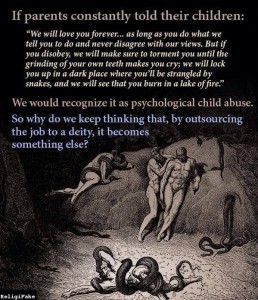 Making the rounds of Facebook these days is an anti-religious meme which basically equates religious teaching to child abuse. It says:
If parents constantly told their children:
“We will love you forever . . . as long as you do what we tell you to do and never disagree with our views. But if you disobey , we will make sure to torment you until the grinding of your own teeth makes you cry; we will lock you up in a dark place where you’ll be strangled by snakes, and we will see that you burn in a lake of fire.”
We would recognize it as child abuse.
So why do we keep thinking that, by outsourcing the job to a deity, it becomes something else?
There’s nothing in the meme which specifically mentions Christianity, but because members of our faith so often evangelize by fear, by threatening Hellfire and damnation on those who fail to convert, I’m fairly confident that we can assume the Christian faith to be the target. I wish it weren’t so and I wish I weren’t so sympathetic to the producers of the meme! But, let’s face it, there’s a good deal of really awful theology and really bad evangelism out there.
The truth, however, is that an awful lot (nearly all, in fact) of the mythology of Hell is not found in Holy Scripture. The English word Hell is derived from an ancient Germanic word (hel), which in Norse mythology named a place of eternal punishment. When the Greek Hades (used in the New Testament to name the place of dead) and the Hebrew terms Gehenna or Sheol (used in the Old Testament for the same purpose) were translated into English using this Germanic word, that resulted in a transfer of the pagan concept into Christian theology and its vocabulary.
Then along came poets like Milton and Dante and added all sorts of wonderful, fantastic, and clearly non-biblical imagery to the popular imagination — and, voila! — a full-blown picture of Hell featuring brimstone, lakes of fire, and tormenting demons ruled over by the fallen angel Lucifer, and inhabited by poor human souls condemned to an eternity of pain. One must admit that segments of the church have made full use of this as a scare-tactic mechanism to encourage conversions and to keep the faithful in line, but it was and is wrong to do so. Neither the New Testament Hades nor Old Testament Gehenna had any attached meaning of eternal torment; the Greek signified the place where all the dead, the good, the bad and the indifferent, were thought to go, while the Hebrew terms signified a place of disposal, a place of ending.
It is true that Jesus used imagery of an after-life fire to describe the punishment of unrighteous, but the implication is of annihilation and destruction, not eternal punishment. (See, for example, Matthew 13.) His parables, such as the tale of Dives and Lazarus (Luke 16), cannot be the basis of a theology of eternal torment; parables are metaphoric or analogic teaching tools of limited application and to stretch them beyond their immediate point is to misunderstand and misuse them.
This is especially so when we have his own direct testimony in the Gospel of John. Because of signs displayed in the crowds of many sporting events, many people are familiar with John 3:16 — “For God so loved the world that he gave his only Son, so that everyone who believes in him may not perish but may have eternal life.” And many of us were required to memorize this verse in Sunday School. Few, however, know or memorize the next verse — “Indeed, God did not send the Son into the world to condemn the world, but in order that the world might be saved through him.”
Two things must be observed and emphasized about how these verses describe the mission of the Christ. First, in verse 16 the alternatives are not an eternal life of joy versus an eternal life of punishment; the alternatives are “perishing” (i.e., annihilation and ending) or “eternal life.” Second, the purpose of Jesus’ life, teaching, death, resurrection, and ascension is not to condemn but to save.
The meme, so far as it goes, is accurate. There is way too much bad theology threatening people with Hellfire and damnation; to my way of thinking, any such theology is too much. But the meme is as wrong as those who promulgate the pagan mythology of Hell as a part of the Christian faith. It isn’t and we need to expunge it from our theology and from our vocabulary.
In a word, Hell can go to Hell!
====================
A request to my readers: I’m trying to build the readership of this blog and I’d very much appreciate your help in doing so. If you find something here that is of value, please share it with others. If you are on Facebook, “like” the posts on your page so others can see them. If you are following me on Twitter, please “retweet” the notices of these meditations. If you have a blog of your own, please include mine in your links (a favor I will gladly reciprocate). Many thanks!
====================
Father Funston is the rector of St. Paul’s Episcopal Church, Medina, Ohio.
 The Definition of Chalcedon affirms, in part:
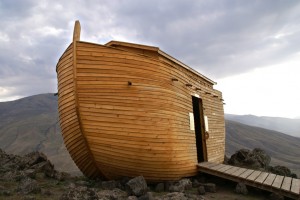 I read those words and heard Bill Cosby’s voice. I’ll bet I’m not alone. More than 50 years ago (1963), Cosby’s debut comedy album Bill Cosby Is a Very Funny Fellow…Right! included a 3-1/2 minute skit he’d been doing on stage entitled Noah: Right! Ever since, it has colored the story of Noah and the ark for Americans; I know people who wouldn’t be born for another quarter century after that album’s release for whom Cosby’s skit is nonetheless an interpretive filter for the Noah story. Millions read the story and hear Noah asking, in Cosby’s voice, “Lord, what’s a cubit?”
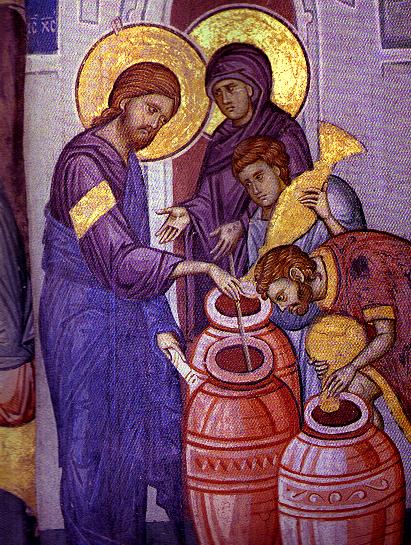 Today is the feast of St. Antony of Egypt. According to a Life of St. Antony written by Athanasius, Antony and his younger sister were orphaned when he was about 18 years of age, inheriting a goodly estate which he began to manage. However, writes Athanasius, six months after his parents’ death he was “turning over in his mind the way the apostles had left everything to follow the Savior” when he heard a sermon on Christ’s encounter with the rich young man whom the Lord instructed, “If you wish to be perfect, go, sell your possessions, and give the money to the poor, and you will have treasure in heaven; then come, follow me.” (Matt. 19:21)
  We make many assumptions based on geography. Think of the all the comedians who make a living in North America by joking about stereotypes of Canadians — the television program South Park has made a running gag of Canadian stereotypes for years! Just try saying, as I truthfully can, “I was born in Las Vegas.” You’ll be very surprised by the reactions and the seriously ridiculous comments (I no longer am).
 What is fear of death but fear of the unknown? The fear of death and the unknown brings anxiety, despair, and a frantic search for meaning. The fear of death and the unknown distracts us and makes us afraid to truly live. We end up fearing both death and life; we end up not attending to those things which are most important.
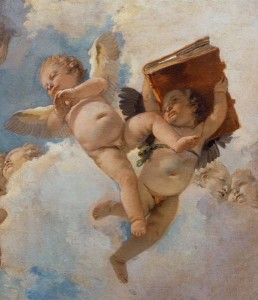 Look up cherub in a secular dictionary and this is what you find: “a member of the second order of angels, often represented as a beautiful rosy-cheeked child with wings.” (Collins) I don’t know why, when, or how the fat little boys with aerodynamically inadequate wings came to be an artistic and now normative depiction of cherubs, but there it is! Technically, these little guys (and they are male) are known as putti — an Italian plural; the singular is putto. (Putto is occasionally used in modern Italian to mean a male toddler.)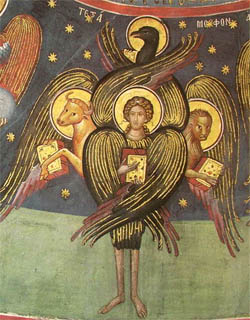


 The musical Godspell debuted in 1971 (my junior year in college); in it, Christ is portrayed as a clown. Whether it was an expression of or the catalyst for the phenomenon of offering clown eucharists as an edgy, avant-garde presentation of the Christian Mysteries, I really don’t know. The two are inextricably linked in my memory.

