From the Psalms:
How long will you assail a person,
will you batter your victim, all of you,
as you would a leaning wall, a tottering fence?
Their only plan is to bring down a person of prominence.
They take pleasure in falsehood;
they bless with their mouths,
but inwardly they curse.
(From the Daily Office Lectionary – Psalm 62:3-4 (NRSV) – February 26, 2013.)
 As I read the lessons and Psalms of the Daily Office lectionary for today, this was the passage that spoke loudest to me, but I did not want to write about it. I tried to reflect upon and author a meditation about some other bits of the Scriptures appointed for today, but my thoughts kept returning to this one.
I’m fairly confident that my comments about it will not be readily accepted by, will indeed by rejected by some of my readers, including not a few of my parishioners. But I have to be honest in my understanding and exegesis of the Bible, and its application to our modern world.
I usually use the version of the Psalms from The Book of Common Prayer in these meditations, but today I’ve chosen to use the New Revised Standard Version because the translation is more accurate. The Prayer Book puts these words in the first person, “How long will you assail me . . . ?” The NRSV is closer to the Hebrew which is in the third person, “How long will you assail a man . . . ? The Hebrew is ‘iysh which can mean a male human being, but can also be translated as gender neutral, so the NRSV is not wrong to do so.
The theologian Karl Barth, in an interview with Time Magazine in 1963 advised theologians “to take your Bible and take your newspaper, and read both. But interpret newspapers from your Bible.” Three years later, in another interview, he said, “The Pastor and the Faithful should not deceive themselves into thinking that they are a religious society, which has to do with certain themes; they live in the world. We still need – according to my old formulation – the Bible and the Newspaper.”
When I read these words from the Bible, I cannot help but remember these words from the news: “I hope he fails. . . . . I hope Obama fails.” (Radio commentator Rush Limbaugh, The Rush Limbaugh Show, January 16, 2009)
I cannot help but remember these words from the news: “The single most important thing we want to achieve is for President Obama to be a one-term president.” (Senate Minority Leader Mitch McConnell, R-Ky, National Journal interview, October 23, 2010)
I cannot help but remember these words from the news: “We’re going to do everything — and I mean everything we can do — to kill it, stop it, slow it down, whatever we can.” (Speaker of the House John Boehner, R-Oh, Politico, concerning President Obama’s first-term agenda, October 28, 2010)
I cannot do anything but what Professor Barth admonished and interpret these newspaper reports from my Bible, especially when my Bible decries and condemns those whose “only plan is to bring down a person of prominence.”
I make no bones of that fact that I am politically a progressive. I’ve never hidden that from anyone and in today’s current American political climate, especially since I live in a “swing state”, that means that I voted for President Obama, twice. My congregation knows that. In the first election, I put no political bumper stickers on my car, but my wife had an Obama/Biden sticker on hers. In the second election, we both did. If I’d had my druthers, I’d rather have voted for the Green Party but, as I said, I live in a swing state and a vote for the Greens would have been, effectively, a vote for the Republican candidates. I voted for President Obama.
So there they are; my political cards are on the table. In politics, economics, and social values, I’m on the “left” of the spectrum. No secrets.
But this isn’t about left or right, Democrat or Republican. It isn’t really about politics, at all. It’s about consensus building and governing with with reason; it’s about values that are not only political but Biblical.
I take the Bible seriously; I’m fairly conservative when it comes to exegeting Holy Scripture. When a Psalm negatively portrays the sorts of politics we see in modern America, I take it seriously.
I can remember a time, not so long ago, when this wasn’t the way our leaders conducted the country’s business. For example, although I was not (and never will be) a member of his party, I remember with affection and respect Senator Everett Dirksen, R-Ill. His was a voice of reason and compromise; his skillful working with Senators Hubert Humphrey (D-Mn) and Mike Mansfield (D-Mt) led to the end of a Republican filibuster and passage of the Civil Rights Act 1964.
It was a Republican who spoke of “the need to maintain balance in and among national programs – balance between the private and the public economy, balance between cost and hoped for advantage – balance between the clearly necessary and the comfortably desirable; balance between our essential requirements as a nation and the duties imposed by the nation upon the individual; balance between actions of the moment and the national welfare of the future. Good judgment seeks balance and progress; lack of it eventually finds imbalance and frustration.” That Republican was President Dwight D. Eisenhower giving his farewell address to the nation on January 17, 1961.
President Eisenhower worked well with a Democratic Senate leader, Lyndon B. Johnson, D-Tx. They both had a fondness for government by consensus and reached across party lines to form a close working relationship. One of Johnson’s favorite sayings was “Come, let us reason together;” he spoke it often after he became president himself. It is a quotation from Scripture:
“Come now, and let us reason together,” says the Lord, “Though your sins are as scarlet, they will be as white as snow; though they are red like crimson, they will be like wool. If you consent and obey, you will eat the best of the land; but if you refuse and rebel, you will be devoured by the sword.” Truly, the mouth of the Lord has spoken. (Isaiah 1:18-20, NAS)
Our political parties do not have to play the sort of political games currently being played. They have worked together in the past; they can do so again. Planning only to bring down one’s opponent, refusing to work toward consensus, failing to reason together . . . these are not only bad politics, they are unfaithful.
Scripture is filled with admonitions to work together:
Oh, how good and pleasant it is, when brethren live together in unity! (Ps 133:1, BCP version)
Now I appeal to you, brothers and sisters, by the name of our Lord Jesus Christ, that all of you be in agreement and that there be no divisions among you, but that you be united in the same mind and the same purpose. (1 Cor. 1:10, NRSV)
Lead a life worthy of the calling to which you have been called, with all humility and gentleness, with patience, bearing with one another in love, making every effort to maintain the unity of the Spirit in the bond of peace. (Eph. 4:1-3, NRSV)
Make my joy complete: be of the same mind, having the same love, being in full accord and of one mind. (Philip. 2:2, NRSV)
Our political leaders who claim the Christian faith should not be governing (in truth, failing to govern) on the basis of “bringing down a person of prominence.” Any who do should be taken to task, but not on the basis of their politics, because on politics people of faith can disagree. No, they should be taken to task because such behavior is unfaithful; it betrays the Biblical witness and the admonitions of Scripture to reason together. Reason and consensus are not only political values; they are Biblical values.
====================
A request to my readers: I’m trying to build the readership of this blog and I’d very much appreciate your help in doing so. If you find something here that is of value, please share it with others. If you are on Facebook, “like” the posts on your page so others can see them. If you are following me on Twitter, please “retweet” the notices of these meditations. If you have a blog of your own, please include mine in your links (a favor I will gladly reciprocate). Many thanks!
====================
Father Funston is the rector of St. Paul’s Episcopal Church, Medina, Ohio.
 These two verses have probably caused any number of people to scratch their heads in bewilderment over the centuries. Those who read them in English without looking behind the translation to the original language wonder, “What on earth does this mean?” Those who read them in Hebrew wonder, “How can God have such a terrible sense of humor?”
 Several years ago – 33 to be exact – Bruce Dern starred in a little-remarked movie entitled Middle Age Crazy; it dealt with the main character’s midlife crisis of turning 40 years of age.
  A few days ago I wrote about my interest in superstring theory, m-theory, and the multiverse concept which springs from my life-long love of science fiction and the especially the “alternate reality” sorts of tales. I suggested that Jesus’ miracles might have been accomplished by his somehow accessing an alternate reality to affect this world; that would imply some sort of access to knowledge of those other universes.
 Some years ago, my wife and I were members of a congregation in Southern California where the assistant priest was a military chaplain originally from Georgia. He was normally rather soft-spoken, but when he would introduce the traditional (Jacobean English) version of the Lord’s Prayer using the words from The Book of Common Prayer he would emphasize one word: “And now, as our Savior Christ has taught us, we are BO-WULD to say . . . .”
  Every time I recite Psalm 19 with its words of praise for the Law, I am caught up short by verse 12. In verses 7-11 we read that the Law is perfect and just, that it provides wisdom and rejoicing, that it is more desirable than gold or honey, and that in keeping it there is enlightenment and reward. Then comes the kicker, “Who can tell how often he offends? Cleanse me from my secret faults.” In other words, despite all the grandeur and wonder of the Law, no one can actually keep it!
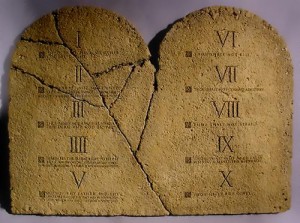 The Bible tells us that the Tablets of the Law were kept in the Arc of the Covenant which traveled with the Hebrews throughout their forty years in the desert and that it was later housed in the Tabernacle and then in the Temple until lost at or about the time of the Babylonian Exile. According to Rabbinic lore, the Ark contained not only the second, whole Tablets, but the broken fragments of the first Tablets, to which Moses refers in this speech from the Book of Deuteronomy.
 We human beings are so proud, so prone to taking credit we really have no right or basis to claim and, apparently, we’ve been doing it for a long time. Moses’ caution to the Hebrews not to do so, not to think that it is through their own merit that the Promised Land is being given them, is a caution to all of us, for we are all “a stubborn people.” Self-importance and obstinacy are the human condition.
 In The Book of Common Prayer on page 264 you’ll find the beginning of the liturgy for Ash Wednesday. If you were here on that day which marks the beginning of this season we call Lent, or in another church to be marked on your forehead with the cross of ashes, to be reminded of your mortality with the familiar words, “Remember you are dust, and to dust you will return,” you will also have heard the Lenten admonition which the presiding priest reads at each Ash Wednesday service. It begins at the bottom of that page and comes in the service after the reading of the lessons of the day and the preaching of the sermon.

