That Which We Have Heard & Known

Occasional thoughts of an Anglican Episcopal priest

Page 125 of 130

Chronos and Kairos and the Search for Answers

I left An Cheathrú Rua on Friday, August 12, 2011, and drove (by back roads, not on the motorway) to Beannchar na Sionna, Contae Uibh Fhaili (Banagher, County Offaly – the Irish name of the town, from the words beanna meaning “antlers” and carraig meaning “rock”, means “place of pointed rocks on the Shannon River” – the county name comes from that of an ancient Irish kingdom, the Uí Failghe). I will be renting a cottage there for a month beginning in a few days and wanted to stop at the cottage to drop some things off with the landlords before continuing to Contae Chill Mhantáin (County Wicklow) where I am visiting the following locations:

Glendalough, site of St. Kevin’s Monastery.
Wickow Town, port city and site of an historic gaol (“jail” to Americans)
Avoca, the town where the BBC series Ballykissangel was filmed

Leaving Banagher, I found myself driving through the city of Birr directly beside Castle Birr and decided, “What the heck? I have time. I’ll visit the demesne of Castle Birr.” Castle Birr is the historic home of the Earls of Rosse and is still occupied by the Parsons family today. Thus the castle itself is not open to the public, but the grounds are.

Castle Birr, Biir, Co. Uibh Fhaili, Éire

Castle Birr, Biir, Co. Uibh Fhaili, Éire

There has been a castle on the site since 1170. From the 14th to the 17th centuries the Ó Céarbhaill family of Eile (Anglicized: O’Carroll of Ely) ruled this part of Ireland. (Their northen neighbors were the Ó Conchubhair Failghe, from which the county gets its name.) The O’Carroll’s ruled from a castle called “The Black Tower” which no longer exists.

After the death of Sir Charles O’Carroll, Sir Laurence Parsons was granted Birr Castle and 1,277 acres of land in 1620. He engaged English masons in the construction of a new castle making use of the gatehouse of the old Black Tower as its foundation. Flankers were added to the gatehouse diagonally at either side, giving the castle the plan it still has today. Descendants embellished the castle in the 18th century and by 1840 it looked as it now does. It is a 100-room private home!

Castle Birr, Biir, Co. Uibh Fhaili, Éire

Castle Birr, Biir, Co. Uibh Fhaili, Éire

The third Earl of Rosse, William Parsons, had no interest in adding to the castle. Instead, his interest lay in astronomy, particularly the study of nebulae, and he took it upon himself to build the largest telescope yet constructed. In 1845 he built on the castle grounds the “Great Telescope”, also called “the Leviathan of Parsonstown”, a reflecting telescope with a 72 in aperture. It was the largest telescope in the world until the Hooker Telescope was built at Mt. Wilson Observatory in California in 1917.

Parsons did not use the telescope for nearly three years after its construction because he turned his attention to famine relief (these were the years of the Great Hunger). But in 1847 he began his work, cataloging and studying nebulae. He discovered 226 of the nebulae and other deep sky objects eventually listed in the New General Catalog compiled in the 1880s by J. L. E. Dreyer and published by the Royal Astronomical Society in 1888.

The Great Telescope, Birr Castle Demesne, Biir, Co. Uibh Fhaili, Éire

The Great Telescope, Birr Castle Demesne, Biir, Co. Uibh Fhaili, Éire

After his death in 1867, his descendants used the Leviathan for another forty or so years. However, it fell into disuse and was partially dismantled in 1908; in 1914, one of the mirrors with its mirror box was transferred to the Science Museum in London. The walls remained. The tube, second mirror box, and universal joint survived. Eventually, however, even these were removed for safety reasons.

In the 1990s, the Leviathan was restored. Since there were no surviving plans, the restorers worked from Parsons’ notes, descriptions written by visitors, drawings and photographs. The restored instrument is what one now sees on the demesne of Birr Castle.

The Great Telescope, Birr Castle Demesne, Biir, Co. Uibh Fhaili, Éire

The Great Telescope, Birr Castle Demesne, Biir, Co. Uibh Fhaili, Éire

The Leviathan and the work of the various members of the Parsons family in astronomy and other sciences are the reason there is a pretty good “history of science” museum on the castle grounds. As I read about George Johnstone Stoney, one of William Parsons’ assistants who went on the achieve his own sort of fame as a physicist and the originator of the term electron, I thought this post about Castle Birr would be a good place to throw in some thoughts I’ve been having about string theory and God.

While on this trip, I’ve been reading The Elegant Universe by Brian Greene (Vintage Books 2000). I mentioned in another post that, for some reason, my “recreational reading” these days seems to be in the area of quantum mechanics and string theory…. I think this is because I am fascinated by the echoes of spirituality, theology, and religion I find in the comments of the mathematicians and physicists who write in this area for the general public. For example, about halfway into this book, Greene writes:

Imagine a universe in which the laws of physics are as ephemeral as the tastes of fashion – changing from year to year, from week to week, or even from moment to moment. In such a world, assuming that the changes do not disrupt basic life processes, you would never experience a dull moment, to say the least. The simplest acts would be an adventure, since random variations would prevent you or anyone else from using past experience to predict anything about future outcomes.
Such a universe is a physicist’s nightmare. Physicists – and most everyone else as well – rely crucially upon the stability of the universe. The laws that are true today were true yesterday and will still be true tomorrow (even if we have not been clever enough to have figure them all out). (Pp 167-68)

That sounds an awful lot like something in Holy Scripture – this bit from the Letter to the Hebrews: ” Jesus Christ is the same yesterday and today and forever.” (Heb. 13:8, NRSV) Greene may have been intentionally echoing Hebrews, but I don’t think so. I think the scientific quest for “the theory of everything” springs from the same source as the religious quest for understanding, and that both science and religion seek the stability of that which is, always has been, and always will be true. Later in the book, Greene discusses the application of string theory to cosmology and the ways in which the two fields learn from each other:

[T]he study of cosmology does hold the promise of giving us our most complete understanding of the arena of the why – the birth of the universe – and this at least allows for a scientifically informed view of the frame within which the questions are asked. Sometime attaining the deepest familiarity is our best substitute for actually having the answer. (Pp. 364-65)

I’m taken by that last thought, that “deep familiarity” is a substitute for “an answer”; I might even amend Greene’s thought to suggest that “deep familiarity” is the answer. Throughout the book Greene refers to spacetime as “the fabric” of the universe. For example, close to his conclusion he writes about the question of whether there was something “before” time, “before” space:

[D]escribing the spacetime fabric in [a] string-stitched form does lead us to contemplate the following question. An ordinary piece of fabric is the end product of someone having carefully woven together individual threads, the raw material of common textiles. Similarly, we can ask ourselves whether there is a raw precursor to the fabric of spacetime – a configuration of strings of the cosmic fabric in which they have not yet coalesced into the organized form that we recognize as spacetime. (P. 378)

The Hebrew Scriptures also speak of deep familiarity and use similar metaphors in describing God’s creative action, the metaphor of knitting and weaving. Jeremiah the prophet, for example, records his call to ministry quoting God as saying to him, “Before I formed you in the womb I knew you, and before you were born I consecrated you,” (Jer. 1:5) words that I recalled when I read Greene’s passage above about the “raw precursor” before the universe had “coalesced into the organized form that we recognize as spacetime.” In Psalm 139 themes one finds in Greene’s book, light and dark, weaving and pre-existence, are found together in a religious expression of the same yearning for deep familiarity:

If I say, “Surely the darkness will cover me, *
and the light around me turn to night,”
Darkness is not dark to you; the night is as bright as the day; *
darkness and light to you are both alike.
For you yourself created my inmost parts; *
you knit me together in my mother’s womb.
I will thank you because I am marvelously made; *
your works are wonderful, and I know it well.
My body was not hidden from you, *
while I was being made in secret and woven in the depths of the earth.
(Psalm 139:10-14 From the American Episcopal Book of Common Prayer Psalter)

In Greene’s discussion of that “raw precursor” before time and space, I was also reminded of the theological terns chronos and kairos, two different understandings of time which come into Christian theology through Greek philosophy. The first, chronos, is time on the move, time with a before and after, time in which we look to the future, experience the present, and remember the past. This is the time Greene writes about when he says, “[W]e, our friends, our belongings, and so forth all move through time … time [is] another dimension of the universe – the fourth dimension.” (p 49) Chronos is measurable, dimensional time.

The second Greek word for time is kairos, which considers time as qualitative rather than quantitative, as significant rather than dimensional; it speaks of time as a moment, time as occasion. Theologically, kairos refers to the “eternal now”, to God’s time, to time outside of time, to the eternal as distinguished from the everlasting. In kairos, there is no sequence, no before and after, no dimensionality, no length to it at all.

Not quite at the conclusion of this book, Greene says:

The astonishment at our ability to understand the universe at all is easily lost sight of in an age of rapid and impressive progress. However, maybe there is a limit to comprehensibility. Maybe we have to accept that after reaching the deepest possible level of understanding science can offer, there will nevertheless be aspects of the universe that remain unexplained. Maybe we will have to accept that certain features of the universe are the way they are because of happenstance, accident, or divine choice. (P. 385)

Reading those words and Greene’s conclusion two pages later, in which he encourages us all to keep striving for answers, to keep seeking to comprehend, I thought how often we have heard scientists, particularly physicists, compared to children playing with fire, and that reminded me of a Scriptural answer to Greene’s “maybe” … that there will be a time when our childish “maybes” will be resolved:

For now we see in a mirror, dimly, but then we will see face to face. Now I know only in part; then I will know fully, even as I have been fully known. And now faith, hope, and love abide, these three; and the greatest of these is love. (1 Cor. 13:12-13, NRSV)

The Leviathan of Parsonstown is a monument to that seeking spirit which informs both science and religion, that searching for comprehension that will be answered in the “eternal now” by that “raw precursor” Who was before time and space.

The Great Telescope, Birr Castle Demesne, Biir, Co. Uibh Fhaili, Éire

The Great Telescope, Birr Castle Demesne, Biir, Co. Uibh Fhaili, Éire

Memories and Good-Byes

I received word yesterday that Earl, a long-time parishioner and good friend back home, had passed away. This was not a surprise; he had been diagnosed with lung cancer some months ago and we expected that he would die while I was on sabbatical. Still, it has filled the day with sadness. I think of his wife, his children, his grandchildren, all of whom I know, and I know that today is a hard one for them. No matter how prepared for a loved one’s death we believe we are, we aren’t. It’s that simple. Death is never easy.

My father died suddenly and unexpectedly when I was not quite six years old; we weren’t prepared. My mother and step-father both died after long and protracted illnesses; we weren’t prepared either time. My mother-in-law passed away after several years of decline into the living death that is Alzheimer’s Disease; even with that long and difficult course, we weren’t prepared. Through the years other friends and family members have died. Parishioners and parishioners’ loved ones have died and I have officiated at their burials and celebrated the Requiem Masses for the repose of their souls. The one thing all of these passings has taught me … no matter how prepared for a loved one’s death we believe we are, we aren’t.

The Irish live with death closer at hand than any other people I’ve encountered. Oh, for sure, there are places where the physical reality of death is nearer at the present; places where famine reigns, places like Somalia and in recent years Ethiopia and other north African countries from which we see the pictures of emaciated corpses and children with malnutrition-distorted bodies. The Irish lived through times like those 165 and more years ago; as the saying goes, they’ve been there, done that.

I’ve written earlier about the famine houses and how they are a living, daily memory of that time. I didn’t write in that entry that in addition to the abandoned homes, there are famine houses that were tombs. Starving families would simply close their door and huddle together in a corner of the house and die. There was no food; there was nothing else to do. (I’m told that there are recorded instances of cannibalism during the famine years. I’ve not read those records myself.) The Irish have been there, done that.

The famine houses are not the only reminders of mortality on this island. There are also the ruins of churches, of small parish churches, of missionary encampments, of great monasteries dating back to the first days of Christianity in Ireland. The names of some are well known: Ballentubber Abbey, a ruin now restored as a parish church and described in another post on this blog; Clonmacnoise in County Offaly which dates from the middle of the 5th Century; the Rock of Cashel, the remains of a 12th Century monastery on a site reputed to have been used by Patrick for the baptism of the kings of Ireland in the 5th Century; Glendalough founded in the Wicklow Mountains by St. Kevin in the 6th Century.

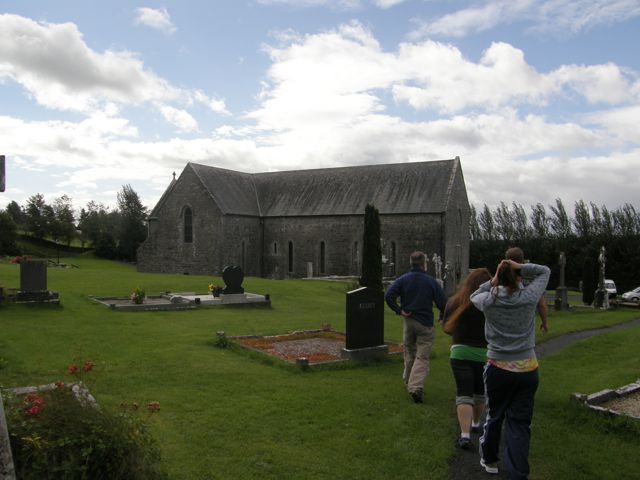
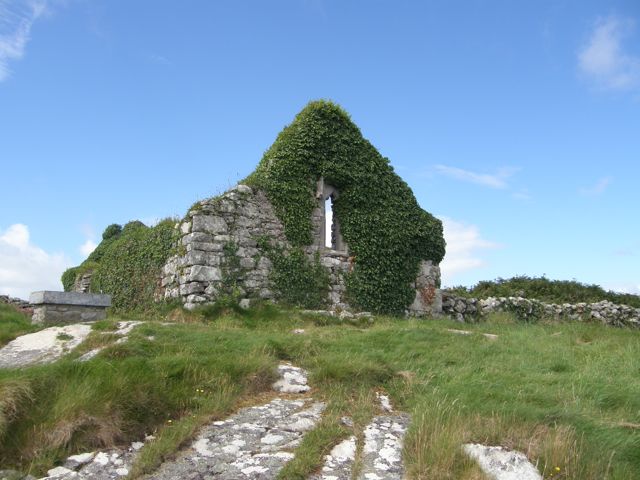
Others are not so well known; Teampall Mhic Ádhaimh (“Church of the Son of Adam”) is a local ruin here on An Cheathrú Rua. Local tradition has it that it was built by a Saint Smochan and archeological and architectural evidence points to a 15th Century construction date. This church is located near the water’s edge at Trá na Reilige (“Beach of the Burial Ground”) at Barr an Doire (“Oaktree Point”).

Teampall Mhac Ádhaimh (Church of the Son of Adam), An Cheathrú Rua

Teampall Mhac Ádhaimh (Church of the Son of Adam), An Cheathrú Rua

Teampall Mhac Ádhaimh (Church of the Son of Adam), An Cheathrú Rua

Teampall Mhac Ádhaimh (Church of the Son of Adam), An Cheathrú Rua

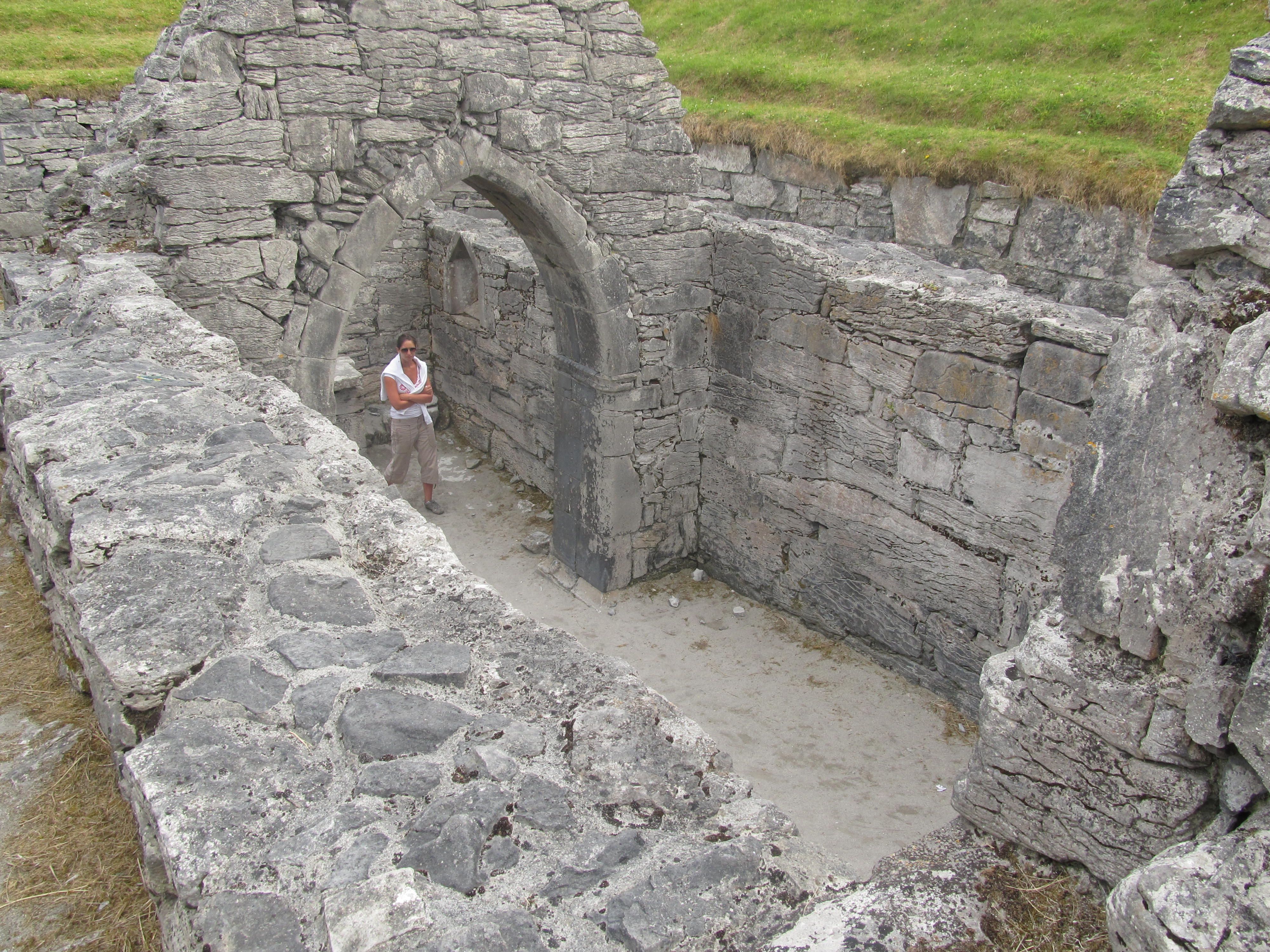
Another is Teampall Chaomháin (“St. Kevin’s Church”), the buried church on Inis Oírr, the smallest of the Aran Islands. These churches probably came into ruin as a result of “the Penal Years” when the practice of Roman Catholicism in Ireland was outlawed by the English. They came into ruin, but not disuse.

Teampall Chaomháin, Inis Oírr (photo from Ciara Grogan)

Teampall Chaomháin, Inis Oírr (photo from Ciara Grogan)

Teampall Chaomháin, Inis Oírr (photo from Ciara Grogan)

Teampall Chaomháin, Inis Oírr (photo from Ciara Grogan)

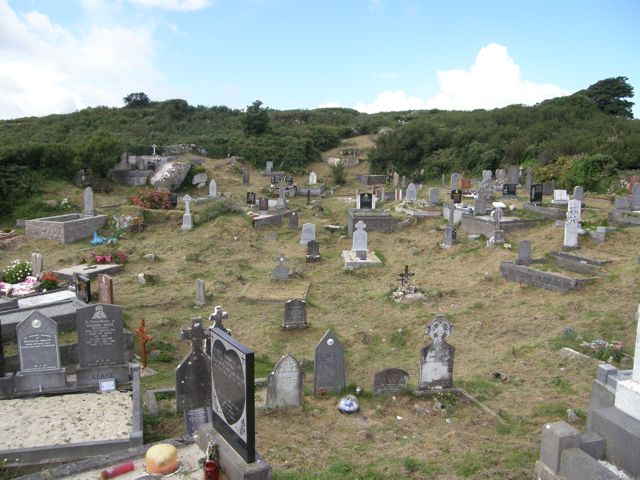
Like many local (and monastic) ruins throughout Ireland, these ruined churches were considered holy ground and so they became burial grounds.

Burial Ground at Teampall Chaomháin, Inis Oírr (photo from Ciara Grogan)

Burial Ground at Teampall Chaomháin, Inis Oírr (photo from Ciara Grogan)

Burial Ground at Teampall Chaomháin, Inis Oírr (photo from Ciara Grogan)

Burial Ground at Teampall Chaomháin, Inis Oírr (photo from Ciara Grogan)

Burial Ground at Teampall Mhac Ádhaimh, Barr an Doire, An Cheathrú Rua

Burial Ground at Teampall Mhac Ádhaimh, Barr an Doire, An Cheathrú Rua

Burial Ground at Teampall Mhac Ádhaimh, Barr an Doire, An Cheathrú Rua

Burial Ground at Teampall Mhac Ádhaimh, Barr an Doire, An Cheathrú Rua

I wandered through the graveyard at Barr an Doire and photographed some of the gravestones, many carved in beautiful Gaelic text. This one marks the grave of Bairbre Nic Donncha, who died April 20, 1960, her husband Peadar, who followed her two days later, and their son Peadar, who died a few days before Christmas in 1995. The blessing on the marker reads, Ar deis De go raibh anam – A chlann a thog, which means “May their souls be at the right hand of God, their family prays.”

Gravestone at Teampall Mhac Ádhaimh, Barr an Doire, An Cheathrú Rua

Gravestone at Teampall Mhac Ádhaimh, Barr an Doire, An Cheathrú Rua

The next stands over the tomb of Chóilín Phádraig Pheatsín, who died April 2, 1959, and his wife Nora, who joined him on March 1, 2002. The prayer reads Taispeáin dúinn, a Thiarna, do trócaire agus tabhair do shlánú (“Show us, Lord, your mercy and grant us your salvation”).

Gravestone at Teampall Mhac Ádhaimh, Barr an Doire, An Cheathrú Rua

Gravestone at Teampall Mhac Ádhaimh, Barr an Doire, An Cheathrú Rua

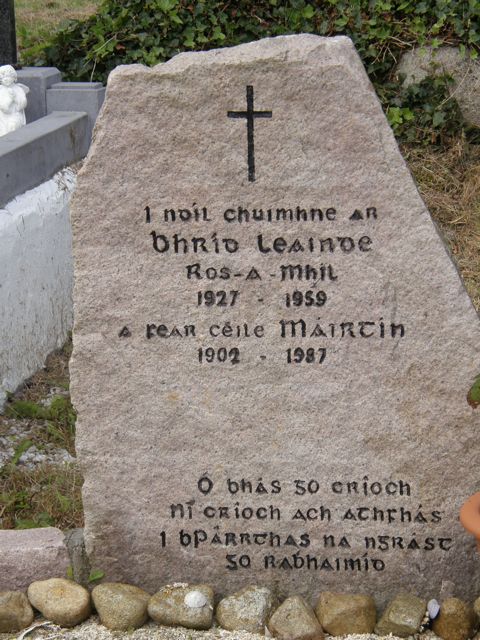
And finally this marker over the grave of Bhrid Leainde, who passed away at the young age of 32 in 1959 and was followed by her husband Máirtín, who died at the age of 85 in 1987. I really like the sentiment expressed on this gravestone: Ó bhás go críoch ní críoch ach athfhas i bPárrthas na ngrast go rabhaimíd (“From death to an end not an end but new growth, we go to the Paradise of grace”).

Gravestone at Teampall Mhac Ádhaimh, Barr an Doire, An Cheathrú Rua

Gravestone at Teampall Mhac Ádhaimh, Barr an Doire, An Cheathrú Rua

Though surrounded by reminders of the deaths of the famine years and by the ruins of churches and the graves they contain, I’m sure Bairbre’s and Peadar’s family, that Chóilín’s and Nora’s children, that Bhrid’s and Máirtín’s loved ones were not prepared for their deaths. No matter how prepared for a loved one’s death we believe we are, we aren’t. And yet we are sustained by faith, by the faith that assures us that death is not an end, but the beginning of new growth in a paradise of grace where, through the Lord’s mercy, we enjoy the fruits of salvation and sit at God’s right hand.

There is a poem by Máirtín Ó Direáin inscribed on a stone plaque dated August 2000 at Teampall Chaomháin on Inis Oírr. The plaque includes a verse of scripture (Is mise an t-aiséirí agus an bheatha – “I am the resurrection and the life”) and a prayer (Suaimhneas sioraí dar muintir a d’migh uainn – “Eternal peace to the people who have left us”). The poem is entitled Cuimhní Cinn (“Memories”). I’ve tried to find a translation, but failing that have translated it myself.

Stone Plaque at Teampall Chaomháin, Inis Oírr (photo from Ciara Grogan)

Teampall Chaomháin, Inis Oírr (photo from Ciara Grogan)

Their memory still lives in my mind:
A white jacket and a bright shirt,
a blue shirt and a green vest,
trousers and drawers of homespun;
our honored old men
traveling to Sunday morning Mass,
a long journey on foot
wakening in my youth my own thoughts:
our ground, our earth, still our blessing.

Their memory still lives in my mind:
Long red choir robes,
blue coats dyed with indigo,
neat knitting women
now in heavy shawls up from Galway
traveling to Mass in the same way;
and although they are going out of fashion
their memory still lives in my mind.
Certainly life will come to me from this land.

Earl’s memory lives in my mind – a tweed sport coat, a purple shirt, two canes, a bushy beard, and ready smile. We knew this was coming, but no matter how prepared for death we believe we are, we aren’t. Being in community, traveling together to Mass memories alive in everyone’s minds, helps us get through that unpreparedness. I’m sorry I can’t be there with our church community to say “Good bye”.

May he rest in peace and rise in glory.

A Word about Signs

Signs are ubiquitous – they are everywhere! Do you remember that old rock-and-roll song by the Five Man Electrical Band (and I do mean old, like 40 years old!)?

And the sign said “Long-haired freaky people need not apply”
So I tucked my hair up under my hat and I went in to ask him why
He said “You look like a fine upstanding young man, I think you’ll do”
So I took off my hat, I said “Imagine that. Huh! Me workin’ for you!”
Whoa-oh-oh

Sign, sign, everywhere a sign
Blockin’ out the scenery, breakin’ my mind
Do this, don’t do that, can’t you read the sign?

And the sign said “Anybody caught trespassin’ would be shot on sight”
So I jumped on the fence and yelled at the house,
“Hey! What gives you the right?
To put up a fence to keep me out or to keep mother nature in
If God was here, he’d tell you to your face, Man, you’re some kinda sinner”

Sign, sign, everywhere a sign
Blockin’ out the scenery, breakin’ my mind
Do this, don’t do that, can’t you read the sign?

Now, hey you, mister, can’t you read?
You’ve got to have a shirt and tie to get a seat
You can’t even watch, no you can’t eat
You ain’t supposed to be here
The sign said you got to have a membership card to get inside
Unh!

And the sign said, “Everybody welcome. Come in, kneel down and pray”
But when they passed around the plate at the end of it all,
I didn’t have a penny to pay
So I got me a pen and a paper
and I made up my own little sign.
I said, “Thank you, Lord, for thinkin’ ’bout me. I’m alive and doin’ fine.”
Wooo!

Sign, sign, everywhere a sign
Blockin’ out the scenery, breakin’ my mind
Do this, don’t do that, can’t you read the sign?

Sign, sign, everywhere a sign
Sign
Sign, sign

They are everywhere! There aren’t a lot of commercial advertising signs in the UK or in Ireland (well, there are a lot in Ireland, but they are mostly small and local). One of my favorites is this on one the local pier (Caladh Tadgh – “the stone pier”):

Sign at Caladh Tadhg, An Cheathrú Rua, Co. na Gaillimhe, Éire

Sign at Caladh Tadhg, An Cheathrú Rua, Co. na Gaillimhe, Éire

I actually have no idea at all what this sign is saying, but I love the wording of it and all the things it suggests to a strange mind like my own.

Here’s another sign one sees a lot of in this part of Ireland these days:

Irish Real Estate "For Sale" Sign

Irish Real Estate "For Sale" Sign

Le Diol is Irish for “For Sale.” If I had the money, I’d be very tempted to buy one of the properties where a sign like this is posted. (The one in this picture is a bed-and-breakfast property in An Cheathrú Rua. I wonder what it would be like to run a B&B….)

There is a sign one sees in the UK and here in Ireland that is similar to a sign we see along roads in the USA:

UK - Ireland Road Sign showing a Camera

UK - Ireland Road Sign showing a Camera

In the States, the sign that is sort of like this (in that it depicts a camera) generally indicates a scenic view-point from which one can take nice photographs. I first saw this sign in southern Scotland, but it never seemed to be at a place where there was anything to see or, if it was, there was never a convenient place to pull over and take a photograph. So I was puzzled by these signs. Since I couldn’t see any scenic view-point pullouts, I began to ignore them.

Then in Derbyshire, I saw the sign together with a sign warning of the presence of pedestrians:

Camera Sign together with Pedestrian Sign

Camera Sign together with Pedestrian Sign

So I was all the more confused. Surely, these signs must be pointing to something worth seeing, and I was missing these scenic views! But there were still no places to pull over where the signs were posted and I didn’t want to just stop in the road way!

Then, near the home of my friends in Penn, High Wycombe, I saw a sign with the same camera image but accompanied by explanatory words:

Speed Cameras Sign

Speed Cameras Sign

Oh! They aren’t signs about scenic views at all! They are signs warning speeding motorists that they are being photographed and their license plate numbers recorded!

Thank heaven I was driving at or below the speed limit (not always true at home, I admit) in the UK and continue to do so here in Ireland. (Of course, I’m of the opinion that anyone who exceeds the speed limit – or, in some places, even drives as fast as the limit – on these roads is completely nuts!)

The lesson of this sign is that we ignore signs, especially those we don’t really understand, at our own peril. That’s true spiritually as surely as it is in driving through a country not one’s own. Being unable to read a sign reminds me of an incident in Matthew’s Gospel:

The Pharisees and Sadducees came, and to test Jesus they asked him to show them a sign from heaven. He answered them, “When it is evening, you say, ‘It will be fair weather, for the sky is red.’ And in the morning, ‘It will be stormy today, for the sky is red and threatening.’ You know how to interpret the appearance of the sky, but you cannot interpret the signs of the times. An evil and adulterous generation asks for a sign, but no sign will be given to it except the sign of Jonah.” Then he left them and went away. (Matthew 16:1-4)

Matthew does not further explain “the sign of Jonah,” but Luke quotes Jesus as explaining the symbolism in his version of this story, “Just as Jonah became a sign to the people of Nineveh, so the Son of Man will be to this generation.” (Luke 11:30) Generally, the “sign of Jonah,” the witness of Jonah as prophet to the ancient Israelites is taken to mean that if Israel would not repent, God would take away the power and strength he had given them and give it to a another nation or people, and that nation would (in turn) humiliate and punish Israel.

So when we fail to appreciate, to understand and heed those signs that appear in our lives, we run the risk of losing that with which we have been entrusted. We run the risk of losing the ministry and the benefits we have been given, and find ourselves in need. We have all been given gifts, and we are expected to use them to the benefit of others; failing to do this, we run the risk of losing them. “From everyone to whom much has been given, much will be required; and from the one to whom much has been entrusted, even more will be demanded.” (Luke 12:48)

Pay attention to the signs in your life!

I’ve not been back to Caladh Tadhg since shooting that first photograph, but when I do I’ll be sure to disinfect!

The Morning Star – Another Musical Bit

I’m experimenting with and learning more about the music software. I’ve put together another selection from the Dantá Dé hymnal which I am calling The Morning Star as a working title. My earliest translation of the lyrics that go with this tune was sung by one of our choristers as a solo at church a couple of years ago; I’m scrapping that translation and starting over. But in the meantime, here’s a simulated four-part choir accompanied by piano with the melody.

The Morning Star

Another Walk through the Connemara

Yesterday and today our student body toured the demesne of Ballynahinch Castle, wandered the narrow main street of Roundstone, and climbed a steep, rocky, boggy hill outside of Cashel in the company of Michael Gibbons, a native of Connemara who is one of Ireland’s leading field archaeologists, a writer, broadcaster, and mountaineer. He is a former director of local and national archaeological survey programs. In his talks about holy wells, ancient burial sites, and the history of the Gaelic lords, it was quite evident that he is very knowledgeable about Irish history especially the pilgrimage tradition in Ireland. I later learned that he spent three years excavating the summit of Croagh Padraig, climbing more than 2,500 feet to work every morning. He certainly moved skillfully and quickly up the hillside in Cashel!

Michael Gibbons, Irish Archeologist and Historian

Michael Gibbons, Irish Archeologist and Historian

Michael has supervised archeological work in such diverse places as the Negev Desert, Egyptian Sinai, and Southern Greece. He has lectured throughout Ireland, at Oxford and Cambridge, at the American National Geographic Society, and at the Smithsonian Institution in Washington, D.C. It was quite a privilege to spend an afternoon hillwalking with him. (Half of the students when on his tour on Monday and half today. I was in the second group.)

Our first stop was at Ballynahinch Castle, a place where Evelyn and I spent a couple of days on our first trip to Ireland in 2005. I was disappointed that today we didn’t actually go into the hotel (yesterday’s group apparently did), but simply roamed the demesne following a circular path around the castle itself.

Ballynahinch Castle Hotel

Ballynahinch Castle Hotel

A famous resident of Ballynahinch was Richard Martin, also known as “Humanity Dick”, founder of The Royal Society for the Prevention of Cruelty to Animals (RSPCA). His ancestors took over the house in 1590. His father the present manor house in the early 1700’s as an inn, the same purpose it now serves as one of the finest hotels in Ireland.

The name Ballynahinch comes from the Irish Baile na hInse meaning “settlement of the island”, a reference to the small island fortress in the lake over which the castle looks. The estate comprises 450 acres of woodlands, gardens, lakes, and rivers, just a small portion of the more than 200,000 acres which the “The Ferocious O’Flahertys” ruled from this place. The lands of the O’Flaherty clan stretched to within fifteen miles of Galway City on the east and into County Mayo to the north-west. The clan leaders were the Gaelic Lords of Connaught and held castles at Ballynahinch, Aughanure, Doon, Moycullen, Bunowen, and Renvyle.

Crannog in Ballynahinch Lake

Crannog in Ballynahinch Lake

Perhaps the most famous O’Flaherty was Grace O’Malley from Mayo who married Donal O’Flaherty in 1546. Called the Pirate Queen of Connemara, she is well known for her meeting with Queen Elizabeth I in 1593. At the age of 63 years at the time, she was said to be an awesome and formidable lady. Although Irish was her native tongue, Grace conversed comfortably the English queen in Latin. An English court scribe described her this way: “In the wild grandeur of her mien erect and high before an English Queen she dauntless stood.”

On the grounds of the estate, Michael Gibbons showed us a holy well dedicated to St. Feithin (Festus), one of several which stretch in a fairly straight line from east to west across this part of Ireland. He explained the importance and history of holy wells in the folk religion of Irish people. What I found of interest is that holy wells were disliked by and the tradition actively discouraged by both Anglican evangelical missionaries and the French-trained Roman Catholic clergy who came to this area after English law again permitted Catholicism to be practiced; nonetheless, the tradition continued and even today one finds holy wells as places of reverence throughout this nation. The Roman church seems to have learned the lesson that this sort of folk religion cannot be obliterated and so has adopted many of these sites as places of pilgrimage. The holy well at Ballynahinch, however, is not one of them as it has dried up (according to legend it did so because it was insulted by a Protestant).

Tobar Feithín on the grounds of Ballynahinch Castle

Tobar Feithín on the grounds of Ballynahinch Castle

We also saw, from a distance, the island fortress or crannog from which the area gets its name and the remains of a 16th century cannon used by the O’Flaherty’s to defend their headquarters. (The term crannog refers to emplacements on small islands, often artificial ones; remains of them can be found in many of Ireland’s lakes. The name is derived from the old Irish crannóc from crann, tree. These islands in many cases were fortified and lived on by people as late as the 17th century.)

After hiking around Ballynahinch, we drove to Roundstone where we spent an hour having lunch. I’ve written about Roundstone in another post on this blog.

Our bus next took us about twenty minutes south of Roundstone to Cashel Hill (Cnoc an Cháisil) where we climbed about eight hundred yards up the hill from a roadside cottage to a megalithic tomb dating from the end of the Stone Age or beginning of the Bronze Age, about 4500 years ago. It is known locally as Altoir Ula (altoir means “altar” and ula refers a tomb or penitential station ); it is also said to have been a “Mass Rock”, a place used by outlaw Roman Catholic priests to celebrate Holy Communion when Roman Catholicism was illegal during what are called “the Penal times”.

Megalithic Tomb, Cashel Hill, Connemara, Co. na Gaillimhe, Éire
Megalithic Tomb, Cashel Hill, Connemara, Co. na Gaillimhe, Éire

Looking like a low hut built out of a few massive and irregular stone slabs, it is a wedge-shaped gallery grave. Its chamber narrows towards the rear or eastern end. The cap-stone forming its roof is about five feet square and sixteen inches thick, and rests on smaller slabs set edgeways in the ground to form the sides, which are the interior stones of double-sided walls. One of these outer slabs, five feet high, stands forward of the main chamber as a sort of portico at the front of the tomb. Originally the whole construction would have been covered by a cairn, traces of which can be seen around it. This is the only known megalithic tomb in the South Connemara area.
Megalithic Tomb, Cashel Hill, Connemara, Co. na Gaillimhe, Éire

Megalithic Tomb, Cashel Hill, Connemara, Co. na Gaillimhe, Éire

Megalithic Tomb, Cashel Hill, Connemara, Co. na Gaillimhe, Éire

Megalithic Tomb, Cashel Hill, Connemara, Co. na Gaillimhe, Éire

Megalithic Tomb, Cashel Hill, Connemara, Co. na Gaillimhe, Éire

Megalithic Tomb, Cashel Hill, Connemara, Co. na Gaillimhe, Éire

Megalithic Tomb, Cashel Hill, Connemara, Co. na Gaillimhe, Éire

Megalithic Tomb, Cashel Hill, Connemara, Co. na Gaillimhe, Éire

Megalithic Tomb, Cashel Hill, Connemara, Co. na Gaillimhe, Éire

Megalithic Tomb, Cashel Hill, Connemara, Co. na Gaillimhe, Éire

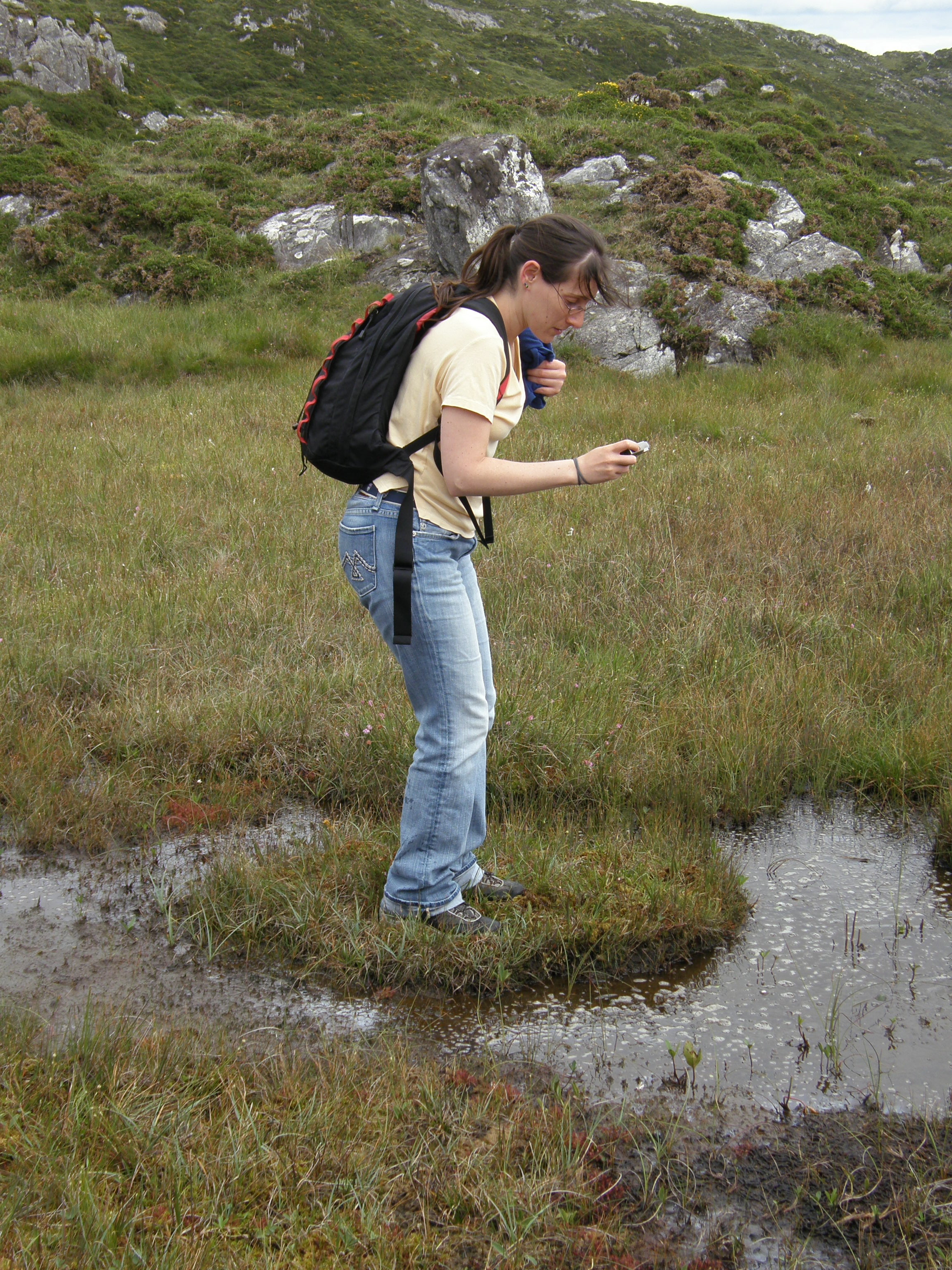
After the tomb, Michael showed us a nearby active bog and explained how bogs grow. He showed us how to walk through bog safely (don’t ever try to jump from place to place!) and demonstrated the buoyancy of a bog mat. One of our classmates, Mara B., stepped out onto the mat (at Michael’s invitation). It was fascinating the way the “ground” in the bog bounced as others walked across it. The mat on which Michael and then Mara stood moved dramatically! The bog water around the mat may have been as many as 18 feet deep; Michael probed with his 5-foot walking stick and met no resistance. The bog is much like quicksand and can suck a person under in just a few minutes.

Active bog area, Cashel Hill, Connemara, Co. na Gaillimhe, Éire

Active bog area, Cashel Hill, Connemara, Co. na Gaillimhe, Éire

Mara B., active bog area, Cashel Hill, Connemara, Co. na Gaillimhe, Éire

Mara B., active bog area, Cashel Hill, Connemara, Co. na Gaillimhe, Éire

The Blessed Wedding in Cana

There was a wedding on An Cheathrú Rua last week. (By the way, that preposition is correct. One speaks of being on An Cheathrú Rua rather than in it. It is a peninsula, after all.) The groom was a bartender at the pub frequented by our student body and the reception, such as it was (very unlike an American wedding celebration) was held there. Anyone and everyone who happened in was a welcome guest.

I did not have an opportunity to witness the wedding, nor any of the preparations. However, when I was in Ireland in 2008, some friends and I climbed Croagh Padraig, the holy mountain in County Mayo also known as “The Reek”. There is an annual event here called “Reek Sunday” (the last Sunday of July) when the penitent climb the mountain. The truly penitent climb it barefoot. Having climbed it wearing fairly sturdy hiking shoes, I can assure you that that would be a substantial act of penitence; but little old ladies were doing just that when I climbed it (a week after Reek Sunday), and they were going up that slope faster than I was! (The background image on this blog, by the way, is Croagh Pádraig.) The hike up the mountain is in emulation of St. Patrick who is said to have climbed the mountain, cleansed it of druid religious use, and offered the Eucharist on its summit.

Another part of the meditative tradition of Croagh Padraig is to start one’s pilgrimage to the mountain at Ballintubber Abbey. Ballintubber is an Anglicization of Baile tobair Phádraig, “place of the well” – the well in question supposedly being a place where St. Patrick baptized converts. Ballintubber Abbey is about 22 miles from Croagh Padraig, so the full penitential practice is to hike cross-country on the Tóchar Phádraig (“Patrick’s Causeway”) and then climb the mountain.

Ballintubber Abbey Church, Co Mayo, Éire

Ballintubber Abbey Church, Co Mayo, Éire

The abbey church has been beautifully restored and is the parish church for the village of Ballintubber. (The church has a lovely website here.) http://www.ballintubberabbey.ie/ My friends and I short-circuited the tradition by attending Mass at the abbey church and then driving from there to the mountain.

Ballintubber Abbey Church, Co Mayo, Éire

Ballintubber Abbey Church, Co Mayo, Éire

The grounds of the abbey church are filled with graves and with statuary, some of it very modern and very interesting, especially a set of non-representational Stations of the Cross which are abstract stone work in place of the usual pictures or statues of the fourteen steps of the way of tears; for example, the Ninth Station, Jesus’ Third Fall, is simply a fallen stone whose shape is vaguely suggestive of a human body.

Ballintubber Abbey Church, Co Mayo, Éire, Stations of the Cross, No. 9

Ballintubber Abbey Church, Co Mayo, Éire, Stations of the Cross, No. 9

The most representational of the stations is the Eleventh, the Crucifixion.

Ballintubber Abbey Church, Co Mayo, Éire, Stations of the Cross, No. 11

Ballintubber Abbey Church, Co Mayo, Éire, Stations of the Cross, No. 11

There is also a wonderful statue of the Madonna with her Child. I find the faces and the poses of the pair striking. Mary is, I believe, depicted as strong and sad; she looks both defiant and obedient, as if unwilling to turn loose of her Son and yet aware that that choice is really not hers to make. As she holds him in a cruciform pose, she seems to be both offering and protecting him at the same time. The Christ Child is depicted in the familiar cruciform manner, but his face is turned towards his mother, not toward the viewer as is more typical. He seems almost puzzled by his Mother’s expression.

Ballintubber Abbey Church, Co Mayo, Éire, Madonna and Child

Ballintubber Abbey Church, Co Mayo, Éire, Madonna and Child

Ballintubber Abbey Church, Co Mayo, Éire, Madonna and Child

Ballintubber Abbey Church, Co Mayo, Éire, Madonna and Child

I often wonder about the relationship between Mary and Jesus. We get only a few glimpses of it in the Gospels. One of my favorite episodes is the Wedding in Cana related in the Gospel of John:

On the third day there was a wedding in Cana of Galilee, and the mother of Jesus was there. Jesus and his disciples had also been invited to the wedding. When the wine gave out, the mother of Jesus said to him, “They have no wine.” And Jesus said to her, “Woman, what concern is that to you and to me? My hour has not yet come.” His mother said to the servants, “Do whatever he tells you.” (John 2:1-5, NRSV)

I have long been fascinated and intrigued by the interaction here! Mary simply assumes that Jesus will take action (and that he has the power to do something to solve the problem of no wine). He feels free to respond negatively to her implied direction, “Help them,” but in the end he does as his mother seems to insist and the result is, as John will later call it, “the first of his signs, in Cana of Galilee.” (v. 11) This multifaceted relationship (which, I suppose, was not too different from any mother-son relationship) was probably present all during Jesus’ life and is caught well, I believe, in faces of the Madonna and Child at Ballintubber.

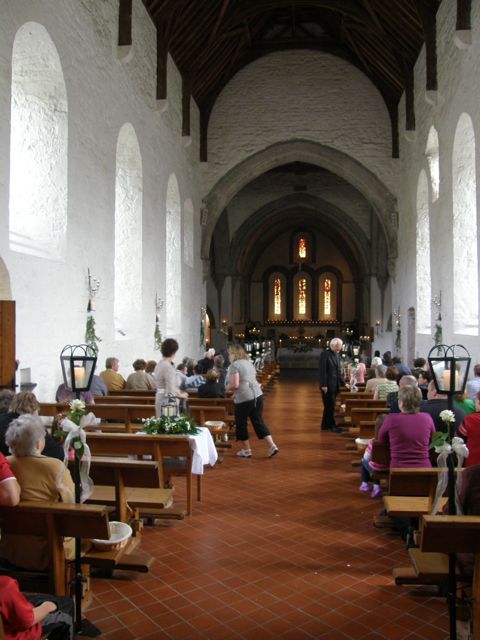
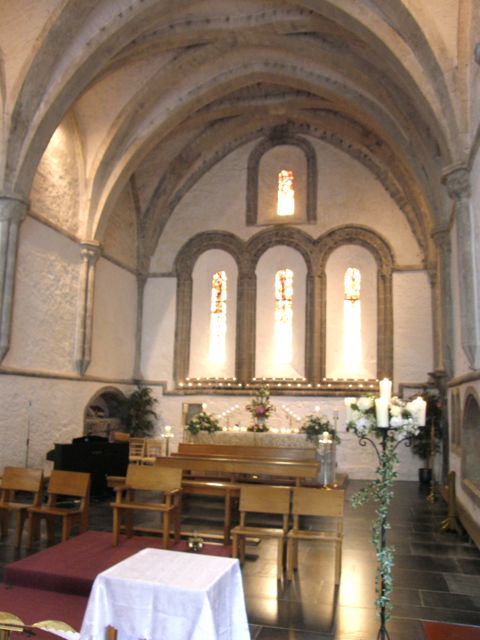
The story from John’s Gospel brings me back to the wedding here on An Cheathrú Rua. On that particular Sunday three years ago, the church at Ballintubber was decorated for a wedding, as you can see from the accompanying photographs. Nuptial church decoration here in Ireland is pretty similar to what is done in the United States, which makes a good deal of sense since I suspect we got quite a few of our wedding customs from Irish immigrants and returning Irish probably have brought back a lot of American customs to this island.

Ballintubber Abbey Church, Co Mayo, Éire, Interior, Decorated for a Wedding

Ballintubber Abbey Church, Co Mayo, Éire, Interior, Decorated for a Wedding

Ballintubber Abbey Church, Co Mayo, Éire, Interior, Decorated for a Wedding

Ballintubber Abbey Church, Co Mayo, Éire, Interior, Decorated for a Wedding

Ballintubber Abbey Church, Co Mayo, Éire, Interior, Decorated for a Wedding

Ballintubber Abbey Church, Co Mayo, Éire, Interior, Decorated for a Wedding

Post-wedding celebrations seem to be different – here there was no dancing (at least not in the pub), no toasts, no throwing of a bouquet or a garter, none of the typical elements of an American wedding reception – but what there was here as there is at home was joy and camaraderie, good wishes and good fun. It’s no wonder, given John’s recording of the first miracle and the human experience of wedding celebration, that the Wedding Banquet has become a lasting and indelible image of the reunion God has in store of God’s People and that the Holy Eucharist is referred to theologically as a foretaste of that heavenly banquet.

Dánta Dé includes a communion hymn specifically about the wedding feast. It is entitled The Blessed Wedding at Cana and is attributed to Maighréad ní Annagáin. Here is the original Irish text and Uná ní Ógáin’s translation of it, followed by a very free adaptation by me making use of some of the Irish hymn’s imagery and telling the story from John in meter and rhyme to be sung to the original tune.

First, the Irish original:

Ag an bpósadh bhí i gCána bhí Rí na ngrás ann i bpearsain,
É féin is Muire Máthair, is nárbh áluinn í an bhainfheis?
Bhí cuideacht ós cionn chláir ann, agun fíon orra i n-easnamh,
‘S an t-uisge bhí h-árthaibh nár bh’áluinn é bhlaiseadh?

A Dhia dhíl, a Íosa, ‘s a Rí ghil na cruinne,
D’iomchuir an choróin spíne is iodhbairt na Croise,
A stolladh is a straoilleadh idir dhaoinibh gan cumann,
Na glasa do sgaoilis, a d’iadhadh n’ár gcoinnibh.

Is ró-bhreágh an stór tá ag Rígh na glóire dúinn i dtaisge,
A chuid fola agus feóla mar lón do na peacaigh’.
Ná cuirigidh bhur ndóchas i n-ór bhuidhe nó i rachmas
Mar is bréagán mar cheó é, seachas glóire na bhFlaitheas.

Ms. ní Ógáin’s translation includes a verse not included in the Irish text of the hymnal, the second address to the Blessed Virgin:

At the marriage-[feast] in Cana
Was the King of grace in person,
He Himself and Mary Mother,
Was it not a beauteous wedding?
At the board the guests were seated,
And the wine to them was lacking,
And the water in the vessels
How delightful to taste it.

O Maiden most holy
Who to sin never yielded,
As thou wert a plant descended
From that king(a) who excelled,
[As of old], pray to Jesus,
To the glorious King of Heaven,
That He make a free way(b) for us
When we turn our steps Homewards.(c)

O dear Lord, O Jesu,
And O bright King of the Universe,
Who didst bear the Thorn-Crown,
And the sacrifice of the Cross;
Who was torn and rent asunder
Among men who were loveless,
Thou didst open the bars
That were closed against us.

Splendid is the treasure
Stored for us by the King of Glory;
His own Blood and Flesh [He giveth]
As Food for the sinful.
Put ye not your hope
In yellow gold or riches,
For as mistlike toys compare they
With the glories of Heaven.

Notes:
(c) i.e. David
(b) Lit.: or, ready road.
(c) or : That His Hand the way throw open
For our blessed home-returning.
(Westminster Irish Service-book).

And my poem derived from the Irish hymn:

King of glory,
King of love,
King of graces, guest at a wedding.
With his mother, with his friends,
seated at the marriage feast waiting.
Came the word: “There is a problem!”
Mary told her son to help them.
“What is this to me?” he asked her;
but to servants she was speaking.

“There is no wine
for the feast.
Do as he says, no hesitation.”
Empty vessels standing there
for the rites of purification.
“Fill them,” he says, “with plain water;
and then draw some for the steward.”
“What is this now?” asks the steward,
“Finest wine in the nation!”

Blessed Mary,
Virgin pure,
Mother of God, you knew that even
that your Jesus was the Christ;
that he was the High King of Heaven.
But did you know he would become
the free way for us to our home?
Through baptism buried with him,
we, too, shall all be risen!

O Lord Jesus,
glorious King,
holy savior who bore the Thorn Crown,
you were beaten, crucified,
killed, and buried, layed in the cold ground.
In fulfillment of the promise,
you broke the bars closed against us.
With your own blood you have freed us!
Death is conquered! Life is newfound!

Your own Body
and your Blood
give us sinners true liberation;
Bread of Heaven, Blessed Cup,
holy table, feast of salvation.
Giving blessings beyond measure;
wedding banquet, splendid treasure.
At the marriage feast of the Lamb,
we are God’s new creation!

Dé Domhnach sa Teach Lóistín

The title of this post means “Sunday in the Boarding House” which is how I have spent this day. I did not go to church today – my choices for worship on An Cheathrú Rua are either Roman Catholic Mass as Gaeilge (“in Irish”) or Roman Catholic Mass as Gaeilge le ceol as Gaeilge (“in Irish with music in Irish”). Since I don’t follow Irish well enough to comprehend the sermon or the music, and I’m not permitted by the Catholic Church’s rules to receive Communion, neither of those options is terribly inviting. There are no non-Roman churches of any sort in this area.

The closest Anglican (Church of Ireland) parishes are St. Nicholas in Galway or the parish in Roundstone. Each is a minimum of 45 minutes driving time away (and could be longer with bad weather or traffic). Traffic was a guarantee in regard to Galway today because this is the last day of the Galway Races, an annual major horse racing event; I drove to Galway yesterday (having forgotten about the races) and experienced huge pedestrian crowds and bumper-to-bumper traffic. In the other direction (which I had driven on Friday) there was weather; today was a rainy, windy day in the Connemara! So I decided to chill and to study all day, which I basically did. Not sure how much of my flashcard review will stick and then become accessible in conversation, but it seemed a good use of the day.

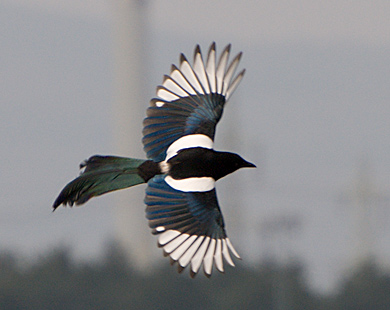
During the afternoon a couple of magpies showed up in the garden outside my window and spent a long time in what appeared to be play. Eurasian magpies are striking birds with contrasting black and white feathers. The black feathers occasionally flash an iridescent green. I didn’t take a picture of them, but here is a picture from Wikicommons showing off the striking contrasting coloring of a magpie in flight.

Eurasian Magpie in Flight (from Wikicommons)

Eurasian Magpie in Flight (from Wikicommons)

Back now to the studies … flashcard, flashcard, flashcard….

A Drive Through the Bog

On a recent afternoon I had one of those introversive episodes when I needed to get away from everyone, from the teach lóistín (“boarding house”) where I am staying, away from housemates, host family, school, and so forth. So I told my bean an tí (“landlady”) that I wouldn’t be home for dinner, got in my rental vehicle (an Opel Astra), and drove away.

My first and only planned stop was at a famine house in the northern precincts of An Cheathrú Rua which I had seen from our school bus when returning from one of our “tours”. Unfortunately, I discovered that the property is fenced off by a vicious looking barbed wire fence, so the photos I had hoped to take, and did take, are all from a distance. I’d hoped to go inside it and take some interior shots, but alas ….

Famine House, An Cheathrú Rua

Famine House, An Cheathrú Rua

I then drove to what passes for a “main highway” in these parts; from an American perspective these are very narrow roads on which the Irish drive at unreasonably high speeds. I turned toward Leitir Moír, deciding on a moment’s notice that since I am familiar with the Irish folk song Peigín Leitir Móir (I can even sing part of it), I should be able to say that I’d been to the town. I have now been … it’s not much; it’s just a small Irish town with a “city center” consisting of a Roman Catholic church, a small park (and car park), a community activity center, and little grocery store. But the song is still catchy and fun – if you want to hear it, click here for a YouTube video of an Irish folk singing family singing it.

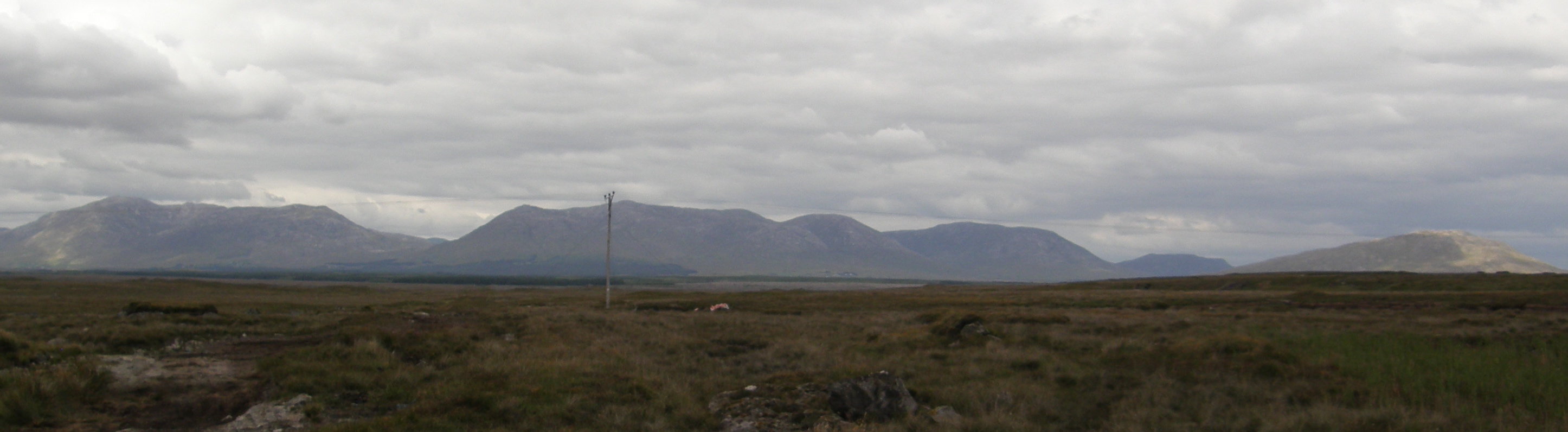
After Leitir Moír, I decided to go to Cloch na Ron (the Anglicized name of which is “Roundstone”, although the Irish actually means “rock of the seals”) and maybe have a bite to eat. That turned out to be a drive through “the bog” which is the area where locals “cut turf” to be used as fireplace fuel during the winter. I took some pictures of turf cutting along the way and enjoyed the views of the Twelve Bens which are the mountains of the Connemara. Lots of people go “hillwalking” among these mountains, a very popular holiday (vacation) activity for the Irish.

The Twelve Bens from Derryrush Road

The Twelve Bens from Derryrush Road

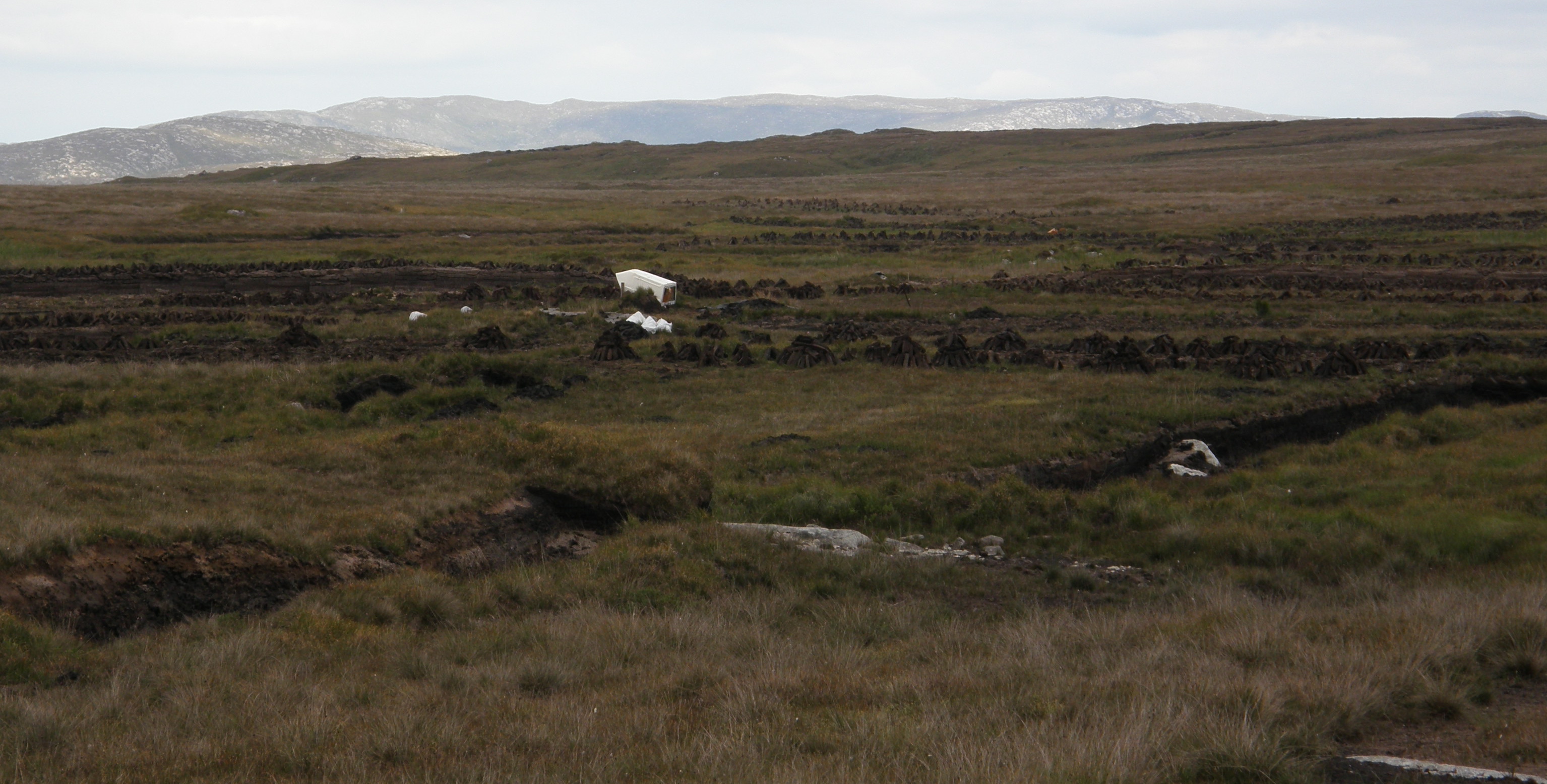
It is estimated that bogs cover about one-sixth of the available land in Ireland, which gets more of its fuel from peat than any country except Finland. In Ireland, many families have an inherited right to cut turf for domestic use which has been handed down for hundreds of years. This inheritable right is called turbary.

The Bog, Showing Family Turf Cutting or "Turbary" Areas

The Bog, Showing Family Turf Cutting or "Turbary" Areas

Here in the west of Ireland, the bog is technically a lowland blanket bog. These are unique in that they are formed in a rainfall-rich locale where the supply of minerals is kept up and the acidity down. The makeup of the bog material includes vegetation of many types.

According to tradition, turf is not cut until after St. Patrick’s Day after the March winds dry the boglands. Early May is generally the turf-cutting time in the West of Ireland, although it continues through the summer months and is still going on while I am here. My host family has gone out to the bog to cut turf, although I’ve been unable to go along because of classes a that the Acadamh. While driving the Derryrush Road from An Cheathrú Rua to Cloch na Ron, I witnessed an old man in rubber boots stacking footings and took the photos you see here. (In retrospect, I wish I’d pulled over – if I could have found a wide enough, dry enough spot to do so – and asked the old man about his activity … 20-20 hindsight!)

In some areas, before turf is cut the top layer of heather and roots is stripped; this can be done by the time consuming process of mowing the vegetation and then cutting back the top layer of soil, or by burning. Burning requires a permit, which is often difficult to obtain.

The Bog, Showing Turf Cutting "Ridge"

The Bog, Showing Turf Cutting "Ridge"

In this area, they don’t seem to strip the bog first. The top layer is fairly sparse here, so the turf is simply cut through the top surface. Generally, it takes one man a week of cutting to prepare a year’s worth of turf fuel.

Antique Slane (Modern Tools Have Steel Blades)

Antique Slane (Modern Tools Have Steel Blades)

Turf cutting is done with a sléan or slane, a long-handled turf spade with a shaped steel end. Slane styles vary from county to county. The direction of the cutting varies from place to place. In this area, turf is cut in a vertical direction; where the bog type is what is called a red raised bog, it is cut in a horizontal direction.

Dried Sods Ready to Burn in the Fire

Dried Sods Ready to Burn in the Fire

The depth of a single piece of cut turf is called a spit or a bar. A vertical turf bank is measured in numbers of bars to a depth of a slane (twelve to eighteen inches in this area.) A good bank might be six bars deep; I’m told that a day in the bog is difficult work and taxes the strength of even the fittest person. The bog is very wet and the trenches created as turf is cut fill almost immediately with water; cutters usually wear high gum or rubber boots. The lowest row of bars is the wettest, but they say that when dried they make the best fuel.

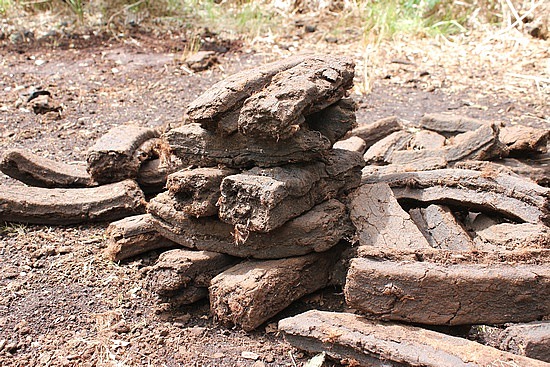
The cut turf is removed to open ground to dry. The soggy sods, as the brick shaped cuttings are called, are laid out on the ground to dry for a week. They are then stacked upright into a footing which continues the drying procedure.

A Field of Footings Next to the Trench or Ridge from which they were cut

A Field of Footings Next to the Trench or Ridge from which they were cut

Close-Up of Footing

Close-Up of Footing

Once the footed turf is somewhat dry, sods are piled into a rickle. When it is finally dry, the turf is carried home to be stacked against an east-facing wall or in a covered shed for protection from westerly winds.

A "Rickle" or Pile of Turf Ready to be Transported Home

A "Rickle" or Pile of Turf Ready to be Transported Home

In the past, turf cutting was only fuel available to many families living in the Connemara, where it is illegal to cut it other than by hand. Many families still use turf for homeheating, although today it can be purchased in compressed briquettes in supermarkets throughout Ireland. I’m told that turf burns cleaner than coal; it has a very a pleasant smell which, together with the smell of mown heather, has come to really be the scent of Ireland to me. There’s nothing quite so comfortable as sitting by a turf fire on cold, damp day with a mug of tea (or in my case, coffee) in hand. I’m told that scones cooked over a turf fire have an especially lovely flavor – I’ve not had (nor do I anticipate having) that experience, but I can imagine that it is true.

After my drive through the Bog along Derryrush Road, I connected with one of the small “highways” of Ireland and made it to Roundstone, which was a bit of a mess. It is a fishing village turned vacation resort. One very narrow street along the waterfront, several B&Bs and a few pubs/eateries. It was a “mess” because next Thursday is the running of the Tour de Bog, a bicycle road race that begins and ends in Roundstone and they were setting up signs, starting/ending line, viewer stands, etc. Some guy with a trailer was trying park it on the main street where there was patently no space to park it! So a long line of cars waited about fifteen minutes for the fruitless maneuvering to end.

I finally parked in the free public parking area and walked to a local pub – had a pint of Smithwick’s ale with the barkeep, a woman about my age who bemoaned the Irish economy and the fact that at 6 p.m. on a Friday evening she had absolutely no business. For the first twenty minutes or so, I was the only customer in the place, then a French family entered and since they had very little English and she had no French, I served as translator.

I finished my beer, bade my new friends farewell – “Adieu!” and “Bon nuit!” to the French family, “Slan!” and “Oíche mhaith!” to the Irish tavern owner – headed back to the car where I noticed that the music shop of Malachy Kearns, reputed to be the best bodhran (Irish drum) maker in Ireland, was open.

I bought a bodhran there in 2005 when Evelyn and I made our first trip to Ireland. We also bought a CD that I really, really liked, but which we gave to a friend (after making a bootleg copy for ourselves, a copy which has since disappeared). I thought I might find another copy but, alas, the stock at Malachy’s store has been replaced with Celtic Woman and a bunch of touristy “moods” CDs that you can find in any Celtic-Gaelic store in the USA. So I bought nothing.

I headed back to An Cheathrú Rua, covering the same roads in the reverse direction (I thought “Jack the GPS” might take me a different route, but no). I got back to town just in time for a really good lecture on “the function of music in the Irish tradition” by Breandán Ó Madagáin, an elderly professor from NUIG. Old he may be, but he has a great singing voice. He really knew his stuff. I had a chance to talk with him briefly about my project and he gave me a copy of an ethnomusicology article he had written which references and briefly discusses the hymnal I’m working on.

After the lecture, I headed for home and bed.

Sunday, a Sermon, and Superstring Theory

Time away from the Irish (the language, not the people)….

On Sunday, 24 July 2011, I left my teach loistín (“boarding house”) and drove the 32 km from An Cheathrú Rua to Galway to attend the Sung Eucharist at the Collegiate Church of St. Nicholas, a church which formerly (pre-Reformation) was the central church of the city. That distinction is now held by the Roman Catholic Cathedral, “The Cathedral of Our Lady Assumed into Heaven and St. Nicholas”. (How the BVM was assumed into St. Nicholas, I have no idea….) But St. Nicholas Collegiate Church, now an Anglican congregation of the Church of Ireland, continues to play a central role in the life of the city. The church has marvelous acoustics and is host to a variety of concerts, dramas, conferences, and other cultural and educational events throughout the year.

Interior of St. Nicholas Collegiate Church, Galway

Interior of St. Nicholas Collegiate Church, Galway

It also plays the role of providing a place of worship for visiting tourists who do not wish to attend a Roman Catholic Mass. The Sunday morning congregation, especially during the summer, is an aggregation of Irish Anglicans, Protestants of several sorts (many of whom do not speak English), and tourists with little or no religious background at all (some of whom, I sure, wander in on Sunday morning to see the historic church and get “trapped” in the service). Such was the congregation this Sunday.

Interior of St. Nicholas Collegiate Church, Galway (from choir)

Interior of St. Nicholas Collegiate Church, Galway (from choir)

I arrived in Galway about one hour before the service, so I went to a local café and had a cup of coffee. Thirty minutes before the service, I made my way to the church and found a seat – not difficult as there were very few people there. A church warden introduced himself and offered me a leaflet which included nearly the entire service with an insert of the hymn lyrics. On learning that I am a priest, he asked if I would read one of the lessons for the day, to which I assented.

One of the transepts of the church has been closed off with a partial glass screen and made into the choir room. The choir was practicing and their music filled the church – it was grand! It put one into a prayerful mood and prepared one to enter into worship.

Transept, St. Nicholas Church, Galway (used as choir room)

Transept, St. Nicholas Church, Galway (used as choir room)

About 15 minutes before the service was to start, a woman priest vested for the day began greeting those of us seated in the nave. She was to be the presider in the absence of the rector, who is on holiday this month.

The service started on time with a procession of crucifer, choir, and clergy. Although lay eucharistic ministers would later assist with the distribution of communion, they were not vested and did not process with the altar party. The placement of choir, clergy and altar assistant was interesting and, given that everything is moveable (and moves frequently for various events), I wondered if this is a standard arrangement or if they experiment regularly with different seating plans.

The service followed a fairly familiar pattern, more similar to the American church’s liturgy than were the Church of England services I experienced a couple of weeks ago, although as in the English church, the service began with a confession and absolution before the Gloria in Excelsis. Then there were the reading of the lessons, a sermon, a variant form of the Creed (sort of a Q-&-A format), prayers, the Peace, the offertory, the Great Thanksgiving, the distribution of Holy Communion (at stations, a central position for the Bread from the priest and four cups of Wine), the final blessing, the last hymn and the dismissal. It all followed a familiar and comforting pattern.

Free-standing Altar, St. Nicholas Church, Galway

Free-standing Altar, St. Nicholas Church, Galway

The lessons for the day were those of the Revised Common Lectionary – from the Hebrew Scriptures the story of Solomon asking God for the gift of wisdom; from the Epistles Paul’s assurance in Romans that nothing can separate us from the love of God; from the Gospel’s Jesus rapid fire mini-parables that the Kingdom of God is like a mustard seed, a buried treasure, a pearl of great price, a net thrown into the sea.

Altar Window, St. Nicholas Church, Galway

Altar Window, St. Nicholas Church, Galway

The homily admonished us to do as Jesus did and look for God’s reign in the ordinary things, the ordinary places, the ordinary people of our lives. In the course of the homily, the preacher compared the structure of Jesus’ delivery of the parables to that of the Psalms referring to the Hebrew practice of parallelism as “the rhyming of ideas.” That description stuck with me.

Chancel and High Altar, St. Nicholas Church, Galway

Chancel and High Altar, St. Nicholas Church, Galway

Later in the day, I relaxed with a book, The Elegant Universe by Brian Greene. In it, describing the findings of quantum mechanics as an introduction to a discussion of superstring theory, the author writes:

Even in an empty region of space – inside an empty box, for example – the uncertainty principle says that the energy and momentum are uncertain: They fluctuate between extremes that get larger as the size of the box and the time scale over which it is examined get smaller and smaller. It’s as if the region of space inside the box is a compulsive “borrower” of energy and momentum, constantly extracting “loans” from the universe and subsequently “paying” them back. But what participates in these exchanges in, for instance, quiet empty region of space? Everything. Literally. Energy (and momentum as well) is the ultimate convertible currency. E=mc2 tells us that energy can be turned into matter and vice versa. Thus if an energy fluctuation is big enough it can momentarily cause, for instance, an electron and its antimatter companion the positron to erupt into existence, even if the region was initially empty! Since this energy must be quickly repaid, these particles will annihilate one another after an instant, relinquishing the energy borrowed in their creation. And the same is true for all other forms that energy and momentum can take – other particle eruptions and annihilations, wild electromagnetic-field oscillations, weak and strong force-field fluctuations – quantum-mechanical uncertainty tells us the universe is a teeming, chaotic, frenzied arena on microscopic scales.

As I read this I was reminded of the first words of Holy Scripture:

In the beginning when God created the heavens and the earth, the earth was a formless void and darkness covered the face of the deep, while a wind from God swept over the face of the waters. Then God said, “Let there be light”; and there was light. And God saw that the light was good; and God separated the light from the darkness. God called the light Day, and the darkness he called Night. And there was evening and there was morning, the first day.

Transfiguration Window, St. Nicholas Church, Galway

Transfiguration Window, St. Nicholas Church, Galway

People ask why I read books on particle physics, quantum mechanics, and string theory for relaxation. I really don’t have a good answer, and I have to admit that a lot of what I read, though it fascinates me, goes right over my head! But, for reasons which are probably beyond anyone’s comprehension, including my own, my idea of relaxing reading is exactly the sort of stuff that bored me to tears 40+ years ago – physics books. In the new understandings of quantum mechanics, superstring theory, the multiverse speculation, and other work seeking the “theory of everything” (or “TOE” as Greene and others call it), I see science converging with religion. As microscopic physics gets “weirder” (Greene’s term, again), it seems to me it gets more theological, as well. Every so often a passage strikes, if you will, a theological cord. This was one of them … the description of even empty space as “teeming, chaotic, frenzied” seems to me to echo, to “rhyme” (to use the preacher’s term) with the idea of the writer of Genesis that “a wind from God” (the Holy Spirit) sweeps over creation. Numerous theologians have taken off from this Genesis account to assert that the Holy Spirit “enthuses” all things; that the wind from God blows through and within all of creation … even empty space. How great it is that science’s new understanding of empty space as “teeming” and “frenzied” rhymes with faith’s vision of empty space as filled with God’s wind!

In Sunday’s sermon, the preacher reminded us to seek God in the everyday stuff of life. As scientists probe the “weirdness” of the smallest dimensions of everyday stuff, I think they’re doing just that … seeking God. They may be calling it the search for the TOE, but to from my perspective it’s just a variation of the same search human beings have been on for millennia, the search for meaning.

Baptismal Font, St. Nicholas Collegiate Church, Galway

Baptismal Font, St. Nicholas Collegiate Church, Galway

And now … back to the Irish.

« Older posts Newer posts »