====================
On the 15th Sunday after Pentecost, September 21, 2014, this sermon was offered to the people of St. Paul’s Episcopal Church, Medina, Ohio, where Fr. Funston is rector.
(The lessons for the day, RCL Proper 20A, Track 2, were Jonah 3:10-4:11, Psalm 145:1-8, Philippians 1:21-30, and Matthew 20:1-16. These lessons can be read at The Lectionary Page.)
====================
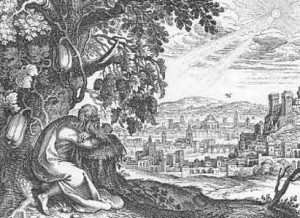 Let’s talk about Jonah. When I say something like “Let’s talk about Jonah,” I have to be more specific. I have to tell you whether I mean “Let’s talk about the Book of Jonah” or “Let’s talk about the character of Jonah portrayed in the book” or “Let’s talk about the Prophet Jonah.” In this case, I mean all three: let’s talk about the book, character, and the prophet — although, to be honest, the prophet’s name really isn’t Jonah; we don’t know the prophet’s name — and that, I hope, will be clearer in a moment.
So, first, the book. The Book of Jonah tells a story from about the end of the 8th Century BCE, but it was written 300 or so years later in the late-5th or early-4th Century BCE. It is addressed to the people who have just returned from the Babylonian exile, who have come back to Jerusalem under the leadership of the priest Ezra and the governor Nehemia. Under Ezra’s and Nehemia’s oversight they are rebuilding the Temple, reestablishing Jewish worship, and (very likely) canonizing the Torah (the five books of Moses).
This is the social milieu within which the book is written. The story in the book, however, is set about 350 years before, around the year 700 BCE. Back then, Judea and its capital had been a vassal state under the Assyrian empire. It was under Assyrian rule that the “ten lost tribes of Israel” were lost. Under a particularly ruthless and brutal king named Sennacherib, the Assyrians became rather unhappy with the Judeans, and laid siege to and sacked Jerusalem in 701 BCE.
We know a lot about the Assyrians because they kept really good records. In the 1800s archeologists discovered the Royal Library of Ashurbanipal in the Assyrian capital city of Nineveh (that name should ring a bell!) consisting of more than 30,000 cuneiform tablets recording Assyrian history. In addition, the Assyrians were fond of illustrating their history, particularly their military victories, with sculpted and brightly painted bas relief murals. In one of the royal dining rooms of Sennacherib’s palace in Nineveh, for instance, there still exists such a sculpture depicting the siege of Lachish, another Judean city captured and destroyed at the same time as the siege of Jerusalem. We know from this mural and from other records that Lachish fared much worse than Jerusalem; its leaders were tortured to death and the town was leveled. That mural in Sennacherib’s dining room shows (in rather graphic detail) the Jewish leadership of Lachish being flayed alive by Assyrian soldiers.
So that is the setting of the story: it was written shortly after the end of the Babylonian exile and set at the time of the brutal Assyrian siege of Jerusalem and Lachish. However, the story of Jonah is not history. It is set in historically verifiable places — Israel, the Mediterranean Sea, and the city of Nineveh — at an historically verifiable time — about the high point of what is called the “Neo-Assyrian Empire,” but it is not itself history. It is, in fact, a work of fiction.
How do we know that? Well, there are several indicators, but let’s just look at a few glaring examples. First, not in the part we read today but in the first chapter, Jonah tries to escape his commission from God by fleeing to Tarshish (about which more in a moment). Instead of traveling northeast to Nineveh, he books passage on a ship heading west, and what happens? You know the story: a big storm kicks up, the sailors become frightened and convinced that some god is trying to kill them, they determine that it’s Jonah’s God, and they throw him overboard. The storm comes to an end and Jonah is swallowed by a “big fish” in whose belly he survives for three days. That ought to be the first clue that we are dealing with a fanciful tale: there are no fish (or other animals) native to the Mediterranean Sea big enough to swallow a human being and, if there were, it would be physically impossible to live three days inside one. (Certainly, I’m not suggesting that God could not have provided a miraculously big fish equipped as a mini-sub; I am suggesting that it’s unlikely.)
The second hint is the description of Nineveh. We read in Chapter 3 that “Nineveh was an exceedingly large city, a three days’ walk across.” (v. 3) But we know from archeology that that’s just not the case! The city of Nineveh was not quite 1900 acres, which is a little less than 3 square miles. It was, maybe, 1-3/4 miles across. You can walk that in under 40 minutes.
The third clue to the fictionality of this story is in the meat of the story itself. Just before the portion we heard today, the king of Nineveh, ruthless and brutal Sennacherib, in response to Jonah’s prophetic proclamation that the city would be destroyed in forty days, rises from his throne and issues this decree:
By the decree of the king and his nobles: No human being or animal, no herd or flock, shall taste anything. They shall not feed, nor shall they drink water. Human beings and animals shall be covered with sackcloth, and they shall cry mightily to God. All shall turn from their evil ways and from the violence that is in their hands. Who knows? God may relent and change his mind; he may turn from his fierce anger, so that we do not perish. (3:7-9)
If there had ever been such a decree or such a nationwide fast in Assyria, it would have been mentioned somewhere in those 30,000-plus tablets in the Royal Library of Ashurbanipal. But it’s not. There’s not the slightest bit of evidence that such a thing ever happened.
So, there you have it, a little bit of fiction, a short, satirical story (and it is short — only four brief chapters) plunked down in the middle of the Bible’s records of prophecy. But that’s OK; through the medium of this short satire a theological truth, a prophetic message is nonetheless conveyed. The prophetic import of the Book of Jonah, however, is not to be found in the words of its principal character, as is the case in most of the prophetic record. The prophetic message of the Book of Jonah is in its principal character himself, not in what he says, but in what he does and in what he represents. The Book of Jonah is prophecy the same way that Hosea’s marrying a prostitute was prophecy, the same way Micah’s wandering the streets of Jerusalem naked was prophecy, the same way Jeremiah’s failure to mourn his wife was prophecy. The people of Israel and Judea saw their one unfaithfulness reflected in Hosea’s spouse, their own shame in Micah’s nakedness, their own bereavement in Jeremiah’s loss. And the people of 4th Century Jerusalem recently returned from the Babylonian exile, would have recognized themselves in the character of Jonah.
In his book And God Created Laughter (Westminster John Knox: 1988), Presbyterian pastor and Professor of Religion Conrad Hyers, wrote this about this character:
Certain details of the comic caricature of Jonah, for instance, are more apparent in the Hebrew. No doubt these allusions were clearer to the people who first heard or read the story.
The opening words of the book of Jonah are a case in point. “Now the word of the Lord came to Jonah the son of Amittai.” Innocent as these words may seem, in Hebrew they contain two important allusions that are central to the comedy that is to follow. Jonah means “dove,” a metaphor sometimes used for the people of Israel, as in Psalm 74:19. Now the image of the dove brings with it a trail of associations that — as the story indicates — are the opposite of what Jonah (Israel) really is.
The dove is associated with hope, as in Noah’s sending out a dove to find land after the flood. Yet this dove (Jonah) behaves in a most contrary manner: sent out to warn of impending destruction, he refuses lest the judgment be averted. The dove is also associated with the theme of escape from troubles and evils, as in Psalm 55:6, “O that I had wings like a dove.” Yet this dove (Jonah) tries to escape from his mission in the hope that Nineveh cannot possibly escape from doom. The dove is further associated with love, as in the Song of Solomon, in which the beloved is dovelike: “My love, my fair one . . . my dove” (2:13,14). Yet this dove (Jonah) has not only no love for the Ninevites but not a penny’s worth of sympathy or pity. Jonah is no dove at all; he is a hawk. Perhaps the only Hebraic association that is directly applicable to Jonah is that he is “like a dove, silly and without sense” (Hos. 7:11). Certainly, flightiness and silliness aptly describe Jonah’s behavior throughout the story.
The other ironic allusion in the opening words is contained in the phrase “son of Amittai.” Amittai means “faithfulness.” A second contradiction with which the story is to deal is announced at the start. This “son of faithfulness” is completely disobedient. His response to the divine command is totally contrary to it. “Dove son of Faithfulness” flies off in the opposite direction lest he become the bearer of the least olive leaf of hope, love, and salvation. (pp. 99-100)
Prof. Hyers mentions Psalm 74 as one instance in which the dove is a symbol for Israel; others are found in the Prophets Hosea (7:11) and Jeremiah (48:28). Surely, this short story’s first readers would have recognized this.
They would also have recognized Israel in Jonah’s tendency to do the opposite of what God had commanded and would have seen allusions to their own worship and liturgy. Prof. Hyers mentions two examples from the sacred poetry of the Psalms and the Song of Solomon. Another is found in Psalm 139:
Where can I go then from your Spirit? *
where can I flee from your presence?
If I climb up to heaven, you are there; *
if I make the grave my bed, you are there also.
If I take the wings of the morning *
and dwell in the uttermost parts of the sea,
Even there your hand will lead me *
and your right hand hold me fast. (vv 6-9, BCP Translation)
In the story, as I mentioned earlier, Jonah is told to travel to the northeast to Nineveh. Nineveh still exists: today it is called Mosul, a city in Iraq with which we have all become familiar because of current events and recent news coverage. To get there from Jerusalem, Jonah should have traveled north to Damascus, then east to Baghdad, then north again to Nineveh, a journey of about 865 miles. Instead, Jonah tried to go west about 3,000 miles to Tarshish. Tarshish is the Hebrew variant of the Greek city name Tartessos, a city in Spain. Today, it is called Cadiz. Located on the Atlantic coast of Spain, to the west of the strait of Gibraltar, it was as far to the west as someone in the ancient Middle East could imagine going! Once one sailed past the Pillars of Hercules, there was nowhere to go, except to drop off the edge of the world. It was truly, in the words of the Psalm, “the uttermost parts of the sea.” And yet, even by going there Jonah could not flee from the presence of the Lord, even there God’s “right hand held him fast.”
So . . . we know now that the Book of Jonah is a short story, perhaps a satirical or humorous one, relaying through the medium of fiction a theological truth. We know that the people of post-Exile Jerusalem would have recognized themselves in its principal character, Jonah. Jonah is called a prophet but, in truth, he’s more like a missionary. Prophets were usually commissioned to speak to God’s own people, whereas Jonah was commissioned to convey the message of God’s justice to a foreign people. When prophets were commanded to speak to foreigners, it was usually to those living in the territory of Israel or Judeah; Jonah is commanded to travel almost 900 miles to the foreigners’ own country to convey God’s message. Try as he might not to do so, he ends up having no choice and eventually preaches to the Ninevites as God requires. And, unlike most prophets, he is actually listened to! The Ninevite king issues that decree that all the people and animals will fast, and they do so.
And what happens? God relents. Instead of destroying the city as the wicked and sinful Ninevites deserve, God pardons them and Jonah gets righteously angry, and this is where we entered the story in today’s lesson, at the very end. Jonah says to God, “See? I knew this would happen!” In the words of the text, “Is not this what I said while I was still in my own country? That is why I fled to Tarshish at the beginning; for I knew that you are a gracious God and merciful, slow to anger, and abounding in steadfast love, and ready to relent from punishing.”
Jonah is so angry that he just wants to die. “Lord, please take my life from me, for it is better for me to die than to live.” This is when God does the thing with the bush which grows up overnight, provides Jonah with shade the next day, then dies leaving Jonah on the following day to withstand the desert sun and heat. This just makes Jonah madder, so he repeats his death wish, “It is better for me to die than to live.” God, using the plant as a teaching tool, replies, “You are concerned about the bush . . . should I not be concerned about Nineveh . . . ?”
And, guess what? That’s the end of the story! God, in good rabbinic fashion using what we call “the Socratic method,” teaches Jonah — who is really the people of Israel — by leaving him — and them and us — with a question.
Jonah and the Israelites want God to be fair. These Ninevites, these Assyrians, are terrible, brutal, despicable people; they attacked and conquered God’s Chosen People; they flayed human beings alive; they decorated their dining rooms with color pictures of this being done. If God were fair, God would wipe them out; that’s what Jonah (and Israel) want. Instead God says, “Shouldn’t I rather be compassionate and merciful?” And leaves them — and us — to contemplate that question.
Whoever the nameless prophet who wrote this little story was, he was brilliant, because there is only one answer to that question just as there is only one answer to the question Jesus poses in gospel parable of the laborers in the vineyard. Hired at different times of the day, some at first light, others throughout the day, and the last just an hour before quitting time, they are all nonetheless paid the same wage. When those who worked all day complain, when they want the owner of the vineyard to be fair, the owner (God!) replies, “Shouldn’t I rather be generous?” And Jesus leaves his disciples — us — to contemplate the question.
Of course, we don’t want God to be fair! If God is going to be fair to “them” (the Assyrians, the later workers, whomever), God is going to be fair to us, too. Is that what we want? Wouldn’t we rather that God be compassionate and merciful and generous?
The good news is that that is what God is. Amen.
====================
A request to my readers: I’m trying to build the readership of this blog and I’d very much appreciate your help in doing so. If you find something here that is of value, please share it with others. If you are on Facebook, “like” the posts on your page so others can see them. If you are following me on Twitter, please “retweet” the notices of these meditations. If you have a blog of your own, please include mine in your links (a favor I will gladly reciprocate). Many thanks!
====================
Father Funston is the rector of St. Paul’s Episcopal Church, Medina, Ohio.






 I suppose that if “an angel of the Lord” told me to “get up and go” that I’d do as Philip did, even in these times when a trip to Gaza would not be the most pleasant journey one could make. I have often remarked at the willingness of the early disciples to drop everything and respond to these calls to ministry. The response of the first of the apostles, of Simon Peter and his brother Andrew, of James and John (the sons of Zebedee), to leave their fishing businesses and take off with Jesus is the same. (Mt 4:18-22) The response of Matthew (or was he called Levi) to leave his tax booth is the same. (Mt 9:9) “Come” and they come; “get up and go” and they go. Modern folk are seldom so swift to respond.

