Our gospel lesson is the shortened version of Jesus’ commission to the twelve as he sends them out to do missionary work. As he continues with their instructions he tells them, “I am sending you out like sheep into the midst of wolves; so be wise as serpents and innocent as doves,”[1] and then he warns them that those who follow him are likely to face all sorts of terrible strife, including bitterness and enmity within families.
“Brother will betray brother to death,” he says, “and a father his child, and children will rise against parents and have them put to death; and you will be hated by all because of my name. But the one who endures to the end will be saved.”[2]
It’s an odd lesson, I suppose, for Father’s Day, but of course Father’s Day isn’t on the church calendar and the Lectionary doesn’t take it into account. It’s simply a coincidence that this lesson about discord between fathers and sons should come up this morning, just as it’s a coincidence that the Old Testament lesson about the promise of a child to the elderly and barren couple Abraham and Sarah should be in the Lectionary rota today.
 “As Jesus was walking along, he saw a man called Matthew sitting at the tax booth; and he said to him, ‘Follow me.’ And he got up and followed him.”
 “Put things in order, … agree with one another, live in peace.”
 “[W]e had hoped that he was the one to redeem Israel . . . and . . . it is now the third day since these things took place.”
 We “boast in our sufferings,” writes Paul to the Romans, “knowing that suffering produces endurance, and endurance produces character, and character produces hope, and hope does not disappoint us….”
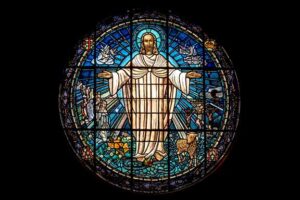 It’s the last Sunday of the Christian year, sort of a New Year’s Eve for the church. We call it “the Feast of Christ the King” and we celebrate it by remembering his enthronement. Each year on Christ the King Sunday we read some part of the crucifixion story. As Pope Francis reminded the faithful in his Palm Sunday homily a few years ago, “It is precisely here that his kingship shines forth in godly fashion: his royal throne is the wood of the Cross!”