From the Letter to the Galatians:
See what large letters I make when I am writing in my own hand!
(From the Daily Office Lectionary – Galatians 6:11 (NRSV) – June 14, 2014)
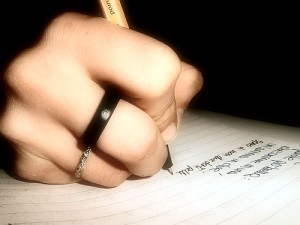 I sort of remember something from New Testament class at seminary that Paul would compose his letters by dictation to a secretary and then add greetings in his own handwriting. What I can’t remember is whether this verse (which seems such a strange intrusion into the text of the letter to the Galatians) in which he comments on the quality of his penmanship is taken by scholars to be proof of genuine Pauline authorship or as evidence that the letter wasn’t truly written by him. I know it’s one or the other. Whatever . . . it’s in the accepted canon of the New Testament.
When I was a kid I remember that one of the attractions at county fairs in the Kansas town where my grandparents lived was a handwriting analysis booth. You would write out in cursive something like “The quick brown fox jumped over the lazy white dog” or “She sells sea shells by the sea shore” and then sign your name. The graphologist (as the analyst was called) would then tell you about your character traits and sometimes predict your future.
I always wanted to have my handwriting analyzed but my grandfather, who was a Palmer method penmanship instructor, would never allow it. He did, however, insist that his grandchildren learn proper cursive penmanship so in addition to going to the fair each summer we also had to practice writing things out and making evenly sized, evenly spaced letters and loops. His handwriting was beautiful, rather more Spencerian than Palmer; mine, while passable, never achieved the fluid beauty of his.
As an adult just finished with college and then a 12-week summer course in paralegal studies, I went to work for a law firm in Las Vegas, Nevada. The firm was then providing office space and occasionally support personnel for the attorneys trying to prove the validity of the so-called “Mormon will,” the alleged handwritten testament of Howard Hughes. From time to time I would be called on to deliver documents to their off-site location elsewhere in Las Vegas and, each time I was there, the lead attorney would delight in showing me the latest in their analysts’ charts and comparisons of the will to other exemplars of Hughes’s handwriting.
All of those things come to mind whenever I read Paul’s comments about this handwriting. (Although he doesn’t comment on the quality of his penmanship, he also makes note of a greeting being “in my own hand” in the first letter to Corinth. 1 Cor 16:21)
Handwriting is a lost art. Some schools have even discontinued instruction in cursive penmanship. I think there’s something sad about that. While what is written is clearly of more import than how it is written — the same thoughts will be conveyed whether written out, lettered, typewritten, or recorded by some electronic method — there is (as the county fair graphologists insisted) a personality to cursive penmanship. There is an investment of one’s self in the handwritten text. Time must be taken and care invested in what is written.
When I finally entered into law practice as an attorney several years after those days of running errands for the Mormon will lawyers, I got into the habit of handwriting the initial drafts of my court briefs and legal arguments. I found I could work with blocks of text, with aggregations of ideas, with turns of phrase and different phrasing more effectively by doing so. Today, when I make my feeble attempts to write poetry, I work initially with pen and paper. I find the act of writing my thoughts and images out makes them somehow more malleable than when they are simply input to the computer screen (as I am now “writing”).
Handwriting and hand-lettering were the means of transmission of information — of data, of lore, of stories, of sacred language, of everything — for millennia until the late 19th Century and the invention of the typewriter. Today, inspired by Paul’s commentary on his penmanship, I give thanks for the untold number of scribes who wrote down their own words or those of others, for Paul with his large letters and for Tertius who took his dictation (Rom 16:22), for monks and other calligraphers who copied holy texts, for poets and story tellers who played with words with pen and ink, and for my grandfather who taught me to value the English word written with the human hand.
====================
A request to my readers: I’m trying to build the readership of this blog and I’d very much appreciate your help in doing so. If you find something here that is of value, please share it with others. If you are on Facebook, “like” the posts on your page so others can see them. If you are following me on Twitter, please “retweet” the notices of these meditations. If you have a blog of your own, please include mine in your links (a favor I will gladly reciprocate). Many thanks!
====================
Father Funston is the rector of St. Paul’s Episcopal Church, Medina, Ohio.
 I was listening to the radio yesterday. A golf club president was being interviewed about a professional golfer who had been killed in an air craft incident. I don’t golf or follow the game, so I have no idea who was being profiled, and that’s not relevant here. What is relevant is that the person being interviewed used the euphemism “he passed” to reference the golfer’s death.
  I have to admit that on first reading this, I had no idea what Qoheleth is saying here! Not the slightest.
 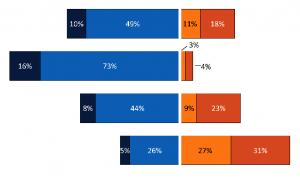 We got up this morning to the startling news that a major political figure had been defeated in his party’s primary by a candidate supported by what I would call an extremist fringe element of the party, a group which has gained more say and more influence in the party than it should have. I didn’t write a lectionary reflection until late in the day because, political news junkie that I am, I spent the morning listening to the radio pundits and perusing the on-line publications. Over and over I found the commentators using hyperbolic metaphors — earthquake, tornado, disaster, calamity — and asserting that the defeat was entirely unforeseen. “Wow!” I thought, “They sound like Qoheleth in today’s reading from Ecclesiastes!”
 My stepfather was a good man with faults. That is probably a description that could apply to millions of people, probably most people — good with faults. Whether he would be classed by Qoheleth as “righteous” or as “wicked” — or perhaps somewhere in between — I have no idea. What I do know is that he enjoyed himself.
  “What is truth?” asked Pilate. (Jn 18:38)
 Paul’s military armaments metaphor for facing the powers of sin and death is very well known; it’s quite popular with preachers and commentators. In the sixth chapter of the letter to the church in Ephesus we find him going on and on about the belt of truth, the breastplate of righteousness, the shield of faith, the helmet of righteousness, and the sword of the spirit. You can tell he’s really getting into this image; he’s having fun with it. My favorite bit of the whole thing is our shoes are to be “whatever will make you ready to proclaim the gospel of peace.” (v. 15)
 Can the finite ever truly know the infinite? Can the human mind ever fully grasp the knowledge of God? We have the assurance of Jeremiah’s prophecy, the consolation of God spoken through “the weeping prophet” that it can. And Jeremiah is not alone.
 Jesus healed a paralytic. More than that, he told him that his sins were forgiven! The scribes became irate, accusing Jesus of blasphemy. Jesus asked them, “Which is easier to tell him his sins are forgiven or to tell him to get up and walk?” As a demonstration of power and authority, Jesus did both.

