That Which We Have Heard & Known

Occasional thoughts of an Anglican Episcopal priest

Page 77 of 130

The Better Angels – Sermon for St. Michael & All Angels Day – September 29, 2013

====================

This sermon was preached on St. Michael and All Angels Day, September 29, 2013, at St. Paul’s Episcopal Church, Medina, Ohio, where Fr. Funston is rector.

(The Episcopal Lectionary, Michaelmas: Genesis 28:10-17; Revelation 12:7-12; Psalm 103; and John 1:47-51. These lessons can be read at The Lectionary Page.)

====================
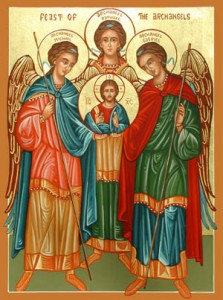
Icon of the ArchangelsWe are stepping out of the “common of time,” away from the progression of lessons assigned for the Sundays of Ordinary Time, and instead celebrating the Feast of Michaelmas, known variously as the Feast of Saint Michael the Archangel or as the Feast of Saints Michael, Gabriel, Uriel, and Raphael, or as the Feast of the Archangels, or as the Feast of Saint Michael and All Angels (the latter being the preferred Anglican name for this commemoration). The only reason we are doing so is a personal conceit of your rector; Michaelmas, the 29th of September, just happens to be my birthday. Today I am celebrating the 30th anniversary of my twenty-eleventh birthday. I’ll get back to that in a moment, but first . . . a word about Michaelmas.

It shouldn’t surprise any of us that on, St. Michael and All Angels Day, we are treated to three very familiar stories of angels in Holy Scripture: first, the story of “Jacob’s ladder;” second, the story of the war in heaven in which Michael, leading the “good” angels, beats “the dragon” (named “the Devil or Satan”) and his “bad” angels; and finally, the gospel story of Jesus telling Nathanael that he will see something like Jacob’s ladder, “ascending and descending upon the Son of Man.”

We know what angels are, or at least we think we do. They are a separate order of creation, beings of spiritual energy who interact with human beings as the servants and often as the messengers of God. The English word angel derives from the Latin angelus which in turn is the romanization of the ancient ángelos which means “messenger” or “envoy.” In the Hebrew of the Old Testament, we find the terms mal’ak elohim (“messenger of God”), mal’ak YHWH (“messenger of the Lord”), bene elohim (“sons of God”) and haqqodesim (“holy ones”) translated into English as angels. The first of these, mal’ak elohim, is what we find in today’s Genesis passage. In addition, there are specific kinds of angels identified in the Hebrew Scriptures. There are the Cherubim – one of whom is placed with a flaming sword to guard the gateway to the Garden of Eden in Genesis 3 and who are said to flank or support God’s throne as, for example, in Hezekiah’s prayer in the book of the Prophet Isaiah (ch. 37); the Cherubs are apparently not cute, little, chubby baby angels! And there are the Seraphim – whom Isaiah describes as having “six wings: with two they covered their faces, and with two they covered their feet, and with two they flew,” and who sing God’s praises in the heavenly throne room.

We know the personal names of some of the angels, particularly the archangels – Gabriel, who is named in the Book of Daniel and identified in the Gospel of Luke as the angel of the Annunciation; Raphael, who is identified as a companion and advisor to Tobias in the apocryphal Book of Tobit; Uriel, who was sent to test the prophet Ezra according to the apocryphal Second Book of Esdras; and Michael, who is the leader of God’s angel army in the story of Revelation today.

We know that human beings, when they die, do not become angels . . . although lots of people say things like that in order to comfort the bereaved who have lost loved ones. Angels, as I said, are a separate order of creation, beings of immense spiritual energy. If the Book of Job is correct, they were created before the physical world: in questioning Job, God asks him if he was there when the foundations of the earth were put in place, “when the morning stars sang together and all the heavenly beings shouted for joy?” (38:7; the term here is bene elohim, sons of God.)

So . . . we know a lot about angels, but why do we venerate them on this particular day? And what can we learn from them? The first question is easy to answer: the date commemorates the dedication of the Sanctuary of St. Michael Archangel built on Monte Gargano in Italy in 493 a.d. in honor of an apparition of the archangel a few years before. The second question is not so easy.

What I think we learn from angels is conscience. Whenever I hear the word “angels,” to be very honest, my first thought is not of their religious history or meaning, but of the conclusion of Abraham Lincoln’s first inaugural address given on March 4, 1861, just two weeks after Jefferson Davis had been inaugurated as president of the Confederacy. Referring to that secession and the potential of war to preserve the Union, finished his speech saying:

We are not enemies, but friends. We must not be enemies. Though passion may have strained it must not break our bonds of affection. The mystic chords of memory, stretching from every battlefield and patriot grave to every living heart and hearthstone all over this broad land, will yet swell the chorus of the Union, when again touched, as surely they will be, by the better angels of our nature.

I love that turn of phrase, “the better angels of our nature.” I’m not the least bit sure what Mr. Lincoln meant by the phrase, but it has always appealed to me. A few years ago, a Harvard psychologist named Steven Pinker used it as the title of a book in which he named four of these “better angels:”

  • Empathy, which “prompts us to feel the pain of others and to align their interests with our own”
  • Self-control, which “allows us to anticipate the consequences of acting on our impulses” and thus to regulate those impulses
  • Moral sense, which “sanctifies a set of norms and taboos that govern the interactions among people”
  • Reason, which “allows us to extract ourselves from our parochial vantage points.”

These are all, to my way of thinking, gifts of God. In a sense, they are a modern rendition of what St. Paul called the “fruit of the Spirit,” although Paul listed nine attributes: love, joy, peace, forbearance, kindness, goodness, faithfulness, gentleness and self-control. (Galatians 5:22-23) Or of those gifts of the Holy Spirit listed by Isaiah: wisdom, understanding, counsel, fortitude, knowledge, piety, and fear of the Lord. It is through these fruits and gifts that human conscience is informed and moral judgment enlightened, and conscience, as Thomas Merton said, “is the light by which we interpret the will of God in our own lives.” (No Man Is an Island)

Some of you may be familiar with the Henry Fonda film from the 1940s entitled The Ox-Bow Incident. It’s based on a novel of the same name by the Nevada writer Walter Van Tilburg Clark. In the story, the narrator Art Croft is one of two men who drift into a Nevada ranching town and end up becoming part of a posse that turns into a lynch mob. They end up hanging, without a trial, three men who may or may not actually be guilty of the crimes they are accused of — cattle rustling and murder. Reflecting on what has happened, Art Croft asks, “If we can touch God at all, where do we touch him save in the conscience?” If the angels are the messengers of God, perhaps our conscience is the means through which the “better angels of our nature” communicate God’s will to us. As Theologian Peter Kreeft explains, the conscience as “the voice of God in the soul.”

Along those lines, in a Michaelmas sermon preached a few years ago, the Very Rev. John Hall, Dean of Westminster Abbey, said this:

We can and should then think of God speaking directly to us, out of his love and care for us as individuals. However we must understand God’s presence with us as a reality inseparable from that of God’s presence among us. Through our fellowship in the Church, Christ’s Body, God informs our conscience through his Word and feeds our soul through the sacraments, drawing us together as Christians into unity with each other and with himself. If we try to go it alone as Christians, we run great risks of going astray. The Church understands the work and role of the angels as assisting in mediating the presence of God with us and amongst us. (29 September 2010)

I don’t think I can learn much from angels as mighty beings standing guard at the entrance to Eden, or as warriors fighting Satan and casting him out of heaven, or as singers in the heavenly choir, or as the pillars and supports of God’s throne. But as the prompters and prickers of my conscience, as the “better angels” of empathy, moral sense, self-control, and reason, as the communicators of the gifts and fruits of the Spirit, as mediators of God’s presence in the Church, I can learn a great deal from them.

The Psalmist, in our gradual this morning, declared that God’s righteousness and merciful goodness endure forever “on those who keep his covenant and remember his commandments and do them.” It is these “better angels” who keep that memory alive in our consciences and to them, and to the God whose presence they mediate within us individually and among us corporately, we can turn for answers to life’s challenges.

So . . . as I said, it’s my birthday. Today, and for the next decade or so, when asked how old I am, I can answer, “Sixty-something.” (A graphic I posted today on my Facebook page says, “I’m not sixty-something. I’m $59.95 plus shipping and handling.”) In any event, a birthday is a time of taking stock, or considering one’s past, one’s actions, the answers one has developed in one’s life, and one’s future.

I mentioned in a conversation with some parishioners last week that when I’d been ten years at St. Francis Parish in Stilwell, Kansas, my congregation last before this one, Evelyn and I came to the conclusion that it was time to leave. One of the people I was talking with asked, “You’ve been here at St. Paul’s for ten years. Is it time to leave?” That’s a birthday sort of question. It’s what might be called “a big question.”

The past six decades, like everyone’s life, has been full of big questions of that sort, to be honest. Whether to study law? Whether to get married? Whether to leave the practice of law? Whether to become a priest? Move to Kansas? Leave Kansas? Accept nomination in an episcopal election? Those are big questions. But sometimes our replies to big questions are little answers, puny responses that put off meeting the real challenges.

A friend recently shared a poem with me, a poem by Dame Edith Louisa Sitwell. I wasn’t familiar with Sitwell so I did some research on her. She was the eldest child of the 4th Baronet of Renishaw Hall, born in 1887. In her twenties, she began publishing poems in the Daily Mirror newspaper. She was six feet tall and habitually wore brocade gowns, gold turbans, and (one biographer said) “a plethora of rings.” Apparently she was given to public feuds with other literary figures. One critic said of her that “wore other people’s bleeding hearts on her own safe sleeve,” and another called her “an eccentric matriarch with a slender grip on reality.” Just my sort of poet! No wonder I liked what she had to say about our responses to life’s questions in a short poem entitled Answers:

I kept my answers small and kept them near;
Big questions bruised my mind but still I let
Small answers be a bulwark to my fear.

The huge abstractions I kept from the light;
Small things I handled and caressed and loved.
I let the stars assume the whole of night.

But the big answers clamoured to be moved
Into my life. Their great audacity
Shouted to be acknowledged and believed.

Even when all small answers build up to
Protection of my spirit, still I hear
Big answers striving for their overthrow.

And all the great conclusions coming near.

I believe the “great conclusions coming near,” the big answers clamoring, the huge abstractions shouting to be acknowledged, are the angels calling each of us to greater ministries, the messengers of God urging us to a more audacious Christian presence in the world.

In a couple of months’ time, our construction project will be done. We’ll have a great new gallery, an expanded parish hall, a great new face presented to the community. When we broke ground here in July, the Old Testament lesson was the same reading from Genesis we hear this morning. I suggested then that this place, this St. Paul’s Episcopal Church located at 317 East Liberty Street in Medina, Ohio, is like Jacob’s Bethel.

It is an awesome place. It is a house of God. It is a gate of heaven. But just like Jacob’s Bethel, it is a place we are bidden to leave; it is a place from which the angels of God bid us go. A church building is meant to be the base from which the people of God go into the world. A church building is meant to be a place of life, a center of ministry, a place of assembly, where God’s people gather to worship, to hear the message of the angels, to celebrate the meaning of life, and to be transformed, and then “burst forth,” back out into the world to share the Good News with, and transform the lives of, others. The angels of God call us individually and corporately to greater ministries, to a more audacious Christian presence in our world.

The answer to that “big question” I was asked is, “No, it’s not time for me to leave St. Paul’s.” But it is time for all of us as St. Paul’s to leave this place, to go out from this new building we are creating, to “burst forth” into the world like Jacob and his offspring, to be “angels,” messengers of God, telling the world the Good News of God in Christ.

Amen.

====================

A request to my readers: I’m trying to build the readership of this blog and I’d very much appreciate your help in doing so. If you find something here that is of value, please share it with others. If you are on Facebook, “like” the posts on your page so others can see them. If you are following me on Twitter, please “retweet” the notices of these meditations. If you have a blog of your own, please include mine in your links (a favor I will gladly reciprocate). Many thanks!

====================

Father Funston is the rector of St. Paul’s Episcopal Church, Medina, Ohio.

There Is a Balm in Gilead: The True Riches of Community — Sermon for the 18th Sunday after Pentecost, Proper 20C — September 22, 2013

====================

This sermon was preached on the Eighteenth Sunday after Pentecost, September 22, 2013, at St. Paul’s Episcopal Church, Medina, Ohio, where Fr. Funston is rector.

(Revised Common Lectionary, Pentecost 18 (Proper 20, Year C): Jeremiah 8:18-9:1; Psalm 79:1-9; 1 Timothy 2:1-7; and Luke 16:1-13. These lessons can be read at The Lectionary Page.)

====================

CommunityAs you know, we now have an Education for Ministry seminar group working in this parish. Eight of us began meeting two weeks ago and we will have our first working session tomorrow night. One of the things that EFM encourages students to do is explore their personal spiritual autobiographies using a variety of formats and tools, and then share as much of that autobiography with the seminar group as they are comfortable doing. Each of the four years begins with the sharing of spiritual autobiographies, and the seminar group’s mentor or facilitator is asked to lead off.

So in addition to reading and re-reading these scriptures this past week, I’ve also been reviewing my life. The theme for EFM spiritual autobiographies this year is “Living Faithfully in Your World” and we are asked to consider a number of “worlds” or “contexts” in which we live, one of which is (obviously) family. We are asked, “Who are the people of importance in that world?” and “What events do you remember?” and “What stands out for you as you remember moving through different stages of your life?”

I don’t intend to give you this morning the spiritual autobiography that I will be sharing with the EFM group tomorrow, but as I read Jesus telling the Parable of the Manager that Luke relates in today’s Gospel lesson, I realized that money has played an interesting role in my personal spiritual development. So, if I may, I’d like to share with you three stories from my life which have impacted my understanding of what money is because that has direct bearing on what I understand Jesus to be saying in this story.

The first story has to do with my father’s death when I was 5-1/2 years old. The death of a parent, as you either know through personal experience and can pretty accurately imagine, is a real world-changing event for anyone. In my life it meant an almost complete change of lifestyle because, although my father was a very successful accountant in Las Vegas, Nevada, he was, apparently, not very good at managing his own accounts. My mother discovered that he was so heavily in debt that there was, quite literally, nothing in his estate. She had to sell our home and move us into an inexpensive two-bedroom apartment which she could only afford by taking in a lodger. She and I shared one bedroom, and another woman (who provided childcare when necessary, in exchange for reduced rent) took the other. She had to sell her car (a Cadillac Coupe de Ville my father had given her) and buy a used Nash Rambler stationwagon. As a WW2 veteran, my father was covered by a $10,000 life insurance policy, the proceeds of which paid for his funeral and the lawyer’s fee for handling his estate and settling his debts. My mother (and thus her children, my brother and I) inherited nothing from my father.

But my mother was an incredibly resourceful and talented woman who went to work, supported her children, saved and invested, and in a few years time was doing quite well for herself. She remarried, and she and my step-father purchased several homes over the years, amassed a reasonable amount of wealth, and lived comfortably.

The second story is that in 1971, my maternal grandmother, a widow, suffered a stroke and my mother and step-father invited her and my bachelor uncle who lived with her to live with them. Two years later, Grammy suffered a second, massive stroke and passed away. Shortly before her death, she advised my mother that she, my mother, had demonstrated that she could take care of herself so my grandmother had decided to leave all of her estate (which included my late grandfather’s, as well) to my uncle . . . my uncle who did not work, had never worked (although fully capable of doing so), and had never contributed the upkeep or expenses of the household. My mother’s reward for pulling herself and her children up out of poverty was to be disinherited.

The third story happened a decade later when my widowed paternal grandmother died. This happened while I was in law school. Evelyn and I were married by then, and she and I together with my mother and step-father, my brother and my sister-in-law, all traveled to Denver for her funeral and for the reading of her will. As it turned out, she (on instructions of my late grandfather which she felt unable to disobey even after he died) had also disinherited our family because my grandparents way back in 1940 had disapproved of my parents’ marriage. Never mind that there had been grandchildren who (in the case of my brother) had lived with our grandparents for six years while in high school and junior college, or who (in my own case) had spent nearly every summer for ten years with them. Those things didn’t matter. We were disinherited. Since the day my grandmother’s will was read, no one from my side of the family has had any contact with my aunt (who received the entire estate) or any of my cousins.

What I believe about money as a result of these three events is this: Money is an incredibly powerful symbol. It can be used to create and sustain relationships, or it can be used to destroy them. It can be used to help others, or it can be used to wound and hurt them. But money, in and of itself, has no intrinsic meaning or value. Think for a moment, to what do we assign value? Our money is nothing more than bits of paper and scraps of metal which are of far less actual value than we say they represent. Do we value gold or silver? When you get right down to it, they are nothing more than rocks. Do we value our homes? They are only brick and wood and mortar. Our Car? Our boat? Our books? Our clothing? Our other possessions? These are the things that our opening collect this morning describes as “things that are passing away.” Giving value to these sorts of things, and there many things we treasure, is giving value to that which in reality has no value.

There is an ancient term for giving value to that which has no value; it is called idolatry. It was the idolatry of the ancient Jews that caused Jeremiah to cry out on God’s behalf, “My joy is gone, grief is upon me, my heart is sick.” Giving value to that which has no value had hurt God’s “poor people,” so God mourned and was dismayed. Through the prophet God asks, “Is there no balm in Gilead? Is there no physician there?”

What is the remedy for idolatry? What treatment is there for giving value to that which has no value?

This is what today’s Gospel lesson answers. I’m sure you’ve heard this parable before; I know that many of you have read it in Bible study groups; you’ve probably heard other sermons about it. And you’ve probably been as stumped by it as are all the scholars and commentators and preachers who’ve ever dealt with it. I’m stumped by it. One of the things I’ve often wondered about it, as perhaps you have, is “Who is God in this parable?” and “Who am I in this parable?” Is God the master? Is God the manager? Is God one of the debtors? Who is God? And who are we?

Reading this parable this week in the context of doing my EFM spiritual autobiography and remembering those three events of death and inheritance, I came to the realization that those are the wrong questions! Parables aren’t necessarily allegories of God-and-me, and this one especially so. God isn’t in this parable; we might be but God certainly is not! If we want to make sense of the parables we have to read them in context. We have to consider where they appear in the narrative. Matthew, Mark, Luke, and John weren’t just compiling collections of things Jesus said without regard to when and where and to whom and why they were said. The gospel writers were authors of narratives and we have to look at the whole narrative, not just a little piece lifted out of its context.

This parable only makes sense if we take note of who was listening to it in Luke’s larger story: some disciples, some tax collectors, and some scoffing, sniping scribes and Pharisees whom Luke describes as “lovers of money, [who] heard all this, and . . . ridiculed [Jesus].” (v. 14) Immediately before telling this tale, Jesus has told the two tales of loss (a lost sheep and a lost coin) that we heard last week, and the tale we call “the story of the Prodigal Son.” Immediately after telling this tale, Jesus reminds the scoffing Pharisees that “what is prized by human beings is an abomination in the sight of God,” (v. 15) and proceeds to tell them the story of Lazarus and the rich man. Luke, as the gospel writer, positions this parable told to lovers of money in the middle of a series of stories about possessions and wealth.

This is not a story about God! It’s a story about money! It’s a story about what Jesus calls (in the original Greek) tou mamona te adikia, “the mammon of unrighteousness,” translated in our New Revised Version reading as “dishonest wealth.”

What do you suppose he means by such a term?

Preacher and author John Ortberg tells a story about the first nice piece of furniture he and his wife bought back in the 1980s. At the time they had three children ages four, two, and six-months. Because of its color, the new sofa became known as “the mauve sofa.” This nice new sofa replaced an old couch they had called the “yaya couch” because Ortberg would play a game with the kids bounce on the couch as they called out together “Yaya!”

Well, you know what happened when they replaced the old yaya couch with the new mauve sofa. Suddenly new rules went into effect. “Do not eat on the mauve sofa. Do not bounce on the mauve sofa. Do not play on the mauve sofa. Do not sit on the mauve sofa. Do not even breathe near the mauve sofa. You may play and sit on the rest of the furniture, but on the day you do anything to the mauve sofa you shall surely die!”

One day, Ortberg’s wife found a red stain on the mauve sofa. The family was assembled. “Children,” said Mom, “look at this stain. This red stain will not come out! Now we are going to stay here until someone tells me who spilled something red on this sofa.” The wide-eyed and fearful children stood silently: no one confessed. They knew it meant death to the culprit.

Ortberg finishes his story saying, “Now that was many years ago. I still remember the old yaya couch and the mauve sofa. I have many happy memories of that yaya couch, bouncing the children, wrestling and playing together. The only memory I have of the mauve sofa was the day I ate a jelly donut on it and spilled the filling.”

Let’s be honest. Wealth changes things, and it changes us. Wealth, as Jesus said, is dishonest, and frankly it makes us dishonest.

A few months ago, Time Magazine ran an article entitled How Money Makes You Lie and Cheat. It reported on a study undertaken by some Harvard and University of Utah professors of business ethics. “[Three hundred] students were randomly assigned to think about either money or about nothing in particular by descrambling sentences; the money-related sentences included phrases such as ‘She spends money liberally’ while those unrelated to cash included ‘She walked on grass.’” In follow-up tests, “those who reconstructed the money-related sentences were far more likely to say they would do things like steal a ream of paper from the office copy machine than those who worked with the unrelated sentences. [and] Students cued to consider money told twice as many lies.”

The lead researcher commented that “small and unnoticeable reminders of money can produce lying, cheating, and essentially stealing 10 minutes later,” and that “[Money cues] trigger . . . decision [making through] a cost/benefit analysis and the significance is that we’re not considering other things like moral issues.” In the report of the study itself, the researchers conclude that “the mere presence of money, an often taken-for-granted and easily overlooked feature of our daily lives, can serve as a prompt for immoral behavior.” (Science Direct)

This is what Jesus is talking about when he asks, “If then you have not been faithful with the dishonest wealth, who will entrust to you the true riches?” This is why he draws a distinction between “dishonest wealth” and “true riches,” and why he tells us, “You cannot serve God and wealth.” True riches are our relationships — with our parents and our children, with our grandparents and our grandchildren, with our spouses, with our friends, with everyone around us, with God; these are what our opening collect describes as “things heavenly,” the things that shall endure, to which we hope to hold fast. And relationships that are affected by, possibly disrupted by, maybe even destroyed by money and what we do with it. Jesus encourages us, as a remedy for idolatry, to learn from the “children of this age.” What he encourages us to learn is to “make friends for ourselves” by means of the “dishonest wealth” so that those new friends might “welcome us into the eternal homes.” Instead of using “dishonest wealth” in ways that break relationship or exploit others, we are to use money to form relationships. Like the manager in the story, we are to form friendships that are reciprocal and egalitarian, relationships that release people from debt, relationships that enrich the lives of those within them. These are the true riches.

When my mother and my step-father made their estate plan, they insisted that their wealth be shared equally among their children and their children’s children. My brother and his family, my step-sister and her family, me and my family — we were treated equally and we received equal shares, because what mattered was not the wealth; what mattered was the relationship.

In telling the Parable of the Manager, Jesus is not teaching about God; Jesus is teaching about money and about us. We are, all of us, managers of wealth entrusted to us by God. We have been entrusted with wealth and, like the manager in the story, we must decide what are we going to use it for. The love of things, of money, of possessions? Do we treat that with which we’ve been entrusted as if we owned it ourselves? Or do we use it for God’s purposes, to create relationships and to sustain community? In the end it’s not a story about business ethics, but about a deeper level of motivation: what do I care about? What do I really care about? What true riches do I really care about?

There is a balm in Gilead. There is a remedy for idolatry. There is a treatment for giving value to that which has no value. The health of God’s poor people is restored by friendship, by relationship, by the true riches of community.

Let us pray:

Almighty God, whose loving hand has given us all that we possess: Grant us grace that we may honor you with our wealth and possessions, and, remembering the account which we must one day give, may be faithful stewards of your bounty, through Jesus Christ our Lord. Amen. (Adapted from The Book of Common Prayer, 1979, p. 827)

====================

A request to my readers: I’m trying to build the readership of this blog and I’d very much appreciate your help in doing so. If you find something here that is of value, please share it with others. If you are on Facebook, “like” the posts on your page so others can see them. If you are following me on Twitter, please “retweet” the notices of these meditations. If you have a blog of your own, please include mine in your links (a favor I will gladly reciprocate). Many thanks!

====================

Father Funston is the rector of St. Paul’s Episcopal Church, Medina, Ohio.

Radical Transformation — Sermon for the 16th Sunday after Pentecost, Proper 18C — September 8, 2013

====================

This sermon was preached on the Sixteenth Sunday after Pentecost, September 8, 2013, at St. Paul’s Episcopal Church, Medina, Ohio, where Fr. Funston is rector.

(Revised Common Lectionary, Pentecost 16 (Proper 18, Year C): Jeremiah 18:1-11; Psalm 139:1-5,12-17; Philemon 1-21; and Luke 14:25-33. These lessons can be read at The Lectionary Page.)

====================

Swallowtail MetamorphosisWe are given three very challenging readings from Holy Scripture this morning. First, there is Jeremiah’s familiar, but radical, prophetic metaphor of God as a potter able to do with the nation of Israel what a potter does with a spoiled piece of work. Second, perhaps the oddest piece of New Testament literature, Paul’s personal letter to a man named Philemon returning a runaway slave whom Paul has converted to Christianity. And, lastly, Luke’s report of Jesus’ radical requirement that his followers must hate their possessions, their families, and even themselves. What I believe is common among these lessons is a call to radical transformation.

Let’s look first at the Gospel lesson. According to Luke, Jesus says to a great multitude of people, “Whoever comes to me and does not hate father and mother, wife and children, brothers and sisters, yes, and even life itself, cannot be my disciple.” It appears to have been Jesus’ intention to turn away any potential follower who might be half-hearted, or luke-warm; he was not willing to just let anyone come along. Jesus was not interested in “church growth.” But when Jesus says, “You cannot be my disciple,” we need to careful parse and understand what he is saying. He is not say, “I will not let you be my disciple.” The Greek is ou dunatai einai mou mathetes. The verb dunamai means “to be able to, to have power to” – from its root dunamis we get our word “dynamic.” Jesus is not saying he will prevent or stand in the way of such a person becoming a disciple; rather, Jesus is saying such a person is simply incapable of becoming a disciple. The blockage is in that person, not in Jesus.

Jesus goes on to illustrate what he means with two short parables which would have been within the experience and understanding of his listeners: a man counting the cost of building a tower and a king calculating the probability of success in going to war. These examples of what we might call “social calculus” give meaning to Jesus’ use of the word “hate” — and that’s what it is in Greek; in fact, “detest” might be an even better translation — and applying it to family, wealth, and even one’s own soul. Discipleship, as Jesus understands it, is complete, total, uncompromising. It includes counting the costs and considering what it means to set out on the path of discipleship; one cannot do so on the spur of the moment in a brief burst of enthusiasm without a thought where that path might end. Jesus’ use of “hate,” illustrated by stories where there are two possible courses of action, only one of which may chosen and that one must be chosen decisively, underscores that, for Jesus, full commitment means the severance of even potential commitment to any other possibility.

For us, as contemporary Christians, this Gospel faces us with the hard truth of what it means to follow Jesus; we must grapple with the reality that our Messiah is a radical, counter-cultural prophet. As my friend Presbyterian theologian Bruce Reyes-Chow puts it, in this Gospel Jesus calls us “to step into that space of faithfulness that Jesus calls ‘hate.'” (The Hardest Question) That’s really, really hard! His message and actions are not easy to follow, and they do not fit easily or comfortably into our 21st Century context. It is a call to radical transformation.

This was also the message of the Prophet Jeremiah with his deceptively folksy metaphor of a potter reworking a lump of clay.

A potter working with clay was an everyday occurrence in the ancient world. This is not an artisan working on an art piece that Jeremiah is describing. This is a merchant working on the rough and ready pots that were the everyday utensils of a typical Judean household, not perfect, not particularly attractive, but serviceable, useful to hold the grain, oil, and wine to sustain life, the jug to hold water, the bowl or plate from which to eat. God sends Jeremiah to the potters to watch him at this everyday commercial task, and as Jeremiah looks on, the potter decides that his work just isn’t going according to plan . . . and so he smashes the clay and destroys the pot that he is making. He begins again.

There was, in Jeremiah’s time, a conflict or tension between what has come to be called “temple theology,” which the religious leaders of the nation, the King and the priests, believed, and a “covenant theology” taught by the prophets. Temple theology taught that Israel was God’s chosen nations so that bad things would not happen to Israel; indeed, bad things could not happen because of the protection of God guaranteed by performance of the proper rituals and sacrifices in the temple. Covenant theology, on the other hand, was an understanding that God rewards obedience and punishes disobedience, that more than ritual sacrifice was required of God’s people, that fulfillment of the whole covenant, especially its social teachings of justice and care for the poor, the widowed, the orphan, and the stranger, was required.
God says to Jeremiah, “I can do with Israel what this potter has done with his clay.” The word “potter” spoken here by God is based on the verb, yatsar, “to fashion, form.” This is the verb used in Genesis 2:7 to describe God’s creative action when God took up a piece of wet clay and molded it into Adam, the human being. It is a reminder that humankind was formed for a purpose just the way the jugs and bowls and plates of the potter are formed for a purpose and, when that purpose is unfulfilled . . . . well, you understand.

Jeremiah’s prophecy is a call for repentance which includes the unequivocal warning that there are consequences for failing to honor God’s covenant and that those consequences can be severe. The people of God need to know that God’s actions toward them are not limited to the blessings of temple theology; they include the possible consequences of covenant theology, as well. It is a call, as all true calls for repentance are, to radical transformation.

And then we have the Letter to Philemon.

This one chapter letter, the shortest piece of literature in the Christian bible, may just be the most challenging. On its face, it’s just a letter sending a slave back to his master, and therein lies the difficulty.

In the ancient Greco-Roman world, anybody could become a slave for a variety of reasons — being captured in war, becoming unable to pay your own debts, being sold in to slavery by one’s own parents faced with bankruptcy. It is estimated that as much as 40% of the populace of the Roman Empire were slaves! Slaves were the property of their masters. They could be bought and sold at discretion; they could be expelled from their master’s demesne simply for being old or sick. They were often abused. Most important for our understanding of Paul’s letter to Philemon is that a master had the right to kill a slave when he or she ran away. It is not clear that Onesimus was a run-away, but that is the accepted understanding of this letter. Paul was dealing with a potential life or death matter.

Paul’s appeal to Philemon is to accept Onesimus back because, under Paul’s tutelage, Onesimus has become a Christians, as Philemon himself has become. Paul urges the master to accept the slave as his brother in Christ. What is troubling for us is that Paul does not demand that Philemon give Onesimus his freedom. What is troubling for us is that Paul says nothing about what Onesimus might want. From Philemon’s perspective Onesimus is a slave and a useless one at that. What Onesimus actually was, we are not told. We are never told what he thinks or feels.

As Holly Hearon, Professor of New Testament at Christian Theological Seminary, in Indianapolis, Indiana, says:

The letter to Philemon challenges us to discern, in and for Christ, what is the right thing to do. It would be easy if doing the right thing was, for example, taking out the garbage, or helping an elderly person cross the street. It is another when the right thing involves a radical transformation of social relationships: of learning to see people that time and experience have led us to view one way in a completely new way. It is another thing when this radical transformation of social relationships asks us to give up what we have come to view as our rights: to willingly let go of privilege. It is another thing when this letting go of privilege leads us to assume a relationship of kinship — of obligation — with those whom we have formerly viewed with suspicion because we now recognize that we are bound together in Christ. (Working Preacher)

So, again, the theme of the reading, the demand of the reading, is radical transformation.

In his Second Letter to the church in Corinth, Paul wrote, “If anyone is in Christ, there is a new creation: everything old has passed away; see, everything has become new!” (2 Cor. 5:17) In his letter to the Romans, he wrote, “Do not be conformed to this world, but be transformed by the renewing of your minds.” (Rom. 12:2a)
Radical transformation involves removing the barriers that prevent us from becoming Christ’s new creation, the things that prevent us from being renewed. Jesus told us to “hate” anything that stands in our way; simply put, that means letting go of those things. That’s easier said than done; in fact, on our own I don’t believe we can. The message of Jeremiah’s homely potter metaphor is that the One with the power to do so is not us, poor lumps of clay that we are; it is God. In Alcoholics Anonymous the first two of the Twelve Steps are:

1. We admitted we were powerless over alcohol — that our lives had become unmanageable.
2. Came to believe that a power greater than ourselves could restore us to sanity.

That is a statement of the very core of Jeremiah’s metaphor: We’re powerless; God isn’t. We do not have the power in ourselves to follow Jesus, but with God’s grace we can.

Being a follower of Jesus and living a life of radical transformation requires a commitment to allow God to continually work on transforming us, and that commitment must be full including severing every potential commitment to any other possibility. Radical transformation does not happen overnight; it takes time, it takes persistence, it takes faith. It takes a willingness to let go and an inner desire to allow the Potter to remake us into the creation God intends us to be.

And when we are transformed, when we are that new creation, we can turn to God and say with the Psalmist: “I will thank you because I am marvelously made; your works are wonderful, and I know it well.” Amen.

====================

A request to my readers: I’m trying to build the readership of this blog and I’d very much appreciate your help in doing so. If you find something here that is of value, please share it with others. If you are on Facebook, “like” the posts on your page so others can see them. If you are following me on Twitter, please “retweet” the notices of these meditations. If you have a blog of your own, please include mine in your links (a favor I will gladly reciprocate). Many thanks!

====================

Father Funston is the rector of St. Paul’s Episcopal Church, Medina, Ohio.

The Lord Helps Those . . . . — Sermon for the 15th Sunday after Pentecost, Proper 17C — September 1, 2013

====================

This sermon was preached on the Fifteenth Sunday after Pentecost, September 1, 2013, at St. Paul’s Episcopal Church, Medina, Ohio, where Fr. Funston is rector.

(Revised Common Lectionary, Pentecost 15 (Proper 17, Year C): Jeremiah 2:4-13; Psalm 81:1,10-16; Hebrews 13:1-8,15-16; and Luke 14:1, 7-14. These lessons can be read at The Lectionary Page.)

====================

Portrait of Benjamin FranklinFinish this verse: “The Lord helps those . . . .”

Congregation responds: “. . . . who help themselves.”

Do you know where to find that in Scripture?

You won’t. It’s not there. But a lot of people think it is. A survey done by the Barna organization within the past few years showed that at least 80% of American Christians believe that old saying is a biblical verse! It’s not.

“God helps those who help themselves” is probably the most often quoted piece of “Scripture” not found in the Bible. This saying is usually attributed to Ben Franklin because it was quoted in Poor Richard’s Almanac in 1757. In reality it predates Franklin by several centuries! One of the earliest forms of this saying goes back to Aesop’s fable, Hercules and the Waggoner, where the moral of the story is “the gods help them that help themselves.” The modern variant, “God helps those who help themselves,” was first coined by the English political theorist Algernon Sydney in a posthumous essay published in 1698 entitled Discourses Concerning Government. It is not a religious sentiment at all; it comes from moralistic politics! And it carries with it an implied negative corollary – that God will refuse to help those who (for whatever reason) don’t help themselves!

It also demands that we consider the truth of what happens to those who do help themselves . . . those who help themselves to too much . . . those who, as Jeremiah put it, “go after worthless things, and become worthless themselves.”

But for now let us consider, instead, the simple and straightforward statement we find in the Letter to the Hebrews: “The Lord is my helper; I will not be afraid. What can anyone do to me?” The writer of the Letter is quoting from Psalm 118. In the prayer book this declaration is phrased: “The Lord is at my side, therefore I will not fear; what can anyone do to me?” This is a theme we find again and again in the Psalms: the nearness and unconditional nature of God’s aid.

When my mother planned her funeral (something I encourage everyone to think about doing; it is a real gift to your survivors!) she chose Psalm 121 to be read; that psalm is also appointed for the Feast of St. Francis of Assisi, and so for two reasons it is one of my favorites. That psalm reads:

1 I lift up my eyes to the hills; *
from where is my help to come?
2 My help comes from the Lord, *
the maker of heaven and earth.
3 He will not let your foot be moved *
and he who watches over you will not fall asleep.
4 Behold, he who keeps watch over Israel *
shall neither slumber nor sleep;
5 The Lord himself watches over you; *
the Lord is your shade at your right hand,
6 So that the sun shall not strike you by day, *
nor the moon by night.
7 The Lord shall preserve you from all evil; *
it is he who shall keep you safe.
8 The Lord shall watch over your going out and your coming in, *
from this time forth for evermore.

The graphic on the front of our bulletin this morning is a quotation from the King James version of another psalm, Psalm 46. In the prayer book, the first few verse are rendered:

1 God is our refuge and strength, *
a very present help in trouble.
2 Therefore we will not fear, though the earth be moved, *
and though the mountains be toppled into the depths of the sea;
3 Though its waters rage and foam, *
and though the mountains tremble at its tumult.
4 The LORD of hosts is with us; *
the God of Jacob is our stronghold.

Psalm 46 was the inspiration for Martin Luther’s great hymn, a favorite of this congregation, A Mighty Fortress Is Our God.

Nowhere in these psalms, nor anywhere else in the Bible will you find anything that provides a Judaic or Christian basis for the sentiment that “God helps those who help themselves” and its negative corollary that God refuses to assist those who don’t. In fact, the Bible teaches the opposite. God helps the helpless, the poor, the weak, the needy! The Prophet Isaiah, for example, declares, “For you have been a refuge to the poor, a refuge to the needy in their distress, a shelter from the rainstorm and a shade from the heat. When the blast of the ruthless was like a winter rainstorm, the noise of aliens like heat in a dry place, you subdued the heat with the shade of clouds; the song of the ruthless was stilled.” (Isa. 25:4-5) In the Letter to the Romans, St. Paul declares, “For while we were still weak, at the right time Christ died for the ungodly.”

Jesus once told a parable that underscored the unconditional nature of God’s help:

Which one of you, having a hundred sheep and losing one of them, does not leave the ninety-nine in the wilderness and go after the one that is lost until he finds it? When he has found it, he lays it on his shoulders and rejoices. And when he comes home, he calls together his friends and neighbors, saying to them, “Rejoice with me, for I have found my sheep that was lost.” (Luke 15:4-6)

We human beings are the lost sheep of this parable, the completely helpless sheep, in need of God’s saving help.

God does not help those who can help themselves, simply because no one can do so! We cannot help ourselves; we cannot free ourselves from slavery to sin and death. Our own power fails us when we rely on it, rather than God.

As another psalm (Psalm 118) says:

16 There is no king that can be saved by a mighty army; *
a strong man is not delivered by his great strength.
17 The horse is a vain hope for deliverance; *
for all its strength it cannot save.
18 Behold, the eye of the Lord is upon those who fear him, *
on those who wait upon his love,
19 To pluck their lives from death, *
and to feed them in time of famine.

To believe that God’s help is conditioned on our helping ourselves is foolish. It is not only unbiblical, it is prideful! Pride and arrogance motivate us to believe that we can do everything through our own effort and with our own merit, that we can pick ourselves up by our own spiritual and moral bootstraps. However, the clear warrant of Scripture is that “God opposes the proud, but gives grace to the humble.” (James 4:6)

I got to thinking about the contrast between that popular aphorism and the teaching of Scripture because of the Gospel lesson. In the Gospel lesson for today in which Jesus gives the advice:

When you are invited [to a banquet], go and sit down at the lowest place, so that when your host comes, he may say to you, “Friend, move up higher”; then you will be honored in the presence of all who sit at the table with you. For all who exalt themselves will be humbled, and those who humble themselves will be exalted.

It occurred to me that Jesus is, indeed, addressing that second corollary of the old aphorism, that question I suggest at the beginning of this sermon: what happens to those who do help themselves . . . those who help themselves to too much? “All who exalt themselves will be humbled” is a pretty clear answer.

We live in a world dominated by those who have helped themselves to quite a bit. We live in a world where there are a few (“the 1%” we have come to call them), who have helped themselves to much, much more than they will ever be able to use, to the detriment of those who could make very good use of it. The writer of the Letter to the Hebrews clearly counseled against such acquisitiveness: “Keep your lives free from the love of money, and be content with what you have; for he has said, ‘I will never leave you or forsake you.’” And he said, “Do not neglect to do good and to share what you have, for such sacrifices are pleasing to God.”

Trust in God. Everything else will fade; everything else will let you down. Over and over again the Bible teaches this lesson that we humans have a hard time understanding. Our tendency is to put our trust in and help ourselves to things, money, stuff. Somebody once asked John Rockefeller how much was enough; he answered, “Just a little bit more.”

I hate to say it, but we are all like that. We accumulate stuff at an incredible rate. We can’t seem to let go of what we have and we are always gather just a little bit more. We build extra garages for our stuff. I read recently that there are now more than 35,000 self-help storage facilities in the United States, with something like 1-1/2 billion square feet of extra storage because our houses and apartments can’t contain it all. I confess – Evelyn and I rent one of those units: it’s full of stuff we haven’t visited in a couple of years. I don’t really know why we keep it! I guess because we’re just like other people. The more we have, the more we need; the more we have, the more we worry about it. We have become like those against whom Jeremiah prophesied, like those who “went after worthless things, and became worthless themselves.”

But, says the Letter to the Hebrews, “be content with what you have; for [God] has said, ‘I will never leave you or forsake you.’” And Jesus, continuing the imagery of the banquet, said to his host in today’s Gospel story (and to us):

When you give a luncheon or a dinner, do not invite your friends or your brothers or your relatives or rich neighbors, in case they may invite you in return, and you would be repaid. But when you give a banquet, invite the poor, the crippled, the lame, and the blind. And you will be blessed, because they cannot repay you, for you will be repaid at the resurrection of the righteous.

Give the stuff away. Give it to those who need it. Help yourself by divesting yourself of all that stuff.

If there is any truth in that old saying that “God helps those who help themselves” it is in this, that God will repay those who give their stuff to the poor, the crippled, the lame, and the blind; that God will help those who help others. God will help those who help themselves by getting rid of the accumulated possessions we have but do not need, the accumulated wealth that can be of use to others. We don’t need it! And we needn’t be afraid of losing it. “The Lord is my helper; I will not be afraid. What can anyone do to me?”

“Do not neglect to do good and to share what you have, for such sacrifices are pleasing to God.” Those with whom you share may not be able to repay you, but “you will be repaid at the resurrection of the righteous.”

So now, let’s finish that verse differently: “The Lord helps those . . . who help others!”

Amen.

====================

A request to my readers: I’m trying to build the readership of this blog and I’d very much appreciate your help in doing so. If you find something here that is of value, please share it with others. If you are on Facebook, “like” the posts on your page so others can see them. If you are following me on Twitter, please “retweet” the notices of these meditations. If you have a blog of your own, please include mine in your links (a favor I will gladly reciprocate). Many thanks!

====================

Father Funston is the rector of St. Paul’s Episcopal Church, Medina, Ohio.

Facebook friends with God – From the Daily Office – August 19, 2013

From the Second Book of Samuel:

Now Absalom had set Amasa over the army in the place of Joab. Amasa was the son of a man named Ithra the Ishmaelite, who had married Abigal daughter of Nahash, sister of Zeruiah, Joab’s mother.

(From the Daily Office Lectionary – 2 Samuel 17:24 (NRSV) – August 19, 2013.)

Social Media IconsReading a verse like this one from the Second Book of Samuel makes me feel like I’m sitting at my in-laws’ kitchen table, or even in my grandmother’s kitchen. Up until very recently, this is the way people connected with other people. I can hear my late father-in-law reminding my wife of someone in the small town where she was born and raised:
“Oh, you know Sally! She was married to Bob, Jim’s brother, and her uncle Fred was your second grade teacher’s (Mrs. Jones’s) husband’s brother-in-law, Bill. Mr. Jones’s sister Margaret was his first wife.”

Often as I listened to conversations like this I would find myself lost in the tangled web of interpersonal relationships, trying desperately to trace the connections between spouses, siblings, cousins, friends-of-the-family, business associates, church members, and the-people-we-don’t-know-but-talk-about that defined a person’s identity in the society of that small town and within my spouse’s extended community of family and friends.

With the advent of the internet, Facebook, Tumblr, Pinterest, Linked-In, Google+, and the list goes on . . . With the advent of social media and these means of connecting that are at once more direct but more tenuous, more easily understood but less well defined, how do we now understand personal identity or personhood?

Personhood is a social construct that entails the very relationships the writer of Second Samuel sought to portray, the relationships my father-in-law used to recall to my wife who Sally was. The ability to be in those relationships is one way to understand what it means to be a person. Personhood is defined by a human being’s ability to have relationships with other human beings and, from a theological standpoint, to enter into the special relationship human beings have with God.

Contemporary social media now allows me to be in relationship with more people more immediately than has ever been possible in the past. Some years ago in a course in pastoral practice, I read that the greatest number of close interpersonal relationships a clergy person can sustain is about fifty. We may “know” many more people, but the limit on the number of people with whom our face-to-face relationships can be meaningful in any particular sense is about fifty – maybe a little lower for an introvert like myself, possibly a little higher for an extrovert.

But now I have over 800 “friends” on Facebook and “know” maybe a similar number of additional Facebook users through discussion group pages . . . . “Oh, you know Eric! He’s friends with Michael, who’s in that glass collecting Facebook group started by Brad, who follows Sid on Twitter.”

We Christians are supposed to understand God through the metaphor of personhood — the Holy Trinity, a unity of three Persons (Father, Son, and Holy Spirit). When our understanding of personhood is stretched (and some might say “warped”) by new technologies of relationship, does our concept of God change? How do we understand God and God’s Personhood in this new digital age?

I don’t know. I don’t have an answer. But I know this: I’m not just Facebook friends with God.

====================

A request to my readers: I’m trying to build the readership of this blog and I’d very much appreciate your help in doing so. If you find something here that is of value, please share it with others. If you are on Facebook, “like” the posts on your page so others can see them. If you are following me on Twitter, please “retweet” the notices of these meditations. If you have a blog of your own, please include mine in your links (a favor I will gladly reciprocate). Many thanks!

====================

Father Funston is the rector of St. Paul’s Episcopal Church, Medina, Ohio.

Irrelevant Shouting – From the Daily Office – August 17, 2013

From the Second Book of Samuel:

David and his men went on the road, while Shimei went along on the hillside opposite him and cursed as he went, throwing stones and flinging dust at him.

(From the Daily Office Lectionary – 2 Samuel 16:13 (NRSV) – August 17, 2013.)

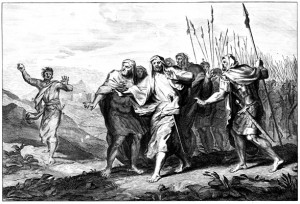
Shimei Curses David by Otto ElligerToday’s Old Testament reading describes part of what happened during the conflict between David and his rebellious son Absalom. Making his way from Hebron to Jerusalem, David is accosted by a Benjamite, Shimei the son of Gera, who curses and berates him, throws stones and dust at him, and predicts disaster ahead.

It is accompanied by a reading from the Gospel of Mark describing Jesus’ triumphal entry into Jerusalem:

Those who went ahead and those who followed were shouting, “Hosanna! Blessed is the one who comes in the name of the Lord! Blessed is the coming kingdom of our ancestor David! Hosanna in the highest heaven!” (Mark 11:10-11)

Quite a contrast, isn’t it? But here’s the thing, neither Shimei’s curses of David nor the Jerusalem crowd’s praises of Jesus accurately predicted the future. Although David’s son Absalom died in the conflict, and to a father that would be disaster, David did not; his rule as king over Israel was long and prosperous, and is considered a “golden age.” Jesus’ entry into Jerusalem would end in less than a week with his death by crucifixion.

That’s something to remember. The voices all around us, whether critical or flattering, whether damning or praising, do not foretell our future. As irritating or pleasant as they may be, they are of little import. What matters is the voice within. What matters is what we tell ourselves and what we believe we hear of the Voice of God, that still small voice that is often drowned out by the irrelevant shouting along the side of the road.

====================

A request to my readers: I’m trying to build the readership of this blog and I’d very much appreciate your help in doing so. If you find something here that is of value, please share it with others. If you are on Facebook, “like” the posts on your page so others can see them. If you are following me on Twitter, please “retweet” the notices of these meditations. If you have a blog of your own, please include mine in your links (a favor I will gladly reciprocate). Many thanks!

====================

Father Funston is the rector of St. Paul’s Episcopal Church, Medina, Ohio.

The Stones of Zion: the Hardscape of Salvation – From the Daily Office – August 16, 2013

From the Psalter:

You will rise up and have compassion on Zion,
for it is time to favor it;
the appointed time has come.
For your servants hold its stones dear,
and have pity on its dust.

(From the Daily Office Lectionary – Psalm 102:13-14 (NRSV) – August 17, 2013.)

Rocky PathMy parish is currently undertaking a building renovation which will include redoing some of the concrete pathways and landscaping. In the process of overseeing this work, I’ve learned a new word – hardscape – which means the area of a designed landscape made up of hard wearing materials such as stone, concrete, and similar construction materials. I’ve been thinking about rocks and stones for the better part of a month. That’s why I haven’t written one of these meditations . . .

I got hung up on an image from the Old Testament reading for July 22, 2013, which included this verse: “Saul took three thousand chosen men from all Israel and went to seek David and his men in front of the Rocks of the Wild Goats.” I couldn’t get that description, “the Rocks of the Wild Goats,” out of my mind. I’ve read the Daily Office lessons everyday, but as I thought about them, I kept coming back to “the Rocks of the Wild Goats.” And then, this morning’s Psalm has this bit about the stones of Zion and something clicked.

The Stones of Zion: the Hardscape of Salvation

Slipping from my hand
The looking glass falls to the rocky path
In a glittering crescendo
It shatters into shards of shimmering shine
And crashing crystalline cacophony

Saul went in the direction
Of the Rocks of the Wild Goats
In a dark and stony cavern
David silently snipped the corner of his cloak
And saved the king

Jesus walked the way of weary tears
Up the stony slope of an escarpment shaped like a skull
On that dark and windswept hillside
Soldiers tossed dice for a seamless tunic
And killed a king

The women gathered grieving in the garden
Beside a boulder that had blocked a burial vault
On a dark and cheerless morning
Magdalen turned from an empty shroud
And beheld her king

Slipped from my hand
The shattered mirror of my life fallen on a path
Strewn with goat rocks, gravelly skulls, and tombstones
The glittering, shimmering shards lovingly gathered
And saved by a king

====================

A request to my readers: I’m trying to build the readership of this blog and I’d very much appreciate your help in doing so. If you find something here that is of value, please share it with others. If you are on Facebook, “like” the posts on your page so others can see them. If you are following me on Twitter, please “retweet” the notices of these meditations. If you have a blog of your own, please include mine in your links (a favor I will gladly reciprocate). Many thanks!

====================

Father Funston is the rector of St. Paul’s Episcopal Church, Medina, Ohio.

Be Dressed for Action — Sermon for the 12th Sunday after Pentecost (Proper 14C) — August 11, 2013

====================

This sermon was preached on the Twelfth Sunday after Pentecost, August 11, 2013, at St. Paul’s Episcopal Church, Medina, Ohio, where Fr. Funston is rector.

(Revised Common Lectionary, Pentecost 12 (Proper 14, Year C): Isaiah 1:1,10-20; Psalm 50:1-8,23-24; Hebrews 11:1-3,8-16; and Luke 12:32-40. These lessons can be read at The Lectionary Page.)

====================

Children in British Slum, circa 1955We are used to thinking of the Book of Isaiah as the work of a single prophet, but it is really three books: First Isaiah, comprising chapters 1-39; Second Isaiah, made up of chapters 40-55; and Third Isaiah, chapters 56-66. These three prophets did their work in three different and distinct periods in Jewish history: the late 8th Century BCE; the mid-6th Century BCE, and the late 6th Century BCE, respectively. This is clear from evidence in their writings: their themes vary and each prophet speaks from a different location. First Isaiah is clearly set in pre-exilic Jerusalem; Second Isaiah was obviously written in Babylon; Third Isaiah speaks from post-exilic Jerusalem. Nonetheless, there is a sense of unity in the writings that make up this book. Phrases and themes recur, and there are linkages later and earlier passages. Today’s reading is from First Isaiah and introduces a topic which will be taken up again by Second and Third Isaiah: what constitutes proper worship?
Ritual worship in First Isaiah’s day was centered at the Temple in Jerusalem. Prof. James T. Dennison, Jr., of Northwest Theological Seminary, in an article about today’s reading from Isaiah describes the cultic activity:

At the temple, there were throngs of people. Multitudes trampled the courts of the temple – hustle and bustle, service upon service, activity upon activity. On the Sabbath; at the monthly new moon service; at the appointed feasts – Passover, Pentecost, Yom Kippur, Tabernacles. Why you couldn’t keep the good folks away. And offerings – did they bring offerings! Burnt offerings, peace offerings, grain offerings – why what more could you ask? All that Moses prescribed, they brought. Piety by the bushel; holiness by the herd; sanctity by the sheepfold. And the fellowship – oh, the friends they met and the people they talked to, the news they caught up on and the gossip they passed on. And the motions – why they spread out their hands in prayer. They lifted their arms to the sky – what a pious sight, the smoke of their offerings ascending and the ascension of these holy hands. What ecstasy! What piety! What religiosity! (A Tale of Two Cities: Isaiah and Worship)

“What liturgical hypocrisy!” cries Isaiah. Isaiah condemns this worship as so much theater in the absence of care for the weakest in society; God, he says, rejects liturgical activities devoid of the pursuit of justice and righteousness. The stinging critique of worship that we heard in today’s Old Testament lesson is not an indictment of worship in general. Rather, the prophet tells us that God takes no joy in the pomp and circumstance when it is accompanied by unjust behavior, when in fact it covers up injustice:

When you stretch out your hands, I will hide my eyes from you; even though you make many prayers, I will not listen; your hands are full of blood. Wash yourselves; make yourselves clean; remove the evil of your doings from before my eyes; cease to do evil. (Isa. 1:15-16)

It is a cry his successor, Third Isaiah, will take up two centuries later condemning hollow, hypocritical ritual fasting: the fast that God chooses, he says, is “to loose the bonds of injustice, to undo the thongs of the yoke, to let the oppressed go free, and to break every yoke.” (Isa. 58:6) The worship offered those whose hands are full, metaphorically, with the blood of the oppressed will not be accepted; the blood of animals offered in sacrificial worship will not atone for the injustice in the community. The emptiness of the ritual reminds the Divine Judge of society’s crimes against its weaker and less fortunate members.

Isaiah calls on his listeners, the worshipers of ancient Judah and worshipers in modern America, to hear the word of the Lord, the torah of God: “Learn to do good; seek justice, rescue the oppressed, defend the orphan, plead for the widow.” (Isa. 1:17)

This is precisely what Jesus says in today’s Gospel lesson: “Sell your possessions, and give alms. Make purses for yourselves that do not wear out, an unfailing treasure in heaven, where no thief comes near and no moth destroys. For where your treasure is, there your heart will be also.” (Lk. 12:33-34) And then he gives his famously imprecise warning of the Second Coming: “Be alert, be ready, be dressed for action, because you don’t when it will be.” How does one do this? By doing the things Jesus has already mentioned. As Lutheran pastor John Petty puts it:

If one’s treasure has been kept to one’s self, one’s treasure is always at risk. If one’s treasure has been given to the poor, it is “unfailing.” If your treasure is with yourself, your heart is directed toward yourself. If your treasure has been given to the poor, your heart is with the poor — or, in other words, with God. (Progressive Involvement)

“And why do you worry about clothing? Consider the lilies of the field, how they grow; they neither toil nor spin, yet I tell you, even Solomon in all his glory was not clothed like one of these.” (Matt. 6:28-29) If you have clothed the naked, you are dressed and ready to go. It’s like Jesus said at another time:

I was hungry and you gave me food, I was thirsty and you gave me something to drink, I was a stranger and you welcomed me, I was naked and you gave me clothing, I was sick and you took care of me, I was in prison and you visited me. * * * Just as you did it to one of the least of these who are members of my family, you did it to me. (Matt. 25:35-36,40)

The answer to the “how” question begs the next inquiry . . . when? That the tough one because we are dealing with what has been called “the uncertain certainty of Christ’s return.” Remember, Jesus said no one, including himself, would know when that day would come; like the old television show Candid Camera, it will happen when we least expect it. A ministerial colleague of mine in a more conservative evangelical tradition once commented, “We have focused so much emotional energy on the expectation that we have not done the work to be done before Jesus returns.” It’s just so much theater in the absence of care for the weakest in society. God takes no joy in ritual liturgy or any worship unaccompanied by righteous behavior and justice.

In the late 19th and early 20th Centuries, our own Anglican tradition was divided between those who favored a more ceremonial, ritual style of liturgy, commonly called Anglo-Catholics, and those who favored far less ritual in worship. The latter, generally referred to as Evangelicals or as “the Low Church Party” would have said that liturgy such as we usually celebrate now is “hollow and unsatisfying, ceremonial . . . in place of the life-giving Word.” In an Evangelical Australian publication it was denounced in terms nearly as prophetic as Isaiah’s:

We never read once of Paul, or Peter, or of any of the other apostles having lights and swinging censers and vestments and copes and mitres and chasubles, and elaborate processions, and so forth. * * * Seen in the clear light of the Word of God, [ritual worship] is not only blasphemous, but idolatrous. It is absolutely opposed to Scriptural teaching. (The Signs of the Times, August 27, 1923)

Eventually, as common Prayer Book liturgy makes clear, we Anglicans arrived (as is our wont) at a compromise encompassing many styles of worship and settling into the broad liturgical practices of today. But the concern of Isaiah for ritual worship accompanied by social justice was not lost on the Anglo-Catholics.
At the Second Anglo-Catholic Congress held in London in 1923, the Bishop of Zanzibar, the Right Reverend Frank Weston, closed the meeting with an address entitled Our Present Duty. The last words of Bishop Weston’s address, which could as easily be spoken to 21st Century Americans, are these:

I say to you, and I say it to you with all the earnestness that I have, that if you are prepared to fight for the right of adoring Jesus in his Blessed Sacrament, then you have got to come out from before your Tabernacle and walk, with Christ mystically present in you, out into the streets of this country, and find the same Jesus in the people of your cities and your villages. You cannot claim to worship Jesus in the Tabernacle, if you do not pity Jesus in the slum.

Now mark that — this is the Gospel truth. If you are prepared to say that the [Christian] is at perfect liberty to rake in all the money he can get no matter what the wages are that are paid, no matter what the conditions are under which people work; if you say that the [Christian] has a right to hold his peace while his fellow citizens are living in hovels below the levels of the streets, this I say to you, that you do not yet know the Lord Jesus in his Sacrament. You have begun with the Christ of Bethlehem, you have gone on to know something of the Christ of Calvary — but the Christ of the Sacrament, not yet. Oh brethren! if only you listen to-night your movement is going to sweep [this nation]. If you listen. I am not talking economics, I do not understand them. I am not talking politics, I do not understand them. I am talking the Gospel, and I say to you this: If you are Christians then your Jesus is one and the same: Jesus on the Throne of his glory, Jesus in the Blessed Sacrament, Jesus received into your hearts in Communion, Jesus with you mystically as you pray, and Jesus enthroned in the hearts and bodies of his brothers and sisters up and down this country. And it is folly — it is madness — to suppose that you can worship Jesus in the Sacraments and Jesus on the Throne of glory, when you are sweating him in the souls and bodies of his children. It cannot be done.

There then, as I conceive it, is your present duty; and I beg you, brethren, as you love the Lord Jesus, consider that it is at least possible that this is the new light that the Congress was to bring to us. You have got your Mass, you have got your Altar, you have begun to get your Tabernacle. Now go out into the highways and hedges where not even the Bishops will try to hinder you. Go out and look for Jesus in the ragged, in the naked, in the oppressed and sweated, in those who have lost hope, in those who are struggling to make good. Look for Jesus. And when you see him, gird yourselves with his towel and try to wash their feet.

(Our Present Duty, slightly amended. Bishop Weston said “Anglo-Catholic” rather than “Christian” and “England” rather than “the nation” – but with those simple amendments this statement applies as well to church members in the contemporary United States as it did to Anglo-Catholics in the England of a century ago.)

Another Anglican a century and a half earlier summarized the Christian duty somewhat more succinctly. Although it is disputed that John Wesley ever actually uttered what is now known as “John Wesley’s Rule,” it certainly accords with his preaching, with today’s lesson from Isaiah’s prophecy, and with the Gospel:

“Do all the good you can,
by all the means you can,
in all the ways you can,
in all the places you can,
at all the times you can,
to all the people you can,
as long as ever you can.”

This understanding and appreciation for the meaning behind Isaiah’s prophecy, his condemnation of worship not connected to a ministry of social justice has been a part of our Anglican ethos from the very beginning. Shortly after the Church of England separated from Rome, when Archbishop Thomas Cranmer and his collaborators produced the first English Book of Common Prayer in 1549, they included at the end of the rite of Holy Communion a closing prayer which included this petition:

We therfore most humbly beseche thee, O heavenly father, so to assist us with thy grace, that we may continue in that holy felowship, and doe all suche good woorkes, as thou hast prepared for us to walke in.

That prayer, or one very much like it, has been used to end Anglican services of the Holy Eucharist for nearly 500 years. In our current American Prayer Book we have a descendent of that prayer in contemporary English which includes the modern version of that petition:

And now, Father, send us out to do the work you have given us to do, to love and serve you as faithful witnesses of Christ our Lord.

Floating around the internet recently, being “tweeted” on Twitter and “shared” on Facebook, is a “meme” which also echoes Isaiah. A “meme” is a photograph over which has been superimposed, using Photoshop or some other graphics application, a caption. (Often the caption may seem to have nothing to with the picture.) This particular “meme” shows a man sitting on the floor of a work bay in an auto repair facility. The caption reads: “Sitting in church for an hour on Sunday morning doesn’t make you a Christian any more than sitting in a garage makes you a car.” A bit snarky, perhaps, but the message is clearly the same as First Isaiah’s.

Whether that prophet eight centuries before Christ, or Third Isaiah two centuries later, or Christ himself in the First Century, Cranmer in the 16th, Wesley in the 18th, the Evangelicals or Bishop Weston in the early 20th Century, or a snarky Facebook “meme” in the 21st, the message is the same: worship devoid of social justice and righteousness is unacceptable!

“Sell your possessions, and give alms.” (Luke 12:33)

“Sell your possessions, and give alms.” (Luke 12:33)

“Wash yourselves; make yourselves clean. * * * Learn to do good; seek justice, rescue the oppressed, defend the orphan, plead for the widow. ” (Isaiah 1:16-17)

“Be dressed for action and have your lamps lit.” (Luke 12:35)

Amen.

====================

A request to my readers: I’m trying to build the readership of this blog and I’d very much appreciate your help in doing so. If you find something here that is of value, please share it with others. If you are on Facebook, “like” the posts on your page so others can see them. If you are following me on Twitter, please “retweet” the notices of these meditations. If you have a blog of your own, please include mine in your links (a favor I will gladly reciprocate). Many thanks!

====================

Father Funston is the rector of St. Paul’s Episcopal Church, Medina, Ohio.

God Our Mother — Sermon for the 11th Sunday after Pentecost (Proper 13C) — August 4, 2013

====================

This sermon was preached on the Eleventh Sunday after Pentecost, August 4, 2013, at St. Paul’s Episcopal Church, Medina, Ohio, where Fr. Funston is rector.

(Revised Common Lectionary, Pentecost 11 (Proper 13, Year C): Hosea 11:1-11; Psalm 107:1-9, 43; Colossians 3:1-11; and Luke 12:13-21. These lessons can be read at The Lectionary Page.)

====================

Drawing of Mother Holding Baby, Artist UnknownThis passage is one of my favorites in the book of the prophet Hosea. Hosea’s major metaphor for the relationship of God with Israel, as we learned last week, is that of marriage. Hosea portrayed God as Israel’s “husband” and condemned the nation because of the “adulterous” relationship it had had with other gods. As a “prophetic act” Hosea married a prostitute named Gomer, with whom his relationship parallels that of God with Israel. He tells of Gomer running away from him and having sex with another man, but he loves her and forgives her. Similarly, even though the people of Israel worshiped other gods, Hosea prophesied that Yahweh continues to love his people and does not abandon God’s covenant with them. This passage, however, departs from that metaphor and presents, instead, an image of God as Divine Parent, an image which is surprisingly feminine and maternal.

When Israel was a child, I loved him,
and out of Egypt I called my son.
* * *
It was I who taught Ephraim to walk,
I took them up in my arms;
but they did not know that I healed them.
I led them with cords of human kindness,
with bands of love.

In these verses God is portrayed as an adoptive parent. God’s lovingly brought Israel out of Egypt, cared for Israel, taught, comforted, healed, and nurtured Israel. The Divine Adoptive Parent nurtured this child, taught the child to walk, held this child in times of suffering and anguish, offered healing when he was injured. But just as Hosea’s earlier metaphor likened God to a cuckolded husband, God is now an abandoned parent.

Israel’s disobedient and defiant nature becomes clear as God offers a general indictment against Israel’s idolatry.

The more I called them,
the more they went from me;
they kept sacrificing to the Baals,
and offering incense to idols.

The Baals are competitor gods to Yahweh. They were local gods, represented by fertile fields, jars of olive oil, the smell of baking bread, the aroma of roasting meat. They appealed to the senses and to one’s immediate sense of satisfaction and well-being. In the Spring, the followers of the Baals would cry “Baal is alive” through the villages, and the worshipers of Yahweh would joined; they were hedging their bets hoping to ensure a bounteous crop and a satisfied family. The cult of Yahweh demanded worship in sometimes far-away sacred places. Sacrificial worship hadn’t yet been centralized at Jerusalem, but there were only a few places where it cold be offered. The Baals were more immediate so many Israelites would take out a little insurance and serenade Baal along with the neighbors. After all, where was YHWH anyway and what has he done for you recently?

These Baals of satisfaction and well-being are precisely the “gods” which got the attention of the rich man in the Gospel parable Jesus tells today.

The land of a rich man produced abundantly. And he thought to himself, ‘What should I do, for I have no place to store my crops?’ Then he said, ‘I will do this: I will pull down my barns and build larger ones, and there I will store all my grain and my goods. And I will say to my soul, ‘Soul, you have ample goods laid up for many years; relax, eat, drink, be merry.’ But God said to him, ‘You fool! This very night your life is being demanded of you. And the things you have prepared, whose will they be?’ So it is with those who store up treasures for themselves but are not rich toward God.

And so it was with the people of ancient Israel:

They shall return to the land of Egypt,
and Assyria shall be their king,
because they have refused to return to me.
The sword rages in their cities,
it consumes their oracle-priests,
and devours because of their schemes.
My people are bent on turning away from me.
To the Most High they call,
but he does not raise them up at all.

It was not the Baals who accomplished those things that many believed they had done; it was not they who were nurturing Israel; it was Yahweh! And like a spurned husband, like a rejected parent, Yahweh was angry! God, rejected and spurned, is furious and, frankly, vindictive. God will throw Israel out of the promised land. God will send them back to Egypt or turn them over to the invading Assyrians. God will allow war to consume the people and their lying priests. God is disgusted by their schemes. They think they have ample goods laid up for many years, so that they can relax, eat, drink, and be merry. God will show them what fools they are! God feels the indignation and rage that any parent might toward a disrespectful child.

Bu then, God rises above this anguish and anger; we are privileged to witness Yahweh’s churning emotional conflict commitment, the turmoil deep within God’s heart:

How can I give you up, Ephraim?
How can I hand you over, O Israel?
* * *
My heart recoils within me;
my compassion grows warm and tender.
I will not execute my fierce anger;
I will not again destroy Ephraim;
for I am God and no mortal,
the Holy One in your midst,
and I will not come in wrath.

At the heart of this passage are two Hebrew words, one of which is translated as “heart”; the other, as “compassion”. The first is leb and in Judaic understanding it refers not merely to the body’s physical heart, but to the innermost being of the human person. It refers to the center of personal life, to a human being’s psychic and spiritual energies upon which the whole moral and religious condition of a person completely depends. Here, it is God who has this sort of inner core of being, and the center of God’s Being is inextricably linked in Hosea’s prophecy with God’s compassion, not with Yahweh’s righteous anger and wrath . . . God’s essential Being is eternally and indelibly characterized by love and compassion.

Our English word compassion derives from the Latin for “suffering together”; compassion is the ability to share in the suffering of another, to be empathetic. There are two Hebrew words translated as “compassion;” Hosea uses them both. Although in this passage he uses is nichuwm, which has its root in the concept of regret or sorrow, elsewhere he describes God’s compassion using the synonym rechemet, which comes from the Hebrew root rechem which literally means “womb”. The Hebrew understanding of compassion is deeply maternal, rooted in a profound metaphor of birthing and motherhood; compassion in Hebrew thought might best be conceived not as “shared suffering”, but as “womb love”.

This word applied to God conjurs a beautiful image of God as our mother doing all the amazing and miraculous things a life-giving, nurturing mother does. She protects her child; she nourishes, cradles, and prepares her child. Whether she gives birth to the child or adopts the child, how can she give up or forget her child? “Can a woman forget her nursing child, or show no compassion for the child of her womb?” asks God in book of the prophet Isaiah, “Even these may forget, yet I will never forget you.” (Isaiah 49:15)

The 14th Century mystic and saint, Dame Julian of Norwich (1342-1416), wrote of God our Mother with these words:

It is a characteristic of God to overcome evil with good.

Jesus Christ therefore, who himself overcame evil with good, is our true Mother. We received our ‘Being’ from Him ­ and this is where His Maternity starts ­ And with it comes the gentle Protection and Guard of Love which will never ceases to surround us.

Just as God is our Father, so God is also our Mother.

And He showed me this truth in all things, but especially in those sweet words when He says: “It is I”.

As if to say, I am the power and the Goodness of the Father, I am the Wisdom of the Mother, I am the Light and the Grace which is blessed love, I am the Trinity, I am the Unity, I am the supreme Goodness of all kind of things, I am the One who makes you love, I am the One who makes you desire, I am the never-ending fulfillment of all true desires. (…)

Our highest Father, God Almighty, who is ‘Being’, has always known us and loved us: because of this knowledge, through his marvelous and deep charity and with the unanimous consent of the Blessed Trinity, He wanted the Second Person to become our Mother, our Brother, our Savior.

It is thus logical that God, being our Father, be also our Mother. Our Father desires, our Mother operates and our good Lord the Holy Ghost confirms; we are thus well advised to love our God through whom we have our being, to thank him reverently and to praise him for having created us and to pray fervently to our Mother, so as to obtain mercy and compassion, and to pray to our Lord, the Holy Ghost, to obtain help and grace. (From “Revelations of Divine Love”, LIX, LXXXVI).

We may, like the ancient Israelites or like the man in Christ’s gospel parable this morning, be tempted away from God by those things which seem to satisfy our immediate needs, by fertile fields, jars of olive oil, the smell of baking bread, the aroma of roasting meat; we may believe that we have ample goods laid up for many years, and so be tempted to relax, eat, drink, and be merry. But let us never forget the source of all those things. As the Psalm today recalls to us, it is God who puts our feet on a straight path; it is the Lord who does wonders for his children; it is God who satisfies the thirsty and fills the hungry with good things. Hosea reminds us that we are God’s children and that at the center of God’s Being is the womb-love of a mother for her child, for us.

Whoever is wise will ponder these things,
and consider well the mercies of the Lord.

Amen.

====================

A request to my readers: I’m trying to build the readership of this blog and I’d very much appreciate your help in doing so. If you find something here that is of value, please share it with others. If you are on Facebook, “like” the posts on your page so others can see them. If you are following me on Twitter, please “retweet” the notices of these meditations. If you have a blog of your own, please include mine in your links (a favor I will gladly reciprocate). Many thanks!

====================

Father Funston is the rector of St. Paul’s Episcopal Church, Medina, Ohio.

God’s Faithfulness Prevails — Sermon for the 10th Sunday after Pentecost (Proper 12C) — July 28, 2013

====================

This sermon was preached on the Tenth Sunday after Pentecost, July 28, 2013, at St. Paul’s Episcopal Church, Medina, Ohio, where Fr. Funston is rector.

(Revised Common Lectionary, Pentecost 10 (Proper 12, Year C): Hosea 1:2-10; Psalm 85; Colossians 2:6-19; and Luke 11:1-13. These lessons can be read at The Lectionary Page.)

====================

Baptism“Name this child.” That’s what I say to parents of infant baptismal candidates as I take their children from them. The words are not actually written in the baptismal service of The Book of Common Prayer as they are in some other traditions’ liturgies, but there is a rubric on page 307 that says, “Each candidate is presented by name to the Celebrant . . . .” so asking for the child’s name is a practical way of seeing that done. It’s practical, but it’s also a theological statement.

There is a common religious belief found in nearly all cultures that knowing the name of a thing or a person gives one power over that thing or person. One finds this belief among African and North American indigenous tribes, as well as in ancient Egyptian, Vedic, and Hindu traditions; it is also present in all three of the Abrahamic religions, Judaism, Christianity, and Islam.

The naming we do at baptism echoes the naming that takes place in Jesus’ tradition as a faithful Jew. In Judaism, when a male infant is circumcised on the eighth day after his birth, the mohel who performs the brit milah prays, “Our God and God of our fathers, preserve this child for his father and mother, and his name in Israel shall be called ________” and the prayer continues that, by his naming, the infant will be enrolled in the covenant of God with Israel. The same thing is done when a girl is named in the ceremony called zeved habat, or “presentation of the daughter” at the first formal reading of the Torah following her birth. In baptism, we do the same; the church says to its newest member, “This is who you are: washed in the waters of baptism, sealed by the Holy Spirit, and marked as Christ’s own forever,” a brother or sister in the church, a fellow member of the household of God.

To give a name to anything, especially to another human being, is a powerful thing! In the first verses of Genesis we are told, “God said ‘Let there be Light’ and there was light.” (Gen. 1:3) God named the light before it was created; this process continues through the rest of the story. God says, “Let there be” and names the thing which will come into existence; the naming seems a necessary first step in creation. There is a sense in which the name given shapes the future of the thing, or of the person, named.

So this morning I will ask that question of Danny and Nikki ___________ (parents) and of Peter ___________ (Godfather) who will name Ryan George __________ (infant) as a child of God, and of Mary __________ (sponsor) who will name Jacqueline Ann ____________ (adult) as a child of God, and through baptism we all will welcome Ryan and Jackie into the household of faith, into a covenant relationship with Almighty God and with each of us.

In today’s lesson from the Prophet Hosea, we find God instructing the prophet to give strange and bewildering names to his children as powerful, prophetic signs of Israel’s broken relationship with God. Hosea’s firstborn son is to be named Jezreel, which refers to the location of a particularly brutal and bloody massacre of Israelite royalty; his daughter is to be called, Lo-ruhamah, which means “no pity,” as a sign that God will have no compassion for his people who have gone astray; and a second son is to be named, Lo-ammi, which means “no people,” to let the Israelites know they are no longer God’s people.

Preachers often use their children as sermon illustrations, but what God demands of Hosea seems a little extreme. These poor kids aren’t going to have to live merely with the embarrassment of a single sermon, they are going to live with these names, these prophetic, judgmental names for their entire lives! But as bad as that is, giving these awful names to his children is not the hardest thing God demands of Hosea. No, the hardest thing is marrying their mother, Gomer.

Hosea is ordered by God to (in the words of our NRSV translation) “take for yourself a wife of whoredom and have children of whoredom.” He is to marry a prostitute who will continue in her scandalous and adulterous behavior, even though Hosea will be faithful to her throughout the marriage. Why? Because it is a prophetic sign, a prophetic action symbolizing the way in which Israel has dealt with God: because “the land commits great whoredom by forsaking the Lord.” God loves Israel with all the passion and loyalty of a faithful husband, but Israel, like a promiscuous wife, has been unfaithful to God.

It is an unfortunate prophetic metaphor, for it is misogynistic to the core! Portraying God as a faithful (but dominant) husband and Israel as a supposed-to-be obedient (and submissive) wife perpetuates a patriarchalism that is inappropriate to our society. As a metaphor it may have communicated clearly to its ancient Israelite audience, but it doesn’t communicate quite so clearly to us, clouded as it is with its ancient cultural bias. So as we read and seek to understand Hosea’s message in our day and age, we must extract the meaning from the metaphor and then, perhaps, cast the metaphor aside, separating the kernel of truth from the chaff of historical baggage.

In the modern world, marriage is not the patriarchal, male-dominated institution it was in Hosea’s time, but the metaphor can still work for us. In our Prayer Book, the meaning of marriage is summarized in the introductory comments with which the presiding minister begins the ceremony. We are told that it is a bond and covenant established by God in creation and that the union of the parties “in heart, body, and mind is intended by God for their mutual joy [and] for the help and comfort given one another in prosperity and adversity.” (BCP 1979, page 423)

Later in the service, just before the Nuptial Blessing is given, we pray for the couple that “each may be to the other a strength in need, a counselor in perplexity, a comfort in sorrow, and a companion in joy,” and that “their life together [may be] a sign of Christ’s love to this sinful and broken world, that unity may overcome estrangement, forgiveness heal guilt, and joy conquer despair.” (Page 429) In such a relationship neither party dominates the other, neither is submissive; it is a mutual and interdependent bond of covenant obligations, one to the other.

When Hosea’s prophetic metaphor is understood in these terms, it emphasizes that God is angry with God’s people for abandoning the covenant obligations they had to God, even as God remained faithful. What Hosea’s marriage metaphor communicates to us, as it did to his ancient audience, is that it is divine fidelity, not human inconstancy, that will ultimately save the relationship. It is God’s faithfulness, not our own, which prevails and redeems our relationship with God.

This is also the message of the author of the Letter to the Colossians, an epistle traditionally said to have been written by St. Paul, but which is now no longer believed to be of his authorship. The reason for that is in the very part of the text on which I want to focus our attention, the sentence where the author writes: “When you were buried with [Christ] in baptism, you were also raised with him through faith in the power of God, who raised him from the dead.” The author seems to echo Paul’s understanding of baptism in the Letter to the Romans, particularly a section we read every year on Easter Sunday. Paul writes, “Do you not know that all of us who have been baptized into Christ Jesus were baptized into his death? . . . . If we have been united with him in a death like his, we will certainly be united with him in a resurrection like his.” (6:3,5) The theology is similar, but note the significant shift: in Romans, Paul writes that we will be raised with Christ, whereas the author of Colossians asserts that our resurrection with Christ has already happened by reason of baptism. These two passages reflect the wonderful here-but-not-quite-here mysterious paradox of Christianity; we both celebrate the present reality of and anticipate the future consummation of our salvation in Christ. The victory has already been won, but not yet.

Now, what I really want to focus on is why our resurrection, our salvation, whether it is a present reality or something yet to occur, should happen at all! In Romans, Paul says that it happens “by the glory of the Father.” (v. 4) The author of Colossians asserts that it is “through faith in the power of God” according to our translation; that would seem to imply that our faith is somehow responsible for our salvation, that the means for our resurrection is our fidelity. But there is a growing body of scholarship which suggests that this is a misunderstanding of the original Greek of the text. The Greek is dia te pisteo te energeia tou theou . . . literally: “through the faith the working of God.” Traditional English translations add the preposition “in” into the interpretation which would imply that this powerful, operative faith is ours, but the Greek can also be understood to mean not “faith in” but rather “faith of” – in other words, it is God’s faith!

The 18th Century Lutheran translator Johann Albrecht Bengel suggested exactly this in his Annotations on the New Testament when he translated this text to say that our salvation, our resurrection comes about through faith which is a work of God. This text, he says, is “a remarkable expression: faith is of Divine operation.” (Gnomon of the New Testament, A. Fausset, tr., Clark:Edinburgh 1858, page 171, emphasis in original) Our resurrection with Christ is not brought about because of our faith; it is not because of us, or anything we do or believe! We are saved through the faithfulness of God who, by his glory and power, raised Christ from the dead.

It is also God’s faithfulness to which Jesus alludes in the parental metaphor which he uses in his instruction about prayer: “Is there anyone among you who, if your child asks for a fish, will give a snake instead of a fish? Or if the child asks for an egg, will give a scorpion? If you then, who are evil, know how to give good gifts to your children, how much more will the heavenly Father give the Holy Spirit to those who ask him!” God is the faithful parent who always responds when we ask, who is always there to be found when we search, who always opens the door when we knock. It is God’s faithfulness, not our own, which prevails and redeems our relationship with God.

On this we can rely; in this faithful God, we can have faith.

So let’s go back to Hosea’s marriage metaphor. The Lutheran Book of Worship, used by our brothers and sisters in the Evangelical Lutheran Church in America, with whom we enjoy a relationship of full communion, says this about marriage: “The Lord God in his goodness created us . . . and by the gift of marriage founded human community in a joy that begins now and is brought to perfection in the life to come. Because of sin, our age-old rebellion, the gladness of marriage can be overcast, and the gift of the family can become a burden. But because God, who established marriage, continues still to bless it with his abundant and ever-present support, we can be sustained in our weariness and have our joy restored.” (LBW 1978, page 203)

It is into the household of God, the community of joy restored, the covenant of mutual help and comfort sustained by the faithfulness of God, that we welcome Ryan George and Jacqueline Ann this morning. They (and we together with them) will make the statements of belief and the promises of action set out in the Baptismal Covenant (BCP 1979, pages 304-04), and they (and we) will try faithfully to keep them. Fortunately, however, it is God’s faithfulness, not theirs (nor ours), which will prevail and redeem them (and us), and their (and our) relationship with God.

Let us pray:

Almighty God, by our baptism into the death and resurrection of your Son Jesus Christ, you turn us from the old life of sin: Grant that we, being reborn to new life in him, may live in righteousness and holiness all our days; through Jesus Christ our Lord, who lives and reigns with you and the Holy Spirit, one God, now and for ever. Amen. (BCP 1979, page 254)

====================

A request to my readers: I’m trying to build the readership of this blog and I’d very much appreciate your help in doing so. If you find something here that is of value, please share it with others. If you are on Facebook, “like” the posts on your page so others can see them. If you are following me on Twitter, please “retweet” the notices of these meditations. If you have a blog of your own, please include mine in your links (a favor I will gladly reciprocate). Many thanks!

====================

Father Funston is the rector of St. Paul’s Episcopal Church, Medina, Ohio.

« Older posts Newer posts »