 There is an aphorism about preaching that says the preacher “must hold the Bible in one hand and the newspaper in the other.” This is often attributed to the influential Swiss theologian Karl Barth, whom Time Magazine in the 1960s called “the greatest living Protestant theologian.” Truth is, however, that he never really said it. What he actually said, in an interview with Time in 1963, was, “Take your Bible and take your newspaper, and read both. But interpret newspapers from your Bible.”[1] In other words, try to understand events in the world through the lens of Scripture and take guidance from it as you seek to live in this world.
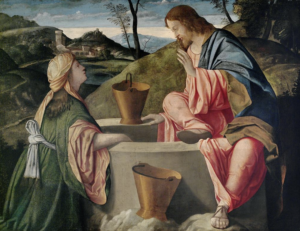
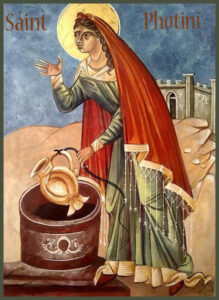
As I followed the news media the past few weeks, two stories stood out for me. One was the witness of the women who are the surivors of Jeffrey Epstein’s human trafficking enterprise. The other was the tale of the US Women’s Ice Hockey team who won the Olympic gold medal but were nonetheless made the butt of a joke by the president. It seemed to me that John’s story of Jesus’ long conversation with the Samaritan woman at Jacob’s well offers us a lens through which to view these news stories. So I started making notes for a sermon along those lines.
 When I was about 8 or 9 years of age, my grandparents gave me an illustrated bible with several glossy, color illustrations of various stories. They weren’t great art, but they were clear and very expressive. My favorite amongst them was the illustration of today’s gospel lesson.
 We have three intriguing lessons from scripture today. First we have a denunciation of Hebrew worship, which also interestingly contains a verse most famous in American politics for having been spoken on the steps of the Lincoln monument by Dr. Martin Luther King, Jr. Some people who dislike liturgy, or some aspect of liturgy, like incense, or vestments or music, ignoring that sentence about justice flowing like streams, have used this text to prove that God also dislikes, liturgy, or incense, or vestments, or whatever. However, that’s not what this lesson is about and I’ll get back to that in just a moment.
  “The kingdom of heaven may be compared to a king . . . .”
 Power and authority. These are the subjects of our lessons from Scripture this morning. Later this month they will figure as key concepts in a trial scheduled to begin in Fulton County, Georgia. That trial will focus on an alleged attempt to disrupt, even to stop, what we have come to call “the peaceful transfer of power.” Historian Maureen MacDonald wrote a few years ago:
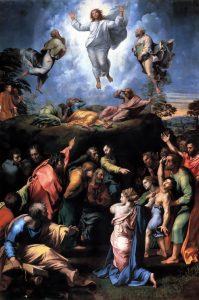 Today, in the normal course of the Lectionary, would have been the 10th Sunday after Pentecost on which, this year, we would have read the lessons known as “Proper 13” in which the gospel lesson is Matthew’s story of the feeding of the 5,000. However, since this is August 6, we don’t follow the normal course. We step away from the Lectionary to celebrate one of the feasts which, in the language of the Prayer Book, “take precedence of a Sunday,”
 We “boast in our sufferings,” writes Paul to the Romans, “knowing that suffering produces endurance, and endurance produces character, and character produces hope, and hope does not disappoint us….”
 Anthelme Brillat-Savarin , an 18th century French politician once said, “Tell me what kind of food you eat, and I will tell you what you what kind of man are.”
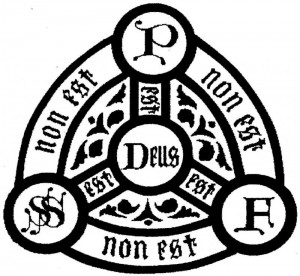 There is an old tradition in the church: on Trinity Sunday, rectors do their best to get someone else to preach. If they have a curate or associate priest, he or she gets the pulpit on that day. If not, they try to invite some old retired priest to fill in (as Father George has done today). No one really wants to preach on Trinity Sunday, the only day of the Christian year given to the celebration or commemoration of a theological doctrine, mostly because theology is dull, dry, and boring to most people and partly because this particular theology is one most of us get wrong no matter how much we try to do otherwise. Back when I was a curate getting the Trinity Sunday assignment, my rector encouraged me with the sunny observation that, listening to a sermon in almost any church on Trinity Sunday, one could be practically guaranteed to hear heresy.
 Today the Lectionary gives us what, at first glance, are two stories about leadership, but what they really are are stories of people trying to protect God (or God’s appointed leader) in inappropriate ways

