 “You are the light of the world. … [L]et your light shine before others, so that they may see your good works and give glory to your Father in heaven.”[1]
Last week, I read this story on Facebook:
I own a small bakery. Business has been slow. Rent is up. I was thinking about closing. Last Friday, a teenager came in. He looked nervous. He counted out change for a cookie. He was short 50 cents. “It’s okay,” I said. “Take it.” He ate it at a table, looking at his math homework. I walked over. “Quadratic equations?” He nodded. “I don’t get it.” I sat down and helped him for 20 minutes. He got it. He left smiling. The next day, he came back with two friends. They bought cookies. The day after that, five kids came. Apparently, he told the school, “The lady at the bakery helps with homework.” Now, my bakery is the after-school hang-out spot. It’s loud. It’s messy. There are backpacks everywhere, Yesterday, I found a note in the tip jar. It was wrapped around a $20 bill. “Thanks for helping my son pass math. A Mom.” I’m not closing the bakery. I think I finally found my purpose. It’s not cookies. It’s community.
This baker is a light shining before others. I think that both Jesus and the prophet Isaiah would have approved of this baker.
 In any event, I know that Mother Lisa has been over all of that with them, so this sermon is not for them. It’s for you, their family and friends; it’s about their marriage, but it’s for you.
 One of the things I try to do when I read the stories of Jesus in the Gospels, when he uses an odd or striking metaphor like “I will make you fishers of people”
 I understand that St. Andrew’s Parish is, today, beginning its annual stewardship campaign, so I suppose it’s appropriate that we heard the story of Jesus being confronted by the wealthy man who wants to inherit eternal life in today’s Gospel reading from Mark. This tale must have been an important one to the earliest Christians, because we find it in all three of the Synoptic Gospels. Mark tells us only that the man is wealthy; Matthew adds that he is young; and Luke informs us that he is a ruler of some sort. But none of those details really changes the basic nature of the encounter: a potential disciple comes to Jesus seeking guidance and Jesus tells him that he must give up everything he possesses – “You lack one thing; go, sell what you own, and give the money to the poor….”
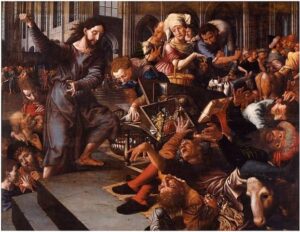 When I was about 8 or 9 years of age, my grandparents gave me an illustrated bible with several glossy, color illustrations of various stories. They weren’t great art, but they were clear and very expressive. My favorite amongst them was the illustration of today’s gospel lesson.
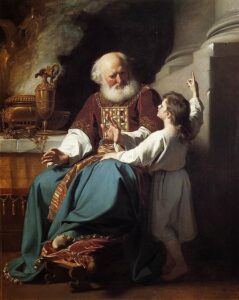 In the Episcopal Church, when we baptize a person, we pray that God will “give them an inquiring and discerning heart, the courage to will, and to persevere, a spirit to know, and love, [God], and the gift of joy, and wonder in all [God’s] works.”
 On April 12, a little more than seven months ago, I was privileged to officiate and preach at a service of Choral Evensong at Trinity Episcopal Cathedral in Cleveland. Following the service, on our way home to Medina, my wife Evelyn and I stopped at a Lebanese restaurant in Middleburg Heights for a late dinner in celebration of our 43rd wedding anniversary, which that day was. After a lovely meal of hummus, baba ganoush, spicy beef kafta, and chicken shwarma, we went home to bed. A few hours later, around 2 a.m., I woke up with a horrendous case of heartburn. I took some antacid and went back to sleep sitting up in my favorite armchair. At 7 a.m. the next morning, I woke up knowing that I hadn’t had indigestion after all; I was having a heart attack.
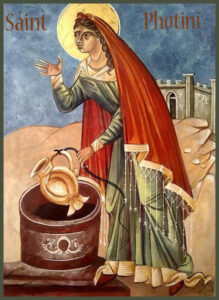 We “boast in our sufferings,” writes Paul to the Romans, “knowing that suffering produces endurance, and endurance produces character, and character produces hope, and hope does not disappoint us….”