 Christology is one of those odd words of the Christian tradition that one doesn’t hear much in church but which one hears a lot in academic circles. Christology is defined as “the field of study within Christian theology which is primarily concerned with the ontology and person of Jesus as recorded in the canonical Gospels and the epistles of the New Testament.”[1] That’s really helpful, isn’t it? Begs the questions, “What is theology? What is ontology? What is a ‘canonical Gospel’?”
Christology in its basic form is just the attempt answer some deceptively simple questions: Who was Jesus? Who is Jesus? Who will Jesus be? What did he do? What is he doing now? What will he do in the future?
Today’s lessons from the Prophet Isaiah, the Letter to the Hebrews, and the Gospel according to Mark present us with three different Christologies: the suffering servant of Isaiah, the high priest following in the footsteps of the Old Testament character of Melchizedek, and the kingly messiah following in the line of David the Shepherd King of Israel. Jesus debunks the latter in his conversation with James and John, the sons of Zebedee, but it remains a prominent feature of Christian understanding. All three shape our understanding of who Jesus was, who he is today, and who he will be tomorrow.
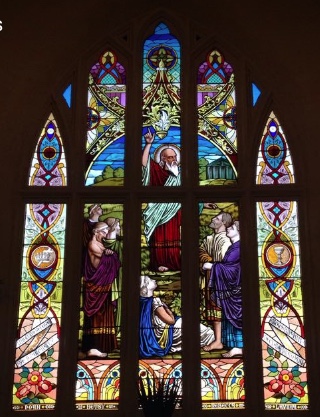 Fifteen years ago when I came to Medina for the first time in my life to meet the people of St. Paul’s Parish and, with them, make the mutual determination whether our life-paths were to converge, Earl and Hildegarde picked Evie and me up at the Cleveland airport. They first took us to Yours Truly Restaurant where we had a bite of lunch and then they brought us here, so that we could see the church.
 Last week we began our parish’s annual fund campaign with the theme “Transforming Generosity.” You should have received your pledge card for 2019 together with a letter about the nature of stewardship and generosity. There was an article in the newsletter similar to that letter, and early in the week you received an email (if you receive email) which is repeated on an insert in your bulletin this morning. Your parish leadership team has asked and will continue to encourage you to do two things that may seem contradictory: first, to make your financial commitment for 2019 earlier than usual, and second, to take your time in doing so. Our hope is that you will submit your estimates of giving on or before the first Sunday in November, but that you will give real prayerful and careful consideration to how your financial support of your church reflects your relationship with God. Stewardship, as that letter said, is not a matter of fund raising; stewardship is a matter of spiritual health. The “Transforming Generosity” theme hopes to inspire you to be a faithful steward and so to give as an expression of your relationship with God.
 Some of you may have heard of Brooks’s law, which has to do with the time it takes to complete a software project. It’s similar to the general law of diminishing returns in economics. Professor Fred Brooks of the University of North Carolina first proposed the law in 1975; it holds that “adding manpower to a late software project makes it later.”

