 When I find myself in times of trouble,
Mother Mary comes to me
Speaking words of wisdom, let it be
And in my hour of darkness
she is standing right in front of me
Speaking words of wisdom, let it be[1]
I did not begin this morning with “Happy Christmas” or “Merry Christmas” because, although it’s December 24th, it’s not Christmas; it’s not even Christmas Eve yet! The rest of the world may want you to think it’s Christmas and that it has been since mid-October, but the Episcopal Church insists that it is not yet Christmas. In fact, there’s still more than nine months until Christmas if we believe the good news we just heard from the evangelist Luke! We still have some time to wait for trees and carols and packages, for festive dinners and “chestnuts roasting on an open fire” and the “holy infant so tender and mild.” We still have some of the Advent season to complete and so on this, the Fourth Sunday of Advent, we focus our attention on Mary and consider not the end of her pregnancy, but its beginning, that moment when the Angel Gabriel told her that she had been chosen to be the mother of the Messiah.
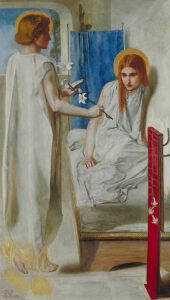
Visual artists depict the stories of the bible in many fascinating ways and their works can help us explore scripture’s meaning. Often their images capture or suggest nuances in a story that we might miss just hearing the words. This morning, I’d like to tell you about three paintings that particularly speak to me about the Annunciation. They are the Pre-Raphaelite Dante Gabriel Rosetti’s Ecce Ancilla Domini painted in the 1850s, Florentine painter Sandro Botticelli’s late 15th Century Cestello Annunciation, and a contemporary piece by American artist John Collier.
 John, your parish secretary, puts together a mailing every week that he sends to the clergy who will be joining you as presiders and preachers. He includes in that mailing some of the material from an Augsburg Fortress publication called “Sundays and Seasons,” which is a great lectionary resource. The illuminations that your lectors read before each Bible reading giving a little introduction about the lesson come from “Sundays and Seasons.” I’ve been familiar with the publication for a long time, though I’ve never been a subscriber: I used to participate in a weekly ecumenical lectionary study group that included Presbyterian, Methodist, Lutheran, and Episcopal clergy and our Lutheran colleagues often brought something from “Sundays and Seasons” into our discussions.
  We have three intriguing lessons from scripture today. First we have a denunciation of Hebrew worship, which also interestingly contains a verse most famous in American politics for having been spoken on the steps of the Lincoln monument by Dr. Martin Luther King, Jr. Some people who dislike liturgy, or some aspect of liturgy, like incense, or vestments or music, ignoring that sentence about justice flowing like streams, have used this text to prove that God also dislikes, liturgy, or incense, or vestments, or whatever. However, that’s not what this lesson is about and I’ll get back to that in just a moment.
  What does it mean to say “Jesus is Lord”? The question arises because of today’s dialog between Jesus and some of the Pharisees about the relative importance of the Commandments. Jesus responds to a lawyer’s question about the greatest commandment and then follows his response with a question about the lordship of the Messiah, the anticipated “Son of David.”
  “The kingdom of heaven may be compared to a king . . . .”
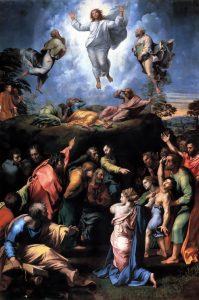 Today, in the normal course of the Lectionary, would have been the 10th Sunday after Pentecost on which, this year, we would have read the lessons known as “Proper 13” in which the gospel lesson is Matthew’s story of the feeding of the 5,000. However, since this is August 6, we don’t follow the normal course. We step away from the Lectionary to celebrate one of the feasts which, in the language of the Prayer Book, “take precedence of a Sunday,”
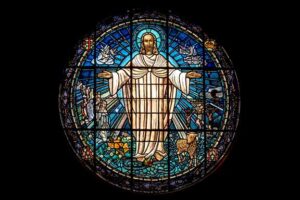 It’s the last Sunday of the Christian year, sort of a New Year’s Eve for the church. We call it “the Feast of Christ the King” and we celebrate it by remembering his enthronement. Each year on Christ the King Sunday we read some part of the crucifixion story. As Pope Francis reminded the faithful in his Palm Sunday homily a few years ago, “It is precisely here that his kingship shines forth in godly fashion: his royal throne is the wood of the Cross!”