Lord God,
We ask you to hold the people of Ukraine deep in your heart.
Protect them, we pray; from violence,
from political gamesmanship,
from being used and abused.Give, we pray, the nations of the world the courage
and the wisdom to stand up for justice
and the courage, too, to dare to care generously.Lord, in your mercy, take from us all the tendencies in us
that seek to lord it over others:
take from us those traits
that see us pursuing our own needs and wants
before those of others.Teach us how to live in love and dignity and respect
following your example,
that life may triumph over death,
and light may triumph over darkness. Amen. [1]
The Pope’s message for Lent is a poignant one, beginning with an acknowledgement that “going to some small extent without food [may not seem to] mean much, at a time when so many of our brothers and sisters are victims of war … and are undergoing such suffering, both physically and morally.” Nonetheless, insisted His Holiness, “Lent must mean something,” and he urged all Christians to focus on “the common heritage of humanity.”[2]
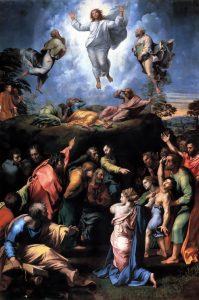 Today, as I write this, is Trinity Sunday 2020, but my imagination this morning is not caught up by the Lectionary gospel lesson of the day, the last mountain-top experience of the Eleven when, just before his Ascension, Jesus gives them the Great Commission.
 When I was a kid growing up first in southern Nevada and then in southern California, the weeks leading up to Christmas (we weren’t church members so we didn’t call them “Advent”) were always the same. They followed a pattern set by my mother. We bought a tree and decorated it; we set up a model electric train around it. We bought and wrapped packages and put them under the tree, making tunnels for that toy train. We went to the Christmas light shows in nearby parks and drove through the neighborhoods that went all out for cooperative, or sometimes competitive, outdoor displays. My mother would make several batches of bourbon balls (those confections made of crushed vanilla wafers and booze) and give them to friends and co-workers. Christmas Eve we would watch one or more Christmas movies on TV, and early Christmas morning we would open our packages . . . carefully so that my mother could save the wrapping paper. Then all day would be spent cooking and watching TV and playing bridge. After the big Christmas dinner, my step-father and I would do the clean up, my brother and my uncle would watch TV . . . and my mother would sneak off to her room and cry. You see . . . no matter how carefully we prepared, no matter how strictly we adhered to Mom’s pattern, something always went wrong. We never got it right; Christmas never turned out the way my mother wanted it to be.
 There is an old tradition in the church: on Trinity Sunday, rectors do their best to get someone else to preach. If they have a curate or associate priest, he or she gets the pulpit on that day. If not, they try to invite some old retired priest to fill in (as Father George has done today). No one really wants to preach on Trinity Sunday, the only day of the Christian year given to the celebration or commemoration of a theological doctrine, mostly because theology is dull, dry, and boring to most people and partly because this particular theology is one most of us get wrong no matter how much we try to do otherwise. Back when I was a curate getting the Trinity Sunday assignment, my rector encouraged me with the sunny observation that, listening to a sermon in almost any church on Trinity Sunday, one could be practically guaranteed to hear heresy.
 Lenten Journal, Day 21
 Children, as those of us who have had or who have been children know, grow in their ability to communicate. Vocabularies grow. Grammars develop. They move from simple one- or two-syllable concepts – such as “Mama” or “Dada” or “NO!” – to more complex ideas.
 Our kids this week have been “Shipwrecked,” but they’ve also been “rescued by Jesus.”
 For recreational reading these days, I’m into a novel entitled Winter of the Gods.

