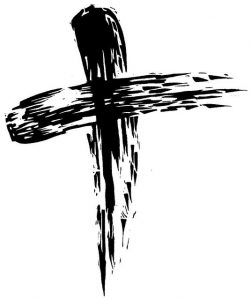
 Today marks the beginning of the season we call “Lent,” an old English word which refers to the springtime lengthening of the days. What is this season all about, these forty days (not counting Sundays) during which we are to be, in some way, doing what a hymn attributed to St. Gregory the Great says: “Keep[ing] vigil with our heavenly lord in his temptation and his fast?”[1]
A few years ago, Dr. Jonn Sentamu, the current Archbishop of York, described Lent as a time for seeking and getting to know God better.[2] Similarly, an essay about Lent in an issue of the National Catholic Register was titled “A Season for Seeking.”[3] I’m not sure I buy that, however. As the Roman Franciscan author Richard Rohr says, “We cannot attain the presence of God because we’re already in the presence of God. What’s absent is awareness.”[4] Lent is not so much a time for seeking God, who is always there, as it is for becoming aware of God.
And the interesting thing is that we are encouraged to become aware of God by becoming more aware of ourselves. Yes, Jesus does say to give with one hand not letting the other know what’s happening, but this seems more an instruction to follow the Deuteronomic command to “open your hand [to one in need] … to give liberally and be ungrudging when you do so”[5] rather than a direction to act without self-awareness.
 A Buddhist tells this story:
 “In the Name of God the Broken-Hearted. Amen.”
 In the beginning, God said . . . and there is creation.
 When I was a kid growing up first in southern Nevada and then in southern California, the weeks leading up to Christmas (we weren’t church members so we didn’t call them “Advent”) were always the same. They followed a pattern set by my mother. We bought a tree and decorated it; we set up a model electric train around it. We bought and wrapped packages and put them under the tree, making tunnels for that toy train. We went to the Christmas light shows in nearby parks and drove through the neighborhoods that went all out for cooperative, or sometimes competitive, outdoor displays. My mother would make several batches of bourbon balls (those confections made of crushed vanilla wafers and booze) and give them to friends and co-workers. Christmas Eve we would watch one or more Christmas movies on TV, and early Christmas morning we would open our packages . . . carefully so that my mother could save the wrapping paper. Then all day would be spent cooking and watching TV and playing bridge. After the big Christmas dinner, my step-father and I would do the clean up, my brother and my uncle would watch TV . . . and my mother would sneak off to her room and cry. You see . . . no matter how carefully we prepared, no matter how strictly we adhered to Mom’s pattern, something always went wrong. We never got it right; Christmas never turned out the way my mother wanted it to be.
 While making a presentation at a conference about teaching English as a second language, an expert in the field remarked that one of the difficulties is that there are many instances in English when a double-negative renders positive meaning and this is confusing for non-English speakers. “It’s fortunate,” she said, “there’s no way in English that a double positive can convey negative meaning.”
  This is a special Sunday for me. Friday marked the 28th anniversary of my ordination as a priest in the Episcopal Church. It was on Sunday, June 23, 1991, that I celebrated my first mass. So I am grateful to you and to Fr. George for the privilege of an altar at which to celebrate the Holy Mysteries and a pulpit from which to preach the gospel on this, my anniversary Sunday.
 There is an old tradition in the church: on Trinity Sunday, rectors do their best to get someone else to preach. If they have a curate or associate priest, he or she gets the pulpit on that day. If not, they try to invite some old retired priest to fill in (as Father George has done today). No one really wants to preach on Trinity Sunday, the only day of the Christian year given to the celebration or commemoration of a theological doctrine, mostly because theology is dull, dry, and boring to most people and partly because this particular theology is one most of us get wrong no matter how much we try to do otherwise. Back when I was a curate getting the Trinity Sunday assignment, my rector encouraged me with the sunny observation that, listening to a sermon in almost any church on Trinity Sunday, one could be practically guaranteed to hear heresy.
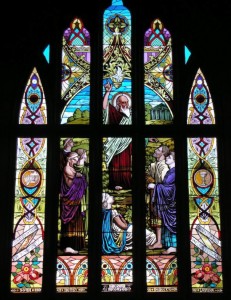 Lenten Journal, Day 32 – 5th Sunday in Lent

