 I am not preaching today, the 35th anniversary of my ordination to the priesthood. If I were, I might offer something like this, but then again I might not. These are simply my thoughts apropos of today’s gospel lesson (Matthew 10:24-39) in light of the day. Particularly Jesus disturbing statement, “Do not think that I have come to bring peace to the earth; I have not come to bring peace, but a sword…. and one’s foes will be members of one’s own household.”[1] I would start the sermon with the story of a dog.
In November, 1941, a brick maker named Carlo Soriani found an injured puppy by the side of the road in the village of Luco di Mugello, which is a neighborhood in metropolitan Florence. He took the puppy home, nursed it back to health, and then he and his wife adopted the dog and named it “Fido” (pronouncedo “Fee-doh” in Italian), a name meaning “faithful.”
Mr. Soriani worked at a brick kiln some miles away from his home. Every morning he went to the bus stop at the Piazza Dante in the center of Luco di Mugello accompanied by Fido; he’d get on the bus and Fido would go back home. Every evening, Fido would go to the bus stop and wait for Carlo, and then they’d walk home together. Everybody in Luco di Mugello got to know Fido.
On December 30, 1943, the brick kiln was bombed and Carlo Soriani was killed. That evening, Fido went to the bus stop like he always did, but Carlo didn’t get off the bus. Fido went home, but he returned to the bus stop the next evening to wait and, again, no Carlo. He did it again the next evening, and the next, and the next. Fido went to the bus stop to wait for Carlo every evening for the next 15 years, until he died, at the bus stop, on the night June 9, 1958. Mrs. Soriani buried Fido in the municipal cemetery next to her husban Carlo.
The village erected a statue of Fido at the bus stop in the Piazza Dante which is still there; it bears the legend “A Fido, Esempio di Fedelta (To Fido, Paragon of Faithfulness)”. I learned of Fido and saw his statue when, in June of 1969, I spent part of the summer in Florence with my brother Rick and his wife Jan. They were there because Jan was working on her doctorate in Italian literature; Rick and I went to the Dante Aleghieri Scuola per Stranieri and tried to learn to speak Italian. It was a great summer, one of those formative experiences that stay with you all your days.
Twenty-two years after that summer, as I mentioned before, on June 21, 1991, the Rt. Rev. Stewart Clarke Zabriskie, then Bishop of Nevada, and the college of presbyters of that diocese, laid hands on me and made me a priest. So this is a day of great happiness, because the gift of the priesthood has been a source of profound joy through all these three-and-a-half decades. To share the gospel of love, to preside at the Holy Eucharist, to stand with people at the brightest and at the darkest times of their lives – at weddings, at baptisms, at hospital bedsides, at gravesides – and to offer them God’s blessing and the message of hope; these are the sources of that joy. So today I celebrate.
But it is also an anniversary of profound grief.
Two years to the day after my ordination, Rick, who was my only sibling, died of brain cancer, glioblastoma, the same disease that killed the late Senator John McCain. It’s a horrible disease, invariably fatal. Back when Rick was diagnosed the average lifespan following onset of symptoms was six months; for Rick it was nine. His first signs manifested in October 1992, but were misdiagnosed as a stroke. It wasn’t determined to be cancer until January. When it was, he set himself a goal: to live long enough to see his daughter Saskia, his firstborn, graduate from college, to be there for her on that big day in May. To make that goal required some truly heroic and, frankly, sacrificial palliative measures.
Rick was the vice-president of San Diego State University in California, where he was also Dean of the Faculty and chair of the Department of Political Science. He had authored several books and scholarly articles; he spoke four languages, loved baroque music, read English and French mystery novels, and collected modern art. He gave all that up in order to be with Saskia on her graduation day. To extend his life long enough that he could do so, neurosurgeons excized as much of the tumor as possible, taking a good deal of brain matter with it. He lost much of his memory and his ability to communicate. As the disease progressed, that worsened. The last time I spoke to Rick, just a few days before he died, he couldn’t remember his children’s names; he couldn’t remember the three colors of the lights on traffic signals; he could barely frame even the simplest sentence. The tragic thing was that he knew he used to be able to do all those things and so much more, but he’d given them up to stand with his daughter as she graduated from college. That’s faithful parenting in the face of adversity.
Faithfulness is what Jesus is talking about in today’s story from Matthew’s gospel. When he says these hard and, frankly, harsh words, that he brings not peace but a sword, that because of his gospel there will be conflict within families, that his followers must love him more than they love their parents or their children, that “those who find their life will lose it, and those who lose their life for my sake will find it,”[2] he is talking about what the great German pastor theologian Dietrich Bonhoeffer called “the cost of discipleship.”[3] Being faithful to the teaching and example of Jesus of Nazareth is costly. Faithfulness of any kind makes demands; Christian faithfulness demands sacrifice, especially.
For priests, this means giving up a normal life. Our tradition does not demand as much as some others. We are not expected to be celibate and forego the pleasures and demands of marriage and parenthood, but we do give up the idea that our time is our own, the notion that “what we do” is something we can leave behind at 5 o’clock each evening and return to at 9 a.m. the next day, the concept of a “weekend.”
Frankly, we also give up the institution of friendship. Oh, we have colleagues and people to whom we grow close, but my wife once wisely observed a couple of years after I was ordained, “We no longer have friends; we have parishioners.” As much as we protest against it, claiming there is no difference between the laity and the ordained, the truth is that once the bishop lays hands on a person, there is a change in the way one is perceived by others, a change in all your interpersonal interactions. If you don’t believe me, just put on a dog collar for a day and go about your usual activities. People stop telling you risque jokes. They look at you horrified if you utter a curse word, lose your temper, or criticize a politician in public. And if they do any of that, even if you don’t know them, they will turn to you and apologize. The first few times it happens, it’s really weird. Especially when it comes from people whom you’ve known for years!
And it happens not just to you, but to your family. Clergy life is often described as “life in a fishbowl.” Everyone in your parish knows your business, or at least thinks they have a right to know your business (although they may not think you have any right to know theirs). Your social life as a family becomes inextricably tied to your church; you don’t really have much time for one outside the parish. And the result is that you become painfully familiar with the phenomenon of “ghosting.”
You know that is, right? Wikipedia defines it as “the practice of suddenly ending all communication and avoiding contact with another person without any apparent warning or explanation and ignoring any subsequent attempts to communicate.”[4] This is frequently how people leave church congregations. They just disappear. They ghost the pastor and many of the other members. Why did they leave? There are many reasons people stop attending a church: some because they disagree with something that was preached or some position taken by the church or the priest; most for other reasons. But you don’t know. You try to find out; you get rebuffed. You doubt yourself. Was it something you said or did? You feel like Fido, the Italian dog. These people you showed up for, whose weddings you were part of, whose babies you baptized, whose hands you held through illness and the deaths of loved ones and the losses of jobs, for whom you keep showing up, don’t … they don’t show up, and they never do again. And it hurts. Whatever the reason may have been, losing the people you’ve grown to love – especially if it’s by ghosting – hurts!
Like Fido, you keep coming back. You keep waiting for these people who became important to you, but whom you no longer see. Like my brother, you cut away parts of yourself so you won’t feel the pain of the abandonment. Like the person Jesus describes in the gospel lesson, you accept that the person who has ghosted you is no longer part of your church family. You don’t want to think of them as “enemies” (the word Jesus uses in this gospel passage), but the part of your life that they were a part of is lost. Faithfulness to your calling as a priest, faithfulness to Jesus’ gospel, demands that you experience this.
Of course, this is true to some extent of everyone who tries their best to be faithful to Jesus. I’m sure everyone has experienced friends, companions, colleagues, or co-workers who, upon learning of your commitment to your faith, have turned away to one extent or another. We all have to deal with the harsh truth of Jesus’ words.
I remember wondering, as I was preparing for my ordination, why Psalm 43 is appointed for the ordination of a priest because it contains this verse which seems so incongruous, the fifth verse:
Why are you so full of heaviness, O my soul?
and why are you so disquieted within me?
35 years later, after 35 years of showing up and after 33 of these paradoxical anniversaries, I no longer wonder about that.
Faithfulness to Jesus is a source of great joy, but it can be … it will be; Jesus assures us of this … it will be also a source of great pain and profound griet, of great heaviness and enormous disquiet. The dual nature of this anniversary, a celebration of my ordination and the grieving over the loss of my only sibling, reminds me of the sacrifices that faithfulness requires, and keeps me grounded. Instead of wondering about Psalm 43, I find I can pray its last verse with thanksgiving:
Put your trust in God;
for I will yet give thanks to him,
who is the help of my countenance, and my God.[5]
Amen.
====================
This is not a homily. I have, as of early June 2026, stepped aside from prieslty ministry for the time being, so on this anniversary I neither presided nor preached at Sunday worship. This is simply a meditation, written off the cuff, with very little editing.
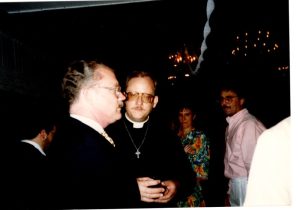
The illustration is a snapshot of my late brother and me at the reception following my ordination service at Christ Church Episcopal, Las Vegas, Nevada, on June 21, 1991.
====================
Notes:
Click on footnote numbers to link back to associated text. Unless otherwise indicated, all quotations from Scripture are from the New Revised Version Updated Edition.
[1] Matthew 10:34,36
[2] Matthew 10:39
[3] See Dietrich Bonhoeffer, The Cost of Discipleship (Scribner, New York:1963)
[4] Ghosting (behavior), Wikipedia
[5] Psalm 43:5-6 (BCP Version) from The Book of Common Prayer 1979


Leave a Reply