 When I was in the 8th Grade, I attended Robert Fulton Junior High School in Van Nuys, California, which is in the San Fernando Valley area of the Los Angeles metroplex. At some point during the year, Mrs. R. Smith, who taught English, gave my class an assignment to memorize and interpret a poem; we had to get up in front of the class, recite the poem, and then give our interpretation. When it came to be my turn, I recited my chosen poem, said what I believed it meant, and explained my interpretation. Mrs. Smith responded, “Your interpretation is wrong,” to which I replied, “I can interpret a poem any damned way I please!”
Well, as you might expect, she immediately ordered me to the Vice-Principal’s office, where I sat for about an hour and a half waiting for my mother whom the Vice-Principal called, to come from her office in another part of Los Angeles. I missed two other classes because of my rejection of Mrs. Smith’s one-right-interpretation approach to poetry and, while I remember the punishment, I no longer remember the poem nor the lesson she was trying to teach.
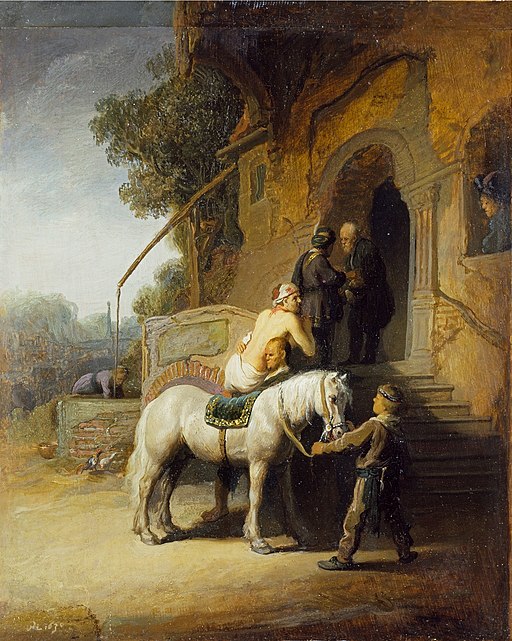
I tell you this story because that one-right-interpretation approach is the way the church has looked at the Parable of the Good Samaritan for most of its existence; for the first 1500 years that one right way was a lot different than the way most of us hear the story today.

 There is an old tradition in the church: on Trinity Sunday, rectors do their best to get someone else to preach. If they have a curate or associate priest, he or she gets the pulpit on that day. If not, they try to invite some old retired priest to fill in (as Rachel has done today). No one really wants to preach on Trinity Sunday, the only day of the Christian year given to the celebration or commemoration of a theological doctrine, mostly because theology is dull, dry, and boring to most people and partly because this particular theological doctrine is one most of us get wrong no matter how much we try to do otherwise.
  Come Holy Spirit, Comforter, Spirit of Truth,

 When my nephew, who’s now in his mid-40s, was about six years old, he was given a homework assignment that he found frustrating and he just didn’t want to finish it, but his mother made him sit down and do it rather than something else more to his liking. In his frustration, he blurted out, “I hate you!” My late sister-in-law responded calmly, “That’s too bad because I love you.” After a moment of reflection, my nephew amended his angry outburst: “I love you, too,” he said, “but I don’t like you right now.”
 I really don’t like television commercials, and I’m pretty sure I’m not alone in that regard. It’s a common complaint; we all talk about how much we dislike TV advertising. We all subscribe to Amazon Prime, Netflix, Hulu, and other streaming services so we can avoid them. And yet, sometimes a particularly memorable advertisement tag-line will worm it’s way into one’s regular conversation. My step-father had one of those: whenever my mother made anything even slightly piquant he would say, “Mama mia, that’s a spicy meatball,” which some of you may recognize from an old Alka-Seltzer commercial.
 A book entitled Stories for the Heart was published a few years ago by inspirational speaker Alice Gray. It is a compilation of what Gray calls “stories to encourage your soul;” one of them is the following story, whose original author she says is unknown. It may not be true, but I (for one) hope it is:

