From the Book of Acts:
While they were stoning Stephen, he prayed, “Lord Jesus, receive my spirit.” Then he knelt down and cried out in a loud voice, “Lord, do not hold this sin against them.” When he had said this, he died. And Saul approved of their killing him. That day a severe persecution began against the church in Jerusalem, and all except the apostles were scattered throughout the countryside of Judea and Samaria. Devout men buried Stephen and made loud lamentation over him. But Saul was ravaging the church by entering house after house; dragging off both men and women, he committed them to prison.
(From the Daily Office Lectionary – Acts 7:59-8:3 (NRSV) – December 26, 2012.)
 On the second day of Christmas the church remembers a murder, the martyrdom of Stephen, and our Daily Office lectionary won’t let us forget it. Often the readings of the Daily Office seem to have nothing to do with the season and they seldom are tied to a saint’s commemoration, but today the morning and evening readings tell the whole story in gruesome detail.
Stephen is revered as the church’s first martyr. The word martyr in Greek merely means “witness” but the church (and thus our modern society) uses it to mean someone who has suffered and died for their faith. The Celtic church would identify three kinds of martyrdom, only one of which involves death, so-called “red martyrdom.” The others were “green martyrdom” and “white martyrdom.”
The green martyrs were those who left ordinary society for the life of a hermit on the mountaintops or islands of Ireland following the example of the Egyptian anchorites. Eventually, they merged their individual dwellings into the monastic communities which dominated the Irish church from the 6th through 9th Centuries.
White martyrs went further. They left Ireland altogether as missionaries. The first of these were Columba and his followers who founded the monastery at Iona. Others following their example went into northern Europe and beyond.
The 2nd Century theologian Tertullian said that “the blood of the martyrs is the seed of the church.” This is usually understood to mean that through the sacrifice of their lives the “red martyrs” led others to conversion and, on this Feast of Stephen, we see the great example of that in the eventual conversion of Saul, the zealous Jewish persecutor of the church, into Paul, the equally-zealous Christian missionary. But it seems to me that the blood of the green martyrs and the white martyrs, which was not spilled but continued to course through their veins during a life of prayer and service, was equally effective in the conversion of others.
It is not so much the blood of the martyrs but, as the original Greek word says, the witness of the martyrs, the example and testimony of the martyrs of all sorts, red, green, and white, that nurtures the growth of the church. On this second day of Christmas, we should remember that, in some sense, we are all called to martyrdom; we are all called to witness to our faith in the Child whose birth we continue to celebrate.
====================
A request to my readers: I’m trying to build the readership of this blog and I’d very much appreciate your help in doing so. If you find something here that is of value, please share it with others. If you are on Facebook, “like” the posts on your page so others can see them. If you are following me on Twitter, please “retweet” the notices of these meditations. If you have a blog of your own, please include mine in your links (a favor I will gladly reciprocate). Many thanks!
====================
Father Funston is the rector of St. Paul’s Episcopal Church, Medina, Ohio.

 This is one of my favorite images from Scripture, God as strong rock, castle, crag, and stronghold. In fact, during my sabbatical last year this verse kept coming to mind as I explored the ruins of castles and monastic foundations in Scotland, England, and Ireland. My fondness for this metaphor today dovetails with my thoughts the past couple of days about the nature of sovereignty (see yesterday’s meditation on praying Psalm 72 in modern America) and God’s reign (the day before, considering the modern political implications of Christ’s triumphal entry in John 9).
  “Average Sunday Attendance” – also known as “ASA” – has become a hot topic in church circles. It’s how we gauge the health of congregations, not that it’s a very good measure of that, but what other easily accessed metric to governing boards and denominational judicatories have? If the parish priest, pastor, senior minister, whatever he/she may be called is doing a good job, the assumption is, the pews are going to be full. So if we count the number of seats in the seats, voila! we know if things are good.
 As I look at life, crooked lines abound. It’s what human beings do. Bar-Jesus (as the magician Elymas is also named in the Book of Acts) may have been making the straight crooked with evil intent, but I suspect that most human beings just do it out of habit, out of an inability to do anything else, out of (maybe) some sort of primate instinct to make a mess. My mother used to admonish me, in a lot of circumstances, “Don’t get bent out of shape!” At sixty years of age, I have come to suspect that there is no way to avoid life getting bent out of shape! Crooked lines abound.
 A couple of days ago I talked about Cornelius’s conversion from pagan to Christian through some time spent as a pious not-quite-proselyte Gentile. In today’s reading Peter defends his decision to baptize the Gentiles (Cornelius and his entire household) with this great question, “Who was I that I could hinder God?” It certainly shut down his critics!
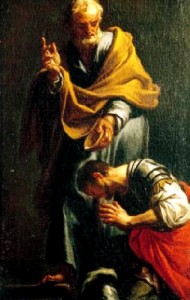 Judaism is not a missionary religion. It is, however, a proselytic religion. This means that Jews don’t go looking for converts, but those who come to them interested in becoming Jews are instructed and initiated; these initiates are called proselytes. Cornelius might have become a proselyte, but we know that he was not because if he had been, Peter would have had no issues with seeing him, meeting him, eating with him. Peter did have those issues initially, but then was shown the vision of unclean animals which he was told to eat. Peter interpreted that vision to mean that he should not treat non-Jews as unclean; it was the beginning of the Jewish Christian church welcoming non-Jews (“Gentiles”) as members.
 Saint Stephen, one of the first deacons of the church, has just preached a sermon in which he has reminded his hearers, Jewish authorities in Jerusalem, that the Jews had a history of mistreatment of prophets, Their ancestors, he has said, “killed those who foretold the coming of the Righteous One, and now [his listeners] have become his betrayers and murderers.” No wonder they were angry with him.
 This short passage from the Book of Acts describes the sort of world Jesus intended. Not just the sort of church . . . . the sort of world, the sort of human society, a complete community in which no one claims private ownership (it’s all God’s remember) and where there are no needy persons because what is needed is distributed equitably.
 These are the words spoken by the great crowd of Jews and others who thronged the streets of Jerusalem for the Festival of Shavu’ot when the Twelve, empowered by the Holy Spirit, begin to tell the story of Jesus in languages they had never before spoken. Shavu’ot is a celebration with both agricultural and historical significance in Judaism. It is known as the “festival of the first fruits,” a harvest feast when the first fruits were brought as offerings to the Temple; it is also known as the “festival of the giving of the Law,” a celebration of the handing down of Torah on Mt. Sinai. It was called Pentecost, a Greek word meaning “fiftieth”, because it always falls on the fiftieth day after the Passover. That year it fell on the fiftieth day after the Resurrection and, thus, the Christian feast of the Holy Spirit carries that name, as well.

