Occasional thoughts of an Anglican Episcopal priest

Category: Acts (Page 7 of 9)

The Neighbors Can See In! — Sermon for the Annual Parish Meeting — January 26, 2014

====================

This sermon was preached on the Patronal Feast Sunday of St. Paul’s Episcopal Church, Medina, Ohio, where Fr. Funston is rector. It was the Sunday of the Annual Parish Meeting and, as part of the service, a newly built Gallery addition to the parish’s fellowship hall was dedicated.

(The lessons for the day were for the Conversion of St. Paul from the Episcopal Church’s sanctoral calendar: Acts 26:9-21; Galatians 1:11-24; Psalm 67; and Matthew 10:16-22. These lessons can be read at The Lectionary Page.)

====================
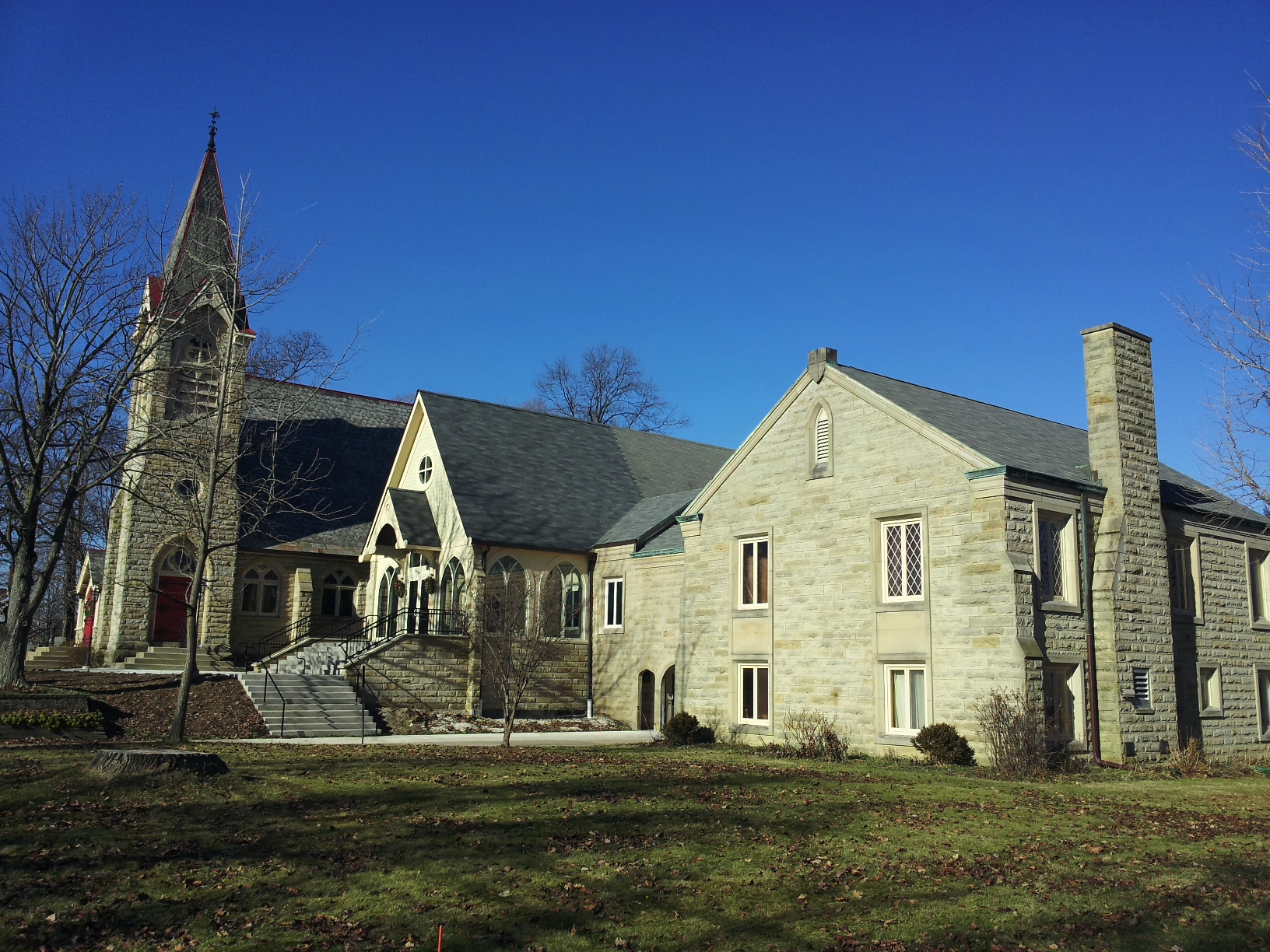
St Paul's Church -- December 2013

A few decades ago when I was studying law I was introduced to the term “officious intermeddler.” In law, an officious intermeddler is someone who, on their own and without any authority either by invitation or pre-existing legal duty, interjects himself into the affairs of another, and then seeks some sort of recompense for doing so. That pretty much describes young Saul of Tarsus and at least his initial quest to rid Judaism of the followers of Jesus of Nazareth. He was simply a rabbinic student, not any sort of priest or religious official when he began his crusade against Peter and James and the others. I don’t think he was doing it for money, but I do think he might have been looking for a pay-off in the form a religious reputation; if he was successful, he would become a powerful rabbi among the Jewish the people.

Saul was born and raised in the Greek city of Tarsus and apparently received a good education both in orthodox Judaism and in Greek philosophy; Tarsus was a center of Stoic teaching and we see a good deal of Stoicism in the letters he wrote after becoming a Christian missionary. While still fairly young, Saul was sent to Jerusalem to receive rabbinic instruction at the Hillel school under Gamaliel, one of the most noted rabbis in Jewish history. This would have exposed the young rabbinic student to a broad range of classical literature, philosophy, and ethics. Not a lot more is known of his background before he decided to make a name for himself dealing with the pesky proclaimers of what he considered to be a pernicious heresy.

Until the destruction of the Jerusalem Temple in 70 A.D. the followers of Jesus of Nazareth were simply one of many subsets of Judaism; there were few, if any, Gentile followers of Jesus and those Gentiles who wanted to be a part of the new group were required to convert to Judaism before being allowed to join the Jesus group. Judaism at the time was much like Christianity is today; there were different “schools,” similar to our denominations.

We are familiar from the Gospel stories with the Pharisees and the Sadducees, two of the competing versions of the faith; we may also be familiar with the Essenes who were part of the mix. In addition, influential rabbis had their groups of followers: John the Baptizer had had his disciples; Gamaliel had his; perhaps Nicodemus, who became a secret follower of Jesus, had his own school; and, of course, Jesus had had his. On the major feasts and liturgical days, all Jews would observe the Temple rituals together, but for their sabbath observance and instruction they would go to the synagogue which adhered to the school they found most convincing, or where their rabbi taught. They recognized each other as Jews; they just didn’t agree on some particulars. No big deal. And, usually, when their rabbi passed away, their group disbanded.

Except for the disciples of Jesus, those people who followed what they called “the Way.” Their rabbi was dead; the whole city had seen him crucified. But unlike the followers of other dead rabbis, these people didn’t disband; they claimed that their rabbi was still alive and they still met to proclaim his teachings. They even went so far as to suggest that he was divine; they were claiming that he had ushered in a new kingdom of God. In the Jewish council, the Sanhedrin, some sought to have them kicked out of the temple, but Saul’s own teacher, Gamaliel, defended them. The Book of Acts reports his words to the Sanhedrin:

Fellow Israelites, consider carefully what you propose to do to these men. For some time ago Theudas rose up, claiming to be somebody, and a number of men, about four hundred, joined him; but he was killed, and all who followed him were dispersed and disappeared. After him Judas the Galilean rose up at the time of the census and got people to follow him; he also perished, and all who followed him were scattered. So in the present case, I tell you, keep away from these men and let them alone; because if this plan or this undertaking is of human origin, it will fail; but if it is of God, you will not be able to overthrow them — in that case you may even be found fighting against God! (Acts 5:35-39)

Apparently Saul did not agree with his teacher. He became an officious intermeddler, a self-appointed — that’s really what “officious” means — a self-appointed policeman protecting the purity of the Temple; he was going to get that Jesus crowd kicked out. In his letter to the Galatians he would confess that prior to his conversion he “was violently persecuting the church of God and was trying to destroy it.” (Gal. 1:13) It is in the description of the martyrdom of the first deacon, Stephen, that we first encounter Saul in the New Testament. We don’t know whether Saul was an instigator of the events that led to Stephen’s death, but we know that he was there.

The 7th Chapter of Acts tells us that Stephen preached a sermon in the presence of the Temple council, an admittedly rather inflammatory homily, after which “with a loud shout [those present] rushed together against him. Then they dragged him out of the city and began to stone him; and the witnesses laid their coats at the feet of a young man named Saul.” (Acts 7:57-58) We are told that “Saul approved of their killing him.” (Acts 8:1) Saul didn’t take part, really; he just stood at the road side looking on.

After that, Saul became more and more openly and actively involved in the persecution of the Jesus movement, “ravaging the church by entering house after house; dragging off both men and women, he committed them to prison.” (Acts 8:3) Eventually, this officious intermeddler received his remuneration — recognition and ratification of his activities by the high priest from whom he sought, and received, letters of warrant empowering him to go to Damascus, “arrest any who belonged to the Way, men or women, [and] bring them bound to Jerusalem.” (Acts 9:2) It was while journeying to Damascus that the events he described to King Agrippa in the reading we heard this morning occurred. It was while on that road to Damascus that the truth of the Gospel of Jesus Christ, which he had been unable to see, was revealed to him. As he wrote to the Galatians, God “was pleased to reveal his Son to me, so that I might proclaim him among the Gentiles.” But in the experience, we are told in Acts, something like scales covered his eyes as if symbolizing the blindness of heart he had suffered, and until he learned the fullness of the Gospel he was unable to see.

I will return to Saul and his conversion in a moment, but before I do I want to review a little bit of our parish history. So for the moment, let’s put Saul aside but keep in mind his story, especially those scales that eventually fell from his eyes.

We are beginning the 197th year of the life of St. Paul’s Parish. Founded in 1817 in Weymouth, the congregation moved to this location in the 1830s. After about 50 years in a wooden Greek revival structure, in 1884 the congregation built the stone church in which we are worshiping today. When weather permitted they would gather for after church fellowship on the lawn, fully open to their neighbors’ view and could invite the neighbors to take part.

In 1903, they built the Parish House in which our present day Parish Hall, kitchen, and dining room are located. It was a separate structure with one of those wide and inviting Victorian front porches. When the congregation gathered after church for fellowship, education, or other activities, they came and went through the front doors of the church, onto that veranda, and in and out the front door of the Parish House, again fully visible to their neighbors whom they continued to invite to participate.

Another fifty or so years later, the congregation built Canterbury House and linked it together with the Parish House and the church building with the concourse that came to be known simply as “the hallway.” The hallway replaced the Victorian veranda with fortress-like stone wall; it cut off the neighbors’ view of the congregation’s comings and goings, and blocked the neighbors’ appreciation of the church’s fellowship and other activities. The hallway incorporated a new entryway off the driveway leading to a parking lot that was built at the rear of the church property, and it was through those doors (and other doors at the rear of the Parish House) that members began entering the church building. The front doors of the Parish House and the church building fell into disuse, and the parishioners stopped invited the neighbors.

If anything was going on inside the Episcopal Church, you couldn’t tell it from the street. Stained glass windows on the church building, opaqued windows on the hallway, that imposing stone wall, and a set of large red doors which could not be opened from the outside blocked the public’s view of whatever it was the Episcopalians were doing.

Interestingly enough, the Episcopalians couldn’t see out, either. But until the new Gallery was built, and the sunshine and view of the street let in, we had failed to notice that! We were simply unaware that when we were inside this church’s physical plant we were visually cut off from the world around us; we just didn’t notice. We sat at here at the road side, but we were disconnected from the world going by on the major trafficway outside.

To be sure, there was plenty going on inside the church. Things were booming. It was the 1960s and the World War II and Korean War generations were coming to church, raising their children, participating in church clubs, holding fundraisers, even reaching out in overseas mission. The Episcopal Church was an active place . . . you just couldn’t tell it from the street.

And that story was true for the Episcopal Church as a whole, as a national institution, as well. We were pretty much a self-contained and self-reliant denomination. Someone not born into the Episcopal Church might occasionally wander through our doors, become fascinated with our peculiar style of being Christian, and join us, but we didn’t go out and encourage that sort of thing. Billy Graham and people like him might go out and evangelize and try to convert people, but that just wasn’t our style. We were doing quite well behind our stone walls and opaque windows, and our understanding of evangelism was that it was something other people did. After all, as one grand dame of the era is supposed to have put it, “Everyone who should be an Episcopalian already is one.” The world outside the Episcopal Church didn’t know much about us, and we were fine with that.

Then came the 1970s and things began to change. Social change was in the air both in the secular world and in the church. It was not comfortable. Women started suggesting that some of them might have a call to ordained ministry, and some of our best theologians supported them and agreed; behind our stone walls and opaque windows we were fighting like cats and dogs about it. The outside world only got a glimpse of it when a few very angry people threw open the red doors and stormed out, proclaiming themselves to be the only real Anglican Christians and the rest of us heretics, doomed to Hell. We got a lot of press, but not the kind of attention we really wanted. As soon as we could, we closed the red doors and regained our composure behind our stone walls.

But then, not very many years later, the General Convention approved a new Prayer Book. The process of revision had been going on for nearly 20 years but most of us hadn’t been paying attention. When the new book was approved in 1976 and then ratified in 1979 it seemed to many that the church was being completely overturned. The outside world got another glimpse of us when some more very angry people threw open the red doors and stormed out, proclaiming that they used the only real Anglican Prayer Book and that the rest of us were heretics, damned to Hell. Again, we got a lot of press, but once again it was not the kind of attention we really wanted. As soon as we could, we got back behind our stone walls.

Things were quiet for a while, but then the people of the Diocese of New Hampshire decided to elect their Archdeacon to be their Bishop and, horror of horrors, it turned out (they had known all along) he was a homosexual living in a committed, long-term relationship with another man. All hell broke loose behind our stone stone walls and opaque windows as we dealt with that. The arguing got so loud that the neighbors could hear us and, again, a group of very angry people threw open the red doors and stormed out, proclaiming themselves to be the only real Anglican Christians and the rest of us heretics, definitely headed straight to Hell. Again, we got a lot of press, and again we tried to regain our composure behind our stone walls. But we couldn’t because, finally, we started noticing something.

We noticed that the church was getting smaller. Fewer people were attending. Fewer children were enrolling in Sunday School. Fewer teens were coming to EYC meetings. Fewer dollars were getting deposited into the bank. And we decided, because we had gotten out of the habit of looking outside, that it was because of something we had done — it was because we ordained women; it was because we’d changed the Prayer Book; it was because we had a gay bishop. We were wrong, however. If we hadn’t been shut up behind our stone walls and opaque windows, we might have noted that the same thing — lower attendance, fewer children, fewer teens, less income — was happening to the Lutherans, and the Methodists, and the Presbyterians, and also to non-church groups like the Masons, and the Elks, and local bowling leagues. There was a societal change going on and, unable to see out through our stone walls and opaque windows, we couldn’t see it. We couldn’t figure out why the church was leaking membership because we weren’t looking in the right place.

And while all of that was going on . . . every time it rained there was water pouring into the church basement. Every time there was a heavy snow and it melted, there was water pouring into the basement. We got used to seeing buckets in the entryway and water stains on the basement ceiling because we couldn’t figure out where the leak was and we couldn’t figure out how to stop it. Physically, as well as metaphorically, we couldn’t figure out why the church was leaking.

We’ve learned a thing or two in the Episcopal Church in the last decade. We’ve learned that the church fails to grow not because of our internal failures; it fails to grow because of our external failures. The church has failed to grow because we have sequestered ourselves behind stone walls and opaque windows, and have failed to engage with our neighbors, who cannot see what we are doing and to whom we have not been paying attention. Out of this have come movements and experiments to get our denomination back out, on the other side of our stone walls, back into public engagement.

We are seeing new ministries such as “Church Without Walls,” an experiment in the Jacksonville, Florida, which calls people from all walks of life into partnership with “the least of these.” “Church Without Walls” describes itself as “a community of presence made up of individuals looking for the spiritual companionship and connection that give meaning to life.” The community seeks to welcome everyone — the homeless and the affluent, the addicted and those in recovery, the churched and the un-churched, the spiritual but not religious, the believer, the doubter and the seeker. They are grounded in the reality that “by opening ourselves to strangers, the despised or frightening or unintelligible other, we will see more and more of the holy.” (Description from the Diocese of Florida website.) And similar communities are being created in San Jose, California; Springfield, Pennsylvania; Bentonville, Arkansas; Milwaukee, Wisconsin; and elsewhere.

We are seeing experiments in public liturgy such as “Ashes to Go” — an effort to give people an opportunity to receive the mark of repentance and encourage them to give thought to their spiritual lives without requiring them to attend a full Ash Wednesday service. The first such public imposition of ashes was offered by the cathedral in Chicago, Illinois, and has since been offered in a variety of locations throughout the country, including some places here in Ohio.

What the Episcopal Church has learned through these and other programs is that we have to tear down the stone walls and break out the opaqued windows that have separated us from our neighbors. When we do that and the church again engages with the world around it, the leaking stops; the church begins to grow again. Like Saul, after the scales fell his eyes when he was baptized and took the name Paul, by which we know him better, we have seen the truth and know that we, too, are “to open [the eyes of those around us] so that they may turn from darkness to light and from the power of Satan to God, so that they may receive forgiveness of sins and a place among those who are sanctified by faith in [Jesus].” (Acts 26:18)

And here we are in a congregation that has quite literally removed its stone wall and its opaqued windows, whose neighbors can now see clearly what is going on in the Episcopal Church, and who can see our neighbors even when we are inside our building. We have opened ourselves to engagement with the world around us. We are not a “Church Without Walls,” but we have become a church that lives in glass house . . . the neighbors can see in and we’d better make sure that what they see is good stuff!

If you have picked up a copy of the 2014 Annual Journal, you will see some interesting data. We are at the beginning a new period of growth. For 2013 we have a mixed bag of membership statistics: 21 new members joined the congregation by baptism, confirmation, reception or transfer; we had larger congregations for both Easter and Christmas services; we had more Sunday services. On the other hand, our average attendance is down slightly. The task before us is to grow both in membership and active commitment. The foundation is here. For 2014, we have a 7% increase in the number of pledging households; total pledging is up (compared to last year) by over 4%. We have a committed membership.

Our outreach to the community is strong. The Free Farmers’ Market, our food pantry, assisted 5,333 individuals during the past year, distributing nearly 50,000 pounds of food. The volunteer effort to accomplish that is phenomenal, and all members of the coordinating committee and all the volunteer workers are to be commended. Our support of the regional Battered Women’s Shelter expanded this year as, in addition to the regular monthly collection of supplies, our new Lenten Rose Chapter of the Daughters of the King oversaw a special drive for personal hygiene items and, through the effort of our Senior Warden, we provided several dozen stuffed toys to the children sheltered there. Our youth group also continued their annual tradition of making and giving away teddy bears to needy children at Christmas time.

Outreach of a different sort is exercised in the monthly Brown Bag Concert program which is entering its seventh year. Our music director is to be commended for the excellent work she does in recruiting performers and hosting our guests at those events. Because of the construction of the new Gallery, we did not hold any “Fridays at St. Paul’s Concerts,” but we are looking forward to the return of that program as early as this coming May when the chamber ensemble of the Cleveland Philharmonic Orchestra will be performing in this sanctuary.

Fellowship continues with the men’s breakfasts, the Episcopal Church Women, the new Daughters of the King chapter, the Sunday morning breakfast group, and the return this month of the Foyer Group dinner program. Christian education for children and youth is going strong with Godly Play and the Episcopal Youth Community; many of our EYC members are recognized leaders in the diocesan youth programs and are to be commended for that. Many of them are not here today because they have spent the weekend in training to lead the next “Happening” retreat for young people. For adults we have a regular weekly bible study and, starting last September, an Education for Ministry seminar group going strong.

By nearly every measure, this is a vibrant and lively parish. This church is no longer leaking! It is not leaking rain water into the basement; it is not leaking membership. Both the literal and the figurative stone walls have fallen away, like the scales that fell from St. Paul’s eyes, and the vibrancy and life of this parish is visible for all to see and for all to be invited into.

We were blinded and confused by our stone walls and our opaque windows, whether figurative or literal, but in the end, we know that we are called, as Paul was, to share the wonderful news that the risen Jesus, the Son of God, is Messiah and his kingdom is here now. Our experience of engaging in the Inviting the Future Project and building our beautiful new Gallery, is our “ Damascus Road ” experience. A new day for St. Paul’s Parish is shining through the windows of the Gallery and our calling is to insure that the neighbors — who can see us once again, just as they could in 1884 and in 1903 and in every year up to 1960, and (more importantly) whom we can now see — our calling is to insure that they can see the kingdom of God shining out, that they are invited to come into it.

Let us pray:

Give us grace, O Lord, to answer readily the call of our Savior Jesus Christ and proclaim to all people the Good News of his salvation, that we and the whole world may perceive the glory of his marvelous works; who lives and reigns with you and the Holy Spirit, one God, for ever and ever. Amen. (Collect for the 3rd Sunday after Epiphany)

====================

A request to my readers: I’m trying to build the readership of this blog and I’d very much appreciate your help in doing so. If you find something here that is of value, please share it with others. If you are on Facebook, “like” the posts on your page so others can see them. If you are following me on Twitter, please “retweet” the notices of these meditations. If you have a blog of your own, please include mine in your links (a favor I will gladly reciprocate). Many thanks!

====================

Father Funston is the rector of St. Paul’s Episcopal Church, Medina, Ohio.

The Worms of Pride – From the Daily Office – July 17, 2013

From the Book of Acts:

Now Herod was angry with the people of Tyre and Sidon. So they came to him in a body; and after winning over Blastus, the king’s chamberlain, they asked for a reconciliation, because their country depended on the king’s country for food. On an appointed day Herod put on his royal robes, took his seat on the platform, and delivered a public address to them. The people kept shouting, “The voice of a god, and not of a mortal!” And immediately, because he had not given the glory to God, an angel of the Lord struck him down, and he was eaten by worms and died.

(From the Daily Office Lectionary – Acts 12:20-23 (BCP Version) – July 17, 2013.)

Parasitic HookwormOccasionally when studying Scripture I have thought, “This can’t possibly have happened.” I’m sure that what I am reading is meant to be an allegory or a metaphor, or that it is simply pious legend that the biblical author has incorporated into his story. This strange little story of the death of Herod Agrippa I was one of those passages. It’s just a little weird.
It turns out, however, that this story is verified by an extrabiblical source. The Roman Jewish historian Flavius Josephus recounts almost the same series of events. In Josephus’s telling, Herod wears a robe of silver rather than purple, but the meaning is the same: royal pride. In addition, Josephus adds the details that Herod sees an owl perch overhead during the daytime, a negative omen, and that Herod suffered severe and disabling abdominal pain for five days before dying, suggesting that the “worms” may have been intestinal parasites.

Where Josephus and the author of Acts (Luke) most agree is with regard to royal pride. Not only do they both portray Herod in that splendid purple or silver robe, Josephus parallels Luke saying, “Presently his flatterers cried out, one from one place, and another from another, (though not for his good) that he was a god . . . . Upon this the king neither rebuked them nor rejected their impious flattery.” (Antiquities 19.8.2)

I don’t know whether Herod’s parasites, suffering, and death were, in fact, a divine punishment for pride; they may simply have been the result of his prideful behavior. Sometimes out of vanity, we humans can do things that are not good for our health. I’ve been guilty of that myself. Indeed, even during the past few days.

We are undertaking a remodeling project at my parish, expanding the parish hall and rebuilding the street-side entrance of one wing of our building. It is work necessitated by the deterioration of the foundation of a 1960s addition to the church building. That deterioration has been most evident inside a basement storage area we affectionately refer to as “the mushroom farm.” Dark, damp, dank, and smelly, this large closet has suffered most from seepage of ground water through the concrete and cinder block of the foundation. It has been, for a long time, a place of mold and mildew.

Another place where these have grown is in the plenum between the cinder block exterior walls and the interior drywall affixed to them through use of 1″ x 3″ wooden furring strips. Over the years, as water has leaked through the walls, the wood has been stained, has rotted, and has been a medium for growth of mold.

As the workers demolishing these structures in preparation for our new construction have done their work, they have kicked up mold-laden concrete and wood dust. Each day during their labors, I have been walked through the site several times taking photographs of their progress. I want to document the need for and the progress of this renovation. This may be, I will admit, a matter of vanity or pride that I do so.

It’s also rather stupid of me!

One of the earliest instructions that was deeply impressed upon me as a child was to instruct medical people that I am allergic to penicillin. Whenever I do, I am asked, “What happens when you take it?” I have to answer honestly, “I don’t know. I’ve just always been told that I am allergic to it.” Being allergic to penicillin might, you would imagine, suggest to one that there might be an issue of sensitivity to other molds . . . . But I grew up in the desert! Molds were not an issue!

Until I moved to the midwest . . . Twenty or so years ago when I moved to the Missouri River valley (in the Kansas City area) and the high humidity of northeastern Kansas, I discovered seasonal molds play havoc with my health. Then ten years ago I moved to northeastern Ohio – more of the same.

Knowing this, I should be staying completely away from the demolition of the mushroom farm and the moldy drywall furring, shouldn’t I? But I insist on documenting this project . . . so my allergy, like Herods “worms,” is having a field day.

A few years ago, the indie rock group Chaotica put out a tune called Mr. Vanity. Among its lyrics are these words:

Why must you hide
Way inside, Mr. Vanity?
Why do you try to deny
Your own humanity?

So who died? Made you king?
You’re not god of anything.
What are you? Just a man!
Who on Earth gave you
The master plan?
Get a life. Get a clue.
Someone here should humble you.

* * *

Feed your greed
And your pride…
Hope it eats you up inside.

Those lyrics could almost have been written based on the story of the death of King Herod Agrippa I! That story from Acts, which Josephus’s testimony shows to be an historic one, reads like an allegory. It certainly could be one. His pride (in the form of those worms, those intestinal parasites) ate him up inside! Mine is making me sneeze my fool head off!

Pride is destructive. The worms of pride do eat you up inside!

But . . . confession time . . . I plan to keep on visiting the work site and taking photographs. I will put up with the sneezing and coughing! Mea culpa, mea culpa, mea maxima culpa!

====================

A request to my readers: I’m trying to build the readership of this blog and I’d very much appreciate your help in doing so. If you find something here that is of value, please share it with others. If you are on Facebook, “like” the posts on your page so others can see them. If you are following me on Twitter, please “retweet” the notices of these meditations. If you have a blog of your own, please include mine in your links (a favor I will gladly reciprocate). Many thanks!

====================

Father Funston is the rector of St. Paul’s Episcopal Church, Medina, Ohio.

Seven Times a Day? – From the Daily Office – July 3, 2013

From the Psalter:

Seven times a day do I praise you, because of your righteous judgments.

(From the Daily Office Lectionary – Psalm 119:164 (BCP Version) – July, 2013.)

Book of Common Prayer (1979)The Book of Acts, the earliest church history, tells us that the followers of Jesus practiced daily prayer: “Day by day, as they spent much time together in the temple, they broke bread at home and ate their food with glad and generous hearts.” (Acts 2:46) Eventually, the Christians were excluded from Jewish worship assemblies, either by their own choice or by action of the authorities, and in an unrelated development, the Temple was destroyed in 70 AD. Where, then, did Christians pray together? Or, for that matter, alone?

It is likely that there were ascetics who sought solitude away from the cities and what they perceived as a sinful society around them from the start of the Christian community. They may have emulated John the Baptizer and his followers, the Jewish Essenes, or other esoteric communities. However, the first historically verifiable hermit (or “anchorite”) seems to be St. Anthony of Egypt. Unfortunately for him, others were attracted to his lifestyle and he found himself surrounded by disciples following his example. During Anthony’s lifetime, one of his followers, St. Pachomius established the first community for ascetics living together, “cenobites,” during the early part of the Fourth Century. By the end of the Fifth Century, these monks had developed the practice of gathering together for prayer and the early outlines of a Liturgy of the Hours composed of seven “offices” had emerged. It is possible that number of services was chosen because of this (and similar) verses in Scripture.

The foundation of modern western monasticism was the Rule of St. Benedict, authored by Benedict of Nursia in the 6th century. As part of his design for monks living in community, he adopted the practice of regular hours of prayer, adding an eighth. The eight monastic hours are the following:

  • Matins (during the night, usually at midnight; sometimes called Nocturns)
  • Lauds (at dawn, or 3 a.m.)
  • Prime (approximately 6 a.m.; this is the hour added by Benedict)
  • Terce (approximately 9 a.m.)
  • Sext (approximately 12 noon)
  • None (approximately 3 p.m.)
  • Vespers (approximately 6 p.m., “at the lighting of the lamps”)
  • Compline (approximately 9 p.m., before retiring)

Archbishop Thomas Cranmer, the genius behind the Anglican Prayer Book tradition, took bits and pieces of these monastic hours to create the offices of Daily Morning Prayer and Daily Evening Prayer included in The Book of Common Prayer of 1549 and in every revision of the Prayer Book since. It was Cranmer’s idea that individuals and families, like monks in community, would say these offices every day, coming together with others on Sundays to celebrate the Holy Communion.

It was, I’m afraid, a wonderful but never realized vision; I doubt very seriously that there has ever been a time since the Reformation when Anglicans, in general, stop during their days for even a single instance of regular, corporate, liturgical prayer, let alone twice a day, let alone seven or eight times a day. Nonetheless, the Anglican ethos is one of constant daily prayer deriving from the Scriptural witness of the Psalms.

It is my practice to say the Daily Offices at morning and evening and, occasionally, Compline before retiring. The current American Prayer Book of 1979 includes two forms of Morning Prayer, an office for Noonday Prayer, two forms of Evening Prayer, an order for Compline, and four short forms for individual prayer throughout the day. Our tradition is steeped in the monastic tradition!

But how many of us can say this verse of Psalm 119 with complete authenticity? I know that I can’t! Two times a day? Usually. Seven times a day? It just doesn’t happen! It probably should, but it doesn’t.

====================

A request to my readers: I’m trying to build the readership of this blog and I’d very much appreciate your help in doing so. If you find something here that is of value, please share it with others. If you are on Facebook, “like” the posts on your page so others can see them. If you are following me on Twitter, please “retweet” the notices of these meditations. If you have a blog of your own, please include mine in your links (a favor I will gladly reciprocate). Many thanks!

====================

Father Funston is the rector of St. Paul’s Episcopal Church, Medina, Ohio.

Leopards Changing Spots – From the Daily Office – July 1, 2013

From the Book of Acts:

They dragged [Stephen] out of the city and began to stone him; and the witnesses laid their coats at the feet of a young man named Saul.

(From the Daily Office Lectionary – Acts 7:58 (NRSV) – July 1, 2013.)

LeopardThis is the first appearance in the Christian story of the man who will become the early church’s greatest evangelist and the author of most of the New Testament. We are told that as he witnessed the martyrdom of the first deacon, “Saul approved of their killing him.” (Acts 8:1)

Saul would take the Gentile form of his name, Paul, when baptized and under that name would spread the Christian faith among non-Jews. One assumes that, from time to time, he might have told the story of witnessing Stephen being killed – it would make a powerful sermon illustration, don’t you think? He obviously told it to someone because eventually it got to Luke, who included it in his little history of the church.

This story of a public execution brought to mind a conversation I had with a parishioner just a few days ago. Texas recently executed its 500th death-penalty convict since resuming executions in 1980s; that news led us into a discussion of the death penalty. I am opposed to the death penalty on several grounds; my parishioner favors it. In the course of our conversation he put forth the argument that execution rids society of criminals who will kill again. He’s convinced that killers don’t change: “The leopard never changes his spots,” he said.

He certainly has the Bible (or at least the the Old Testament on his side. This old shibboleth comes from word of God spoken through the prophet Jeremiah! Lamenting the sinfulness of God’s People, the Lord asks: “Can Ethiopians change their skin or leopards their spots?”(Jer. 13:23, NRSV). Of course, the message of the prophet would suggest that the answer to that question is “Yes” else why call the people to repentance? And therein lies the theological and ethical issue I have with the death penalty. (I have legal, economic, and practical issues with it, as well.)

The death penalty denies the power of God in Christ to redeem, restore, and transform human existence. It precludes any possibility of repentance and amendment of life. When the capital punishment is imposed, the life of the convicted person is devalued and all possibility of change is ended. When the government undertakes capital punishment on behalf of the people (on my behalf), the people are implicated in that judgment and we are made to share in an ethic we may not accept (one which I do not accept). An ethic which says, as my congregant put it, that “leopards cannot change their spots.”

But that is not the Christian ethic (nor is it the ethic of the Old Testament in which that image is first spoken). The Christian ethic says that repentance is always possible. It is, in a very real sense, the whole message of Christ: “Repent, for the kingdom of heaven has come near.” (Matthew 3:2) The leopard can change its spots and the Christian hope is always that it will.

After all, Saul – who held the cloaks of the executioners and approved their killing of Stephen – changed his!

====================

A request to my readers: I’m trying to build the readership of this blog and I’d very much appreciate your help in doing so. If you find something here that is of value, please share it with others. If you are on Facebook, “like” the posts on your page so others can see them. If you are following me on Twitter, please “retweet” the notices of these meditations. If you have a blog of your own, please include mine in your links (a favor I will gladly reciprocate). Many thanks!

====================

Father Funston is the rector of St. Paul’s Episcopal Church, Medina, Ohio.

Change Is Life – From the Daily Office – June 25, 2013

From the Book of Acts:

“I tell you, keep away from these men and let them alone; because if this plan or this undertaking is of human origin, it will fail; but if it is of God, you will not be able to overthrow them — in that case you may even be found fighting against God!”

(From the Daily Office Lectionary – Acts 5:38-39 (NRSV) – June 25, 2013.)

Emerging Monarch ButterflyThe Pharisee Gamaliel gave sound advice to the Sanhedrin: “Leave them alone. If their movement is of God, you will not be able to stop it.” It’s advice the church, which benefited from it, has often failed to heed. We ought to follow it more often than we do . . . but there is that other rule the church more frequently follows: “Any change, at any time, for any reason, is to be deplored.” (Often attributed to an otherwise unidentified Victorian-era “Duke of Cambridge.”)

Episcopalians are said to be the poster children for this rule. The old joke asks, “How many Episcopalians does it take to change a light bulb?” . . . .

“Change! My grandmother gave that lightbulb!”

None of us are really comfortable with change. I suspect that most people, if they had their druthers, would just keep things mostly the same. For most of us the status quo is comfortable and staying the course gives us a sense of security. A read recently about a guy who bought a new radio, brought it home, placed it on the refrigerator, plugged it in, turned it to a station coming out of Nashville, home to the Grand Ole Opry, and then pulled all the knobs off. He had he wanted and had not intention to change.

But life without change isn’t life. It’s death. If there is one constant in this world it is that living things change; only lifeless things are static. And life, as Scripture tells us, is God’s will for God’s People. Isaiah prophesied, “No more shall there be in it an infant that lives but a few days, or an old person who does not live out a lifetime; for one who dies at a hundred years will be considered a youth, and one who falls short of a hundred will be considered accursed.” (Isa. 65:20)

Take heed of Gamaliel’s words to the Sanhedrin. Change is evidence of life, and life is the will of God, so change may be of God and, if so, you will be unable to overthrow it.

====================

A request to my readers: I’m trying to build the readership of this blog and I’d very much appreciate your help in doing so. If you find something here that is of value, please share it with others. If you are on Facebook, “like” the posts on your page so others can see them. If you are following me on Twitter, please “retweet” the notices of these meditations. If you have a blog of your own, please include mine in your links (a favor I will gladly reciprocate). Many thanks!

====================

Father Funston is the rector of St. Paul’s Episcopal Church, Medina, Ohio.

Nominate, Pray, Take Your Chances – From the Daily Office – June 18, 2013

From the Book of Acts:

So they proposed two, Joseph called Barsabbas, who was also known as Justus, and Matthias. Then they prayed and said, “Lord, you know everyone’s heart. Show us which one of these two you have chosen to take the place in this ministry and apostleship from which Judas turned aside to go to his own place.” And they cast lots for them, and the lot fell on Matthias; and he was added to the eleven apostles.

(From the Daily Office Lectionary – Acts 1:23-26 (NRSV) – June 18, 2013.)

Note: This blog has been “silent” the past few days for a variety of reasons. It was John Lennon, I believe, who observed that “life is what happens to you while you’re busy making other plans.” The past half-week or so has certainly been an example of that!

Drawing StrawsToday’s reading from Luke’s history of the early church details the method by which the eleven remaining apostles chose someone to replace Judas. It was a simple method: (a) identify the candidates; (b) pray; (c) take your chances. They drew lots, but they might have thrown dice, cut a deck of cards, flipped a coin, or done any number of other things that would have randomized the outcome.

There is something instructive in this lesson for Episcopalians who are now preparing for the 2015 meeting of the General Convention of the Episcopal Church at which a new Presiding Bishop will be chosen.

The Presiding Bishop is the Episcopal Church’s chief pastor (“head cook and bottle-washer” my late stepfather would have said). He or she (our current PB is a woman) is the Primate and Metropolitan of the church, equal in rank to the Archbishop of Canterbury and the other head pastors of the several autocephalic (independent and self-governing, though related and interdependent) provinces of the Anglican Communion.

How the Presiding Bishop is selected has changed three times in the 200-plus years of the American church’s existence. Under the original 1789 constitution of the church, the Presiding Bishop was simply the senior bishop in order of consecration. He (back then it was always “he”) served until death or retirement, when the next senior bishop took over; the Presiding Bishop retained his diocesan position (and in those days a bishop was also a parish rector). His only real duties were to be chief consecrator of new bishops and to preside at meetings of the House of Bishops; there was no national church administration and, to be honest, no Anglican Communion with which to interact. Eventually, the office was made elective in 1919. The archives of the Episcopal Church tell us:

The first election of a Presiding Bishop by General Convention took place in 1925. Since 1943 the Presiding Bishop has been required to resign diocesan jurisdiction upon election. In 1967 the duties of the office were significantly enhanced. As “Chief Pastor,” the Presiding Bishop is charged with initiating and developing church policy and strategy, speaking God’s Word to the church and the world, and visiting every diocese of the church. The title “Primate” was added in 1982. The Cathedral of Saint Peter and Saint Paul in Washington, D.C., is the official seat of the Presiding Bishop. The office of the Presiding Bishop is located at the Episcopal Church Center in New York City. The present term of office for the Presiding Bishop is nine years.

A term limitation was first imposed in 1976 when the canons were amended to provide for a twelve-year term (four triennia); this was amended in 1994 when the term was shortened to nine years. Our current Presiding Bishop was elected in 2006 and her term will end at the General Convention of 2015 when her successor will be elected.

In the past, the election has been by the House of Bishops with the House of Deputies concurring. Nominees were selected by the Bishops and the method of nomination and the balloting kept secret. At the last General Convention, it was decided that the whole church should be involved in the nomination process and a “joint commission” was created to select nominees consisting laity, clergy, and bishops. In the current budget of the church the princely sum of $226,000 is set aside for the expenses of this nominating committee. At the 2015 convention, because there has been no change in the Constitution or canons governing the process, the House of Bishops will elect and the election will be reported to the House of Deputies for its concurrence. Laity and clergy will not actually vote for the Presiding Bishop; they will “rubber stamp” the House of Bishops choice — the House of Deputies has never failed to concur in a Presiding Bishop election.

There are calls now to democratize the process further by amending the canons to provide that the PB be elected by both Houses of the General Convention, the House of Deputies voting “by orders” (which means the lay deputies and clergy deputies vote separately); to be selected, a nominee would need a majority of the votes of the bishops, a majority of clergy votes, and a majority of lay votes. (A “vote by orders” in the House of Deputies is a complicated and structurally conservative process actually requiring more than a simple majority, but that’s too much to think about this morning.)

I read about the drawing of lots by the Apostles in the first chapter of Acts and I begin to question the complication and expense of the processes we have devised . . . . Do they really work any better?

Praying and “taking your chances” has worked for the People of God throughout history, and random chance has been used to discern the divine will in many religions. For example, the I Ching (The Book of Changes) of China seeks guidance using the random tossing of yarrow stocks or the flipping of three coins to produce “hexagrams,” the meanings of which are recorded in the book. In the ancient Jewish religion, the High Priest carried two stones (or possible wooden or bone plates) in his breastplate, the Urim and Thummim, which were used to divine God’s Will; exactly what they were and how they were used is lost to history, but one speculation is that they were a sort of “holy dice” which would be cast and a message or meaning derived therefrom.

I have been told that in the tradition of some Eastern or Oriental Orthodox churches (particularly the Ethiopian church) bishops are selected by chance: the names of the eligible candidates are written on slips of paper which are put into a chalice and then one is randomly pulled out by a child. I’ve also been told that a similar method is (or was) used by the Moravians to select bishops with the interesting addition of a blank paper which, if drawn, would indicate that God was not satisfied with any of the named candidates and that the church should consider additional nominees.

It seems to me that these methods are equally as “democratic” as the expensive and complicated processes now underway in (or proposed for the future of) the Episcopal Church. We all share in such a random chance process!

Why not simply put the names of all eligible diocesan bishops (every bishop who has been in office at least five years and who will not reach mandatory retirement age before the end of the nine-year term) into a large chalice, pray, and let the youngest deputy present draw out a name? Presiding Bishop selected, complicated process and exorbitant expense avoided, and (by the way) the example of Scripture honored and followed.

Nominate, pray, take your chances! It worked for the Apostles. Surely it could work for us.

====================

A request to my readers: I’m trying to build the readership of this blog and I’d very much appreciate your help in doing so. If you find something here that is of value, please share it with others. If you are on Facebook, “like” the posts on your page so others can see them. If you are following me on Twitter, please “retweet” the notices of these meditations. If you have a blog of your own, please include mine in your links (a favor I will gladly reciprocate). Many thanks!

====================

Father Funston is the rector of St. Paul’s Episcopal Church, Medina, Ohio.

Y’All Ain’t Gonna Believe This! – Sermon for Pentecost Sunday – May 19, 2013

====================

This sermon was preached on the Feast of Pentecost, May 19, 2013, at St. Paul’s Episcopal Church, Medina, Ohio, where Fr. Funston is rector.

(Revised Common Lectionary, Pentecost (Year C): Genesis 11:1-9; Psalm 104:25-35,37; Acts 2:1-21; and John 14:8-17,25-27. These lessons can be read at The Lectionary Page.)

====================

Iconic Fresco of the scattering at the Tower of BabelI was told once that there is a difference between Yankee fairy tales and Northern fairy tales, and the difference is found in the way they begin. Yankee fairy tales start off, “Once upon a time . . . . ” Southern fairy tales begin, “Y’all ain’t gonna believe this!”

We sort of have two stories of those sorts given to us today to go along with the lesson from the Gospel of John. Now, I’m not suggesting that the stories from Genesis and the Book of Acts are fairy tales . . . but the story of the Tower of Babel is a sort of “Once upon a time” story, and the story of the first Christian Pentecost is a “Y’all ain’t gonna believe this” story.

Sometimes I think that the entire Book of Acts was written with a sort of understood “Y’all ain’t gonna believe this” underlying all of its history of the earliest Christian community. The author of this book is the same person who wrote the Gospel of Luke, so we’ll call him “Luke”. Luke was writing to someone he addresses as “Theophilus”; I don’t know if that was his correspondent’s actual name – the word means “God lover” so it may not have been. In any case, Luke writes to Theophilus and in the introduction to Acts, Luke says something along the lines of, “In the first book, Theophilus, I wrote about all that Jesus did and taught from the beginning until the day when he was taken up to heaven, after giving instructions through the Holy Spirit to the apostles whom he had chosen.” (Acts 1:1-2) “Now, I’m going to tell you about what happened afterward with his followers . . . and y’all aint gonna believe this!” And then he goes on to tell all the things that the apostles and disciples did – healing people, raising people from the dead, living peacefully in community, supporting one another, spreading the Gospel, and growing the Christian community. It’s a pretty amazing story!

In today’s Gospel, Jesus promised Philip and the other apostles that, because he was going to the Father and because they would receive the Holy Spirit, they would do greater things than he had done. In the Book of Acts, this “ya’ll ain’t gonna believe this” story, Luke tells Theophilus that that promise had been fulfilled.

The “once upon a time” story that we get to go along with the Pentecost story is the tale of the Tower of Babel. In Jewish literature, this story is not called that. Jews prefer to call this “the story of the generation of division,” which is really a better title because it focuses on what’s important about the tale, the effect of building the tower, not the tower itself.

Now again, I’m not suggesting this is a fairy tale, but I would suggest to you that it is a myth, a word that I use in the strictest technical sense. This story is the last of the tales in what some scholars call the “prehistory” or “primeval stories” section of the Old Testament, Chapters 1 through 11 of the Book of Genesis, which deal with four large “themes” or theological issues at the heart of the Jewish faith and, thus, of our Christian religion, as well. They are myths in the sense that the writer Joseph Campbell hinted at when he said, “Myths are clues to the spiritual potentialities of the human life.” A myth, as defined by the Encyclopedia Britannica, is

a symbolic narrative, usually of unknown origin and at least partly traditional, that ostensibly relates actual events and that is especially associated with religious belief.

The church historian and theologian Phyllis Tickle makes a distinction between Scriptural stories which are “actual” and those which are “factual.” These mythic theological narratives of Genesis are actually true, even though they may not be factual. We don’t know when, or even if, they happened . . . “Once upon a time” . . . myths may not tell us any facts, but they convey great and central truths.

In Chapter 1 of Genesis, of course, we find the theme of creation, the great cosmic story of how everything came to exist, of how God created “in six days” all that is, seen and unseen. In Chapters 2 through 5, the story of Eden and of Adam and Eve, we learn how and why humankind is distinctive within creation; how and why men and women have knowledge, reason, and skill; how and why we are different from the other animals in the world. The themes here are knowledge and self-awareness. In part of this story, the subplot of Cain and Abel, the themes of evil and separation are brought in; the story seeks to answer the question, “Why — when given all this wonderful world, when blessed by God with memory, rationality, and talent — why do human beings nonetheless behave badly and hurt one another?” Chapters 6 through 10, the story of the Flood and of Noah and his family, the themes of obedience, disobedience, and sin, and of God’s response to them, become the focus.

And then we come to this story in Chapter 11. This story forms a sort of bridge between the mythic pre-history and the historic tales of the Jewish people themselves, beginning with the calling of Abram from his home in Ur of the Chaldees to become Abraham, the father of nations, the first of the Hebrews, and the spiritual ancestor of all Jews, Christians, and Muslims. This story treats of the question of diversity: why — if all humans came from one family, first from Adam and Eve, and then after the Flood from Noah and his brood — why are there so many different nations and races, so many different languages? But the theme here is not diversity.

Once upon a time, the story goes, all these people settled in the plain of Shinar (which would be in modern day Iraq, by the way), and they decided to build a city and, in that city, to build a tower that could reach to the heavens. They were united by one language and they shared a single purpose. But God objected! “We’re not going to allow that,” God said. One wonders, or at least I do, what’s the problem? These people are unified; they are functioning well as a community. They are doing the best they can – that’s the whole point of the storyteller pointing out that they used oven-fired bricks and “bitumen” (which is tar) to build the tower; these were the finest materials available in that place. But for some reason, God objected.

The source of God’s objection is revealed to us in the reason the people stated among themselves for undertaking this mighty building project. “Let us make a name for ourselves; otherwise we shall be scattered abroad upon the face of the whole earth.” (Gen. 11:4) This is not about unity of purpose, nor is it about religious faith, even though their goal is make a tower to reach to heaven. (Note that the Lord is not mentioned by these people, these tower-builders; God, the Lord, does not figure into their plans at all.)

No, this is not about unity, or community, or religion. This is about power. In the ancient middle east having a name meant having power. Having a name meant that you were somebody. Having a name meant that you have a position on the stage of the drama that is the world. Having a name might even mean that you were center stage. And knowing someone else’s name – that was about power, too.

Remember the story of Moses meeting God in the burning bush? Moses asks God’s name, and God basically says, “Nope. Not going to tell you. I am who I am and that’s name enough for you to use. As far as you’re concerned, that is my name for all time.” (See Exodus, Ch. 3) Knowing someone’s name in that time and place was believed to give you power over that other, and having a name of your own meant being the central power of your own life. The issue here, the great theme of this “Once upon a time” story is not about having unity; the theme is not about religion. The theme is about power and about who or what is central on the stage of human existence.

There is a secondary theme, as well, a theme that echoes the theme of the Flood story. When God created the first humans in the cosmic creation story of Genesis, Chapter 1, God commanded them: “Be fruitful and multiply, and fill the earth, and subdue it; and rule over the fish of the sea and over the birds of the sky and over every living thing that moves on the earth.” (Gen. 1:28) And after the Flood, God repeated this command to Noah and his family: ” God blessed Noah and his sons and said to them, ‘Be fruitful and multiply, and fill the earth.'” (9:1) These folks on the plain at Shinar wanted power to avoid “filling the earth.” They wanted to not be “scattered abroad,” but rather to remain in that one place; a direct violation of God’s mandate.

So God thwarted their designs. The story is a tale of folk etymology. The name of the place was “Babel” or Babylon, and no one really knows the origin of that name. But the Jews, in telling these stories, as they often did, linked the name to a word in their language, the word “balel,” a word meaning “confusion.” The story says the name of the place is “Babel” because it was there that God confused them by changing their speech, by creating a diversity of languages so that they no longer understood one another. They could not work together and in their confusion, they scattered, accomplishing God’s design that humankind fill the earth. They attempted to place themselves and their power at the center of the story, and they suffered the consequences.

The four human themes of the theological narratives of Genesis 1-11 are knowledge and self-awareness, evil and separation, obedience and sin, and power. Over-arching them all, though, is the theme of God’s creative spirit and of God’s grace. In the words of Psalm 99, “You were a forgiving God to them, and yet an avenger of their evil deeds;” the God who brought everything into being responds again and again with forgiveness and grace.

Coptic Icon of PentecostWhich brings us to the second story, the “y’all ain’t gonna believe this” story of the first Christian Pentecost. The twelve (with the addition of Matthias a few days before) who would become known as the Apostles were again together in the Upper Room, perhaps together with several other disciples including all those women, Joanna, Suzanna, Mary the mother of James, Mary Magdalen, and the other Mary, those women who “used to follow him and provided for him when he was in Galilee.” (Mark 15:41) The first ECW! They were there in that room where they’d shared that last supper, that Passover meal with Jesus, that room where they had cowered in fear on the day of the crucifixion and the next day hiding from the Jewish authorities and the Roman police, that room where the risen Jesus had come to them not once but twice and had allowed Thomas to feel his wounds, that room where Jesus had told them to wait for “the Advocate, the Holy Spirit, whom the Father will send in my name, will teach you everything, and remind you of all that I have said to you.” (John 14:26) There they were, in that room, probably as confused and bewildered as all those people on the plain at Shinar when the Lord scattered them with confused speech.
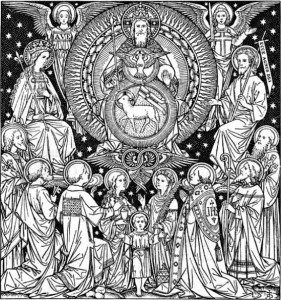
All of a sudden it happened, there was the sound a mighty rushing wind and . . . y’all ain’t gonna believe this . . . they all caught fire! Or, at least, that’s what it looked like. “Tongues, as of fire, appeared among them, and a tongue rested on each of them. All of them were filled with the Holy Spirit and began to speak in other languages.” (Acts 2:3) And they went out into the streets and began to preach the story of Jesus, the Good News of God’s salvation of humankind, to everyone there. It was the feast of Shavuot, called Pentecost in Greek. Fifty days after the Passover (that’s what Pentecost means in Greek, “fiftieth day”), this was an agricultural festival when Jews came from all over to make the offerings of the First Fruits at the Temple in Jerusalem. So there were Jews and proselytes from all the known world — from Pamphylia and Phrygia, from Egypt and Mesopotamia, from Libya and Crete, from Greece and Rome — people who spoke a bewildering variety of languages. Yet when the disciples went out into the streets, each of these heard the Gospel preached in his or her own language.

Now language, which had once divided and scattered the people, united them. The difference was in what was put at the center. Where the people on the plain at Shinar, the people who tried to build that great city and that tower reaching to the heavens, had put themselves and their own name, their own power, at the center, the disciples and those who heard their message, put God incarnate in Jesus Christ, God active in the Holy Spirit, at the center. From here they would go out — Andrew to Greece, Jude to Persia, Thomas to India, Mark to Egypt, Matthew to Ethiopia, Peter to Rome, Philip to Asia Minor, and others to many other places — they would fill the earth with the Good News of Jesus, healing the sick, raising the dead, creating the beloved community wherever they went. All because they put God at the center.

And this is the message for us in these two stories on this Pentecost Sunday, this birthday of the Church, this celebration of the coming of the Holy Spirit promised by Jesus in our reading from the Gospel of John.

Once upon a time we human beings put ourselves and our name and our power at the center of our lives . . . and look where that got us. But if we put God at the center? Y’all ain’t gonna believe this . . . . !

Amen!

====================

A request to my readers: I’m trying to build the readership of this blog and I’d very much appreciate your help in doing so. If you find something here that is of value, please share it with others. If you are on Facebook, “like” the posts on your page so others can see them. If you are following me on Twitter, please “retweet” the notices of these meditations. If you have a blog of your own, please include mine in your links (a favor I will gladly reciprocate). Many thanks!

====================

Father Funston is the rector of St. Paul’s Episcopal Church, Medina, Ohio.

One of Those Weeks (Salvation Belongs to Our God) – Sermon for the Fourth Sunday of Easter – April 21, 2013

====================

This sermon was preached on the Fourth Sunday of Easter, April 21, 2013, at St. Paul’s Episcopal Church, Medina, Ohio, where Fr. Funston is rector.

(Revised Common Lectionary, Fourth Sunday of Easter: Acts 9:36-43; Psalm 23; Revelation 7:9-17; and John 10:22-30. These lessons can be read at The Lectionary Page.)

====================

Etching of the Heavenly Throne RoomIt’s Good Shepherd Sunday . . . the Fourth Sunday of the Easter Season is always Good Shepherd Sunday. Every year, regardless of which of the three years of the Lectionary cycle we are in, we hear some lessons which mention shepherds or lambs, and we recite the 23rd Psalm as the Gradual, and we sing every “Shepherd hymn” in the hymnal. I’ve been preaching Good Shepherd sermons for 25 years, so I pretty much thought this was going to be one of those Sundays when I could just “wing it” and preach extemporaneously.

But it’s not. The events of the past week have made this a Good Shepherd Sunday unlike any that has come before. This Good Shepherd Sunday, as I read the words of the 23rd Psalm, “Though I walk through the valley of the shadow of death, I shall fear no evil,” (Ps. 23:4) I cannot help but be aware of all those who, unknowingly, were in that very place on Monday afternoon; I cannot help but think of Boylston Street, Boston, as “the valley of the shadow of death.”

Today’s Gospel lesson is John the Evangelist’s story of an event that happened before Jesus’ crucifixion, something that happened as he was teaching in the Jerusalem Temple. “The Jews,” which is John’s way of naming the temple authorities (the priests and scribes) gathered around Jesus and put him on the spot. “Are you the Messiah?” they ask, “Tell us plainly.”

Jesus’ answer is to say that he has said as much and that it is plain to those who are his sheep, because his sheep understand what he says: “My sheep hear my voice. I know them, and they follow me.” (John 10:27) They hear what I say; they understand my words; and they do what I tell them.

Well, maybe . . . .

Let’s be honest. Understanding Jesus and doing what he says aren’t always very easy. For example, St. Luke tells us that Jesus said, “Be merciful, just as your Father is merciful. Do not judge, and you will not be judged; do not condemn, and you will not be condemned. Forgive, and you will be forgiven.” (Luke 6:36-37) And St. Matthew tells us that he commanded, “Love your enemies and pray for those who persecute you.” (Matt. 5:44) I know what those words mean, but when it comes to the events of this week, they are not easy to obey.

But . . . OK . . . let’s give it a try. Our prayer book heritage gives us words to pray when we cannot think of the words ourselves, so let’s give this praying for those who hurt us a try using some of those prayers:

O God, the Father of all, whose Son commanded us to love our enemies: Lead them and us from prejudice to truth: deliver them and us from hatred, cruelty, and revenge; and in your good time enable us all to stand reconciled before you, through Jesus Christ our Lord. Amen. (Book of Common Prayer 1979, page 816)

Into your hands, O Lord, we commend Tamerlan Tsarnaev, as into the hands of a faithful Creator and most merciful Savior, praying that he may be redeemed in your sight. Wash him, we pray, in the blood of that immaculate Lamb who was slain to take away the sins of the world; that, whatever defilements he may have contracted in the midst of this earthly life being purged and done away, he may be presented before you pure and without spot; through the merits of Jesus Christ your only Son our Lord. Amen. (Adapted from the BCP 1979, page 488)

O God, whose mercy is everlasting and whose power is infinite; Look down with pity and compassion upon Dzhokhar Tsarnaev; and whether you visit him to test his fortitude or to punish his offences, enable him with your grace to submit himself willingly to your holy will and to your judgment. O Lord, go not far from him or any person whom you have laid in a place of darkness; and seeing that you have not cut him off suddenly, chasten him as a father and grant that he, duly considering your great mercies, may genuinely turn to you with true repentance and sincerity of heart; through Jesus Christ our Lord. Amen. (Adapted from the Book of Common Prayer of 1789, A Form of Prayer for the Visitation of Prisoners.)

This is what our Shepherd requires of us, that we pray for the repose of the soul of Tamerlan Tsarnaev and for the salvation Dzhokhar Tsarnaev, even though we find it very difficult to do.

When I was still practicing law, I had occasion to defend a dentist whose hobby was sculpting. One of the pieces he showed me was a very nicely done, and in most respects very traditional, Crucifix. What was nontraditional about it was the expression on Jesus’ face; it was contorted in obvious and quite extreme rage.

I asked him about that saying, “I don’t think I’ve ever seen Christ depicted in that way, and I can’t say that I’ve ever conceived of this reading any of the Gospels’ crucifixion stories.” He answered by asking me, “You know in the Gospel according to Luke when Jesus says, ‘Father, forgive them . . . . ?’ I’ve always heard that as angry, as Jesus saying to God the Father, ‘You forgive them because, right now, I can’t.'”

If you, like me, are having some difficulty in praying for those two boys, let these prayers be offered in that same spirit. We pray for God to take them, for God to forgive them, because right now, we can’t. We know exactly what Jesus meant but right now, we can’t do it. So we ask our Shepherd to do it for us. Because, as the multitude witnessed by St. John of Patmos cried so clearly, “Salvation belongs to our God who is seated on the throne, and to the Lamb!” (Rev. 7:10)

That’s one of the Good News lessons for today, for this week, I think. Jesus asks us to pray for and forgive those who do us wrong, but if we can’t, he can do it for us. We don’t need the fancy words of prayers out of the prayer book tradition. We just need Jesus’ own words, his words on the cross, “Father, forgive them.” That’s really all we need to say, “Father, forgive them.” Because even if we can’t, he can.

I think the other Good News lesson for this week is in something else Jesus says in today’s Gospel lesson: “I give them eternal life, and they will never perish. No one will snatch them out of my hand.”

Yesterday, I was at a diocesan leadership conference and, as you might expect, during the break times, our conversations centered around the events of the week.

A colleague commented at a diocesan meeting this morning, “It’s been one of those weeks.” My first thought was, “One of what weeks? There aren’t very many weeks like this!” The more I thought about it, however, I think maybe every week is like this. Every week people die. It’s an uncomfortable reality, but it’s true. Every week people die. It’s nothing to fear, however. I remember hearing a bishop (it may have been Desmond Tutu) say that being a Christian means (among other things) accepting the fact that you have already died. Certainly that is the witness of scripture: “Do you not know that all of us who have been baptized into Christ Jesus were baptized into his death? Therefore we have been buried with him by baptism into death, so that, just as Christ was raised from the dead by the glory of the Father, so we too might walk in newness of life.” (Rom. 6:3-4) And, again, “Set your minds on things that are above, not on things that are on earth, for you have died, and your life is hidden with Christ in God.” (Col. 3:2-3) And, again, “The saying is sure: If we have died with him, we will also live with him.” (2 Tim. 2:11) The very meaning of the Easter Season which we continue to celebrate is that death has been conquered, and that to God’s faithful people “life is changed, not ended; and when our mortal body lies in death, there is prepared for us a dwelling place eternal in the heavens.” (BCP 1979, page 382)

And every week people do awful things to other people. Sometimes those things are hugely catastrophic for many people, like the bombs at the marathon finish line. Sometimes those things go unseen by nearly everyone except the one injured, like the bullying that has led so many teens to commit suicide. Such things, awful things happen all the time. But . . . “Have you not known? Have you not heard? The Lord is the everlasting God, the Creator of the ends of the earth. He does not faint or grow weary; his understanding is unsearchable. He gives power to the faint, and strengthens the powerless.” (Isaiah 40:28-29) And, again, “The Lord upholds all who are falling, and raises up all who are bowed down.” (Psalm 145:14) And, again, “I can do all things through him who strengthens me.” (Philip. 4:13) The very meaning of the Easter Season which we continue to celebrate is that the power of God overcomes anything, any-awful-thing, the evildoers of this world can throw at us.

Not very long after the bombs exploded in Boston, comedian Patton Oswalt posted a reflection on his Facebook page in which he said:

I remember, when 9/11 went down, my reaction was, “Well, I’ve had it with humanity.”

But I was wrong. I don’t know what’s going to be revealed to be behind all of this mayhem — one human insect or a poisonous mass of broken sociopaths.

But here’s what I DO know. If it’s one person or a HUNDRED people, that number is not even a fraction of a fraction of a fraction of a percent of the population on this planet. You watch the videos of the carnage and there are people running TOWARDS the destruction to help out. (Thanks FAKE Gallery founder and owner Paul Kozlowski for pointing this out to me). This is a giant planet and we’re lucky to live on it but there are prices and penalties incurred for the daily miracle of existence. One of them is, every once in a while, the wiring of a tiny sliver of the species gets snarled and they’re pointed towards darkness.

But the vast majority stands against that darkness and, like white blood cells attacking a virus, they dilute and weaken and eventually wash away the evildoers and, more importantly, the damage they wreak. This is beyond religion or creed or nation. We would not be here if humanity were inherently evil. We’d have eaten ourselves alive long ago.

So when you spot violence, or bigotry, or intolerance or fear or just garden-variety misogyny, hatred or ignorance, just look it in the eye and think, “The good outnumber you, and we always will.”

I think that is the reality to which Scripture testifies; I think that is the triumph of Easter — that the good will always outnumber the evil. “I give them eternal life, and they will never perish. No one will snatch them out of my hand.”

So I guess my colleague was right. It’s been one of those weeks . . . a week when life was changed for some, a week in which the Presence of God helped people get through some really awful stuff, a week when the good outnumbered the bad. It’s been one of those weeks. Every week is. Thanks be to God!

====================

A request to my readers: I’m trying to build the readership of this blog and I’d very much appreciate your help in doing so. If you find something here that is of value, please share it with others. If you are on Facebook, “like” the posts on your page so others can see them. If you are following me on Twitter, please “retweet” the notices of these meditations. If you have a blog of your own, please include mine in your links (a favor I will gladly reciprocate). Many thanks!

====================

Father Funston is the rector of St. Paul’s Episcopal Church, Medina, Ohio.

Going Fishing, Finding Grace – Sermon for the Third Sunday of Easter – April 14, 2013

====================

This sermon was preached on the Third Sunday of Easter, April 14, 2013, at St. Paul’s Episcopal Church, Medina, Ohio, where Fr. Funston is rector.

(Revised Common Lectionary, Third Sunday of Easter: Acts 9:1-20; Psalm 30; Revelation 5:11-14; and John 21:1-19. These lessons can be read at The Lectionary Page.)

====================

Palestinian Fishing Boat 1880Several years ago, shortly after my mother died, my step-dad’s business partner also passed away leaving my step-dad to run the business they had created together. Now it is no insult to my step-dad, Stan, who had never before been a business owner, to say that he knew little or nothing about running a business. He’d been a tool-and-die man most of his working life with a brief foray into sales, but he’d never been in the “front office” and he’d certainly never been a manager or executive of any sort. Stan didn’t know accounts receivable from fish, and inventory control was a foreign language to him.

So I took a leave of absence from the parish where I was then rector, left Evie and the kids on their own in Kansas, moved in with my step-dad in Costa Mesa, California, and became the de facto president and chief executive officer of Halogen Valve Systems. The company had been created to manufacture and market an emergency chlorine valve actuator for municipal water systems, a product my step-dad and his partner had invented and patented. I knew nothing about chlorine, water systems, or valves, but I did know computers, accounting, and business management, so I dove right in to the job, searching through computer files, finding blueprints and parts lists, learning supplier names and product numbers, customer contacts, and so forth; contacting suppliers and customers; charting supply and distribution patterns; organizing the warehouse, the manufacturing shop, and the front office. In the meantime, Stan taught me about chlorine gas and water purification and emergency valve actuators.

After a couple of months, I had the business pretty well systematized and was ready to turn it back to my step-dad and an office manager, so it came time to show my step-dad what I’d set up and teach him what he needed to know. We’d sit down in my office together and, at each session, we’d spend about an hour going over some aspect of the management plan. Our time was limited to an hour because each time, at just about the hour mark, Stan would stand up and say, “I’m going out to the shop.” And off he’d go, out to the manufacturing floor to work with the guys who were building the valve actuators. What he was doing is exactly what Peter does in today’s gospel lesson from John.

Stan could only take so much management talk, so much double-entry bookkeeping, so much inventory control . . . at some point, at that hour limit, he was filled up. He needed to do something with which he was familiar, to give his brain and his spirit time to process all the confusion of front office management. He was going back to the part of the business he could understand. Peter does the same thing in today’s gospel lesson. He’s taken as much confusion as he can stand. All the glory and wonder at the beginning of Holy Week, all the terror and sadness of Good Friday, all the bewilderment and relief and joy of Easter Sunday . . . it’s all been just about more than he can take and it’s time to do something he can understand. “I’m going fishing,” he says. “I’m going back to the part of this business I understand.” And the others know exactly how he feels and they chime in with, “We’ll join you.”

So off they go and as they are fishing, a figure appears on the beach and calls to them. It’s Jesus, who gives them some advice about fishing and then invites them to a grilled fish breakfast he is preparing. While they are eating, he and Peter engage in a conversation, but before we get into that, let’s take a look at the other major story of this morning.

Our Lectionary also gives us the story of St. Paul’s conversion in today’s reading from the Book of Acts. It’s a familiar enough story for us here at St. Paul’s Parish. We hear it at least twice a year, and now the Lectionary gives it to us a third time. Saul of Tarsus, a Jew among Jews, a Pharisee among Pharisees, a prosecutor of the heretics who proclaim this upstart rabbi Jesus to be the Messiah, is on his way to Damascus with letters of warrant from the chief priests to arrest and prosecute any Christians he finds there. Along the road, however, he is knocked on his butt, literally knocked off his horse by a blinding light and a crash of thunder and a voice which asks, “Saul, why are you persecuting me?” In surprise, he asks the voice who it is that is speaking and he is told, “I am Jesus!” And Saul and Jesus have a conversation.

Saul’s conversation with Jesus is rather abrupt. Jesus simply tells him to get up and go to a certain place in Damascus and there he will be instructed. Peter’s conversation is rather different. Three times Jesus asks him “Do you love me?” Three times Peter answers, “You know I do.” Three times Jesus tells Peter to take care of Jesus’ sheep.

When we read this in English, we miss a very important nuance in John’s use of language and we are apt to miss John’s point. The first two times Jesus asks Peter, “Do you love me?” John uses the word agape to render the question. This word is normally used in the Greek scriptures to describe perfect or “divine” love. When Peter answers Jesus in the affirmative, he uses another word, phileo, which means “brotherly love.” This suggests that he loved Jesus as a brother, not yet fully understanding his Risen Lord’s divinity. Jesus then calls Peter to feed the lambs. Jesus asks the second time, again using “agape.” Jesus at first had not gotten the answer from Peter that he wanted but, again, Jesus receives the same response from Peter. Jesus then repeats the feeding admonition, changing it so that Peter is responsible for feeding the not just the lambs, but the whole flock. The third time, Jesus changes the word and asks Peter the question in Peter’s own terms; Jesus uses the disciple’s “brotherly love” word, phileo.

What is happening in this conversation, indeed with this whole scene, is that Jesus is meeting Peter where Peter can meet Jesus. Peter had to get out of Jerusalem; he had to get to someplace, to doing something, that he could grasp. So Jesus met him there. Peter couldn’t quite yet understand Jesus’ godliness, using a term for human rather than divine love. So Jesus went along with him. Jesus met and interacted with Peter is a manner appropriate to Peter’s situation. Jesus does the same with Saul.

Saul was a fire-brand, a person who so aggressively and energetically promoted his own cause, his own understanding of religion that he encouraged unrest among Jews and kindled strife for the followers of Jesus. And Jesus did with him what he had done with Peter. He came to him in the place and in the manner in which Saul could be reached and led to understand. Saul clearly had heard the gospel message preached by the disciples; he’d heard it and rejected it. The soft and gentle approach hadn’t worked. So, in the alternative, Jesus came to him with flash of light and a clap of thunder, and knocked him on his butt!

The two stories from Scripture today teach us the same lesson. Jesus comes to us when and where and as we are able to understand and appreciate him, gently to some, more aggressively to others. But however he comes, he comes. We call this “grace.” Simply put, grace is the free and unmerited favor manifesting our salvation and bestowing blessings upon us. Both Peter and Paul received this grace in ways appropriate to them, as do we all.

Earlier this week an author named Brennan Manning passed away. Brennan was an American Roman Catholic, a friar, a priest (who had married!), a contemplative, and a frequent speaker at religious events. He lived a fascinating and turbulent life, and wrote many books, one of which was The Ragamuffin Gospel. In it, he wrote this about grace:

Because salvation is by grace through faith, I believe that among the countless number of people standing in front of the throne and in front of the Lamb, dressed in white robes and holding palms in their hands (see Revelation 7:9), I shall see the prostitute from the Kit-Kat Ranch in Carson City, Nevada, who tearfully told me that she could find no other employment to support her two-year-old son. I shall see the woman who had an abortion and is haunted by guilt and remorse but did the best she could faced with grueling alternatives; the businessman besieged with debt who sold his integrity in a series of desperate transactions; the insecure clergyman addicted to being liked, who never challenged his people from the pulpit and longed for unconditional love; the sexually abused teen molested by his father and now selling his body on the street, who, as he falls asleep each night after his last “trick,” whispers the name of the unknown God he learned about in Sunday school.

“But how?” we ask.

Then the voice says, “They have washed their robes and have made them white in the blood of the Lamb.”

There they are. There we are — the multitude who so wanted to be faithful, who at times got defeated, soiled by life, and bested by trials, wearing the bloodied garments of life’s tribulations, but through it all clung to faith.

My friends, if this is not good news to you, you have never understood the gospel of grace. (The Ragamuffin Gospel: Good News for the Bedraggled, Beat-Up, and Burnt Out)

The stories of Peter fishing on the Sea of Galilee and of Saul traveling to Damascus, and of their encounters with Jesus in those places, teach us that Jesus comes to us wherever and however we are, even defeated, soiled, and bloodied, to give us salvation and blessing, to give us the unmerited favor of God, to give us grace. We may have gone out to the manufacturing floor; we may have gone fishing; we may be on a trip pursuing our passion. Wherever we are, Jesus meets us, and there we find grace. Amen.

====================

A request to my readers: I’m trying to build the readership of this blog and I’d very much appreciate your help in doing so. If you find something here that is of value, please share it with others. If you are on Facebook, “like” the posts on your page so others can see them. If you are following me on Twitter, please “retweet” the notices of these meditations. If you have a blog of your own, please include mine in your links (a favor I will gladly reciprocate). Many thanks!

====================

Father Funston is the rector of St. Paul’s Episcopal Church, Medina, Ohio.

The Leaflet in the Lou – From the Daily Office – March 19, 2013

From the Letter to the Romans:

But what does it say? “The word is near you, on your lips and in your heart” (that is, the word of faith that we proclaim); because if you confess with your lips that Jesus is Lord and believe in your heart that God raised him from the dead, you will be saved. For one believes with the heart and so is justified, and one confesses with the mouth and so is saved. The scripture says, “No one who believes in him will be put to shame.” For there is no distinction between Jew and Greek; the same Lord is Lord of all and is generous to all who call on him. For, “Everyone who calls on the name of the Lord shall be saved.”

(From the Daily Office Lectionary – Romans 10:8-13 (NRSV) – March 19, 2013.)

Public Restroom SinksIn my opinion there is probably no more misused piece of writing in all of Holy Scripture, unless perhaps it is Paul’s other toss-off line (in this same epistle): “For we hold that a person is justified by faith apart from works prescribed by the law.” (Rom. 3:28 NRSV) Both of them have led people to a religion that is all talk and no walk, which I am quite sure was not Paul’s intention at all!

I went to high school pretty much in the absolute middle of the United States. The geographic center of the U.S. is just outside the small town of Lebanon, Kansas. I went to high school in Salina, Kansas, about 100 miles away. At the time, and probably to this day, it is pretty much conservative, evangelical Christian territory. There are a few nutty Episcopalians, but not many; a few more good German Lutherans and just about as many good German Catholics. But the conservative, evangelical traditions rule the roost.

One of the things I most remember about my high school years in the center of the country are the evangelical Christian pamphlets that one would find distributed in, of all places, the public restrooms of filling stations and coffee shops. I know that sounds weird, and frankly it is weird! But almost without fail, anytime I would make use of such public facilities in the late 1960s I would find a small pamphlet on the wash basin counter, on the back of the toilet, or on top of the urinal telling me that all I needed to do to be saved and escaped the fires of Hell was “confess with your lips that Jesus is Lord and believe in your heart that God raised him from the dead.” That’s all. Nothing more.

That always struck me as nonsense. Even to a 14-year-old high school freshman, it just seemed like there ought to be more to it than the five-step outline for salvation set out in the public restroom pamphlet (and which I’ve subsequently seen enumerated elsewhere):

  1. Hear the Gospel (Romans 10:17)
  2. Believe the Gospel (Mark 16:16)
  3. Repent of sins (Luke 13:3)
  4. Confess Christ. (Matthew 10:32)
  5. Be Baptized for the remission of sins (Acts 2:38).

It seemed like poppycock because pretty regularly the priest in my church would recite other passages of Scripture: “Not every one that saith unto me, Lord, Lord, shall enter into the kingdom of heaven; but he that doeth the will of my Father which is in heaven.” (Matt. 7:21 KJV) was his favorite offertory sentence. And I recall more than one sermon in which he made reference to the Letter of James with its (to me, at least) cogent reasoning:

What good is it, my brothers and sisters, if you say you have faith but do not have works? Can faith save you? If a brother or sister is naked and lacks daily food, and one of you says to them, “Go in peace; keep warm and eat your fill,” and yet you do not supply their bodily needs, what is the good of that? So faith by itself, if it has no works, is dead. But someone will say, “You have faith and I have works.” Show me your faith apart from your works, and I by my works will show you my faith.

The leaflet in the lou seemed not even to require faith. I know it says that one step is to “Believe the Gospel” and another to “Confess Christ,” but those only require intellectual ascent, not faith. Just because one accepts the factuality of the Jesus story, and possibly even tells others about it, doesn’t mean that one trusts in Jesus as Lord and Savior. So even though it might have been parroting Paul in the 10th chapter of Romans, it seemed to have overlooked the 3rd chapter. And it’s authors had clearly dismissed James’s conclusion that “faith by itself, if it has no works, is dead.”

It’s not that the five steps in the bathroom broadside are wrong. It’s that they are incomplete. There are so many more steps – feeding the hungry, clothing the naked, caring for the ill, visiting the prisoners, housing the homeless, selling everything you own and giving the money to the poor, not being a stumbling block to others, loving your neighbor, and many many more. One can’t just talk the talk; one must walk the walk; one must take the journey.

Salvation is a journey of many steps through many places doing many things. Salvation is not achieved with five simple steps communicated through a community water closet!

====================

A request to my readers: I’m trying to build the readership of this blog and I’d very much appreciate your help in doing so. If you find something here that is of value, please share it with others. If you are on Facebook, “like” the posts on your page so others can see them. If you are following me on Twitter, please “retweet” the notices of these meditations. If you have a blog of your own, please include mine in your links (a favor I will gladly reciprocate). Many thanks!

====================

Father Funston is the rector of St. Paul’s Episcopal Church, Medina, Ohio.

« Older posts Newer posts »