Occasional thoughts of an Anglican Episcopal priest

Category: Mark (Page 11 of 18)

The Storm of Depression – Sermon for August 19, 2014, Pentecost 9, Proper 14A

====================

On the Ninth Sunday after Pentecost, August 10, 2014, this sermon was offered to the people of St. Paul’s Episcopal Church, Medina, Ohio, where Fr. Funston is rector.

(The lessons for the day were: 1 Kings 19:9-18; Psalm 85:8-13; Romans 10:5-15; and Matthew 14:22-33. These lessons can be read at The Lectionary Page.)

====================
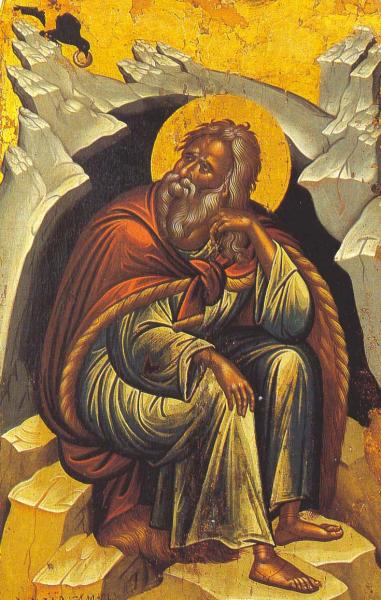
Icon of ElijahThere is a very strong possibility that at least five people in this nave today are suffering from depression. Not just garden variety, feeling a little bit down, depression, but from clinical depression that is being (or should be) treated with medication and therapy. Psychiatrists see more people suffering from depression than people suffering from all other emotional problems combined. It is currently estimated that one in every twenty Americans has been medically diagnosed is currently under treatment for depression. If all of those patients were formed into some sort of organization it would be more than twice the size of the Episcopal Church.

So there’s a very, very good chance that a few of those patients are here today. And it’s a certainty that there is at least one former depression patient in the room: me. I won’t go into the gory details, but about 17 years ago, I had my own bad run-in with clinical depression, but with medication, cognitive therapy, and most importantly spiritual direction, I came through it.

I bring this up because we have two lessons today that directly address the matter of depression and human failure to cope with failure, chaos, and fear. These lessons are instructive not only for those who suffer from clinical depression, but also for those who live and work with them, and for everyone who occasionally suffers from disappointment with life, with frustration and regret. The first is part of the story of Elijah, the Man of God.

Today we have heard a famous and familiar story from the 19th Chapter of the First Book of Kings, the story of Elijah encountering God at the entrance of a cave on Mt. Horeb, which is also called Mt. Sinai, the very place where Moses received the Law from the hand of God. Technically and religiously, what Elijah experiences is called a theophany or epiphany, a manifestation of the divine, but practically what he has received is treatment for depression. Elijah is a classic example of a clinically depressed human being and Yhwh does for him exactly what modern psychiatry has come to understand as the best treatment for depression.

But let’s back up and get the back story on all of this.

This is actually the second theophany Elijah experiences in relatively short order. The first was on another mountain, Mt. Carmel, which is about 280 miles north-northwest of Mt. Horeb. The occasion was Elijah’s battle with the prophets of Baal. You may recall that at the time Ahab was king in Israel, the northern kingdom. Ahab’s queen is a woman named Jezebel who is a princess of Tyre in Phoenicia and a worshiper of Baal. One of Elijah’s prophetic complaints against King Ahab is that he has allowed his queen to establish Baal worship in Israel. As a demonstration of the supremacy of Yhwh, Elijah challenged the 400 prophets of Baal who served Jezebel to a duel. They would each offer a sacrifice on Mt. Carmel and the one whose sacrifice is accepted will be shown to be the prophet of the true god.

The prophets of Baal erected an altar, as did Elijah, and they placed upon it several butchered animals, as Elijah did on his altar. Then the prophets of Baal began to solicit their god; they danced and prayed and sang and prostrated themselves but nothing happened. Then it was Elijah’s turn. Before invoking Yhwh, however, Elijah had the people douse his altar and the offering on it with water, not once but three times. Then, when he called upon the Lord, heavenly fire consumed not only the sacrificed livestock, but the very stones of the altar. This is the first theophany.

As a result, the people repented of their faithlessness, fell on their faces, and worshiped Yhwh. Then Elijah ordered them: “Seize the prophets of Baal; do not let one of them escape.” (1 kg 18:40) Which they did, and they killed all of the prophets of Baal. King Ahab was present during the challenge and witnessed the slaughter of his wife’s religious leadership.

At the beginning of Chapter 19, Ahab rides back to his palace in the city of Jezreel and tells Jezebel what has happened. Her response is to threaten Elijah with death. She sends him a message: “So may the gods do to me, and more also, if I do not make your life like the life of one of [the prophets of Baal] by this time tomorrow.” (v. 2) So he flees the northern kingdom for Mt. Horeb and this is where we are in our reading today.

Elijah experiences the second theophany. He hears the voice of God asking him, “Elijah, what are you doing here?” (v. 9) Elijah’s answer is the that of a severely depressed person! “I have been very zealous for the Lord, the God of hosts; for the Israelites have forsaken your covenant, thrown down your altars, and killed your prophets with the sword. I alone am left, and they are seeking my life, to take it away.” (v. 10)

What do we know about this answer. We know that most of it isn’t true. The Israelites have not forsaken God’s covenant: at Mt. Carmel just a short while before they had repented of any allegiance to the religion of Baal and sworn themselves faithful to Yhwh. They have not killed Yhwh’s prophets with the sword: they have, in fact, killed the prophets of Baal. Elijah is not left alone: there are all those people who swore that oath of repentance at Mt. Carmel, if not many others. They are not all seeking his life: only Jezebel and her followers are doing so.

Elijah, exhibiting classic signs and symptoms of depression, has focused on and exaggerated the negatives in his life, completely ignoring anything and everything positive.

So God decides to get his attention, maybe shake him out of this funk. God sends an earth-shattering wind, then with an earthquake, then with a great fire, but (our scripture insists) God is not in any of those things. Lastly, there is “the sound of sheer silence” and in that deep, deep desert silence Elijah hears a small, still voice . . . the voice of God . . . asking once again, “Elijah, what are you doing here?” (v. 13)

And how does Elijah answer? Almost exactly as he did before: “I have been very zealous for the Lord, the God of hosts; for the Israelites have forsaken your covenant, thrown down your altars, and killed your prophets with the sword. I alone am left, and they are seeking my life, to take it away.” (v. 14) Despite this dramatic theophanic event, in which God has intended to lift Elijah out of his despondency, Elijah’s responses to Yhwh, both before and after the theophany, are nearly identical. His thoughts, words, and actions are those of severely depressed person — withdrawal and escape, moodiness, apprehension and fear, self-pity, feelings of worthlessness, loss of hope and confidence, anger, irritability, wrong headedness, fixation on negative events, and physical exhaustion to name just a few.
And what does God do?

God doesn’t tell him cheer up; God doesn’t tell him to snap out of it; God doesn’t try to reason with him and convince him that all is well. No, God sets Elijah a goal; he gives him a task to perform. Yhwh gets Elijah active and involved once again in his prophetic ministry. “Get up and go do this,” God says, “anoint two new kings in Aram and Israel, and prepare for your retirement by taking Elisha as your apprentice and successor.” (vv. 15-16) This is precisely the sort of specific goal-setting that modern psychology prescribes for the treatment of depression!

Just last year a study published at the University of Liverpool demonstrated that people with clinical depression tend to describe personal goals lacking a specific focus. The lack of specificity makes it more difficult to achieve the goal and this, in turn, creates a downward cycle of negative thoughts. Setting specific goals and realizing them triggers an electro-chemical chain reaction in the brain that makes the patient feel rewarded, and this stimulates happiness, motivation, and self-esteem. (Generalized Goals Linked to Depression)

This is exactly what Yhwh does for Elijah, setting specific goals. What is scientific research has shown to be psychologically true is shown here in scripture to be spiritually true.

The second lesson that I believe directly addresses the issue of depression is the gospel tale of Jesus walking on the stormy waters of the Sea of Galilee.

I must be honest with you; this is one of those Jesus stories with which I am decidedly uncomfortable. I don’t think these stories of Jesus violating the laws of nature are meant to demonstrate Jesus to be some sort of superman or a powerful magician or even to be God. I believe they are, rather, prophetic actions, physical metaphors from which we are to learn something much more important, something about ourselves and about human nature.

Throughout the biblical canon, in other literature of the ancient middle east, and even in our world today, the image of a storm at sea is a powerful metaphor of chaos and even of uncontrollable evil. Twice the gospel writers use it as a way to demonstrate Jesus’ power. First, there is the incident when Jesus is in the boat with the disciples, asleep during a storm. They awaken him and he rebukes the wind and calms the sea. According to Matthew, whose gospel we are exploring in this year of the lectionary cycle, that incident took place earlier. This is the second time the disciples on are on the Galilean lake in bad weather at night, but this time Jesus isn’t with them.

In this story, Jesus is walking on the water and (Mark asserts in his version of the tale – Mk 6:47-51) intends to pass them by. However, they see him, think he is a ghost, and cry out. He identifies himself and reassures them, at which point Peter decides he would like to try this water-walking thing and asks Jesus, “Lord, if it is you, command me to come to you on the water.” (Mt 14:28) Jesus says, “Come” and Peter gets out of the boat and begins to walk on the stormy sea. Note that — Jesus has not quelled the storm. The wind is still blowing; presumably, the water is still choppy, the waves still beating on the boat. Peter successfully takes a few steps, but then is distracted and frightened by the weather and begins to sink. Jesus rescues him; they get in the boat; and that’s when the storm ends and the sea becomes calm.

So what does this say to us about dealing with depression and disappointment?

Let’s say that the stormy sea, the wind, the waves, and all of that are a metaphor for the negativity, chaos, and fear which is clinical depression (and, to a lesser extent, any experience of sadness or grief). And let’s say that Jesus is setting for Peter (and by extension the other disciples) the same sort of goal that Yhwh set for Elijah, a specific, attainable goal, something easily accomplished . . . just walking on the water. We know it can be done; Jesus hass just demonstrated that.

And Peter in fact does accomplish it — he takes a few steps. But then he is distracted; the negative thoughts of depression, the repetitive ruminating over the fear and chaos sets back in. This can and does happen. Recovery from depression is not the quick and easy path the story in First Kings might suggest (and, in fact, even there it isn’t clear that Elijah recovered — he only accomplishes one of the three goals set for him). Recovery from depression takes time; dealing with disappointment, grief, and sadness takes time, and there can be (probably will be) set backs.

The set backs, however, if proper support is given by family, friends, therapists, spiritual directors, and others, don’t prevail. Recovery does happen. Depression can be conquered. The storm of grief can be weathered. The sea can be calmed.

In the epistle today, Paul tells the Romans that the righteousness of faith is not something far away. One doesn’t have ascend to heaven or descend into the abyss to find it. It is, he says, very near; it is, he says, “on your lips and in your heart.” So, too, is the strength that overcomes depression, that gets through regret and grief. Every person has it, has been gifted with it by God. Recognizing that fact takes time and support.

Most clearly in our lesson from Elijah, but also found in our other lessons, the psychological truth demonstrated by modern science are the spiritual truths set out in scripture. “Listen to what the Lord God is saying, for he is speaking peace to his faithful people and to those who turn their hearts to him,” especially those who are struggling with depression or emotional illness, with sadness, frustration, and regret. Let us pray:

Heavenly Father in whom we live and move and have our being: yours is the small still voice of guidance in good times and bad. In your infinite mercy, bring peace and comfort to those who face days sometimes filled with pain and depression. Help us to realize that through you there is joy and the promise of lasting peace. Help us through the rough times and over the stormy seas. Walk before and beside us that we may reach out to you in our journey through life. Help us to focus not on our misfortunes, but on our blessings, through your Son, Jesus Christ our Lord who calms our seas and who is alive and reigns with you and the Holy Spirit, one God, now and forever. Amen.

====================

A request to my readers: I’m trying to build the readership of this blog and I’d very much appreciate your help in doing so. If you find something here that is of value, please share it with others. If you are on Facebook, “like” the posts on your page so others can see them. If you are following me on Twitter, please “retweet” the notices of these meditations. If you have a blog of your own, please include mine in your links (a favor I will gladly reciprocate). Many thanks!

====================

Father Funston is the rector of St. Paul’s Episcopal Church, Medina, Ohio.

Particular Social Groups – From the Daily Office – July 16, 2014

From the Gospel according to Matthew:

Jesus said: “When the Son of Man comes in his glory, and all the angels with him, then he will sit on the throne of his glory. All the nations will be gathered before him, and he will separate people one from another as a shepherd separates the sheep from the goats, and he will put the sheep at his right hand and the goats at the left. Then the king will say to those at his right hand, ‘Come, you that are blessed by my Father, inherit the kingdom prepared for you from the foundation of the world; for I was hungry and you gave me food, I was thirsty and you gave me something to drink, I was a stranger and you welcomed me, I was naked and you gave me clothing, I was sick and you took care of me, I was in prison and you visited me.’ Then the righteous will answer him, ‘Lord, when was it that we saw you hungry and gave you food, or thirsty and gave you something to drink? And when was it that we saw you a stranger and welcomed you, or naked and gave you clothing? And when was it that we saw you sick or in prison and visited you?’ And the king will answer them, ‘Truly I tell you, just as you did it to one of the least of these who are members of my family, you did it to me.’ Then he will say to those at his left hand, ‘You that are accursed, depart from me into the eternal fire prepared for the devil and his angels; for I was hungry and you gave me no food, I was thirsty and you gave me nothing to drink, I was a stranger and you did not welcome me, naked and you did not give me clothing, sick and in prison and you did not visit me.’ Then they also will answer, Lord, when was it that we saw you hungry or thirsty or a stranger or naked or sick or in prison, and did not take care of you?’ Then he will answer them, ‘Truly I tell you, just as you did not do it to one of the least of these, you did not do it to me.’ And these will go away into eternal punishment, but the righteous into eternal life.”

(From the Daily Office Lectionary – Matthew 25:31-46 (NRSV) – July 16, 2014)

Social GroupsI don’t usually quote the entire Daily Office Lectionary lesson in these meditations, I try to focus on one image, one metaphor, one statement in one or two verses from one of the lessons or psalms for the day, but today it just seems right to set out the whole end-time, judgment day, sheep-and-goats story that Jesus tells of the Last Day. Here’s why:

A couple of days ago a friend and colleague in ordained ministry posted a link to an essay on her Facebook page. The essay concerned the difficulty the essayist felt in being what he called “a liberal Christian.” He complained (rightly, in my experience) about the fact that among his politically liberal (and not uncommonly agnostic or atheist) friends, he found himself criticized and even ridiculed for his religious faith, while among his religiously Christian (and not uncommonly politically conservative) friends, he found himself criticized and even rejected because of his liberal politics. (The essay is here.)

The very first comment posted by any of her Facebook friends was this, “Chaplain, why not just preach The Word without regard for particular social groups?” (My friend has spent most of her ordained ministry in uniform ministering to American armed forces personnel, which explains why she is addressed as “Chaplain” by the commenter.)

Apart from the ambiguity of whatever it may be that the commenter means by “The Word,” which would be a subject for another meditation perhaps, my reaction to the suggestion was, “Is that even possible?” My faith is a social one (I’m even tempted to say “a political one”); “the word” (here, I mean “the bible”) is almost exclusively about God’s dealing with “particular social groups.” Whenever the prophets of the Old Testament speak, they speak to social classes (usually the ruling class) about the treatment of “particular social groups” (usually the poor). When Jesus deals with individuals (apart from the healing stories), it is usually not about their individual faith or personal behavior, and if it is, it’s almost always about how that behavior affects others.

For example, although in his conversation with the Samaritan woman at Jacob’s Well he and she do mention her personal life he does not focus on that. Instead, he turns the conversation toward the propriety of worship by groups (her Samaritans, his Jews, and eventually “true worshipers”) in various places and at various times. (Jn 4) When the Canaanite (or Syrophoenician) woman seeks healing for her daughter, neither the nature of the illness nor the personal behavior of the woman or the child are the subject of conversation; the discussion focuses on the targets of Jesus’ ministry (“the children” – i.e., the Jews – or “the dogs” – i.e., the Gentiles). (Mt 15:22-28) When Jesus does address matters of individual religious practice, it is usually to criticize it for taking the believer’s attention away from the needs of “particular social groups”:

The Pharisees and the scribes asked him, “Why do your disciples not live according to the tradition of the elders, but eat with defiled hands?” He said to them, “Isaiah prophesied rightly about you hypocrites, as it is written, ‘This people honors me with their lips, but their hearts are far from me; in vain do they worship me, teaching human precepts as doctrines.’ You abandon the commandment of God and hold to human tradition.” Then he said to them, “You have a fine way of rejecting the commandment of God in order to keep your tradition! For Moses said, ‘Honor your father and your mother’; and, ‘Whoever speaks evil of father or mother must surely die.’ But you say that if anyone tells father or mother, ‘Whatever support you might have had from me is Corban’ (that is, an offering to God ) — then you no longer permit doing anything for a father or mother, thus making void the word of God through your tradition that you have handed on. And you do many things like this.” (Mk 7:5-13)

And then today’s Daily Office gospel lesson. How can one “preach The Word without regard for particular social groups” when the Word Incarnate does not do so? Here he specifically tells us that his followers will be (are they not already?) divided into “particular social groups” at the day of judgment, into the “sheep” on his right and the “goats” on his left. And he will address each group with regard to how they treated other “particular social groups” — the naked, the hungry, the thirsty, the sick, the imprisoned, the “members of my family.”

I cannot see any way to “preach The Word without regard for particular social groups.” Neither Judaism nor Christianity is an individual faith; neither is concerned exclusively, nor even primarily, with individual behavior and practice, with the individual’s relationship with God. Both have major social components; both are concerned with human beings living in community, in covenant relationship with other human beings, in “particular social groups.” The Jews are nowhere described as “the chosen individuals of God;” they are the People of God. Christians were not told that where one is praying Jesus would be there, but “where two or three are gathered.” (Mt 18:20) Ours is a social, even a political, faith concerned with “particular social groups.”

====================

A request to my readers: I’m trying to build the readership of this blog and I’d very much appreciate your help in doing so. If you find something here that is of value, please share it with others. If you are on Facebook, “like” the posts on your page so others can see them. If you are following me on Twitter, please “retweet” the notices of these meditations. If you have a blog of your own, please include mine in your links (a favor I will gladly reciprocate). Many thanks!

====================

Father Funston is the rector of St. Paul’s Episcopal Church, Medina, Ohio.

Who Would Be the Church? – A Holy Place in the Holy Land – From the Daily Office – July 3, 2014

From the Psalter:

Behold now, bless the Lord, all you servants of the Lord, you that stand by night in the house of the Lord.

Lift up your hands in the holy place and bless the Lord; the Lord who made heaven and earth bless you out of Zion.

(From the Daily Office Lectionary – Psalm 134 (BCP Version) – July 3, 2014)

Up an hour later than usual, breakfast at the Sisters of Nazareth today was the same as yesterday. Our bags were collected and we walked down past the R.C. Basilica, past the open air mosque, through the market district and to the bus. A long ride first to Mount Tabor and then to the very small town of Burkin.

Mount Tabor is the traditional location of the Transfiguration, that strange vision seen by Peter, James, and John of Jesus in conversation with Moses and Elijah. There is a lovely church here designed by (you can, by now, probably guess) Antonio Barluzzi. To get to the top of the mount, we had to get off the bus at a visitor center at the base and then ride up the mountain in minivans.

The road up is steep and has many switchbacks — now there is a physical parable or metaphor for the spiritual life! The physical reality of the place is lost in the simple description one finds in the gospels: “Jesus took with him Peter and James and John, and led them up a high mountain apart, by themselves.” (Mk 9:2) Mark (and Matthew who repeats the story) make it sound like they went out for a Sunday afternoon stroll. This would be a hike! This really is a high – and steep – mountain.

The church is quite beautiful with a dazzling mosaic of the Transfiguration event in the dome of the apse, two interior side chapels — one dedicated to St Francis; one for the Reserved Sacrament — and two exterior chapels — one for Elijah and one for Moses. St. Peter never got to build his three monuments (booths) but the Franciscans and Barluzzi did it for him. The Elijah chapel is interesting in that it contains a mural of the prophet’s competition with the prophets of Baal — two altars are depicted, one with a pile of meat but no fire and one with fire consuming what is on it. I’ve never seen that story depicted in art before; in this mural, the meat on the altar of Baal looks like it came straight from a really good butcher’s shop, prime cuts.

On the terrace next to the church, we encountered a cat (the most recent of many), really just a kitten, who was very vocal and very affectionate. She would have made a great souvenir, but getting her through customs would likely have been impossible. She was quite a distraction from the view, however.

One other interesting piece of art was in a gated (locked) garden — I think it shows St Francis either taking Jesus’ body from the cross, or helping Jesus’ to get down from the cross. Without being able to get closer to it and more time to study it, I can’t really be sure. In either case, it is a subject for further contemplation.

Back down the mountain we got back in our bus and took off for Burkin which turns out to be a small and very depressed village (most cities, towns, and villages in Palestine are depressed — whatever economic prosperity there is in Israel is not being shared with the Arabs). Here we visited the tiny church of St. George, which commemorates the spot on which Jesus healed ten lepers. (Luke 17:12-19) It is the fourth oldest continuously in use worship space in the world! There has been a church here since the early Fourth Century! It is under the jurisdiction of the Greek Orthodox Patriarchate.

We were guided into town and to the church by Usama, a member of the Greek Orthodox congregation. One can tell that he and the other members of this church are very proud of their heritage. Unlike most older Orthodox buildings we have visited, this space is immaculate. The silver is polished; the cloth hangings and altar vestments are clean and bright; the icons are dusted. Pride in their place is patent in every corner.

The worship space is tiny – our group of 18 people more than half filled it. It is probably very crowded on Sundays for the Divine Liturgy and at other times of Orthodox worship. This congregation has a membership of 65 people. They are the only Christians in a town of over 7,000 population. Their witness is astounding!

Usama then guided us to his home where his wife and some other ladies in the congregation, assisted by a young boy, hosted us to lunch. The tables were filled with tomato and cucumber salad, yoghurt, pita, and chiken and lamb shwarma served on heaping platters of seasoned rice. There was enough to feed a group five times our size.

Several of us had two or three helpings of the delicious food when Usama’s wife, Neda, came around and piled one more serving on everyone’s plate: “Eat,” she said, “how do I know you liked it if you leave some behind?” It was all in good fun and the graciousness and vibrancy of their hospitality was overwhelming.

The congregation supports itself by selling the usual trinkets, but mostly by making pure olive oil soap which they sell for an amazingly low price. Evie and I will look into whether we can find a way to help sell their soap in our part of the U.S. to provide greater income for them as they maintain the Christian presence in this place.

We talked with them about the dwindling of the congregation, what it is like to be a Christian minority in an overwhelmingly Muslim community. Neda said that she and her neighbors get along just fine, that she and her family visit them to celebrate Eid al-Fitr (the major Muslim feast celebrating the end of Ramadan) and their neighbors visit them to celebrate Christmas. We asked if they had ever considered leaving. “No,” Neda replied quickly, “If we left, who would be the church?”

Who would be the church? A question for us all to ponder.

Lord, bless these servants who lift up their hands in your holy place and witness to your Name!

====================

A request to my readers: I’m trying to build the readership of this blog and I’d very much appreciate your help in doing so. If you find something here that is of value, please share it with others. If you are on Facebook, “like” the posts on your page so others can see them. If you are following me on Twitter, please “retweet” the notices of these meditations. If you have a blog of your own, please include mine in your links (a favor I will gladly reciprocate). Many thanks!

====================

Father Funston is the rector of St. Paul’s Episcopal Church, Medina, Ohio.

Rise! Rise! Rise! – Sermon for Easter 7 (Ascension Sunday) – RCL Year A – June 1, 2014

====================

On the Seventh Sunday of Easter: the Sunday after the Ascension, June 1, 2014, this sermon was offered to the people of St. Paul’s Episcopal Church, Medina, Ohio, where Fr. Funston is rector.

(The lessons for the day were: Acts 1:6-14; Psalm 68:1-10, 33-36; 1 Peter 4:12-14, 5:6-11; and John 17:1-11. These lessons can be read at The Lectionary Page.)

====================

Ascension of Christ by Salvadore Dali

You may write me down in history
With your bitter, twisted lies,
You may trod me in the very dirt
But still, like dust, I’ll rise.

Does my sassiness upset you?
Why are you beset with gloom?
‘Cause I walk like I’ve got oil wells
Pumping in my living room.

Just like moons and like suns,
With the certainty of tides,
Just like hopes springing high,
Still I’ll rise.

Did you want to see me broken?
Bowed head and lowered eyes?
Shoulders falling down like teardrops,
Weakened by my soulful cries?

Does my haughtiness offend you?
Don’t you take it awful hard
‘Cause I laugh like I’ve got gold mines
Diggin’ in my own backyard.

You may shoot me with your words,
You may cut me with your eyes,
You may kill me with your hatefulness,
But still, like air, I’ll rise.

Does my sexiness upset you?
Does it come as a surprise
That I dance like I’ve got diamonds
At the meeting of my thighs?

Out of the huts of history’s shame
I rise
Up from a past that’s rooted in pain
I rise
I’m a black ocean, leaping and wide,
Welling and swelling I bear in the tide.

Leaving behind nights of terror and fear
I rise
Into a daybreak that’s wondrously clear
I rise
Bringing the gifts that my ancestors gave,
I am the dream and the hope of the slave.
I rise
I rise
I rise.

(From And Still I Rise,Maya Angelou, Random House:1978.
Note — The verse beginning “Does my sexiness upset you?” was not read in church.)

The late Dr. Maya Angelou, who died this week and was (in my opinion) one of the greatest of contemporary English-language poets, wrote that poem (entitled Still I Rise) in 1978. Though it speaks out of her experience as a black woman growing up in the segregated South of the mid-20th Century, I believe it also speaks to us in our context today, celebrating the Ascension of Christ into heaven and, also, honoring our five newly minted high school graduates.

The Feast of the Ascension was Thursday. You may have missed it, however; it is a feast largely ignored by the Church. It passes by and we seldom, if ever, give any thought to it. In the Sunday rota it is noted only as the day after which the Seventh Sunday of Easter comes: that’s exactly how today’s collect is titled in The Book of Common Prayer, Seventh Sunday of Easter: The Sunday after Ascension Day. Kind of sad, because the Ascension really is the last event of the Incarnation, the last scene of the last act of the great drama which is “the Christ event.” Fortunately, this year (Year A of the Revised Common Lectionary) we have actually heard the story of the Ascension from the Book of Acts. This is not the case in the other two years of the rotation; in years B and C the Ascension isn’t even mentioned in any of the Sunday readings.

The story of Christ’s Ascension is told not only in Acts, which we heard this morning, it is also found in the Gospels of Mark and Luke. Mark’s account is brief, a single verse: “So then the Lord Jesus, after he had spoken to them, was taken up into heaven and sat down at the right hand of God.” (Mk 16:19) Luke’s is also short: “He led them out as far as Bethany, and, lifting up his hands, he blessed them. While he was blessing them, he withdrew from them and was carried up into heaven.” (Lk 24:50-51).

Although neither Matthew’s Gospel nor John’s mention the Ascension event itself, both include prophetic references to it. According to Matthew, in his trial before the High Priest just before his Crucifixion, Jesus said, “I tell you, from now on you will see the Son of Man seated at the right hand of Power and coming on the clouds of heaven.” (Mt 26:64) In John’s Gospel, after the Resurrected Jesus tells Mary Magdalene not to cling to him, he gives her a message for the Apostles: “Go to my brothers and say to them, ‘I am ascending to my Father and your Father, to my God and your God.'” (Jn 20:17) So the fact of Jesus’ Ascension is well attested by Christian Scripture.

This Jesus, whom the powers of his age had (to use Dr. Angelou’s poetic language) tried to “write down in their history with bitter, twisted lies,” had tried to “tread in the very dirt” — this Jesus rose, not only from the grave into a new earthly existence, but into heaven. This Jesus, whom they “wanted to see broken, with bowed head and lowered eyes, with shoulders falling down like teardrops, weakened by his soulful cries” — this Jesus rose into very center of the Godhead. This Jesus, whom they “killed with their hatefulness” rose “out of the huts of the Hebrews’ history of shame,” from Israel’s past, a past “rooted in pain,” “bringing the gifts that his ancestors gave;” he is “the dream and the hope” of every human being enslaved to sin and death. He is our hope and he rose. He ascended into heaven taking our humanity into the very presence of God Almighty.

If the Incarnation (meaning the whole of Jesus’ earthly being, the entire time of God’s being in the flesh on earth) were viewed as a stage play, the drama of salvation would be seen in this way:

Act One — In the Nativity, God becomes a human being offering great promise to humankind.
Act Two — In the life of Jesus, God fully enters human existence in all its aspects making clearer the meaning of the promise.
Act Three — In the death and resurrection of Jesus, God defeats death and opens the way of eternal life to all human beings setting the scene for fulfillment of the promise.
Act Four — In the Ascension, the story comes full circle as a human being becomes God bringing the promise of the Nativity to fruition.
(Pentecost and all that follows it are the epilogue, just as the story of Israel and the words and works of the Prophets are the prologue.)

The Ascension is the denouement of the entire story but, unfortunately, most of the audience, thinking the play concluded, left after Act Three; some may even have left in the middle of that act. The climax of the drama played out on Thursday to a largely empty theater.

One of the Episcopal Church’s collects for today says: “We believe your only-begotten Son our Lord Jesus Christ to have ascended into heaven, so we may also in heart and mind there ascend.” (BCP 1979, page 226) I think this prayer gets it slightly wrong. Our ascension with Jesus is not a future thing that we “may” later attain. Rather, in Jesus’ Ascension we all have already ascended. It is not only Christ’s humanity but our humanity that ascended into heaven. God has already seated us in the heavenly places in Christ Jesus; our ascension is not so much an experience to be attained, but a reality to be experienced. As St. Athanasius famously put it, “God became man that man might become God.” This is known theologically as the theosis or deification of humanity, and in the Ascension of Jesus it has already happened.

So here we are, deified human beings capable, as Jesus told us, of doing the very works that he did and, in fact, of doing greater works because he has ascended to the Father and he will do whatever we ask in his name — at least that’s what he promised in the Gospel lesson from John we heard in church two weeks ago (Jn 14:12-13) — but do we actually do them? Do we do the works of power and witness to the truth of the Gospel? Let’s be honest and admit that we usually don’t.

We don’t because we’re a lot like the eleven guys standing on that hilltop in Bethany “gazing up toward heaven.” Like them, as Prof. James Holbert of the Perkins School of Theology has written, “We are too enamored of the ascending Jesus, our necks strained as we peer upward, hoping for a further sign, for a magic act, for a cloud spelling out ‘I love you.'”

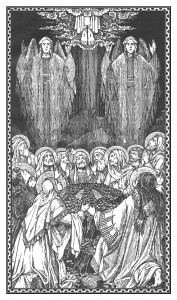
Ascension WoodcutIt’s my favorite part of the story, really, because it demonstrates just how human the Apostles really were, how much like us. It’s this part of the story that is depicted in the woodcut on the cover of our bulletins. There they are looking up, Jesus’ feet just disappearing, when the “two men” (probably angels) appear and ask them why they are staring into space. In our modern vernacular, the two angels tell them, “Don’t just stand there. Do something!”

Prof. Holbert paraphrases and analyzes what the angels say in this way:

“Why do you stand looking into heaven?” Did you not pay attention to him just a few moments ago? He said, ‘Go,’ and you are rooted on this spot, looking longingly for some further word from him. He will come back in the same way that he went, but you need ask no further questions about when, they imply. “When” is simply not the right question to ask.

Why in heaven’s name (I mean that quite literally!) do so many Christians then spend vast amounts of time, inordinate amounts of energy, immoderate amounts of speculation, asking precisely that very question? We have been asked to be “his witnesses” to the world, not his calculators for his return. It remains a thorough mystery to me why this is so, and has been so throughout Christian history.

But I suppose I do know the answer. It is far safer, far less demanding, to be a speculator than a witness. Speculators write books of calculations, hold seminars that attract thousands, rake in untold piles of loot, while prognosticating a certain time for Jesus’ return. Witnesses, on the other hand, just witness to the truth of the gospel: the truth of justice for the whole world, the love of enemies, and the care for the marginalized and outcast. As Acts 1 makes so clear, the world needs far fewer speculators and far more witnesses. (Speculators or Witnesses)

Which brings me to our five high school graduates . . . . You have finished that part of your education which society has made mandatory. Whatever you do from now on is up to you. You may, if you and your families decide, continue your education at college or university; you may continue it in trade or vocational school; you may continue it as an apprentice in a skilled trade. You may, alternatively, decide to enter the work force immediately and skip any further formal education and training, opting instead for what is known as “on the job training.” And you could, although no one here would recommend it or be happy if you did so, opt to do none of these things and, instead, become a bum, a grifter, a burden on society, in which case you will learn the hard and dangerous lessons of the streets.

Whatever you choose to do, you may have noted that every path means continuing to learn. I hope, as I’m sure everyone here and your parents hope, that you will learn the lessons of faith, hope, and love.

We hope that you will learn the lessons that Dr. Angelou learned and tried to teach us through her poetry — if people tell lies about you, rise above it; if people try to tread you in the dirt, rise above it; if they want to see you broken and weeping, disappoint them and rise above it; if they try to shoot you with their words, cut you with their eyes, or kill you with their hatefulness, rise above it.

We hope that you will learn to be, as Prof. Holbert said, witnesses “to the truth of the gospel: the truth of justice for the whole world, the love of enemies, and the care for the marginalized and outcast,” that you will learn to be (as the Letter of James puts it) “doers of the word, and not merely hearers.” (James 1:22)

That is our hope for you and our prayer.

And now I have a word for the parents of our graduates. I’ve been where you are now, twice. When our eldest, our son Patrick, entered college he went away to the University of the South in Sewanee, Tennessee. We drove him down to Sewanee and, with other freshman parents, we attended a meeting with the school’s president while our children took part in orientation activities. At the end of our meeting, the president was quite blunt: he basically said, “Go away. Get off campus. Let go of your sons and daughters.” Like Mary Magdalene, we were being told not to cling, not to hold on. So we left that meeting, found our son, and said good-bye. After he hugged us both, he turned and walked down the street toward to his dormitory, and he never looked back.

I stood there watching him go and, like those guys on the Mount of Olives, I wanted him to look back; I was “hoping for a further sign, for a magic act, for a cloud spelling out ‘I love you.'” Like them, I didn’t get it. I suppose the Apostles realized at some point as they stared into the sky that their friend, their rabbi, was no longer the man they thought they knew; he was something more. He was, and is, God. Standing on that campus lane at Sewanee, I knew that this young man was no longer the child I thought I knew; he was something more. He was, and is, an adult.

Both of our children, Patrick and Caitlin, are adults. So are yours. I’m proud to say that both of ours are college graduates and, though Caitlin is not working in her chosen field (yet), both are fully employed, productive members of society. So will yours be.

So don’t cling to them and don’t just stand there watching them go away, fading into the distance. You have things to do because, like them, like those eleven guys on that hillside in Bethany, like everyone of us, you too are called to be witnesses “to the truth of the gospel: the truth of justice for the whole world, the love of enemies, and the care for the marginalized and outcast,” to be “doers of the word.”

So graduates, parents of graduates, everyone . . . Remember the implication of the angels at the Ascension.

Don’t just stand there. Do something!

Experience the reality of the Ascension. Christ’s Ascension, our Ascension, your Ascension!

Rise!

Rise!

Rise!

Amen.

====================

A request to my readers: I’m trying to build the readership of this blog and I’d very much appreciate your help in doing so. If you find something here that is of value, please share it with others. If you are on Facebook, “like” the posts on your page so others can see them. If you are following me on Twitter, please “retweet” the notices of these meditations. If you have a blog of your own, please include mine in your links (a favor I will gladly reciprocate). Many thanks!

====================

Father Funston is the rector of St. Paul’s Episcopal Church, Medina, Ohio.

What Is Joy? – From the Daily Office – May 19, 2014

From Book of Psalms:

The pastures of the wilderness overflow,
the hills gird themselves with joy,
the meadows clothe themselves with flocks,
the valleys deck themselves with grain,
they shout and sing together for joy.

(From the Daily Office Lectionary – Psalm 65:12-13 (NRSV) – May 19, 2014)

Joy Carved on StoneWhat is joy? A bible study group at church grappled with that question recently and I’m still thinking about the question, so these concluding verses of today’s evening psalm got my attention. It’s not just a matter of defining emotion. Joy is a religious attitude, a stance toward God mentioned numerous of times in the Holy Scriptures; according to St. Paul, it is one of the “fruits of the Spirit.” (Gal 5:22) It’s important to know what we mean when we name it.

In the bible study discussion, I found it amazing that, although “laughter” was mentioned as we tried to answer this question, the common synonyms “happiness,” “mirth,” “giddiness,” and the like (even “gladness”) were not. We wrestled with the issue by exploring such questions as: “When do you feel it?” “Who are you with?” “Where does it come from?” “Where are you when you know joy?” and a really tough one “How do you feel when you experience it?”

That question almost seems redundant, doesn’t it? But as we tried to answer that in some meaningful way another question was asked, “Did Jesus feel joy on the cross?”

Catholic philosopher Peter Kreeft says that joy “is more than happiness, just as happiness is more than pleasure. Pleasure is in the body. Happiness is in the mind and feelings. Joy is deep in the heart, the spirit, the center of the self.” If he’s right, and I think he is, then the answer to our question about Jesus must be “Yes.” Jesus felt joy on the cross!

Consider Christ’s “seven last words”:

“Father, forgive them; for they do not know what they are doing.” (Lk 23:34)
“Truly I tell you, today you will be with me in Paradise.” (Lk 23:43)
“Woman, here is your son” . . . “Here is your mother.” (Jn 19:26-27)
“My God, my God, why have you forsaken me?” (Mk 15:34; Mt 27:46)
“I am thirsty.” (Jn 19:28)
“It is finished.” (Jn 19:30)
“Father, into your hands I commend my spirit.” (Lk 23:46)

Read in this, the traditional order in which they are presented in Good Friday meditations, only one simply cannot be read or understood as containing any joy: Mark’s and Matthew’s report of his cry of despair, “Why have your forsaken me?”

Jesus had told his disciples that joy is the result of a relationship with God:

I am the true vine, and my Father is the vinegrower. He removes every branch in me that bears no fruit. Every branch that bears fruit he prunes to make it bear more fruit. You have already been cleansed by the word that I have spoken to you. Abide in me as I abide in you. Just as the branch cannot bear fruit by itself unless it abides in the vine, neither can you unless you abide in me. I am the vine, you are the branches. Those who abide in me and I in them bear much fruit, because apart from me you can do nothing. Whoever does not abide in me is thrown away like a branch and withers; such branches are gathered, thrown into the fire, and burned. If you abide in me, and my words abide in you, ask for whatever you wish, and it will be done for you. My Father is glorified by this, that you bear much fruit and become my disciples. As the Father has loved me, so I have loved you; abide in my love. If you keep my commandments, you will abide in my love, just as I have kept my Father’s commandments and abide in his love. (Jn 15:1-10)

He concluded this discourse saying to them, “I have said these things to you so that my joy may be in you, and that your joy may be complete.” (v. 11)

In the Psalms, the hills, the sheep, the trees, all of nature is described as experiencing and giving voice to joy. This makes sense only if joy is a relationship with God. On the cross, only once, only in that cry of “why have you forsaken me,” do we find Jesus unable to sense that connection. In fact, the “seven last words” in their traditional order evince the very human journey every person has experienced at one time or another during a time of trouble, a journey from trust in God (“Forgive them”) into the valley darkness where God seems absent and back out again with a renewed sense of kinship with God (“Into your hands, I commend my spirit”).

What is joy? A connection with God, a relationship in which we are fulfilled not by our own efforts, not by the circumstances in which we find ourselves, not by anything other than the Presence and grace of God. Even in the hardest and most troubling of situations, even hanging on a cross, we can know joy.

====================

A request to my readers: I’m trying to build the readership of this blog and I’d very much appreciate your help in doing so. If you find something here that is of value, please share it with others. If you are on Facebook, “like” the posts on your page so others can see them. If you are following me on Twitter, please “retweet” the notices of these meditations. If you have a blog of your own, please include mine in your links (a favor I will gladly reciprocate). Many thanks!

====================

Father Funston is the rector of St. Paul’s Episcopal Church, Medina, Ohio.

Wilderness – From the Daily Office – May 1, 2014

From the Book of Exodus:

As Aaron spoke to the whole congregation of the Israelites, they looked towards the wilderness, and the glory of the Lord appeared in the cloud.

(From the Daily Office Lectionary – Exodus 16:10 (NRSV) – May 1, 2014.)

Painted Desert Wilderness AreaTwo days ago we celebrated the Feast of St. Mark the Evangelist and the Gospel lesson for use at the Eucharist was the opening of his Gospel which relates the story of Jesus’ baptism following which, Mark says, “the Spirit immediately drove him out into the wilderness,” (Mk 1:12) so the word “wilderness” caught my attention today.


Years ago I read a commentary on the book of Revelation in which the author asserted that the wilderness is the true home of the People of God, that it is in the wilderness that the People find their true identity. Here in this verse we find the Hebrews looking towards the wilderness where they find the glory of God. Is that our true identity? St. Irenaeus wrote, “Gloria Dei est vivens homo,” which means “The Glory of God is a living person,” sometimes translated as “The Glory of God is the human fully alive.” Is that what the Hebrews spied in the wilderness? Is that what the Redeemer was compelled by the Spirit to discover out there with the wild beasts?

Yesterday I read an essay comparing the scientific theory of “dark matter” and “dark energy” to the doctrine of Original Sin, and suggesting that both spring from a human “primal desperation to make sense of our overwhelming ignorance.” The author suggested, “Truth lives in a lot of places – but we often just cannot seem to find out exactly where.” In the wilderness, where there is an absence of distraction, where our ignorance becomes more evident, where the Spirit drove Jesus, where the Hebrews encountered the Glory of God, perhaps truth is more readily apparent. And the truth will make us free (Jn 8:32), free to be truly alive.

I am a member of the Masonic fraternity (although these days not a very active one). In Freemasonry, the tools of stone masonry are given symbolic meanings. Among the first tools to which a new Mason is introduced is the common gavel. We are told that in operative masonry this tool breaks off the rough corners of the stone to better fit it to the builder’s use. Freemasons are to use it metaphorically to divest ourselves of the “vices and superfluities of life,” thereby becoming better fit as “living stones” to be used by the Supreme Architect of the Universe. The reference, of course, is to the First Letter of Peter in which the Apostle admonishes us:

Come to him, a living stone, though rejected by mortals yet chosen and precious in God’s sight, and like living stones, let yourselves be built into a spiritual house, to be a holy priesthood, to offer spiritual sacrifices acceptable to God through Jesus Christ. (1 Pet 2:4-5)

It seems to me that in the wilderness those “vices and superfluities,” which I think are all those things we use to cover up or deny our “overwhelming ignorance,” naturally fall away — the work of using that gavel to remove them is much easier. The wilderness is a sort of quarry where we are cut away from all that we have accumulated, all that we have used to deny our ignorance; we are trimmed of that excess to become the building stones of that “spiritual house” of which Peter wrote. Little wonder that the Hebrews looked to the wilderness and saw God, little wonder the Spirit drove Jesus into the wilderness to be fitted for his ministry, little wonder we find our true identity there. Stripped of the doctrines, theories, and metaphors with which we cover our ignorance, we find that we don’t need them. Without them we are living stones, living human beings, a spiritual house, a royal priesthood, truly alive, the glory of God.

====================

A request to my readers: I’m trying to build the readership of this blog and I’d very much appreciate your help in doing so. If you find something here that is of value, please share it with others. If you are on Facebook, “like” the posts on your page so others can see them. If you are following me on Twitter, please “retweet” the notices of these meditations. If you have a blog of your own, please include mine in your links (a favor I will gladly reciprocate). Many thanks!

====================

Father Funston is the rector of St. Paul’s Episcopal Church, Medina, Ohio.

Standing by Jesus – Sermon for Palm Sunday (Year A) – April 13, 2014

====================

This sermon was preached on Palm Sunday, April 13, 2014, at St. Paul’s Episcopal Church, Medina, Ohio, where Fr. Funston is rector.

(The lessons for the day were: Isaiah 50:4-9a; Psalm 31:9-16; Philippians 2:5-11; and Matthew 21:1-11. In addition, Zechariah 9:9-12 was read at the Liturgy of the Palms, and the Passion story, Matthew 26:14-27:66, was read at the conclusion of the Mass. Except for the Zechariah text, these lessons can be read at The Lectionary Page.)

====================

Donkey with Colt

When fishes flew and forests walked
And figs grew upon thorn,
Some moment when the moon was blood
Then surely I was born;

With monstrous head and sickening cry
And ears like errant wings,
The devil’s walking parody
On all four-footed things.

The tattered outlaw of the earth,
Of ancient crooked will;
Starve, scourge, deride me: I am dumb,
I keep my secret still.

Fools! For I also had my hour;
One far fierce hour and sweet:
There was a shout about my ears,
And palms before my feet.

That’s one of my favorite pieces of verse, The Donkey, by G.K. Chesterton, in which he captures Palm Sunday from the perspective of the donkey that Jesus rode.

Matthew’s version of Jesus’ entry into Jerusalem is somewhat confusing because he pluralizes the donkey. Did you notice that in the reading of the Gospel lesson? “The disciples went and did as Jesus had directed them; they brought the donkey and the colt, and put their cloaks on them, and he sat on them.” Why does Matthew do this (when none of the other Gospel writers do so)? Some have speculated that it is because Matthew wants to tell the story in a way that precisely mirrors the prophecy in Zechariah: as you can see in the Gospel reading, Matthew’s version of Zechariah is that the Messiah will come “mounted on a donkey, and on a colt, the foal of a donkey.”

That argument presupposes, however, that Matthew does not understand Jewish poetry which uses what is called “parallelism” to underscore or highlight a particular idea, saying the same thing in two or more ways, often connected with the conjunction “and”. But Matthew was an educated Jew, so that argument doesn’t float. Others have suggested that Matthew is the first Christian biblical literalist, but that doesn’t hold water either since Matthew’s Gospel is full of metaphor and allegory. No, the likely reason Matthew does this is to present Jesus as the least military, the least kingly, the least imperial of all possible messiahs. Bible scholar John Dominic Crossan points out that Jesus the Messiah (and Matthew the Gospel writer)

. . . want two animals, a donkey with her little colt beside her, and that Jesus rides “them” in the sense of having them both as part of his demonstration’s highly visible symbolism. In other words, Jesus does not ride a stallion or a mare, a mule or a male donkey, and not even a female donkey. He rides the most unmilitary mount imaginable: a female nursing donkey with her little colt trotting along beside her.

Matthew, Mark, and Luke also make point of telling us that Jesus approached Jerusalem from the east. They do this be situating us to landmarks: Matthew tells us in today’s lesson that it was “when they had come near Jerusalem and had reached Bethphage, at the Mount of Olives” that Jesus sent two of the disciples to get the donkey and the colt. This direction of approach is important.

At the time of the Passover, as pilgrims made their way into the city for the ritual observances, the population of Jerusalem would swell from around 50,000 (about twice the size of Medina) to well over 200,000 (more than the population of Akron). We know from secular histories that it was the custom for the Roman governor to make a militaristic triumphal entry to Jerusalem — with war horse, chariot, and weapons — each year in the days before Passover to remind the pilgrims that Rome was in charge. Because the Passover is a celebration of liberation from imperial Egypt, imperial Rome was very uneasy about so many people being in town. Pilate’s procession displayed not only imperial power, but also Roman imperial theology, according to which the emperor was not simply the ruler of Rome, but the Son of God.

The Roman garrison was on the coast at Caesarea Maritima, a city built by Herod the Great to honor Caesar Augustus, so their approach would have been from the west. So there were two processions into Jerusalem. One — the procession of the Roman army — coming from the west, demonstrating imperial might; the other — those with Jesus — coming from the east, making a clearly anti-imperial witness. Jesus’ subversive donkey ride reminded all those waving Palm branches that Rome was the new Egypt, and the Emperor was the new Pharaoh.

And, obviously, the crowd got it! People began to spread their cloaks on the road for Jesus to ride over like a red carpet; they remembered, perhaps, the story in the Second Book of Kings, which tells how the crowds spread their cloaks on the ground when Jehu was anointed King of Israel. They cut palm branches or other leafy plants as Jews did at other celebrations and festivals and strewed them in Jesus’ path; perhaps they remembered the admonition of Psalm 118: “The Lord is God, and he has given us light. Bind the festal procession with branches, up to the horns of the altar.” (v. 27) They must have, for they began chanting verses of that psalm:

Save us, we beseech you, O Lord!
O Lord, we beseech you, give us success!
Blessed is the one who comes in the name of the Lord.
We bless you from the house of the Lord. (Ps 118:25-26)

This is what Hosanna means. Hosanna is not a shout of exultation, though we have made it one; hosanna is a prayer for salvation. The Hebrew is h?shi `?h nn? and it means “Save now, we pray.”

Recognizing Jesus as the “Son of David,” the crowd chanted the words “Hosanna! Blessed is he who comes in the name of the Lord!” and others respond, “Blessed is the coming kingdom of our father David! Hosanna in the highest!”

The scene was set for a clash not only with the authorities of the Jewish nation, but with imperial Rome. The first Holy Week had begun. And ever since that first Holy Week, the followers of Jesus have been trying to figure out what to do with it. Sara Miles of St Gregory of Nyssa Episcopal Church in San Francisco says, “it’s kind of confusing: there’s a lot of different stuff going on in Holy Week. You could get whiplash” and she explains:

Think about it. During Holy Week, we wave palms in the air and hail Jesus as king, the long-awaited messiah who’s going to save us from our oppressors, then we change our minds and scream that the oppressors should crucify him; we share a loving last supper with Jesus and he washes our feet, then we sneak out after dinner and betray him. Jesus begs us to stay with him, we promise we will, then we don’t. We abandon him, he’s arrested and beaten; he forgives us, then we run away. Then Jesus is killed; we lay him in the tomb and weep; we go back for him, then he’s gone, then he’s back, and then — wait! — he’s not dead at all.

Spiritual whiplash, indeed!

But necessary whiplash, I’m afraid . . . . If we just skip from Palm Sunday to Resurrection Sunday, without stopping to ponder the days between, Jesus’ last supper with his friends, his night of tormented prayer in the garden, his scourging and crucifixion, the fear and anguish of his disciples, and their confusion on finding the empty tomb, then we will have misunderstood the whole thing. We’ll be lulled into believing that the Christian life is just one triumph after another. We will have failed to appreciate that triumph often comes with suffering and death. Palm Sunday is only the opening act of the drama of redemption; it takes courage and commitment to enter completely into the fullness of the story.

It is so much easier to come for the pomp of Palm Sunday and then go about our business for the week, ignoring Maundy Thursday and Good Friday, before coming back in for the trumpets, the lilies, the bells, and all the rest of the great show on Resurrection Sunday. But this year somebody needs to stand by Jesus. Somebody needs to hang in there with him. Somebody needs to stay at his side as he is humiliated, beaten, mocked, and killed. Holy Week is our annual confrontation with that choice.

The donkey had no choice facing her

One far fierce hour and sweet:
[When] There was a shout about [her] ears,
And palms before [her] feet.

She and her colt had not choice, but we do. If we don’t have the courage to stand by Jesus, who will?

====================

A request to my readers: I’m trying to build the readership of this blog and I’d very much appreciate your help in doing so. If you find something here that is of value, please share it with others. If you are on Facebook, “like” the posts on your page so others can see them. If you are following me on Twitter, please “retweet” the notices of these meditations. If you have a blog of your own, please include mine in your links (a favor I will gladly reciprocate). Many thanks!

====================

Father Funston is the rector of St. Paul’s Episcopal Church, Medina, Ohio.

Salted with Fire – From the Daily Office – April 8, 2014

From the Gospel of Mark:

Jesus said: “For everyone will be salted with fire. Salt is good; but if salt has lost its saltiness, how can you season it? Have salt in yourselves, and be at peace with one another.”

(From the Daily Office Lectionary – Mark 9:49-50 (NRSV) – April 8, 2014.)

Fiery Human FiguresAs Mark constructs his version of the story of Jesus, the Lord has just advised his followers to cut off body parts that might cause them to sin saying it is better to enter Heaven maimed than to be thrown into Hell where “the fire is never quenched.” To this admonition, then, Mark adds this statement about salt.

Has Mark just taken some disparate sayings of Jesus both of which talk of fire and put them together? That’s one theory. Or is Mark accurately relaying a conversation between Jesus and his disciples and, if so, is Jesus suggesting that everyone will be “salted” with hellfire and is he saying that this is a good thing?

The hellfire in question is the fire of Gehenna; the Greek word translated as “hell” in the passage is géennan. This is a reference to the valley of Hinnom, south of Jerusalem, where the filth and dead animals of the city were cast out and burned; thus, it is a metaphor or symbol for wickedness and its destruction.

The “salting” of which Jesus speaks may be simple seasoning, or it may be the use of salt as a food preservative. If the latter understanding applies, Jesus would seem to be saying that everyone will be “preserved” through the purging, the burning away of wickedness and sin. And this makes sense immediately following upon his startling admonition to cut off and dispose of hands, feet, or eyes which might cause one to “stumble.”

A common image for living through troubles and hardships is “going through the fire.” It’s a biblical metaphor drawn from the prophet Isaiah: “When you pass through the waters, I will be with you; and through the rivers, they shall not overwhelm you; when you walk through fire you shall not be burned, and the flame shall not consume you.” (Isa 43:2) Another prophet, Zechariah, understood such “walking through fire” to have the purgative and preservative effect to which Jesus seems to be alluding: ” I will put [the remnant of Israel] into the fire, refine them as one refines silver, and test them as gold is tested. They will call on my name, and I will answer them. I will say, ‘They are my people’; and they will say, ‘The Lord is our God.'” (Zech 13:9)

One of my favorite hymns, How Firm a Foundation, includes a verse based on this prophecy:

When through fiery trials thy pathways shall lie,
My grace, all sufficient, shall be thy supply;
The flame shall not hurt thee; I only design
Thy dross to consume, and thy gold to refine.

I believe it is to this “refining by fire” that Jesus’ deceptively simple statement, “Everyone will be salted with fire,” refers. At one time or another, everyone will be “salted” with hellfire, and as troublesome and even painful as that may be at the time, it is a good thing.

====================

A request to my readers: I’m trying to build the readership of this blog and I’d very much appreciate your help in doing so. If you find something here that is of value, please share it with others. If you are on Facebook, “like” the posts on your page so others can see them. If you are following me on Twitter, please “retweet” the notices of these meditations. If you have a blog of your own, please include mine in your links (a favor I will gladly reciprocate). Many thanks!

====================

Father Funston is the rector of St. Paul’s Episcopal Church, Medina, Ohio.

Ask Questions – From the Daily Office – April 7, 2014

From the Gospel of Mark:

They went on from there and passed through Galilee. He did not want anyone to know it; for he was teaching his disciples, saying to them, “The Son of Man is to be betrayed into human hands, and they will kill him, and three days after being killed, he will rise again.” But they did not understand what he was saying and were afraid to ask him.

(From the Daily Office Lectionary – Mark 9:30-32 (NRSV) – April 7, 2014.)

Red Question MarksAs a parish priest, part of my ministry is teaching. I’ve also been a teacher in the more formal sense as an adjunct college instructor, and as a practicing attorney I mentored young lawyers just entering practice. In every setting I have found, as Jesus experiences here, that students are reluctant to ask questions. Mark ascribes their hesitancy to fear, but there are other reasons the disciples might not have asked questions. It seems to me that there are at least three possible reasons why students don’t ask questions:

  1. They understand everything so completely that questions aren’t necessary. Mark tells us that isn’t the case here and the witness of the gospel accounts, his and the others, makes it pretty clear that the disciples are often “clueless.” In my own experience, especially in church settings, this is seldom the reason students fail to seek further instruction.
  2. They are so utterly lost that they don’t even know where to begin asking, what to ask first. If this were a formal educational setting and this were the case, the student would be in a lot of trouble. Once someone has gotten thoroughly lost with regard to the subject of instruction, it’s virtually impossible to catch up with the rest of the class. But it’s probably not the reason in this case; the disciples have been with Jesus for a long time now and they at least have some idea what’s going on.
  3. They don’t want to embarrass themselves. This is probably the most common reason students fail to seek clarification; they don’t want to look silly or stupid before their peers, or they don’t want to disappoint the instructor. No matter how often I have told my students that “there are no stupid questions,” they still won’t ask. The sensitive ego afraid of embarrassment gets in the way of learning. I suspect that this is the source of the disciples fear in this story.

That question-fearing sensitive ego is a particularly adult problem.

Anyone who has ever spent time with a 4-year-old knows that it is not a problem for them; children that age ask questions. Lots of them.

  • “Why does the dog do that?”
  • “What makes the sun stay up?”
  • “Why is the sky blue?”
  • “Where is the moon in the daytime?”
  • “How did God make birds?”

And every answer leads to another question. Many an adult dealing with a curious toddler knows that this can get pretty annoying, but we also know that this is how children learn — it’s how adults learn, too — by asking questions.

Immediately after this episode the disciples began an argument about which of them was the greatest. In response to that argument, Jesus told them, “Whoever wants to be first must be last of all and servant of all.” Then he set a child among them and said, “Whoever welcomes one such child in my name welcomes me, and whoever welcomes me welcomes not me but the one who sent me.” (Mk 9:35-37) A short while later, as people were bringing children to him for a blessing, he said, “Truly I tell you, whoever does not receive the kingdom of God as a little child will never enter it.” (Mk 10:15)

These admonitions are usually thought to refer to leadership, but I think we can also hear them as responses to the disciples’ fearful failure to ask questions when they lacked understanding. Children ask questions. Be like a child. Ask questions.

====================

A request to my readers: I’m trying to build the readership of this blog and I’d very much appreciate your help in doing so. If you find something here that is of value, please share it with others. If you are on Facebook, “like” the posts on your page so others can see them. If you are following me on Twitter, please “retweet” the notices of these meditations. If you have a blog of your own, please include mine in your links (a favor I will gladly reciprocate). Many thanks!

====================

Father Funston is the rector of St. Paul’s Episcopal Church, Medina, Ohio.

Four-Legged Fealty – From the Daily Office – March 31, 2014

From the Gospel of Mark:

Now the woman was a Gentile, of Syrophoenician origin. She begged him to cast the demon out of her daughter. He said to her, “Let the children be fed first, for it is not fair to take the children’s food and throw it to the dogs.” But she answered him, “Sir, even the dogs under the table eat the children’s crumbs.” Then he said to her, “For saying that, you may go — the demon has left your daughter.” So she went home, found the child lying on the bed, and the demon gone.

(From the Daily Office Lectionary – Mark 7:26-30 (NRSV) – March 31, 2014.)

Shaggy MuttThis may be the most puzzling and disconcerting story in the Gospels. I was taught that Jews had a tradition of denigrating Gentiles as “dogs” — a reference to many negative characteristics of dogs as scavengers, publically shameless, and so on, and to their ritual uncleanness in Jewish law — and that Jesus is just being a typical First Century Palestinian Jew in referring to this obnoxious foreign woman in this way. But . . . the last time I had to preach on this text I did some additional research and found a well-documented paper by a Roman Catholic scholar who had found absolutely no historical literature to substantiate that exegetical tradition. None! In fact, it appears that the first instance in the literary record of a Jew insulting a Gentile by calling him or her a “dog” is . . . this one. Jesus. Insulting this woman.

And then there’s bit we are told about the form of the Greek word for “dog” used in this text. The usual Greek word for dog is kuon. Here, Jesus uses the diminutive noun kunaria. Kunaria refers to domesticated dogs, household pets say some, not wild dogs or mongrels that roam the streets. Of course, we don’t really know if Jesus used a word for “domesticated dog.” Jesus and this woman likely conversed in Aramaic, not Greek; what we have here is Mark’s report in Greek of a conversation in Aramaic (which we then read in English translation further muddying the waters). The usual point made when this is brought up is that Jesus is somehow softening the “traditional” Jewish insult of Gentiles — which (as noted above) didn’t actually exist so . . . what then?

What I’m left with is the feeling that I am reading a fragmentary and garbled account of a much longer conversation, exactly the sort of situation in which misunderstanding and error is likely to occur. (The dangers of acting on the basis of such a thing were explored in a Francis Ford Coppola movie, The Conversation, forty years ago. It’s a movie I highly recommend, but to discuss it here would be a diversion from the morning thought I want to get down about this pericope.)

So . . . here’s something that occurs to me about domestic dogs and this woman: tenaciousness, loyalty, and faithfulness. Instead of considering this epithet to be an insult, what if what we have here is Jesus making a favorable comparison? This woman is “like a dog with a bone;” she won’t let go of the matter of getting healing for her child. She is loyal to her child and her needs in the same way a domestic dog is loyal; dog are not called “man’s best friend” without reason.

I have had several canine companions over the years. I have loved every single one of them and still think of each of them time to time; I’ve forgotten the names and appearances of human friends, but of none of my dogs! Each of them was a model of unconditional love. If Jesus was referring not to the negative qualities of wild dogs and mongrels, but to the positive qualities of domestic dogs and household pets, then his commendation of the woman’s faith makes much more sense.

Years ago when I was a child, my parents owned a one-volume collection of poetry entitled something like Best Loved Poems of America. It included a poem entitled Rags. It’s not a great poem, but it’s the only poem I specifically remember from that entire tome:

We called him “Rags.” He was just a cur,
But twice, on the Western Line,
That little old bunch of faithful fur
Had offered his life for mine.

And all that he got was bones and bread,
Or the leavings of soldier grub,
But he’d give his heart for a pat on the head,
Or a friendly tickle and rub

And Rags got home with the regiment,
And then, in the breaking away-
Well, whether they stole him, or whether he went,
I am not prepared to say.

But we mustered out, some to beer and gruel
And some to sherry and shad,
And I went back to the Sawbones School,
Where I still was an undergrad.

One day they took us budding M. D.s
To one of those institutes
Where they demonstrate every new disease
By means of bisected brutes.

They had one animal tacked and tied
And slit like a full-dressed fish,
With his vitals pumping away inside
As pleasant as one might wish.

I stopped to look like the rest, of course,
And the beast’s eyes levelled mine;
His short tail thumped with a feeble force,
And he uttered a tender whine.

It was Rags, yes, Rags! who was martyred there,
Who was quartered and crucified,
And he whined that whine which is doggish prayer
And he licked my hand and died.

And I was no better in part nor whole
Than the gang I was found among,
And his innocent blood was on the soul
Which he blessed with his dying tongue.

Well I’ve seen men go to courageous death
In the air, on sea, on land!
But only a dog would spend his breath
In a kiss for his murderer’s hand.

And if there’s no heaven for love like that,
For such four-legged fealty — well
If I have any choice, I tell you flat,
I’ll take my chance in hell.
(Rags by Edmund Vance Cooke)

I’d like to think that Jesus was paying tribute dogs’ “four-legged fealty” and not insulting but complimenting this tenacious, loyal, faithful mother, commending her as an example to his disciples and to us. Mark just garbled the conversation!

====================

A request to my readers: I’m trying to build the readership of this blog and I’d very much appreciate your help in doing so. If you find something here that is of value, please share it with others. If you are on Facebook, “like” the posts on your page so others can see them. If you are following me on Twitter, please “retweet” the notices of these meditations. If you have a blog of your own, please include mine in your links (a favor I will gladly reciprocate). Many thanks!

====================

Father Funston is the rector of St. Paul’s Episcopal Church, Medina, Ohio.

« Older posts Newer posts »