Occasional thoughts of an Anglican Episcopal priest

Category: Mark (Page 13 of 18)

Mystical Jesus – From the Daily Office – March 1, 2014

From John’s Gospel:

Now among those who went up to worship at the festival were some Greeks. They came to Philip, who was from Bethsaida in Galilee, and said to him, “Sir, we wish to see Jesus.” Philip went and told Andrew; then Andrew and Philip went and told Jesus.

(From the Daily Office Lectionary – John 12:20-22 (NRSV) – March 1, 2014.)

Single Grain of WheatThis is such a great set up! Here are these Greeks (whether gentiles or Greek-speaking Jews of the Diaspora is unclear) who want to meet Jesus. They come to Philip who apparently speaks Greek and make their request. He goes to Andrew (another unclear thing: does he take the Greeks with him?) The two of them go see Jesus (with the Greeks?)

Now, how will Jesus respond?

If the Greeks are gentiles, will he respond as he did to the Syro-Phoenician woman: “It is not fair to take the children’s food and throw it to the dogs.” (Matt. 15:26)

Will he respond as he did to the centurion who sought healing for his servant: “Truly I tell you, in no one in Israel have I found such faith.” (Matt. 8:10)

If they are Jews, will he remind them of the Law as he did the rich young man who asked about eternal life: “You lack one thing; go, sell what you own, and give the money to the poor, and you will have treasure in heaven; then come, follow me.” (Mk. 10:21)

Will he welcome them and invite them to eat with him as he did the tax collectors and sinners? (Luke 15:1-2)

Uh . . . no. Not John’s Jesus. John’s Jesus goes off on some entirely self-centered tirade about glorification and grain dying and eternal life and his soul being troubled! John’s Jesus doesn’t respond to Andrew or Philip or the Greeks at all! I swear, there are times when Jesus as portrayed in the Fourth Gospel seems to be somewhere on the autism spectrum; his answers to inquiries are so far removed from the subject of the question one wonders if he even heard what was asked, or knows or cares who is asking. (This is one of those times!) Is this an accurate portrayal of the way Jesus interacted with people? Can this be historically factual?

So here’s my thought: the Jesus of the Fourth Gospel is not the historical Jesus. This Jesus is John’s attempt to communicate the spiritual nature of the resurrected and ascended Lord; this Jesus is a mystical reality not an historical portrait. L. William Countryman in The Mystical Way in the Fourth Gospel called Jesus’ strange, almost non-responsive, frequently offensive dialogs “obnoxious.” Although that’s a good description, I think they are almost hallucinatory. They twist the reader’s understanding of reality and open the reader’s mind to new possibilities. Would you see Jesus? Then consider a kernel of grain and how its life increases even though it dies? Would you see Jesus? Then follow Jesus, do as Jesus does, do what Jesus teaches. Would you see Jesus? Then listen for the voice of the Father. Jesus’s answers seem non-responsive, but they are gateways to new appreciations.

====================

Father Funston is the rector of St. Paul’s Episcopal Church, Medina, Ohio.

Chaotic Water – From the Daily Office – February 1, 2014

From the Gospel of John:

When evening came, his disciples went down to the lake, got into a boat, and started across the lake to Capernaum. It was now dark, and Jesus had not yet come to them. The lake became rough because a strong wind was blowing. When they had rowed about three or four miles, they saw Jesus walking on the lake and coming near the boat, and they were terrified. But he said to them, “It is I; do not be afraid.” Then they wanted to take him into the boat, and immediately the boat reached the land towards which they were going.

(From the Daily Office Lectionary – John 6:16-21 (NRSV) – February 1, 2014.)

Blessing the Church Computer copyright Dave WalkerToday, February 1, is the ancient Irish feast of Imbolc, considered the beginning of spring and sacred to the goddess Brigid; it has become the commemoration of St. Brigid of Kildare, sometimes called Ireland’s “other patron saint.” (The lesson from John’s Gospel, however, is simply the Daily Office reading, not specific to the saint’s day.) Among the traditions of Imbolc (and, thus, of St. Brigid’s feast) is the visiting of holy wells, walking around them in prayer, and taking some of their water to be used to bless people and things.

For ancient peoples, the sea and other large bodies of water were vast, chaotic, and frightening places. In the ancient middle east, the sea was deified as Tiamat, goddess of primordial chaos and mother of the gods. In Irish mythology, the chaotic and dangerous sea separates the land of the living from the Otherworld, called Tír na nÓg (“Land of Youth”). Holy wells are viewed as places where the chaotic, spiritual dimension breaks into the everyday world.

Jesus’ walking on the water is a story told in three of the Gospels: Mark, Matthew, and John — Matthew adds Jesus inviting Peter to join him. It is a demonstration of the Lord’s mastery over the chaotic; Matthew’s addition of the invitation to Peter and Peter’s being able to do so until, as writer Madeleine L’Engle put it, “he remembered he didn’t know how” is symbolic of the empowerment Christ offers us to do the same.

Quantum Space-TimeIn a sense, we walk on the surface of chaos all the time. One of the learnings from quantum mechanics is that things are not nearly as solid as they seem. The everyday world seems to “float” on what has been called a “quantum foam.” The Greeks posited that if we continue to divide matter we get to atoms; if we divide atoms, we get electrons, neutrons, and other subatomic particles; if we try to divide subatomic particles, eventually we get to get quantum fields and even multidimensional vibrating strings. At the quantum level, reality is a quivering mass of quantum chaos. We walk on the surface of chaos all the time!

The story of Jesus (and Peter) walking on the water and the reality of the quantum chaos beneath our everyday lives should remind us that we do know how to do this. Water as a symbol of blessing is also a reminder of that; when we bless water and then use it to bless other things, like the Irish use the water from holy wells, we are declaring that we have the power and ability to deal with the chaos and to control the chaos in our lives.

====================

A request to my readers: I’m trying to build the readership of this blog and I’d very much appreciate your help in doing so. If you find something here that is of value, please share it with others. If you are on Facebook, “like” the posts on your page so others can see them. If you are following me on Twitter, please “retweet” the notices of these meditations. If you have a blog of your own, please include mine in your links (a favor I will gladly reciprocate). Many thanks!

====================

Father Funston is the rector of St. Paul’s Episcopal Church, Medina, Ohio.

Punctuation and Spirituality – From the Daily Office – January 29, 2014

From the Gospel of John:

[Jesus said:] “Very truly, I tell you, the hour is coming, and is now here, when the dead will hear the voice of the Son of God, and those who hear will live. For just as the Father has life in himself, so he has granted the Son also to have life in himself; and he has given him authority to execute judgment, because he is the Son of Man. Do not be astonished at this; for the hour is coming when all who are in their graves will hear his voice and will come out — those who have done good, to the resurrection of life, and those who have done evil, to the resurrection of condemnation.”

(From the Daily Office Lectionary – John 5:25-29 (NRSV) – January 29, 2014.)

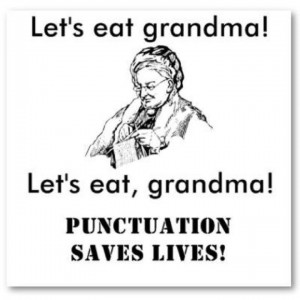
Punctuation Saves LivesThere are times when I’m reading one or another of the Gospels and I am pulled up short; I just have stop and say, “Really? Jesus said that? Really?”

This is one of those times! Did Jesus really say (and I paraphrase), “We’re going to get people up out of their graves just so we can punish them.” That’s what verse 29 is saying with that weird turn of phrase “the resurrection of condemnation”; all the dead will be raised, some to life and some to condemnation. (Whether that means an eternity of punishment or simply annihilation is another issue I’ve dealt with before and won’t address again today.)

Maybe what Jesus said ended before this verse; maybe this is John interpreting what Jesus said. Perhaps the quotation from Jesus should end with the words “because he is the Son of Man” and the part that starts “Do not be astonished” is John’s commentary. Could be. It’s an issue that could be solved by judicious use of punctuation. Unfortunately, John didn’t use punctuation and where to insert quotation marks, periods, commas, etc. is left to the “best guess” of modern translators based on noun declensions, verb tenses, and a colloquial understanding of the original language.

You see, punctuation is a modern invention. So are spaces between the words, although they have been around longer than colons, semi-colons, and full stops. Spaces were the bright idea of Irish monks working in early medieval scriptoria about 1400 years ago; punctuation marks came along about a thousand years later. They weren’t even all that common when the translators of the Authorized (“King James”) version made their estimations of where to put them in the biblical text in 1611.

The lack or improper placement of punctuation can lead to interesting misunderstandings. A popular t-shirt design noting that “punctuation saves lives” demonstrates its point with two similarly worded but radically different sentences:

“Let’s eat Grandma.”

versus

“Let’s eat, Grandma.”

Scripture itself contains an example of a misunderstanding which punctuation might have cleared up. In Mark’s Gospel, the writer applies a prophecy of Isaiah to John the Baptizer saying that his is “the voice of one crying out in the wilderness: ‘Prepare the way of the Lord, make his paths straight,'” (Mk. 1:3) Isaiah, however, seems to have said something slightly different: “A voice cries out: ‘In the wilderness prepare the way of the Lord, make straight in the desert a highway for our God.'” (Isa. 40:3) Matthew and Luke, relying on Mark, repeat his slightly altered quotation — compare Matt. 3:3 and Luke 3:4. Is the voice crying out in the wilderness or is the way of the Lord in the wilderness? The gospellers and the prophet seem to have a disagreement.

So which is it in John’s Gospel? Should the quotation from Jesus be ended a sentence earlier and the bit about getting people out their graves only to condemn them be attributed to the writer instead? To do so would, I admit, fly in the face of centuries of understanding of Jesus’ words to the Jewish authorities when they confronted him in the Temple following the healing of the crippled man at the pool of Bethesda, from which this text is taken. But it’s at least a possibility to consider, and it highlights how carefully one must read scripture.

Punctuation, as the t-shirt says, can save lives. It can also have a significant impact one’s spirituality!

====================

A request to my readers: I’m trying to build the readership of this blog and I’d very much appreciate your help in doing so. If you find something here that is of value, please share it with others. If you are on Facebook, “like” the posts on your page so others can see them. If you are following me on Twitter, please “retweet” the notices of these meditations. If you have a blog of your own, please include mine in your links (a favor I will gladly reciprocate). Many thanks!

====================

Father Funston is the rector of St. Paul’s Episcopal Church, Medina, Ohio.

Make the Circuit – From the Daily Office – January 27, 2014

From the Psalter:

Make the circuit of Zion; walk round about her;
count the number of her towers.
Consider well her bulwarks; examine her strongholds;
that you may tell those who come after.

(From the Daily Office Lectionary – Psalm 48:11-12 (BCP Version) – January 28, 2014.)

Look Crosswalk Pavement SignI’m intrigued that, near the end of what is a pretty standard hymn-of-praise sort of psalm, there is this admonition to be a careful observer. Jesus will echo this admonition, not in its exact words but in intent, several times in the gospels.

Jesus often urges his followers to pay attention to things and to observe carefully; each of the gospels includes at least one such admonition:

“From the fig tree learn its lesson: as soon as its branch becomes tender and puts forth its leaves, you know that summer is near.” (Matt: 24:32; cf. Mark 13:28)

“Be alert at all times . . . . (Luke 21:36; cf. Mark 13:33)

“Pay attention to what you hear . . . .” (Mark 4:24; cf. Luke 8:18)

“Do you not say, ‘Four months more, then comes the harvest’? But I tell you, look around you, and see how the fields are ripe for harvesting.” (John 4:35)

In the novel Stranger in a Strange Land, the science fiction author Robert Heinlein invented the profession of “Fair Witness.” This is an individual trained to observe events and report exactly what he or she sees and hears, making no extrapolations or assumptions; the Fair Witness draws no conclusions and makes no inferences from what is observed. At one point in the story, a Fair Witness is asked the color of house. She replies, “It is white on this side;” she refuses to venture an opinion as to the color of the sides which cannot be seen.

When I first read Stranger, I was intrigued with that idea and when I was a practicing trial lawyer, I often wished that I could call a Fair Witness to the stand. Practicing attorneys are well aware of how poorly most people observe, recall, and report what happens in the world around them. Although traditionally valued by the courts, eye-witness testimony is notoriously inaccurate!

So the Bible’s admonitions to carefully observe, to “make the circuit” of the subject, to walk around it, to count its features, to examine, and to consider well are good ones. But it is not “Fair Witness” observation to which we are encouraged, not simply the accurate gathering of facts. It is, rather, to intelligent consideration and contemplation, to the drawing of inferences, and to the making of conclusions on the basis of observed data. A modern reader might even say that the Bible urges us to make use of the scientific method!

A Cambridge University scientist, William Beveridge, in his book explaining The Art of Scientific Investigation (1957) wrote, “Interpreting the clue and realizing its possible significance requires knowledge without fixed ideas, imagination, scientific taste, and a habit of contemplating all unexplained observations.” I believe that this is as true of religion as it is of science. It applies to consideration of one’s faith and one’s spirituality, as well as to observation of the physical world. This is why the Bible encourages us to pay attention.

Like science, religion is hampered by “knowledge with fixed ideas,” by lack of imagination, and by failure to contemplate the unexplained. I also think it is imperative that a religious person have what Beveridge calls “scientific taste,” which I understand to mean a passion for observation, a commitment to being alert at all times, a delight in taking the time to “make the circuit of Zion.”

====================

A request to my readers: I’m trying to build the readership of this blog and I’d very much appreciate your help in doing so. If you find something here that is of value, please share it with others. If you are on Facebook, “like” the posts on your page so others can see them. If you are following me on Twitter, please “retweet” the notices of these meditations. If you have a blog of your own, please include mine in your links (a favor I will gladly reciprocate). Many thanks!

====================

Father Funston is the rector of St. Paul’s Episcopal Church, Medina, Ohio.

Spooky Jesus – From the Daily Office – January 20, 2014

From the Gospel of John:

When he was in Jerusalem during the Passover festival, many believed in his name because they saw the signs that he was doing. But Jesus on his part would not entrust himself to them, because he knew all people and needed no one to testify about anyone; for he himself knew what was in everyone.

(From the Daily Office Lectionary – John 2:23-25 (NRSV) – January 20, 2014.)

Jesus Holy CardThe Definition of Chalcedon affirms, in part:

Following the holy fathers, we all with one accord teach men to acknowledge one and the same Son, our Lord Jesus Christ, at once complete in Godhead and complete in manhood, truly God and truly man, consisting also of a reasonable soul and body; of one substance (homoousios) with the Father as regards his Godhead, and at the same time of one substance with us as regards his manhood; like us in all respects, apart from sin . . . .

That last bit is derived from Holy Scripture, specifically from a verse in the Letter to the Hebrews: “We do not have a high priest who is unable to sympathize with our weaknesses, but we have one who in every respect has been tested as we are, yet without sin.” (Heb. 4:15 NRSV)

The Jesus described by the writer of Hebrews and affirmed in the Chalcedonian definition is a man I can follow. There are times when the Jesus described by the writer of the Fourth Gospel creeps me out! This is one of them. The thought that someone could “know all people” and “know what is in everyone” is just spooky.

Now, let me be clear, I am not speaking of the eternal Second Person of the Trinity; I’ve no doubt that God knows all people and knows what is in everyone. But the human person born in early First Century Palestine, who ate and drank and walked around, who expressed joy and disappointment, who got mad, who went to parties, who hiked the roads from town to town, that guy who was “like me in all respects” . . . . I don’t think that Jesus in his human life had access to the divine mind or could have known “what was in everyone.” If he did, he wasn’t like me and what he lived through, what he taught, and his death, resurrection, and ascension have no bearing on my life or meaning for me. He’s too spooky for me!

Years ago I was given a “holy card” which I have since lost. (In the Roman Catholic tradition, holy cards, also called “prayer cards” are small, devotional pictures, often mass-produced for the use of the faithful.) This card had what I’m sure is a very unrealistic portrait of Jesus done in what is technically called “lenticular printing;” that’s the process that makes the printed image seem to change or move as it is viewed from different angles. On that holy card, Jesus’ eyes seemed to move and follow you. It was creepy! When I read about Jesus reading the minds of everyone around him and knowing “what was in everyone,” I think of that spooky holy card.

John does this a lot; this gospel sometimes makes Jesus so divine that the human being gets lost. The wisdom of the biblical canon is that John’s too-divine Jesus is tempered by Mark’s portrait which is too human! (Could the longer ending of Mark’s Gospel, Mark 16:9-20 which includes the Great Commission and a description of Christ’s Ascension, have been added as a corrective to that too-human portrayal? That’s a topic for another exploration.)

I’m not suggesting that John’s Gospel be discounted or overlooked or thrown away. I’m just acknowledging that its mind-reading Jesus who “knew what was in everyone” is someone I wrestle with (like Israel in the desert with the angel of God). He’s spooky and spooky bothers me.

====================

A request to my readers: I’m trying to build the readership of this blog and I’d very much appreciate your help in doing so. If you find something here that is of value, please share it with others. If you are on Facebook, “like” the posts on your page so others can see them. If you are following me on Twitter, please “retweet” the notices of these meditations. If you have a blog of your own, please include mine in your links (a favor I will gladly reciprocate). Many thanks!

====================

Father Funston is the rector of St. Paul’s Episcopal Church, Medina, Ohio.

Angelic Toddlers – From the Daily Office – January 14, 2014

From the Book of Genesis:

The Lord God sent [Adam] forth from the garden of Eden, to till the ground from which he was taken. He drove out the man; and at the east of the garden of Eden he placed the cherubim, and a sword flaming and turning to guard the way to the tree of life.

(From the Daily Office Lectionary – Genesis 2:23-24 (NRSV) – January 14, 2014.)

Putti with Book by Giovanni Battista Tiepolo, 1744Look up cherub in a secular dictionary and this is what you find: “a member of the second order of angels, often represented as a beautiful rosy-cheeked child with wings.” (Collins) I don’t know why, when, or how the fat little boys with aerodynamically inadequate wings came to be an artistic and now normative depiction of cherubs, but there it is! Technically, these little guys (and they are male) are known as putti — an Italian plural; the singular is putto. (Putto is occasionally used in modern Italian to mean a male toddler.)

Say the word cherub (or its adjectival form, cherubic) to nearly anyone, and the image that will spring to his or her mind is almost guaranteed to be a putto. For me, this inaccurate representation of the cherubim has become the poster child for everything that needs to be unlearned.

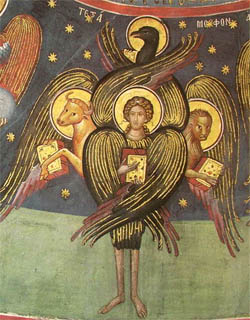
As the end of the story of the Garden of Eden ought to make clear, the cherubim are beings of immense power, stationed on the path to the tree of life wielding flaming swords. They are the bearers of the throne of God (see Isaiah 37:16). Ezekiel describes the cherubim when recounting his vision of “four living creatures” whom he later identifies as cherubim:

Tetramorph, Fresco at Meteora Monastery

They were of human form. Each had four faces, and each of them had four wings. Their legs were straight, and the soles of their feet were like the sole of a calf’s foot; and they sparkled like burnished bronze. Under their wings on their four sides they had human hands. And the four had their faces and their wings thus: their wings touched one another; each of them moved straight ahead, without turning as they moved. As for the appearance of their faces: the four had the face of a human being, the face of a lion on the right side, the face of an ox on the left side, and the face of an eagle. (Ezek. 1:5b-10; cf. Ezek. 10)

Although our error of imagination in regard to the appearance of the cherubim can be easily corrected by a few minutes of bible study like this, the larger issue of unlearning is not so quickly or easily dealt with.

An old comedy album by the group the Firesign Theatre was entitled Everything You Know Is Wrong. I wouldn’t go that far, but we are conditioned by our families, societies, and culture to “know” many things . . . and much what we “know” as a result of that conditioning is simply inaccurate. Before we can know the truth, we have to unlearn the things of which we are convinced because of our conditioning.

Unlearning, however, is not simply replacing inaccuracies with “true facts.” It is not about right or wrong. Unlearning is an attitude of openness to that which lies beneath the judgment of right or wrong. It is about “moving away from” rather than “moving towards.” Zen masters often use the metaphor of emptying a full cup of tea. There is nothing beyond the emptying. The cup is not emptied so that it can be refilled; it is emptied so that it can be empty. Only when it is truly empty with no expectation or anticipation of being filled is the cup open to the future.

Jesus used another metaphor, that of an innocent child: “Truly I tell you, whoever does not receive the kingdom of God as a little child will never enter it.” (Mark 10:15)

So perhaps our chubby little wingéd friends, those little angelic toddlers, are a good image after all. If they are, as I suggested, the poster children for unlearning, let’s think about the way toddlers receive things.

A way to unlearn might be to try to go back to our first learning experiences and explore new things as toddlers would, through playfulness and curiosity. Toddlers never seem to have a plan, no preconceived notion of where they are going, no expectation of what is coming next. Jiddu Krishnamurti, the Indian philosopher, often described truth as a “pathless land;” toddlers seem to live in such a pathless country, a place of endless discovery. This, I think, is where Jesus invites: to a place where we can open ourselves, empty ourselves, and unlearn our conditioning, to the pathless country of truth where we can wander like a toddler with playfulness and deep curiosity.

====================

A request to my readers: I’m trying to build the readership of this blog and I’d very much appreciate your help in doing so. If you find something here that is of value, please share it with others. If you are on Facebook, “like” the posts on your page so others can see them. If you are following me on Twitter, please “retweet” the notices of these meditations. If you have a blog of your own, please include mine in your links (a favor I will gladly reciprocate). Many thanks!

====================

Father Funston is the rector of St. Paul’s Episcopal Church, Medina, Ohio.

Shaking Grammy – From the Daily Office – December 14, 2013

From the Prophet Haggai:

Thus says the Lord of hosts: Once again, in a little while, I will shake the heavens and the earth and the sea and the dry land; and I will shake all the nations, so that the treasure of all nations shall come, and I will fill this house with splendor, says the Lord of hosts.

(From the Daily Office Lectionary – Haggai 2:6-7 (NRSV) – December 14, 2013.)

Antique KitchenI remember a movie scene, maybe a cartoon? A character is picked up by his ankles and shaken, and all the change in his pockets rattles out and collects on the ground beneath him . . . . That is what first came to mind when I read these verses of Haggai, still going on about rebuilding the Temple in Jerusalem immediately after the Babylonian Exile.

Then another memory, a memory of being shaken myself.

I spent many childhood summers with my paternal grandparents in a small town in southeastern Kansas. They had moved there in 1919. My grandfather had purchased five city lots. On one he built there home, a three-bedroom bungalow. On another he built a similar home to rent out for income; eventually, it would be the home of my father’s older brother and his family who lived there during those childhood summers. On a third, Granddad built a large structure which might have been called a barn if it were on a farm or a ranch; we just called it “the garden shed.” That lot also was the location of the chicken coop where my grandmother collected eggs every morning. The remaining two lots were my grandfather’s garden and fruit orchard, where I worked and played with my cousins summer mornings; in the afternoon, we would go to the city swimming pool or to the library or to the movies.

My grandfather was a very good gardener, so there always seemed to be plenty of beans, tomatoes, cucumbers, corn, okra, you-name-it for my grandmother to can, make into preserves, cook fresh, blanch and freeze, and so forth. When I think of her, I most often picture her in the kitchen.

Grammy Funston was a small woman. If she was fully five feet tall, I’d be surprised. Because kitchen counters were just a bit too tall for her, she preferred to sit at the kitchen table to do her vegetable and fruit preparation, the peeling, dicing, slicing, sorting, and what-all that is required to cook, preserve, or can garden produce.

Grammy’s kitchen was the way into the house from the garden, the orchard, the play yard, and the work shed: up the back porch steps, into the mudroom, past the stairs to the basement, into and through the kitchen to get to wherever else you might be headed. With all that cooking and canning going on, boiling pots of water on the stove, pans of cooking jams and jellies, stacks of glass mason jar and jelly glasses, it was also a busy and sometimes dangerous place. She didn’t mind people coming and going through her work space, but she had one hard-and-fast rule – no running in the kitchen.

Violate that rule and you would find yourself snagged! For a woman as petite as she was, she was incredibly strong and had a grip like iron. Run past her in that kitchen and her arm would flash out like a bull-whip; her hand would latch on to your upper arm like a vice; and you would find yourself planted right in front of her about to get a stern talking-to. She had a habit of placing her hands on both your upper arms and shaking you as she made her points: “You could get seriously hurt!” SHAKE “Do you understand me?” SHAKE “This is a dangerous place!” SHAKE

“I will shake the heavens and the earth and the sea and the dry land; and I will shake all the nations. . . .” I picture God as a grandmother working in her kitchen, making all sorts of good things, and occasionally snagging an unruly creation by the arm, grabbing the world by both shoulders. “This is a dangerous place!” SHAKE “You need to pay attention!” SHAKE “Do you understand me?” SHAKE

It’s the message of Advent, again! “Be alert; I have already told you everything.” (Mark 13:23) SHAKE!

====================

A request to my readers: I’m trying to build the readership of this blog and I’d very much appreciate your help in doing so. If you find something here that is of value, please share it with others. If you are on Facebook, “like” the posts on your page so others can see them. If you are following me on Twitter, please “retweet” the notices of these meditations. If you have a blog of your own, please include mine in your links (a favor I will gladly reciprocate). Many thanks!

====================

Father Funston is the rector of St. Paul’s Episcopal Church, Medina, Ohio.

Irrelevant Shouting – From the Daily Office – August 17, 2013

From the Second Book of Samuel:

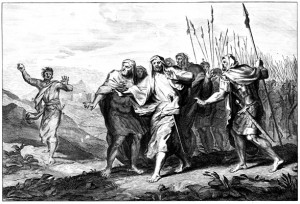
David and his men went on the road, while Shimei went along on the hillside opposite him and cursed as he went, throwing stones and flinging dust at him.

(From the Daily Office Lectionary – 2 Samuel 16:13 (NRSV) – August 17, 2013.)

Shimei Curses David by Otto ElligerToday’s Old Testament reading describes part of what happened during the conflict between David and his rebellious son Absalom. Making his way from Hebron to Jerusalem, David is accosted by a Benjamite, Shimei the son of Gera, who curses and berates him, throws stones and dust at him, and predicts disaster ahead.

It is accompanied by a reading from the Gospel of Mark describing Jesus’ triumphal entry into Jerusalem:

Those who went ahead and those who followed were shouting, “Hosanna! Blessed is the one who comes in the name of the Lord! Blessed is the coming kingdom of our ancestor David! Hosanna in the highest heaven!” (Mark 11:10-11)

Quite a contrast, isn’t it? But here’s the thing, neither Shimei’s curses of David nor the Jerusalem crowd’s praises of Jesus accurately predicted the future. Although David’s son Absalom died in the conflict, and to a father that would be disaster, David did not; his rule as king over Israel was long and prosperous, and is considered a “golden age.” Jesus’ entry into Jerusalem would end in less than a week with his death by crucifixion.

That’s something to remember. The voices all around us, whether critical or flattering, whether damning or praising, do not foretell our future. As irritating or pleasant as they may be, they are of little import. What matters is the voice within. What matters is what we tell ourselves and what we believe we hear of the Voice of God, that still small voice that is often drowned out by the irrelevant shouting along the side of the road.

====================

A request to my readers: I’m trying to build the readership of this blog and I’d very much appreciate your help in doing so. If you find something here that is of value, please share it with others. If you are on Facebook, “like” the posts on your page so others can see them. If you are following me on Twitter, please “retweet” the notices of these meditations. If you have a blog of your own, please include mine in your links (a favor I will gladly reciprocate). Many thanks!

====================

Father Funston is the rector of St. Paul’s Episcopal Church, Medina, Ohio.

Tribalism and an Illustration of Compromise – From the Daily Office – July 18, 2013

From the Gospel according to Mark:

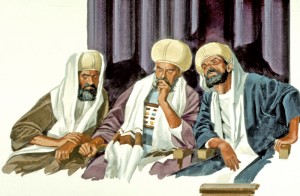
The Pharisees went out and immediately conspired with the Herodians against [Jesus], how to destroy him.

(From the Daily Office Lectionary – Mark 2:6 (NRSV) – July 18, 2013.)

Three Elders ConspiringJesus had healed someone on the sabbath; that’s the simple back ground to the Pharisees and Herodians conspiracy against Jesus. This alliance is an interesting one since in generally the two groups hated one another! But their fear of Jesus apparently was enough to get them to work together against him.

It’s an odd alliance, particularly if looked at from the view point of the Pharisees. Their name is taken from the Hebrew word parash meaning “to separate;” they adhered to a strict piety and disciplined adherence to the Torah. They refused to associate with Gentiles or any “unclean” person or thing. They exhibited all of the characteristics of what, in our modern world politics, has come to be called “tribalism.”

Recently a friend and colleague bemoaned what she called “the tyranny of liberalism” noting that those on the political left were “wasting precious energy and time beating each other up.” I suggested to her that the problem is not with liberalism (nor, indeed, with conservatism). Rather the issue in modern society is the “tribalism” that seems to have taken over all of American social thought and civic behavior (including behavior in the church).

Tribes (like the Pharisees) group around and define membership on the basis of some type of purity – purity of thought, purity of belief, purity of blood, purity of precious bodily fluids, purity of whatever. Stray even a little bit from that purity and, like white blood cells, other members of the tribe will attack. A liberal voicing illiberal opinions, a conservative embracing a liberal point . . . they will be pilloried by their co-tribalists much faster than by the “opposition.”

This kind of tribal thinking has infected both political parties, many churches, the liberal and conservative political camps . . . name some segment of current American society and you can identify its tribal attributes. There are Pharisees of all stripes in our national community today. Both houses of our nation’s legislature have succumbed to a deeply seated “us versus them” mentality of political tribalism that goes beyond even traditional partisanship; nothing is getting done and so long as this persists nothing is likely to get done.

Not a single one of us is immune to tribalism; none of us avoids it entirely. However, we can do something about it. We can become aware of it. We can identify our own biases and question our own motivation. We can confess our own sinfulness in this regard and repent, turning away from it in favor of a more constructive way of working together.

In the second chapter of his catholic epistle, James addresses the issue of favoritism:

If a man comes into your assembly with a gold ring and dressed in fine clothes, and there also comes in a poor man in dirty clothes, and you pay special attention to the one who is wearing the fine clothes, and say, “You sit here in a good place,” and you say to the poor man, “You stand over there, or sit down by my footstool,” have you not made distinctions among yourselves, and become judges with evil motives? (James 2:2-4)

He then condemns this favoritism as sinful: “If you show partiality, you are committing sin and are convicted by the law as transgressors.” (v. 9) It is, he says, a violation of what Christ called the second great commandment: Love your neighbor as yourself. Partisan tribalism, I would suggest, is simply a political form of the favoritism scripture here condemns.

I remember reading once that Christians are called to pledge unwavering allegiance to the Lamb, not to the donkey or the elephant. We are bidden by scripture to pray for our governments and our leaders without regard to their politics or our own. If we will do that, while becoming aware of our own motives and biases, we can eschew tribalism and model a way of doing social business, of being community that will benefit all.

The alliance between the Herodians and the Pharisees, even though it was against Jesus, demonstrates that even those with the most tribal of instincts can compromise and work together. We should foster and encourage such behavior, even if this example might not the best illustration to use.

====================

A request to my readers: I’m trying to build the readership of this blog and I’d very much appreciate your help in doing so. If you find something here that is of value, please share it with others. If you are on Facebook, “like” the posts on your page so others can see them. If you are following me on Twitter, please “retweet” the notices of these meditations. If you have a blog of your own, please include mine in your links (a favor I will gladly reciprocate). Many thanks!

====================

Father Funston is the rector of St. Paul’s Episcopal Church, Medina, Ohio.

Honoring Women on Fathers’ Day – Sermon for the 4th Sunday after Pentecost (Proper 6C) – June 16, 2013

====================

This sermon was preached on the Fourth Sunday after Pentecost, June 16, 2013, at St. Paul’s Episcopal Church, Medina, Ohio, where Fr. Funston is rector.

(Revised Common Lectionary, Pentecost 4 (Proper 6, Year C): 1 Kings 21:1-21a; Psalm 5:1-8; Galatians 2:15-21; Luke 7:36-8:3. These lessons can be read at The Lectionary Page.)

====================

Mary Magdalene Susanna and Joanna by Janet McKenzieToday, I would like to talk about women. I know it’s Fathers’ Day but as my friend and colleague (someone known to many of you) the Rev. Jennifer Leider recently remarked, “The lectionary is no respecter of secular holidays.” On this 4th Sunday after Pentecost, looking at the lessons for Proper 6 in Lectionary Year C, we have some readings from Scripture which draw our attention to women: women as active agents in the world of men, as subjects who act rather than as objects which are acted upon. Given the cultures, the political realities, and the social mores of the times and places in which these stories happened and were recorded, that’s really quite amazing! So, it may be Fathers’ Day, but let’s take a look at these biblical women.

The first woman to consider is the wife of King Ahab of Israel, Queen Jezebel. Jezebel was the daughter of Ethbaal, king of Tyre, the Phoenician empire. She was a powerful woman who commanded her own army and had considerable control over the religious establishment of her homeland. According to the Scriptures, she converted her husband to the worship of Ba’al and convinced him to have many Jewish prophets killed. As we heard a couple of weeks ago, she brought 450 prophets of Ba’al into Israel and the Jewish prophet Elijah challenged them to a competition, which he and Yahweh won, and he then had the prophets of Ba’al slaughtered. This made Jezebel his enemy and, out of fear for her, he fled the country. In today’s lesson from the First Book of Kings we see her wielding this power and manipulating her husband’s acquisition of a vineyard by getting the legitimate owner, Naboth, falsely accused of and executed for blasphemy. This was not a woman to be messed with; she had political, military, and religious power.

This was not so with the second woman we meet in Scripture today, a woman described in Luke’s Gospel as a “notorious sinner” who interrupts a dinner party to wash Jesus’ feet with her tears, dry them with her hair, and anoint them with costly oil poured from an alabaster jar.

In all four of the gospels there is a story like this. Matthew, Mark, Luke, and John all relate a tale of a woman who, at a dinner party, comes and anoints Jesus with a jar of balm described as extravagantly expensive. In each story someone objects to the waste of the valuable ointment (or the money spent on it). In each story someone questions Jesus’ credentials as a religious person. In each story Jesus defends the woman’s action.

In Matthew’s Gospel the event happens “while Jesus was at Bethany in the house of Simon the leper,” just a few days before the Crucifixion; “a woman came to him with an alabaster jar of very costly ointment, and she poured it on his head as he sat at the table.” When the action is challenged by the disciples, Jesus defends it as an anointing for his burial. (Matt. 26:6-13) Mark’s version is essentially the same as Matthew’s.

John says that it was Jesus’ feet that were anointed, rather than his head, but agrees with Matthew and Mark this event took place just a few days before Jesus’ execution. Like Luke, John describes the woman as washing Jesus’ feet with her tears and drying them with her hair. But John identifies the woman as Mary of Bethany, the sister of Martha and Lazarus.

Luke is the only one who doesn’t put relate this story as part of the narrative Jesus’ passion and death. In this version, Luke takes the story of anointing, places it in the house of a Pharisee, adds the parable of excused mortgages, and gives us a story forgiveness, not a story of preparation for death.

In each of the other stories, especially John’s telling, there is some suggestion that the woman has a legitimate right to be at the dinner, or at least in the house. This is not the case here. As I said a moment ago, this woman is described by Luke as “a notorious sinner.” She is clearly not an invited guest; she is not a member of Simon the Pharisee’s household. She just comes in off the street and does this remarkable, surprising thing. We might wonder how this could have happened; how could she have gotten all the way into the dining room to do this? To answer that question, we need to imagine ourselves in First Century Palestine.

Imagine that world for a moment. There are no telephones, neither cell phones nor land lines. There is no air conditioning. There is no refrigeration. Nothing electric at all. Furthermore, there is no credit; lending or credit are forbidden in the Law of Moses. Whatever was needed for daily life, especially food, had to be purchased with cash everyday. Whatever communication there was need of had to be done in person or through a messenger, usually a servant or slave employed specifically to run messages around town. Whatever business was done was usually done from the home, not from an office somewhere else. There were no schools; whatever education a child may have gotten was done at home by parents or, if the family was wealthy, by servants or hired tutors.

So people were constantly coming and going; members of the household going out to shop everyday and returning with their purchases. Messengers from others delivering family or business communications; the households own messengers taking messages to others. Servants coming and going.

Houses of the sort a prominent man like Simon the Pharisee would have had had a central courtyard with a number of rooms opening off it. The courtyard would have been separated from the public street by a wall and a gate, the gate usually open to all that coming and going.

The other three sides of the courtyard was surrounded by rooms, which would have been open to the courtyard to provide ventilation and cooling. Their inner walls would have been finished with a smooth coat of clay or plaster, decorated with elaborate frescoes. Wide benches of stone for sitting and sleeping, and shelves for storage would have been built into the walls. Stairs or a ladder would have led up onto the roof, which was used as an outdoor room most likely for bathing and laundry during the day and for sleeping at night during summer heat.

These rooms tended to be small and dark, so the courtyard and the roof were the important parts of the house; here those activities needing good light, spinning and weaving, food preparation, and dining would have taken place. In the courtyard of a First Century house you might find:

  • the mikveh, a pool of clean rainwater used for ritual cleansing
  • a kitchen area where food, purchased day by day, was prepared
  • a covered area where people worked and socialized, where they ate

This was the center of activity and socializing; it was here that all that coming and going took place. It was here that a woman might enter the gate right off the public street and interrupt a dinner in progress.

And that is what this woman did. A “notorious sinner,” an outcast, one of the lowest of the low, took matters into her own hands. Knowing that Jesus was there and knowing that he might be able to help her do something to end her abject abnegation, she felt herself empowered. She had heard, no doubt, about the several times he had healed and forgiven others even when others thought it violated the Law in some way (Luke, Chapters 5 and 6). She might have heard about (or even been present at) his Sermon on the Plain. When he said:

Blessed are you who are poor, for yours is the kingdom of God. Blessed are you who are hungry now, for you will be filled. Blessed are you who weep now, for you will laugh. Blessed are you when people hate you, and when they exclude you, revile you, and defame you on account of the Son of Man. Rejoice in that day and leap for joy, for surely your reward is great in heaven; for that is what their ancestors did to the prophets. (Luke 6:20-23)

she might have understood that he was speaking to her. And when she heard him say:

Do not judge, and you will not be judged; do not condemn, and you will not be condemned. Forgive, and you will be forgiven; give, and it will be given to you. A good measure, pressed down, shaken together, running over, will be put into your lap; for the measure you give will be the measure you get back. (Luke 6:37-38)

she may have made her plan to give everything she had, to spend whatever she had on that costly jar of oil, to give him her best in thanksgiving for the forgiveness she felt had been given her. So she took matters into her own hands, bought that ointment, and walked through that gate and into that dinner party. Jesus rewarded her boldness and confirmed her forgiveness in the parable he told the Pharisee and in the words with which he thanked her and sent her on her way, “Your faith has saved you; go in peace.”

The last image of women we have in today’s lessons is not a single woman, but a group of women. Luke tells us that, shortly after this extraordinary dinner party, Jesus went on through cities and villages, proclaiming the good news, and that with him where the twelve and “some women who had been cured of evil spirits and infirmities: Mary, called Magdalene, from whom seven demons had gone out, and Joanna, the wife of Herod’s steward Chuza, and Susanna, and many others, who provided for them out of their resources.” (Luke 8:1-3) Here we have a picture of women of who in one sense are like Jezebel: they are independent women of means, some married, some unmarried, who own their own property and resources, women who have the authority to do as they wish. But in another sense they are like the woman with the alabaster jar; they give from their resources to provide for Jesus in his ministry.

So these are the three pictures of women in today’s scriptures: a woman of wealth and power who used who wealth and power to corrupt and manipulate; a woman of absolutely no status whatsoever who felt empowered to give probably everything she had in gratitude for the forgiveness brought to her by Jesus; and women of independent means who made their own decisions to work for the betterment of the world, who (in this particular instance) supported Jesus in his ministry of forgiveness. It is certainly not like Jezebel, but like the others that the Episcopal Church and the Anglican Communion encourages and hopes to help women to become through our adoption of the Third Millennium Goal: to promote gender equality and empower women.

Not only in this Gospel story, but again and again in the Gospels we see Jesus meeting and interacting with women in ways that honor them, raise them up, and empower them. There is the woman who argued that “even the dogs get to eat the crumbs under the table” as she begged for healing for her daughter, whose faith Jesus applauded. There is the widow he observed who gave all she had to the temple treasury, whom Jesus praised for putting the wealthy to shame. There was Mary Magdalene, who became the first witness to the resurrection, the first evangelist of the Good News of the Risen Christ.

These are women whom Jesus empowered to be something other than the role their society would have put them in, to act with confidence that they, like the men around them, were created in the image of God.

Many women around the world today live in circumstances that make it difficult, if not impossible, to act with similar confidence. News reports daily document the level of violence against women: rape as a weapon of war (or as a possible danger of military service), so-called honor killings, sex trafficking, and other horrors suffered by women simply because they are women. In the United States today, homicide is the third leading cause of death for girls aged 1 to 4 and also for young women, 15 to 24, and most are killed by someone they know.

We are called by Jesus and by the church to emulate his ministry of forgiveness and empowerment, to offer women throughout the world the opportunity to choose life in a world ravaged by war, hunger, disease, and death; to promote gender equality so that women and men have equal opportunities and equal roles in decision-making throughout society. To promote equality between the sexes is to promote the healing of our world and to further the church’s ministry of reconciliation.

Yes, it’s Fathers’ Day, and as Jennifer Leider said, “The lectionary is no respecter of secular holidays.” But as it happens, Time Magazine decided to celebrate Fathers’ Day this week by asking some famous fathers to write open letters to their daughters, and those letters echo remarkably the message of today’s lectionary readings. Senator Marco Rubio wrote to his daughters Amanda and Daniella: “My hope for my daughters is that they will grow up to be strong, confident women who understand that they can be whatever that want to be in life.” Chicago mayor Rahm Immanuel wrote to his daughters Ilana and Leah his hope that they would be “smart, fearless, independent . . . strong, trailblazing women.” And producer Aaron Sorkin wrote this advice to his daughter Roxanne: “Be brave and know that the bravest thing you can do is be willing to not fit in. Never take pleasure in someone else failing. Dare to fail yourself. Be the one who doesn’t care as much about clothes as the person wearing them. Be kind, be compassionate and be humble.”

Our call as Christians, the message of today’s lessons, is that we are to help build a world where that is possible, where no woman need be as conniving and manipulative as Jezebel, where no woman should be as put down and subjected as the woman who interrupted the dinner party, where every woman can be as independent and resourceful as those who followed Jesus and supported his ministry of forgiveness.

Today’s Gospel teaches us that the best way to honor fathers is empower their daughters.

====================

A request to my readers: I’m trying to build the readership of this blog and I’d very much appreciate your help in doing so. If you find something here that is of value, please share it with others. If you are on Facebook, “like” the posts on your page so others can see them. If you are following me on Twitter, please “retweet” the notices of these meditations. If you have a blog of your own, please include mine in your links (a favor I will gladly reciprocate). Many thanks!

====================

Father Funston is the rector of St. Paul’s Episcopal Church, Medina, Ohio.

« Older posts Newer posts »