Occasional thoughts of an Anglican Episcopal priest

Category: Matthew (Page 21 of 29)

Cleaning Cups – From the Daily Office – December 12, 2013

From Matthew’s Gospel:

[Jesus said:] “Woe to you, scribes and Pharisees, hypocrites! For you clean the outside of the cup and of the plate, but inside they are full of greed and self-indulgence.”

(From the Daily Office Lectionary – Matt. 23:25 (NRSV) – December 12, 2013.)

Dirty CupThe devisers of our Episcopal Church Daily Office Lectionary were a clever bunch, weren’t they?

Here we are less than two weeks from Christmas Day, in the middle of that great orgy of greed and indulgence which is the holiday gift buying season, and they give us Jesus saying this!

Yesterday, TIME Magazine announced that their selection of the 2013 Person of the Year is Pope Francis, the current Bishop of Rome and Supreme Pontiff of the Roman Catholic Church. Interesting choice, especially at this time of year given that less than a month ago he said:

The worship of the ancient golden calf has returned in a new and ruthless guise in the idolatry of money and the dictatorship of an impersonal economy lacking a truly human purpose. The worldwide crisis affecting finance and the economy lays bare their imbalances and, above all, their lack of real concern for human beings; man is reduced to one of his needs alone: consumption. (Evangelii Gaudium, published 24 November 2013, Paragraph 55)

I am not a Roman Catholic, but I find myself fully in agreement with the pope’s insistence that unfettered capitalism and unrestrained “free markets” are contrary to the Gospel mandate. His insistence that the church and society are called by Christ, compelled by the Spirit to help “those who are in thrall to an individualistic, indifferent and self-centered mentality to be freed from those unworthy chains and to attain a way of living and thinking which is more humane, noble and fruitful, and which will bring dignity to their presence on this earth (Para. 208),” is fully in accord with what I understand Jesus to be saying in this (and other) verses of Scripture.

There is little that any one person can do in this regard. I’ve done this Advent what I can — I stayed away from all retail activity on Thanksgiving and Black Friday, not giving into or being part of the feeding frenzy of “holiday sales” — I am trying to “buy local” both for gifts and for personal needs — I do my banking at a local financial institution, not with one of the national conglomerates — I plan to give few gifts this year, but instead to make dedicated contributions to Episcopal Relief & Development, Médecins sans Frontières, Habitat for Humanity, and similar organizations.

These are small things. In the vast, global financial network that is our dysfunctional economy, they are a drop in the ocean. But they are something. The American Unitarian clergyman Edward Everett Hale is quoted as saying, “I am only one, but I am one. I can’t do everything, but I can do something. The something I ought to do, I can do. And by the grace of God, I will.” If each of us does something to clean the inside of the cup which is our economy of greed and indulgence, perhaps we can change it.

The clever compilers of our lectionary and the pope have reminded us that Jesus calls us to do so. This Advent, I am doing what I can.

====================

A request to my readers: I’m trying to build the readership of this blog and I’d very much appreciate your help in doing so. If you find something here that is of value, please share it with others. If you are on Facebook, “like” the posts on your page so others can see them. If you are following me on Twitter, please “retweet” the notices of these meditations. If you have a blog of your own, please include mine in your links (a favor I will gladly reciprocate). Many thanks!

====================

Father Funston is the rector of St. Paul’s Episcopal Church, Medina, Ohio.

I’m sorry? – From the Daily Office – December 11, 2013

From the Psalter:

I confess my iniquity; I am sorry for my sin.

(From the Daily Office Lectionary – Psalm 38:18 (NRSV) – December 11, 2013.)

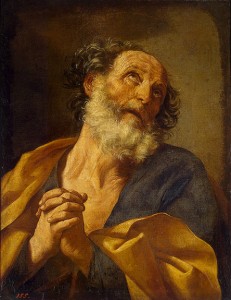
Repentance of St Peter by Guido ReniI thought, “Surely, this is wrong! There can’t be anything as weak and lifeless in Scripture (especially in the Psalms) as the plaintive little cry, ‘I’m sorry . . . .'” So instead of the New Revised Standard Version, I turned to The Book of Common Prayer, sure that I would find a stronger statement, perhaps “I repent.” But, no. The BCP version of this psalm is really even worse because it renders the verb in the future tense: “I will confess my iniquity and be sorry for my sin.” Come on! “I will be sorry”? Really?

I couldn’t sit there in my pajamas disconcerted by such a feeble, apologetic rendering of what must surely be a more forceful statement in the Hebrew. I turned to my old interlinear Hebrew-English Old Testament and my Hebrew lexicon; I had to climb the stairs to the second floor study because those are not close to hand next to the recliner in the den. It was worth the effort; I breathed a sigh of relief. The Hebrew is da’ag, which means “to fear, be anxious, be concerned, be afraid, be careful.” In fact, the American Standard translation (which is what my interlinear uses) renders this verse: ” I am full of anxiety because of my sin.” In the Complete Jewish Bible (which I also snagged while I was upstairs), the translation is similar: “I am anxious because of my sin.” To be fearful or to be filled with anxiety because of one’s sinfulness is a lot more than merely being sorry! But even that doesn’t seem quite strong enough . . . .

I’m not sure why the words “I am sorry” set my teeth on edge, but they do. When my children were younger like all children they committed youthful indiscretions; when called on the carpet, their first words were always, “I’m sorry.” My response was almost always, “Don’t be sorry. Change your behavior.” Feeling badly about one’s wrong-doing is simply not enough! What is called for by Scripture, what is called for by the process of growing to maturity, is repentance. “Repent and turn from all your transgressions; otherwise iniquity will be your ruin,” says Ezekiel (Ezek. 18:30) In another place, the Psalmist proclaims, “If one does not repent, God will whet his sword.” (Ps. 7:12) “Repent,” says Jesus, “for the kingdom of heaven has come near.” (Matt. 4:17)

To repent is to lament one’s guilty state, turn away from it, change one’s mind and purpose, and undertake amendment of life and behavior. It is so much more than simply being sorry! It is to take action to alleviate one’s deep-set feelings of anxiety and fear. “Don’t be sorry. Change your behavior.”

Although Advent is not the penitential season that Lent is, there is in it a call to contrition. Last Sunday and next at the weekly celebration of the Eucharist we hear of John the Baptizer who came “proclaiming a baptism of repentance for the forgiveness of sins,” and announcing the arrival of the one who would baptize with the Holy Spirit and with fire. (Luke 3:3,16) In Advent, we do our best once again to heed his call and prepare again for the Messiah’s arrival.

There is so much more required than simply a weak plea of “I’m sorry,” and certainly more the Prayer Book’s promise to be sorry in the future! Only with true repentance, right now, and amendment of life, now and in the future, can we “come to the unity of the faith and of the knowledge of the Son of God, to maturity, to the measure of the full stature of Christ.” (Eph. 4:13)

====================

A request to my readers: I’m trying to build the readership of this blog and I’d very much appreciate your help in doing so. If you find something here that is of value, please share it with others. If you are on Facebook, “like” the posts on your page so others can see them. If you are following me on Twitter, please “retweet” the notices of these meditations. If you have a blog of your own, please include mine in your links (a favor I will gladly reciprocate). Many thanks!

====================

Father Funston is the rector of St. Paul’s Episcopal Church, Medina, Ohio.

Lions Eating – From the Daily Office – December 4, 2013

From the Prophet Amos:

Thus says the Lord: As the shepherd rescues from the mouth of the lion two legs, or a piece of an ear, so shall the people of Israel who live in Samaria be rescued, with the corner of a couch and part of a bed.

(From the Daily Office Lectionary – Amos 3:12 (NRSV) – December 4, 2013.)

Lion EatingI’m sitting here this morning knowing full well that I should be writing something about Advent and, truth be told, there are other parts of today’s daily readings that would lend themselves to an Advent reflection. But…. yesterday a federal court in Michigan decreed that the city of Detroit could carry on with a restructuring of its debt through bankruptcy and, more importantly and more destructively, that among the obligations that could be discharged are its pension responsibilities to former municipal employees. I was deeply troubled by that news when I heard it yesterday morning and I’ve been pondering it since.

It’s been more than thirty years since I graduated from law school (thirty years!) and at no time in those three decades have I practiced bankruptcy law, and I certainly haven’t kept up with the changes in statutory or judicial determination of what debts can and cannot be discharged. The only significant change that I know of personally is the legislative decision that student loans cannot be subjected to bankruptcy protection (about which I am keenly aware as the parent of a young adult with significant educational debt). Nonetheless, I recall from my law school studies that the basic concept of court-supervised bankruptcy is supposed to fairness and equity to both debtor and creditors. Sometimes fairness requires that an obligation cannot be set aside in bankruptcy; sometimes equity demands that the creditor be made whole to the greatest extent possible. There is something that seems to me grossly unfair about allowing an employer to simply walk away from a contractual promise to pay a pension, about putting pensioners into the same class of creditors with vendors and lenders.

So with that news of the day in my consciousness, I sat down to read the Daily Office and contemplate the Lectionary texts . . . and the image of the lion with two legs of a lamb or the ear of a goat hanging from its lips (which Amos has taken from the laws of Exodus) struck me as a visual metaphor for the plight of Detroit’s retirees (and possibly those of other employers, public and private, if this decision sets a precedent).

The law of Moses requires that someone entrusted with another’s livestock who has lost an animal to a predator, in order to prove that that is the case and that he has not taken it for his own use, salvage some part of the carcass (Exod. 22:13). Amos twists the legal requirement into a prophetic metaphor by using the verb “rescue” to refer to the salvage of the body parts and then uses the metaphor to describe the way in which God will “rescue” the Israelites of Samaria, driving the point home by saying that those few who will be “rescued” will also come away with only a fragment of their possessions, “the corner of a couch and part of a bed.”

I’m not really sure who’s the lion or who’s the rescuer in the Detroit bankruptcy, but I’m pretty certain who the sacrificial lambs are, who the people who are going to get to keep only a fragment (if that) of what ought to be legally theirs. At one point, Jesus warned his disciples about those whom he described as loving “to be greeted with respect in the marketplaces,” who want to have the “places of honor at banquets:” “They devour widows’ houses,” he said. (Luke 20:46-47) I can’t help but think of that warning, and see this image of the lion with legs dangling from its mouth, when I think of the pensioners who will be deprived of their retirement income by this court decision and the actions of the city managers of Detroit.

Perhaps the Advent message in the lesson from Amos today is found a few verses further on when the prophet addresses those “who oppress the poor, who crush the needy” and warns them, “The time is surely coming upon you, when they shall take you away with hooks . . . .” (Amos 4:1-2) That is the Advent theme, “The time is surely coming . . . the time is surely coming.”

The time is surely coming when the King will say to some, “I was hungry and you gave me no food, I was thirsty and you gave me nothing to drink, I was a stranger and you did not welcome me, naked and you did not give me clothing . . .” And he will assure them, “Truly I tell you, just as you did not do it to one of the least of these, you did not do it to me.” (Matt. 25:42-43,45)

I wonder if he will add, “I was a retiree and you did not pay me my pension.” I wonder if he will mention the bankruptcy of Detroit.

====================

A request to my readers: I’m trying to build the readership of this blog and I’d very much appreciate your help in doing so. If you find something here that is of value, please share it with others. If you are on Facebook, “like” the posts on your page so others can see them. If you are following me on Twitter, please “retweet” the notices of these meditations. If you have a blog of your own, please include mine in your links (a favor I will gladly reciprocate). Many thanks!

====================

Father Funston is the rector of St. Paul’s Episcopal Church, Medina, Ohio.

The Advent Question – Sermon for Advent 1, RCL Year A – December 1, 2013

====================

This sermon was preached on the First Sunday of Advent, December 1, 2013, at St. Paul’s Episcopal Church, Medina, Ohio, where Fr. Funston is rector.

(The Revised Common Lectionary, Advent 1A: Isaiah 2:1-5; Psalm 122; Romans 13:11-14; and Matthew 24:36-44. These lessons can be read at The Lectionary Page.)

====================

Advent WreathFriday was a Holy Day in America! It was a day when all across the nation thousands, if not millions, of people breathed prayers of thanks. It was a day when all across the nation thousands, if not millions, improved the lives of many, many others. It was a day when news organizations from the smallest local radio station to international broadcast and cable conglomerates asked Americans across the nation, “How did you participate?” Yes, Friday was a Holy Day in America!

Wait! Did he say, “Friday?” Yes, he said, “Friday.” It was Black Friday. The day on which, we are told, retailers whose businesses have been operating at a loss all year long finally find themselves making a profit, when the ink on the ledger changes (in accounting tradition and terminology) from red to black. The thousands, possibly millions, uttering those thanksgivings were the managers, executives, Chief Executive Officers, financial officers, accountants, stockholders, and owners of retail concerns from smallest local boutique to the largest retail chains. Those thousands, possibly millions, who improved the lives of those retail owners and managers were the shoppers, the consumers, the buyers of bargains who . . .

In Odessa, Texas, trampled an 8-year-old boy and got themselves pepper-sprayed by store security in a mad rush to tear open a WalMart pallet of bargain-priced tablet computers.
* * *
In Las Vegas, Nevada, another shopper in the leg during a struggle over a bargain TV in a Black Friday sale at Target.
* * *
In incidents in Virginia and California, stabbed and slashed each other with knives in their efforts to get at sale-priced merchandise.

And they all did it in celebration of the birth of our Lord and Savior Jesus Christ. Or so those news organizations, from the smallest radio station to the international broadcast and cable conglomerates, tell us — this is all a part of “the Christmas Season.”

Somehow, though, I think we can be fairly sure that this isn’t what the Prophet Isaiah had in mind when he wrote:

Come, let us go up to the mountain of the LORD,
to the house of the God of Jacob;
that he may teach us his ways
and that we may walk in his paths.

Nor is it what St. Paul had in mind when he wrote:

Let us live honorably as in the day, not in reveling and drunkenness, not in debauchery and licentiousness, not in quarreling and jealousy.

Yes, the church has a rather different understanding of what we should be about during these days leading up to the celebration of the Messiah’s birth. Contrary to what the retail advertisers and the international news conglomerates tell us, this is not “the Christmas season.” This is the season of Advent. These four weeks or so leading up to Christmas Day are a time when the church bids us, as we make our preparations to celebrate the Messiah’s Birth, also to more consciously prepare for the his return. To ask ourselves a question . . .

But the question for Advent is not “When will Jesus come back?” Although the Scriptures continually remind us that one day God will, in Isaiah’s words, “judge between nations and shall arbitrate for many people,” Jesus reminds us that “about that day and hour no one knows.” So we must “keep awake” because we “do not know on what day [the] Lord is coming.” “The Son of Man is coming at an unexpected hour.” No, the question is not about when (or even if) the Messiah will return.

We all know that preparing to celebrate the birth of Christ is not a once-and-done thing. We do it again and again and again, every year. Sometimes we make mistakes doing it — We invite the wrong co-worker to our open house . . . next year we won’t do that again! We try using gorgonzola cheese in the stuffing . . . won’t do that again! Sometimes something new turns out to be something we want to do again — Apollo’s Fire’s Christmas vespers was lovely; we’ll take that in again next year. Going to church is great; let’s do that again soon! It’s not once-and-done; it’s something we do again and again and again.

Preparing for the Messiah’s return is also not a once-and-done thing. It’s something we have to work at and be ready at any time. This is what Jesus is saying when says that “two will be in the field; one will be taken and one will be left. Two women will be grinding meal together; one will be taken and one will be left,” or when he reminds us that “if the owner of the house had known in what part of the night the thief was coming, he would have stayed awake and would not have let his house be broken into.” It’s not that those things will happen at the end of time when he returns, but rather that they can happen at any time and, therefore, one must always be prepared. We must, in fact, always be preparing. We are to stay awake, to watch for signs of God’s activity in the world.

No, the question is not about when (or even if) the Messiah will return.

On the First Sunday in Advent, we are called upon to take our God and ourselves seriously. We are called upon to recognize that life can be changed, possibly even ended in an instant and to live our lives accordingly.

I was reminded earlier in the week by an old colleague from Kansas about something our bishop, the Rt. Rev. Bill Smalley, often said when we would gather as clergy. He liked to say that each order of the clergy, deacons, priests, and bishops, had a particular “iconic ministry.” Priests, in particular, he would say are the “icons of the story.” The role of the priest, in Bishop Smalley’s estimation, is to tell the story of God, the story of God’s People, the story of Jesus . . . to tell the story again and again and again. My colleague said, “Throughout the church year our worship tells the story over and over without much thought about how we live our lives, how we live in the Kingdom of God. We say we gather to praise God, but in truth we gather to tell the story, over and over. Our praise of God is in our lives.” And so, my old colleague suggested, a person who truly believes the story should ask him- or herself, “How does a person who believes this story live and praise God?”

That strikes me as a really good question to ask oneself during Advent, “How does a person who believes this story live?” Isaiah’s answer was, “they shall beat their swords into plowshares, and their spears into pruning hooks; nation shall not lift up sword against nation, neither shall they learn war any more.” St. Paul’s answer was, “Make no provision for the flesh, to gratify its desires.”

How does a person who believes this story live? It’s not a question that I can answer for you, but it is a question we can explore together and find answers that work for each of us, though our answers may not be exactly the same. And we may find answers that work for us today but won’t be right next year. It’s not a question with a once-and-done answer.

I was reading through a list of “things you can do for Advent,” things like read a chapter of Holy Scripture every morning, or reconnect with five old but not recently contacted friends, or reach out to a new charity. They were all good suggestions, but the one that particular rang a bell for me this year was to take five minutes every morning and make a list. Not a Christmas list of things to buy, or things to do, or things you want. Make an Advent list list of 24 blessings in your life, it could include the people you love, the people who love you in spite of yourself, the signs you recognize of God’s presence in your life. After you’ve made your list, each day in Advent pray a prayer of thanks for one of the things on the list.

That made sense to me this year because for me, this year, the answer to ” How does a person who believes this story live?” is “With gratitude.” And then my friend Mary Frances Schjonberg shared her sermon for this morning and in it introduced me to a poet new to me, Gunilla Norris. She is a psychotherapist who describes her work as “the practice of spiritual awareness in the most mundane and simple of circumstances.” In a poem called Polishing the Silver, she prays for the gift of gratitude:

As I polish let me remember
the fleeting time that I am here. Let me let go of
all silver. Let me enter this moment
and polish it bright. Let me not lose my life
in any slavery – from looking good
to preserving the past, to whatever idolatry
that keeps me from just this –
the grateful receiving of the next thing at hand.

Remember, it’s not Christmas yet. It’s Advent and Advent asks a question: “How does a person ‘keep awake’ because we ‘do not know on what day [the] Lord is coming?'” How does a person who believes this story live? Poet Norris suggests a pretty good answer to consider: By gratefully receiving the next thing at hand. Amen.

====================

A request to my readers: I’m trying to build the readership of this blog and I’d very much appreciate your help in doing so. If you find something here that is of value, please share it with others. If you are on Facebook, “like” the posts on your page so others can see them. If you are following me on Twitter, please “retweet” the notices of these meditations. If you have a blog of your own, please include mine in your links (a favor I will gladly reciprocate). Many thanks!

====================

Father Funston is the rector of St. Paul’s Episcopal Church, Medina, Ohio.

Like a Lawnmower — From the Daily Office – November 28, 2013

From Matthew’s Gospel:

[Jesus said:] For the kingdom of heaven is like a landowner who went out early in the morning to hire laborers for his vineyard.

(From the Daily Office Lectionary – Matthew 20:1 (NRSV) – November 28, 2013.)

Man Mowing a LawnI had to read the first line of this familiar parable three or four times this morning before my eyes (it had to be my eyes; it couldn’t have been my brain) focused well enough to properly read the word landowner. On first reading, I read it as lawnmower.

“The kingdom of heaven is like a lawnmower . . . .”

What!?

I read it again; same thing! Shake my head; drink some coffee; look again. Oh! Landowner!

So I read the rest of the story about the vineyard owner hiring men in the morning, more at noon, a last bunch late in the day . . . and then paying them all the same wage. “So the last will be first, and the first will be last.” (v. 16) Nice counterpoint to the really awful bit of the First Letter of Peter appointed for today: “Slaves, accept the authority of your masters with all deference, not only those who are kind and gentle but also those who are harsh.” (1 Peter 2:18)

Although I really feel like I should be contemplating the issues of economic justice the two readings present, especially on Thanksgiving Day when I must acknowledge that I am so blessed and there are so many who aren’t, that has to be a conversation for another time. Meditating on the daily readings, I just kept coming back to my blurry-eyed misreading of the text.

“The kingdom of heaven is like a lawnmower . . . .”

Several weeks ago, back when it was warm and the grass was growing and it hadn’t rained for a few days so the dirt wasn’t spongy and the grass wasn’t too wet and I could mow the lawn, that’s what I was doing. Running the machine in long, curving swaths across our hillside back yard, I noticed a praying mantis in the piece I’d be covering in the next pass. The insect was bright green, about two inches long, and apparently injured.

Sure enough on my next pass there it was, right in front of the lawnmower. I disengaged the mower blade, disengaged the self-propelling mechanism, powered down the engine, set the brake, and walked around to scoop up the bug. I carried it to the edge of the lawn, to a flower bed where we have planted day lilies, forsythia, and butterfly bush, and set it among the plants. I hoped that I hadn’t been responsible for its injuries and that it would regrow whatever limb it was missing. (I think mantids are like crabs, that they can grow back whole limbs.) I walked back to the mower, re-engaged all the mechanisms, released the brake, and resumed my mowing.

So I think I can see how the kingdom of heaven might be like a lawnmower, if the word is understood to refer to the person doing the mowing, not to the machine.

I’m still working on the machine as a metaphor for heaven . . . I’ll probably be working on that one all day. Reading scripture in the early morning does that, sets my mind spinning and whirling and chopping away at these images, the ones actually in the bible and the extrabiblical ones my blurry-eyed imagination puts there. All day long. These images and metaphors challenge preconceptions, whack down received wisdom, pulverize prejudices, slice through both silly and profound notions, and mix my thoughts and the things I think I know all together in a rich mulch from which new ideas often grow and old ones give fruit.

Interestingly, a colleague yesterday commented on Facebook: “One of the things I am thankful for is the interesting dialogues and debates that can be fostered via Facebook. We may not always agree on any number of a wide variety of issues, but it is always interesting and informative to see the diversity of opinions that are offered on any number of topics from Ashes to Go, to politics, to how we prepare recipes, to how to approach some of the pressing social ills of our day, and so on and so forth. For me it helps further develop my own thoughts and perspective.” That’s my take on it, too, and it’s a lot like the processing I do as I reflect on biblical and extra-biblical metaphors; it all gets mashed together into a fertile mass.

So today while I’m at church presiding at the Eucharist, at home roasting a turkey, later in the day playing dominoes with friends, that’s what will be happening. I’ll be thinking about strange metaphors, about contemplation, about Facebook conversations, and what it all might teach, because “The kingdom of heaven is like a lawnmower . . . .”

Thanks be to God!

====================

A request to my readers: I’m trying to build the readership of this blog and I’d very much appreciate your help in doing so. If you find something here that is of value, please share it with others. If you are on Facebook, “like” the posts on your page so others can see them. If you are following me on Twitter, please “retweet” the notices of these meditations. If you have a blog of your own, please include mine in your links (a favor I will gladly reciprocate). Many thanks!

====================

Father Funston is the rector of St. Paul’s Episcopal Church, Medina, Ohio.

Creating Community – From the Daily Office – November 21, 2013

From the Matthew’s Gospel:

Whoever welcomes one such child in my name welcomes me.

(From the Daily Office Lectionary – Matthew 18:5 (NRSV) – November 21, 2013.)

Creating CommunityI’m following a thread on a friend’s Facebook page about the future of the “institutional church,” by which I think the various participants mean their several denominations. (We are Episcopalians, Methodists, Presbyterians, Lutherans, etc., all of whom seem primarily to identify as Christians and only secondarily with the variety of polities, theologies, liturgical styles, and so forth we each prefer.) I suggested in the discussion that creating institutions is in the very nature of human beings; we create them, criticize them, tear them down, reform them, and recreate them, but we never escape from them. Another participant in response said, “I do not create community.”

“Really?” I thought as I read that. Then what is Jesus talking about when he bids us to welcome others? What is it that we are about when we enter a church fellowship? The other continued, “Community is right in front of us.” Now, that’s true. But do we not “create” a new community when we join that which pre-exists us? When we welcome the child in Christ’s name, we so alter the existing community that it is no longer the same, it is something new. It can never go back to, never again simply that which it was.

“See,” says the Lord, “I am making all things new.” (Rev. 21:5) We and our welcome are the tools which God uses to create new communities out of the old.

In that thread, I said, “I don’t despair of the institutional church; I believe it is in a state of flux and reform, but it will survive. We may not recognize it were we to come back in a 100 years or so, but it will be here.” Whether it will be Episcopalian or Presbyterian or Congregational or Methodist is anyone’s guess, but it will definitely be community created by human beings empowered by God and used for God’s purpose of making all things new.

====================

A request to my readers: I’m trying to build the readership of this blog and I’d very much appreciate your help in doing so. If you find something here that is of value, please share it with others. If you are on Facebook, “like” the posts on your page so others can see them. If you are following me on Twitter, please “retweet” the notices of these meditations. If you have a blog of your own, please include mine in your links (a favor I will gladly reciprocate). Many thanks!

====================

Father Funston is the rector of St. Paul’s Episcopal Church, Medina, Ohio.

Be Dressed for Action — Sermon for the 12th Sunday after Pentecost (Proper 14C) — August 11, 2013

====================

This sermon was preached on the Twelfth Sunday after Pentecost, August 11, 2013, at St. Paul’s Episcopal Church, Medina, Ohio, where Fr. Funston is rector.

(Revised Common Lectionary, Pentecost 12 (Proper 14, Year C): Isaiah 1:1,10-20; Psalm 50:1-8,23-24; Hebrews 11:1-3,8-16; and Luke 12:32-40. These lessons can be read at The Lectionary Page.)

====================

Children in British Slum, circa 1955We are used to thinking of the Book of Isaiah as the work of a single prophet, but it is really three books: First Isaiah, comprising chapters 1-39; Second Isaiah, made up of chapters 40-55; and Third Isaiah, chapters 56-66. These three prophets did their work in three different and distinct periods in Jewish history: the late 8th Century BCE; the mid-6th Century BCE, and the late 6th Century BCE, respectively. This is clear from evidence in their writings: their themes vary and each prophet speaks from a different location. First Isaiah is clearly set in pre-exilic Jerusalem; Second Isaiah was obviously written in Babylon; Third Isaiah speaks from post-exilic Jerusalem. Nonetheless, there is a sense of unity in the writings that make up this book. Phrases and themes recur, and there are linkages later and earlier passages. Today’s reading is from First Isaiah and introduces a topic which will be taken up again by Second and Third Isaiah: what constitutes proper worship?

Ritual worship in First Isaiah’s day was centered at the Temple in Jerusalem. Prof. James T. Dennison, Jr., of Northwest Theological Seminary, in an article about today’s reading from Isaiah describes the cultic activity:

At the temple, there were throngs of people. Multitudes trampled the courts of the temple – hustle and bustle, service upon service, activity upon activity. On the Sabbath; at the monthly new moon service; at the appointed feasts – Passover, Pentecost, Yom Kippur, Tabernacles. Why you couldn’t keep the good folks away. And offerings – did they bring offerings! Burnt offerings, peace offerings, grain offerings – why what more could you ask? All that Moses prescribed, they brought. Piety by the bushel; holiness by the herd; sanctity by the sheepfold. And the fellowship – oh, the friends they met and the people they talked to, the news they caught up on and the gossip they passed on. And the motions – why they spread out their hands in prayer. They lifted their arms to the sky – what a pious sight, the smoke of their offerings ascending and the ascension of these holy hands. What ecstasy! What piety! What religiosity! (A Tale of Two Cities: Isaiah and Worship)

“What liturgical hypocrisy!” cries Isaiah. Isaiah condemns this worship as so much theater in the absence of care for the weakest in society; God, he says, rejects liturgical activities devoid of the pursuit of justice and righteousness. The stinging critique of worship that we heard in today’s Old Testament lesson is not an indictment of worship in general. Rather, the prophet tells us that God takes no joy in the pomp and circumstance when it is accompanied by unjust behavior, when in fact it covers up injustice:

When you stretch out your hands, I will hide my eyes from you; even though you make many prayers, I will not listen; your hands are full of blood. Wash yourselves; make yourselves clean; remove the evil of your doings from before my eyes; cease to do evil. (Isa. 1:15-16)

It is a cry his successor, Third Isaiah, will take up two centuries later condemning hollow, hypocritical ritual fasting: the fast that God chooses, he says, is “to loose the bonds of injustice, to undo the thongs of the yoke, to let the oppressed go free, and to break every yoke.” (Isa. 58:6) The worship offered those whose hands are full, metaphorically, with the blood of the oppressed will not be accepted; the blood of animals offered in sacrificial worship will not atone for the injustice in the community. The emptiness of the ritual reminds the Divine Judge of society’s crimes against its weaker and less fortunate members.

Isaiah calls on his listeners, the worshipers of ancient Judah and worshipers in modern America, to hear the word of the Lord, the torah of God: “Learn to do good; seek justice, rescue the oppressed, defend the orphan, plead for the widow.” (Isa. 1:17)

This is precisely what Jesus says in today’s Gospel lesson: “Sell your possessions, and give alms. Make purses for yourselves that do not wear out, an unfailing treasure in heaven, where no thief comes near and no moth destroys. For where your treasure is, there your heart will be also.” (Lk. 12:33-34) And then he gives his famously imprecise warning of the Second Coming: “Be alert, be ready, be dressed for action, because you don’t when it will be.” How does one do this? By doing the things Jesus has already mentioned. As Lutheran pastor John Petty puts it:

If one’s treasure has been kept to one’s self, one’s treasure is always at risk. If one’s treasure has been given to the poor, it is “unfailing.” If your treasure is with yourself, your heart is directed toward yourself. If your treasure has been given to the poor, your heart is with the poor — or, in other words, with God. (Progressive Involvement)

“And why do you worry about clothing? Consider the lilies of the field, how they grow; they neither toil nor spin, yet I tell you, even Solomon in all his glory was not clothed like one of these.” (Matt. 6:28-29) If you have clothed the naked, you are dressed and ready to go. It’s like Jesus said at another time:

I was hungry and you gave me food, I was thirsty and you gave me something to drink, I was a stranger and you welcomed me, I was naked and you gave me clothing, I was sick and you took care of me, I was in prison and you visited me. * * * Just as you did it to one of the least of these who are members of my family, you did it to me. (Matt. 25:35-36,40)

The answer to the “how” question begs the next inquiry . . . when? That the tough one because we are dealing with what has been called “the uncertain certainty of Christ’s return.” Remember, Jesus said no one, including himself, would know when that day would come; like the old television show Candid Camera, it will happen when we least expect it. A ministerial colleague of mine in a more conservative evangelical tradition once commented, “We have focused so much emotional energy on the expectation that we have not done the work to be done before Jesus returns.” It’s just so much theater in the absence of care for the weakest in society. God takes no joy in ritual liturgy or any worship unaccompanied by righteous behavior and justice.

In the late 19th and early 20th Centuries, our own Anglican tradition was divided between those who favored a more ceremonial, ritual style of liturgy, commonly called Anglo-Catholics, and those who favored far less ritual in worship. The latter, generally referred to as Evangelicals or as “the Low Church Party” would have said that liturgy such as we usually celebrate now is “hollow and unsatisfying, ceremonial . . . in place of the life-giving Word.” In an Evangelical Australian publication it was denounced in terms nearly as prophetic as Isaiah’s:

We never read once of Paul, or Peter, or of any of the other apostles having lights and swinging censers and vestments and copes and mitres and chasubles, and elaborate processions, and so forth. * * * Seen in the clear light of the Word of God, [ritual worship] is not only blasphemous, but idolatrous. It is absolutely opposed to Scriptural teaching. (The Signs of the Times, August 27, 1923)

Eventually, as common Prayer Book liturgy makes clear, we Anglicans arrived (as is our wont) at a compromise encompassing many styles of worship and settling into the broad liturgical practices of today. But the concern of Isaiah for ritual worship accompanied by social justice was not lost on the Anglo-Catholics.
At the Second Anglo-Catholic Congress held in London in 1923, the Bishop of Zanzibar, the Right Reverend Frank Weston, closed the meeting with an address entitled Our Present Duty. The last words of Bishop Weston’s address, which could as easily be spoken to 21st Century Americans, are these:

I say to you, and I say it to you with all the earnestness that I have, that if you are prepared to fight for the right of adoring Jesus in his Blessed Sacrament, then you have got to come out from before your Tabernacle and walk, with Christ mystically present in you, out into the streets of this country, and find the same Jesus in the people of your cities and your villages. You cannot claim to worship Jesus in the Tabernacle, if you do not pity Jesus in the slum.

Now mark that — this is the Gospel truth. If you are prepared to say that the [Christian] is at perfect liberty to rake in all the money he can get no matter what the wages are that are paid, no matter what the conditions are under which people work; if you say that the [Christian] has a right to hold his peace while his fellow citizens are living in hovels below the levels of the streets, this I say to you, that you do not yet know the Lord Jesus in his Sacrament. You have begun with the Christ of Bethlehem, you have gone on to know something of the Christ of Calvary — but the Christ of the Sacrament, not yet. Oh brethren! if only you listen to-night your movement is going to sweep [this nation]. If you listen. I am not talking economics, I do not understand them. I am not talking politics, I do not understand them. I am talking the Gospel, and I say to you this: If you are Christians then your Jesus is one and the same: Jesus on the Throne of his glory, Jesus in the Blessed Sacrament, Jesus received into your hearts in Communion, Jesus with you mystically as you pray, and Jesus enthroned in the hearts and bodies of his brothers and sisters up and down this country. And it is folly — it is madness — to suppose that you can worship Jesus in the Sacraments and Jesus on the Throne of glory, when you are sweating him in the souls and bodies of his children. It cannot be done.

There then, as I conceive it, is your present duty; and I beg you, brethren, as you love the Lord Jesus, consider that it is at least possible that this is the new light that the Congress was to bring to us. You have got your Mass, you have got your Altar, you have begun to get your Tabernacle. Now go out into the highways and hedges where not even the Bishops will try to hinder you. Go out and look for Jesus in the ragged, in the naked, in the oppressed and sweated, in those who have lost hope, in those who are struggling to make good. Look for Jesus. And when you see him, gird yourselves with his towel and try to wash their feet.

(Our Present Duty, slightly amended. Bishop Weston said “Anglo-Catholic” rather than “Christian” and “England” rather than “the nation” – but with those simple amendments this statement applies as well to church members in the contemporary United States as it did to Anglo-Catholics in the England of a century ago.)

Another Anglican a century and a half earlier summarized the Christian duty somewhat more succinctly. Although it is disputed that John Wesley ever actually uttered what is now known as “John Wesley’s Rule,” it certainly accords with his preaching, with today’s lesson from Isaiah’s prophecy, and with the Gospel:

“Do all the good you can,
by all the means you can,
in all the ways you can,
in all the places you can,
at all the times you can,
to all the people you can,
as long as ever you can.”

This understanding and appreciation for the meaning behind Isaiah’s prophecy, his condemnation of worship not connected to a ministry of social justice has been a part of our Anglican ethos from the very beginning. Shortly after the Church of England separated from Rome, when Archbishop Thomas Cranmer and his collaborators produced the first English Book of Common Prayer in 1549, they included at the end of the rite of Holy Communion a closing prayer which included this petition:

We therfore most humbly beseche thee, O heavenly father, so to assist us with thy grace, that we may continue in that holy felowship, and doe all suche good woorkes, as thou hast prepared for us to walke in.

That prayer, or one very much like it, has been used to end Anglican services of the Holy Eucharist for nearly 500 years. In our current American Prayer Book we have a descendent of that prayer in contemporary English which includes the modern version of that petition:

And now, Father, send us out to do the work you have given us to do, to love and serve you as faithful witnesses of Christ our Lord.

Floating around the internet recently, being “tweeted” on Twitter and “shared” on Facebook, is a “meme” which also echoes Isaiah. A “meme” is a photograph over which has been superimposed, using Photoshop or some other graphics application, a caption. (Often the caption may seem to have nothing to with the picture.) This particular “meme” shows a man sitting on the floor of a work bay in an auto repair facility. The caption reads: “Sitting in church for an hour on Sunday morning doesn’t make you a Christian any more than sitting in a garage makes you a car.” A bit snarky, perhaps, but the message is clearly the same as First Isaiah’s.

Whether that prophet eight centuries before Christ, or Third Isaiah two centuries later, or Christ himself in the First Century, Cranmer in the 16th, Wesley in the 18th, the Evangelicals or Bishop Weston in the early 20th Century, or a snarky Facebook “meme” in the 21st, the message is the same: worship devoid of social justice and righteousness is unacceptable!

“Sell your possessions, and give alms.” (Luke 12:33)

“Sell your possessions, and give alms.” (Luke 12:33)

“Wash yourselves; make yourselves clean. * * * Learn to do good; seek justice, rescue the oppressed, defend the orphan, plead for the widow. ” (Isaiah 1:16-17)

“Be dressed for action and have your lamps lit.” (Luke 12:35)

Amen.

====================

A request to my readers: I’m trying to build the readership of this blog and I’d very much appreciate your help in doing so. If you find something here that is of value, please share it with others. If you are on Facebook, “like” the posts on your page so others can see them. If you are following me on Twitter, please “retweet” the notices of these meditations. If you have a blog of your own, please include mine in your links (a favor I will gladly reciprocate). Many thanks!

====================

Father Funston is the rector of St. Paul’s Episcopal Church, Medina, Ohio.

Leopards Changing Spots – From the Daily Office – July 1, 2013

From the Book of Acts:

They dragged [Stephen] out of the city and began to stone him; and the witnesses laid their coats at the feet of a young man named Saul.

(From the Daily Office Lectionary – Acts 7:58 (NRSV) – July 1, 2013.)

LeopardThis is the first appearance in the Christian story of the man who will become the early church’s greatest evangelist and the author of most of the New Testament. We are told that as he witnessed the martyrdom of the first deacon, “Saul approved of their killing him.” (Acts 8:1)

Saul would take the Gentile form of his name, Paul, when baptized and under that name would spread the Christian faith among non-Jews. One assumes that, from time to time, he might have told the story of witnessing Stephen being killed – it would make a powerful sermon illustration, don’t you think? He obviously told it to someone because eventually it got to Luke, who included it in his little history of the church.

This story of a public execution brought to mind a conversation I had with a parishioner just a few days ago. Texas recently executed its 500th death-penalty convict since resuming executions in 1980s; that news led us into a discussion of the death penalty. I am opposed to the death penalty on several grounds; my parishioner favors it. In the course of our conversation he put forth the argument that execution rids society of criminals who will kill again. He’s convinced that killers don’t change: “The leopard never changes his spots,” he said.

He certainly has the Bible (or at least the the Old Testament on his side. This old shibboleth comes from word of God spoken through the prophet Jeremiah! Lamenting the sinfulness of God’s People, the Lord asks: “Can Ethiopians change their skin or leopards their spots?”(Jer. 13:23, NRSV). Of course, the message of the prophet would suggest that the answer to that question is “Yes” else why call the people to repentance? And therein lies the theological and ethical issue I have with the death penalty. (I have legal, economic, and practical issues with it, as well.)

The death penalty denies the power of God in Christ to redeem, restore, and transform human existence. It precludes any possibility of repentance and amendment of life. When the capital punishment is imposed, the life of the convicted person is devalued and all possibility of change is ended. When the government undertakes capital punishment on behalf of the people (on my behalf), the people are implicated in that judgment and we are made to share in an ethic we may not accept (one which I do not accept). An ethic which says, as my congregant put it, that “leopards cannot change their spots.”

But that is not the Christian ethic (nor is it the ethic of the Old Testament in which that image is first spoken). The Christian ethic says that repentance is always possible. It is, in a very real sense, the whole message of Christ: “Repent, for the kingdom of heaven has come near.” (Matthew 3:2) The leopard can change its spots and the Christian hope is always that it will.

After all, Saul – who held the cloaks of the executioners and approved their killing of Stephen – changed his!

====================

A request to my readers: I’m trying to build the readership of this blog and I’d very much appreciate your help in doing so. If you find something here that is of value, please share it with others. If you are on Facebook, “like” the posts on your page so others can see them. If you are following me on Twitter, please “retweet” the notices of these meditations. If you have a blog of your own, please include mine in your links (a favor I will gladly reciprocate). Many thanks!

====================

Father Funston is the rector of St. Paul’s Episcopal Church, Medina, Ohio.

Honoring Women on Fathers’ Day – Sermon for the 4th Sunday after Pentecost (Proper 6C) – June 16, 2013

====================

This sermon was preached on the Fourth Sunday after Pentecost, June 16, 2013, at St. Paul’s Episcopal Church, Medina, Ohio, where Fr. Funston is rector.

(Revised Common Lectionary, Pentecost 4 (Proper 6, Year C): 1 Kings 21:1-21a; Psalm 5:1-8; Galatians 2:15-21; Luke 7:36-8:3. These lessons can be read at The Lectionary Page.)

====================

Mary Magdalene Susanna and Joanna by Janet McKenzieToday, I would like to talk about women. I know it’s Fathers’ Day but as my friend and colleague (someone known to many of you) the Rev. Jennifer Leider recently remarked, “The lectionary is no respecter of secular holidays.” On this 4th Sunday after Pentecost, looking at the lessons for Proper 6 in Lectionary Year C, we have some readings from Scripture which draw our attention to women: women as active agents in the world of men, as subjects who act rather than as objects which are acted upon. Given the cultures, the political realities, and the social mores of the times and places in which these stories happened and were recorded, that’s really quite amazing! So, it may be Fathers’ Day, but let’s take a look at these biblical women.

The first woman to consider is the wife of King Ahab of Israel, Queen Jezebel. Jezebel was the daughter of Ethbaal, king of Tyre, the Phoenician empire. She was a powerful woman who commanded her own army and had considerable control over the religious establishment of her homeland. According to the Scriptures, she converted her husband to the worship of Ba’al and convinced him to have many Jewish prophets killed. As we heard a couple of weeks ago, she brought 450 prophets of Ba’al into Israel and the Jewish prophet Elijah challenged them to a competition, which he and Yahweh won, and he then had the prophets of Ba’al slaughtered. This made Jezebel his enemy and, out of fear for her, he fled the country. In today’s lesson from the First Book of Kings we see her wielding this power and manipulating her husband’s acquisition of a vineyard by getting the legitimate owner, Naboth, falsely accused of and executed for blasphemy. This was not a woman to be messed with; she had political, military, and religious power.

This was not so with the second woman we meet in Scripture today, a woman described in Luke’s Gospel as a “notorious sinner” who interrupts a dinner party to wash Jesus’ feet with her tears, dry them with her hair, and anoint them with costly oil poured from an alabaster jar.

In all four of the gospels there is a story like this. Matthew, Mark, Luke, and John all relate a tale of a woman who, at a dinner party, comes and anoints Jesus with a jar of balm described as extravagantly expensive. In each story someone objects to the waste of the valuable ointment (or the money spent on it). In each story someone questions Jesus’ credentials as a religious person. In each story Jesus defends the woman’s action.

In Matthew’s Gospel the event happens “while Jesus was at Bethany in the house of Simon the leper,” just a few days before the Crucifixion; “a woman came to him with an alabaster jar of very costly ointment, and she poured it on his head as he sat at the table.” When the action is challenged by the disciples, Jesus defends it as an anointing for his burial. (Matt. 26:6-13) Mark’s version is essentially the same as Matthew’s.

John says that it was Jesus’ feet that were anointed, rather than his head, but agrees with Matthew and Mark this event took place just a few days before Jesus’ execution. Like Luke, John describes the woman as washing Jesus’ feet with her tears and drying them with her hair. But John identifies the woman as Mary of Bethany, the sister of Martha and Lazarus.

Luke is the only one who doesn’t put relate this story as part of the narrative Jesus’ passion and death. In this version, Luke takes the story of anointing, places it in the house of a Pharisee, adds the parable of excused mortgages, and gives us a story forgiveness, not a story of preparation for death.

In each of the other stories, especially John’s telling, there is some suggestion that the woman has a legitimate right to be at the dinner, or at least in the house. This is not the case here. As I said a moment ago, this woman is described by Luke as “a notorious sinner.” She is clearly not an invited guest; she is not a member of Simon the Pharisee’s household. She just comes in off the street and does this remarkable, surprising thing. We might wonder how this could have happened; how could she have gotten all the way into the dining room to do this? To answer that question, we need to imagine ourselves in First Century Palestine.

Imagine that world for a moment. There are no telephones, neither cell phones nor land lines. There is no air conditioning. There is no refrigeration. Nothing electric at all. Furthermore, there is no credit; lending or credit are forbidden in the Law of Moses. Whatever was needed for daily life, especially food, had to be purchased with cash everyday. Whatever communication there was need of had to be done in person or through a messenger, usually a servant or slave employed specifically to run messages around town. Whatever business was done was usually done from the home, not from an office somewhere else. There were no schools; whatever education a child may have gotten was done at home by parents or, if the family was wealthy, by servants or hired tutors.

So people were constantly coming and going; members of the household going out to shop everyday and returning with their purchases. Messengers from others delivering family or business communications; the households own messengers taking messages to others. Servants coming and going.

Houses of the sort a prominent man like Simon the Pharisee would have had had a central courtyard with a number of rooms opening off it. The courtyard would have been separated from the public street by a wall and a gate, the gate usually open to all that coming and going.

The other three sides of the courtyard was surrounded by rooms, which would have been open to the courtyard to provide ventilation and cooling. Their inner walls would have been finished with a smooth coat of clay or plaster, decorated with elaborate frescoes. Wide benches of stone for sitting and sleeping, and shelves for storage would have been built into the walls. Stairs or a ladder would have led up onto the roof, which was used as an outdoor room most likely for bathing and laundry during the day and for sleeping at night during summer heat.

These rooms tended to be small and dark, so the courtyard and the roof were the important parts of the house; here those activities needing good light, spinning and weaving, food preparation, and dining would have taken place. In the courtyard of a First Century house you might find:

  • the mikveh, a pool of clean rainwater used for ritual cleansing
  • a kitchen area where food, purchased day by day, was prepared
  • a covered area where people worked and socialized, where they ate

This was the center of activity and socializing; it was here that all that coming and going took place. It was here that a woman might enter the gate right off the public street and interrupt a dinner in progress.

And that is what this woman did. A “notorious sinner,” an outcast, one of the lowest of the low, took matters into her own hands. Knowing that Jesus was there and knowing that he might be able to help her do something to end her abject abnegation, she felt herself empowered. She had heard, no doubt, about the several times he had healed and forgiven others even when others thought it violated the Law in some way (Luke, Chapters 5 and 6). She might have heard about (or even been present at) his Sermon on the Plain. When he said:

Blessed are you who are poor, for yours is the kingdom of God. Blessed are you who are hungry now, for you will be filled. Blessed are you who weep now, for you will laugh. Blessed are you when people hate you, and when they exclude you, revile you, and defame you on account of the Son of Man. Rejoice in that day and leap for joy, for surely your reward is great in heaven; for that is what their ancestors did to the prophets. (Luke 6:20-23)

she might have understood that he was speaking to her. And when she heard him say:

Do not judge, and you will not be judged; do not condemn, and you will not be condemned. Forgive, and you will be forgiven; give, and it will be given to you. A good measure, pressed down, shaken together, running over, will be put into your lap; for the measure you give will be the measure you get back. (Luke 6:37-38)

she may have made her plan to give everything she had, to spend whatever she had on that costly jar of oil, to give him her best in thanksgiving for the forgiveness she felt had been given her. So she took matters into her own hands, bought that ointment, and walked through that gate and into that dinner party. Jesus rewarded her boldness and confirmed her forgiveness in the parable he told the Pharisee and in the words with which he thanked her and sent her on her way, “Your faith has saved you; go in peace.”

The last image of women we have in today’s lessons is not a single woman, but a group of women. Luke tells us that, shortly after this extraordinary dinner party, Jesus went on through cities and villages, proclaiming the good news, and that with him where the twelve and “some women who had been cured of evil spirits and infirmities: Mary, called Magdalene, from whom seven demons had gone out, and Joanna, the wife of Herod’s steward Chuza, and Susanna, and many others, who provided for them out of their resources.” (Luke 8:1-3) Here we have a picture of women of who in one sense are like Jezebel: they are independent women of means, some married, some unmarried, who own their own property and resources, women who have the authority to do as they wish. But in another sense they are like the woman with the alabaster jar; they give from their resources to provide for Jesus in his ministry.

So these are the three pictures of women in today’s scriptures: a woman of wealth and power who used who wealth and power to corrupt and manipulate; a woman of absolutely no status whatsoever who felt empowered to give probably everything she had in gratitude for the forgiveness brought to her by Jesus; and women of independent means who made their own decisions to work for the betterment of the world, who (in this particular instance) supported Jesus in his ministry of forgiveness. It is certainly not like Jezebel, but like the others that the Episcopal Church and the Anglican Communion encourages and hopes to help women to become through our adoption of the Third Millennium Goal: to promote gender equality and empower women.

Not only in this Gospel story, but again and again in the Gospels we see Jesus meeting and interacting with women in ways that honor them, raise them up, and empower them. There is the woman who argued that “even the dogs get to eat the crumbs under the table” as she begged for healing for her daughter, whose faith Jesus applauded. There is the widow he observed who gave all she had to the temple treasury, whom Jesus praised for putting the wealthy to shame. There was Mary Magdalene, who became the first witness to the resurrection, the first evangelist of the Good News of the Risen Christ.

These are women whom Jesus empowered to be something other than the role their society would have put them in, to act with confidence that they, like the men around them, were created in the image of God.

Many women around the world today live in circumstances that make it difficult, if not impossible, to act with similar confidence. News reports daily document the level of violence against women: rape as a weapon of war (or as a possible danger of military service), so-called honor killings, sex trafficking, and other horrors suffered by women simply because they are women. In the United States today, homicide is the third leading cause of death for girls aged 1 to 4 and also for young women, 15 to 24, and most are killed by someone they know.

We are called by Jesus and by the church to emulate his ministry of forgiveness and empowerment, to offer women throughout the world the opportunity to choose life in a world ravaged by war, hunger, disease, and death; to promote gender equality so that women and men have equal opportunities and equal roles in decision-making throughout society. To promote equality between the sexes is to promote the healing of our world and to further the church’s ministry of reconciliation.

Yes, it’s Fathers’ Day, and as Jennifer Leider said, “The lectionary is no respecter of secular holidays.” But as it happens, Time Magazine decided to celebrate Fathers’ Day this week by asking some famous fathers to write open letters to their daughters, and those letters echo remarkably the message of today’s lectionary readings. Senator Marco Rubio wrote to his daughters Amanda and Daniella: “My hope for my daughters is that they will grow up to be strong, confident women who understand that they can be whatever that want to be in life.” Chicago mayor Rahm Immanuel wrote to his daughters Ilana and Leah his hope that they would be “smart, fearless, independent . . . strong, trailblazing women.” And producer Aaron Sorkin wrote this advice to his daughter Roxanne: “Be brave and know that the bravest thing you can do is be willing to not fit in. Never take pleasure in someone else failing. Dare to fail yourself. Be the one who doesn’t care as much about clothes as the person wearing them. Be kind, be compassionate and be humble.”

Our call as Christians, the message of today’s lessons, is that we are to help build a world where that is possible, where no woman need be as conniving and manipulative as Jezebel, where no woman should be as put down and subjected as the woman who interrupted the dinner party, where every woman can be as independent and resourceful as those who followed Jesus and supported his ministry of forgiveness.

Today’s Gospel teaches us that the best way to honor fathers is empower their daughters.

====================

A request to my readers: I’m trying to build the readership of this blog and I’d very much appreciate your help in doing so. If you find something here that is of value, please share it with others. If you are on Facebook, “like” the posts on your page so others can see them. If you are following me on Twitter, please “retweet” the notices of these meditations. If you have a blog of your own, please include mine in your links (a favor I will gladly reciprocate). Many thanks!

====================

Father Funston is the rector of St. Paul’s Episcopal Church, Medina, Ohio.

Bullshit, You F—–g Fundamentalist! – From the Daily Office – June 7, 2013

From the Psalter:

Sacrifice and offering you do not desire, but you have given me an open ear.

(From the Daily Office Lectionary – Psalm 40:6 (NRSV) – June 7, 2013.)

Religion BulletIn the Psalter in the Episcopal Church Book of Common Prayer this verse (numbered “7” there) is rendered: “In sacrifice and offering you take no pleasure (you have given me ears to hear you).” I rather prefer the NRSV’s translation because the “open ear” can hear more than God, and that open-eared hearing of others is much on my mind this morning.

Earlier this morning I was surfing around on Facebook when up popped a “meme” — one of those pictures over which a caption of some sort has been superimposed — from one of the liberal political pages I “follow.” (Yes, I follow liberal political pages. I also follow conservative political pages. And I follow pages with cute pictures of kittens and puppies. You can find just about everything on Facebook.)

The meme features a cartridge. I’m no expert, but I believe it to be a Russian 7.62x39mm round, or possible a 308 Win cartridge. In any event, on the bullet are inscribed three religious symbols: Judaism’s Star of David, a Christian Latin cross, and the Star-and-Crescent of Islam. The superimposed caption reads: “Religion. The Number One Cause of War.”

I commented that the meme reflected an historically invalid assertion and that there are many mixed causes of war, some of which (e.g., economics, nationalist politics, famine or natural disaster) may be more causative than religious belief. The first response to my comment was, “Bullshit!” Some other less scatological responses told me I was wrong. What followed was a fairly reasonable discussion with some commenters agreeing with me and arguing my point further, and others disagreeing but arguing their position rationally. The discussion came to an abrupt end when a dissenter called me a “f—–g fundamentalist.”

Although there was that brief rational discussion between the first response and the last one, it is those two replies — together with the nature of the meme itself — that frame my thoughts about the Psalm verse. In addition, my meditation this morning is informed by the gospel lesson from Luke:

Jesus told this parable to some who trusted in themselves that they were righteous and regarded others with contempt: “Two men went up to the temple to pray, one a Pharisee and the other a tax collector. The Pharisee, standing by himself, was praying thus, ‘God, I thank you that I am not like other people: thieves, rogues, adulterers, or even like this tax collector. I fast twice a week; I give a tenth of all my income.’ But the tax collector, standing far off, would not even look up to heaven, but was beating his breast and saying, ‘God, be merciful to me, a sinner!’ I tell you, this man went down to his home justified rather than the other; for all who exalt themselves will be humbled, but all who humble themselves will be exalted.” (Luke 18:9-14)

It seems to me that too much of our civic discourse is not civil discourse. Too often conversations, particularly political or religious discussions, are framed in obstinate, polarizing absolutes. These absolutes plug the ears of the participants, to use the Psalm’s image. The Pharisee in the parable represents this closed-minded, plugged-ear way of thinking: he is so certain and self-assured as to brook no contradiction. “Thank God I am not like other people. In everything I do and think, I am right; nothing anyone can ever say will change my opinion or belief.” The ears of the Pharisee are not open; he is impervious to inputs from outside his own mind. He inhabits a world of absolutes in which he is the paragon of virtue and rectitude. This is not someone one can talk to.

The tax-collector, on the other hand, represents a different approach. “I am a sinner. Something in my life and in the world which I inhabit is not right, and I cannot make it so. I need the help of someone or something other than myself.” The tax-collector is not self-assured; his ears are open and listening for the inputs of others, especially from God but also from others in the society around him. He is willing to admit (and does admit) his own fallibility. Not only might he be wrong, he is willing to accept already that he is. This is someone with whom one can converse.

The discussion of the meme on Facebook, insofar is it involved me and two others (and, to a lesser extent, the other participants, as well), can be cast as a conversation between the two characters of this parable:

Pharisee – “Religion is the cause of war.”
Tax-collector – “I think there may be other causes.”
Pharisee – “Bullshit, you f—–g fundamentalist.”

End of discussion.

I can’t really debate the assertion that religion is a cause of war. (It is, but not its principal source.) However, I believe that a “glittering generality,” an absolutist assertion like the meme — an unconditional statement that is not susceptible of historical validation — is not helpful to a reasoned discussion of war’s causes and, more importantly, its solution.

How have we arrived at this highly polarized state of civic discourse? I don’t know and that’s really not the issue either. The issue is how can we back away from it? How can we unplug the “open ear” that God has given us? How can the church, which once fostered and encouraged open debate of issues (that’s how the Reformation got started, for example) promote civil debate?

Many congregations across several denominations sponsor forums and workshops on the issues of the day. This is a step in the right direction but, more often than not, the participant audiences at these debates are merely our own people. My question (and I have no answers to it) is how to begin to dialog with the Pharisees of the day: what does one say in response to “Bullshit, you f—–g fundamentalist” that will allow the conversation to continue?

Jesus once told Peter to forgive someone “seventy times seven times” (Matt. 18:22). I struggle with finding one productive response to “Bullshit, you f—–g fundamentalist”! Coming up with 490 of them is going to be really, really difficult!

====================

A request to my readers: I’m trying to build the readership of this blog and I’d very much appreciate your help in doing so. If you find something here that is of value, please share it with others. If you are on Facebook, “like” the posts on your page so others can see them. If you are following me on Twitter, please “retweet” the notices of these meditations. If you have a blog of your own, please include mine in your links (a favor I will gladly reciprocate). Many thanks!

====================

Father Funston is the rector of St. Paul’s Episcopal Church, Medina, Ohio.

« Older posts Newer posts »