Occasional thoughts of an Anglican Episcopal priest

Category: Matthew (Page 22 of 29)

Honoring Women on Fathers’ Day – Sermon for the 4th Sunday after Pentecost (Proper 6C) – June 16, 2013

====================

This sermon was preached on the Fourth Sunday after Pentecost, June 16, 2013, at St. Paul’s Episcopal Church, Medina, Ohio, where Fr. Funston is rector.

(Revised Common Lectionary, Pentecost 4 (Proper 6, Year C): 1 Kings 21:1-21a; Psalm 5:1-8; Galatians 2:15-21; Luke 7:36-8:3. These lessons can be read at The Lectionary Page.)

====================

Mary Magdalene Susanna and Joanna by Janet McKenzieToday, I would like to talk about women. I know it’s Fathers’ Day but as my friend and colleague (someone known to many of you) the Rev. Jennifer Leider recently remarked, “The lectionary is no respecter of secular holidays.” On this 4th Sunday after Pentecost, looking at the lessons for Proper 6 in Lectionary Year C, we have some readings from Scripture which draw our attention to women: women as active agents in the world of men, as subjects who act rather than as objects which are acted upon. Given the cultures, the political realities, and the social mores of the times and places in which these stories happened and were recorded, that’s really quite amazing! So, it may be Fathers’ Day, but let’s take a look at these biblical women.

The first woman to consider is the wife of King Ahab of Israel, Queen Jezebel. Jezebel was the daughter of Ethbaal, king of Tyre, the Phoenician empire. She was a powerful woman who commanded her own army and had considerable control over the religious establishment of her homeland. According to the Scriptures, she converted her husband to the worship of Ba’al and convinced him to have many Jewish prophets killed. As we heard a couple of weeks ago, she brought 450 prophets of Ba’al into Israel and the Jewish prophet Elijah challenged them to a competition, which he and Yahweh won, and he then had the prophets of Ba’al slaughtered. This made Jezebel his enemy and, out of fear for her, he fled the country. In today’s lesson from the First Book of Kings we see her wielding this power and manipulating her husband’s acquisition of a vineyard by getting the legitimate owner, Naboth, falsely accused of and executed for blasphemy. This was not a woman to be messed with; she had political, military, and religious power.

This was not so with the second woman we meet in Scripture today, a woman described in Luke’s Gospel as a “notorious sinner” who interrupts a dinner party to wash Jesus’ feet with her tears, dry them with her hair, and anoint them with costly oil poured from an alabaster jar.

In all four of the gospels there is a story like this. Matthew, Mark, Luke, and John all relate a tale of a woman who, at a dinner party, comes and anoints Jesus with a jar of balm described as extravagantly expensive. In each story someone objects to the waste of the valuable ointment (or the money spent on it). In each story someone questions Jesus’ credentials as a religious person. In each story Jesus defends the woman’s action.

In Matthew’s Gospel the event happens “while Jesus was at Bethany in the house of Simon the leper,” just a few days before the Crucifixion; “a woman came to him with an alabaster jar of very costly ointment, and she poured it on his head as he sat at the table.” When the action is challenged by the disciples, Jesus defends it as an anointing for his burial. (Matt. 26:6-13) Mark’s version is essentially the same as Matthew’s.

John says that it was Jesus’ feet that were anointed, rather than his head, but agrees with Matthew and Mark this event took place just a few days before Jesus’ execution. Like Luke, John describes the woman as washing Jesus’ feet with her tears and drying them with her hair. But John identifies the woman as Mary of Bethany, the sister of Martha and Lazarus.

Luke is the only one who doesn’t put relate this story as part of the narrative Jesus’ passion and death. In this version, Luke takes the story of anointing, places it in the house of a Pharisee, adds the parable of excused mortgages, and gives us a story forgiveness, not a story of preparation for death.

In each of the other stories, especially John’s telling, there is some suggestion that the woman has a legitimate right to be at the dinner, or at least in the house. This is not the case here. As I said a moment ago, this woman is described by Luke as “a notorious sinner.” She is clearly not an invited guest; she is not a member of Simon the Pharisee’s household. She just comes in off the street and does this remarkable, surprising thing. We might wonder how this could have happened; how could she have gotten all the way into the dining room to do this? To answer that question, we need to imagine ourselves in First Century Palestine.

Imagine that world for a moment. There are no telephones, neither cell phones nor land lines. There is no air conditioning. There is no refrigeration. Nothing electric at all. Furthermore, there is no credit; lending or credit are forbidden in the Law of Moses. Whatever was needed for daily life, especially food, had to be purchased with cash everyday. Whatever communication there was need of had to be done in person or through a messenger, usually a servant or slave employed specifically to run messages around town. Whatever business was done was usually done from the home, not from an office somewhere else. There were no schools; whatever education a child may have gotten was done at home by parents or, if the family was wealthy, by servants or hired tutors.

So people were constantly coming and going; members of the household going out to shop everyday and returning with their purchases. Messengers from others delivering family or business communications; the households own messengers taking messages to others. Servants coming and going.

Houses of the sort a prominent man like Simon the Pharisee would have had had a central courtyard with a number of rooms opening off it. The courtyard would have been separated from the public street by a wall and a gate, the gate usually open to all that coming and going.

The other three sides of the courtyard was surrounded by rooms, which would have been open to the courtyard to provide ventilation and cooling. Their inner walls would have been finished with a smooth coat of clay or plaster, decorated with elaborate frescoes. Wide benches of stone for sitting and sleeping, and shelves for storage would have been built into the walls. Stairs or a ladder would have led up onto the roof, which was used as an outdoor room most likely for bathing and laundry during the day and for sleeping at night during summer heat.

These rooms tended to be small and dark, so the courtyard and the roof were the important parts of the house; here those activities needing good light, spinning and weaving, food preparation, and dining would have taken place. In the courtyard of a First Century house you might find:

  • the mikveh, a pool of clean rainwater used for ritual cleansing
  • a kitchen area where food, purchased day by day, was prepared
  • a covered area where people worked and socialized, where they ate

This was the center of activity and socializing; it was here that all that coming and going took place. It was here that a woman might enter the gate right off the public street and interrupt a dinner in progress.

And that is what this woman did. A “notorious sinner,” an outcast, one of the lowest of the low, took matters into her own hands. Knowing that Jesus was there and knowing that he might be able to help her do something to end her abject abnegation, she felt herself empowered. She had heard, no doubt, about the several times he had healed and forgiven others even when others thought it violated the Law in some way (Luke, Chapters 5 and 6). She might have heard about (or even been present at) his Sermon on the Plain. When he said:

Blessed are you who are poor, for yours is the kingdom of God. Blessed are you who are hungry now, for you will be filled. Blessed are you who weep now, for you will laugh. Blessed are you when people hate you, and when they exclude you, revile you, and defame you on account of the Son of Man. Rejoice in that day and leap for joy, for surely your reward is great in heaven; for that is what their ancestors did to the prophets. (Luke 6:20-23)

she might have understood that he was speaking to her. And when she heard him say:

Do not judge, and you will not be judged; do not condemn, and you will not be condemned. Forgive, and you will be forgiven; give, and it will be given to you. A good measure, pressed down, shaken together, running over, will be put into your lap; for the measure you give will be the measure you get back. (Luke 6:37-38)

she may have made her plan to give everything she had, to spend whatever she had on that costly jar of oil, to give him her best in thanksgiving for the forgiveness she felt had been given her. So she took matters into her own hands, bought that ointment, and walked through that gate and into that dinner party. Jesus rewarded her boldness and confirmed her forgiveness in the parable he told the Pharisee and in the words with which he thanked her and sent her on her way, “Your faith has saved you; go in peace.”

The last image of women we have in today’s lessons is not a single woman, but a group of women. Luke tells us that, shortly after this extraordinary dinner party, Jesus went on through cities and villages, proclaiming the good news, and that with him where the twelve and “some women who had been cured of evil spirits and infirmities: Mary, called Magdalene, from whom seven demons had gone out, and Joanna, the wife of Herod’s steward Chuza, and Susanna, and many others, who provided for them out of their resources.” (Luke 8:1-3) Here we have a picture of women of who in one sense are like Jezebel: they are independent women of means, some married, some unmarried, who own their own property and resources, women who have the authority to do as they wish. But in another sense they are like the woman with the alabaster jar; they give from their resources to provide for Jesus in his ministry.

So these are the three pictures of women in today’s scriptures: a woman of wealth and power who used who wealth and power to corrupt and manipulate; a woman of absolutely no status whatsoever who felt empowered to give probably everything she had in gratitude for the forgiveness brought to her by Jesus; and women of independent means who made their own decisions to work for the betterment of the world, who (in this particular instance) supported Jesus in his ministry of forgiveness. It is certainly not like Jezebel, but like the others that the Episcopal Church and the Anglican Communion encourages and hopes to help women to become through our adoption of the Third Millennium Goal: to promote gender equality and empower women.

Not only in this Gospel story, but again and again in the Gospels we see Jesus meeting and interacting with women in ways that honor them, raise them up, and empower them. There is the woman who argued that “even the dogs get to eat the crumbs under the table” as she begged for healing for her daughter, whose faith Jesus applauded. There is the widow he observed who gave all she had to the temple treasury, whom Jesus praised for putting the wealthy to shame. There was Mary Magdalene, who became the first witness to the resurrection, the first evangelist of the Good News of the Risen Christ.

These are women whom Jesus empowered to be something other than the role their society would have put them in, to act with confidence that they, like the men around them, were created in the image of God.

Many women around the world today live in circumstances that make it difficult, if not impossible, to act with similar confidence. News reports daily document the level of violence against women: rape as a weapon of war (or as a possible danger of military service), so-called honor killings, sex trafficking, and other horrors suffered by women simply because they are women. In the United States today, homicide is the third leading cause of death for girls aged 1 to 4 and also for young women, 15 to 24, and most are killed by someone they know.

We are called by Jesus and by the church to emulate his ministry of forgiveness and empowerment, to offer women throughout the world the opportunity to choose life in a world ravaged by war, hunger, disease, and death; to promote gender equality so that women and men have equal opportunities and equal roles in decision-making throughout society. To promote equality between the sexes is to promote the healing of our world and to further the church’s ministry of reconciliation.

Yes, it’s Fathers’ Day, and as Jennifer Leider said, “The lectionary is no respecter of secular holidays.” But as it happens, Time Magazine decided to celebrate Fathers’ Day this week by asking some famous fathers to write open letters to their daughters, and those letters echo remarkably the message of today’s lectionary readings. Senator Marco Rubio wrote to his daughters Amanda and Daniella: “My hope for my daughters is that they will grow up to be strong, confident women who understand that they can be whatever that want to be in life.” Chicago mayor Rahm Immanuel wrote to his daughters Ilana and Leah his hope that they would be “smart, fearless, independent . . . strong, trailblazing women.” And producer Aaron Sorkin wrote this advice to his daughter Roxanne: “Be brave and know that the bravest thing you can do is be willing to not fit in. Never take pleasure in someone else failing. Dare to fail yourself. Be the one who doesn’t care as much about clothes as the person wearing them. Be kind, be compassionate and be humble.”

Our call as Christians, the message of today’s lessons, is that we are to help build a world where that is possible, where no woman need be as conniving and manipulative as Jezebel, where no woman should be as put down and subjected as the woman who interrupted the dinner party, where every woman can be as independent and resourceful as those who followed Jesus and supported his ministry of forgiveness.

Today’s Gospel teaches us that the best way to honor fathers is empower their daughters.

====================

A request to my readers: I’m trying to build the readership of this blog and I’d very much appreciate your help in doing so. If you find something here that is of value, please share it with others. If you are on Facebook, “like” the posts on your page so others can see them. If you are following me on Twitter, please “retweet” the notices of these meditations. If you have a blog of your own, please include mine in your links (a favor I will gladly reciprocate). Many thanks!

====================

Father Funston is the rector of St. Paul’s Episcopal Church, Medina, Ohio.

Bullshit, You F—–g Fundamentalist! – From the Daily Office – June 7, 2013

From the Psalter:

Sacrifice and offering you do not desire, but you have given me an open ear.

(From the Daily Office Lectionary – Psalm 40:6 (NRSV) – June 7, 2013.)

Religion BulletIn the Psalter in the Episcopal Church Book of Common Prayer this verse (numbered “7” there) is rendered: “In sacrifice and offering you take no pleasure (you have given me ears to hear you).” I rather prefer the NRSV’s translation because the “open ear” can hear more than God, and that open-eared hearing of others is much on my mind this morning.

Earlier this morning I was surfing around on Facebook when up popped a “meme” — one of those pictures over which a caption of some sort has been superimposed — from one of the liberal political pages I “follow.” (Yes, I follow liberal political pages. I also follow conservative political pages. And I follow pages with cute pictures of kittens and puppies. You can find just about everything on Facebook.)

The meme features a cartridge. I’m no expert, but I believe it to be a Russian 7.62x39mm round, or possible a 308 Win cartridge. In any event, on the bullet are inscribed three religious symbols: Judaism’s Star of David, a Christian Latin cross, and the Star-and-Crescent of Islam. The superimposed caption reads: “Religion. The Number One Cause of War.”

I commented that the meme reflected an historically invalid assertion and that there are many mixed causes of war, some of which (e.g., economics, nationalist politics, famine or natural disaster) may be more causative than religious belief. The first response to my comment was, “Bullshit!” Some other less scatological responses told me I was wrong. What followed was a fairly reasonable discussion with some commenters agreeing with me and arguing my point further, and others disagreeing but arguing their position rationally. The discussion came to an abrupt end when a dissenter called me a “f—–g fundamentalist.”

Although there was that brief rational discussion between the first response and the last one, it is those two replies — together with the nature of the meme itself — that frame my thoughts about the Psalm verse. In addition, my meditation this morning is informed by the gospel lesson from Luke:

Jesus told this parable to some who trusted in themselves that they were righteous and regarded others with contempt: “Two men went up to the temple to pray, one a Pharisee and the other a tax collector. The Pharisee, standing by himself, was praying thus, ‘God, I thank you that I am not like other people: thieves, rogues, adulterers, or even like this tax collector. I fast twice a week; I give a tenth of all my income.’ But the tax collector, standing far off, would not even look up to heaven, but was beating his breast and saying, ‘God, be merciful to me, a sinner!’ I tell you, this man went down to his home justified rather than the other; for all who exalt themselves will be humbled, but all who humble themselves will be exalted.” (Luke 18:9-14)

It seems to me that too much of our civic discourse is not civil discourse. Too often conversations, particularly political or religious discussions, are framed in obstinate, polarizing absolutes. These absolutes plug the ears of the participants, to use the Psalm’s image. The Pharisee in the parable represents this closed-minded, plugged-ear way of thinking: he is so certain and self-assured as to brook no contradiction. “Thank God I am not like other people. In everything I do and think, I am right; nothing anyone can ever say will change my opinion or belief.” The ears of the Pharisee are not open; he is impervious to inputs from outside his own mind. He inhabits a world of absolutes in which he is the paragon of virtue and rectitude. This is not someone one can talk to.

The tax-collector, on the other hand, represents a different approach. “I am a sinner. Something in my life and in the world which I inhabit is not right, and I cannot make it so. I need the help of someone or something other than myself.” The tax-collector is not self-assured; his ears are open and listening for the inputs of others, especially from God but also from others in the society around him. He is willing to admit (and does admit) his own fallibility. Not only might he be wrong, he is willing to accept already that he is. This is someone with whom one can converse.

The discussion of the meme on Facebook, insofar is it involved me and two others (and, to a lesser extent, the other participants, as well), can be cast as a conversation between the two characters of this parable:

Pharisee – “Religion is the cause of war.”
Tax-collector – “I think there may be other causes.”
Pharisee – “Bullshit, you f—–g fundamentalist.”

End of discussion.

I can’t really debate the assertion that religion is a cause of war. (It is, but not its principal source.) However, I believe that a “glittering generality,” an absolutist assertion like the meme — an unconditional statement that is not susceptible of historical validation — is not helpful to a reasoned discussion of war’s causes and, more importantly, its solution.

How have we arrived at this highly polarized state of civic discourse? I don’t know and that’s really not the issue either. The issue is how can we back away from it? How can we unplug the “open ear” that God has given us? How can the church, which once fostered and encouraged open debate of issues (that’s how the Reformation got started, for example) promote civil debate?

Many congregations across several denominations sponsor forums and workshops on the issues of the day. This is a step in the right direction but, more often than not, the participant audiences at these debates are merely our own people. My question (and I have no answers to it) is how to begin to dialog with the Pharisees of the day: what does one say in response to “Bullshit, you f—–g fundamentalist” that will allow the conversation to continue?

Jesus once told Peter to forgive someone “seventy times seven times” (Matt. 18:22). I struggle with finding one productive response to “Bullshit, you f—–g fundamentalist”! Coming up with 490 of them is going to be really, really difficult!

====================

A request to my readers: I’m trying to build the readership of this blog and I’d very much appreciate your help in doing so. If you find something here that is of value, please share it with others. If you are on Facebook, “like” the posts on your page so others can see them. If you are following me on Twitter, please “retweet” the notices of these meditations. If you have a blog of your own, please include mine in your links (a favor I will gladly reciprocate). Many thanks!

====================

Father Funston is the rector of St. Paul’s Episcopal Church, Medina, Ohio.

Justice Begins At Home – From the Daily Office – June 6, 2013

From the Book of Deuteronomy:

You shall appoint judges and officials throughout your tribes, in all your towns that the Lord your God is giving you, and they shall render just decisions for the people. You must not distort justice; you must not show partiality; and you must not accept bribes, for a bribe blinds the eyes of the wise and subverts the cause of those who are in the right. Justice, and only justice, you shall pursue, so that you may live and occupy the land that the Lord your God is giving you.

(From the Daily Office Lectionary – Deuteronomy 16:18-20 (NRSV) – June 6, 2013.)

Hands Through Prison BarsJustice. When I was initiated into the “free and accepted” fraternity of Masons, I was taught that justice is “that standard or boundary of right which enables us to render to every man [sic] his just due without distinction.” Justice, I was told, “is not only consistent with divine and human laws, but is the very cement and support of civil society.” Furthermore, my instructor continued, justice in large measure “constitutes the really good man, so should it be the invariable practice of every Mason never to deviate from the minutest principal thereof.”

As a child in Sunday School, I learned that justice is a quality of the kingdom of Heaven made real in the church’s practice of acceptance and equality. But that really wasn’t true in the church of the early 1950s – not everyone was accepted and not everyone was equal. In fact, I don’t think I would be too far off the mark to say that the Christian church then and now has done a pretty lousy job of teaching, by word and example, what justice, on an individual and personal basis, is. The Masons’ initiatory instruction probably does a better job of personalizing the idea of justice than does any teaching of the church.

We’re pretty good at teaching about “social justice” and addressing justice as a global goal. There are several books and websites where one can read something similar to this (copied from a popular church website):

It is central to the Christian faith that God desires a world in which justice is done. However, the past hundred years have revealed the scale of injustice in the world to be greater than anyone had previously imagined. Global forces that are deeply unfair determine the destiny of the world’s poorest people and cause damage to the planet’s environment. War and suffering follow. This has led to a planet on which, every eight seconds, a child in the developing world dies from diarrhea because his or her community has dirty water. When seen through God’s eyes, this and many similar issues are an outrage.

Striving for justice and working for peace, particularly for the world’s poorest people, are at the heart of what it means to be a follower of Jesus. The good news he came to announce was that suffering and oppression could be brought to an end. Christians believe that their faith should lead them to be the people who help bring that about.

The challenge Christians face is to have a personal way of life that does not add to the world’s problems. This means adopting a simple lifestyle in which the world’s resources are not wasted, buying goods that have been fairly traded, and changing habits that damage the environment. In the richer parts of the world many of them support and give money to organizations that are seeking to improve the conditions of the world’s poorest people, to end conflicts, and to preserve the planet.

I have no real quibble with what this says about justice on a global scale. My concern is, “What do we do about justice in our personal lives and in our most intimate local communities, our parish churches?”

This became an issue in my parish when a church member was arrested, and the fact of the arrest and the nature of the charges were splashed across the front page of the local newspaper’s Friday morning edition. The details are unimportant; what is important is how the rest of the church will deal with this parishioner and other members of the family.

On reading the newspaper, I contacted the family; on Saturday, I visited the arrestee at the county jail. I assured them all of my prayers. But then, in the privacy of my study, I began to wonder, “Should I say anything about the situation in church? Should I rework my sermon for Sunday?” At our early service, I said nothing; but just before our principal service, because of something I was asked by another member, I knew I had to address the issue. Our practice is to make announcements before beginning our worship, so when those were concluded, I said something along these lines:

You may have read Friday’s paper or have learned otherwise that a member of this congregation has been arrested and jailed. None of us know the details, so none of us really has anything to say. What I would ask is that we not speculate, not gossip, not spread rumors, and not judge. Instead, let us keep our fellow member and the family in our prayers, and allow the justice system to do its job. Let’s remember that as Americans we are bidden to treat everyone as innocent until proven guilty, and as Christians we are bidden to forgive even the guilty.

Was that enough? I asked some colleagues; I asked friends on Facebook: “Do you know of resources to help a pastor lead a congregation through dealing with the rather public and embarrassing arrest of a parish member?”

Pretty much deafening silence followed . . . .

I searched the internet.

Pretty much nothing there . . . .

I did learn that there is something called Prison Ministry Awareness Sunday among North American Orthodox Christians. This year, an encyclical from the Assembly of Canonical Orthodox Bishops sets the observation on June 9 and calls on members of Orthodox faith communities to participate in the church’s ministry to those who are in prison, and to support and encourage “those who bring the Gospel of hope and salvation to the incarcerated.” Their letter begins with these words:

We greet you in the surpassing joy of the Risen Christ. By the grace of God, we are blessed to observe the Sixth Sunday of Pascha, which this year falls on June 9, as Prison Ministry Awareness Sunday. We embrace the diakonia of prison ministry in keeping with the example of our Risen Lord Jesus Christ, the Great Physician of our souls, who did not come to call the righteous, but sinners to repentance; who ate in the houses of thieves and forgave the sins of harlots; and who said that, when we visit those in prison, we are in truth visiting Him, the Lord of Glory. (Orthodox Christian Prison Ministry, emphasis in original.)

I believe the Orthodox bishops are on to something. How we handle the arrest and incarceration of a parishioner should be informed by Jesus’ description of the Last Judgment in the 25th chapter of Matthew. When he says, “I was in prison and you visited me” by visiting “one of the least of these who are members of my family,” we should hear his words as addressing the full experience of arrest, arraignment, trial, and sentence. As anyone goes through that process, we should see that person as bearing Jesus’ identity, and however we relate to that person and his or her family will reveal how we relate to Christ. This is especially true of those who are our brothers or sisters in the local Christian community.

Concern for global social justice is well and good, and it certainly has and deserves a place in the teachings and practice of the church. But in light of our parish experience, I believe that, like charity, justice begins at home. How we treat one another in these difficult circumstances in the intimate setting of our parish communities is foundational of our efforts to promote justice in the wider sense.

I’m troubled that there seem to be so few resources available to clergy and church members providing guidance in these circumstances. The Sentencing Project reports that “the United States is the world’s leader in incarceration with 2.2 million people currently in the nation’s prisons or jails — a 500% increase over the past thirty years.” Surely this is something that will increasingly occur in our parishes. We need to address it.

====================

A request to my readers: I’m trying to build the readership of this blog and I’d very much appreciate your help in doing so. If you find something here that is of value, please share it with others. If you are on Facebook, “like” the posts on your page so others can see them. If you are following me on Twitter, please “retweet” the notices of these meditations. If you have a blog of your own, please include mine in your links (a favor I will gladly reciprocate). Many thanks!

====================

Father Funston is the rector of St. Paul’s Episcopal Church, Medina, Ohio.

Evil Lies in Our Own Voice – From the Daily Office – May 14, 2013

From the Gospel according to Luke:

[Jesus said to his disciples] “Whoever listens to you listens to me, and whoever rejects you rejects me, and whoever rejects me rejects the one who sent me.”

(From the Daily Office Lectionary – Luke 10:16 (NRSV) – May 14, 2013.)

Church WindowI’ve been thinking a lot about this listen to voices stuff. A few weeks ago, the Fourth Sunday of Easter (April 21, 2013), we heard one of the “good shepherd” lessons in which Jesus says, “My sheep hear my voice. I know them, and they follow me.” (John 10:27). Now, he says, we hear his voice in the voices of his apostles, those whom he has sent. (This verse is taken from his instructions to and commissioning of the Seventy who are sent out to preach the Good News and heal those who come to them.)
And elsewhere he suggests that we hear his voice in the pleas of the needy for help. In Jesus’ explanation of the eschaton (end time) when the king shall separate the goats from the sheep, those who fail to help the needy from those who provide aid, he says, “Truly I tell you, just as you did it to one of the least of these who are members of my family, you did it to me.” (Matt. 25:40) Clearly, in some sense, those who render assistance have “listened” to those in need; the needy speak on behalf of Christ when they seek relief.

On the other hand, it is often said that God normally speaks to us through our consciences. That “still, small voice” that Elijah heard (1 Kings 19:12, KJV), that voice that speaks within the heart of a person is understood to be the voice of God. This is why prayer is described as a conversation with God, why prayer is understood to be as much (if not more) an activity of listening as of speaking. The thoughts that come to me in those moments of prayer, the promptings expressed by that “small voice,” however, sound like me. I hear my conscience in my own voice.

At a conference in the past few days, I heard a recovering alcoholic say, “I have a disease which lies to me in my own voice.” He went on to suggest that this is true of the power of evil in general, that it lies to us in our own voice. That interior voice we hear speaking to us may not, in fact, be God.

I’ve learned through the years that anything I hear in that “still, small voice” (which, I must admit, always sounds like my own voice) needs to be tested. I need to take those promptings and subject them to examination in the light of Scripture, but (again) that’s usually just me and my own voice doing the examining. I also need to take those promptings and lay them before one or more trusted advisors; I need to listen to those whom God sends into my life to aid in discernment. These may be family members, fellow clergy, lay leaders and members of the church, a spiritual director, or the hierarchs of my denominational tradition. Whomever, they help me to figure out if what I am hearing in my own voice is from God, from the power of evil, or from my own ego and wishful thinking.

“Whoever listens to you listens to me,” but whoever listens only to his or her own voice may not be doing so. Yes, God speaks to us in our own still, small voice, but the power of evil lies to us in our own voice. Inner promptings must be tested by community discernment.

====================

A request to my readers: I’m trying to build the readership of this blog and I’d very much appreciate your help in doing so. If you find something here that is of value, please share it with others. If you are on Facebook, “like” the posts on your page so others can see them. If you are following me on Twitter, please “retweet” the notices of these meditations. If you have a blog of your own, please include mine in your links (a favor I will gladly reciprocate). Many thanks!

====================

Father Funston is the rector of St. Paul’s Episcopal Church, Medina, Ohio.

One of Those Weeks (Salvation Belongs to Our God) – Sermon for the Fourth Sunday of Easter – April 21, 2013

====================

This sermon was preached on the Fourth Sunday of Easter, April 21, 2013, at St. Paul’s Episcopal Church, Medina, Ohio, where Fr. Funston is rector.

(Revised Common Lectionary, Fourth Sunday of Easter: Acts 9:36-43; Psalm 23; Revelation 7:9-17; and John 10:22-30. These lessons can be read at The Lectionary Page.)

====================

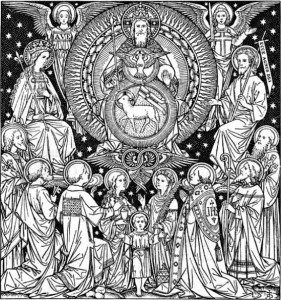
Etching of the Heavenly Throne RoomIt’s Good Shepherd Sunday . . . the Fourth Sunday of the Easter Season is always Good Shepherd Sunday. Every year, regardless of which of the three years of the Lectionary cycle we are in, we hear some lessons which mention shepherds or lambs, and we recite the 23rd Psalm as the Gradual, and we sing every “Shepherd hymn” in the hymnal. I’ve been preaching Good Shepherd sermons for 25 years, so I pretty much thought this was going to be one of those Sundays when I could just “wing it” and preach extemporaneously.

But it’s not. The events of the past week have made this a Good Shepherd Sunday unlike any that has come before. This Good Shepherd Sunday, as I read the words of the 23rd Psalm, “Though I walk through the valley of the shadow of death, I shall fear no evil,” (Ps. 23:4) I cannot help but be aware of all those who, unknowingly, were in that very place on Monday afternoon; I cannot help but think of Boylston Street, Boston, as “the valley of the shadow of death.”

Today’s Gospel lesson is John the Evangelist’s story of an event that happened before Jesus’ crucifixion, something that happened as he was teaching in the Jerusalem Temple. “The Jews,” which is John’s way of naming the temple authorities (the priests and scribes) gathered around Jesus and put him on the spot. “Are you the Messiah?” they ask, “Tell us plainly.”

Jesus’ answer is to say that he has said as much and that it is plain to those who are his sheep, because his sheep understand what he says: “My sheep hear my voice. I know them, and they follow me.” (John 10:27) They hear what I say; they understand my words; and they do what I tell them.

Well, maybe . . . .

Let’s be honest. Understanding Jesus and doing what he says aren’t always very easy. For example, St. Luke tells us that Jesus said, “Be merciful, just as your Father is merciful. Do not judge, and you will not be judged; do not condemn, and you will not be condemned. Forgive, and you will be forgiven.” (Luke 6:36-37) And St. Matthew tells us that he commanded, “Love your enemies and pray for those who persecute you.” (Matt. 5:44) I know what those words mean, but when it comes to the events of this week, they are not easy to obey.

But . . . OK . . . let’s give it a try. Our prayer book heritage gives us words to pray when we cannot think of the words ourselves, so let’s give this praying for those who hurt us a try using some of those prayers:

O God, the Father of all, whose Son commanded us to love our enemies: Lead them and us from prejudice to truth: deliver them and us from hatred, cruelty, and revenge; and in your good time enable us all to stand reconciled before you, through Jesus Christ our Lord. Amen. (Book of Common Prayer 1979, page 816)

Into your hands, O Lord, we commend Tamerlan Tsarnaev, as into the hands of a faithful Creator and most merciful Savior, praying that he may be redeemed in your sight. Wash him, we pray, in the blood of that immaculate Lamb who was slain to take away the sins of the world; that, whatever defilements he may have contracted in the midst of this earthly life being purged and done away, he may be presented before you pure and without spot; through the merits of Jesus Christ your only Son our Lord. Amen. (Adapted from the BCP 1979, page 488)

O God, whose mercy is everlasting and whose power is infinite; Look down with pity and compassion upon Dzhokhar Tsarnaev; and whether you visit him to test his fortitude or to punish his offences, enable him with your grace to submit himself willingly to your holy will and to your judgment. O Lord, go not far from him or any person whom you have laid in a place of darkness; and seeing that you have not cut him off suddenly, chasten him as a father and grant that he, duly considering your great mercies, may genuinely turn to you with true repentance and sincerity of heart; through Jesus Christ our Lord. Amen. (Adapted from the Book of Common Prayer of 1789, A Form of Prayer for the Visitation of Prisoners.)

This is what our Shepherd requires of us, that we pray for the repose of the soul of Tamerlan Tsarnaev and for the salvation Dzhokhar Tsarnaev, even though we find it very difficult to do.

When I was still practicing law, I had occasion to defend a dentist whose hobby was sculpting. One of the pieces he showed me was a very nicely done, and in most respects very traditional, Crucifix. What was nontraditional about it was the expression on Jesus’ face; it was contorted in obvious and quite extreme rage.

I asked him about that saying, “I don’t think I’ve ever seen Christ depicted in that way, and I can’t say that I’ve ever conceived of this reading any of the Gospels’ crucifixion stories.” He answered by asking me, “You know in the Gospel according to Luke when Jesus says, ‘Father, forgive them . . . . ?’ I’ve always heard that as angry, as Jesus saying to God the Father, ‘You forgive them because, right now, I can’t.'”

If you, like me, are having some difficulty in praying for those two boys, let these prayers be offered in that same spirit. We pray for God to take them, for God to forgive them, because right now, we can’t. We know exactly what Jesus meant but right now, we can’t do it. So we ask our Shepherd to do it for us. Because, as the multitude witnessed by St. John of Patmos cried so clearly, “Salvation belongs to our God who is seated on the throne, and to the Lamb!” (Rev. 7:10)

That’s one of the Good News lessons for today, for this week, I think. Jesus asks us to pray for and forgive those who do us wrong, but if we can’t, he can do it for us. We don’t need the fancy words of prayers out of the prayer book tradition. We just need Jesus’ own words, his words on the cross, “Father, forgive them.” That’s really all we need to say, “Father, forgive them.” Because even if we can’t, he can.

I think the other Good News lesson for this week is in something else Jesus says in today’s Gospel lesson: “I give them eternal life, and they will never perish. No one will snatch them out of my hand.”

Yesterday, I was at a diocesan leadership conference and, as you might expect, during the break times, our conversations centered around the events of the week.

A colleague commented at a diocesan meeting this morning, “It’s been one of those weeks.” My first thought was, “One of what weeks? There aren’t very many weeks like this!” The more I thought about it, however, I think maybe every week is like this. Every week people die. It’s an uncomfortable reality, but it’s true. Every week people die. It’s nothing to fear, however. I remember hearing a bishop (it may have been Desmond Tutu) say that being a Christian means (among other things) accepting the fact that you have already died. Certainly that is the witness of scripture: “Do you not know that all of us who have been baptized into Christ Jesus were baptized into his death? Therefore we have been buried with him by baptism into death, so that, just as Christ was raised from the dead by the glory of the Father, so we too might walk in newness of life.” (Rom. 6:3-4) And, again, “Set your minds on things that are above, not on things that are on earth, for you have died, and your life is hidden with Christ in God.” (Col. 3:2-3) And, again, “The saying is sure: If we have died with him, we will also live with him.” (2 Tim. 2:11) The very meaning of the Easter Season which we continue to celebrate is that death has been conquered, and that to God’s faithful people “life is changed, not ended; and when our mortal body lies in death, there is prepared for us a dwelling place eternal in the heavens.” (BCP 1979, page 382)

And every week people do awful things to other people. Sometimes those things are hugely catastrophic for many people, like the bombs at the marathon finish line. Sometimes those things go unseen by nearly everyone except the one injured, like the bullying that has led so many teens to commit suicide. Such things, awful things happen all the time. But . . . “Have you not known? Have you not heard? The Lord is the everlasting God, the Creator of the ends of the earth. He does not faint or grow weary; his understanding is unsearchable. He gives power to the faint, and strengthens the powerless.” (Isaiah 40:28-29) And, again, “The Lord upholds all who are falling, and raises up all who are bowed down.” (Psalm 145:14) And, again, “I can do all things through him who strengthens me.” (Philip. 4:13) The very meaning of the Easter Season which we continue to celebrate is that the power of God overcomes anything, any-awful-thing, the evildoers of this world can throw at us.

Not very long after the bombs exploded in Boston, comedian Patton Oswalt posted a reflection on his Facebook page in which he said:

I remember, when 9/11 went down, my reaction was, “Well, I’ve had it with humanity.”

But I was wrong. I don’t know what’s going to be revealed to be behind all of this mayhem — one human insect or a poisonous mass of broken sociopaths.

But here’s what I DO know. If it’s one person or a HUNDRED people, that number is not even a fraction of a fraction of a fraction of a percent of the population on this planet. You watch the videos of the carnage and there are people running TOWARDS the destruction to help out. (Thanks FAKE Gallery founder and owner Paul Kozlowski for pointing this out to me). This is a giant planet and we’re lucky to live on it but there are prices and penalties incurred for the daily miracle of existence. One of them is, every once in a while, the wiring of a tiny sliver of the species gets snarled and they’re pointed towards darkness.

But the vast majority stands against that darkness and, like white blood cells attacking a virus, they dilute and weaken and eventually wash away the evildoers and, more importantly, the damage they wreak. This is beyond religion or creed or nation. We would not be here if humanity were inherently evil. We’d have eaten ourselves alive long ago.

So when you spot violence, or bigotry, or intolerance or fear or just garden-variety misogyny, hatred or ignorance, just look it in the eye and think, “The good outnumber you, and we always will.”

I think that is the reality to which Scripture testifies; I think that is the triumph of Easter — that the good will always outnumber the evil. “I give them eternal life, and they will never perish. No one will snatch them out of my hand.”

So I guess my colleague was right. It’s been one of those weeks . . . a week when life was changed for some, a week in which the Presence of God helped people get through some really awful stuff, a week when the good outnumbered the bad. It’s been one of those weeks. Every week is. Thanks be to God!

====================

A request to my readers: I’m trying to build the readership of this blog and I’d very much appreciate your help in doing so. If you find something here that is of value, please share it with others. If you are on Facebook, “like” the posts on your page so others can see them. If you are following me on Twitter, please “retweet” the notices of these meditations. If you have a blog of your own, please include mine in your links (a favor I will gladly reciprocate). Many thanks!

====================

Father Funston is the rector of St. Paul’s Episcopal Church, Medina, Ohio.

Faith, Works, Fruits – From the Daily Office – April 12, 2013

From the First Letter of John:

Little children, let no one deceive you. Everyone who does what is right is righteous, just as he is righteous. Everyone who commits sin is a child of the devil; for the devil has been sinning from the beginning. The Son of God was revealed for this purpose, to destroy the works of the devil. Those who have been born of God do not sin, because God’s seed abides in them; they cannot sin, because they have been born of God. The children of God and the children of the devil are revealed in this way: all who do not do what is right are not from God, nor are those who do not love their brothers and sisters.

(From the Daily Office Lectionary – 1 John 3:7-10 (NRSV) – April 12, 2013.)

The Fruits of the SpiritIt’s been several days since I last offered one of these meditations. I took time off to deal with a family medical issue and then there was Holy Week and then there was Easter and then there was something else and then . . . . Life can become a series of excuses for not getting things done. John, in this first catholic epistle, will brook no excuses, no procrastination. Get it done! Do what is right, for that is righteousness; “all who do not do what is right are not from God.”

Among my favorite verses of Scripture is James 1:22 – “Be doers of the word, and not merely hearers who deceive themselves” – which I guess is why I could never really be a Lutheran (of any sort). Luther condemned James as a “straw epistle” because, apparently, its author’s insistence that “religion that is pure and undefiled before God, the Father, is this: to care for orphans and widows in their distress, and to keep oneself unstained by the world” (1:27), and that “faith by itself, if it has no works, is dead” (2:17) conflicted with Luther’s insistence on a Pauline doctrine of justification by grace through faith alone. I wonder what Luther made of John’s insistence that the righteous actually do something . . . .

I am an Episcopalian by choice. If I was schooled in any sort of religion as a child, I was reared in the American Campbellite tradition on my mother’s side of the family and in the Methodist tradition on my father’s; but the truth is, my nuclear family was pretty much unchurched. So when I was in high school I made my own decision about a church to attend and, when I experienced the worship and ministry in the Episcopal Church, I knew was “home.”

One of the things I most appreciate about our tradition is our insistence that a professed faith has active consequences; in our liturgy of baptism, these are laid out in the Baptismal Covenant. I preached about that last Sunday when I had the privilege to preside at a baptism. I won’t get into that again; I would just ask my reader to read that sermon (the last posting on this blog).

Righteousness is not just about works; justification is not just about faith. It’s not either-or; it’s a both-and sort of thing. (That’s something we Episcopalians and Anglicans say a lot, “It’s a both-and sort of thing.”) Belief produces results; faith is made alive in works; the Spirit brings forth fruit. As Someone once said, “You will know them by their fruits.” (Matt. 7:16) But that same Someone suggested that there is a limit to how long one can procrastinate before actually doing something, before actually bearing that fruit. Remember the parable about a fruitless tree which ended, “If it bears fruit next year, well and good; but if not, you can cut it down”? (Luke 13:-10) There is a limit to procrastination and to excuses, so be about it; whatever it is that your faith requires of you, get it done!

====================

A request to my readers: I’m trying to build the readership of this blog and I’d very much appreciate your help in doing so. If you find something here that is of value, please share it with others. If you are on Facebook, “like” the posts on your page so others can see them. If you are following me on Twitter, please “retweet” the notices of these meditations. If you have a blog of your own, please include mine in your links (a favor I will gladly reciprocate). Many thanks!

====================

Father Funston is the rector of St. Paul’s Episcopal Church, Medina, Ohio.

The Leaflet in the Lou – From the Daily Office – March 19, 2013

From the Letter to the Romans:

But what does it say? “The word is near you, on your lips and in your heart” (that is, the word of faith that we proclaim); because if you confess with your lips that Jesus is Lord and believe in your heart that God raised him from the dead, you will be saved. For one believes with the heart and so is justified, and one confesses with the mouth and so is saved. The scripture says, “No one who believes in him will be put to shame.” For there is no distinction between Jew and Greek; the same Lord is Lord of all and is generous to all who call on him. For, “Everyone who calls on the name of the Lord shall be saved.”

(From the Daily Office Lectionary – Romans 10:8-13 (NRSV) – March 19, 2013.)

Public Restroom SinksIn my opinion there is probably no more misused piece of writing in all of Holy Scripture, unless perhaps it is Paul’s other toss-off line (in this same epistle): “For we hold that a person is justified by faith apart from works prescribed by the law.” (Rom. 3:28 NRSV) Both of them have led people to a religion that is all talk and no walk, which I am quite sure was not Paul’s intention at all!

I went to high school pretty much in the absolute middle of the United States. The geographic center of the U.S. is just outside the small town of Lebanon, Kansas. I went to high school in Salina, Kansas, about 100 miles away. At the time, and probably to this day, it is pretty much conservative, evangelical Christian territory. There are a few nutty Episcopalians, but not many; a few more good German Lutherans and just about as many good German Catholics. But the conservative, evangelical traditions rule the roost.

One of the things I most remember about my high school years in the center of the country are the evangelical Christian pamphlets that one would find distributed in, of all places, the public restrooms of filling stations and coffee shops. I know that sounds weird, and frankly it is weird! But almost without fail, anytime I would make use of such public facilities in the late 1960s I would find a small pamphlet on the wash basin counter, on the back of the toilet, or on top of the urinal telling me that all I needed to do to be saved and escaped the fires of Hell was “confess with your lips that Jesus is Lord and believe in your heart that God raised him from the dead.” That’s all. Nothing more.

That always struck me as nonsense. Even to a 14-year-old high school freshman, it just seemed like there ought to be more to it than the five-step outline for salvation set out in the public restroom pamphlet (and which I’ve subsequently seen enumerated elsewhere):

  1. Hear the Gospel (Romans 10:17)
  2. Believe the Gospel (Mark 16:16)
  3. Repent of sins (Luke 13:3)
  4. Confess Christ. (Matthew 10:32)
  5. Be Baptized for the remission of sins (Acts 2:38).

It seemed like poppycock because pretty regularly the priest in my church would recite other passages of Scripture: “Not every one that saith unto me, Lord, Lord, shall enter into the kingdom of heaven; but he that doeth the will of my Father which is in heaven.” (Matt. 7:21 KJV) was his favorite offertory sentence. And I recall more than one sermon in which he made reference to the Letter of James with its (to me, at least) cogent reasoning:

What good is it, my brothers and sisters, if you say you have faith but do not have works? Can faith save you? If a brother or sister is naked and lacks daily food, and one of you says to them, “Go in peace; keep warm and eat your fill,” and yet you do not supply their bodily needs, what is the good of that? So faith by itself, if it has no works, is dead. But someone will say, “You have faith and I have works.” Show me your faith apart from your works, and I by my works will show you my faith.

The leaflet in the lou seemed not even to require faith. I know it says that one step is to “Believe the Gospel” and another to “Confess Christ,” but those only require intellectual ascent, not faith. Just because one accepts the factuality of the Jesus story, and possibly even tells others about it, doesn’t mean that one trusts in Jesus as Lord and Savior. So even though it might have been parroting Paul in the 10th chapter of Romans, it seemed to have overlooked the 3rd chapter. And it’s authors had clearly dismissed James’s conclusion that “faith by itself, if it has no works, is dead.”

It’s not that the five steps in the bathroom broadside are wrong. It’s that they are incomplete. There are so many more steps – feeding the hungry, clothing the naked, caring for the ill, visiting the prisoners, housing the homeless, selling everything you own and giving the money to the poor, not being a stumbling block to others, loving your neighbor, and many many more. One can’t just talk the talk; one must walk the walk; one must take the journey.

Salvation is a journey of many steps through many places doing many things. Salvation is not achieved with five simple steps communicated through a community water closet!

====================

A request to my readers: I’m trying to build the readership of this blog and I’d very much appreciate your help in doing so. If you find something here that is of value, please share it with others. If you are on Facebook, “like” the posts on your page so others can see them. If you are following me on Twitter, please “retweet” the notices of these meditations. If you have a blog of your own, please include mine in your links (a favor I will gladly reciprocate). Many thanks!

====================

Father Funston is the rector of St. Paul’s Episcopal Church, Medina, Ohio.

The Whole World is Irish on March 17 – Sermon for the Feast of St. Patrick – March 17, 2013

====================

This sermon was preached on Sunday, March 17, 2013, at St. Paul’s Episcopal Church, Medina, Ohio, where Fr. Funston is rector.

(Episcopal Sanctorale Lectionary, Patrick of Ireland: Psalm 97:1-2,7-12; Ezekiel 36:33-38; and Matthew 28:16-20. These lessons can be read at The Lectionary. At St. Paul’s Parish, during Lent, we are using the Daily Office of Morning Prayer as our antecommunion; therefore, only these two lessons and the psalm were read. The Epistle lesson, 1 Thessalonians 2:2b-12, was not used.)

====================

Icon of St. Patrick of IrelandIn Ainm an Athar, agus an Mhic, agus an Spioraid Naoimh. Áiméan.
Dia dhaoibh ar maidin, gach duine. Beannachtaí na fheile Padraig oraibh.

That’s more Irish than I’ve spoken in nearly two years! What I said was, “God be with you this morning, everyone. The blessings of the Feast of St. Patrick be with you.” In other words, Happy St. Paddy’s Day!

Everyone loves to be Irish on St. Paddy’s Day. Even though we Funstons being descendants of Anglican Irish (or as the Irish would say, “Protestants”) did not have much, if anything, to do with the Irish communities of my childhood, we still (like everyone else) enjoyed St. Patrick’s Day. We would go to the parades, see and hear the pipe-and-drum corps, and all the other traditional sorts of things. On the evening news, we would see the reports of parades in other places, especially the big one down Fifth Avenue in New York City. And we would usually have corned beef and cabbage for dinner.

I have no problem with people dressing kilts (which aren’t really Irish, at all), putting green food coloring in beer, eating corned beef and cabbage (which is also not really Irish), or any of the other silly things people do on this day. It’s all part of the fun. Many like to watch Irish-themed movies on St. Patrick’s Day. My favorite is the heartwarming tale of a boxer’s return home in The Quiet Man, but I also like the mythical nonsense of Darby O’Gill and the Little People, or the intense drama of The Field, or the whacky comedy of Waking Ned Devine. Those movies are the only times I hear anyone say, “Top o’ the mornin’ to ye” or “Faith and begorrah.” At least, I’ve never heard anyone say those things during any of my trips to Ireland.

The worship committee thought we ought to step away from Lent for a day (because March 17 today falls on Sunday) and celebrate St. Patrick. After all, on March 17, the whole world is Irish . . . but the man we commemorate wasn’t Irish and it would be much truer to his memory if on his feast day all the world tried to be not Irish, but Christian.

Patrick, who was a Romano-Brit (meaning a Roman who lived in Britain) was the son of a minor imperial official named Calpornius, who was also a deacon in the church; his grandfather Potitus was a priest. Around the year 406 A.D., at the age of 16, Patrick was kidnapped and made a slave in Ireland to a minor tribal king. After six years, he escaped and returned home to Britain, and then went to Rome. There he was ordained a priest and a bishop and, according to the chronicle of Prosper of Aquitane, was appointed bishop to the Irish by Pope Celestine I; he arrived back in Ireland in 432 A.D. He landed near modern-day Belfast and set up his principal foundation in Armagh, which is now considered the Primatial See of Ireland. He ministered primarily in that part of the country known as Ulster. Patrick was not the first bishop appointed to bring the Christian faith to the people of Ireland. Ciaran and Palladius came before him, but their mission (primarily in Munster and Leinster, further south) did not bear the same fruits as Patrick’s. So today, what we celebrate is not Irish identity or heritage; today, we celebrate the success of a mission to spread the Christian faith.

The choir is going sing a poetic prayer or lorica attributed to Patrick, the famous St. Patrick’s Breastplate, as their anthem. It is attributed to him, but there is disagreement as to whether he actually wrote it. But he did write this prayer:

I give thanks to the one who strengthened me in all things, so that he would not impede me in the course I had undertaken and from the works also which I had learned from Christ my Lord. Rather, I sensed in myself no little strength from him, and my faith passed the test before God and people. (The Confession of St. Patrick)

For St. Patrick it seems the faith which passed the test was deeply Trinitarian and deeply evangelical. He is credited with using the shamrock, now one of the national emblems of Ireland, as an illustration of the Trinity – three lobes, yet one leaf – although that is probably an 18th Century legend rather than a historical fact. And as you heard, the Gospel lesson for his commemoration is the Great Commission: “Go therefore and make disciples of all nations, baptizing them in the name of the Father and of the Son and of the Holy Spirit, and teaching them to obey everything that I have commanded you.” Christ’s final words to his apostles before ascending into Heaven. This evangelical, Trinitarian faith — not green beer nor Celtic music nor corned beef and cabbage nor Irish-ness itself — but trust in God the Father, God the Son, and God the Holy Spirit shared with and commended to everyone around us, this is what we celebrate when we celebrate the Feast of St. Patrick.

I thought perhaps the lesson from Ezekiel was chosen for his feast because, with its “forty shades of green,” Ireland might make one think of the garden of Eden, and in Ireland there are both ruined towns and towns that are inhabited, some of both walled and fortified. But I think rather that it was chosen because, just as the nations around Israel came to know the Lord, the God of Israel, so the nations to which Irish missionaries went came to know the Lord Jesus Christ. What Patrick started in Ireland in 5th Century by the mid 6th Century was spreading to northern Europe, carried there by Irish priests and monks practicing what was called “white martyrdom.” The term comes from a 7th Century Irish sermon called the Cambrai homily:

Now there are three kinds of martyrdom that are counted as a cross to us, namely, white, blue, and red martyrdom.
It is white martyrdom for a man when he separates from everything that he loves for God, although he does not endure fasting and labor thereby.
The blue martyrdom is when through fasting and hard work they control their desires or struggle in penance and repentance.
The red martyrdom is when they endure a cross or destruction for Christ’s sake, as happened to the Apostles when they were persecuted the wicked and taught the law of God. (O. Davis, Celtic Spirituality, Paulist Press: 1999)

The white martyrs left everything dear to them — homes, families, familiar surroundings, even Ireland itself — to spread the Gospel in distant lands; white martyrdom was a pilgrimage on behalf of Christ that might be extended permanently so that they would never again see their homeland. They went first to Scotland and the north of England, but then further afield to Holland, Germany, Scandinavia, Switzerland, and even further. Like the man who had brought Christianity to their homeland, they held a deeply Trinitarian and deeply evangelical faith; and it is that faith which we celebrate when we celebrate St. Patrick’s Day.

It is that faith we all claim and, when we commemorate Patrick, it is to the spread of that faith that we dedicate ourselves. On the first day of Lent, Ash Wednesday, a special Litany of Penance is recited in Episcopal Churches. Among the confessions of that Litany we find this petition: “Our negligence in prayer and worship, and our failure to commend the faith that is in us, we confess to you, Lord.” (BCP 1979, page 268)

Let us remember that confession on St. Patrick’s Day and try not so much to be Irish, but try to be better Christians. Let us be like Patrick, who was not Irish, but Christian, and like him let us follow Christ’s Great Commission. If we must be Irish on this day, let us be like those Irish white martyrs of old, and commend the faith that is in us, a faith that is deeply Trinitarian and deeply evangelical.

Let us remember, also, a petition from the Great Litany which we recited on the First Sunday in Lent four weeks ago:

That it may please thee to inspire us, in our several callings, to do the work which thou givest us to do with singleness of heart as thy servants, and for the common good, we beseech thee to hear us, good Lord. (BCP 1979, page 151)

Let us pray:

Everliving God, whose will it is that all should come to you through your Son Jesus Christ: Inspire our witness to him, that all may know the power of his forgiveness and the hope of his resurrection; who lives and reigns with you and the Holy Spirit, one God, now and for ever. Amen.

====================

A request to my readers: I’m trying to build the readership of this blog and I’d very much appreciate your help in doing so. If you find something here that is of value, please share it with others. If you are on Facebook, “like” the posts on your page so others can see them. If you are following me on Twitter, please “retweet” the notices of these meditations. If you have a blog of your own, please include mine in your links (a favor I will gladly reciprocate). Many thanks!

====================

Father Funston is the rector of St. Paul’s Episcopal Church, Medina, Ohio.

Pope Francis – From the Daily Office – March 14, 2013

From Paul’s Letter to the Church in Rome:

So then, brothers and sisters, we are debtors, not to the flesh, to live according to the flesh — for if you live according to the flesh, you will die; but if by the Spirit you put to death the deeds of the body, you will live. For all who are led by the Spirit of God are children of God. For you did not receive a spirit of slavery to fall back into fear, but you have received a spirit of adoption. When we cry, “Abba! Father!” it is that very Spirit bearing witness with our spirit that we are children of God, and if children, then heirs, heirs of God and joint heirs with Christ — if, in fact, we suffer with him so that we may also be glorified with him.

(From the Daily Office Lectionary – Romans 8:12-17 (NRSV) – March 14, 2013.)

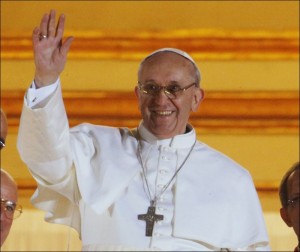
Pope FrancisThere were two things about which I was unaware when I wrote yesterday’s meditation referring to the folk chorus Abba, Father. First of all, I didn’t know that today’s readings would include Paul’s comments to the Romans on that form of addressing God. Secondly, I had no idea that the modern day Romans (in the form of the Papal Conclave) would have elected a new pope by today.

Today the entire world, Protestant, Anglican, and Orthodox Christians, as well as those of other religions, together with the world’s Roman Catholics, are taking stock of the newest successor of St. Peter, trying to figure out who Pope Francis is and what his election means. According to all the news reports I’ve seen, he is a humble man with much concern for the poor and the economically oppressed. On the other hand, he is apparently a doctrinal conservative who has had some pretty negative things to say about contraception, a woman’s right to reproductive choice, and the legalization of abortion, as well as about the LGBT community and the rights of gay, lesbian, and transgendered persons. How this will all shake out in his leadership of the Roman Catholic Church is anyone’s guess.

I hope that he will listen to what Paul has to say in his letter to the Roman church of long ago. I hope that he will acknowledge that “all who are led by the Spirit of God are children of God,” even though that Spirit may be leading them in non-Christian directions. I hope that he will consider the suggestion of his fellow Jesuit, Avery Dulles, who wrote: “On Christian grounds, it may be held that the divine person who appears in Jesus is not exhausted by that historical appearance. The symbols and myths of other religions may point to the one who Christians recognize as the Christ.” (Revelation and the Religions, Quaker Universalist Fellowship: 1999)

It is my understanding of basic Christian doctrine that the Holy Spirit may act wherever and whenever she chooses. If we presume to constrain the activity of the Holy Spirit, if our doctrinal predisposition is to limit God to only our particular religious assumptions, then we are not faithful to the Truth. Christian tradition recognizes a mandate to seek Truth wherever it may be found and to follow the Holy Spirit wherever she may lead, even if that may be into consideration of other religions or non-Christian philosophies. I hope his Holiness will be of the same understanding and seek interfaith dialogue.

Even more, I hope that he will seek common cause with non-Roman Christians, even when our ecclesiologies and theologies may not agree with those of the Holy See. I pray that he will acknowledge that Protestants, Anglicans, and Orthodox Christians are “children of God, and if children, then heirs, heirs of God and joint heirs with Christ.” It was a great disappointment when his predecessor, Benedict XVI, ratified and confirmed a statement that “those Christian Communities born out of the Reformation of the sixteenth century . . . because of the absence of the sacramental priesthood, have not preserved the genuine and integral substance of the Eucharistic Mystery [and] cannot, according to Catholic doctrine, be called ‘Churches’ in the proper sense.” (Responsa Quaestiones, June 29, 2007) As an Anglican, especially, I would dispute the basic assumptions about the priesthood and the Eucharist, but even without regard to that quibble, to deny that any group of Christians is the church seems to me to be an unnecessary stumbling block to ecumenical relations. Hopefully, Pope Francis will be more gracious than his predecessor in acknowledging that “where two or three are gathered in [his] name, [Christ is] there among them.” (Matt. 18:20 NRSV)

Which brings me back to the folk chorus Abba, Father and yesterday’s meditation. The petition of the song is

Mold us, mold us and
Fashion us,
Into the image,
Of Jesus your Son
Of Jesus your Son.
Father, may we be one in you,
May we be one in you,
As he is in you,
And you are in him.

God the potter is constantly molding the church. May Pope Francis’s election be an opportunity not only for the Roman Catholic Church to be molded anew, may it also be an occasion for the whole of the Christ’s universal church, and God’s people of other faiths, to be molded together into a new ecumenical and interfaith cooperation.

====================

A request to my readers: I’m trying to build the readership of this blog and I’d very much appreciate your help in doing so. If you find something here that is of value, please share it with others. If you are on Facebook, “like” the posts on your page so others can see them. If you are following me on Twitter, please “retweet” the notices of these meditations. If you have a blog of your own, please include mine in your links (a favor I will gladly reciprocate). Many thanks!

====================

Father Funston is the rector of St. Paul’s Episcopal Church, Medina, Ohio.

God’s Annoying Accent – From the Daily Office – March 13, 2013

From the Prophet Jeremiah:

The word that came to Jeremiah from the Lord: “Come, go down to the potter’s house, and there I will let you hear my words.” So I went down to the potter’s house, and there he was working at his wheel. The vessel he was making of clay was spoiled in the potter’s hand, and he reworked it into another vessel, as seemed good to him. Then the word of the Lord came to me: Can I not do with you, O house of Israel, just as this potter has done? says the Lord. Just like the clay in the potter’s hand, so are you in my hand, O house of Israel. At one moment I may declare concerning a nation or a kingdom, that I will pluck up and break down and destroy it, but if that nation, concerning which I have spoken, turns from its evil, I will change my mind about the disaster that I intended to bring on it. And at another moment I may declare concerning a nation or a kingdom that I will build and plant it, but if it does evil in my sight, not listening to my voice, then I will change my mind about the good that I had intended to do to it. Now, therefore, say to the people of Judah and the inhabitants of Jerusalem: Thus says the Lord: Look, I am a potter shaping evil against you and devising a plan against you. Turn now, all of you from your evil way, and amend your ways and your doings.

(From the Daily Office Lectionary – Jeremiah 18:1-11 (NRSV) – March 13, 2013.)

Potters Hands at WheelYears ago, my wife and I were active in the Cursillo community in another state. In fact, we met through that community, so it was very important to us. We participated in the three-day weekends; we took part in the reunions; we even had the “De Colores” bumper-stickers on our cars. At that time, folk masses and simple guitar-accompanied choruses were also popular in the Episcopal Church and a lot of the music used in the Cursillo movement spilled over into church on Sundays and at other times. A favorite of many people was a tune which mixed Jeremiah’s potter metaphor with some of Jesus’ language from the Gospels:

Abba, Abba Father
You are the potter
And we are the clay,
The work of your hands
Mold us, mold us and
Fashion us,
Into the image,
Of Jesus your Son
Of Jesus your Son.
Father, may we be one in you,
May we be one in you,
As he is in you,
And you are in him
Glory, glory and praise to you
Glory and praise to you
Forever amen….

I remember sitting with my table groups during the Cursillo weekends and at nearly every one one of the speakers would ask that we sing this song, and then would talk about how God molds each individual into a Christ-like figure. But that isn’t what the song says, at all! Nor is it what Jeremiah prophesies in this pericope! This isn’t about individuals.

The song, following Jeremiah’s lead, speaks of a group being molded: “Mold us . . . Fashion us.” Us not me. God the potter in Jeremiah’s prophecy molds “the house of Israel,” a nation, a kingdom, not the individual residents of that house or nation. Certainly, as a part of that group each member may be, must be changed, but the emphasis is on and the prophecy is about systemic, group-wide change, not individual transformation.

When a potter molds a pot, a drinking vessel, a piece of sculpture, he works with a mass of clay. The mass is made up of molecules, but the potter does not concern himself with these small, constituent bits. He does not work with each molecule. He pushes this way and that on the mass, and the individual molecules, most of which are never directly manipulated by the potter, move and change as the mass moves; most are shoved about not by the potter but by their neighbors. The potter may, from time to time, work with smaller bits, but always with the intention that that bit will add to the value or beauty of the whole. His concern is with the larger work.

Of course, Jesus was concerned about individual people. He loved the one lost sheep separated from the ninety-nine; he searched for the one of ten coins that was missing. His reason for doing so, however, was restoration of the community. The ninety-nine were incomplete without the missing lamb; the “round ten” were not round without the missing coin. He sent the Samaritan women at the well back into her city (John 4); he rescued the woman caught in adultery from being stoned, but sent her back into her community, saying “Go your way” (John 8); he raised a little girl from death, restoring her to her family whom he instructed to nourish her (Mark 5).

Jesus was concerned about individuals, but he was committed to the ideal of community in which there would be a close relationship between members. His disciples were related not just individually to him, but also to one another. He formed them into a group that would give itself mutual support, a community that would reach out to others and invite them in. Yes, he said, the first commandment is to love God, but there is a second, equal commandment — Love your neighbor as yourself. (Matt. 22:37-39 NRSV)

St. Paul used the metaphor of “the body of Christ” to describe the church: “Now you are the body of Christ and individually members of it.” (1 Cor. 12:27 NRSV) God the potter molds the church and each of us get shoved into our proper place as the potter works. At times, the potter may work with an individual bit, but the potter’s attention is on the whole. God the potter’s concern was with “the house of Israel;” God the potter’s concern is with the Body of Christ, the church.

It’s too bad modern English doesn’t have a clearly plural form of the pronoun you. That used to be the plural pronoun and thou was the singular. Perhaps we should create a new plural form or borrow one to use in translating Scripture. We could render God the potter as sounding like a Southerner: ” Can I not do with y’all just as this potter has done?” Or like a Pittsburgher: “Can I not do with youse just as this potter has done?” We might find God’s accent annoying, but at least we would understand what was meant!

====================

A request to my readers: I’m trying to build the readership of this blog and I’d very much appreciate your help in doing so. If you find something here that is of value, please share it with others. If you are on Facebook, “like” the posts on your page so others can see them. If you are following me on Twitter, please “retweet” the notices of these meditations. If you have a blog of your own, please include mine in your links (a favor I will gladly reciprocate). Many thanks!

====================

Father Funston is the rector of St. Paul’s Episcopal Church, Medina, Ohio.

« Older posts Newer posts »