Occasional thoughts of an Anglican Episcopal priest

Category: Matthew (Page 23 of 29)

A Community of Fishers – From the Daily Office – March 11, 2013

From the Prophet Jeremiah:

I am now sending for many fishermen, says the Lord, and they shall catch them; and afterwards I will send for many hunters, and they shall hunt them from every mountain and every hill, and out of the clefts of the rocks. For my eyes are on all their ways; they are not hidden from my presence, nor is their iniquity concealed from my sight. And I will doubly repay their iniquity and their sin, because they have polluted my land with the carcasses of their detestable idols, and have filled my inheritance with their abominations.

(From the Daily Office Lectionary – Jeremiah 16:16-18 (NRSV) – March 11, 2013.)

Still from A River Runs Through ItI wonder if Jesus had this prophecy in mind when he called Andrew and Peter and said to them, “Follow me, and I will make you fish for people.” (Matt. 4:19)

When we modern, urban Americans read biblical references to fishermen, I suspect that a majority of us picture someone sitting lazily on the banks of a river with a pole stuck in the soil next to them, a line trailing off to a bobbing float; or perhaps we imagine Tom Skerrit standing in the Blackfoot River casting hand-tied flies trying to snag a large trout. Although hook-and-line fishing was not unknown in the ancient world, it was then, as now, a recreational sort of fishing. When God says through Jeremiah that he is sending fishermen to catch the wayward people of Israel, when Jesus tells his new disciples that they will become fishers of people, the reference is a very different sort of fishing.

The image we should have is of net fishing, probably using either a dragnet or a cast net. The dragnet is one of the oldest of fishing dating from the third millennium B.C. in Egypt. The dragnet, perhaps 250 to 300 yards long, and varing in height from 3 to 8 yards, would be taken out from the shore by boat which would proceed straight out for a distance, then turn parallel to the shore for a bit, and then turn back to the shore. The bottom of the net would be weighted with sinkers, and the top would have cork floats attached. Tow lines attached to each end of the net were hauled in by a teams of sixteen men for large nets, fewer for for smaller nets. This method of fishing is described in the books of Habakkuk, Ezekiel, and Matthew.

A cast net was, as the name suggests, thrown or cast onto the waters by one man either from shore or from a boat. After it had sunk to the bottom, trapping fish within it, the caster and others would dive down to it and either retrieve the fish individually placing them into pouches, or they would gather the footrope of the net, gathering the fish into a sort of purse formed by the net and bring them up together.

In either event, the picture we get is of teamwork. Biblical fishing was a community activity, something that required cooperation to be effective. So, although God promised to send a single shepherd, the Messiah, God in this prophecy of Jeremiah also promised to send a working party.

And, one wonders, who might that be? The church? All the baptized? No doubt. God’s team is made up of the spiritual descendants of the ones to whom Jesus said, “Follow me, and I will make you fish for people.” Midway through Lent as we are, this might be a good time to turn from individual self-examination and consider how well we are doing as a community of fishers.

====================

A request to my readers: I’m trying to build the readership of this blog and I’d very much appreciate your help in doing so. If you find something here that is of value, please share it with others. If you are on Facebook, “like” the posts on your page so others can see them. If you are following me on Twitter, please “retweet” the notices of these meditations. If you have a blog of your own, please include mine in your links (a favor I will gladly reciprocate). Many thanks!

====================

Father Funston is the rector of St. Paul’s Episcopal Church, Medina, Ohio.

Ambassadors of Christ: Welcoming the Prodigal – Sermon for the Fourth Sunday in Lent – March 10, 2013

====================

This sermon was preached on Sunday, March 10, 2013, at St. Paul’s Episcopal Church, Medina, Ohio, where Fr. Funston is rector.

(Revised Common Lectionary, Lent 4, Year C: Psalm 32; 2 Corinthians 5:16-21; and Luke 15:1-3, 11b-32. These lessons can be read at The Lectionary Page. At St. Paul’s Parish, during Lent, we are using the Daily Office of Morning Prayer as our antecommunion; therefore, only these two lessons and the psalm were read. The Old Testament lesson, Joshua 5:9-12, was not used.)

====================

5 Hands Grabbing Water RingThe picture on the front of the bulletin today is one I found on the internet several months ago and which I just found intriguing. I can’t recall what I was doing or reading or searching for when I ran across it, but it grabbed my attention and seemed to me to be a great illustration for baptism and the baptismal covenant set out in The Book of Common Prayer.

That covenant of five promises is made immediately after the person being baptized or, if an infant, his or her parents and Godparents have affirmed their faith in the word of Apostles’ Creed as we shall do in a few minutes. The baptismal pledges are made in answer to five questions, to each of which the answer is, “I will, with God’s help:”

  • Will you continue in the apostles’ teaching and fellowship, in the breaking of bread, and in the prayers?
  • Will you persevere in resisting evil, and, whenever you fall into sin, repent and return to the Lord?
  • Will you proclaim by word and example the Good News of God in Christ?
  • Will you seek and serve Christ in all persons, loving your neighbor as yourself?
  • Will you strive for justice and peace among all people, and respect the dignity of every human being?

Think of the ring of water in the picture as representing the sacrament; the five hands trying to grasp it, the five promises of the covenant.

We are told in the Catechism at the back of prayer book that living up to these promises is the way we, as the ministers of the church, both lay and ordained, pursue the churches mission:

Q. What is the mission of the Church?
A. The mission of the Church is to restore all people to unity with God and each other in Christ.
Q. How does the Church pursue its mission?
A. The Church pursues its mission as it prays and worships, proclaims the Gospel, and promotes justice, peace, and love.

“To restore all people to unity with God and each other.” That’s what Paul is talking about in the lesson we have today from the Second Letter to the Church in Corinth: God “reconciled us to himself through Christ, and has given us the ministry of reconciliation; that is, in Christ God was reconciling the world to himself, not counting their trespasses against them, and entrusting the message of reconciliation to us. So we are ambassadors for Christ, since God is making his appeal through us.” (2 Cor. 18-20)

Reconcile is an interesting word. It has three parts, actually to prefixes and a base verb, all from the Latin. The base verb is calare (or cilire in this combined form); it means to call. The first prefix is “con-” which means “together.” Our word council comes from this combination; a council is called to together to accomplish something, to make a decision, to govern an organization or a political subdivision. The next prefix is “re-” which means “again.” Reconciliation is the act of calling together again . . . and again . . . and again. It isn’t something done only once; it takes time and it on-going effort.

We have a story of reconciliation in the Gospel story this morning, the familiar story of the prodigal son. We all know this story, but let me just quickly recap what it’s all about.

In Jesus’ time in First Century Palestine the typical pattern of inheritance was that the first-born son would receive two-thirds of his father’s wealth, and any other sons would share the remaining one-third. (Daughters got nothing other than their dowries.) In this story there are only the two sons, the younger of whom decides he doesn’t want to wait for Dad to die. “Give me my inheritance now!” is his demand of his father, a demand which is highly insulting to the father. He’s basically saying, “I wish you were dead. I’m done with this family. I’m leaving.” And that is what he does.

The boy takes his money and goes off to sew his wild oats, which he does with a vengeance! He blows the whole thing, the entire sum; however much it may have been, he spends it all. This, by the way, is what “prodigal” means! To be prodigal means to spend one’s money or resources with extravagance, lavishly, abundantly, profusely, often to the point of complete depletion. Doing so is not necessarily a bad thing! In the context of this story, of course, there is an implication of negativity, that the younger son is a wastrel, a spendthrift, a good-for-nothing idler; his older brother, when he returns home, certainly seems to think so. But Jesus’ point is not to criticize the younger brother, and Jesus does not condemn profligate spending of resources. You may remember this story told in Matthew’s Gospel:

Someone came to [Jesus] and said, “Teacher, what good deed must I do to have eternal life?” And he said to him, “Why do you ask me about what is good? There is only one who is good. If you wish to enter into life, keep the commandments.” He said to him, “Which ones?” And Jesus said, “You shall not murder; You shall not commit adultery; You shall not steal; You shall not bear false witness; Honor your father and mother; also, You shall love your neighbor as yourself.” The young man said to him, “I have kept all these; what do I still lack?” Jesus said to him, “If you wish to be perfect, go, sell your possessions, and give the money to the poor, and you will have treasure in heaven; then come, follow me.” When the young man heard this word, he went away grieving, for he had many possessions. (Matthew 19:16-22 NRSV)

So lavishly disposing of one’s wealth is not the moral issue here.

As we are usually led through consideration of this story our focus turns to the father who is said to represent God, a loving and generous parent who forgives the wastrel son and welcomes him back with open arms. Certainly in the father we find an example of the reconciliation which is our baptismal ministry, but if the father represents God, then the reconciliation is God’s doing, not ours . . . and the Cathechism clearly teaches us that we are to be the ministers of reconciliation — or as Paul puts it, we are the ambassadors of Christ.

What if, instead of the father, God is another of the characters in this story? What if God instead is the prodigal who seems so irresponsible? I am here borrowing from journalist and seminarian David R. Henson who asks:

What if God is the God who comes to us in the disguise of those we despise, those who have hated and killed us, rejected us and abandoned us, those who annoy and frustrate us most, those who are excluded?

In the guise of the sinner, the debauched, the prostitute, the unclean, the enemy, the unsavory, God comes to us and challenges us to participate in a radical, irresponsible hospitality that turns the rules of polite society upside-down.

And if God comes to us as this, how do we respond? As the father does, subverting social norms and opening his life to the chaos the prodigal brings? Or as the brother does, maintaining society’s values but closing off his life to loving the Other?

In this parable, Jesus is asking us whether we will entertain angels, even if the angels look to us like demons, like exactly what we fear and loathe. He is asking us whether we can overcome our prejudice and the oppression of religiosity to open our arms enough to embrace the Other, the other who is actually our closest kin. (Patheos)

Katherine Grieb, who teaches at Virginia Theological Seminary, also suggests that the father in the parable is not a figure for God. She writes, “What happens if we focus on the man who had two sons and read this parable as an answer to the question the Corinthians might have asked Paul: What does it mean to be an ambassador for Christ?” In other words, the father is us; the father is the one to whom is given the ministry of reconciliation. The father in the parable “models grace-filled responses [of reconciliation] — to the teenager who says, “You’re the worst parent in the world, I wish you were dead!” — to the awkward penitent — to the passive-aggressive rule keeper.” Grieb recalls theologian Karl Barth who suggested that “if Jesus himself had not left the Father and traveled into the far country to share a table with sinners, we would still be there, eating those pig pods. Shouldn’t Christ’s ambassadors also request a table in the sinners’ section?” (The Real Prodigal, The Christian Century, March 9, 2004, p. 21)

There is a communion hymn that is one of my favorites. It’s not in our hymnal, although I wish it was; I would have selected it for today. It is entitled God and Man at Table Are Sat Down (and I know that’s not “inclusive language” but bear with me and remember that man for centuries was considered a generic term). It begins with a description of the church at worship . . . .

O, welcome, all ye noble saints of old
As now before your very eyes unfold
The wonders all so long ago foretold.
God and man at table are sat down.

Elders, martyrs, all are falling down;
Prophets, patriarchs are gath’ring round.
What angels longed to see now man has found:
God and man at table are sat down.

But then it veers away from that noble and comforting description of the holy people of God gathered from across time, and names a few other folks who are to be welcomed to the banquet:

Beggars, lame, and harlots also here;
Repentant publicans are drawing near.
Wayward sons come home without a fear.
God and man at table are sat down.

In the Episcopal Church we have what we call “the sacrament of reconciliation,” auricular confession to a priest; you can find the formal rite of confession in the Prayer Book beginning on page 447. It’s a wonderful thing to be able to offer that. But I believe the true “sacrament of reconciliation” is what we offer and celebrate at this table. Here, as ambassadors of Christ with a ministry of reconciliation we are to welcome prophets, patriarchs and matriarchs, martyrs and saints, but more importantly we are to invite and embrace, again and again, the beggars and the wastrels, the prostitutes and the pimps, the passive-aggressive rule keepers and the insulting teenagers.

Paul wrote, “From now on, we regard no one from a human point of view,” neither saint nor sinner, neither patriarch nor prostitute, neither martyr nor miscreant; “everything old has passed away . . . [and] everything [and everyone] has become new!”

If we grab that water ring, if we live up to our baptismal pledges, if we carry out our mission of reconciliation, if we are truly ambassadors for Christ, I think the greatest thing that could be said of us is “These people welcome sinners and eat with them.”

====================

A request to my readers: I’m trying to build the readership of this blog and I’d very much appreciate your help in doing so. If you find something here that is of value, please share it with others. If you are on Facebook, “like” the posts on your page so others can see them. If you are following me on Twitter, please “retweet” the notices of these meditations. If you have a blog of your own, please include mine in your links (a favor I will gladly reciprocate). Many thanks!

====================

Father Funston is the rector of St. Paul’s Episcopal Church, Medina, Ohio.

Health Is a Human Right – From the Daily Office – March 6, 2013

From the Prophet Jeremiah:

Is there no balm in Gilead? Is there no physician there? Why then has the health of my poor people not been restored?

(From the Daily Office Lectionary – Jeremiah 8:22 (NRSV) – March 6, 2013.)

Good Health SignWhy has the health of the people not been restored? This is God’s question of the leadership of ancient Israel, but it could certainly be the question asked of modern America! Other questions could also be asked, even in the aftermath of the healthcare reform debates, the passage of the Affordable Care Act, and its vindication as constitutional by the U.S. Supreme Court. Why is it that, in the practice of medicine, we do not have equal treatment for everybody? Why is that every American is guaranteed a lawyer, but not a doctor? Why don’t we (even now) have guaranteed health care for everyone?

By an odd coincidence, on the Episcopal sanctorale calendar today is the commemoration of two pioneering physicians and their sons who followed in their footsteps, William W. Mayo and Charles F. Menninger. Among the readings prescribed for their celebration is Sirach 38:8: “God’s works will never be finished; and from him health spreads over all the earth.” Health is an endowment of the Creator to every person; it is a natural right. Why has it been taken from the people, and why has it not been restored?

The human right to good health should mandate a system of preventive health care and medical care for everyone. Every human being should be guaranteed the right to good quality health care, to living conditions that enable each to be as healthy as possible, to adequate food, to good housing, and to a healthy environment. Arguments about reforming our health care and medical treatment delivery system framed in terms of markets, costs, competition, or insurance are red herrings rooted in presumptions that deny this basic truth. A for-profit, market-driven medical care model treats health as a commodity to be bought and sold, and leads to inequities, to severely decreased well-being, and to needless loss of life. The Affordable Care Act is, at best, a stop-gap measure. What is required is a complete re-imagining of our health care system.

Any debate about medical treatment and health care should be structured and waged within the realm of human and civil rights, within the realm of morality and spirituality. A reform of our medical delivery system must take it out of the false model of markets (“competition” in health and medical delivery is a myth!) and place it squarely in the realm of human rights. Good health and medical care are basic rights recognized in the Declaration of Independence’s assertion that “life, liberty, and the pursuit of happiness” are guaranteed by God, protected by the penumbra of the U.S. Constitution, and explicitly spelled out in the United Nations’ Universal Declaration of Human Rights, a statement adopted in 1948 with strong American encouragement.

As Christians, we are called to remember the poor and those less fortunate than ourselves. Assuring that all enjoy their right to health care is basic to honoring life. Those without good preventive care and medical treatment when needed live shorter and sicker lives. Failure to work for universal health care sends the message that only those with the wealth to afford private health care really matter. This is a message squarely opposed by the Gospel of Jesus Christ who made it clear that we are called to care for “the least of these who are members of my family.” (Matthew 25:40 NRSV)

Recently, the Episcopal bishops of the two dioceses in the State of Ohio wrote to the state’s governor and other elected officials in support of the expansion of Medicaid coverage. In their public letter they set out the teaching of our church in this area:

The Episcopal Church affirms the following principles as they pertain to health care:

  • health care, including mental health care, should be available to all persons in the United States;
  • access to health care should be continuous;
  • health care should be affordable for individuals, families, and businesses;
  • national and state health care policy should be affordable and sustainable for society;
  • health care should enhance health and well-being by promoting access to high-quality care that is effective, efficient, safe, timely, patient-centered and equitable; and
  • health care providers should not be expected to assume a disproportionate share of the cost of providing care.

“God’s works will never be finished; and from him health spreads over all the earth.” . . . “Why then has the health of my poor people not been restored?” Good health is not a commodity to be bought and sold. It is a gift of God, and adequate preventive health care and good medical treatment are the right of every human being.

====================

A request to my readers: I’m trying to build the readership of this blog and I’d very much appreciate your help in doing so. If you find something here that is of value, please share it with others. If you are on Facebook, “like” the posts on your page so others can see them. If you are following me on Twitter, please “retweet” the notices of these meditations. If you have a blog of your own, please include mine in your links (a favor I will gladly reciprocate). Many thanks!

====================

Father Funston is the rector of St. Paul’s Episcopal Church, Medina, Ohio.

The Holy Families – From the Daily Office – March 2, 2013

From the Gospel of John:

After this Jesus went about in Galilee. He did not wish to go about in Judea because the Jews were looking for an opportunity to kill him. Now the Jewish festival of Booths was near. So his brothers said to him, “Leave here and go to Judea so that your disciples also may see the works you are doing; for no one who wants to be widely known acts in secret. If you do these things, show yourself to the world.” (For not even his brothers believed in him.) Jesus said to them, “My time has not yet come, but your time is always here. The world cannot hate you, but it hates me because I testify against it that its works are evil. Go to the festival yourselves. I am not going to this festival, for my time has not yet fully come.” After saying this, he remained in Galilee.

(From the Daily Office Lectionary – John 7:1-10 (NRSV) – March 2, 2013.)

Holy Family IconThirty or so years before the episode described here by John, Mary “gave birth to her firstborn son and wrapped him in bands of cloth, and laid him in a manger, because there was no place for them in the inn” in a town called Bethlehem. (Luke 2:7) We are told here and elsewhere that Jesus had brothers, and his brothers were named “James and Joseph and Simon and Judas.” (Matthew 13:55) He had sisters, too, but their names are not reported in Scripture.
We know next to nothing about his family life. His siblings are not mentioned in the two stories we have from his childhood and adolescence. One supposes it was pretty typical of his time and place. We are told that a Jewish man in First Century Palestine live a life of hard, physical labor either in the farm fields or in the workshop. His wife prepared meals, kept the house, made and washed clothing, and bore and cared for the children. Babies were breastfed, and weaned after 18 months to 3 years. At the age of 13, boys entered adulthood and were apprenticed to learn a craft. Although there is no evidence that boys at the time underwent a ritual bar mitzvah as current Jewish adolescents do, Shmuel ha-Katan a Talmudic scholar writing at the close of the First Century AD does indicate that the completion of the 13th year marked the age for responsibility to the Law. Girls assisted their mothers with domestic work and rearing the younger children; at the age of 12 they were eligible to marry.

If we assume Mary’s and Joseph’s family followed this pattern Jesus and his siblings lived together for at least their formative years. Furthermore, it appears from this story (and others in the Gospels) that as adults the children lived nearby. This seems to have been a tightknit family, although maybe one with some issues. Modern psychology has shown that first born children hold the exclusive attention of the parents and grandparents until the birth of the next child. This is believed to allow for the development of a confident individual who is certain of his place and does fear competition. Jesus would certainly seem to live up to this expectation.

Eventually, the first born does have to deal with the challenge of newcomers. The second born usually ends up in a fight for attention that starts even before he or she is weaned. The expectation that the second will achieve the same standards as the older sibling can result in self-undercutting behavior or in over-achieving behavior in competition with the elder sibling. We don’t know who was the second child in this family; if the listing of Jesus’ brothers’ names in Matthew’s Gospel is in birth order, perhaps it was James. Given that James later became the first Bishop of Jerusalem, that is an interesting possibility.

The arrival of more brothers and sisters may lead second and later children to “middle child syndrome” where the child, being neither youngest nor oldest strives to find a rational role to fill within the family. The youngest children of a large family can face a variety of confusing relationships. Could this be the reason that “not even his brothers believed in him?”

Of course, all this is speculation. We don’t, as I said before, really know anything about Jesus’ early family life. Nor do we have any basis for supposing that the family of Joseph and Mary conformed to these modern psychological stereotypes. What we do know is that Jesus grew up in the bosom of a family, reared by a loving mother and foster father, surrounded by brothers and sisters. In doing so, he sanctified family life in whatever form it may come – large families like his own, childless couples, single-parent households, same-sex couples with or without children – in whatever configurations human beings may form themselves into household units, those families are holy families because each, in its own way, replicates the family in which the Son of God was reared.

The Book of Common Prayer (1979) of the Episcopal Church includes a traditional prayer for families. I’ve edited it to be more inclusive than the original:

Almighty God, our heavenly Father, you set the solitary in families: We commend to your continual care the homes in which your people dwell. Put far from them, we pray, every root of bitterness, the desire of vainglory, and the pride of life. Fill them with faith, virtue, knowledge, temperance, patience, godliness. Knit partners together in constant affection. Turn the hearts of the parents to the children, and the hearts of the children to the parents; and so enkindle fervent charity among us all, that we may evermore be kindly affectioned one to another; through Jesus Christ our Lord. Amen.

====================

A request to my readers: I’m trying to build the readership of this blog and I’d very much appreciate your help in doing so. If you find something here that is of value, please share it with others. If you are on Facebook, “like” the posts on your page so others can see them. If you are following me on Twitter, please “retweet” the notices of these meditations. If you have a blog of your own, please include mine in your links (a favor I will gladly reciprocate). Many thanks!

====================

Father Funston is the rector of St. Paul’s Episcopal Church, Medina, Ohio.

(Re)Learning Stewardship of Space – From the Daily Office – February 28, 2013

From the Psalms:

Your adversaries roared in your holy place;
they set up their banners as tokens of victory.
They were like men coming up with axes to a grove of trees;
they broke down all your carved work with hatchets and hammers.
They set fire to your holy place;
they defiled the dwelling-place of your Name and razed it to the ground.
They said to themselves, “Let us destroy them altogether.”
They burned down all the meeting-places of God in the land.
There are no signs for us to see; there is no prophet left;
there is not one among us who knows how long.
How long, O God, will the adversary scoff?
will the enemy blaspheme your Name for ever?

(From the Daily Office Lectionary – Psalm 74:4-9 (BCP version) – February 28, 2013.)

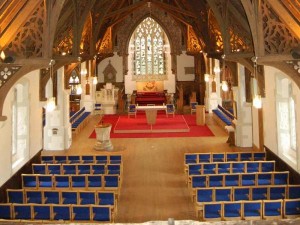
St Margaret’s Church, Leiston, UKDespite the tradition that the Psalms were written by King David, any good commentary will tell you that this Psalm was written probably in the first decades of the Sixth Century BC, at around the time of the fall of Jerusalem to the Babylonians circa 598 BC. Some scholars would even suggest that it was written as late as the Maccabean era (circa 165 BC). Personally, I tend to go with the earlier date; the Psalm’s description of wide spread destruction of religious meeting places seems more in line with the pre-Exilic invasion.

The first deportation of the Jewish leadership followed almost immediately; two more deportations would occur. Those who were taken away were separated from their land and from the temple, central elements in their identity as the People of God. Loss of their homeland and, more importantly, the loss of their exclusive worship space, the temple made a critical impact on their experience and understanding of God. Could they worship God in a foreign land? Where was God in this alien land? For that matter, who was God? Their confusion is expressed in Psalm 137:

By the waters of Babylon we sat down and wept,
when we remembered you, O Zion.
. . .
How shall we sing the Lord’s song
upon an alien soil? (vv. 1,4 BCP version)

Today’s evening Psalm expresses the dismay of those left behind, those who are still in the land but whose places of assembly and worship have been destroyed. Both groups face the same issue: how to worship God without the traditional, exclusive-use worship spaces? Could it even be done?

They learned the lesson that God is not tied to land or temple, that God’s rule extends everywhere. They learned that their appreciation of God’s presence was not dependent on there being the traditional, exclusive-use worship place, that they could worship God anywhere. This is, unfortunately, a lesson that God’s People have forgotten and need to learn again.

We in the Christian church are tied to our buildings, especially those of us who are part of highly liturgical traditions. Our custom (or perhaps we would be better to call it a habit or even an addiction) of structured, even majestic worship with processions, high altars, choirs, fancily vested clergy, and pipe organs seems to demand special spaces in which to indulge it. We forget that these spaces are simply tools for ministry; instead, we treat them as holy themselves and we use them exclusively for worship. We call them “houses of worship” or, even more telling, “houses of the Lord.”

In the spring of 2009 in Cleveland, Ohio, near where I live, the Roman Catholic bishop announced the closure of 52 parish church buildings because the parishes were deemed financially nonviable. The outcry was deafening; the members of many of these congregations could not imagine being the church without their historic building. The Cleveland Plain Dealer reported that the pastor of one of the closed churches tried to teach his flock that the “building is a beautiful building. A magnificent building, but the bottom line is, it isn’t the church. We are.”

Buildings are simply tools and tools should be properly used. While they are useful tools, the loss of buildings and property could actually be a blessing in disguise to such congregations. In American church culture, many churches, like these Roman Catholic parishes, have developed an unwholesome attachment to their buildings and locations. Loss of their building and property could free a congregation to discover its identity as the Body of Christ. The threat of loss could also be salutary; it can encourage a rethinking of our stewardship and use of space.

Proper stewardship of space would encourage the use of our worship locations for other, additional purposes. Flexible space could allow the area used for worship a few hours each Sunday to be used, for example, as a soup kitchen on weekdays. This is exactly what an historic Episcopal church in New York has done. Church of the Holy Apostles‘ nave becomes a dining room where thousands of people are fed. The church which worships there has come to understand that space is not holy because “God lives there.” It is holy because they worship there, and it is no less holy when used for other purposes, such as feeding the poor. After all, “just as you did it to one of the least of these who are members of my family, you did it to me.” (Matthew 25:40 NRSV) Thirteen of the closed Roman Catholic parishes successfully appealed the closure order to the Vatican and the bishop was ordered to reopen the buildings, which occurred late in 2012. Whether the parishes will make any changes in the way they do outreach ministries in their neighborhoods remains to be seen.

The Babylonians destroyed the holy places, but the People of God learned a lesson about their need of holy space . . . that they didn’t need an exclusive-use worship space . . . and they lived on. Today’s economy is, perhaps, making exclusive worship places nonviable, but the People of God can live on without them, or they can live on while making faithful multiple uses of them. The lesson learned by the Jews during the Exile must constantly be relearned.

====================

A request to my readers: I’m trying to build the readership of this blog and I’d very much appreciate your help in doing so. If you find something here that is of value, please share it with others. If you are on Facebook, “like” the posts on your page so others can see them. If you are following me on Twitter, please “retweet” the notices of these meditations. If you have a blog of your own, please include mine in your links (a favor I will gladly reciprocate). Many thanks!

====================

Father Funston is the rector of St. Paul’s Episcopal Church, Medina, Ohio.

“Be” not “Go” 24/7 – From the Daily Office – February 27, 2013

From the Gospel of John:

The man [from the pool at Beth-zatha] went away and told the Jews that it was Jesus who had made him well. Therefore the Jews started persecuting Jesus, because he was doing such things on the sabbath. But Jesus answered them, “My Father is still working, and I also am working.” For this reason the Jews were seeking all the more to kill him, because he was not only breaking the sabbath, but was also calling God his own Father, thereby making himself equal to God.

(From the Daily Office Lectionary – John 5:15-18 (NRSV) – February 27, 2013.)

I go to vs I am GraphicRecently, a graphic has been making the rounds on Facebook. I received it from another church and posted it on my parish’s Facebook page about 24 hours ago with the caption, “Something to think about.” As of the moment I am writing, this graphic has been “liked” 235 times. It has been shared 1,412 times. And according to Facebook’s calculations, it has been seen over 132,400 times. That’s only as originating our page. It is being posted and shared on other pages and, no doubt, has even larger numbers than these at some of those other pages.

The graphic in question is the illustration of this meditation. It suggests a distinction between what it calls “the consumer church” and “the missional church.” The first is characterized by an attitude in its members of “I go to church;” the second, by a realization that “I am the church.”

“My Father is still working, and I also am working.”

When I read these words, they spoke to me of the same thing, the difference in paradigm between “going to church” and “being church.” For Jesus, his ministry on this earth among the People of God was not simply something he was doing; it’s who he was. It wasn’t work he could walk away from, go home from at night, take a day off, or go away on a long weekend. His Father was working “24/7” and, so, so was he. This is the difference between “going to” and “being.”

Theologically, this difference is most often discussed in connection with ordained ministry, in distinguishing between a “functional” view of ordination and an “ontological” theology of Holy Orders.

Ontology deals with the nature or substance of thing. It answers the question, “What is it?” The ontological view holds that ordination works a permanent and indelible change in the character of the deacon, priest, or bishop ordained. It is a sacrament which, like baptism, cannot be repeated, nor can Holy Orders be conferred temporarily. The ontological view is that ordination places one in an exclusive position in the community of the church, not a better or privileged place, but one from which the clergy person is to live exclusively in service of the people of God. This view is summarized in the aphorism “Once a priest always a priest.”

Orthodox theology holds that this is also the nature of baptism, the sacrament of membership in the church. According to St. Gregory of Nyssa, a real metaphysical, ontological change takes place in the baptized person, if the baptized person lives a virtuous life and makes his or her baptism effective in faith. Again, the church’s understanding is that once one is baptized, one remains forever baptized.

At the other end of the spectrum of understandings of these sacraments is the “functional” or “relational” view. As to ordination, it is a view that the sacrament is nothing more than a license to perform the functions of ordained ministry within the context of the local church community; apart from his or her relation to that community, the ordained minister is nothing and possesses nothing. According to the functional view, any of the tasks normally performed by the ordained could be performed by others within the church if properly authorized by the local community. When the ordained minister ceases to function in that role, he or she ceases to be ordained.

However, there is no “functional” theology of baptism. To the best of my knowledge, all Christian traditions hold that once a person has been baptized with water “in the name of the Father and of the Son and of the Holy Spirit” (Matthew 28:19 NRSV), they are then and forever baptized. They may quibble about whether immersion is needed; they may describe the effect of baptism differently, as the “washing away of sin” or as conferring an indelible “mark” or “seal.” But once baptized, always baptized: “There is one body and one Spirit, just as you were called to the one hope of your calling, one Lord, one faith, one baptism, one God and Father of all, who is above all and through all and in all.” (Ephesians 4:4-6 NRSV)

At least that’s the theology . . . the lived reality is often something different. For many church members, baptism is something that “was done” to them; they do not view it as defining who they are. For these Christians, church is a place they “go” not a Body to which they belong, not something they “are.” This morning, a member of my parish governing board brought this up in the context of contributions and offerings, budgets and bills. She made particularly note of the many church members who make an offering when they attend, but do not consider the church’s financial need when they are absent. “They are like people buying a service,” she said. Church is a place they “go;” church is not who they “are.”

I think this is why the graphic has proven so popular. There are many, many church members who “are the church,” who do not merely “go to church.” The graphic resonates with them. They realize that their Father is always working and that they, like Jesus, are also always working. Their Christian identity is a 24/7 thing.

In baptism, says The Book of Common Prayer, by water and the Holy Spirit God bestows upon God’s servants the forgiveness of sin and raises them to the new life of grace. The newly baptized person is “sealed by the Holy Spirit in Baptism and marked as Christ’s own for ever.” (BCP 1979, page 308)

During this season of Lent, as the baptized are invited to observe “a holy Lent, by self-examination and repentance; by prayer, fasting, and self-denial; and by reading and meditating on God’s holy Word” (page 265), I hope that all baptized persons will come to believe that church is who they are, not simply someplace they go.

====================

A request to my readers: I’m trying to build the readership of this blog and I’d very much appreciate your help in doing so. If you find something here that is of value, please share it with others. If you are on Facebook, “like” the posts on your page so others can see them. If you are following me on Twitter, please “retweet” the notices of these meditations. If you have a blog of your own, please include mine in your links (a favor I will gladly reciprocate). Many thanks!

====================

Father Funston is the rector of St. Paul’s Episcopal Church, Medina, Ohio.

The Possibility Is Just Too Wonderful – From the Daily Office – February 23, 2013

From the Psalms:

Lord, you have searched me out and known me;
you know my sitting down and my rising up;
you discern my thoughts from afar.
You trace my journeys and my resting-places
and are acquainted with all my ways.
Indeed, there is not a word on my lips,
but you, O Lord, know it altogether.
You press upon me behind and before
and lay your hand upon me.
Such knowledge is too wonderful for me;
it is so high that I cannot attain to it.
Where can I go then from your Spirit?
where can I flee from your presence?
If I climb up to heaven, you are there;
if I make the grave my bed, you are there also.
If I take the wings of the morning
and dwell in the uttermost parts of the sea,
Even there your hand will lead me
and your right hand hold me fast.

(From the Daily Office Lectionary – Psalm 139:1-9 (BCP version) – February 23, 2013.)

Multiple Worlds IllustrationA few days ago I wrote about my interest in superstring theory, m-theory, and the multiverse concept which springs from my life-long love of science fiction and the especially the “alternate reality” sorts of tales. I suggested that Jesus’ miracles might have been accomplished by his somehow accessing an alternate reality to affect this world; that would imply some sort of access to knowledge of those other universes.

I’ve never believed that the human Jesus had access to the divine mind in that way, so I’m not sure how I feel about that implication. Or maybe a spiritual connection to another reality doesn’t require that; perhaps that sense of and access to a healthier reality is what the Celts are onto with their idea of a “thin place”. Perhaps there are places where the divisions between the universes are permeable, and perhaps there are people who, like Jesus can sense that, and draw the realities together. Perhaps the ability to do this is what Jesus promised his disciples when he said, “If you do not doubt in your heart, but believe that what you say will come to pass, it will be done for you. So I tell you, whatever you ask for in prayer, believe that you have received it, and it will be yours.” (Mark 11:23-24) I know that’s a lot of “perhapses” . . . . but that’s part of what meditation is all about, imagining the possibilities.

And it is possibilities and alternate realities, and the question of God’s knowledge of them, that grab my attention today as I consider the evening psalm. The psalmist sings of God’s knowledge, which is all encompassing; God’s understanding of the psalmist’s existence is inescapable. In theology this is call “omniscience”; God is described as “all knowing.”

If there is only a universe, a single reality, this would mean that God knows the past, the present, and the future of the one-and-only timeline, and this gives rise to the doctrine of predestination, a sort of determinism: if God knows ahead of time what will happen, then events in the universe are effectively predetermined from God’s point of view. I have a lot of difficulty with predestination because, if it is true, then Jesus promise that “the truth will make you free” (John 8:32) is hollow. There is no freedom in a single universe whose future is determined.

But what if m-theory is right and there are alternative realities, an infinity of them? What if what God “knows” is not the future of a single reality, but all the multiplicity of possible outcomes? What God “knows” in that case is not what must be, but what might be. God knows, for example, what will become of Schrödinger’s cat . . . in every possible outcome there may be.

The multiverse theory is much too complicated to lay out in a brief theological reflection (and I’m certainly not the theoretical mathematician who could do so, in any case), but at its highest level it simply postulates that any universe that is mathematically possible has equal possibility of actually existing: if the physicists and mathematicians can get it to work out on paper, even if it can’t exist in this universe, it would exist “somewhere”. And, I would suggest, the God of possibilities would know about that universe.

God’s omniscience over a multiverse reality truly is “too wonderful for me.” It is also, from my point of view, much more exciting than any deterministic, single-universe idea that God simply knows the future of a solitary timeline. It means that God is the God of possibility. “For God all things are possible,” said Jesus (Matt. 19:26) And again, “What is impossible for mortals is possible for God.” (Luke 18:27) And again, “Abba, Father, for you all things are possible.” (Mark 14:36)

Søren Kierkegaard wrote, “Inasmuch as for God all things are possible, it may be said that this is what God is: one for whom all things are possible . . . God is that all things are possible, and that all things are possible is the existence of God.” (The Sickness Unto Death) For Kierkegaard, human existence is not confined to the known, to one concrete, “factual” reality; a multitude of possibilities is fundamental to human life. The human soul is released by possibility; it is possibility that makes us free.

Superstring theory, m-theory, the multiverse hypothesis . . . these are the new science of possibility. Our omniscient God is the God of possibility. And possibility is the truth that sets us free! That is just too wonderful!

====================

A request to my readers: I’m trying to build the readership of this blog and I’d very much appreciate your help in doing so. If you find something here that is of value, please share it with others. If you are on Facebook, “like” the posts on your page so others can see them. If you are following me on Twitter, please “retweet” the notices of these meditations. If you have a blog of your own, please include mine in your links (a favor I will gladly reciprocate). Many thanks!

====================

Father Funston is the rector of St. Paul’s Episcopal Church, Medina, Ohio.

Far More Than We Can Ask Or Imagine – From the Daily Office – January 19, 2013

From the Letter to the Ephesians:

Now to him who by the power at work within us is able to accomplish abundantly far more than all we can ask or imagine, to him be glory in the church and in Christ Jesus to all generations, for ever and ever. Amen.

(From the Daily Office Lectionary – Ephesians 3:20-21 (NRSV) – January 19, 2013.)

IMAGINATION by archanNEpiscopalians who say the Daily Office are familiar with this text; a variation of it is one of the options for the Grace at the end of both Morning and Evening Prayer. Each time I recite those words at the end of the office, I am reminded how limited our imaginations are!

Yesterday, I wrote here about seeking ways to incorporate the cutting-edge practices of the “emerging church” into the life and ministry of the “inherited church”. I received one response which asked, “so there is no place for people who have grown up in the Church, then?” Of course there is, I replied. Something new is not a threat to that which is old, it is simply new. Are our imaginations are so limited that we cannot envision there being something new in the church without also thinking that means the loss of something old and valued? Are our churches and church structures so limited that they cannot encompass both old and new together?

We are bounded by our questions; our imaginations are limited by what we ask. It is not without good reason that St. Paul phrased this doxology to say that God can accomplish “more than we can ask or imagine.” What we ask limits what we can imagine. How we ask frames our expectations. The sorts of questions we pose determine the limits of our thinking. When we ask the right questions, we get the right answers; with the right questions, we expand our thinking and with expanded thinking, we broader horizons.

There are many trite and hackneyed sayings about imagination: “All things are possible to those who believe.” — “What the mind can conceive, it can achieve.” The thing about the trite and the hackneyed, however, is that it’s true; we say these things again and again because we recognize their validity. Just consider what human imagination has wrought: humankind has gone to the moon; heavier-than-air contraptions carry human beings through the sky at supersonic speeds; kidneys, lungs, hearts, hands, and faces have been transplanted from one body to another; we carry small light-weight devices with which we can access all the knowledge human beings have ever accumulated. These things were the stuff of science fiction not too long ago; they are now science fact.

So why is our imagination so limited when it comes to the future of the church? In our spiritual and religious life we should be even more imaginative. “Ask, and it will be given you; search, and you will find; knock, and the door will be opened for you.” (Matthew 7:7) Ask anything you like, said Jesus. Tell trees to be uprooted! Cause mountains to be thrown into the sea! For God’s sake, use your imagination! We are made, the Genesis story tells us, in the image of God. The novelist Henry Miller once wrote, “Imagination is the voice of daring. If there is anything godlike about God, it is that. He dared to imagine everything.” If there is anything godlike about us, it is that we have that same voice of daring. “Use it,” is the command of our Lord.

God is able to do far more than we can ask or imagine. The funny thing is, so are we.

====================

A request to my readers: I’m trying to build the readership of this blog and I’d very much appreciate your help in doing so. If you find something here that is of value, please share it with others. If you are on Facebook, “like” the posts on your page so others can see them. If you are following me on Twitter, please “retweet” the notices of these meditations. If you have a blog of your own, please include mine in your links (a favor I will gladly reciprocate). Many thanks!

====================

Father Funston is the rector of St. Paul’s Episcopal Church, Medina, Ohio.

The One Who IS – From the Daily Office – January 11, 2013

From the Gospel of John:

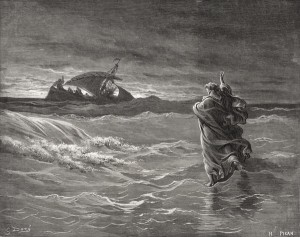
When evening came, his disciples went down to the lake, got into a boat, and started across the lake to Capernaum. It was now dark, and Jesus had not yet come to them. The lake became rough because a strong wind was blowing. When they had rowed about three or four miles, they saw Jesus walking on the lake and coming near the boat, and they were terrified. But he said to them, “It is I; do not be afraid.” Then they wanted to take him into the boat, and immediately the boat reached the land towards which they were going.

(From the Daily Office Lectionary – John 6:16-21 (NRSV) – January 11, 2013.)

Gustav Dore, Jesus Walking on the Water (1866)Jesus walking on the water has always struck me as a very funny story. “Funny” in the sense of “oddly out of place”, although it also has a certain Monty-Python-esque quality to it as well. The fact that it is reported in three of the Gospels – in the synoptic Gospels of Mark and Matthew and here in John – attests to its importance for the early church. John’s version of the story is the simplest, but it contains all the elements – a storm, rough seas, disciples’ fear. Like Mark, John leaves out Matthew’s addition of Peter trying to join Jesus on the surface of the lake.

I say the story seems out of place because it is (other than Jesus’ fit of pique at the poor fruitless fig tree, which has a parabolic quality to it, the fig being a rabbinic metaphor for the Torah; Mark 11:12-14, and Matthew 21:18-22) the single demonstration of divine power by Jesus which does not benefit another person or group of people. Other manifestations of power result in the provision of food (the wine at the wedding in Cana, the feeding of crowds of 5,000 and 4, 000) or in the healing of the supplicant or some other person. Jesus here seems to be simply about his own business. In fact, Mark makes it clear that “He intended to pass them by.” (Mark 6:48b) However, the disciples see him so he must respond.

It is Jesus’ response that underscores why this story is here, I think, and the NRSV translation does not do it justice. The Greek is “Ego eimi, me phobeithe.” The words “ego eimi” are the same words used in the Septuagint (the early Greek translation of the Hebrew Scriptures) when God’s identity is revealed as “I AM” (for this is what the Greek emphatically states). In Exodus, God speaks to Moses out of the burning bush and, when Moses asks God’s name, he is told, “I AM who I AM;” the Greek is “ego eimi”. (Exodus 3:14) In a similar way, Isaiah the prophet reports God saying several times, “I, even I AM He;” the Greek is “ego eimi.” Later in John’s Gospel, Jesus will use this same construction in his famous “I am” statements. Here as there, Jesus’ identity with God is what is stressed.

And this is also the import of the story of Jesus’ walking on the water, this miracle with no other purpose, no parabolic meaning as in the blasting of the fig tree, no benefit to another as in the feeding or healing miracles. This miracle simply demonstrates the power of Jesus over nature, and simply over nature, but over the forces of death and chaos represented by water and the storm. It is, purely and simply, a manifestation of divine power.

I try always to keep before my mind’s eye the Jesus who is human, to remember that he was “one who in every respect has been tested as we are” (Heb. 4:15) But every so often it is important to remember that Jesus is also divine, fully divine, God incarnate. It is necessary every so often simply to stand in awe of the One who walked on the water, the One WHO IS, and yet who humbled himself to become as we are.

====================

A request to my readers: I’m trying to build the readership of this blog and I’d very much appreciate your help in doing so. If you find something here that is of value, please share it with others. If you are on Facebook, “like” the posts on your page so others can see them. If you are following me on Twitter, please “retweet” the notices of these meditations. If you have a blog of your own, please include mine in your links (a favor I will gladly reciprocate). Many thanks!

====================

Father Funston is the rector of St. Paul’s Episcopal Church, Medina, Ohio.

The Presence of the Lord – From the Daily Office – January 3, 2013

From the Book of Genesis:

Jacob left Beer-sheba and went toward Haran. He came to a certain place and stayed there for the night, because the sun had set. Taking one of the stones of the place, he put it under his head and lay down in that place. And he dreamed that there was a ladder set up on the earth, the top of it reaching to heaven; and the angels of God were ascending and descending on it. And the Lord stood beside him and said, “I am the Lord, the God of Abraham your father and the God of Isaac; the land on which you lie I will give to you and to your offspring; and your offspring shall be like the dust of the earth, and you shall spread abroad to the west and to the east and to the north and to the south; and all the families of the earth shall be blessed in you and in your offspring. Know that I am with you and will keep you wherever you go, and will bring you back to this land; for I will not leave you until I have done what I have promised you.” Then Jacob woke from his sleep and said, “Surely the Lord is in this place – and I did not know it!”

(From the Daily Office Lectionary – Gen. 28:10-16 (NRSV) – January 2, 2013.)
 
Sunlight figure on wind-swept hilltopHow many places do we go where the Lord is and we do not know it? This story of Jacob reminds me of a song we sang in the Cursillo community where I meant my wife. It’s very pretty, very contemplative, and usually sung as an accompaniment to Holy Communion:

Surely the presence of the Lord is in this place.
I can feel His mighty power and His grace.
I can hear the brush of angels wings.
I see glory on each face.
Surely the presence of the Lord is in this place.

I like the song; I have good memories associated with it. The thing about the song that bothers me, however, is its linking of the Lord’s presence to a time or place of emotional or spiritual glory. Christians believe that God is omnipresent; as St. Paul said, God “is above all and through all and in all.” (Eph. 4:6) And even if we don’t quite believe that, we believe that Jesus promised that “where two or three are gathered in my name, I am there among them.” (Matt. 18:20) He didn’t promise to be there only when times were good or when people were on a spiritual high. Surely Christians gather in bad times and well as good, in times of sorrow as wall as of joy. We believe that God is present in those times, too.

It is often that we find ourselves unable to discern God’s presence, however. We find ourselves, like Jacob, not knowing that God is present. The question is how to train ourselves to be aware of the holy whenever and wherever we may be.

Here is a resolution for the New Year: to take the steps necessary to clear our consciences of those distractions that keep us from recognizing God’s presence with us. Let us resolve to turn off the cell phone, the television, the computer . . . to put down the newspaper, the book, the magazine . . . to listen carefully and prayerfully for the presence of God.

Perhaps if we do that we can live another lyric that this story brings to mind, the song Presence of the Lord by Blind Faith:

I have finally found a way to live
Just like I never could before
I know that I don’t have much to give
But I can open any door

Everybody knows the secret
Everybody knows the score
I have finally found a way to live
In the presence of the Lord

Because the truth is that surely the Lord is in all places – and often we do not know it! Let us resolve to finally find a way to live in the presence of the Lord.

====================

A request to my readers: I’m trying to build the readership of this blog and I’d very much appreciate your help in doing so. If you find something here that is of value, please share it with others. If you are on Facebook, “like” the posts on your page so others can see them. If you are following me on Twitter, please “retweet” the notices of these meditations. If you have a blog of your own, please include mine in your links (a favor I will gladly reciprocate). Many thanks!

====================

Father Funston is the rector of St. Paul’s Episcopal Church, Medina, Ohio.

« Older posts Newer posts »