Occasional thoughts of an Anglican Episcopal priest

Category: Bible (Page 109 of 111)

Baptismal Sermon for Advent 1: Tear Open the Heavens and Come Down!

What would you do if the world were to end tomorrow? That’s a good question to be thinking about as we consider our lesson from Mark’s Gospel; that’s a good question to be thinking about as we contemplate baptizing these two boys today. In today’s Gospel reading, Jesus is warning his disciples about the end of time, and the picture he paints is not pretty:

the sun will be darkened,
and the moon will not give its light,
and the stars will be falling from heaven,
and the powers in the heavens will be shaken.

It’s pretty vivid, to say the least; the stuff of fantasy novels or Hollywood films. This vivid imagery had a powerful effect on Jesus’ first audience, who were Jews familiar with the compelling visions of their prophets, or on the first generation of Christians who expected Jesus to return at any moment, but that’s not really the case with us, is it? Do we really think it still makes sense, let alone actually predicts what’s going to happen? 2,000 years of no return have deadened its power for us!

Of course, predictions of the end still do attract considerable attention, much of it derisive and ridiculing, although there are also true believers. Witness the tremendous attention and preparation given after Harold Camping predicted – and heavily promoted! – that Jesus would return on May 21, and then when that failed, on October 21 of this past year. A little more than a decade ago it was Y2K; a generation ago it was Hal Lindsey and The Late, Great Planet Earth; and next year I’m sure there will be all sorts of attention paid to the ancient Mayan calendar’s apparent suggestion that the world ends on December 21, 2012. Speculation about the end of the world runs rampant. And that’s part of the problem. So many have predicted the end of the world and Jesus’ return to great fanfare and failure that they are almost a laughingstock.

But we are Bible-believing Christians who weekly stand up in church and say, “We believe in one Lord, Jesus Christ, [who] will come again in glory to judge the living and the dead, and his kingdom will have no end.” So when Jesus looks back to and echoes the Prophet Isaiah, and tells his followers that he will come again and how it will be, we should take it seriously!

Especially, we should take it seriously on a day when we take two infant boys and pray over them, when we douse them with water and invoke the power of God’s Holy Spirit to deliver them, open them, fill them, teach them, and send them out into the world in God’s Name, when we make them a part of the People of God, members in the Body of Christ, and participants in the Royal Priesthood of all believers. Our prayers may not seem quite so vivid, quite so fantastic, but we are doing in the lives of these children nothing less than what Isaiah did in the lives of the Hebrew People when, on their behalf, he cried out to God, “Tear open the heavens and come down!”

We should take it seriously! But it often seems that, left to our own devices, we really don’t. We don’t mind approaching God on our own terms, but we often act as if we don’t really want God getting too close. As a colleague of mine puts it, “Like a cagey, skittish cat, we approach God … a little. Slowly. With constant suspicion. And at the slightest movement we scurry in the opposite direction.”

People want to be close to God. Or, at the very least we want to want to be close to God. We want to think of ourselves as “spiritual” people and we want others to think of us that way. And we want to be safe and comfortable while we do that. But along comes Isaiah who prays for heavens to be torn open, for mountains to quake, for nations to tremble … along comes Jesus who tells us to be alert for darkening skies, for falling stars, for shaking heavens. Our general stance of skittishness, of cautious approach, of wary-curiosity is vanquished by Advent’s opening cry to God to “tear open the heavens and come down” and by our baptismal prayer that God will deliver, open, fill, teach, and send not only these children, but all of us, out into the world to do the work he has given us to do. Advent and baptism are meant to kindle in these children and in us the insatiable desire for God to come and, I say again, we should take it seriously! As Christian write Annie Dillard says,

Does anyone have the foggiest idea of what sort of power we so blithely invoke? Or, as I suspect, does no one believe a word of it? The churches are children playing on the floor with their chemistry sets, mixing up a batch of TNT to kill a Sunday morning. It is madness to wear ladies’ straw hats and velvet hats to church; we should all be wearing crash helmets. Ushers should issue life preservers and signal flares; they should lash us to our pews.

We should take it seriously, indeed!

This is what St. Paul is saying to Christians in Corinth when he greets them, “Grace to you and peace from God our Father and the Lord Jesus Christ,” and then reminds them:

[Y]ou are not lacking in any spiritual gift as you wait for the revealing of our Lord Jesus Christ. He will also strengthen you to the end, so that you may be blameless on the day of our Lord Jesus Christ. God is faithful; by him you were called into the fellowship of his Son, Jesus Christ our Lord.

Paul’s vision for the church at Corinth is also our vision as we begin a new church year, as we baptize these young boys. Grace has been given to us, the grace of being called into the fellowship of Christ, into the communion of saints. But grace is never appropriated individually, just for oneself; it is always communal in nature, an insertion into community. This is what baptism accomplishes, for we are assured that “all who are baptized into the death of Jesus Christ … live in the power of his resurrection and look for him to come again in glory.”

In the verse just before our reading from the First Letter to the Corinthians begins, Paul addresses the church members as ” those who are sanctified in Christ Jesus, called to be saints.” By these words “sanctified” and “saints”, Paul means that church members set apart from worldly things for a special, divine purpose. In our baptismal liturgy, these children will be told that that “are sealed by the Holy Spirit in Baptism and marked as Christ’s own for ever.”

To be sanctified or made holy, to be marked as God’s own has practical implications; it forms and shapes all aspects of the life of the People of God, the way church members live. Throughout the Old Testament, God desires that Israel be different from the nations around them, that they engage in practices and locate themselves within a narrative that marks that difference. It’s the same in the New Testament, in which the church is called to be different from the culture that surrounds us. In our epistle reading today, Paul particularly notes that the church at Corinth is called not only “out” of the world, but “into” community: they and we were “called into the fellowship of [God’s] son, Jesus Christ our Lord.” Faithfulness is a team sport that requires the unity of the church.

That faithfulness, the work of the spiritual gifts begun in us through our unity in the church, through our fellowship in Christ and with one another, is lived out through an active waiting for Christ to be revealed. This waiting is not our usual catlike skittishness, our cautious approach, our wary-curiosity; this waiting is the praying and thanksgiving, the singing and sharing that transform our speech and our knowledge, our words and our expectations, into conformity with Jesus. The community of faith itself, the one in which we find ourselves, is called to see Christ coming in its very midst, to take the end of time very seriously.

We should take it seriously, and we do. That is why today, as we begin a new church year, as we look for Christ to come again in glory, in joyful obedience to Christ, we bring into his fellowship these children, baptizing them in the Name of the Father, and of the Son, and of the Holy Spirit, crying out to God, “Tear open the heavens and come down” in their lives and into ours. Amen.

Sermon for Christ the King: Prepare yourself; gotta have a friend in Jesus!

(Sermon starts with a video of Norman Greenbaum’s Spirit in the Sky. The lyrics are reproduced here.)

When I die and they lay me to rest,
Gonna go to the place that’s the best.
When I lay me down to die,
Goin’ up to the spirit in the sky.
Goin’ up to the spirit in the sky;
That’s where I’m gonna go when I die.
When I die and they lay me to rest,
I’m gonna go to the place that’s the best.

Prepare yourself; you know it’s a must –
Gotta have a friend in Jesus,
So you know that when you die
He’s gonna recommend you
To the spirit in the sky.
Oh, recommend you
To the spirit in the sky;
That’s where you’re gonna go when you die.
When you die and they lay you to rest,
You’re gonna go to the place that’s the best.

Never been a sinner; I never sinned.
I got a friend in Jesus,
So you know that when I die|
He’s gonna set me up with
The spirit in the sky.
Oh, set me up with the spirit in the sky;
That’s where I’m gonna go when I die.
When I die and they lay me to rest,
I’m gonna go to the place that’s the best.
Go to the place that’s the best.

Isn’t that a great song? Written by a Jewish hippy folk-rocker in 1970…. A bit overly confident in the first verse, but that’s the way of some hymns, don’t you think? I mean “Praise my soul, the King of heaven” in which we claim to be “ransomed, healed, restored, [and] forgiven” betrays a pretty over-the-top confidence as well! The theology in the second verse is pretty good, although in the third it’s not so hot – so let’s take a look at that second verse because it really does have something to do with the Gospel lesson for this feast of Christ the King.

Prepare yourself; you know it’s a must –
Gotta have a friend in Jesus,
So you know that when you die
He’s gonna recommend you
To the spirit in the sky.

Today is the last Sunday of the Christian year, the last Sunday after the Feast of Pentecost, the last Sunday before the church year begins again on the First Sunday of Advent. We call it “The Feast of Christ the King” and in the lessons for the day we focus on Christ’s return, his Second Coming, to reign as king over all of creation. In this year “A” of the lectionary cycle, we are still in the same cycle of lessons that we began several weeks ago, Matthew’s description of the events of the first Holy Week. What we heard today takes place on Wednesday – Jesus has just told his disciples some parables about being prepared – the Parable of the Ten Bridesmaids – and about properly stewarding what he has given them – the Parable of the Talents. Now he tells them plainly what will happen at the end of time. This is not a parable! This is a straight-forward statement of what will happen:

When the Son of Man comes in his glory,
and all the angels with him,
then he will sit on the throne of his glory.
All the nations will be gathered before him,
and he will separate people one from another
as a shepherd separates the sheep from the goats,
and he will put the sheep at his right hand
and the goats at the left. (Matthew 25:31-33)

There’s nothing parabolic about this. This is what will be – Jesus on his throne with the people gathered before him. To some he will say, “Step over here on my right and ‘inherit the kingdom prepared for you from the foundation of the world.'” To others he will say, “Step to my left and ‘go away into eternal punishment.'”

“Prepare yourself; you know it’s a must – gotta have a friend in Jesus!” You do not want him to not be your friend, no way, no how! So how do we get to be Jesus’ friend?

Well, that’s laid out here in pretty straight-forward fashion, as well:

I was hungry and you gave me food,
I was thirsty and you gave me something to drink,
I was a stranger and you welcomed me,
I was naked and you gave me clothing,
I was sick and you took care of me,
I was in prison and you visited me.

In Matthew’s Gospel Jesus completes his teaching ministry voicing the same concerns with which he began it in the opening words of the Sermon on the Mount:

Blessed are the poor in spirit, for theirs is the kingdom of heaven.
Blessed are those who mourn, for they will be comforted.
Blessed are the meek, for they will inherit the earth.
Blessed are those who hunger and thirst for righteousness, for they will be filled
Blessed are the merciful, for they will receive mercy.
Blessed are the pure in heart, for they will see God.
Blessed are the peacemakers, for they will be called children of God.
Blessed are those who are persecuted for righteousness’ sake, for theirs is the kingdom of heaven.

In Luke’s Gospel we are told that Jesus began his ministry by identifying himself as the one who would provide for the hungry and the thirsty, the meek and the mournful, the poor and the persecuted. He went to his hometown synagogue and read from the Prophet Isaiah:

The Spirit of the Lord is upon me,
because he has anointed me
to bring good news to the poor.
He has sent me to proclaim release to the captives
and recovery of sight to the blind,
to let the oppressed go free,
to proclaim the year of the Lord’s favor.

And then told them, “Today this scripture has been fulfilled in your hearing.” He would be the bringer of blessing, but now, three years later ….

At the end of his teaching ministry he has handed the Good News over to his followers, like the master handing over the Talents to his slaves, to used and to be increased, and he says to them plainly, “It’s your show now! You provide the food and the drink; you provide the clothing and the shelter; you care for the sick and the prisoner; you welcome the outcast and the lost. Befriend the least of these and you befriend me.” In John’s Gospel, he makes this even clearer when he says, “You are my friends if you do what I command you. I do not call you servants any longer, because the servant does not know what the master is doing; but I have called you friends.”

“Prepare yourself; you know it’s a must – gotta have a friend in Jesus!”

You know, there are two things about this end-time description that intrigue me. The first is that Jesus doesn’t mention a single one of the things that good religious people always seem to think are important. For example, he doesn’t say to either the sheep or the goats anything about sex or gambling or drinking or church-going or Bible-verse memorizing or any of that …

The sheep are not rewarded for attending religious services, nor are the goats condemned for skipping them.

The sheep are not rewarded for being faithful to their spouses, nor are the goats condemned for adultery.

The sheep are not rewarded for giving to the religious establishment, nor are the goats condemned for their lack of charitable giving.

The sheep are not rewarded for staying away from the casinos, nor are the goats condemned for betting at the racetrack.

The sheep are not rewarded for preaching their religion on street corners or on people’s door steps or at their places of work, nor are the goats condemned for failing at evangelism.

The sheep are not rewarded for being teetotalers, nor are the goats condemned for drunkenness.

The sheep are not rewarded for studying their scriptures, nor are the goats not condemned for being biblically illiterate.

We might all agree that we would expect the righteous sheep to behave as described, and that it would be a lot better if the unrighteous goats didn’t … but Christ the King judging between them at the end of time doesn’t seem to be concerned with questions of religious observance and moral behavior. He’s concerned the harsh realities of hunger and thirst, poverty and homelessness, illness and persecution, and whether anybody has addressed them.

The second thing that is intriguing and noteworthy about the scene Jesus describes is the complete lack of self-awareness by both the righteous and the condemned. “Really?” the sheep ask, “When did we do that?” “You’re kidding?” the goats exclaim, “When did we fail to do that?”

And this is where we really have to be very careful that we are understanding of what Jesus is saying. He is not suggesting, in any way, shape, or form, that there is some sort of cosmic check-list that we have comply with. “OK. I worked at Free Farmers’ Market the past four weeks handing out fresh vegetables. Feed the hungry, check! I donated all my old clothing to the Good Will. Clothe the naked, check!” No! It doesn’t work that way.

The righteous don’t go before the King waving a check list: “Look, Jesus, look what we did!” Instead, they are surprised to learn that they did it. Because it’s not really about “doing” … it’s about “being”. It’s not about doing good deeds; it’s about simply being good. That’s why Jesus doesn’t have to mention sex or gambling or religious observance, because someone who would feed the hungry, clothe the naked, house the stranger, or care for the poor without thinking about it surely would lead a moral and religious life. They “walk the walk” whether they “talk the talk” or not.

In the letter of James we are admonished to “be doers of the word, and not merely hearers who deceive themselves.” James asks this important question: “What good is it, my brothers and sisters, if you say you have faith but do not have works? Can faith save you? If a brother or sister is naked and lacks daily food, and one of you says to them, ‘Go in peace; keep warm and eat your fill,’ and yet you do not supply their bodily needs, what is the good of that? So faith by itself, if it has no works, is dead. But someone will say, ‘You have faith and I have works.’ Show me your faith apart from your works, and I by my works will show you my faith.”

Jesus is well aware of the differences between people. He knows that how we live our lives shows more clearly the kind of person we are than anything we might say, any belief we might claim. So his criteria for separating people at the end of time are based on what we do during the course of our lives. Those who quietly get on with living the Good News – feeding those who were hungry, clothing those who were naked, visiting those who were sick or in prison – not because there’s some rule or check list, but simply because they have a need and we have the means to meet it – these are the people who will be taken to one side and told that, in fact, they had been doing those things for Jesus himself; by their works, they showed their faith – they had done what Jesus commanded; they had been Jesus’ friends. Those who do not do these things – not out of some evil intent, but simply because they are, perhaps, too self-centered to see the needs of others – will be told that when they failed to do those things, they were neglecting to do them for Jesus; by their lack of works they showed their faith was dead; they had not done what Jesus commanded; they had not been his friends.

“You are my friends [when] you do what I command you.”

To some the King will say, “Step over here on my right and ‘inherit the kingdom prepared for you from the foundation of the world.'” To others he will say, “Step to my left and ‘go away into eternal punishment.'”

“Prepare yourself; you know it’s a must – gotta have a friend in Jesus!”

Sermon on the Parable of the Talents: “You Wicked and Lazy Servant!”

(This is not the sermon I preached on Sunday, November 13, 2011. It is not that sermon because I didn’t write that sermon down before preaching it … I didn’t even make an outline of that sermon before preaching it. This sermon [since I didn’t preach it, maybe that’s the wrong word] is what I wrote down several hours later – I think it contains some of what I said, expands on part of what I said, and probably leaves out some of what I said.)

Give us open minds, O God, minds ready to receive and to welcome such new light of knowledge as it is your will to reveal to us. Let not the past ever be so dear to us as to set a limit to the future. Give us courage to change our minds when that is needed. Let us be tolerant to the thoughts of others and hospitable to such light as may come to us through them. Amen.

A few days ago, a member of the congregation came to my office with that prayer. She said she’d found it in going through some of her old papers. It is a prayer attributed to John Baillie, who was a Church of Scotland minister in the mid-20th Century; in fact, he was the Moderator of the Church of Scotland during the 1940s. I think the three most important words in this prayer are “Give us courage” because they directly address the lesson of today’s reading from the Holy Gospel.

Let’s remember once again where we are in Scripture here at the end of Lectionary Year A of the Revised Common Lectionary’s cycle, the context of this lesson we have heard from the Gospel according to Matthew. For the past several weeks, we have been reliving the events of Holy Week as related in the closing chapters of Matthew’s Gospel. We have seen Jesus, after entering the city of Jerusalem, cleanse the Temple. You remember, he threw out the money changers, the bankers, the sellers of sacrificial animals, all those who were profiting from others’ religious devotion; “You will not make my father’s house a place of thievery!” he said to them.

Then we heard him in the Temple courtyard being confronted by Pharisees, Sadducees, Herodians, lawyers, and all sorts of powerful groups who wanted to test him, to trick him, to trap him in some ill-advised statement that might form the basis of a prosecution. They were trying to get rid of him, so they asked about taxes, about Commandments, about the after-life. But Jesus was too good a teacher, too good a debater to get caught in their traps and, by his questions, he silenced them and put an end to those confrontations.

Now with his disciples, a large group of his followers, not just his Twelve intimate companions, he is trying to explain what is going to happen next and what comes after that. He is trying to make them understand that he is probably going to be arrested and will quite likely die, but he is also trying to get them to appreciate that his death will not be the end of the story. He is trying to teach them that they have responsibilities that will continue past his execution, and that he will be back to judge how well they have done.

Following the same didactic method he has always used, he does this teaching through the medium of parables. First he tells a parable illustrating the Kingdom of Heaven as being like ten bridesmaids waiting with lamps to greet a bridegroom. Five were wise, conserved their oil, and were able to go into the celebration with the bridegroom, but five were foolish, used up their oil and had to go buy more. While they were away in the market place, the bridegroom came and they missed the party. “Be alert,” he says, “for you do not know when Judgment Day will come.”

Next he tells the parable set out in today’s Gospel reading (Matt. 25: 14-30), the story of the wealthy man going away and leaving his assets in the care of servants. As the text is set out in our Lectionary Book, it says, “Jesus said, ‘The Kingdom of Heaven is as if …” But those words, “The Kingdom of Heaven” are not found in these verses of Matthew’s 25th Chapter. All Matthew quotes Jesus as saying is “For it is as if ….” (v. 14) I don’t believe that the “it” Jesus is here describing is the Kingdom of Heaven at all. Rather, he is describing what will happen when he returns at that time about which we will “know neither the day nor the hour.” (v. 13) He is describing what theology calls “the parousia” – the last day, the judgment day, the winnowing at the end of time – when he, the Master, will return to receive “the account which we must one day give.” (Prayer for the Right Use of God’s Gifts, The Book of Common Prayer – 1979, pg. 827)

To fully understand this Parable to the Talents, we must appreciate not only this context, we must also understand what a “talent” is. I wonder sometimes why the translators of the Bible chose to transliterate the Greek word talonton in this way, why they didn’t translate that Greek word into something that would more clearly communicate the meaning of this story.

In our modern English, we hear the word talent and we immediately think of skills and abilities, the ability to sing a song or play an instrument, the ability to paint a picture or wire a computer; these are what we understand talents to be. But that is not what is meant here. To be blunt about it, what Jesus is talking about here is money! And not just a small amount of it.

Biblical historians tell us that a talent in the first century was an amount of money equal to fifteen to twenty times the average worker’s annual earnings. Let me say that again – fifteen to twenty times the average worker’s annual earnings. To put that in perspective …. in September the Bureau of the Census issued a report on the economic data collected in 2010 entitled Income, Poverty, and Health Insurance Coverage in the United States: 2010 (available online). In that report it shows that last year the median income of a single-male worker in the United States was about $35,000 (Table 1, page 6 of the report). Fifteen times that amount is more than a half-million dollars! So that’s one way to understand a talent – in terms of today’s earnings it would be $500,000 or a little more!

Another way to understand the value of a talent is this … Another definition of the word is that it was a measurement of gold – a talent was 80 pound of gold. 80 pounds! The price of gold today is $1,788 per ounce … per ounce! $1,788 times 16 times 80 yields the value of a talent as more than $2,288,000! This is no paltry sum the master in the parable entrusts to his servants…. even the one with regard to whom he has the least faith in his ability gets a huge amount of money, and at this rate the one who got the most to manage got more than $11,000,000!

So these three guys, these three servants get these huge sums of money to manage during the boss’s absence. Two of them invest the money in some way and over the time of the owner’s absence, however long that was, they double his money. When he returns, they present him the money and the earnings, and to each he says, “Well done, good and faithful servant; enter into the joy of your master.”

The third guy, the one who got the least, doesn’t do that. He, fearing his master’s possible displeasure, buries the money and when the boss returns he digs it up and gives it back to him. The master has not lost anything; he gets back exactly what he gave the servant, but how does he respond? “You wicked and lazy slave!” And he has the guy tossed into the outer darkness where there will be weeping and gnashing of teeth.

Now you have to understand that this would have absolutely shocked Jesus’ original audience. This is precisely what they would have been taught was the thing to do. The Pharisees, the rabbis of their day, taught that this is what the Law of Moses required. When someone entrusted you with an asset, you were expected to return that asset to them – no more, no less. The safest possible thing you could do, the Pharisees taught, was to bury the asset in a secret place so that you could later return it unwasted to its owner. And yet Jesus says this is a wicked and lazy thing to do, and worthy of nothing less than the punishment of banishment to the outer darkness.

Remember that this parable is told by Jesus to the disciples, to those to whom he is entrusting the most precious thing he can give them – his Gospel, his Good News, his ministry on earth, his church. He is saying to them that he will someday return and he will expect to see that that Gospel has been spread, that Good News proclaimed, that ministry performed, and that church grown, not simply conserved and held safe and secure.

This is a story in which Jesus commends his church to take risks, just like the two faithful servants who invested their master’s assets and earned a 100% profit … there is never return on investment if there is no risk. Jesus wants his church to take risks.

In his book, Five Practices of Fruitful Congregations, United Methodist Bishop Robert Schnase, writes about risk-taking mission and service. He writes this:

Risk-taking refers to “extraordinary opportunities for life-changing engagement with other people with steps into greater uncertainty, a higher possibility of discomfort, resistance, or sacrifice. Risk-taking mission and service takes people into ministries that push them out of their comfort zone, stretching them beyond the circle of relationships and practices that routinely define their faith communities.”

That sounds a lot like the prayer attributed to Sir Francis Drake that our Inviting the Future Capital Campaign Committee has chosen to guide us in that effort, that prayer that God will push us beyond our horizons, beyond our comfort zones, beyond our usual circles of relationship and practice. What most struck me about the bishop’s definition, though, was its recognition that risk-taking presents us with “a higher possibility of discomfort, resistance, or sacrifice.”

Many of you, I know, like to use the bible paraphrase The Message in your daily devotions and bible study. That paraphrase was written by Eugene Peterson, a retired Presbyterian pastor. In one of his other books, The Jesus Way, Eugene Peterson wrote this: “A sacrificial life is the means, and the only means, by which a life of faith matures.”

What both Schnase and Peterson are saying, what many Christian writers have said, is that Christianity is an adventure of the spirit or it is not Christianity. We must repent of our obsession with safety and security; we must be willing to take risks if we are going to do the tasks that only we as Jesus’ people can do! We must be willing to accept the risk that we may make mistakes. One of my favorite playwrights, George Bernard Shaw, who was not a Christian, once said, “A life spent making mistakes is not only more honorable but more useful than a life spent in doing nothing.” That, I think, is the point that Jesus is making, that Jesus is insisting upon in this parable.

The past few weeks in our lessons from the Hebrew Scriptures we have recalled the journey of the Chosen People from slavery in Egypt to freedom in the Holy Land. We have remembered how they crossed the Red Sea, how God gave Moses the ability to strike the water with his staff so that it parted and the sea floor became solid, dry ground that the people could cross. We have remembered how Joshua was instructed at the River Jordan to have twelve men representing the Tribes of Israel carry the Ark of the Covenant into the river where they were to stand, and as they did so the waters of the river ceased to flow so that the river bed became solid, dry ground that the people could cross. I am sure that there were some who, as they made that crossing, took small, timid steps, unsure and afraid as they went…. But we no longer have Moses with his magic rod; we no longer have the Ark to go before us. The Red Sea isn’t parting for us, and the river isn’t going to stop flowing. We don’t have the luxury of small, timid steps….

The river has carved a chasm, a great canyon, and if we are going to cross over from where we are to where Jesus expects us to be, we are going to have to take a leap of faith … you can’t cross a canyon with small, timid steps.

You’ve all heard that term before – “a leap of faith”? There are a couple of guys named Michael Frost and Alan Hirsch who have written a book encouraging the Church to embrace a theology of risk, adventure, and courage which they have titled by turning that phrase around. Their book is called The Faith of Leap! That is what Jesus in this Parable of the Talents is calling us to have, the Faith of Leap.

The past couple of days three members of this congregation and I attended our annual diocesan convention. One of the bits of business we do at that convention is to adopt a budget for the diocese in the coming year. We’re in the process of doing the same here in the parish – a committee is looking at our income and expenses and developing a financial plan for the Vestry to adopt for 2012. At the convention and in the parish each year we hear the same thing: “We have to pare down our expenses. We have to economize. We have to balance the budget. We have to be safe and secure and only do what we think we can afford to do.” We hear this everywhere in the church, at all levels, every year. It boils down to a cry to avoid risk.

I understand this inclination to security. Several years ago, before I was ordained, I was on the board of trustees of the church’s camp and conference center in the Diocese of Nevada, a facility called Camp Galilee. We had some maintenance that needed to be done – cabins needed reroofing, some cabins needed to be “winterized” so we could get greater year-round use out of the facilities, driveways and parking areas needed to be paved. A few of us on the board, myself included, felt we needed to be frugal and prudent; we believed we should not incur debt to do this work, but only do that part of it which we could afford. Our bishop was the late Wes Frensdorff, a man whom I have come to regard as one of the few true Saints I have ever known. Wes listened to us as we made our case for safety and security, and then replied, “A church that is not in debt is a church that is not doing its proper ministry.” It’s taken me years to understand what Bishop Frensdorff was saying … but I know now that he was simply following what Jesus is saying in this Parable of the Talents: we as Jesus’ church are called to be risk-takers.

You know … with regard to this parable, I have always thought that, when the Master returned, if the timid and fearful servant had, instead of burying the one talent, invested it in a losing proposition, that would have been alright. I’ve always thought that if he had said to the boss, “Look, I’m sorry; I lost your money. I’m just not as good a business man as these other two guys. I took the one talent and I invested it in what I thought was a good risk, but it didn’t turn out that way” the Master would have replied, “That’s OK! You tried. You gave it a good shot. Learn from your mistake, learn from your fellow servants. You’ll do better next time. Enter now into the joy of your master.”

One of the pieces of information we are provided at the convention is a multi-page chart which gives us the “ASA” or “Average Sunday Attendance” of every church in the diocese. That chart also shows the annual plate-and-pledge income of every congregation and the annual operating expenses of every parish. And it includes a calculation of income per worshiper and expenses per worshiper. I took a close look at that data and prepared a little chart of my own comparing our figures to two things – the average of similar churches in our Mission Area and the average for the diocese. (By “similar churches” I mean those with full-time rectors and at least one other full- or part-time staff person.) Here is what I discovered:
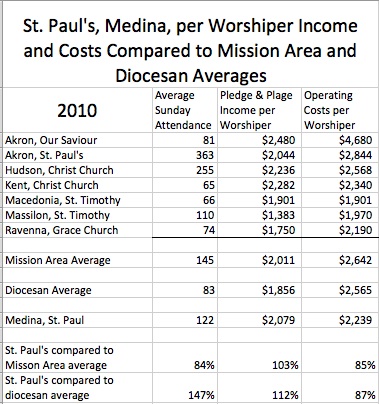
What I discovered is that we run a very efficient church operation compared to other congregations. Our income per worshiper is 112% of the diocesan average, while our operating costs per worshiper are only 87% of the diocesan average. We spend only $2,239 per year for the ministry we at St. Paul’s Parish do with, for, and on behalf of each of you worshipers. You know, if I were, what I would say about that? I’d say, “How dare you! How dare you spend only $2,200 a year for me!” How dare we, indeed! Here you are of infinite worth to God Almighty, entrusted by God with the Good News of Christ, and we spend only a paltry $43 a week on your behalf! How dare we be so timid and fearful! This data says that we run a tight ecclesiastical ship … but, I’m sad to say, that means we don’t take much risk at all ….

And I believe this is true of the entire church, not just St. Paul’s, not just the Diocese of Ohio, not just the Episcopal Church, but the whole Christian community in the United States of America for at least the last four decades if not longer. We have, I believe, been burying our treasure, the deposit entrusted to us by our Master, in the sand … and not just our talent; we’ve been burying our heads in the sand as well.

C. Kirk Hadaway, the statistical research maven at our national church headquarters, has published a series of reports on church growth (or perhaps one should say, “church shrinkage”) in the Episcopal Church. His graph of our membership data for the past several decades looks like this:
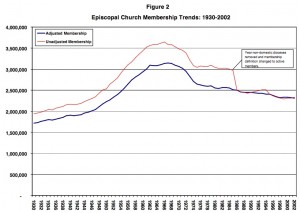
If you removed our denominational name from this graph, however, you wouldn’t be able to tell, from the shape and direction of the curve, which mainline denomination it represents. The membership graphs for the Lutherans, the Methodists, the Presbyterians, and others all look pretty much the same. The church has been shrinking … and I believe the reason is that we have been afraid to risk. We have sought the security and safety represented by balanced budgets; we have not taken the risks we have to take if we are to have the “faith of leap” that Jesus in this parable commends to us. We have become safe, secure …. and boring. Bishop Frensdorff had a coffee mug on which were the words “Budgets Are For Wimps”! We have become wimpy!

In the Book of Revelation, the Risen Christ directs the seer, John of Patmos, to write a series of letters to seven churches. To the Church in Laodicea John is directed to write: “I know your works; you are neither cold nor hot. I wish that you were either cold or hot. So, because you are lukewarm, and neither cold nor hot, I am about to spit you out of my mouth.” (Rev. 3:15-16) Without the “faith of leap,” without a willingness to take risks, no congregation, no denomination is hot or cold … with are pared-down, balanced budgets, we are merely tepid and timid, tasteless and wimpy, unworthy of anything but being spat out, consigned like the timid and fearful, wicked and lazy servant to the place of outer darkness where there will be weeping and gnashing of teeth.

Now please note that this Parable of the Talents is not a parable about personal stewardship. It is a parable directed to the entirety of Christ’s disciples, to the church as a whole. It is the church which has received this deposit of faith, this Gospel, this Good News; it is the church which Jesus expects to invest it, take necessary risks with it, nurture it, and return it to him – not as he left it with us, but as we have grown it during his time away. There may be here a teaching for each of us as individuals, but what each of us is to learn from it is for us personally to determine. And where that individual learning intersects with our corporate responsibility is for each of us to discern.

In the Parable of the Talents, the Master returned and to the first two servants, who faithfully used and increased what had been entrusted to them, he extended the greeting, “Well done, good and faithful servant, enter into the joy of your master.” To the timid and fearful servant who avoided risk for the safety and security of a hole in the ground, he gave the condemnation, “You wicked and lazy servant!”

At end of time, at the Parousia, on the last great day, at the Judgment … the Master will return, he will call us to account; we will return to him the church he has entrusted to us and he will say to us …..

(At this point I sat down…. After a few minutes, I asked the ushers to pass out a sheet containing the prayer which began the sermon and also the following commitment. I rose and asked the congregation to read it with me:)

My Church is composed of people like me.
I help make it what it is.
It will be friendly, if I am.
Its pews will be full, if I help fill them.
It will do great work, if I work.
It will make generous gifts to many causes, if I am a generous giver.
It will bring other people into its worship & fellowship if I invite them.
It will be a church of loyalty and love,
— of fearlessness and faith,
— and a church with a noble spirit
— if I, who make it what it is,
— am filled with these same things.

Therefore, with the help of God,
I shall dedicate myself
to the task of being all the things that I want my church to be.

Give us courage, Lord! Give us the faith of leap! Amen.
Medicine for Society’s Ills: Sermon for the 8th Annual Medina County Red Mass

I’d like to share with you two vignettes from the life of Eric Funston and, I promise you, I will tie these in with the readings from Scripture that we have just heard, readings which the Common of Saints bids us read when we celebrate the life and ministry of St. Luke the Physician. The first vignette is the most recent.

The River Sligachan, Isle of Skye, Scotland

The River Sligachan, Isle of Skye, Scotland

A few weeks ago, my wife Evelyn and I had the opportunity to spend time together touring Scotland and, as part of that trip, we spent time in the Inner Hebrides, particularly visiting the Holy Island of Iona and the Isle of Skye. Our trip to Iona started in the port town of Oban, where we caught the ferry to the island of Mull. The Oban ferry takes you to the town of Craignure where you disembark and then drive (if you are daring) or take a bus for the hour-and-half, 37 miles to the village of Fionnphort where you board another ferry for the short voyage to the Holy Island. We opted to take the bus and so we were both able to enjoy scenery along the road, which (by the way) is a single-track two-way highway with wide places every few miles to permit traffic to pass in each direction. For much of the length of this highway one follows the River Lussa, which is a wide and, when we were there, very active and swift-flowing river. The River Lussa flows through the Lussa Glen (“glen” is the Scots word for a valley) on either side of which are very high, very steep hills; as someone who comes originally from the intermountain west I would call them mountains, but they are certainly bigger than any hill or mountain I’ve seen in Ohio! The source of the River Lussa, and all the rivers on the Isle of Mull, is the dew that collects and the rain that falls on these hills.

The same is true on the Isle of Skye which we visited a few days later. We stayed there in the town of Portree, the unofficial capital of Skye, and drove to visit other parts of the island, including a drive to the village of Talisker, home of the whisky of the same name. On the way we drove along the River Sligachan, which for nearly its entire length that day was white water, a rushing torrent of foam! As on Mull, the source of the river is merely the dew and rain falling on the high hills around it.

What was most fascinating for us was watching the water come down the hillsides to feed these rivers. You could see, through the mist and rain, its beginnings in small streams high on the hillsides, streams which then joined with others, and then others until they formed beautiful, dazzling waterfalls. We’ve been places in the world where they have made tourist attractions of the local waterfall … there are dozens, if not hundreds, of waterfalls feeding the rivers of Mull and Skye that would be many of those tourist-attraction waterfalls to shame. To be honest, after the first twenty minutes or so of the drive from Craignure to Fionnphort, or the drive from Portree to Talisker, I was sort of suffering waterfall fatigue: “Oh, yeah, another waterfall … great…” And all these waterfalls feeding these rushing, gushing, foaming, frothing rivers making their way to the sea.

Second vignette … about twenty-five years ago I was a litigator specializing in medical malpractice and medical product liability defense. I was also one of the five managing shareholders of the largest law firm in the state of Nevada: twenty-two shareholders, twenty-eight associates, and a whole slew of support staff. We owned our own 60,000-square-foot, four-story office building, on the third floor of which was our law library, the largest private law library in the state. Adjacent to the law library we had a large conference room which we called “The War Room”. When someone was in trial, it became our command headquarters; it was where we began our day before heading to the courthouse and it was where we ended our day debriefing what had happened in the trial. It was also where we kept the office liquor cabinet.

Often, when I was in a trial, after the client would leave, after the associates and the paralegals would go home, I would pour myself a drink, go into the library, and just sit there and look around at all those law books – this was in the days before Lexis/Nexis and Westlaw and computer-assisted legal research, when you had to know the key-number system and the index to ALR – I’d sit there and just feel the presence of all that law! … the Pacific Reporters, the Federal Reporters, the USCA, the Nevada Statutes, the Restatement of the Law, Corpus Juris and ALR, those odd tax publications by CCH and BNA, the specialty law journals to which we subscribed … all that massive flood of legal wisdom. Just sit there in amazement at the accumulated wisdom of the American legal system. Maybe some of it would soak into me by osmosis….

So who is this Luke we are commemorating this evening and why are we doing so at a service whose avowed purpose is to seek God’s guidance for those who sit on the Bench and those who appear at the Bar?

Well, to answer the second question first, St. Luke’s feast day was yesterday so it just seemed appropriate to recognize that and use the lessons assigned his feast today. Who he was is the only Gentile writer whose words appear in the New Testament, a Greco-Syrian physician from the city of Antioch who accompanied St. Paul in his later travels, perhaps was even with him in his imprisonment and at the time of Paul’s martyrdom (as our odd little reading from Paul’s Second Letter to Timothy suggests – “Only Luke is [still] with me”). Luke is generally acknowledged to be the author of both the Gospel which bears his name and the Book of Acts. Because he was a physician, the Common of Saints bids us read the portion of the Book of Ecclesiasticus, also called Sirach or Ben Sira, that we heard this evening, and it is to that Scripture that I would like to turn now.

The author of this text, Yeshua ben Sira, sings the praises of physicians, as we heard, and then goes on to praise others who contribute to society, the farmers and the artisans, the smith and the potter, but he does so with this interesting introduction: “The wisdom of the scribe depends on the opportunity of leisure; only the one who has little business can become wise.” Acknowledging that society depends on these tradesmen and craftspeople, he nonetheless says, “They do not sit in the judge’s seat, nor do they understand the decisions of the courts.” Although “they maintain the fabric of the world, and their concern is for the exercise of their trade,” the need to set hand to plow or to potter’s wheel, to spend their hours “on business” makes it impossible for them to “become wise”. “How different, says Ben Sira, “the one who devotes himself to the study of the law….”

That famous Ohioan William Howard Taft, Secretary of War, President, Chief Justice of the United States Supreme Court, once said, “I love judges, and I love courts. They are my ideals, that typify on earth what we shall meet hereafter under a just God.”

Ben Sira seems to have been of a similar mind. He believe that God would direct the counsel and decision-making of judges: “If the great Lord is willing, he will be filled with the spirit of understanding; he will pour forth words of wisdom …. He will show the wisdom of what he has learned …. Many will praise his understanding …. Nations will speak of his wisdom, and the congregation will proclaim his praise.”

So Ben Sira begins praising those who study and practice medicine and ends praising those who study and practice the law; as physicians and surgeons are to the individual, so lawyers and judges are to the community. As the former heal the ills of the body, the latter deal with the ills of society. Perhaps this is why Luke the Physician, who in his Gospel relates several individual healing miracles of Jesus, tells of the beginning of Jesus’ ministry not in terms of medical or physical healing, but in terms of social healing. Jesus, he writes, took the scroll of the Prophet Isaiah, and proclaimed in the synagogue that he had been anointed to bring good news to the poor, to proclaim release to the captives and freedom to the oppressed, to right the social wrongs usually addressed by the law and by the courts.

Ben Sira wrote that physicians and pharmacists extract medicines out of the earth, and that from God in this way health spreads over all the earth. I want to suggest to you that societal health promoted by the rule of law is much the same. Remember the dew and the rain falling on the high hills of the Scottish highlands and islands, coming down into a thousand thousand little streams and rivulets, joining into larger streams and cataracts, combining into great waterfalls, and eventually great rushing wild rivers. The law is formed in the same way, from a thousand thousand sources … from agreements between friends, from contracts among businesses, from proverbs and maxims by which we govern our lives, from the words of rulers, the founders of nations, legislative bodies, legal scholars, and yes, even judges in the courts. From a thousand thousand sources, the rules of society combining and interacting and joining together to form that great wild rushing river of law!

That is what I would marvel at on those late nights sitting along surrounded by the statute books, the case reports, the legal encyclopedias and law journals. Our library was like a great reservoir in which all of that wisdom, all of that great rushing river of law was gathered and stored, waiting someone to extract from it just the right rule, just the right canon, the right decision to solve this particular issue. Ben Sira wrote that the physician and the pharmacist extract medicine out of the earth, and that is what lawyers and judges do, extract from that great flood of law the solutions to many of society’s problems, the legal medicines to cure society’s ills.

The humorist Ambrose Bierce defined a lawsuit as “a machine which you go into as a pig and come out as a sausage.” I prefer to think of the work of our judges and courts in a different way – using a different metaphor.

Not all of the water that runs down the hills of Scotland flows into those rivers and out to the sea. A good deal of it soaks into the earth, filters down through the soil and then through lime stone and eventually forms aquifers that accumulate on the top of the granite which is the bedrock of Scotland; it flows in underground streams to emerge in various places as beautifully clear spring water. And then the Scots do this wondrous thing … they mix it with malted barley in the process of extraction, fermentation, and distillation that produces whisky. (Whisky gets its name, by the way, from the Gaelic uisce beatha, the “water of life”.)

It seems to me that rather than Bierce’s sausage grander, this is a better metaphor for what our courts do. It’s the lawyers’ job to bring before the judge, from that great reservoir of all that law from all its sources, the particular canons, statutes, maxims, and rules that he or she thinks best apply to the facts of the case. Lawyers do this by bringing motions, settling proposed jury instructions, filing briefs in the trial court or on appeal, and making oral arguments before the courts. Judges then have the task to take what the lawyers present and, if you will, mix it around with the facts of the case, sort of let it ferment and then distill out of all that the resolution, the answer that best provides justice and equity, that treats this particular wound on the body of society.

I know its fashionable for some politicians to decry and criticize “activist judges”, and to suggest that judges should only apply the law not make it, but that betrays a fundamental misunderstanding of the role of our courts. If that were all judges were supposed to do, we could program computers to take care of our lawsuits and criminal prosecutions – and dystopian fiction and B-grade science-fiction movies are filled with stories predicting (accurately, I think) what the horrible result of that would be – a sausage grinder, indeed! We do well to remember the words of the great jurist Oliver Wendell Holmes, Jr.: “The law embodies the story of a nation’s development through many centuries, and it cannot be dealt with as if it contained only the axioms and corollaries of a book of mathematics.” The work of the court is like “painting a picture, not doing a sum.”

No! Judges are supposed to be activists! Courts and judges have always made law; in fact, courts and judges were making laws before there were legislatures to do so! And even now, because practically every case brought to court is unique unto itself, as the rules and maxims, the statutes and precedents are presented and applied to it, each case creates a little bit of new law, sometimes in unanticipated ways.

Just as the water that flows down the Scottish hillsides, even if it happens by some accident to mix with a some grain, doesn’t become whisky, the “water of life”, unless a master distiller sets his or her hand to it, his or her skill and knowledge and wisdom, so all those rules and maxims and statutes in all the law books don’t solve society’s problems, don’t treat society’s ills, unless a learned judge applies his or her skill and knowledge and wisdom.

Let us pray that, in the words of Ben Sira, that the great Lord will fill the judges of our courts with the spirit of understanding; that they will pour forth words of wisdom. Let us pray that the Lord will direct their counsel and knowledge, that they will have the leisure to become wise, and they will show the wisdom of what they have learned, so that the poor in our community will receive good news, the captives will be released, and all shall be freed from oppression.

In the Name of the Father, and of the Son, and of the Holy Spirit. Amen!

Give Back to Caesar…. Give to God: A Sermon for Proper 24A

Once again we are in the 22nd Chapter of Matthew which we began last week with Jesus telling that strange parable of the wedding banquet, but to truly understand what is going on here we have to go back to Chapter 21.

At the beginning of Chapter 21, Jesus tells two disciples to go to Bethphage and untie the foal of a donkey which he needs to ride into the city of Jerusalem. When I tell you that, you should immediately realize that this story takes place on or shortly after Palm Sunday; in fact, today’s confrontation takes place on the Monday after Palm Sunday. Jesus rode into the city in triumph and was haled as a king, as the One who comes in the Name of the Lord. He had gone to the Temple and driven out the sellers of sacrificial animals and the money-changers. After that, he returned to Bethany and spent the night, probably in the home of his friends Mary and Martha. The next day he went back to the Temple and began teaching in parables, during which he is confronted by various power groups – the Pharisees, the Sadducees, the Herodians, and probably others.

In this conversation, Matthew tells us that Jesus’ antagonists are the Pharisees and the Herodians. That’s important information because any sort of cooperative action between those two groups was darn near impossible. Matthew is saying something here like, “Harry Reid and John Boehner went together to ask Jesus this question.” It’s like saying that a Tea Partier and a participant in Occupy Wall Street took a united stand on something.

Pharisees, of course, were the Jewish sticklers for the Law. They insisted that righteousness required adherence to every little “jot and tittle” of the Mosaic rules. Herodians on the other hand weren’t Jews at all! They were Idumeans who had come to rule in Jerusalem with their king, Herod, as puppets under the Romans; they didn’t give one wit for the Law. But here they are confronting Jesus together because both felt threatened by him.

They come and ask what sounds like a simple question: Under the Jewish Law is it permissible, for a Jew, to pay taxes to the Romans? They’re trying to trap Jesus – if he says “Yes” he’ll lose the support of religious Jews and his movement will fizzle; if he says “No” he’ll be liable to arrest and prosecution by the Romans as political troublemaker and his movement will lose its leader and fizzle. They win in either case.

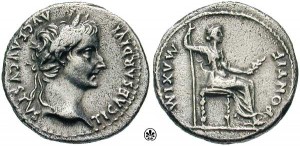
Jesus, however, is not going to fall for the trap. He asks to see one of the coins that would be used to pay the tax. Doing so, he traps them and points out how ridiculous their alliance is. The Pharisees, under the Law, could not possibly have possessed the coin in question and would never have brought one into the Temple precincts. Under the Jewish Law it was absolutely forbidden to bring into the Temple anything bearing an image, especially something bearing a religious image, an idol of a foreign religion. On one side, the coin in question, a denarius, would have had an image of Caesar and the words, Augustus Tiberius Caesar Divi Augusti Filius – “Augustus Tiberius, Emperor, son of the Divine Augustus”; on the other side, Caesar’s title Pontifex Maximus– “High Priest”. In other words, the coin was a religious object; it proclaimed the creed of the emperor-worship cult which was part of the Roman civic religion. The Herodians, client rulers of the Romans, would have had no problem with the coin, but it would have been anathema to the Pharisees. By asking for the coin, and getting a Herodian to produce one, Jesus was demonstrating to everyone who utterly ridiculous this alliance between the two parties was.

Jesus’ answer to the question, though, is what truly exposes the hypocrisy of their partnership: “Give [back] therefore to the emperor the things that are the emperor’s, and to God the things that are God’s” (Matt. 22:21). (Our New Revised Standard Version of the text says to “give” to the emperor – the word “render” is more familiar to many of us from the King James Version – but the Greek verb is apodidomi, which means to “give back”, to “return” or to “repay”.)

Jesus’ answer is tricky; it gets to the very heart of the matter and points out how very different these two parties are. The Herodians would be perfectly happy with Jesus’ reply; they would be satisfied with an answer that seems to suggest that we owe equal allegiance to the governing authorities and to God, that the political realm and the religious realm place separate but equal demands upon us and that we are obliged to obey both. There are plenty of modern American folks who would agree with them, too.

To the Pharisees, on the other hand, “The earth is the Lord’s and all that is in it, the world and all who dwell therein.” (Ps. 24:1 They would that morning have said in their daily prayers, “It is our duty to praise the Master of all, to ascribe greatness to the Molder of primeval creation” (the Aleinu); thus, they would have prayed that God’s Name be “exalted and sanctified in the world that he created” (the Kaddish). If, as these prayers suggest, all things belong to God, then what can possibly be left over to return to the emperor? Both the Pharisee and the Herodians are left wondering what Jesus really means. Whose side (if any) he is really on?

Of course, the answer to that question is that Jesus is on neither side of that division. Jesus is on God’s side.

But we, like the Pharisees and the Herodians, are left here wondering, what does this answer mean for us? How are we to understand and live out Jesus’ answer?

By answering, “Repay to Caesar what belongs to Caesar,” Jesus is not unambiguously saying, “Go ahead, pay your taxes!” Rather, by placing the emperor and God in parallel, Jesus also makes parallel their images. They give him the denarius and he gives it right back to them with this question, “Whose head is this, and whose title?” And, of course, they answer, “Caesar’s.” “OK, fine,” says Jesus, “it must be his. Give it back to him.” The second half of the answer, “and [give] to God what belongs to God,” is comprehensive and includes all areas of life. Having pointed out whose likeness is on the coin, Jesus answer demands that we then ask ourselves and answer the further question, “What – or (better) who – bears God’s image?”

After this confrontation, the 22nd Chapter of Matthew contains two more challenges to Jesus. The Sadducees, after the Pharisees and the Herodians walk away, present their rather silly hypthetical about the imaginary woman who married seven brothers in succession and ask, “Whose wife will she be in the afterlife?” (in which the Sadducees, by the way, don’t even believe). Then the kicker … a lawyer asks him, “Teacher, which commandment is the greatest?” Jesus, as we will hear in next week’s Gospel lesson, is that loving God with one’s whole heart, mind and soul is the first and greatest commandment, and the second, loving one’s neighbor as oneself, is just as important. Humans, not coins, bear God’s true image, and no edict of Caesar, no tax imposed or law declared by the secular government, can absolve Jesus’ followers from the mandate to love God and to see and serve God in our neighbor.

To what seemed like a trick question Jesus responded, “Give to Caesar what is Caesar’s, and to God what is God’s.” On that ancient denarius that was given to Jesus was an image of Caesar, merely money was owed to him, whereas every human being bears the image of God, implying that each of us, and all of us together, “render to God,” the Master of all and the Molder of creation, our selves, our entire selves wholly and without reservation.

Let us pray:

Almighty and eternal God, so draw our hearts to you, so guide our minds, so fill our imaginations, so control our wills, that we may be wholly yours, utterly dedicated to you; and then use us, we pray, according to your will, and always to your glory and the welfare of your people; through our Lord and Savior Jesus Christ. Amen.

Where’s the Groom? – A Sermon for Proper 23A

Today in the lessons from Scripture we’ve heard two stories – one that the Book of Exodus gives us as a true story from the history of our ancestors in the faith of Yahweh, the other a parable told by Jesus to instruct the followers of that faith.

The historical tale tells us that when Moses went up Mt. Sinai to receive the Tablets with the Ten Best Ways (as Mother Kay referred to the Ten Commandments last week), the people left down at the base camp got a little anxious and decided they needed some sort of focus object for their worship, an idol (in other words). So they appealed to Moses’ brother Aaron to “make us a god”.

Now they hadn’t yet heard the Law that God had given to Moses, the Law in which God had said, “You shall not make for yourself an idol, whether in the form of anything that is in heaven above, or that is on the earth beneath, or that is in the water under the earth,” the Law in which God specifically commanded, “You shall not make gods of silver alongside me, nor shall you make for yourselves gods of gold.” They hadn’t yet heard it, but they broke it in ignorance because that is exactly what Aaron and these Hebrews did!

Aaron took their golden jewelry, melted it down, and cast it into the form of a Golden Calf, and then the people “offered burnt offerings and brought sacrifices of well-being,” they “sat down to eat and drink, and rose up to revel.” In other words, they threw a party.

The parable is also about a party. Jesus tells his audience that the kingdom of heaven is like a wedding reception hosted by a king for his son. Those who were initially invited made light of the occasions and killed the messengers who brought their invitations, so the king sent his army to wipe them out. That, as you remember is what God had threatened to do with the revelers back at Mt. Sinai. As we might expect, that story in Exodus tells us that God got mighty angry about the Golden Calf and threatened to wipe out the Hebrews whom he had just saved from the Egyptians and start over. If not for Moses’ pleas on their behalf, that’s what God would have done.

The king in Jesus’ parable doesn’t exercise the same restraint, however. “His troops destroyed those murderers, and burned their city.” Then the king sends his servants out into the highways and byways to bring in whomever they can find to fill the banqueting hall so there can be a party. They “gathered all whom they found, both good and bad; so the wedding hall was filled with guests.”

Now if the parable ended there, we could all breathe a sigh of relief. Two stories of God’s mercy and compassion. In the historical tale, God relented and “changed his mind about the disaster that he planned to bring on his people.” In the parable, the king, who clearly represents God, (although he justly condemns the murderers) eventually extends welcome to all sorts and conditions of human beings, the good and the bad. Everybody is welcome; nobody is excluded. We like this! It makes us feel good; it’s warm and fuzzy.

Unfortunately for those good feelings, however, the parable doesn’t stay with that warm and fuzzy ending. Jesus adds a post-script: “When the king came in to see the guests, he noticed a man there who was not wearing a wedding robe, and he said to him, ‘Friend, how did you get in here without a wedding robe?’ And he was speechless. Then the king said to the attendants, ‘Bind him hand and foot, and throw him into the outer darkness, where there will be weeping and gnashing of teeth.'” Not so warm and fuzzy anymore…. In fact, we’re confused!

There is a tradition of exegesis going back centuries that argues that it was an ancient wedding tradition that the groom’s father would host the nuptial feast and provide everything necessary: the food, the wine, the place, the decorations, and the festal garments for the guests. Unlike today’s weddings, you wouldn’t have to rent your own tuxedo or buy your party dress; the host would supply it for you. Thus, the guests from the streets, including the one who eventually gets thrown out, would have had the opportunity to dress appropriately as they arrived. This one fellow, however, failed to honor his host’s generosity by failing to put on the proffered garment. Apparently, it was St. Augustine, the early Fifth Century bishop of Hippo, who first made this assertion, but modern scholars have failed to turn up any historical evidence to support it.

Another typical interpretation of this parable and the unhappy guest’s failure to put on a wedding garment it is analogous to putting on righteousness, to our obligation to change our life to one of penitent joyfulness as Susan Pendleton Jones, director of special programs at Duke Divinity School, argues in her fairly standard exegesis of this parable:

Jesus is issuing the invitation for all to join him as God’s guests in a banquet feast called the kingdom of heaven.

Life in the kingdom is a party where God is the host and all of us have received a royal invitation. Yet some of us come unprepared, as a second parable reminds us. One guest is improperly dressed, and is thrown out of the banquet – quite a contrast to the inclusive tone of the previous parable. To wear a wedding garment is to know the significance of the occasion, to allow God’s gracious invitation to change our lives, and to live accordingly. The dinner guest has received a gift from the king – the invitation to a joyous, elaborate feast – to which he has not responded appropriately. When we receive a gift such as salvation or forgiveness, we are called to lives of penitent joyfulness.

All are invited to feast at the table, but not every response is acceptable. We are called to repent in preparation or the party, not because we have to but because we know we are entering into the presence of a gracious, forgiving God. We will be left out if we think that God’s love carries with it no desire for response from us. Though we are often tempted to play the host, these parables together confirm that we need God to be the host – not only for the grace-filled invitation to the banquet, but also for the expectation of holy living that God presumes of those in attendance. Grace is amazing, but so God’s desire for our response. (Party Time, The Christian Century, Sept. 22-29, l999, p. 897)

All of that is certainly valid commentary and there is much for us to think about there, but let me stretch our understanding here just a little by taking a different approach, one suggested by the Reformer John Calvin. It seems to me that there’s someone left out of this parable … Where’s the bridal couple? More specifically, where’s the groom? I think we have to hear and understand this parable through the lens of Scripture, not through the lens of a questionable assertion about historical wedding practices, and I think we can’t escape the verse from the Book of Revelation that tells us, “Blessed are those who are invited to the marriage supper of the Lamb.” (Rev. 19:9) We know who the groom is, but we still have to ask, in the context of the parable, where is the groom?

In the lesson from Paul’s letter to the church in Philippi today, the apostle asks his readers “stand firm in the Lord” and to “be of the same mind in the Lord.” In other letters, he expresses this same thought in a different way – in the letter to the Romans he admonished his readers to “put on the Lord Jesus Christ;” in the letter to the Ephesians, he encouraged his readers to clothe themselves with the likeness of God; and in his letter to the Galatians, he reminds all Christians that when “you were baptized into Christ [you] clothed yourselves with Christ.” John Calvin asserted that when we seek to understand this parable and meaning of putting on the wedding garment, we should look to these verses for guidance. If we do, we find that the unhappy thrown-out guest isn’t us at all! We are already clothed in our wedding garment.

We who are baptized have already clothed ourselves with Christ; we have already put on the likeness of the Lamb of God who is the groom at this wedding. So again I ask, when the one guest is tossed “into the outer darkness, where there will be weeping and gnashing of teeth,” where is the groom?
Well, we know the answer.

Open your Prayer Books, if you would please, to page 53. At the bottom of the page is the beginning of the Apostle’s Creed; I chose to look at this Rite I version because it’s rather more graphic and direct than the modern translation. Look at the last line on page 53. In the Apostle’s Creed we assert about Jesus Christ that “He descended into hell.” Perhaps you’ve just glossed over that statement in the Creed. Perhaps you’ve never had a satisfactory explanation of what Jesus was doing in hell between his death and resurrection.

Our faith teaches us that before he was raised from the dead, Jesus went to the place of the dead to retrieve those who had not heard the Gospel and to break open the iron bars of the gates of hell. In Peter’s first letter we are told that Jesus “was put to death in the flesh, but made alive in the spirit, in which also he went and made a proclamation to the spirits in prison, who in former times did not obey,” (1 Pet. 3:18-20) and that “the gospel was proclaimed even to the dead, so that, though they had been judged in the flesh as everyone is judged, they might live in the spirit as God does.” (1 Pet. 4:6)

A few years ago it was fashionable in some circles to ask “What would Jesus do?” That’s what I’m getting at asking where is the groom in the parable. The Creed and the First Letter of Peter tell where Jesus the Groom is in this parable. They tell us what he would do, what he was doing! He went to get the ones cast into outer darkness and bring them into the kingdom, to the wedding banquet with him. And that is where we, who are already clothed in Christ through baptism, are called to go as well.

I don’t know, to be honest, whether this is a “right” interpretation of this parable, or any better an interpretation of it than the more traditional exegesis of Ms. Jones from Duke or the host-provides-the-garment story from Bishop Augustine. It has been said parables work best when we stop working so hard to interpret them and instead allow them to interpret us. That’s true also of the historical stories of the Bible, stories like today’s tale of the Golden Calf.
These stories challenge us to take our clothing in Christ seriously. They encourage us not to understood ourselves as saved and going to heaven, as the guests wearing the proper tuxedo at the wedding feast, but rather, clothed in Christ, putting on the likeness of the Groom, to stand in the place of the Groom, to plead like Moses on behalf of the other, to be the one who goes into the outer darkness to retrieve and to protect the other. Isn’t that where the Groom is? Isn’t that what Jesus did and what Jesus would do? Isn’t that what we who have been clothed with Christ in our baptism should do? Then and only then can we, in the words of the Psalm, see the prosperity of God’s elect and be glad with the gladness of God’s people, only then will we glory in God’s inheritance.

Let us pray:

O God of all the nations of the earth: Remember the multitudes who have been created in your image but have not known the redeeming work of our Savior Jesus Christ, especially those who are our neighbors and friends, or the members of our own families; and grant that we, having clothed ourselves in Christ, by our prayers and our labors may bring them to know and worship you as you have been revealed in your Son; who lives and reigns with you and the Holy Spirit, one God, for ever and ever. Amen.

Chronos and Kairos and the Search for Answers

I left An Cheathrú Rua on Friday, August 12, 2011, and drove (by back roads, not on the motorway) to Beannchar na Sionna, Contae Uibh Fhaili (Banagher, County Offaly – the Irish name of the town, from the words beanna meaning “antlers” and carraig meaning “rock”, means “place of pointed rocks on the Shannon River” – the county name comes from that of an ancient Irish kingdom, the Uí Failghe). I will be renting a cottage there for a month beginning in a few days and wanted to stop at the cottage to drop some things off with the landlords before continuing to Contae Chill Mhantáin (County Wicklow) where I am visiting the following locations:

Glendalough, site of St. Kevin’s Monastery.
Wickow Town, port city and site of an historic gaol (“jail” to Americans)
Avoca, the town where the BBC series Ballykissangel was filmed

Leaving Banagher, I found myself driving through the city of Birr directly beside Castle Birr and decided, “What the heck? I have time. I’ll visit the demesne of Castle Birr.” Castle Birr is the historic home of the Earls of Rosse and is still occupied by the Parsons family today. Thus the castle itself is not open to the public, but the grounds are.

Castle Birr, Biir, Co. Uibh Fhaili, Éire

Castle Birr, Biir, Co. Uibh Fhaili, Éire

There has been a castle on the site since 1170. From the 14th to the 17th centuries the Ó Céarbhaill family of Eile (Anglicized: O’Carroll of Ely) ruled this part of Ireland. (Their northen neighbors were the Ó Conchubhair Failghe, from which the county gets its name.) The O’Carroll’s ruled from a castle called “The Black Tower” which no longer exists.

After the death of Sir Charles O’Carroll, Sir Laurence Parsons was granted Birr Castle and 1,277 acres of land in 1620. He engaged English masons in the construction of a new castle making use of the gatehouse of the old Black Tower as its foundation. Flankers were added to the gatehouse diagonally at either side, giving the castle the plan it still has today. Descendants embellished the castle in the 18th century and by 1840 it looked as it now does. It is a 100-room private home!

Castle Birr, Biir, Co. Uibh Fhaili, Éire

Castle Birr, Biir, Co. Uibh Fhaili, Éire

The third Earl of Rosse, William Parsons, had no interest in adding to the castle. Instead, his interest lay in astronomy, particularly the study of nebulae, and he took it upon himself to build the largest telescope yet constructed. In 1845 he built on the castle grounds the “Great Telescope”, also called “the Leviathan of Parsonstown”, a reflecting telescope with a 72 in aperture. It was the largest telescope in the world until the Hooker Telescope was built at Mt. Wilson Observatory in California in 1917.

Parsons did not use the telescope for nearly three years after its construction because he turned his attention to famine relief (these were the years of the Great Hunger). But in 1847 he began his work, cataloging and studying nebulae. He discovered 226 of the nebulae and other deep sky objects eventually listed in the New General Catalog compiled in the 1880s by J. L. E. Dreyer and published by the Royal Astronomical Society in 1888.

The Great Telescope, Birr Castle Demesne, Biir, Co. Uibh Fhaili, Éire

The Great Telescope, Birr Castle Demesne, Biir, Co. Uibh Fhaili, Éire

After his death in 1867, his descendants used the Leviathan for another forty or so years. However, it fell into disuse and was partially dismantled in 1908; in 1914, one of the mirrors with its mirror box was transferred to the Science Museum in London. The walls remained. The tube, second mirror box, and universal joint survived. Eventually, however, even these were removed for safety reasons.

In the 1990s, the Leviathan was restored. Since there were no surviving plans, the restorers worked from Parsons’ notes, descriptions written by visitors, drawings and photographs. The restored instrument is what one now sees on the demesne of Birr Castle.

The Great Telescope, Birr Castle Demesne, Biir, Co. Uibh Fhaili, Éire

The Great Telescope, Birr Castle Demesne, Biir, Co. Uibh Fhaili, Éire

The Leviathan and the work of the various members of the Parsons family in astronomy and other sciences are the reason there is a pretty good “history of science” museum on the castle grounds. As I read about George Johnstone Stoney, one of William Parsons’ assistants who went on the achieve his own sort of fame as a physicist and the originator of the term electron, I thought this post about Castle Birr would be a good place to throw in some thoughts I’ve been having about string theory and God.

While on this trip, I’ve been reading The Elegant Universe by Brian Greene (Vintage Books 2000). I mentioned in another post that, for some reason, my “recreational reading” these days seems to be in the area of quantum mechanics and string theory…. I think this is because I am fascinated by the echoes of spirituality, theology, and religion I find in the comments of the mathematicians and physicists who write in this area for the general public. For example, about halfway into this book, Greene writes:

Imagine a universe in which the laws of physics are as ephemeral as the tastes of fashion – changing from year to year, from week to week, or even from moment to moment. In such a world, assuming that the changes do not disrupt basic life processes, you would never experience a dull moment, to say the least. The simplest acts would be an adventure, since random variations would prevent you or anyone else from using past experience to predict anything about future outcomes.
Such a universe is a physicist’s nightmare. Physicists – and most everyone else as well – rely crucially upon the stability of the universe. The laws that are true today were true yesterday and will still be true tomorrow (even if we have not been clever enough to have figure them all out). (Pp 167-68)

That sounds an awful lot like something in Holy Scripture – this bit from the Letter to the Hebrews: ” Jesus Christ is the same yesterday and today and forever.” (Heb. 13:8, NRSV) Greene may have been intentionally echoing Hebrews, but I don’t think so. I think the scientific quest for “the theory of everything” springs from the same source as the religious quest for understanding, and that both science and religion seek the stability of that which is, always has been, and always will be true. Later in the book, Greene discusses the application of string theory to cosmology and the ways in which the two fields learn from each other:

[T]he study of cosmology does hold the promise of giving us our most complete understanding of the arena of the why – the birth of the universe – and this at least allows for a scientifically informed view of the frame within which the questions are asked. Sometime attaining the deepest familiarity is our best substitute for actually having the answer. (Pp. 364-65)

I’m taken by that last thought, that “deep familiarity” is a substitute for “an answer”; I might even amend Greene’s thought to suggest that “deep familiarity” is the answer. Throughout the book Greene refers to spacetime as “the fabric” of the universe. For example, close to his conclusion he writes about the question of whether there was something “before” time, “before” space:

[D]escribing the spacetime fabric in [a] string-stitched form does lead us to contemplate the following question. An ordinary piece of fabric is the end product of someone having carefully woven together individual threads, the raw material of common textiles. Similarly, we can ask ourselves whether there is a raw precursor to the fabric of spacetime – a configuration of strings of the cosmic fabric in which they have not yet coalesced into the organized form that we recognize as spacetime. (P. 378)

The Hebrew Scriptures also speak of deep familiarity and use similar metaphors in describing God’s creative action, the metaphor of knitting and weaving. Jeremiah the prophet, for example, records his call to ministry quoting God as saying to him, “Before I formed you in the womb I knew you, and before you were born I consecrated you,” (Jer. 1:5) words that I recalled when I read Greene’s passage above about the “raw precursor” before the universe had “coalesced into the organized form that we recognize as spacetime.” In Psalm 139 themes one finds in Greene’s book, light and dark, weaving and pre-existence, are found together in a religious expression of the same yearning for deep familiarity:

If I say, “Surely the darkness will cover me, *
and the light around me turn to night,”
Darkness is not dark to you; the night is as bright as the day; *
darkness and light to you are both alike.
For you yourself created my inmost parts; *
you knit me together in my mother’s womb.
I will thank you because I am marvelously made; *
your works are wonderful, and I know it well.
My body was not hidden from you, *
while I was being made in secret and woven in the depths of the earth.
(Psalm 139:10-14 From the American Episcopal Book of Common Prayer Psalter)

In Greene’s discussion of that “raw precursor” before time and space, I was also reminded of the theological terns chronos and kairos, two different understandings of time which come into Christian theology through Greek philosophy. The first, chronos, is time on the move, time with a before and after, time in which we look to the future, experience the present, and remember the past. This is the time Greene writes about when he says, “[W]e, our friends, our belongings, and so forth all move through time … time [is] another dimension of the universe – the fourth dimension.” (p 49) Chronos is measurable, dimensional time.

The second Greek word for time is kairos, which considers time as qualitative rather than quantitative, as significant rather than dimensional; it speaks of time as a moment, time as occasion. Theologically, kairos refers to the “eternal now”, to God’s time, to time outside of time, to the eternal as distinguished from the everlasting. In kairos, there is no sequence, no before and after, no dimensionality, no length to it at all.

Not quite at the conclusion of this book, Greene says:

The astonishment at our ability to understand the universe at all is easily lost sight of in an age of rapid and impressive progress. However, maybe there is a limit to comprehensibility. Maybe we have to accept that after reaching the deepest possible level of understanding science can offer, there will nevertheless be aspects of the universe that remain unexplained. Maybe we will have to accept that certain features of the universe are the way they are because of happenstance, accident, or divine choice. (P. 385)

Reading those words and Greene’s conclusion two pages later, in which he encourages us all to keep striving for answers, to keep seeking to comprehend, I thought how often we have heard scientists, particularly physicists, compared to children playing with fire, and that reminded me of a Scriptural answer to Greene’s “maybe” … that there will be a time when our childish “maybes” will be resolved:

For now we see in a mirror, dimly, but then we will see face to face. Now I know only in part; then I will know fully, even as I have been fully known. And now faith, hope, and love abide, these three; and the greatest of these is love. (1 Cor. 13:12-13, NRSV)

The Leviathan of Parsonstown is a monument to that seeking spirit which informs both science and religion, that searching for comprehension that will be answered in the “eternal now” by that “raw precursor” Who was before time and space.

The Great Telescope, Birr Castle Demesne, Biir, Co. Uibh Fhaili, Éire

The Great Telescope, Birr Castle Demesne, Biir, Co. Uibh Fhaili, Éire

A Word about Signs

Signs are ubiquitous – they are everywhere! Do you remember that old rock-and-roll song by the Five Man Electrical Band (and I do mean old, like 40 years old!)?

And the sign said “Long-haired freaky people need not apply”
So I tucked my hair up under my hat and I went in to ask him why
He said “You look like a fine upstanding young man, I think you’ll do”
So I took off my hat, I said “Imagine that. Huh! Me workin’ for you!”
Whoa-oh-oh

Sign, sign, everywhere a sign
Blockin’ out the scenery, breakin’ my mind
Do this, don’t do that, can’t you read the sign?

And the sign said “Anybody caught trespassin’ would be shot on sight”
So I jumped on the fence and yelled at the house,
“Hey! What gives you the right?
To put up a fence to keep me out or to keep mother nature in
If God was here, he’d tell you to your face, Man, you’re some kinda sinner”

Sign, sign, everywhere a sign
Blockin’ out the scenery, breakin’ my mind
Do this, don’t do that, can’t you read the sign?

Now, hey you, mister, can’t you read?
You’ve got to have a shirt and tie to get a seat
You can’t even watch, no you can’t eat
You ain’t supposed to be here
The sign said you got to have a membership card to get inside
Unh!

And the sign said, “Everybody welcome. Come in, kneel down and pray”
But when they passed around the plate at the end of it all,
I didn’t have a penny to pay
So I got me a pen and a paper
and I made up my own little sign.
I said, “Thank you, Lord, for thinkin’ ’bout me. I’m alive and doin’ fine.”
Wooo!

Sign, sign, everywhere a sign
Blockin’ out the scenery, breakin’ my mind
Do this, don’t do that, can’t you read the sign?

Sign, sign, everywhere a sign
Sign
Sign, sign

They are everywhere! There aren’t a lot of commercial advertising signs in the UK or in Ireland (well, there are a lot in Ireland, but they are mostly small and local). One of my favorites is this on one the local pier (Caladh Tadgh – “the stone pier”):

Sign at Caladh Tadhg, An Cheathrú Rua, Co. na Gaillimhe, Éire

Sign at Caladh Tadhg, An Cheathrú Rua, Co. na Gaillimhe, Éire

I actually have no idea at all what this sign is saying, but I love the wording of it and all the things it suggests to a strange mind like my own.

Here’s another sign one sees a lot of in this part of Ireland these days:

Irish Real Estate "For Sale" Sign

Irish Real Estate "For Sale" Sign

Le Diol is Irish for “For Sale.” If I had the money, I’d be very tempted to buy one of the properties where a sign like this is posted. (The one in this picture is a bed-and-breakfast property in An Cheathrú Rua. I wonder what it would be like to run a B&B….)

There is a sign one sees in the UK and here in Ireland that is similar to a sign we see along roads in the USA:

UK - Ireland Road Sign showing a Camera

UK - Ireland Road Sign showing a Camera

In the States, the sign that is sort of like this (in that it depicts a camera) generally indicates a scenic view-point from which one can take nice photographs. I first saw this sign in southern Scotland, but it never seemed to be at a place where there was anything to see or, if it was, there was never a convenient place to pull over and take a photograph. So I was puzzled by these signs. Since I couldn’t see any scenic view-point pullouts, I began to ignore them.

Then in Derbyshire, I saw the sign together with a sign warning of the presence of pedestrians:

Camera Sign together with Pedestrian Sign

Camera Sign together with Pedestrian Sign

So I was all the more confused. Surely, these signs must be pointing to something worth seeing, and I was missing these scenic views! But there were still no places to pull over where the signs were posted and I didn’t want to just stop in the road way!

Then, near the home of my friends in Penn, High Wycombe, I saw a sign with the same camera image but accompanied by explanatory words:

Speed Cameras Sign

Speed Cameras Sign

Oh! They aren’t signs about scenic views at all! They are signs warning speeding motorists that they are being photographed and their license plate numbers recorded!

Thank heaven I was driving at or below the speed limit (not always true at home, I admit) in the UK and continue to do so here in Ireland. (Of course, I’m of the opinion that anyone who exceeds the speed limit – or, in some places, even drives as fast as the limit – on these roads is completely nuts!)

The lesson of this sign is that we ignore signs, especially those we don’t really understand, at our own peril. That’s true spiritually as surely as it is in driving through a country not one’s own. Being unable to read a sign reminds me of an incident in Matthew’s Gospel:

The Pharisees and Sadducees came, and to test Jesus they asked him to show them a sign from heaven. He answered them, “When it is evening, you say, ‘It will be fair weather, for the sky is red.’ And in the morning, ‘It will be stormy today, for the sky is red and threatening.’ You know how to interpret the appearance of the sky, but you cannot interpret the signs of the times. An evil and adulterous generation asks for a sign, but no sign will be given to it except the sign of Jonah.” Then he left them and went away. (Matthew 16:1-4)

Matthew does not further explain “the sign of Jonah,” but Luke quotes Jesus as explaining the symbolism in his version of this story, “Just as Jonah became a sign to the people of Nineveh, so the Son of Man will be to this generation.” (Luke 11:30) Generally, the “sign of Jonah,” the witness of Jonah as prophet to the ancient Israelites is taken to mean that if Israel would not repent, God would take away the power and strength he had given them and give it to a another nation or people, and that nation would (in turn) humiliate and punish Israel.

So when we fail to appreciate, to understand and heed those signs that appear in our lives, we run the risk of losing that with which we have been entrusted. We run the risk of losing the ministry and the benefits we have been given, and find ourselves in need. We have all been given gifts, and we are expected to use them to the benefit of others; failing to do this, we run the risk of losing them. “From everyone to whom much has been given, much will be required; and from the one to whom much has been entrusted, even more will be demanded.” (Luke 12:48)

Pay attention to the signs in your life!

I’ve not been back to Caladh Tadhg since shooting that first photograph, but when I do I’ll be sure to disinfect!

The Blessed Wedding in Cana

There was a wedding on An Cheathrú Rua last week. (By the way, that preposition is correct. One speaks of being on An Cheathrú Rua rather than in it. It is a peninsula, after all.) The groom was a bartender at the pub frequented by our student body and the reception, such as it was (very unlike an American wedding celebration) was held there. Anyone and everyone who happened in was a welcome guest.

I did not have an opportunity to witness the wedding, nor any of the preparations. However, when I was in Ireland in 2008, some friends and I climbed Croagh Padraig, the holy mountain in County Mayo also known as “The Reek”. There is an annual event here called “Reek Sunday” (the last Sunday of July) when the penitent climb the mountain. The truly penitent climb it barefoot. Having climbed it wearing fairly sturdy hiking shoes, I can assure you that that would be a substantial act of penitence; but little old ladies were doing just that when I climbed it (a week after Reek Sunday), and they were going up that slope faster than I was! (The background image on this blog, by the way, is Croagh Pádraig.) The hike up the mountain is in emulation of St. Patrick who is said to have climbed the mountain, cleansed it of druid religious use, and offered the Eucharist on its summit.

Another part of the meditative tradition of Croagh Padraig is to start one’s pilgrimage to the mountain at Ballintubber Abbey. Ballintubber is an Anglicization of Baile tobair Phádraig, “place of the well” – the well in question supposedly being a place where St. Patrick baptized converts. Ballintubber Abbey is about 22 miles from Croagh Padraig, so the full penitential practice is to hike cross-country on the Tóchar Phádraig (“Patrick’s Causeway”) and then climb the mountain.

Ballintubber Abbey Church, Co Mayo, Éire

Ballintubber Abbey Church, Co Mayo, Éire

The abbey church has been beautifully restored and is the parish church for the village of Ballintubber. (The church has a lovely website here.) http://www.ballintubberabbey.ie/ My friends and I short-circuited the tradition by attending Mass at the abbey church and then driving from there to the mountain.

Ballintubber Abbey Church, Co Mayo, Éire

Ballintubber Abbey Church, Co Mayo, Éire

The grounds of the abbey church are filled with graves and with statuary, some of it very modern and very interesting, especially a set of non-representational Stations of the Cross which are abstract stone work in place of the usual pictures or statues of the fourteen steps of the way of tears; for example, the Ninth Station, Jesus’ Third Fall, is simply a fallen stone whose shape is vaguely suggestive of a human body.

Ballintubber Abbey Church, Co Mayo, Éire, Stations of the Cross, No. 9

Ballintubber Abbey Church, Co Mayo, Éire, Stations of the Cross, No. 9

The most representational of the stations is the Eleventh, the Crucifixion.

Ballintubber Abbey Church, Co Mayo, Éire, Stations of the Cross, No. 11

Ballintubber Abbey Church, Co Mayo, Éire, Stations of the Cross, No. 11

There is also a wonderful statue of the Madonna with her Child. I find the faces and the poses of the pair striking. Mary is, I believe, depicted as strong and sad; she looks both defiant and obedient, as if unwilling to turn loose of her Son and yet aware that that choice is really not hers to make. As she holds him in a cruciform pose, she seems to be both offering and protecting him at the same time. The Christ Child is depicted in the familiar cruciform manner, but his face is turned towards his mother, not toward the viewer as is more typical. He seems almost puzzled by his Mother’s expression.

Ballintubber Abbey Church, Co Mayo, Éire, Madonna and Child

Ballintubber Abbey Church, Co Mayo, Éire, Madonna and Child

Ballintubber Abbey Church, Co Mayo, Éire, Madonna and Child

Ballintubber Abbey Church, Co Mayo, Éire, Madonna and Child

I often wonder about the relationship between Mary and Jesus. We get only a few glimpses of it in the Gospels. One of my favorite episodes is the Wedding in Cana related in the Gospel of John:

On the third day there was a wedding in Cana of Galilee, and the mother of Jesus was there. Jesus and his disciples had also been invited to the wedding. When the wine gave out, the mother of Jesus said to him, “They have no wine.” And Jesus said to her, “Woman, what concern is that to you and to me? My hour has not yet come.” His mother said to the servants, “Do whatever he tells you.” (John 2:1-5, NRSV)

I have long been fascinated and intrigued by the interaction here! Mary simply assumes that Jesus will take action (and that he has the power to do something to solve the problem of no wine). He feels free to respond negatively to her implied direction, “Help them,” but in the end he does as his mother seems to insist and the result is, as John will later call it, “the first of his signs, in Cana of Galilee.” (v. 11) This multifaceted relationship (which, I suppose, was not too different from any mother-son relationship) was probably present all during Jesus’ life and is caught well, I believe, in faces of the Madonna and Child at Ballintubber.

The story from John’s Gospel brings me back to the wedding here on An Cheathrú Rua. On that particular Sunday three years ago, the church at Ballintubber was decorated for a wedding, as you can see from the accompanying photographs. Nuptial church decoration here in Ireland is pretty similar to what is done in the United States, which makes a good deal of sense since I suspect we got quite a few of our wedding customs from Irish immigrants and returning Irish probably have brought back a lot of American customs to this island.

Ballintubber Abbey Church, Co Mayo, Éire, Interior, Decorated for a Wedding

Ballintubber Abbey Church, Co Mayo, Éire, Interior, Decorated for a Wedding

Ballintubber Abbey Church, Co Mayo, Éire, Interior, Decorated for a Wedding

Ballintubber Abbey Church, Co Mayo, Éire, Interior, Decorated for a Wedding

Ballintubber Abbey Church, Co Mayo, Éire, Interior, Decorated for a Wedding

Ballintubber Abbey Church, Co Mayo, Éire, Interior, Decorated for a Wedding

Post-wedding celebrations seem to be different – here there was no dancing (at least not in the pub), no toasts, no throwing of a bouquet or a garter, none of the typical elements of an American wedding reception – but what there was here as there is at home was joy and camaraderie, good wishes and good fun. It’s no wonder, given John’s recording of the first miracle and the human experience of wedding celebration, that the Wedding Banquet has become a lasting and indelible image of the reunion God has in store of God’s People and that the Holy Eucharist is referred to theologically as a foretaste of that heavenly banquet.

Dánta Dé includes a communion hymn specifically about the wedding feast. It is entitled The Blessed Wedding at Cana and is attributed to Maighréad ní Annagáin. Here is the original Irish text and Uná ní Ógáin’s translation of it, followed by a very free adaptation by me making use of some of the Irish hymn’s imagery and telling the story from John in meter and rhyme to be sung to the original tune.

First, the Irish original:

Ag an bpósadh bhí i gCána bhí Rí na ngrás ann i bpearsain,
É féin is Muire Máthair, is nárbh áluinn í an bhainfheis?
Bhí cuideacht ós cionn chláir ann, agun fíon orra i n-easnamh,
‘S an t-uisge bhí h-árthaibh nár bh’áluinn é bhlaiseadh?

A Dhia dhíl, a Íosa, ‘s a Rí ghil na cruinne,
D’iomchuir an choróin spíne is iodhbairt na Croise,
A stolladh is a straoilleadh idir dhaoinibh gan cumann,
Na glasa do sgaoilis, a d’iadhadh n’ár gcoinnibh.

Is ró-bhreágh an stór tá ag Rígh na glóire dúinn i dtaisge,
A chuid fola agus feóla mar lón do na peacaigh’.
Ná cuirigidh bhur ndóchas i n-ór bhuidhe nó i rachmas
Mar is bréagán mar cheó é, seachas glóire na bhFlaitheas.

Ms. ní Ógáin’s translation includes a verse not included in the Irish text of the hymnal, the second address to the Blessed Virgin:

At the marriage-[feast] in Cana
Was the King of grace in person,
He Himself and Mary Mother,
Was it not a beauteous wedding?
At the board the guests were seated,
And the wine to them was lacking,
And the water in the vessels
How delightful to taste it.

O Maiden most holy
Who to sin never yielded,
As thou wert a plant descended
From that king(a) who excelled,
[As of old], pray to Jesus,
To the glorious King of Heaven,
That He make a free way(b) for us
When we turn our steps Homewards.(c)

O dear Lord, O Jesu,
And O bright King of the Universe,
Who didst bear the Thorn-Crown,
And the sacrifice of the Cross;
Who was torn and rent asunder
Among men who were loveless,
Thou didst open the bars
That were closed against us.

Splendid is the treasure
Stored for us by the King of Glory;
His own Blood and Flesh [He giveth]
As Food for the sinful.
Put ye not your hope
In yellow gold or riches,
For as mistlike toys compare they
With the glories of Heaven.

Notes:
(c) i.e. David
(b) Lit.: or, ready road.
(c) or : That His Hand the way throw open
For our blessed home-returning.
(Westminster Irish Service-book).

And my poem derived from the Irish hymn:

King of glory,
King of love,
King of graces, guest at a wedding.
With his mother, with his friends,
seated at the marriage feast waiting.
Came the word: “There is a problem!”
Mary told her son to help them.
“What is this to me?” he asked her;
but to servants she was speaking.

“There is no wine
for the feast.
Do as he says, no hesitation.”
Empty vessels standing there
for the rites of purification.
“Fill them,” he says, “with plain water;
and then draw some for the steward.”
“What is this now?” asks the steward,
“Finest wine in the nation!”

Blessed Mary,
Virgin pure,
Mother of God, you knew that even
that your Jesus was the Christ;
that he was the High King of Heaven.
But did you know he would become
the free way for us to our home?
Through baptism buried with him,
we, too, shall all be risen!

O Lord Jesus,
glorious King,
holy savior who bore the Thorn Crown,
you were beaten, crucified,
killed, and buried, layed in the cold ground.
In fulfillment of the promise,
you broke the bars closed against us.
With your own blood you have freed us!
Death is conquered! Life is newfound!

Your own Body
and your Blood
give us sinners true liberation;
Bread of Heaven, Blessed Cup,
holy table, feast of salvation.
Giving blessings beyond measure;
wedding banquet, splendid treasure.
At the marriage feast of the Lamb,
we are God’s new creation!

Sunday, a Sermon, and Superstring Theory

Time away from the Irish (the language, not the people)….

On Sunday, 24 July 2011, I left my teach loistín (“boarding house”) and drove the 32 km from An Cheathrú Rua to Galway to attend the Sung Eucharist at the Collegiate Church of St. Nicholas, a church which formerly (pre-Reformation) was the central church of the city. That distinction is now held by the Roman Catholic Cathedral, “The Cathedral of Our Lady Assumed into Heaven and St. Nicholas”. (How the BVM was assumed into St. Nicholas, I have no idea….) But St. Nicholas Collegiate Church, now an Anglican congregation of the Church of Ireland, continues to play a central role in the life of the city. The church has marvelous acoustics and is host to a variety of concerts, dramas, conferences, and other cultural and educational events throughout the year.

Interior of St. Nicholas Collegiate Church, Galway

Interior of St. Nicholas Collegiate Church, Galway

It also plays the role of providing a place of worship for visiting tourists who do not wish to attend a Roman Catholic Mass. The Sunday morning congregation, especially during the summer, is an aggregation of Irish Anglicans, Protestants of several sorts (many of whom do not speak English), and tourists with little or no religious background at all (some of whom, I sure, wander in on Sunday morning to see the historic church and get “trapped” in the service). Such was the congregation this Sunday.

Interior of St. Nicholas Collegiate Church, Galway (from choir)

Interior of St. Nicholas Collegiate Church, Galway (from choir)

I arrived in Galway about one hour before the service, so I went to a local café and had a cup of coffee. Thirty minutes before the service, I made my way to the church and found a seat – not difficult as there were very few people there. A church warden introduced himself and offered me a leaflet which included nearly the entire service with an insert of the hymn lyrics. On learning that I am a priest, he asked if I would read one of the lessons for the day, to which I assented.

One of the transepts of the church has been closed off with a partial glass screen and made into the choir room. The choir was practicing and their music filled the church – it was grand! It put one into a prayerful mood and prepared one to enter into worship.

Transept, St. Nicholas Church, Galway (used as choir room)

Transept, St. Nicholas Church, Galway (used as choir room)

About 15 minutes before the service was to start, a woman priest vested for the day began greeting those of us seated in the nave. She was to be the presider in the absence of the rector, who is on holiday this month.

The service started on time with a procession of crucifer, choir, and clergy. Although lay eucharistic ministers would later assist with the distribution of communion, they were not vested and did not process with the altar party. The placement of choir, clergy and altar assistant was interesting and, given that everything is moveable (and moves frequently for various events), I wondered if this is a standard arrangement or if they experiment regularly with different seating plans.

The service followed a fairly familiar pattern, more similar to the American church’s liturgy than were the Church of England services I experienced a couple of weeks ago, although as in the English church, the service began with a confession and absolution before the Gloria in Excelsis. Then there were the reading of the lessons, a sermon, a variant form of the Creed (sort of a Q-&-A format), prayers, the Peace, the offertory, the Great Thanksgiving, the distribution of Holy Communion (at stations, a central position for the Bread from the priest and four cups of Wine), the final blessing, the last hymn and the dismissal. It all followed a familiar and comforting pattern.

Free-standing Altar, St. Nicholas Church, Galway

Free-standing Altar, St. Nicholas Church, Galway

The lessons for the day were those of the Revised Common Lectionary – from the Hebrew Scriptures the story of Solomon asking God for the gift of wisdom; from the Epistles Paul’s assurance in Romans that nothing can separate us from the love of God; from the Gospel’s Jesus rapid fire mini-parables that the Kingdom of God is like a mustard seed, a buried treasure, a pearl of great price, a net thrown into the sea.

Altar Window, St. Nicholas Church, Galway

Altar Window, St. Nicholas Church, Galway

The homily admonished us to do as Jesus did and look for God’s reign in the ordinary things, the ordinary places, the ordinary people of our lives. In the course of the homily, the preacher compared the structure of Jesus’ delivery of the parables to that of the Psalms referring to the Hebrew practice of parallelism as “the rhyming of ideas.” That description stuck with me.

Chancel and High Altar, St. Nicholas Church, Galway

Chancel and High Altar, St. Nicholas Church, Galway

Later in the day, I relaxed with a book, The Elegant Universe by Brian Greene. In it, describing the findings of quantum mechanics as an introduction to a discussion of superstring theory, the author writes:

Even in an empty region of space – inside an empty box, for example – the uncertainty principle says that the energy and momentum are uncertain: They fluctuate between extremes that get larger as the size of the box and the time scale over which it is examined get smaller and smaller. It’s as if the region of space inside the box is a compulsive “borrower” of energy and momentum, constantly extracting “loans” from the universe and subsequently “paying” them back. But what participates in these exchanges in, for instance, quiet empty region of space? Everything. Literally. Energy (and momentum as well) is the ultimate convertible currency. E=mc2 tells us that energy can be turned into matter and vice versa. Thus if an energy fluctuation is big enough it can momentarily cause, for instance, an electron and its antimatter companion the positron to erupt into existence, even if the region was initially empty! Since this energy must be quickly repaid, these particles will annihilate one another after an instant, relinquishing the energy borrowed in their creation. And the same is true for all other forms that energy and momentum can take – other particle eruptions and annihilations, wild electromagnetic-field oscillations, weak and strong force-field fluctuations – quantum-mechanical uncertainty tells us the universe is a teeming, chaotic, frenzied arena on microscopic scales.

As I read this I was reminded of the first words of Holy Scripture:

In the beginning when God created the heavens and the earth, the earth was a formless void and darkness covered the face of the deep, while a wind from God swept over the face of the waters. Then God said, “Let there be light”; and there was light. And God saw that the light was good; and God separated the light from the darkness. God called the light Day, and the darkness he called Night. And there was evening and there was morning, the first day.

Transfiguration Window, St. Nicholas Church, Galway

Transfiguration Window, St. Nicholas Church, Galway

People ask why I read books on particle physics, quantum mechanics, and string theory for relaxation. I really don’t have a good answer, and I have to admit that a lot of what I read, though it fascinates me, goes right over my head! But, for reasons which are probably beyond anyone’s comprehension, including my own, my idea of relaxing reading is exactly the sort of stuff that bored me to tears 40+ years ago – physics books. In the new understandings of quantum mechanics, superstring theory, the multiverse speculation, and other work seeking the “theory of everything” (or “TOE” as Greene and others call it), I see science converging with religion. As microscopic physics gets “weirder” (Greene’s term, again), it seems to me it gets more theological, as well. Every so often a passage strikes, if you will, a theological cord. This was one of them … the description of even empty space as “teeming, chaotic, frenzied” seems to me to echo, to “rhyme” (to use the preacher’s term) with the idea of the writer of Genesis that “a wind from God” (the Holy Spirit) sweeps over creation. Numerous theologians have taken off from this Genesis account to assert that the Holy Spirit “enthuses” all things; that the wind from God blows through and within all of creation … even empty space. How great it is that science’s new understanding of empty space as “teeming” and “frenzied” rhymes with faith’s vision of empty space as filled with God’s wind!

In Sunday’s sermon, the preacher reminded us to seek God in the everyday stuff of life. As scientists probe the “weirdness” of the smallest dimensions of everyday stuff, I think they’re doing just that … seeking God. They may be calling it the search for the TOE, but to from my perspective it’s just a variation of the same search human beings have been on for millennia, the search for meaning.

Baptismal Font, St. Nicholas Collegiate Church, Galway

Baptismal Font, St. Nicholas Collegiate Church, Galway

And now … back to the Irish.

« Older posts Newer posts »