 Do any of you know the story of Tubby the Cocker Spaniel? Well . . . remember Tubby’s name. We’ll come back to him, but first let’s put today’s gospel lesson in perspective.
This lesson picks up where last week’s lesson ended. You’ll recall that Jesus is sending the twelve out to do missionary work. “Go,” he tells them “to the lost sheep of the house of Israel . . . proclaim the good news . . . cure the sick, raise the dead, cleanse the lepers, cast out demons.”[1] In last week’s lesson, he warned them that this was not going to be easy, that they would face opposition. In this week’s reading, he continues in that vein and ups the ante, increases the volume: it won’t just be difficult, he says, it’s possibly going to be deadly!
There won’t just be arguments at the Thanksgiving table; there will be fights! Your father or your mother, your sister or your brother . . . they won’t just disagree with you; they will be your enemies; they will try to kill you. “Do not think that I have come to bring peace to the earth; I have not come to bring peace, but a sword.”[2]
 Our gospel lesson is the shortened version of Jesus’ commission to the twelve as he sends them out to do missionary work. As he continues with their instructions he tells them, “I am sending you out like sheep into the midst of wolves; so be wise as serpents and innocent as doves,”
 “Put things in order, … agree with one another, live in peace.”
 “[W]e had hoped that he was the one to redeem Israel . . . and . . . it is now the third day since these things took place.”
 We “boast in our sufferings,” writes Paul to the Romans, “knowing that suffering produces endurance, and endurance produces character, and character produces hope, and hope does not disappoint us….”
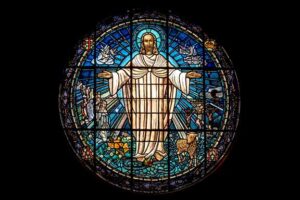 It’s the last Sunday of the Christian year, sort of a New Year’s Eve for the church. We call it “the Feast of Christ the King” and we celebrate it by remembering his enthronement. Each year on Christ the King Sunday we read some part of the crucifixion story. As Pope Francis reminded the faithful in his Palm Sunday homily a few years ago, “It is precisely here that his kingship shines forth in godly fashion: his royal throne is the wood of the Cross!”

 When I was in the 8th Grade, I attended Robert Fulton Junior High School in Van Nuys, California, which is in the San Fernando Valley area of the Los Angeles metroplex. At some point during the year, Mrs. R. Smith, who taught English, gave my class an assignment to memorize and interpret a poem; we had to get up in front of the class, recite the poem, and then give our interpretation. When it came to be my turn, I recited my chosen poem, said what I believed it meant, and explained my interpretation. Mrs. Smith responded, “Your interpretation is wrong,” to which I replied, “I can interpret a poem any damned way I please!”

