Occasional thoughts of an Anglican Episcopal priest

Category: Revelation (Page 4 of 5)

Lord, I Believe; Help Thou My Unbelief – Sermon for “Thomas Sunday” (Easter 2) – April 7, 2013

====================

This sermon was preached on the Second Sunday of Easter, “Thomas Sunday,” April 7, 2013, at St. Paul’s Episcopal Church, Medina, Ohio, where Fr. Funston is rector.

(Revised Common Lectionary, Second Sunday of Easter: Acts 5:27-32; Psalm 150; Revelation 1:4-8; and John 20:19-31. These lessons can be read at The Lectionary Page.)

====================

Doubting Thomas by GuercinoLeslie Dixon Weatherhead (1893-1976) was an English Methodist Minister who served at the City Temple, a Congregational Church in London. He served there from 1936 until his retirement in 1960. In one of his several book, The Christian Agnostic, he wrote, “When people said to me, ‘I should like to be a member of the City Temple, what must I believe?’ I used to say, ‘Only those things which appear to you to be true.’”

Last week at our Easter services, many of us reaffirmed our Baptismal Covenant doing exactly what we are about to ask Graham _____________, or those speaking on his behalf, to do . . . and we will all do it again with them. We will ask one another, “What do you believe?” and in good liturgical fashion we will all answer in the same way; we will answer the questions, “Do you believe in God the Father? Do you believe in Jesus Christ, the Son of God? Do you believe in God the Holy Spirit?” with responses which are nothing more and nothing less than the ancient Apostle’s Creed. Our Anglican tradition calls this creed “the Baptismal Symbol.”

Not a single one of us is likely to balk in the midst of our liturgy and say, “Unless I see the mark of the nails in his hands, and put my finger in the mark of the nails and my hand in his side, I will not believe.” And yet I’ll bet that some of us might be thinking something very much along those lines as we dutifully recite the answers set out for us in The Book of Common Prayer. Many people in our world today, both outside and inside the church, do.

And there is nothing wrong with thinking that. Nothing at all. Because, you see, there are varieties of belief. Writing to the church in Corinth, St. Paul said, “Now there are varieties of gifts, but the same Spirit; and there are varieties of services, but the same Lord; and there are varieties of activities, but it is the same God who activates all of them in everyone.” (1 Cor. 12:4-6) I suggest to you that there are varieties of belief, but the same Christian faith throughout the church.

For example, on a regular Sunday, a Sunday when we are not baptizing new member of God’s household, we would recite the Nicene Creed, which begins:

We believe in one God,
the Father, the Almighty,
maker of heaven and earth,
of all that is, seen and unseen.

Now let’s just take the last phrase of that bit, the part that says God is the “maker of all that is, seen and unseen.” Let’s just take the last word of the last phrase of that bit, “unseen.” What, in your understanding, does that mean?

Are you one of those who believes in a spiritual or supernatural realm? One who believes that, as the introduction to an old television anthology series used to put it, “there is, unseen by most, an underworld, a place that is just as real, but not as brightly lit.” Is that what you think of when you acknowledge your belief in God as maker all that is unseen?

Perhaps you think of the microscopic, atomic, and subatomic realms of Newtonian space or Einsteinian space-time. Maybe you think of the multiverse and the infinite number of alternate realities suggested by the probability equations of quantum mechanics. Possibly you give thought to the 13 tightly curled, hidden dimensions of superstring theory. Or perhaps you don’t think of any of that. Maybe you’ve never given it any thought; you just say the words that are put there in the Prayer Book.

Whatever, it’s all perfectly acceptable because, as the Rev. Mr. Weatherhead said, there is nothing in particular that you must believe about God as maker of all things unseen, “only those things which appear to you to be true.” And if we were to make our way through the rest of the creed, whether the Apostle’s Creed or the Nicene Creed, we would find ourselves facing a bewildering variety of beliefs as we paused at each phrase or word and teased out the various and sundry meanings we all might give it. One of us might say, “This is what that means,” and another would respond, “I don’t believe that at all!” And yet all of us would nonetheless still be comfortable in saying the creed together because, as Peter said to the Temple authorities, “We must obey God rather than any human authority.” (Acts 5:29) And the creeds, important as they are, are human authority, the words of bishops and church counsels and church tradition, not the word of God.

Early in our Anglican history, there were those who wanted to impose a single understanding, a single interpretation of the creeds, of our several prayers, of the Sacraments, and of Scripture. They wanted to enforce a single way of worshiping God and they prevailed upon Queen Elizabeth I to enforce that uniformity for them. She declined. She simply required that the English people worship together, but what each might make of that worship, of the words spoken, of the Sacraments administered, or of the Scriptures read she left to each: “I would not open windows into men’s souls,” she declared. Her preference, worked out in Parliament in a series of acts known as The Elizabethan Settlement, has been called the terminal point of the English Reformation and, in the long run, the foundation of Anglicanism and the “via media” (or “middle way”) we still, 550 years later, claim to be. We still do not open windows into each other’s souls; we still treat ascent to the historic creeds as a matter of individual conscience and interpretation.

Mr. Weatherhead, in his book The Christian Agnostic, also wrote this:

I believe passionately that Christianity is a way of life, not a theological system with which one must be in intellectual agreement. I feel that Christ would admit into discipleship anyone who sincerely desired to follow him, and allow that disciple to make his creed out of his experience; to listen, to consider, to pray, to follow, and ultimately to believe only those convictions about which the experience of fellowship made him sure.

Mr. Weatherhead may have been a Methodist, but these words would sum up the understanding of every Episcopalian or Anglican true to our heritage. Being an Anglican follower of Christ, to which manner of life today we welcome Graham _____________, is not a matter of theological system, even though we ask those questions with prescribed, systematic, creedal answers. Being an Anglican follower of Christ is about community and fellowship, a community and a fellowship in which it would be perfectly acceptable to say, “Unless I see the mark of the nails in his hands, and put my finger in the mark of the nails and my hand in his side, I will not believe.” Because more than mere intellectual assent to particular propositions is at stake. Because there are varieties of belief, but the same Christian faith throughout the church.

That is why the Baptismal Covenant does not end with those three questions and those three systematic, creedal responses. The Baptismal Covenant continues with questions about community and fellowship, questions about respect and dignity, questions about behavior and practice, questions about ministry and mission. Five questions:

Will you continue in the apostles’ teaching and fellowship, in the breaking of bread, and in the prayers?
Will you persevere in resisting evil, and, whenever you fall into sin, repent and return to the Lord?
Will you proclaim by word and example the Good News of God in Christ?
Will you seek and serve Christ in all persons, loving your neighbor as yourself?
Will you strive for justice and peace among all people, and respect the dignity of every human being?

Five questions to which the answer is the same: “I will, with God’s help.”

In the ninth chapter of the Gospel according to Mark there is a story of a man who comes to Jesus seeking healing for his son who is possessed by a demon. The mean tells Jesus that the demon “has often cast him into the fire and into the water, to destroy him; but if you are able to do anything, have pity on us and help us.” Jesus responds to man saying, “If you are able! – All things can be done for the one who believes.” In the wonderful poetic language of the King James version of the Bible we are told that, with tears, the father cries, ” Lord, I believe; help thou mine unbelief.” (Mark 9:17-24)

It is that same cry that we utter when we answer those behavioral questions of the Baptismal Covenant, “I will, with God’s help.” Lord, we believe (we have said that in answer to the first three questions; we believe in whatever manner each of us believes) . . . Lord, we believe; help thou our unbelief. Help us to carry through on the way of life which is implicit in those stated beliefs. We will; we’ll carry through “with God’s help.”

Belief is one of those ambiguous words that can mean so many things. In the creedal sense, it means to give intellectual assent to a stated proposition. “Do you believe in God?” in this sense means do you accept the proposition as true that there is a God. Suppose we change the object of question, however. “Do you believe in your wife/husband/child/parent?” It would be ridiculous, wouldn’t it, to interpret this as asking, “Do you accept as true the proposition that your wife/husband/child/parent exists?” We know that the question, that the word belief as used in the question, means something very different. It means, “Do you trust in your family member? Do you have faith in them? Do you expect them to behave in certain ways, to carry through on promises, to have your best interests at heart?” And if you believe in your family member, will you behave toward them and within the community of your family in equivalent and considerate ways?

And that is precisely what the word belief really means in the creeds and in the Baptismal Covenant. Do you trust in God? Do you have faith in Christ? Do you expect the Holy Spirit to act in certain ways in your life? Are you confident that God will carry through on God’s promises with your best interests at heart? Do you believe in God? And if you believe in God, will you behave toward God and within the community of God’s household the church and of God’s world, “all that is, seen and unseen,” in equivalent and considerate ways?

Thomas, known for all time as “Doubting Thomas,” wanted to believe! The words of that grieving father, “Lord, I believe; help thou mine unbelief,” could as easily have been his. And they are, most certainly, ours. “I will, with God’s help.” Help thou mine unbelief!

Jesus gave Thomas the help he needed; he showed him his hands and his feet; he invited him to put his hand into the wound in his side. “Thomas answered him, ‘My Lord and my God!’ Jesus said to him, ‘Have you believed because you have seen me? Blessed are those who have not seen and yet have come to believe.'” Jesus was talking about us, about you, about me, about all of us “who have not seen and yet have come to believe.” And he was talking about Graham _____________ who, if we do as we promise each time we reaffirm our Baptismal Covenant, if we continue “with God’s help,” if we persevere “with God’s help,” if proclaim “with God’s help,” if we seek and serve others “with God’s help,” if we strive for justice and peace “with God’s help” . . . if we do all that, with God’s help, Graham too will be blessed as one who has not seen and yet has come to believe, because he will, in fact, have seen. He will have seen Christ in us.

“Lord, we believe; help thou our unbelief.”

And now, “to him who loves us and freed us from our sins by his blood, and made us to be a kingdom, priests serving his God and Father, to him be glory and dominion forever and ever. Amen.” (Rev. 1:5b)

The candidate for Holy Baptism will now be presented . . . . .

====================

A request to my readers: I’m trying to build the readership of this blog and I’d very much appreciate your help in doing so. If you find something here that is of value, please share it with others. If you are on Facebook, “like” the posts on your page so others can see them. If you are following me on Twitter, please “retweet” the notices of these meditations. If you have a blog of your own, please include mine in your links (a favor I will gladly reciprocate). Many thanks!

====================

Father Funston is the rector of St. Paul’s Episcopal Church, Medina, Ohio.

More Than Lukewarm – From the Daily Office – January 12, 2012

From the Revelation to John of Patmos:

To the angel of the church in Laodicea write: The words of the Amen, the faithful and true witness, the origin of God’s creation: “I know your works; you are neither cold nor hot. I wish that you were either cold or hot. So, because you are lukewarm, and neither cold nor hot, I am about to spit you out of my mouth. For you say, ‘I am rich, I have prospered, and I need nothing.’ You do not realize that you are wretched, pitiable, poor, blind, and naked.”

(From the Daily Office Lectionary – Revelation 3:14-17 (NRSV) – January 12, 2013.)

Boiling WaterWell! Here we are . . . just a few days ago I mentioned this text in regard to another lectionary reading. I am attending a conference on “emerging Christianity” this week and this text (having come up in that meditation) has been on my mind. There are many among the participants in this conversation who are quite passionate about the “emerging church” movement; they are definitely not “lukewarm”.
How, I wonder, can this passion enliven the “inherited church” (as Phyllis Tickle calls the institutional church)? Can what is happening among the emergents inspire those of us who still value the traditional church? I hope so.

But there is much about the emergent experience about which I am lukewarm! During the “tweet” conversations that accompanied the presentations there was much dismissiveness expressed. There were comments about the “irrelevancy” of holy orders and of the Holy Sacraments. There is a participant who describes himself as “post-theist” and a panel presenter who suggested that the emergent church needed to abandon Christianity! There are inconsistencies such as following a speaker who argued for a new understanding of the atonement (abandoning the substitutionary penal theory) with a congregational song about Jesus “shedding his precious blood for my sins,” or the movement’s infatuation with ancient spiritual practices (chant, incense, candles) coupled with rejection of the ancient creeds. None of these things are true of emergents across the board (anymore than any particular practice of the inherited church is true across the board of all traditions) but encountering them in this conference leaves me . . . lukewarm.

There is much in this conference of value and there is much about the emergent church that gives me hope, but I am firmly convinced that there is just as much if not more of value in the traditions of the faith and in the treasure of the institutional church. Our task is not to abandon the past, but to turn up the heat in the present. We must be more than lukewarm. I hope the experiments of the emerging church can show us one way to do that.

====================

A request to my readers: I’m trying to build the readership of this blog and I’d very much appreciate your help in doing so. If you find something here that is of value, please share it with others. If you are on Facebook, “like” the posts on your page so others can see them. If you are following me on Twitter, please “retweet” the notices of these meditations. If you have a blog of your own, please include mine in your links (a favor I will gladly reciprocate). Many thanks!

====================

Father Funston is the rector of St. Paul’s Episcopal Church, Medina, Ohio.

Ready To Be Sought? – From the Daily Office – January 10, 2013

From the Prophet Isaiah:

I was ready to be sought out by those who did not ask,
to be found by those who did not seek me.
I said, “Here I am, here I am”,
to a nation that did not call on my name.
I held out my hands all day long
to a rebellious people,
who walk in a way that is not good,
following their own devices;
a people who provoke me
to my face continually,
sacrificing in gardens
and offering incense on bricks; . . . .

(From the Daily Office Lectionary – Isaiah 65:1-3 (NRSV) – January 10, 2013.)

Waiting Figure“I was ready to be sought . . . I said, ‘Here I am, here I am’.” Almost more than anything else in Scripture, these words speak to me of God as not just wanting but needing to be in relationship with creation. I have written elsewhere about my understanding of God as the God who communicates; here is the God who seems almost desperate to be in relationship with his people. God speaks and everything comes in to being; in the beginning was the Word. But what good is speaking, what good is a word, if no one hears it, no one answers it? “Here I am, here I am” seems like a plea to be heard, to be recognized, to be answered. But in our modern society, very few people seem to be answering. Many claim to be seeking, many claim to be “spiritual but not religious,” but few are finding God in the traditional faiths and faith communities.

Recently, I had a discussion with a colleague about the non-church-goers who are best described as “apatheists”. This word is a “mash-up” of the words “apathy” and either “theist” or “atheist”. It describes people for whom religious belief is a matter of indifference. It’s not that they disbelieve (a recent article suggested that 80% of apatheists believe there is a God) or that they acknowledge some doubt or lack of understanding of God (as an agnostic would); it’s that the simply don’t care! An acquaintance of mine who accepts the label “apatheist” has put it this way: “I wouldn’t live my life any differently whether there is a God or not. It makes no difference.”

I think this is the modern trend, even among churchgoers. Cultural indifference to religion of any form, a “take or leave it” attitude, is becoming, if not already, the norm in our society. Religion and religious activities are one on a long list of options, and for most people not near the top.

But God is ready to be sought; God stands there in our world saying, “Here I am, here I am.” God does this through the church (and, I believe, other religious institutions of many faith traditions). If God is waiting to be sought, if God is calling “Here I am, here I am,” and people are not seeking and not answering the call, whose fault is that? If God and religion have become a matter of indifference, we who are active leaders of society’s communities of faith must bear the responsibility for that.

Among the Daily Office readings in this season are the letters to the churches in the Book of Revelation, and though it is not today’s reading, I am reminded of the letter to the church in Laodicea: “I know your works; you are neither cold nor hot. I wish that you were either cold or hot. So, because you are lukewarm, and neither cold nor hot, I am about to spit you out of my mouth.” (Rev. 3:15-16) If people are lukewarm about religion, it is because we, the religious, have become lukewarm, worthy of nothing more than being spat out.

Isaiah presents God as not just wanting but needing to be in relationship with creation. God is ready to be sought and calls out clearly “Here I am, here I am.” But does the church?

====================

A request to my readers: I’m trying to build the readership of this blog and I’d very much appreciate your help in doing so. If you find something here that is of value, please share it with others. If you are on Facebook, “like” the posts on your page so others can see them. If you are following me on Twitter, please “retweet” the notices of these meditations. If you have a blog of your own, please include mine in your links (a favor I will gladly reciprocate). Many thanks!

====================

Father Funston is the rector of St. Paul’s Episcopal Church, Medina, Ohio.

The Book of Life – From the Daily Office – December 12, 2012

From John’s Gospel:

Each of them went home while Jesus went to the Mount of Olives. Early in the morning he came again to the temple. All the people came to him and he sat down and began to teach them. The scribes and the Pharisees brought a woman who had been caught in adultery; and making her stand before all of them, they said to him, “Teacher, this woman was caught in the very act of committing adultery. Now in the law Moses commanded us to stone such women. Now what do you say?” They said this to test him, so that they might have some charge to bring against him. Jesus bent down and wrote with his finger on the ground. When they kept on questioning him, he straightened up and said to them, “Let anyone among you who is without sin be the first to throw a stone at her.” And once again he bent down and wrote on the ground. When they heard it, they went away, one by one, beginning with the elders; and Jesus was left alone with the woman standing before him. Jesus straightened up and said to her, “Woman, where are they? Has no one condemned you?” She said, “No one, sir.” And Jesus said, “Neither do I condemn you. Go your way, and from now on do not sin again.”

(From the Daily Office Lectionary – John 7:53-8:11 (NRSV) – December 12, 2012.)
 
Book of Life by ~radeck0There is one ancient manuscript that adds that what Jesus wrote in the sand was “the sins of each of them,” but no others. Most scholars generally hold that we really don’t know what Jesus wrote. I think one of the more fascinating ideas is that Jesus was writing the names of those who were judging the woman.

If that is the case, Jesus’ doing so is another of his “prophetic actions” – deeds done as illustrations of a prophetic point. The probable reference is to Jeremiah 17:13. The NRSV translation of that verse is “O hope of Israel! O Lord! All who forsake you shall be put to shame; those who turn away from you shall be recorded in the underworld, for they have forsaken the fountain of living water, the Lord.” An alternative rendering from the King James version is “O Lord, the hope of Israel, all that forsake thee shall be ashamed , and they that depart from me shall be written in the earth, because they have forsaken the Lord, the fountain of living waters.” The Hebrew word translated in the first as “the underworld” and in the second as “the earth” is ‘erets, which can also be translated as “the ground.” Is Jesus, by writing their names in the ground immediately after calling for “anyone without sin” to cast the first stone, referring to Jeremiah’s warning?

It is only by happenstance that our Jewish friends are celebrating Chanukah this week. Among the many tradition of Chanukah is to greet one another, especially on the last of the eight days of the celebration, with the same greeting used at Yom Kippur: “May your name be written in the book of life.” The contrast between names of the forsaken written in the ground and names of the righteous written in the book of life underscores the Second Coming anticipation of Advent.

The book of life is not only a Jewish image. It is also seen in the Savior’s Second Coming as revealed to John of Patmos who saw “a new heaven and a new earth” and saw “the holy city, the new Jerusalem coming down out of heaven from God, prepared as a bride adorned for her husband.” (Rev. 21:1-2) The gates of that city, John saw, “will never be shut by day – and there will be no night there. People will bring into it the glory and the honor of the nations. But nothing unclean will enter it, nor anyone who practices abomination or falsehood, but only those who are written in the Lamb’s book of life.” (Rev. 21:25-27)

Advent is a time of reflection, a time to prepare, a time to make sure our names are not written on the ground but rather in the book of life, to focus on our own worthiness and not on the sins of others.

====================

A request to my readers: I’m trying to build the readership of this blog and I’d very much appreciate your help in doing so. If you find something here that is of value, please share it with others. If you are on Facebook, “like” the posts on your page so others can see them. If you are following me on Twitter, please “retweet” the notices of these meditations. If you have a blog of your own, please include mine in your links (a favor I will gladly reciprocate). Many thanks!

====================

Father Funston is the rector of St. Paul’s Episcopal Church, Medina, Ohio.

Cooperating with Angels – From the Daily Office – November 13, 2012

From the Book of Revelation:

The angel said to me, “Write this: Blessed are those who are invited to the marriage supper of the Lamb.” And he said to me, “These are true words of God.” Then I fell down at his feet to worship him, but he said to me, “You must not do that! I am a fellow-servant with you and your comrades who hold the testimony of Jesus. Worship God! For the testimony of Jesus is the spirit of prophecy.”

(From the Daily Office Lectionary – Revelation 19:9-10 – November 13, 2012)
 
The Annunciation, fresco by Fra AngelicoPerhaps among the most familiar words from St. John’s apocalypse, “Blessed are they who are invited to the marriage feast of the Lamb.” They are used as a fraction anthem or invitation to communion in many churches. But in this brief passage from Revelation, the most powerful image for me today is the angel saying, “I am a fellow-servant with you and your brothers and sisters.”
All too often, I think, we go through our daily lives with no an awareness of, nor gratitude for the work of the holy angels in our midst and on our behalf. Modern Christians, especially Protestants and Anglicans, seem to be a reluctant to acknowledge the angelic ministry or to call upon the angels (or the saints) for help. But angels are God’s first creatures; created to sing God’s praise and glory, they are God’s ministering spirits, sent as messengers to God’s people (as Scripture witnesses again and again) and to assistance us as heirs of salvation. The effectiveness of the angels’ work in our lives depends upon our cooperation; the more we cooperate, the better.

So, how do we do that? How do we cooperate with the angels? At the very foundation of angelic cooperation is regular prayer and contemplation of God and God’s messengers. Openness of spirit and readiness of will are the proper attitudes of our prayer.

In Carmina Gadelica, a large collection of hymns, prayers, charms, poetry and rituals gathered from the people of the Highlands and islands of Scotland in the late 19th century by Alexander Carmichael, one finds this charming blessing, which we have used as a dismissal at church services:

The love and affection of the angels be to you.
The love and affection of the saints be to you.
The love and affection of heaven be to you,
To guard you and to cherish you.

We cooperate best with the angels when we accept their love and affection in the spirit of the Blessed Virgin: “Here am I, the servant of the Lord; let it be with me according to your word.” (Luke 1:38)

====================

A request to my readers: I’m trying to build the readership of this blog and I’d very much appreciate your help in doing so. If you find something here that is of value, please share it with others. If you are on Facebook, “like” the posts on your page so others can see them. If you are following me on Twitter, please “retweet” the notices of these meditations. If you have a blog of your own, please include mine in your links (a favor I will gladly reciprocate). Many thanks!

====================

Father Funston is the rector of St. Paul’s Episcopal Church, Medina, Ohio.

The Most Important Election . . . NOT! – Sermon for Election Day – November 6, 2012

====================

This sermon was preached on Tuesday, November 6, 2012, at St. Paul’s Episcopal Church, Medina, Ohio, where Fr. Funston is rector.

(Lessons selected for the Mass were Isaiah 26:1-8, Romans 13:1-10, and Mark 12:13-17, from the Episcopal Book of Common Prayer’s lectionary for various occasions, “For the Nation”; the gradual, Psalm 146, was selected by the preacher.)

====================

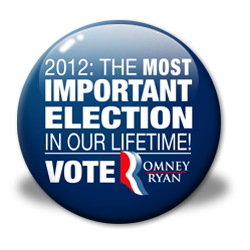
Romney Campaign Button "Most Important Election"“This election is the most important, ever. If that candidate is elected, it will be the end of the world!” The first time I heard that was during the campaign of the first presidential election I paid attention to: the race between John F. Kennedy and Richard Nixon in 1960. I heard it as my family watched the televised debate; it was said by my older brother who was then a freshman studying history and political science at the University of Texas, so of course he knew everything. “That candidate,” by the way, was Richard Nixon. We heard it again in 1964; remember the television commercial with the little girl plucking petals from a daisy and the atomic explosion? “If Barry Goldwater is elected,” it suggested none too subtly, “it will be the end of the world.” We hear it every election, “This election is the most important election of our lifetimes.” And, to be honest, that is a correct statement. Those in the past are no longer important; they’re done and other with. Only this election can impact the future so, at this time, up to now, it is the most important. But truth be told . . . none of them, including this election, are really all that important in the grand scheme of things.
In the Daily Office Lectionary of the Episcopal Church, the cycle of bible readings to be read each morning, today’s New Testament reading was from the Book of Revelation which records the vision St. John of Patmos had of “the new Jerusalem,” of heaven. In the lesson, this is what John reports:

I saw what appeared to be a sea of glass mixed with fire, and those who had conquered the beast and its image and the number of its name standing beside the sea of glass with harps of God in their hands. And they sing the song of Moses, the servant of God, and the song of the Lamb:
“Great and amazing are your deeds,
Lord God the Almighty!
Just and true are your ways,
King of the nations!
Lord, who will not fear
and glorify your name?
For you alone are holy.
All nations will come
and worship before you,
for your judgments have been revealed.” (Revelation 15:2-4)

This song of praise was a wonderful reminder with which to begin Election Day: God is the king of the nations; he alone is holy. As we went to the polls today, we were casting our ballots for political leaders, not religious ones, and certainly not a savior. Today we chose between candidates for various offices, all of whom are simply human beings like ourselves, fallible human beings whom we hope will strive to overcome whatever their faults and frailties may be, and govern to the best of their abilities. Whether the candidates for whom you or I happened to vote are elected is not, at this point, of any real importance; what is of importance is that we respect and honor our system of governance, and support and pray for whichever candidates are ultimately placed in office.

The Psalm which we recited just a few minutes ago reminds us:

Put not your trust in rulers, nor in any child of earth, for there is no help in them.
When they breathe their last, they return to earth, and in that day their thoughts perish.
(Ps. 146:2-3, BCP version)

We are admonished not to rely, although we surely do, on our earthly leaders. We repose more trust, and certainly more expectation, than we ought in our elected leaders, forgetting that they are no different from, nor more perfect than we.

This evening we do not celebrate nor do we extol any political party, any platform, any candidate, any elected office holder. Instead, we give thanks for the freedoms we enjoy, for the country we love, and for the electoral process which allows us to maintain both through peaceful changes in government. We give thanks for the wisdom of our Founding Fathers, for the insight of the framers of the Constitution, for the bravery and sacrifice of those who have defended our rights and liberties, and for the commitment of our fellow citizens who have participated in our democracy and voted in this election. We give thanks for all these things to the one upon whom all this rests, to the one who is the foundation of our existence, to the one who is our ultimate concern, to the one in whose service we find perfect freedom.

When we gather to give thanks for and to pray for our national life, the lectionary of our church asks us to hear and consider the story of the Pharisees and Herodians asking Jesus about taxes: Is it lawful to pay them to Caesar? To which Jesus’ makes his famous reply, “Render to Caesar the things that are Caesar’s and to God the things that are God’s.” This gospel story, says theologian Daniel Deffenbaugh

. . . calls us to be neither enemies of the state nor its staunch allies. Rather, we should think of ourselves, in the words of Stanley Hauerwas, as “resident aliens. ” We do not refuse to give to the emperor the things that are the emperor’s, even when – much to our dismay – their utilization defies our most deeply held convictions. This is as true of the right as it is of the left, and in this we can take some solace. But the affections of our hearts and minds must always, and with greater fervor, be focused on the more urgent clause in Jesus’ directive: “give to God the things that are God’s.” (Allies or Enemies?

This, he says, leaves us in a “posture of perpetual discernment,” constantly trying to distinguish our steadfast devotion to God from our obligations to the nation.
The Cathechism of the Roman Catholic Church interprets this gospel tale as teaching that we should “give to God everything, but give Caesar his due.” Thus, we are called to take part in our national culture for the common good. “It is necessary that all participate, each according to his position and role, in promoting the common good. This obligation is inherent in the dignity of the human person.” (CCC 1913) To the best of our ability, we should all participate in the public arena for the good of the society. Jesus’ answer to the Pharisees and Herodians gives each person freedom to act in that public sphere, but with that freedom come awesome responsibilities, none more awesome than the privilege and obligation to participate in democratic elections, even if we do so in a “posture of perpetual discernment.”

We do our best in that state of constant decision-making. We study the issues and the candidates. We make our choices. We participate in the public arena. We vote. And then we trust . . . not in rulers, not in political parties, not in the candidates, not in any child of earth . . . We render our trust not to Caesar nor anything that is Caesar’s, but to God. It is not that our vote is unimportant, but it is not of ultimate concern.

In the Anglican Communion on November 6, we commemorate one of our greatest theologians, Archbishop William Temple, who served as Archbishop of Canterbury near the Second World War. He served in that post only two years, from his appointment in 1942 to his death in October, 1944. He served in the episcopate for 23 of his 63 years, first as Bishop of Manchester, then as Archbishop of York, and finally in the See of Canterbury. Throughout his life, he was a prolific author of philosophy and theology.

While serving in York, he addressed the 1938 Lambeth Conference, the decennial gathering of Anglican bishops, with these words which, I think, are a good reminder for us today:

While we deliberate, God reigns.
When we decide wisely, God reigns.
When we decide foolishly, God reigns.
When we serve God in humble loyalty, God reigns.
When we serve God self-assertively, God reigns.
When we rebel and seek to withhold our service, God reigns –
The Alpha and the Omega, which is and which was,
And which is to come, the Almighty.

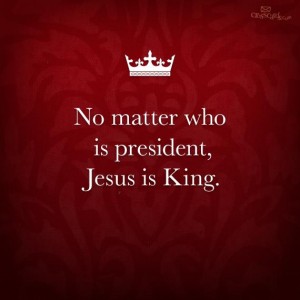
John of Patmos in his apocalypse, the Psalmist in Psalm 146, Archbishop Temple in his address to the gathered bishops . . . they all remind us that no matter how we decide, no matter who is elected today, God reigns. As the graphic on the cover of our bulletin says, “No matter who is president, Jesus is king.”

Let us pray.

O God of light and love, inspire us, we pray, that we may rejoice with courage, confidence, and faith in the Word made flesh, Jesus our King, and that through our participation in our national culture and our democratic processes we may establish that society which has justice for its foundation and love for its law; through the same Jesus Christ, our Lord, who lives and reigns with you and the Holy Spirit, one God, now and for ever. Amen.

====================

A request to my readers: I’m trying to build the readership of this blog and I’d very much appreciate your help in doing so. If you find something here that is of value, please share it with others. If you are on Facebook, “like” the posts on your page so others can see them. If you are following me on Twitter, please “retweet” the notices of these meditations. If you have a blog of your own, please include mine in your links (a favor I will gladly reciprocate). Many thanks!

====================

Father Funston is the rector of St. Paul’s Episcopal Church, Medina, Ohio.

The Sun Will Rise on Wednesday – From the Daily Office – November 6, 2012

From the Book of Revelation:

I saw what appeared to be a sea of glass mixed with fire, and those who had conquered the beast and its image and the number of its name standing beside the sea of glass with harps of God in their hands. And they sing the song of Moses, the servant of God, and the song of the Lamb:
“Great and amazing are your deeds,
Lord God the Almighty!
Just and true are your ways,
King of the nations!
Lord, who will not fear
and glorify your name?
For you alone are holy.
All nations will come
and worship before you,
for your judgements have been revealed.”

(From the Daily Office Lectionary – Revelation 15:2-4 – November 6, 2012)
 
No Matter Who Is President, Jesus is KingThis song of praise from the Revelation to St. John of Patmos is a wonderful reminder on Election Day: God is the king of the nations; he alone is holy. Remember that when you go to the polls today. We are electing political leaders, not religious ones, and certainly not a savior.

In the Psalms there is another such reminder:

Put not your trust in rulers, nor in any child of earth, for there is no help in them.
When they breathe their last, they return to earth, and in that day their thoughts perish.
(Ps. 146:2-3, BCP version)

Today just happens to be the commemoration of one of Anglicanism’s greatest theologians, Archbishop William Temple, who served as archbishop of Canterbury near the end of the Second World War. He served in that post only two years, from his appointment in 1942 to his death in October, 1944. He was a prolific author of philosophy and theology, and served in the episcopate for over twenty years (Bishop of Manchester, 1921-29, and Archbishop of York, 1929-42).

Addressing the 1938 Lambeth Conference (a decennial gathering of Anglican bishops), he said:

While we deliberate, God reigns.
When we decide wisely, God reigns.
When we decide foolishly, God reigns.
When we serve God in humble loyalty, God reigns.
When we serve God self-assertively, God reigns.
When we rebel and seek to withhold our service God reigns –
The Alpha and the Omega, which is and which was,
And which is to come, the Almighty.

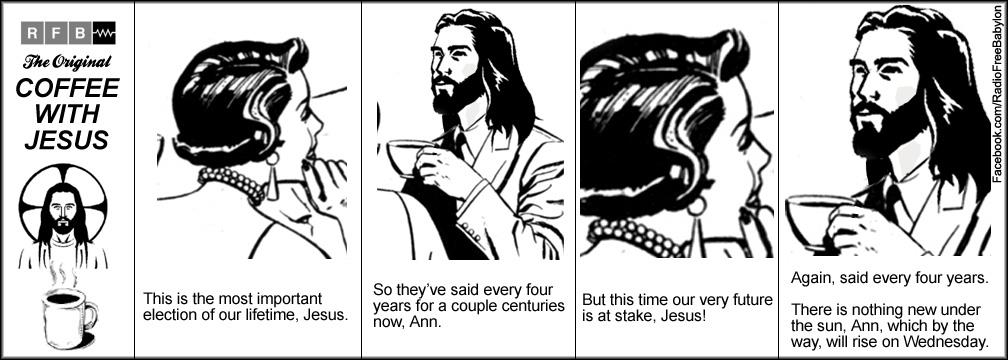
John of Patmos, the Psalmist, Archbishop Temple . . . they all remind us, as does the graphic annexed to this little bit of prose, that no matter who is elected, Jesus is king; no matter how we decide, God reigns.

Or as Jesus would say, the sun will rise on Wednesday.

The Most Important Election

====================

Coffee with Jesus is from Radio Free Babylon’s Facebook page.

A request to my readers: I’m trying to build the readership of this blog and I’d very much appreciate your help in doing so. If you find something here that is of value, please share it with others. If you are on Facebook, “like” the posts on your page so others can see them. If you are following me on Twitter, please “retweet” the notices of these meditations. If you have a blog of your own, please include mine in your links (a favor I will gladly reciprocate). Many thanks!

====================

Father Funston is the rector of St. Paul’s Episcopal Church, Medina, Ohio.

Unbind Him, and Let Him Go! – Sermon for All Saints Sunday – November 4, 2012

====================

This sermon was preached on Sunday, November 4, 2012, at St. Paul’s Episcopal Church, Medina, Ohio, where Fr. Funston is rector.

(Revised Common Lectionary, All Saints, Year B: Isaiah 25:6-9; Psalm 24; Revelation 21:1-6a; and John 11:32-44. These lessons can be read at The Lectionary Page.)

====================

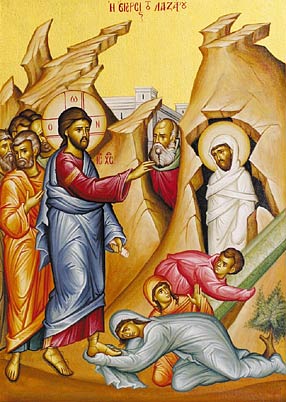
Orthodox Icon of the Raising of LazarusToday, following church tradition, we step away from the calendar of Ordinary Time and, instead, commemorate the Feast of All Saints. That festival is specifically held on November 1, but tradition allows us to celebrate the saints also on the Sunday after that date, so here we are.
Anglicans and Episcopalians for generations have been used to hearing the Beatitudes from Matthew’s gospel (Matt. 5:1-12) or the similar Blessings-and-Woes from Luke’s version (Luke 6:20-26), but since the adoption of the Revised Common Lectionary we also, every three years, hear the story of the raising of Lazarus from the gospel according to John. The listings of who is blessed in the other two gospels make sense as lessons for this day; the story of Lazarus, not so much. It may make us wonder why those who created our new lectionary made that choice.

Unfortunately, there are no easy answers to that question, if there are any answers at all. The development of the lectionary is a creature of time and custom as much as it is of purposeful selection. Lectionaries develop over the centuries. Typically, a lectionary will go through the scriptures in a logical pattern, and also include selections chosen by the community for their appropriateness to particular occasions. The ecumenical scholars who set up our current lectionary looked back over these centuries of development and selected lessons which had the broadest consensus for use on particular days, like today’s celebration of the feasts.

But why that consensus may exist is lost in time. There are no legislative notes indicating why communities thought a particular lesson, like the story of Christ raising Lazarus, fit a particular feast, such as All Saints Day. We who have inherited the tradition must read the lessons and figure out their message for ourselves. On a feast day, the Prayer Book gives us some filters, if you will, to aid in our reflections and our understanding; these are the collect (or prayer) of the day and the “proper preface” said (or chanted) before the Great Thanksgiving. Let’s take a look at the collect again:

Almighty God, you have knit together your elect in one communion and fellowship in the mystical body of your Son Christ our Lord: Give us grace so to follow your blessed saints in all virtuous and godly living, that we may come to those ineffable joys that you have prepared for those who truly love you; through Jesus Christ our Lord, who with you and the Holy Spirit lives and reigns, one God, in glory everlasting. Amen. (BCP Page 245)

The focus of the prayer is the “communion and fellowship” of the saints, the community of the church, which is “knit together . . . in the mystical body” of Christ, which shares in “virtuous and godly living” and together enjoys the “ineffable joys” of eternal life. Likewise the preface focuses on the community:

For in the multitude of your saints you have surrounded us with a great cloud of witnesses, that we might rejoice in their fellowship, and run with endurance the race that is set before us; and, together with them, receive the crown of glory that never fades away. (BCP Page 380)

The emphasis is on the “great cloud of witnesses” (a phrase borrowed from the Letter to the Hebrews 12:1) who rejoice in fellowship and together are crowned with unfading glory.

So in our contemplation of any of the lessons for today, we should look for the ways in which the lesson exemplifies or speaks to the community of faith, and in the raising of Lazarus that comes at the end of the story: “The dead man came out, his hands and feet bound with strips of cloth, and his face wrapped in a cloth. Jesus said to them, ‘Unbind him, and let him go’.” (John 11:44)

“Unbind him, and let him go!” These may be the most powerful words in the story, because with them Jesus not only frees Lazarus, he empowers the community of faith. The community assists in the resurrection; it is the task of the People of God to complete the action of Resurrection. Jesus has called Lazarus out of the tomb, but he is still wearing the clothing of death, his funeral wrappings; the community removes those burial shrouds and dresses him for life.

I love that old Southern Harmony hymn we sang in procession today, especially the chorus which says

As I went down in the river to pray,
Studying about that good ol’ way
And who shall wear the robe and crown?
Good Lord, show me the way.
(“Down in the River to Pray”)

“Who shall wear the robe and crown?” is a reference to the vision of St. John of Patmos recorded in the Book of Revelation, a vision of heaven where “there was a great multitude that no one could count, from every nation, from all tribes and peoples and languages, standing before the throne and before the Lamb, robed in white, with palm branches in their hands.” (Rev. 7:9)

Last Thursday, which was actually All Saints Day, one of the lessons for the Daily Office of Morning Prayer was from the apocryphal book of Second Esdras. In it Ezra reports seeing a similar vision of heaven.

I, Ezra, saw on Mount Zion a great multitude that I could not number, and they all were praising the Lord with songs. In their midst was a young man of great stature, taller than any of the others, and on the head of each of them he placed a crown, but he was more exalted than they. And I was held spellbound. Then I asked an angel, “Who are these, my lord?” He answered and said to me, “These are they who have put off mortal clothing and have put on the immortal, and have confessed the name of God. Now they are being crowned, and receive palms.” Then I said to the angel, “Who is that young man who is placing crowns on them and putting palms in their hands?” He answered and said to me, “He is the Son of God, whom they confessed in the world.” So I began to praise those who had stood valiantly for the name of the Lord. (2 Esdras 2:42-47)

This vision differs from that in Revelation in that the presence of the Son of God is among the crowd, crowning them and putting the palms in their hands. I have to say, I rather prefer this vision to John’s because of that difference. There is something compelling about the Son of God being there with the saints, not high and exalted on a throne, as the Lamb is in the oracle of Revelation, but down with the people. This seems much more like the Jesus described in the Gospels, much more like the God he revealed.

This vision of Christ with the masses, yielding his glory and mixing in with his people, seems somehow quite in keeping with our celebration of all the saints. Today we don’t commemorate only those whose names are known, those who are portrayed in art with golden halos, those in whose particular memory churches and schools are dedicated; today we commemorate those whose names are not known. Ezra’s vision in Second Esdras of Christ mingling with these unknown but godly people appeals to me.

An early 20th Century Roman Catholic Lithuanian archbishop, George Matulaitis, once wrote:

May our model be Jesus Christ: not only working quietly in His home at Nazareth, not only Christ denying Himself, fasting forty days in the desert, not only Christ spending the night in prayer; but also Christ working, weeping, suffering; Christ among the crowds; Christ visiting the cities and villages. (Renovator of the Marians)

This is the Christ of Ezra’s vision; this is the Christ of the saints whom we remember today, Christ among the crowds. Indeed, John of Patmos in our reading from Revelation today describes God among the people: “[God] will dwell with [mortals] as their God; they will be his people, and God himself will be with them; he will wipe every tear from their eyes.” (Rev. 21:3-4)

When Jesus, this Christ among the crowds, this God dwelling with mortals, tells those around him, “Unbind him, and let him go” he is speaking not only to them, but also to us. When we hear those words we should remember another time when he empowered his church to unbind others. In Matthew’s gospel, in conversation with Peter, Jesus said: “I will give you the keys of the kingdom of heaven, and whatever you bind on earth will be bound in heaven, and whatever you loose on earth will be loosed in heaven.” (Matt. 16:19)

And again later to the apostles he said: “Truly I tell you, whatever you bind on earth will be bound in heaven, and whatever you loose on earth will be loosed in heaven.” (Matt. 18:18)

Here the Greek verb luo is translated as “loosen”, but it is the same word in our reading today translated as “unbind”. We have the power and the obligation to unbind and set others free. “Unbind him, and let him go” is Christ’s empowering command to all the saints everyday. It is Christ’s command to us to unbind others and give them their freedom; this is Christ among the crowds, God dwelling with God’s people, showing us the way that we and others can wear the robe and crown.

We unbind others and set them free when we work to alleviate the desperate plight of those who lack material means of survival, whether they are in our own communities, on the Gulf Coast or the eastern seaboard, or in distant countries. We unbind others and set them free when we act to console a brother or sister crushed by loss or fear or despair. We unbind others and set them free when we strive to empower rather than intimidate. We unbind others and set them free when we commit ourselves to justice for all, not merely for ourselves. We unbind others and set them free when we extend to others the mercy we have received from God. Whenever and wherever we find someone bound by sin or system or circumstance, we are to unbind them and set them free, not keep them tangled up in the old affairs, the old clothing, the old funeral wrappings of sin and death; those burial shrouds constrict them and damage everyone. Whenever and wherever we find someone struggling to be free, we are to unbind them and let them go so that we may all wear the robe and crown.

Today we commemorate all the saints, that great cloud of witnesses, that great multitude that no one can count wearing their robes and crowns, the community of the church throughout time and space charged with, committed to, and constantly striving to unbind others and set them free. Amen.

====================

A request to my readers: I’m trying to build the readership of this blog and I’d very much appreciate your help in doing so. If you find something here that is of value, please share it with others. If you are on Facebook, “like” the posts on your page so others can see them. If you are following me on Twitter, please “retweet” the notices of these meditations. If you have a blog of your own, please include mine in your links (a favor I will gladly reciprocate). Many thanks!

====================

Father Funston is the rector of St. Paul’s Episcopal Church, Medina, Ohio.

Horse-Sized Locust Scorpions . . . and Crowns – From the Daily Office – October 25, 2012

From the Book of Revelation:

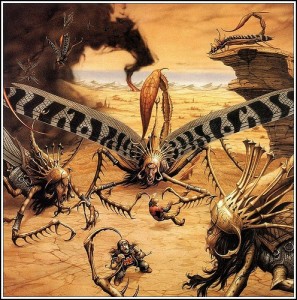
In appearance the locusts were like horses equipped for battle. On their heads were what looked like crowns of gold; their faces were like human faces, their hair like women’s hair, and their teeth like lions’ teeth; they had scales like iron breastplates, and the noise of their wings was like the noise of many chariots with horses rushing into battle. They have tails like scorpions, with stings, and in their tails is their power to harm people for five months. They have as king over them the angel of the bottomless pit; his name in Hebrew is Abaddon, and in Greek he is called Apollyon.

(From the Daily Office Lectionary – Revelation 9:7-11 – October 25, 2012)

Horse-Sized Locust Scorpions, Copyright All rights reserved by _danN_ There’s lovely imagery in St. John of Patmos’s ecstatic dream. I’m particularly fond of his vision of the heavenly throne room:

Around the throne are twenty-four thrones, and seated on the thrones are twenty-four elders, dressed in white robes, with golden crowns on their heads . . . . And whenever the living creatures give glory and honor and thanks to the one who is seated on the throne, who lives forever and ever, the twenty-four elders fall before the one who is seated on the throne and worship the one who lives forever and ever; they cast their crowns before the throne, singing, “You are worthy, our Lord and God, to receive glory and honor and power, for you created all things, and by your will they existed and were created.” (Rev. 4:4,9-11)

From that vision came the last lines of Charles Wesley’s great hymn Love Divine, All Loves Excelling:

Till we cast our Crowns before Thee,
Lost in Wonder, Love, and Praise!

In today’s reading from the Apocalypse, however, the crowns belong to some rather fanciful and frightening beasts that John called “locusts” and then proceeded to describe as anything but locusts! These are monstrous flying insects the size of horses armored for battle possessing scorpions’ tails complete with stingers. We are told that these stingers cause torment but do not kill; those stung “will seek death but will not find it; they will long to die, but death will flee from them.” (v. 6)

I have to admit that I’m never sure quite what to make of or what to do with the Book of Revelation. I know it’s not a prophetic vision of the end times; it’s an apocalyptic vision meant to comfort the people of John’s own time and place (late first or early second century Roman Empire). I know that as the canon of scripture developed there was disagreement about its inclusion. But knowing those things doesn’t really help me know what to do with it now, other than to read it (as the lectionary has had us do for several days) and wonder, “What was John smoking?” This book always seems to me to be a sort of scriptural Scare Tactics or Total Blackout (Syfy channel game shows), or possibly evidence that God has a Tim-Burton-like sense of humor.

But, still, there are those lovely images of the heavenly throne room and the thought that we, unlike the horse-sized locusts, will some day cast our crowns before the throne of glory.

====================

A request to my readers: I’m trying to build the readership of this blog and I’d very much appreciate your help in doing so. If you find something here that is of value, please share it with others. If you are on Facebook, “like” the posts on your page so others can see them. If you are following me on Twitter, please “retweet” the notices of these meditations. If you have a blog of your own, please include mine in your links (a favor I will gladly reciprocate). Many thanks!

====================

Father Funston is the rector of St. Paul’s Episcopal Church, Medina, Ohio.

God My Crag, God My Commonwealth – From the Daily Office – September 20, 2012

From Psalms:

In you, O Lord, have I taken refuge;
let me never be ashamed.
In your righteousness, deliver me and set me free;
incline your ear to me and save me.
Be my strong rock, a castle to keep me safe;
you are my crag and my stronghold.

(From the Daily Office Lectionary – Psalm 71:1-3 (BCP Version) – September 20, 2012)
 
Castle Kennedy, ScotlandThis is one of my favorite images from Scripture, God as strong rock, castle, crag, and stronghold. In fact, during my sabbatical last year this verse kept coming to mind as I explored the ruins of castles and monastic foundations in Scotland, England, and Ireland. My fondness for this metaphor today dovetails with my thoughts the past couple of days about the nature of sovereignty (see yesterday’s meditation on praying Psalm 72 in modern America) and God’s reign (the day before, considering the modern political implications of Christ’s triumphal entry in John 9).

Like any metaphor and every metaphor, God as rocky fortress is limited. All metaphors, similes, and analogies breakdown at some point. Nonetheless, this is where the metaphor in today’s Psalm takes me . . . .

Life in a stone castle was anything but relaxed and luxurious. Even the “lairds and ladies of the manor” would have had their work to do, although it wouldn’t have been as onerous as that of, say, the scullery maids, the chamberlains, or the stable boys. Monastic foundations weren’t much different: a division of labor shared by everyone from the newest novice or lay brother to the abbot or prior. The same would have held true in a Celtic or early medieval convent. Everyone would have had some share in keeping the community within the stone walls running smoothly to everyone’s good. In a very real sense, the castle, monastery, or convent would have been a “commonwealth”.

Although mostly used today in the context of international trade (as in “the commonwealth of nations”) or as a synonym for nation, state, or territory (as in “the Commonwealth of Massachusetts” or “the Commonwealth of Puerto Rico”), the word dates from the 15th Century with a different significance. Meaning “common well-being,” it connoted a community of interest promoting the public welfare or general good of every member.

In the 17th Century the philosopher Thomas Hobbes wrote his book Leviathan on the origin, nature, and forms of a commonwealth, explaining that the function of a commonwealth is to protect human liberty and provide security for the people living in it. Hobbes argued that the citizens or subjects of a commonwealth have the right to food, clothing, and shelter, the right to protection from harm or injury, the right to engage in lawful commerce, the right to an education, the right to health and safety, and the right to legal protection of one’s possessions; these rights are matched by the commonwealth’s mutual responsibility to protect them. Interestingly, Hobbes’s treatise suggests the notion that the kingdom or reign of God is an eternally perfect and spiritual commonwealth.

Which brings me back to the metaphor in the Psalm. God conceived of by the Psalmist as a castle, crag, or rocky fortress is not simply an image of God’s protection of individual safety; it is a metaphor of the community which in God lives and moves and has its being (Acts 17:28). The Psalmist’s strong rock, castle, crag, and stronghold is Jesus’ kingdom of God (or kingdom of heaven). It is the commonwealth of God, “the kingdom of our Lord and of his Messiah, and he will reign forever and ever.” (Rev. 11:15) It is the community of eternal life in which we, believing participants, have mutual accountability for our rights and responsibilities.

When we pray this Psalm and claim God as our stronghold, we also claim our rights and take up our responsibilities as “citizens with the saints and also members of the household of God.” (Eph. 2:19)

====================

Father Funston is the rector of St. Paul’s Episcopal Church, Medina, Ohio.

« Older posts Newer posts »