Occasional thoughts of an Anglican Episcopal priest

Category: Christianity (Page 56 of 84)

Death Rattle of Death – From the Daily Office – April 22, 2014

From the First Letter to the Corinthians:

The last enemy to be destroyed is death.

(From the Daily Office Lectionary – 1 Corinthians 15:26 (NRSV) – April 22, 2014.)

Lungs and FacesTwo weeks before Easter I came down with the flu. I spent three days in bed with a high fever, a racking cough, and a good deal of body aches and pains. A friend who suffered the same illness (it’s gone around our town and several people have suffered through it) described the muscle pain as feeling as if one had been beaten up, thrown the ground, and kicked several times. It felt to me as if every square centimeter of connective tissue in my body was inflamed at the same time. (This is the first time in a couple of weeks or more that I’ve had enough morning energy to write anything after reading the daily lessons.)

It all made getting ready for Palm Sunday, Holy Week, and Easter rather difficult, and even when Resurrection Sunday got here, I didn’t really feel much like celebrating. I always end a respiratory illness like that with two lingering symptoms: a nagging cough and laryngitis – both were in full force on Easter Eve. Gargling with warm salt water and several doses of codeine-laced cough suppressant got me through the Festival Eucharist on Easter morning.

So here we are at Tuesday in Easter week and the lingering cough is still tagging along. I’m feeling like it, not death, is the “last enemy to be destroyed.” Death is already conquered; the cough is not! In my Easter homily, I preached about that sense many (if not all) people have had from time to time of “dying a little” because of life’s many small disappointments, of how that sense is a result of disordered (sinful) creation disrupting the proper relationships of life, and of how all that sinfulness crashed down through time and eternity, through space and the cosmos, hitting one moment, one place:

Think about the weight of all that sin, all that dying, experienced in little ways every day by all the people who have ever lived . . . think of that weight crashing down
through the centuries,
through the millennia,
through all of time and all of space,
crashing down to a single hour,
a single moment,
a single instant,
on a hill outside of Jerusalem,
on a single man,
a man hanging on a cross
who cried out
“It is finished!”

Death, the last enemy, has been conquered. But there seems to be this lingering, nagging cough still sounding through the universe, still tickling at the throat of creation, still hacking away. It’s the death rattle of death. Pay it no mind. Eventually it and even its echoes will fade away.

====================

A request to my readers: I’m trying to build the readership of this blog and I’d very much appreciate your help in doing so. If you find something here that is of value, please share it with others. If you are on Facebook, “like” the posts on your page so others can see them. If you are following me on Twitter, please “retweet” the notices of these meditations. If you have a blog of your own, please include mine in your links (a favor I will gladly reciprocate). Many thanks!

====================

Father Funston is the rector of St. Paul’s Episcopal Church, Medina, Ohio.

“You Have Died (a Little)” – A Sermon for Easter Morning – April 20, 2014

====================

This sermon was preached on Easter Sunday, April 20, 2014, at St. Paul’s Episcopal Church, Medina, Ohio, where Fr. Funston is rector.

(The lessons for the day were: Jeremiah 31:1-6; Psalm 118:1-2,14-24; Colossians 3:1-4; and John 20:1-18. These lessons can be read at The Lectionary Page.)

====================

Shrouded CorpseSeveral days ago, as I was reading again the Easter story and the sections of the Holy Scriptures appointed for this year, I had the radio on and tuned to my favorite oldies station.

I was prayerfully considering and trying to figure out what Paul was saying to the Colossians when he wrote these words that we heard in the Epistle lesson for today: “You have died, and your life is hidden with Christ in God.” (Col. 3:3) I was trying to figure out what Paul meant by “hidden with Christ.” The Greek word is krypto and in addition to “hidden” it can also mean “secret” or “not noticed.” It is the origin of words like cryptogram and cryptography and also of crypt, a synonym for tomb. What does Paul mean? Is he saying our life is buried with Christ? Or that, somehow, the Christian life is a “secret” or that it goes “unnoticed”?

So I was pondering all of that and my oldies station played a very old and familiar song:

It hurts to be in love when the only one you love
Turns out to be someone who’s not in love with you
It hurts to love her so when deep down inside you know
She will never want you, no matter what you do

And so you cry a little bit
Oh, you die a little bit
Day and night, night and day
It hurts to be in love this way

Some of you are old enough to recognize the lyrics of It Hurts To Be In Love by Gene Pitney, a Top Ten hit from 1964.

And then, right after that song, the radio station played the one which has this as the refrain:

Strumming my pain with his fingers
Singing my life with his words
Killing me softly with his song
Telling my whole life with his words
Killing me softly with his song

That was a Number One hit for Roberta Flack in 1973.

Those songs played just as I was prayerfully considering and trying to figure out what Paul was saying to the Colossians when he wrote: “You have died, and your life is hidden with Christ in God.” (Col. 3:3) Now I don’t really think that God speaks to me through the radio or in the lyrics of popular songs, although it’s possible that God does. However, that coincidence of lyrics and Biblical text did take me down a path of revelation that I’d like to share with you this morning.

Those songs and songs like them – you can probably name several popular melodies going back to Cole Porter’s 1944 tune Every Time We Say Goodbye (“Every time we say goodbye, I die little”) or before – songs that mention this sense we have all had of “dying a little” because of a broken heart, because of the loss of a loved one, because of a disappointment in life. I think that’s why these songs become popular. We’ve all had that sense of “dying a little inside” for these and for many other reasons. And so Paul writes to the Colossians and to us:

“You have died, and your life is hidden with Christ in God.”

In his historical play Julius Caesar, William Shakespeare has his title character observe that “a coward dies a thousand times before his death, but the valiant taste of death but once.” (Act 2, Sc. 2) Ernest Hemingway took Shakespeare to task about that. In A Farewell to Arms he wrote:

‘The coward dies a thousand deaths, the brave but one’…. (The man who first said that) was probably a coward…. He knew a great deal about cowards but nothing about the brave. The brave dies perhaps two thousand deaths if he’s intelligent. He simply doesn’t mention them.

I think the truth is that everybody, valiant or cowardly, everybody dies many little deaths throughout our existence on this earth. Each and every one of us is “killed softly” in myriad ways by the circumstances of life. We have, as Paul wrote to the Colossians, died . . . many times over.

Sometimes those little deaths are the result of our own actions; sometimes they are the result of other’s actions; sometimes they happen because that’s just the way the world is. The world, though created by God to be good, is out of kilter; it is, we say theologically, fallen. The world and everything in it, including you and me, are not in the proper relationship with our Creator. We are not in proper relationship with one another. We call that “sin.” And sin, as the writer of the Letter to the Hebrews reminds us, has weight, a weight that clings to us like dirt, and each time we experience one of those little deaths a little more weight, a little more dirt is tossed on until, as Paul wrote in this simple verse in the letter to the Colossians, we are buried.

“You have died, and your life is hidden with Christ in God.”

Think about the weight of all that sin, all that dying, experienced in little ways every day by all the people who have ever lived . . . think of that weight crashing down
through the centuries,
through the millennia,
through all of time and all of space,
crashing down to a single hour,
a single moment,
a single instant,
on a hill outside of Jerusalem,
on a single man,
a man hanging on a cross
who cried out
“It is finished!”

“You have died, and your life is hidden with Christ in God.”

They took him down from the cross and laid him in a tomb and on the day after the Sabbath the women came and found the tomb empty. We know that story so well. It is the foundational story of our faith. We know it so well and yet we have to be reminded of it again and again because those little deaths seem to keep happening and hiding it from us. “Our life is hidden;” it gets buried under that weight; it goes unnoticed.

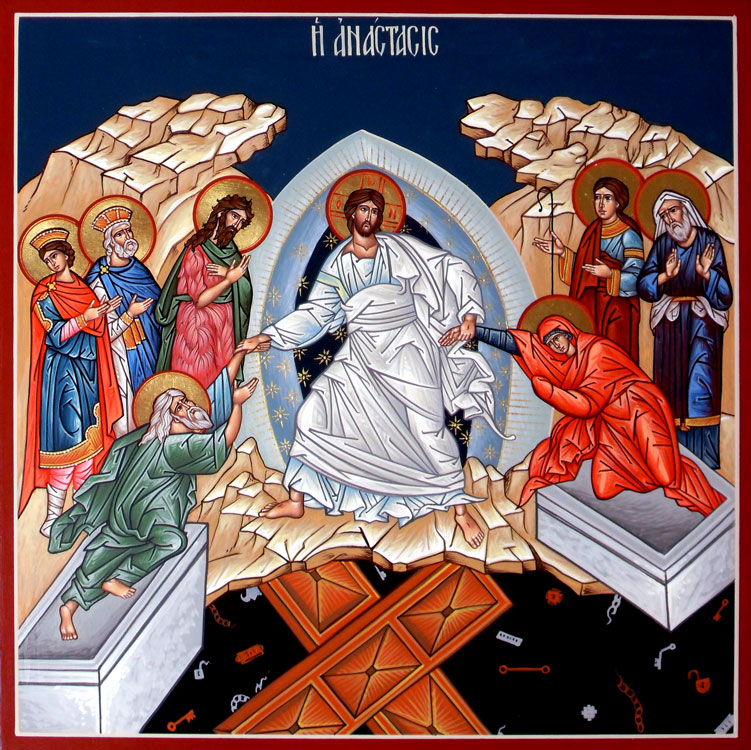
Anastasis IconIn the Eastern Orthodox tradition, icons of the Resurrection depict Christ rising from the tomb with a whole crowd of people. To one side of him crowned and haloed are King David and King Solomon; on the other, we see Abel the first martyr of creation carrying a shepherd’s crook and Moses the first prophet of the Old Covenant. Also present is John the Baptist, who is both the first prophet and the first martyr of the New Covenant. Beneath Christ’s feet, the gates of hell lie broken, often forming a cross. And from two tombs, Adam and Eve are rising, but not of their own accord; Jesus holds them by the wrists and is pulling them from their graves.

The mythological proto-parents of our race, the ancient kings, the prophets and martyrs . . . this little crowd represents all of humankind . . . you and me and all the people who have ever lived, all the people who have ever died any kind of death, whether physical death or the little daily kinds of dying we all have experienced . . .
we are all there,
all being pulled from death,
pulled from out of hiding,
pulled from where we are buried,
pulled from where the life God wants for us is unnoticed,
all rising with Christ to new life.

“In a moment, in the twinkling of an eye, . . . ‘Death has been swallowed up in victory.’ ‘Where, O death, is your victory? Where, O death, is your sting?’” (1 Cor. 52,54-55) “You have died, and your life is hidden with Christ in God.”

We celebrate Easter, the historical fact of the Resurrection of Christ, not because it is something that happened 2,000 or so years ago, although it is certainly that. We celebrate the Resurrection because it is something that happens every day. “You have died . . .” Every day in myriad little ways, as those popular songs and our own experience reminds us, we die a little. Every day our life is obscured and hidden; every day our life is made secret even from us and the life God wants for us goes unnoticed.

But . . .
“It is finished!”
That seemingly endless round of sinful little deaths is over;
it crashed down through time and space
to that one instant
on that one cross
and it was done with,
conquered!
“It is finished!”

Every day Jesus, rising from the tomb, grabs us by the wrist and pulls us from the grave. “I came,” said Jesus, “that they may have life, and have it abundantly.” (John 10:10) Every day, he pulls us up out of the little deaths of sin into the resurrection of that abundant life. “Death has been swallowed up in victory.” “It is finished!”

“When Christ who is your life is revealed, then you also will be revealed with him in glory,” wrote Paul. (Col. 3:4)
Christ has been revealed; we are revealed with him in glory.
Christ is risen.
We are risen!
Death is conquered!
“It is finished!”
We are free!
Alleluia!

====================

A request to my readers: I’m trying to build the readership of this blog and I’d very much appreciate your help in doing so. If you find something here that is of value, please share it with others. If you are on Facebook, “like” the posts on your page so others can see them. If you are following me on Twitter, please “retweet” the notices of these meditations. If you have a blog of your own, please include mine in your links (a favor I will gladly reciprocate). Many thanks!

====================

Father Funston is the rector of St. Paul’s Episcopal Church, Medina, Ohio.

Standing by Jesus – Sermon for Palm Sunday (Year A) – April 13, 2014

====================

This sermon was preached on Palm Sunday, April 13, 2014, at St. Paul’s Episcopal Church, Medina, Ohio, where Fr. Funston is rector.

(The lessons for the day were: Isaiah 50:4-9a; Psalm 31:9-16; Philippians 2:5-11; and Matthew 21:1-11. In addition, Zechariah 9:9-12 was read at the Liturgy of the Palms, and the Passion story, Matthew 26:14-27:66, was read at the conclusion of the Mass. Except for the Zechariah text, these lessons can be read at The Lectionary Page.)

====================

Donkey with Colt

When fishes flew and forests walked
And figs grew upon thorn,
Some moment when the moon was blood
Then surely I was born;

With monstrous head and sickening cry
And ears like errant wings,
The devil’s walking parody
On all four-footed things.

The tattered outlaw of the earth,
Of ancient crooked will;
Starve, scourge, deride me: I am dumb,
I keep my secret still.

Fools! For I also had my hour;
One far fierce hour and sweet:
There was a shout about my ears,
And palms before my feet.

That’s one of my favorite pieces of verse, The Donkey, by G.K. Chesterton, in which he captures Palm Sunday from the perspective of the donkey that Jesus rode.

Matthew’s version of Jesus’ entry into Jerusalem is somewhat confusing because he pluralizes the donkey. Did you notice that in the reading of the Gospel lesson? “The disciples went and did as Jesus had directed them; they brought the donkey and the colt, and put their cloaks on them, and he sat on them.” Why does Matthew do this (when none of the other Gospel writers do so)? Some have speculated that it is because Matthew wants to tell the story in a way that precisely mirrors the prophecy in Zechariah: as you can see in the Gospel reading, Matthew’s version of Zechariah is that the Messiah will come “mounted on a donkey, and on a colt, the foal of a donkey.”

That argument presupposes, however, that Matthew does not understand Jewish poetry which uses what is called “parallelism” to underscore or highlight a particular idea, saying the same thing in two or more ways, often connected with the conjunction “and”. But Matthew was an educated Jew, so that argument doesn’t float. Others have suggested that Matthew is the first Christian biblical literalist, but that doesn’t hold water either since Matthew’s Gospel is full of metaphor and allegory. No, the likely reason Matthew does this is to present Jesus as the least military, the least kingly, the least imperial of all possible messiahs. Bible scholar John Dominic Crossan points out that Jesus the Messiah (and Matthew the Gospel writer)

. . . want two animals, a donkey with her little colt beside her, and that Jesus rides “them” in the sense of having them both as part of his demonstration’s highly visible symbolism. In other words, Jesus does not ride a stallion or a mare, a mule or a male donkey, and not even a female donkey. He rides the most unmilitary mount imaginable: a female nursing donkey with her little colt trotting along beside her.

Matthew, Mark, and Luke also make point of telling us that Jesus approached Jerusalem from the east. They do this be situating us to landmarks: Matthew tells us in today’s lesson that it was “when they had come near Jerusalem and had reached Bethphage, at the Mount of Olives” that Jesus sent two of the disciples to get the donkey and the colt. This direction of approach is important.

At the time of the Passover, as pilgrims made their way into the city for the ritual observances, the population of Jerusalem would swell from around 50,000 (about twice the size of Medina) to well over 200,000 (more than the population of Akron). We know from secular histories that it was the custom for the Roman governor to make a militaristic triumphal entry to Jerusalem — with war horse, chariot, and weapons — each year in the days before Passover to remind the pilgrims that Rome was in charge. Because the Passover is a celebration of liberation from imperial Egypt, imperial Rome was very uneasy about so many people being in town. Pilate’s procession displayed not only imperial power, but also Roman imperial theology, according to which the emperor was not simply the ruler of Rome, but the Son of God.

The Roman garrison was on the coast at Caesarea Maritima, a city built by Herod the Great to honor Caesar Augustus, so their approach would have been from the west. So there were two processions into Jerusalem. One — the procession of the Roman army — coming from the west, demonstrating imperial might; the other — those with Jesus — coming from the east, making a clearly anti-imperial witness. Jesus’ subversive donkey ride reminded all those waving Palm branches that Rome was the new Egypt, and the Emperor was the new Pharaoh.

And, obviously, the crowd got it! People began to spread their cloaks on the road for Jesus to ride over like a red carpet; they remembered, perhaps, the story in the Second Book of Kings, which tells how the crowds spread their cloaks on the ground when Jehu was anointed King of Israel. They cut palm branches or other leafy plants as Jews did at other celebrations and festivals and strewed them in Jesus’ path; perhaps they remembered the admonition of Psalm 118: “The Lord is God, and he has given us light. Bind the festal procession with branches, up to the horns of the altar.” (v. 27) They must have, for they began chanting verses of that psalm:

Save us, we beseech you, O Lord!
O Lord, we beseech you, give us success!
Blessed is the one who comes in the name of the Lord.
We bless you from the house of the Lord. (Ps 118:25-26)

This is what Hosanna means. Hosanna is not a shout of exultation, though we have made it one; hosanna is a prayer for salvation. The Hebrew is h?shi `?h nn? and it means “Save now, we pray.”

Recognizing Jesus as the “Son of David,” the crowd chanted the words “Hosanna! Blessed is he who comes in the name of the Lord!” and others respond, “Blessed is the coming kingdom of our father David! Hosanna in the highest!”

The scene was set for a clash not only with the authorities of the Jewish nation, but with imperial Rome. The first Holy Week had begun. And ever since that first Holy Week, the followers of Jesus have been trying to figure out what to do with it. Sara Miles of St Gregory of Nyssa Episcopal Church in San Francisco says, “it’s kind of confusing: there’s a lot of different stuff going on in Holy Week. You could get whiplash” and she explains:

Think about it. During Holy Week, we wave palms in the air and hail Jesus as king, the long-awaited messiah who’s going to save us from our oppressors, then we change our minds and scream that the oppressors should crucify him; we share a loving last supper with Jesus and he washes our feet, then we sneak out after dinner and betray him. Jesus begs us to stay with him, we promise we will, then we don’t. We abandon him, he’s arrested and beaten; he forgives us, then we run away. Then Jesus is killed; we lay him in the tomb and weep; we go back for him, then he’s gone, then he’s back, and then — wait! — he’s not dead at all.

Spiritual whiplash, indeed!

But necessary whiplash, I’m afraid . . . . If we just skip from Palm Sunday to Resurrection Sunday, without stopping to ponder the days between, Jesus’ last supper with his friends, his night of tormented prayer in the garden, his scourging and crucifixion, the fear and anguish of his disciples, and their confusion on finding the empty tomb, then we will have misunderstood the whole thing. We’ll be lulled into believing that the Christian life is just one triumph after another. We will have failed to appreciate that triumph often comes with suffering and death. Palm Sunday is only the opening act of the drama of redemption; it takes courage and commitment to enter completely into the fullness of the story.

It is so much easier to come for the pomp of Palm Sunday and then go about our business for the week, ignoring Maundy Thursday and Good Friday, before coming back in for the trumpets, the lilies, the bells, and all the rest of the great show on Resurrection Sunday. But this year somebody needs to stand by Jesus. Somebody needs to hang in there with him. Somebody needs to stay at his side as he is humiliated, beaten, mocked, and killed. Holy Week is our annual confrontation with that choice.

The donkey had no choice facing her

One far fierce hour and sweet:
[When] There was a shout about [her] ears,
And palms before [her] feet.

She and her colt had not choice, but we do. If we don’t have the courage to stand by Jesus, who will?

====================

A request to my readers: I’m trying to build the readership of this blog and I’d very much appreciate your help in doing so. If you find something here that is of value, please share it with others. If you are on Facebook, “like” the posts on your page so others can see them. If you are following me on Twitter, please “retweet” the notices of these meditations. If you have a blog of your own, please include mine in your links (a favor I will gladly reciprocate). Many thanks!

====================

Father Funston is the rector of St. Paul’s Episcopal Church, Medina, Ohio.

Salted with Fire – From the Daily Office – April 8, 2014

From the Gospel of Mark:

Jesus said: “For everyone will be salted with fire. Salt is good; but if salt has lost its saltiness, how can you season it? Have salt in yourselves, and be at peace with one another.”

(From the Daily Office Lectionary – Mark 9:49-50 (NRSV) – April 8, 2014.)

Fiery Human FiguresAs Mark constructs his version of the story of Jesus, the Lord has just advised his followers to cut off body parts that might cause them to sin saying it is better to enter Heaven maimed than to be thrown into Hell where “the fire is never quenched.” To this admonition, then, Mark adds this statement about salt.

Has Mark just taken some disparate sayings of Jesus both of which talk of fire and put them together? That’s one theory. Or is Mark accurately relaying a conversation between Jesus and his disciples and, if so, is Jesus suggesting that everyone will be “salted” with hellfire and is he saying that this is a good thing?

The hellfire in question is the fire of Gehenna; the Greek word translated as “hell” in the passage is géennan. This is a reference to the valley of Hinnom, south of Jerusalem, where the filth and dead animals of the city were cast out and burned; thus, it is a metaphor or symbol for wickedness and its destruction.

The “salting” of which Jesus speaks may be simple seasoning, or it may be the use of salt as a food preservative. If the latter understanding applies, Jesus would seem to be saying that everyone will be “preserved” through the purging, the burning away of wickedness and sin. And this makes sense immediately following upon his startling admonition to cut off and dispose of hands, feet, or eyes which might cause one to “stumble.”

A common image for living through troubles and hardships is “going through the fire.” It’s a biblical metaphor drawn from the prophet Isaiah: “When you pass through the waters, I will be with you; and through the rivers, they shall not overwhelm you; when you walk through fire you shall not be burned, and the flame shall not consume you.” (Isa 43:2) Another prophet, Zechariah, understood such “walking through fire” to have the purgative and preservative effect to which Jesus seems to be alluding: ” I will put [the remnant of Israel] into the fire, refine them as one refines silver, and test them as gold is tested. They will call on my name, and I will answer them. I will say, ‘They are my people’; and they will say, ‘The Lord is our God.'” (Zech 13:9)

One of my favorite hymns, How Firm a Foundation, includes a verse based on this prophecy:

When through fiery trials thy pathways shall lie,
My grace, all sufficient, shall be thy supply;
The flame shall not hurt thee; I only design
Thy dross to consume, and thy gold to refine.

I believe it is to this “refining by fire” that Jesus’ deceptively simple statement, “Everyone will be salted with fire,” refers. At one time or another, everyone will be “salted” with hellfire, and as troublesome and even painful as that may be at the time, it is a good thing.

====================

A request to my readers: I’m trying to build the readership of this blog and I’d very much appreciate your help in doing so. If you find something here that is of value, please share it with others. If you are on Facebook, “like” the posts on your page so others can see them. If you are following me on Twitter, please “retweet” the notices of these meditations. If you have a blog of your own, please include mine in your links (a favor I will gladly reciprocate). Many thanks!

====================

Father Funston is the rector of St. Paul’s Episcopal Church, Medina, Ohio.

Ask Questions – From the Daily Office – April 7, 2014

From the Gospel of Mark:

They went on from there and passed through Galilee. He did not want anyone to know it; for he was teaching his disciples, saying to them, “The Son of Man is to be betrayed into human hands, and they will kill him, and three days after being killed, he will rise again.” But they did not understand what he was saying and were afraid to ask him.

(From the Daily Office Lectionary – Mark 9:30-32 (NRSV) – April 7, 2014.)

Red Question MarksAs a parish priest, part of my ministry is teaching. I’ve also been a teacher in the more formal sense as an adjunct college instructor, and as a practicing attorney I mentored young lawyers just entering practice. In every setting I have found, as Jesus experiences here, that students are reluctant to ask questions. Mark ascribes their hesitancy to fear, but there are other reasons the disciples might not have asked questions. It seems to me that there are at least three possible reasons why students don’t ask questions:

  1. They understand everything so completely that questions aren’t necessary. Mark tells us that isn’t the case here and the witness of the gospel accounts, his and the others, makes it pretty clear that the disciples are often “clueless.” In my own experience, especially in church settings, this is seldom the reason students fail to seek further instruction.
  2. They are so utterly lost that they don’t even know where to begin asking, what to ask first. If this were a formal educational setting and this were the case, the student would be in a lot of trouble. Once someone has gotten thoroughly lost with regard to the subject of instruction, it’s virtually impossible to catch up with the rest of the class. But it’s probably not the reason in this case; the disciples have been with Jesus for a long time now and they at least have some idea what’s going on.
  3. They don’t want to embarrass themselves. This is probably the most common reason students fail to seek clarification; they don’t want to look silly or stupid before their peers, or they don’t want to disappoint the instructor. No matter how often I have told my students that “there are no stupid questions,” they still won’t ask. The sensitive ego afraid of embarrassment gets in the way of learning. I suspect that this is the source of the disciples fear in this story.

That question-fearing sensitive ego is a particularly adult problem.

Anyone who has ever spent time with a 4-year-old knows that it is not a problem for them; children that age ask questions. Lots of them.

  • “Why does the dog do that?”
  • “What makes the sun stay up?”
  • “Why is the sky blue?”
  • “Where is the moon in the daytime?”
  • “How did God make birds?”

And every answer leads to another question. Many an adult dealing with a curious toddler knows that this can get pretty annoying, but we also know that this is how children learn — it’s how adults learn, too — by asking questions.

Immediately after this episode the disciples began an argument about which of them was the greatest. In response to that argument, Jesus told them, “Whoever wants to be first must be last of all and servant of all.” Then he set a child among them and said, “Whoever welcomes one such child in my name welcomes me, and whoever welcomes me welcomes not me but the one who sent me.” (Mk 9:35-37) A short while later, as people were bringing children to him for a blessing, he said, “Truly I tell you, whoever does not receive the kingdom of God as a little child will never enter it.” (Mk 10:15)

These admonitions are usually thought to refer to leadership, but I think we can also hear them as responses to the disciples’ fearful failure to ask questions when they lacked understanding. Children ask questions. Be like a child. Ask questions.

====================

A request to my readers: I’m trying to build the readership of this blog and I’d very much appreciate your help in doing so. If you find something here that is of value, please share it with others. If you are on Facebook, “like” the posts on your page so others can see them. If you are following me on Twitter, please “retweet” the notices of these meditations. If you have a blog of your own, please include mine in your links (a favor I will gladly reciprocate). Many thanks!

====================

Father Funston is the rector of St. Paul’s Episcopal Church, Medina, Ohio.

A Present, Close, Immediate Reality – Sermon for Lent 5A – April 6, 2014

====================

This sermon was preached on the Fifth Sunday in Lent, April 6, 2014, at St. Paul’s Episcopal Church, Medina, Ohio, where Fr. Funston is rector.

(The lessons for the day were: Ezekiel 37:1-14; Psalm 130; Romans 8:6-11; and John 11:1-45. These lessons can be read at The Lectionary Page.)

====================
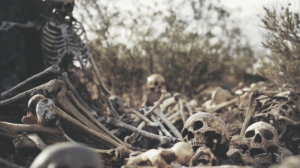
Valley of Dry BonesLet’s just do a bit of bible study today. I think we’ll see a common theme in the three lessons.

First, the very familiar prophetic vision of the “valley of dry bones” from the Book of Ezekiel. Scholars date this prophecy to about 587 BCE. Ezekiel was one of those taken into exile by the Babylonians ten years earlier in 597 BCE. The Babylonians had laid siege to Jerusalem for almost two years, creating conditions of famine, disease, and despair. They destroyed the city of Jerusalem, razed the temple to the ground, killed many of its inhabitants, and forced the rest to migrate to Babylon. This is how the Babylonian conquest is described in the Second Book of Kings, from the paraphrase entitled The Message:

[In] the ninth year and tenth month of Zedekiah’s reign, Nebuchadnezzar set out for Jerusalem immediately with a full army. He set up camp and sealed off the city by building siege mounds around it. The city was under siege for nineteen months (until the eleventh year of Zedekiah). By the fourth month of Zedekiah’s eleventh year, on the ninth day of the month, the famine was so bad that there wasn’t so much as a crumb of bread for anyone. Then there was a breakthrough. At night, under cover of darkness, the entire army escaped through an opening in the wall (it was the gate between the two walls above the King’s Garden). They slipped through the lines of the Babylonians who surrounded the city and headed for the Jordan on the Arabah Valley road. But the Babylonians were in pursuit of the king and they caught up with him in the Plains of Jericho. By then Zedekiah’s army had deserted and was scattered. The Babylonians took Zedekiah prisoner and marched him off to the king of Babylon at Riblah, then tried and sentenced him on the spot. Zedekiah’s sons were executed right before his eyes; the summary murder of his sons was the last thing he saw, for they then blinded him. Securely handcuffed, he was hauled off to Babylon. In the nineteenth year of Nebuchadnezzar king of Babylon, on the seventh day of the fifth month, Nebuzaradan, the king of Babylon’s chief deputy, arrived in Jerusalem. He burned The Temple of God to the ground, went on to the royal palace, and then finished off the city — burned the whole place down. (2 Kgs 25:1-9)

Ezekiel, a young apprentice priest, experienced this. The religious institution he served, the Jerusalem Temple, was destroyed and he was reduced from a prominent position as a priest in Jerusalem to that of a temple-less priest in exile. God then pegged him to become a prophet to the exile community; he tells us in the very first sentence of his book that he “was among the exiles by the river Chebar, the heavens were opened, and [he] saw visions of God.” (Ezek 1:1)

But not only did Ezekiel experience this historical trauma common to all the exiles to a greater or lesser extent, he experienced deep personal loss as well: his wife died and God commanded him not to mourn her. Again, I am reading from The Message:

God’s Message came to me: “Son of man, I’m about to take from you the delight of your life — a real blow, I know. But, please, no tears. Keep your grief to yourself. No public mourning. Get dressed as usual and go about your work – none of the usual funeral rituals.” I preached to the people in the morning. That evening my wife died. The next morning I did as I’d been told. (Ezek 24:15-17)

God’s command for him not to mourn her was to serve as an example for the exile community not to mourn the loss of the Temple.

I don’t know about you, but if I had to endure what Ezekiel and his contemporaries went through I would be a deeply depressed person! I would sink into the depths of despair. And that is what the exiles did. The psalms speak eloquently of their desperation: “By the waters of Babylon we sat down and wept, when we remembered you, O Zion.” (Ps 137:1; BCP version) Other psalms speak for the exiles in their sadness, their weariness settling deep within them. Psalm 31, for example:

Have mercy on me, O Lord, for I am in trouble;
my eye is consumed with sorrow, and also my throat and my belly.
For my life is wasted with grief, and my years with sighing;
my strength fails me because of affliction, and my bones are consumed.
(Ps 31:9-10, BCP version)

Or Psalm 102:

Incline your ear to me;
when I call, make haste to answer me,
For my days drift away like smoke, *
and my bones are hot as burning coals.
My heart is smitten like grass and withered, *
so that I forget to eat my bread.
Because of the voice of my groaning *
I am but skin and bones.
(Ps 102:2-5; BCP version)

Or Psalm 6:

Have pity on me, Lord, for I am weak; *
heal me, Lord, for my bones are racked.
My spirit shakes with terror; *
how long, O Lord, how long?
(Ps 6:2-3; BCP version)

In these psalms and elsewhere in the Hebrew Scriptures, the reference to “bones” is an idiomatic way of referring to one’s deepest self, a way for a person or a community to refer to its most essential self. And so we have Ezekiel’s vision of “dry bones,” a vision of the soul of the exile community. “Mortal,” says God, “these bones are the whole house of Israel.”

Since the dry bones represent the living exiles, we can see that this vision is not concerned with death; death here is a metaphor for the soul-deep desperation, the despair of the exiles. The exiles, bereft of their nation, their city, and (most importantly) their Temple, fear that God has abandoned them. Ezekiel speaks to this hopelessness with a startlingly simple metaphor of divine presence, the immediate closeness of breath, the pervading presence of wind. In just fourteen verses, the Hebrew word ruach occurs nine times, translated as “breath” in verses 5, 6, 8, and 10), as “wind” in verse 9, or as God’s own spirit in verse 14. The prophet’s repetitive use of the word drums the point of the message into his hearers’ consciousness: God’s spirit is the key. With God’s spirit, anything is possible. And God’s spirit is as close as the wind, as close as one’s own breath; there is no place on earth, no instant in time, and no situation of sin that can separate God’s people from God’s spirit. Not the loss of one’s country, one’s city, one’s Temple, even one’s beloved spouse; nothing! God’s spirit is always and everywhere present.

Which brings us to the Epistle lesson taken from the eighth chapter of Paul’s letter to the church in Rome. “To set the mind on the flesh is death,” writes Paul, “but to set the mind on the Spirit is life and peace.” (Rom. 8:6) We need first to understand that Paul’s use of “flesh” is not a reference to the physical body. The body is ethically neutral for Paul; it is neither good nor bad in and of itself. There certainly is nothing wrong with having a body. When Paul writes about the body, he uses the Greek word soma.

In this passage, however, he uses the word sarx, which means “flesh,” as in meat. Paul uses the word in Romans in two ways. First, he uses it to describe physical descent between ancestor and descendant. In the opening greetings of the letter, Paul identifies Jesus as a descendant of David “according to the flesh” (Rom 1:3) and later himself as a Jew because of “Abraham, our ancestor according to the flesh.” (4:1) In this sense, it is largely neutral, but in this sense also it can be negative. For Paul salvation or righteousness before God is not an honor due a particular blood line or a family heritage; it is not by the flesh but by the spirit of God that the followers of Jesus, the members of the community of faith receive life and peace.

In the second way in which Paul uses sarx or “flesh,” Paul is influenced by the dualism of his age which considered the flesh to be imperfect because it is capable of deterioration. Under that philosophical influence, Paul assigns to flesh negative characteristics such as death, hostility to God, and an incapacity to live according to God’s law. When a person’s focus in life is on the flesh and its appetites, that is a focus on death because the flesh does not last. “But,” Paul reassures his readers, “you are not in the flesh; you are in the Spirit, since the Spirit of God dwells in you.” Notice that, like Ezekiel’s message to the exiles in Babylon, Paul’s message is one for the present; not a promise of a future relationship with God, but an assurance of a present one.

Paul believes that this relationship with God is a present reality; it is not a something that exists somewhere else or that is coming in the future. Paul is certain that it is real, it is here, and it is now; because of the life, death, and resurrection of Jesus Christ this new reality is here today. Throughout the rest of this Chapter 8 he will develop his argument that we are currently children of the Father, that we are currently brothers and sisters of Christ, that we currently possess the gifts of the Spirit, and that we are currently enjoy the real and present love of God. He concludes this chapter asking:

Who will separate us from the love of Christ? Will hardship, or distress, or persecution, or famine, or nakedness, or peril, or sword? * * * No, in all these things we are more than conquerors through him who loved us. For I am convinced that neither death, nor life, nor angels, nor rulers, nor things present, nor things to come, nor powers, nor height, nor depth, nor anything else in all creation, will be able to separate us from the love of God in Christ Jesus our Lord. (Rom 8:35,37-39)

For Paul and for us, God is everywhere and always present.

And so we come to the Gospel lesson — another familiar story from the Gospel of John — the raising of Lazarus, a story about what it means to be in relationship with Jesus, what it means to love him and be loved by him. Lazarus is identified by his sisters to Jesus as “he whom you love,” (v. 3) and then John underscores this by telling us that “Jesus loved Martha and her sister and Lazarus.” So in the way Jesus related to this Bethany family we get a clue of what it is to be in relationship with him. And what we learn, perhaps distressingly, is that doesn’t mean that one is protected from bad stuff. John’s Gospel makes this painfully obvious, for in this Gospel, love is linked inextricably to death.

Remember that what is perhaps the best known verse of Christian scripture is from this Gospel: “For God so loved the world that he gave his only Son . . . . ” (Jn 3:16) And it is in John’s Gospel that Jesus says, No one has greater love than this, to lay down one’s life for one’s friends.” (Jn 15:13) So it is with this family; that they love Jesus and he loves them does not mean that bad things, including death, do not happen. Lazarus dies.

And in John’s story, Jesus does not prevent it, nor even arrive until afterward. He is met on the road by Lazarus’ sister Martha who confronts him, “Lord, if you had been here, my brother would not have died.” (v. 21) In response, Jesus assures her that “your brother will rise again.” (v. 23), but she hears only the promise of a future resurrection: “I know that he will rise again in the resurrection on the last day.” (v. 24) And Jesus, “I am the resurrection and the life.” (v. 25) Note, if you will, the verb: Jesus’ reply is in the present tense — “I am . . . .”

The resurrection is not a distant promise; it is not a guarantee of salvation in the future; it is not about an eternal life with God and Jesus in heaven. In the next few chapters of John’s Gospel we will encounter Lazarus reclining at the table with Jesus, sharing food and fellowship. (Jn 13:28) His new relationship with Jesus is intimate and close; it is here and now. For Lazarus and for us, the resurrection is not a future with Jesus; it is a present with Jesus. Jesus is present with Lazarus and his sisters; he is present with us, and through him God is glorified even in that which feels irredeemably bad and painful.

Being in relationship with Jesus, loving him and being loved by him, does not mean that unpleasant things do not happen. It means that when they do, he faces them, even death and grief, with us. It means learning that, in spite of the worst the world can do, the worst that flesh can be subject to, even death and the finality of the grave, Jesus is the resurrection and the life. Nothing is ever so dead that it keeps him from being that in himself and for us. In John, the resurrection is not a future hope; it is the abundant life which is always here, always now. Nothing, as Paul reminded the Romans, not “death, nor life, nor angels, nor rulers, nor things present, nor things to come, nor powers, nor height, nor depth, nor anything else in all creation, [can] separate us” from it. It is, as Ezekiel prophesied to the exiles, as close as the wind, as close as one’s own breath; it is always and everywhere present.

Amen.

====================

A request to my readers: I’m trying to build the readership of this blog and I’d very much appreciate your help in doing so. If you find something here that is of value, please share it with others. If you are on Facebook, “like” the posts on your page so others can see them. If you are following me on Twitter, please “retweet” the notices of these meditations. If you have a blog of your own, please include mine in your links (a favor I will gladly reciprocate). Many thanks!

====================

Father Funston is the rector of St. Paul’s Episcopal Church, Medina, Ohio.

Given First by God – From the Daily Office – April 5, 2014

From the First Letter to the Corinthians:

Love is patient; love is kind; love is not envious or boastful or arrogant or rude. It does not insist on its own way; it is not irritable or resentful; it does not rejoice in wrongdoing, but rejoices in the truth. It bears all things, believes all things, hopes all things, endures all things.

(From the Daily Office Lectionary – 1 Corinthians 13:4-7 (NRSV) – April 5, 2014.)

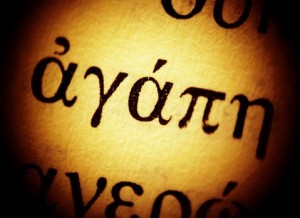
Agape in Greek LetteringThere are six Greek words translated “love” in English: eros (sexual passion), philia (deep friendship), ludus (playful love), pragma (longstanding or mature love), philautia (self love), and agape (unconditional or selfless love). It is the sixth which Paul uses here and which is used extensively throughout the New Testament and in early Christian texts.

It is perhaps perhaps the most radical. This is the love that one extends to all people, whether friends, family members, or strangers. Agape was translated into Latin as caritas, which is the origin of our word “charity.” C.S. Lewis referred to it as “gift love,” the highest form of Christian love. It is similar in nature to concepts appearing in other religious traditions. For example, it has been suggested that the idea of metta or “universal loving kindness” in Theravada Buddhism is the same thing.

Agape is used in the Gospels to describe the love that God has for humanity in general: “For God so loved the world, he gave his only Son” (John 3:16).

It is also used to name the human response to God’s love and to describe the love that Jesus commands be shared and expressed between human beings. In Matthew 5:43-44, agape is used to describe both one’s love of neighbor and the love we are extend to our enemy.

It is not, despite the popularity of this passage as a reading at weddings, about marital love. This is Paul’s instruction to the Corinthians (and through them to all Christians) about “the more excellent way” mentioned at the end of Chapter 12, the manner in which they are to exercise their spiritual gifts.

Chapter 13 does not stand alone. It continues Paul’s discussion of spiritual gifts that begins in the previous chapter and continues through the next. Agape here is to be the guiding principal Christians employ in deciding when, where, and how to use the gifts God has given them. They are to be offered to the community with the same sort of self-sacrificing love exhibited by God to all of humankind: “For God so loved the world that he gave his only Son.”

Agape has nothing to do, as romantic love — eros — does, with attractiveness or attraction; it has nothing to do, as marital love — pragma — does, with compromise; it has nothing to do with any prior relationship, as familial or brotherly love — philia — does. It is to be bestowed on the unloved and the unlovely; it is to be given without regard to whether it is deserved or merited; it is to be given without thought of reciprocity or payback. It is, in a word, to be given as God gives it. It is something human beings are incapable of giving but for the fact that it is first given them by God.

====================

A request to my readers: I’m trying to build the readership of this blog and I’d very much appreciate your help in doing so. If you find something here that is of value, please share it with others. If you are on Facebook, “like” the posts on your page so others can see them. If you are following me on Twitter, please “retweet” the notices of these meditations. If you have a blog of your own, please include mine in your links (a favor I will gladly reciprocate). Many thanks!

====================

Father Funston is the rector of St. Paul’s Episcopal Church, Medina, Ohio.

Bodies, Bees, Ants, Trees – From the Daily Office – April 3, 2014

From the First Letter to the Corinthians:

The body does not consist of one member but of many. If the foot were to say, “Because I am not a hand, I do not belong to the body,” that would not make it any less a part of the body. And if the ear were to say, “Because I am not an eye, I do not belong to the body,” that would not make it any less a part of the body. If the whole body were an eye, where would the hearing be? If the whole body were hearing, where would the sense of smell be? * * * If one member suffers, all suffer together with it; if one member is honored, all rejoice together with it.

(From the Daily Office Lectionary – 1 Corinthians 12:14-17,28 (NRSV) – April 3, 2014.)

Leaf Cutter AntsThe “body analogy” is so deeply engrained in Christian theology through Paul’s use of it in his epistle to the Corinthians and elsewhere that it may be heresy to suggest that its usefulness in the modern world may have come to an end. It was, perhaps, an apt description of the church in a time when church communities were small and close-knit, but does it work in the modern age of the mega-church, or in an age of decentralization?

I ask the question because I truly don’t know . . . .

At a conference I attended recently, a speaker talked about the church as “hive” and described the way in which communities of bees and ants are similar and different, and how that model might be used to understand the modern church. I didn’t buy that argument. Churches are not colonies or hives.

For example, ants are simple creatures following simple rules, each one acting on local information; no ant sees the big picture. No leadership is required; no ant tells any other ant what to do. Even complex behaviors of the colony may be coordinated by relatively simple interactions. No generals command ant warriors. No managers boss ant workers. The queen plays no role except to lay eggs. Even with half a million ants, a colony functions just fine with no management at all. It relies instead upon countless interactions between individual ants, each of which is following simple rules of thumb. Scientists describe such a system as self-organizing.

In many ways, today’s church can seem like this. No single member sees the big picture; when the church community functions smoothly, no leadership is needed. Unfortunately for the analogy, however, human beings are not ants; they are possessed of individual identities and free will, so collections of humans, including churches, seldom run “smoothly.” Furthermore, the thing about ants is that they are pretty much interchangeable; an ant might be a nest worker one day, a trash collector the next, a forager the following day. And one ant can easily say to another, “I have no need of you” because there are plenty of replacements.

Beehives are a bit different from ant colonies, and the insects’ means of communication and “hive-mind” decision making differ, but as an analogy for the church, I think the beehive is as problematic as the ant colony.

More recently, another writer suggested the diffused process of creating computer code by several programmers all connected by a “tree” of files and directories, each working a peace of the bigger project, as an analogy for the church. This overcomes some of the objections to ant colony or beehive metaphors in that one programmer cannot easily take the place of another on the project. I’m not sufficiently familiar with the way teams of code writers work to engage the metaphor, however, so I don’t know how well it works.

Does the body analogy still work? Maybe . . . perhaps to a much less effective degree than when Paul first used it, however. Does the insect community work? Maybe . . . but not sufficiently to provide a true model. Does the programmer tree work? Maybe . . . it may speak to a new generation in ways analogies from nature do not.

What I do know is that each of these metaphors is limited (as any analogy is) and while any one of them may help us understand who we are as a community, they can also mislead us. What is common to them all, however, is that each points toward some form of organization, some type of communication, and a common purpose. Those are the hallmarks of entities — bodies, colonies, hives, communities, churches — that flourish.

====================

A request to my readers: I’m trying to build the readership of this blog and I’d very much appreciate your help in doing so. If you find something here that is of value, please share it with others. If you are on Facebook, “like” the posts on your page so others can see them. If you are following me on Twitter, please “retweet” the notices of these meditations. If you have a blog of your own, please include mine in your links (a favor I will gladly reciprocate). Many thanks!

====================

Father Funston is the rector of St. Paul’s Episcopal Church, Medina, Ohio.

Compartmentalization – From the Daily Office – April 2, 2014

From the First Letter to the Corinthians:

Now there are varieties of gifts, but the same Spirit; and there are varieties of services, but the same Lord; and there are varieties of activities, but it is the same God who activates all of them in everyone. To each is given the manifestation of the Spirit for the common good. To one is given through the Spirit the utterance of wisdom, and to another the utterance of knowledge according to the same Spirit, to another faith by the same Spirit, to another gifts of healing by the one Spirit, to another the working of miracles, to another prophecy, to another the discernment of spirits, to another various kinds of tongues, to another the interpretation of tongues. All these are activated by one and the same Spirit, who allots to each one individually just as the Spirit chooses.

(From the Daily Office Lectionary – 1 Corinthians 12:4-11 (NRSV) – April 2, 2014.)

Compartmented BoxThe genius of Paul is his holistic approach to understanding the gifts of the Spirit, the talents and skills of human beings. Yes, he says, there are all sorts of talents and skills, but they all come from the same source – God the Spirit – and they are all to be used for the same purpose – building up the community. It is a genius that is lost in the modern world, I’m sorry to say.

I spend some time on social media sites such as Facebook and I see people posting the silliest of comments (including some surprisingly stupid quotations from some otherwise intelligent people) which lay down hard-and-fast, black-and-white assertions about things that are clearly false. For example, on Facebook recently the philosophy Bertrand Russell, famously an atheist, was quoted as saying, “So far as I can remember, there is not one word in the Gospels in praise of intelligence.” I don’t know the accuracy or source of the quotation, but there it is. It’s a ridiculous statement on several levels, not the first of which is that it is clearly inaccurate.

Although Jesus or the gospel writers may never have specifically said or written, “Intelligence of good” or something of that nature, Jesus often praises those who understand his parables, or expresses frustration with those who don’t, which is a way of praising intelligence. Further, to limit the Christian message to the Gospels alone leaves out the greater part of the New Testament, including Paul who (as here) praises wisdom and knowledge as gifts of God.

In any event, the posting of that quotation led to a discussion in which one person asserted that “faith and reason are two entirely different things and have nothing to do with one another.” If the writer had been an atheist, I’d have chalked that up to polemic . . . . but the writer claimed to be a Christian! As a Christian, I would debate that proposition fully; faith and reason are neither different nor separate! I would not be alone, either. The late Pope John Paul II began one of his many encyclicals with these words:

Faith and reason are like two wings on which the human spirit rises to the contemplation of truth; and God has placed in the human heart a desire to know the truth – in a word, to know himself – so that, by knowing and loving God, men and women may also come to the fullness of truth about themselves. (Fides et Ratio, 14 Sept. 1998)

Another participant who self-identified as an American citizen asserted in the conversation that “religion has no place in public politics.” Coming from someone whose country’s foundational document, the Declaration of Independence, asserts “that all men are created equal, that they are endowed by their Creator with certain unalienable Rights, that among these are Life, Liberty and the pursuit of Happiness,” a clearly religious sentiment in a public political document, the participant’s argument was not only ridiculous, it could be considered hypocritical! Religion may have no place in government (the U.S. Constitution’s First Amendment is based on that premise), but that is a different thing from saying it has no place in politics.

I tried to suggest that these black-and-white generalizations were inaccurate and did not help to further rational consideration of Bertrand Russell’s assertion, the quotation which had started the conversation. Unfortunately, the discussion became so heated and counterproductive (what at one time back in the days of email list-serves would have been called a “flame war”) that I discontinued participation. Eventually, the original poster closed the discussion and deleted the entire thread.

Finally, this morning, I read a news report in which the first paragraph asserted: “Religion has never fully accepted the LGBT community. It goes against their doctrine, which in and of itself is an issue.” That’s so broad a generalization as to be laughable. “Religion” encompasses every faith system ever adopted by human beings and there is no common “doctrine” amongst them! Furthermore, as an Episcopalian whose church has elected and ordained gay and lesbian bishops, who works regularly with LGBT colleagues both lay and ordained, and whose denomination has come down squarely in favor of marriage equality, I can point to at least one religion about which this generalization is false.

Would that people who write for publication, who produce “content” for the internet, and who take part in the “flame wars” that erupt in social media could adopt St. Paul’s more holistic approach! Instead, we see the tendency to compartmentalize and separate, to insist on a division of public from private, politics from religion, faith from reason, gay from straight, black from white, this from that, whatever from something else, and on and on and on.

The world, however, isn’t black and white; it’s all sorts of grays and other colors. The world isn’t compartmentalized and neither are human beings. The world and the people in it are a fascinating mix of talents, skills, gifts, abilities, positions, attitudes, beliefs, and opinions that cross our arbitrary lines and divisions, that spill from one compartment to the next. We Christians believe all of this flows from one source and all of it has one purpose, to build up community. When we try to compartmentalize and separate, community suffers.

====================

A request to my readers: I’m trying to build the readership of this blog and I’d very much appreciate your help in doing so. If you find something here that is of value, please share it with others. If you are on Facebook, “like” the posts on your page so others can see them. If you are following me on Twitter, please “retweet” the notices of these meditations. If you have a blog of your own, please include mine in your links (a favor I will gladly reciprocate). Many thanks!

====================

Father Funston is the rector of St. Paul’s Episcopal Church, Medina, Ohio.

Gathered – From the Daily Office – April 1, 2014

From the Genesis:

When Jacob ended his charge to his sons, he drew up his feet into the bed, breathed his last, and was gathered to his people.

(From the Daily Office Lectionary – Genesis 49:33 (NRSV) – April 1, 2014.)

Pine Box CoffinHe has kicked the bucket, cashed in his chips, shuffled off this mortal coil, gone the way of all flesh, croaked, gone home, passed away, turned up his toes, ridden the pale horse, fallen off his perch, taken his last bow, entered larger life, joined the choir invisible.

We have so many idioms and euphemisms for the simple reality of death. I suppose that is because death is frightening, although if we take our Christian faith seriously it should not be.

The epistle lesson for the Easter vigil is always a short reading from Paul’s letter to the Romans in which the Apostle reminds us that “we have died with Christ, [and] we believe that we will also live with him.” (Rom. 6:8) There really is nothing to fear. Still, we avoid even mentioning death by using all these idioms and euphemisms (and many more).

As these turns of phrase go, none is quite so lovely as this verse in Genesis describing the death of Israel (Jacob): “He was gathered to his people.” I find something about that very comforting; I’ve never been a big fan of the “going home” euphemism which it resembles (even though there is biblical warrant for it), but I find this image of joining earlier generations inviting. Perhaps that is because of the fond memories I have of childhood family reunions.

In a former parish, I had a congregant who frequently would turn the discussion in bible study or adult education classes to the question of life after death. “I just want to know what happens when I die,” she would say. “Martha,” I would answer, “I don’t know. I haven’t been there yet.”

I don’t know, but I do have faith that our Book of Common Prayer is accurate when it says (in the Preface to the Eucharist to be said at a requiem), “to your faithful people, O Lord, life is changed, not ended; and when our mortal body lies in death, there is prepared for us a dwelling place eternal in the heavens.” (BCP 1979, page 381) One of the collects in the Burial Office includes this petition: “Give us faith to see in death the gate of eternal life, so that in quiet confidence we may continue our course on earth, until, by your call, we are reunited with those who have gone before.” (page 493) Until, the writers of Genesis might have said, we are gathered to our people.

Lent begins with a reminder of our mortality: “You are dust and to dust you shall return.” Here in the middle of the season we find another, but rather more comforting, reminder: you are a part of a people and to your people you shall be gathered.

====================

A request to my readers: I’m trying to build the readership of this blog and I’d very much appreciate your help in doing so. If you find something here that is of value, please share it with others. If you are on Facebook, “like” the posts on your page so others can see them. If you are following me on Twitter, please “retweet” the notices of these meditations. If you have a blog of your own, please include mine in your links (a favor I will gladly reciprocate). Many thanks!

====================

Father Funston is the rector of St. Paul’s Episcopal Church, Medina, Ohio.

« Older posts Newer posts »