====================
A homily offered by the Rev. Dr. C. Eric Funston on the Fifth Sunday after Pentecost, July 9, 2017, to the people of St. Paul’s Episcopal Church, Medina, Ohio, where Fr. Funston is rector.
(The lessons for the service are from Proper 9A (Track 1) of the Revised Common Lectionary: Genesis 24:34-38,42-49,58-67; Psalm 45:11-18; Romans 7:15-25a; and St. Matthew 11:16-19, 25-30. These lessons can be read at The Lectionary Page.)
====================
Once to every man and nation
Comes the moment to decide,
In the strife of truth and falsehood,
For the good or evil side;
Some great cause, God’s new Messiah,
Offering each the bloom or blight,
And the choice goes by forever
‘Twixt that darkness and that light.
James Russell Lowell (1819-1891) was a lawyer, poet, college professor, and diplomat in the middle of the 19th Century. He graduated from Harvard College at the age of 19 in 1838, and was called to the Bar two years later in 1840. In 1855, he succeeded his friend Henry Wadsworth Longfellow as Professor of Modern Languages and Literature at Harvard. He is best remembered as one of the Fireside Poets, a group of New England writers who gained popularity in the first half of the 19th-Century.
Lowell’s political opinions often found expression in his poetry, and the old hymn we know as Once to Every Man and Nation is a part of one example. The words are originally from a much longer poem entitled The Present Crisis published in The Boston Courier in 1845 in protest of the impending U.S. war with Mexico. Some of Lowell’s words were rearranged by Garrett Horder, set to the hymn tune Ebenezer, and published in Horder’s Hymns Supplemental to Existing Collections in 1896.
I can’t help but think of the hymn’s opening lines, “Once to every man and nation comes the moment to decide,” every time I prepare for a baptism, every time I sit down to consider the lessons of the day in light of the once-in-a-life-time event they will accompany. Today, we have another part of the patriarchal story when Abraham’s unnamed servant – we’ll call him Eliezer, the name given Abraham’s servant in another part of Genesis – is sent on an important errand, to find a wife for Isaac. It is really the transition in Genesis from Abraham’s story to that of his son Isaac. The story itself subtly notes this transition when, at the beginning, Eliezer refers to Abraham as his master and then, at the end, names Isaac as his master.
It’s a long story and I won’t go through it in detail (after all, you just heard most of it read to you – there are some verses left out, but we won’t worry about those). The important thing to remember is that this is a story about making a decision – in fact, it is about many decision: Abraham decides to get a spouse for his son, but decides she must not come from among the Canaanite people among whom they live; he decides she must come from his relatives in his former home of Haran; Eliezer decides on a method by which he will discern the identity of the future bride and seeks God’s guidance; Rebekah, who comes to the well and does the thing Eliezer decided would be his sign, decides to accept the proposal that she travel to a foreign country and marry a man she has never met; Isaac decides to accept Rebekah as his wife and, the text tells us, “he loved her.” (Gen 24:67)
In his commentary on Genesis in The New Interpreter’s Bible, Lutheran scholar Terence Fretheim underscores the importance of human decision-making illustrated in this story. Taking issue with another author, Prof. Fretheim says,
One should not say that “the success or failure of the commission depends on whether God grants success or not.” Although success may well depend on God, the activity of human beings may occasion failure even though God intends success. * * * The author presents no claim that lack of success would mean that God had withheld kindness; it could simply result from human decision making. Divine providence does not mean that the future is somehow predetermined or that human decision making can never frustrate the divine designs. (Terence E. Fretheim, Commentary on Genesis, The New Interpreters Bible: Volume 1, Abingdon Press, Nashville:1994, pg pg 510)
Eliezer the servant is the figure in this drama whose decision tree is most obvious. “Given a difficult task, he does what he can and he leaves the rest to God. He travels to the homeland of [Abraham’s] family; he takes his stand at a likely place to meet young women; and then he prays. . . . [H]e watches and waits to discern God’s will. When the sign is fulfilled, [Eliezer] is quick to praise God for God’s faithfulness and [loving kindness]. Finally, he bears witness to others of that divine faithfulness.” (Working Preacher 2017)
Katherine Schifferedecker of Luther Seminary in St. Paul, Minnesota, writes:
We could do worse than follow the example of Abraham’s servant when called to a particular task. Prepare. Pray. Wait. Watch for signs of God’s faithfulness. Then be quick to praise God and to witness to others of God’s faithfulness. Oh, and be generous. Generosity marks the actions of both Rebekah and the servant. (Working Preacher 2017)
But we must acknowledge with Prof. Freitheim that not every decision leads to a happy and successful outcome; failure and difficulty are also potential results of our decisions. We also have to turn Prof. Fretheim’s observation around and note that, while lack of success may not mean that God has withheld kindness, success does not necessarily mean that an enterprise or a decision has God’s blessing.
Lowell’s words as edited into a hymn by Horder continue:
. . . . to side with truth is noble,
When we share her wretched crust,
[Before] her cause bring fame and profit,
And ’tis prosperous to be just;
Then it is the brave man chooses
While the coward stands aside.
Till the multitude make virtue
Of the faith they had denied.
These lines speak of defending truth when falsehood seems to rule. That they were written in 1845 illustrates how history, even if it doesn’t exactly repeat itself, seems to follow recurring themes. As Mark Twain is often reputed to have said, “History doesn’t repeat itself, but it often rhymes.” And that is particularly true in our personal lives, as St. Paul writes in that portion of the letter to the Romans that we hear this morning:
I do not understand my own actions. For I do not do what I want, but I do the very thing I hate. * * * I find it to be a law that when I want to do what is good, evil lies close at hand. (Rom 7:15,21)
The hymn speaks of making the decision to “side with truth” as leading to the sharing of a “wretched crust,” implying that taking the opposite side leads to fame, profit, and prosperity. The brave person chooses to take the side of truth alone, while a coward waits to see what the crowd may do.
Important, once-in-a-lifetime decisions are difficult to make and keep on one’s own (as Paul clearly suggests). This is why no one is ever baptized without sponsors and why, since the theological reappraisal of the sacrament of Baptism that led to the changes in the service of baptism incorporated in our current Book of Common Prayer, baptisms are not done privately but as part of the public worship of the whole People of God. The decision to be baptized is a momentous and once-in-a-lifetime choice, and it is a difficult one to maintain throughout life without help and support.
Today we welcome Braylen into the Household of God through this sacrament. As I wrote in our weekly e-mail newsletter, Baptism is the basis of our entire Christian life; it is the gateway to life in the Spirit and the doorway through which we access the other sacraments. Through Baptism we are freed from sin and reborn as children of God; we become members of Christ, are incorporated into the Church, and share in the church’s mission.
Braylen is only 10 weeks! That’s a lot for 10-week-old person to absorb! This, as I said, is why children (and adults) have baptismal sponsors, also called “Godparents.” Godparents at baptism make big promises to encourage their Godchild to grow in faith and commit to helping them understand how to live their life in a Christian way.
Godparents do not play a special role just on the day of a child’s baptism. To be a Godfather or Godmother is a life-long commitment which will involve special times and treats, but much more as well. Godparents are expected to:
- Give time to their Godchild to talk to about the bigger questions of life – questions about hope, faith and love.
- Model and encourage their Godchild to develop Christian values – being kind and compassionate towards others, being generous towards others in need with time or money and standing against things in the world that cause injustice and suffering.
- Pray for their Godchild through the ups and downs of life and throughout their faith journey.
- Show their Godchild by example how to make good choices in life, for themselves and for others.
- Help their Godchild to learn more about the Christian faith, through the church and in other ways. Godparents should go to church with their Godchild, talk with them about the Bible, and help them learn how to pray.
Being a Godparent is a demanding role. If you are a Godparent, may you be blessed as you shepherd your Godchild through life. But all of us should remember that Godparents also do not make these decisions or take on these obligations alone. The entire Christian community joins with them. At every Baptism everyone in attendance is asked: “Will you by your prayers and witness help this child to grow into the full stature of Christ?” And all answer, “We will.” (BCP 1979, pg 303) Then all present join the candidate and the sponsors in affirming the promises of the Baptismal Covenant.
By the light of burning martyrs,
Jesus bleeding feet I track,
Toiling up new Calvaries ever
With the cross that turns not back;
New occasions teach new duties,
Time makes ancient good uncouth;
They must upward still and onward,
Who would keep abreast of truth.
. . . continues the third verse of the hymn. Baptism is the first step up those “new Calvaries . . . with the cross that turns not back;” it is the beginning of that trek “upward still and onward . . . keep[ing] abreast of truth.” It is not a trek undertaken alone. “Like a mighty army moves the church of God.” (S. Baring-Gould, Onward Christian Soldiers, #562, The Hymnal 1982) It is a trek in which we join “the glorious company of apostles . . . the noble fellowship of prophets . . . the white-robed army of martyrs” by whose light we take journey. (Te Deum, BCP 1979, Morning Prayer, pg 95)
In today’s Gospel lesson, Jesus compares the leadership of the then-present generation, the so-called “wise and intelligent,” to children in a market place. Some of the children want to engage in a game of a make-believe wedding; others among them want to play at a pretend funeral. They cannot make a decision. Jesus offers an alternative to both, a simpler way hidden from wise but open to “infants:” “Take my yoke upon you, and learn from me; for I am gentle and humble in heart, and you will find rest for your souls. For my yoke is easy, and my burden is light.” (Matt 11:29-30)
This is not an offer of a life of ease, but rather a life delivered from the artificial burdens imposed upon us by the expectations of religious society. It is not a summons to be idle, but a call to learn a new way of understanding and living in accord with God’s will. It is, as Australian theologian William Loader says, “a call to lightness of being [in] contrast with the serious calls of those who interpret scripture as demand and stricture.” (First Thoughts)
“It is not that Jesus invites us to a life of ease. Following him will be full of risks and challenges, as he has made abundantly clear. He calls us to a life of humble service, but it is a life of freedom and joy instead of slavery.” (Working Preacher 2011) Our hymn’s last verse acknowledges the dangers of taking the side of truth:
Though the cause of evil prosper,
Yet ‘tis truth alone is strong;
Though her portion be the scaffold,
And upon the throne be wrong;
Yet that scaffold sways the future,
And, behind the dim unknown,
Standeth God within the shadow,
Keeping watch above his own.
The decision to take Christ’s yoke is the decision to live with “Jesus under God’s gracious and merciful reign, free from the burden of sin and the need to prove oneself, free to rest deeply and securely in God’s grace.” (Working Preacher 2011) This is the decision which Braylen, through his parents and Godparents, is making today; it is the decision which he will be invited to affirm later in the Sacrament of Confirmation; it is the decision which we all make everyday.
In the last stanza of his original poem, James Russell Lowell exhorts his readers to be pilgrims, to launch our own Mayflower, and to steer boldly into the future. Today, we welcome Braylen into the Household of God to be a pilgrim with us and we set his course into God’s future, upward and onward, abreast to and yoked with the Truth. May his parents’ and Godparents’ decision lead to a life of love for Braylen as Eliezer’s decision to chose Rebekah lead to a life of love for Isaac. Amen.
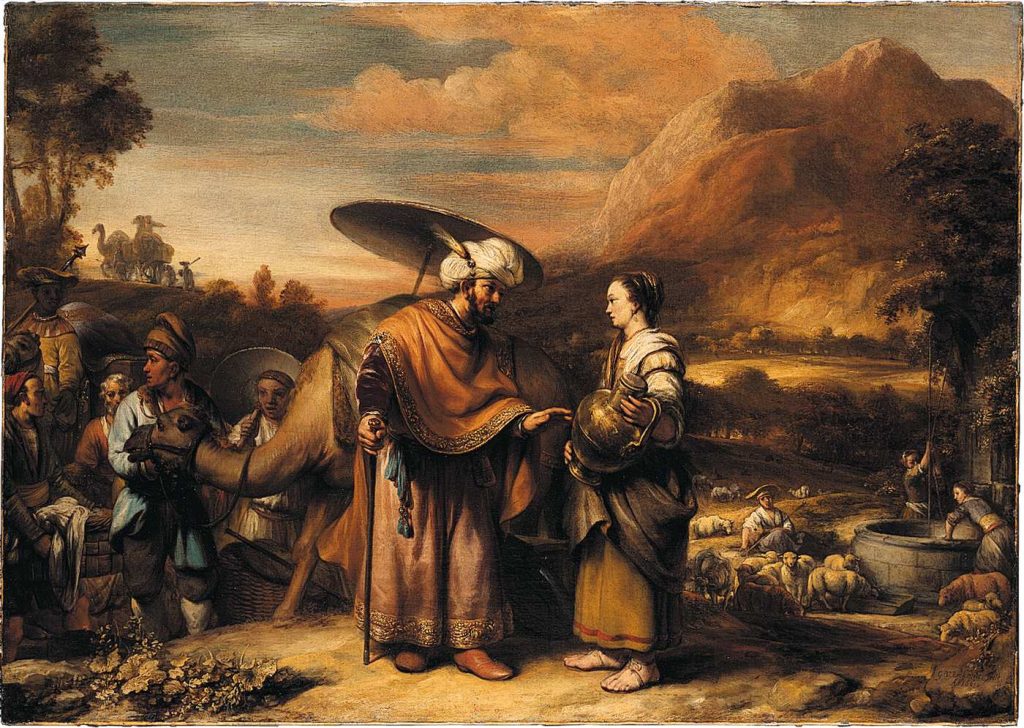
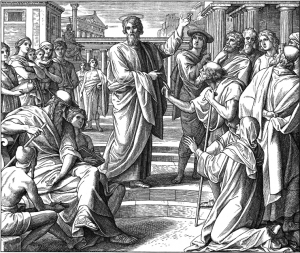
(Note: The illustration is “Rebekah and Eliezer at the Well” by Gerbrand van den Eeckhout (1621–1674). It hangs in the National Gallery, London, UK)
====================
Father Funston is the rector of St. Paul’s Episcopal Church, Medina, Ohio.
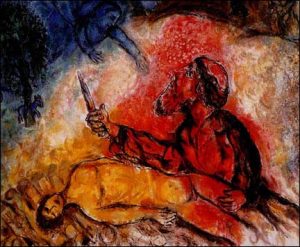 The great Anglican preacher Herbert O’Driscoll begins his reflections on our Old Testament lesson, the story of the testing of Abraham and the binding of Isaac, truthfully the near-murder of Isaac, with these words:
 This is “Trinity Sunday,” the only Sunday of the Christian year dedicated to a truly puzzling Christian doctrine, the peculiar Christian notion that God is one-in-three and three-in one. The late Jim Griffiss, the seminary professor with whom I studied systematic theology, once quipped that one could walk into any church on Trinity Sunday and hear heresy preached; that’s because there is no good or easy way to explain this doctrine. There’s also no way to really understand this doctrine as a matter of intellectual assent. But as a friend of mine said recently, “We [are called to] worship one God in Trinity, not understand one God in Trinity. Accept the Mystery, sing the Te Deum, and move on.” (Facebook discussion) I think he’s right. As a way of describing God, one must admit that the doctrine of the Trinity seems paradoxical, more than a little bit ambiguous, and frankly beyond explanation in a short (or even a long) sermon. So, we won’t be singing the Te Deum today, but I would like to use some poetry to explore how we can experience and worship the Triune God.
 As my parishioners know, I often find the images invoked by poets comforting and illuminating in times of grief.
 Almighty God, on this day you opened the way of eternal life to every race and nation by the promised gift of your Holy Spirit who empowered the disciples to proclaim the Good News to peoples from many lands speaking many tongues: we now pray for those in many lands speaking many languages who have been hurt or killed by terrorist violence in the past fortnight in: London (England), Kabul (Afghanistan), Mosel (Iraq), Minya (Egypt), Khost (Afghanistan), Mastung (Pakistan), Gao (Mali), Borno State (Nigeria), Raqqa (Syria), Mogadishu (Somalia), rural Colombia, Manila (Philippines), Baghdad (Iraq), Basra (Iraq), Portland (Oregon, USA) and Manchester (England). May God grant eternal rest to the departed, healing to the injured, and comfort to those in grief. And since Jesus taught us to love and pray for our enemies, we pray also for those who have committed these violent acts, and for those who may be contemplating additional violence. May God change their hearts and shed abroad the gift of peace throughout the world by the preaching of the Gospel, that it may reach to the ends of the earth; through Jesus Christ our Lord, who lives and reigns with you, in the unity of the Holy Spirit, one God, for ever and ever. Amen.
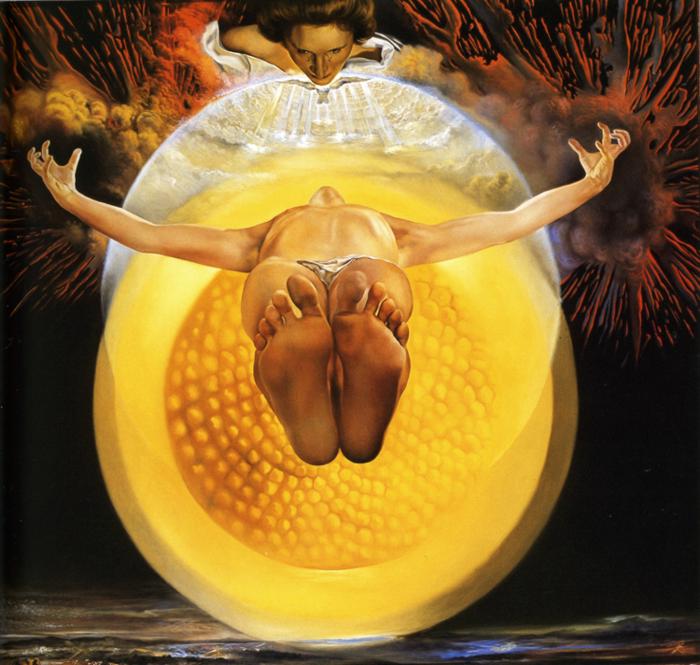 As I read our lessons for today and again as I heard them this morning, two verses in particular have leapt out at me. One from the Gospel of John in which Jesus says: “And this is eternal life, that they may know you, the only true God, and Jesus Christ whom you have sent.” (Jn 17:3) The other is from the story in the Book of Acts in which, after Jesus has been lifted up and a cloud has taken him out of the apostles’ sight, two suddenly-appearing “men in white robes” (angels, one presumes) ask the apostles, “Men of Galilee, why do you stand looking up toward heaven?” (Acts 1:11)
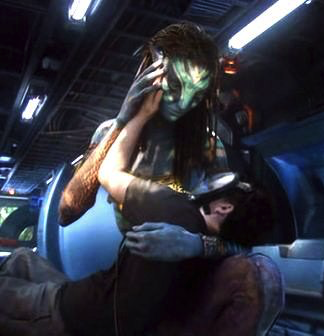 If you have seen Avatar, you know that the human character Jake Sully is a disabled Marine; he is confined to a wheelchair in his “real” human life. But his avatar, a synthetic body into which his conscience is temporarily transferred, is a fully functional Na’Vi male body. At the end of the movie, after Jake has rebelled against his superiors and championed the Na’Vi’s cause against Pandora’s exploitation by Earth, Jake’s crippled body is trapped in a damaged mobile laboratory. Neytiri finds him, breaks into the lab, and rescues him: “In the end, the real Jake is not his avatar. The real Jake is a man, unshaven and unkempt, without functional legs. And Neytiri sees this. As she holds the dying Jake, she tells him ‘I see you.’ This is what love is. Love is not trying to change the other person, to make them perfect, or to focus on their weaknesses. Love is seeing a person for who they are and embracing that person.” (
 A couple of years ago Pope Francis made a cogent observation about praying for those who are hungry: “You pray for the hungry. Then you feed them. That’s how prayer works.” (
 It’s the Fourth Sunday of Easter and that means it’s “Good Shepherd Sunday.” And that means that clergy throughout the church have, for the last week, been scratching their heads thinking, “This again? What can I do this time with the sheep-and-shepherd simile?” But, I’m not among them. For three days this past week, the clergy of this diocese have been in conference with our bishop, with a retired seminary president, and with a retired cathedral dean exploring exactly what we understand our ordinations to the diaconate and to the presbyterate to mean. That has kind of taken my attention off the “Good Shepherd” metaphor.
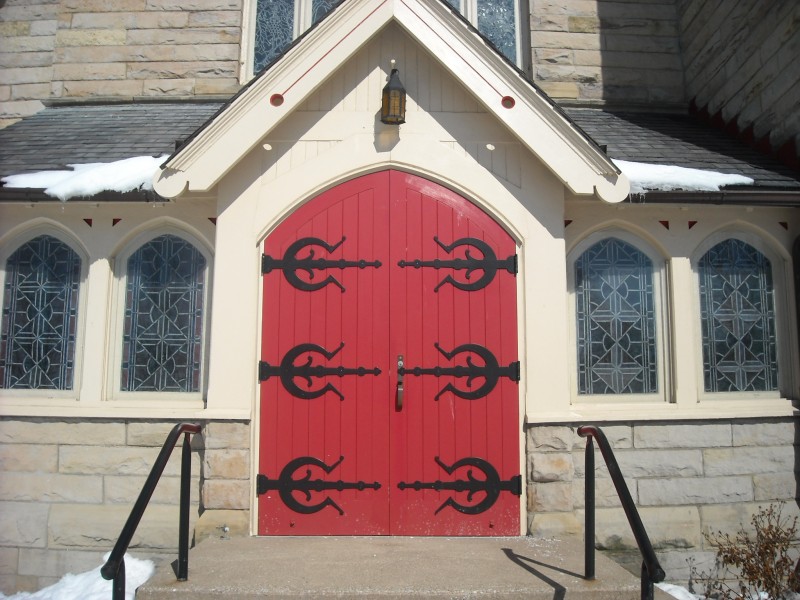 Like many (perhaps most) Episcopal churches, my first congregation had a set of large red doors on the front of their building. But also like many Episcopal churches, no one ever used them because all the members knew how to enter through a more convenient door near the parking lot.

