Occasional thoughts of an Anglican Episcopal priest

Category: Church (Page 25 of 115)

A Meditation on Mortality (for the parish newsletter)

====================

A “Rector’s Reflection” offered by the Rev. Dr. C. Eric Funston in the July 2016 issue of “The Epistle,” the newsletter of St. Paul’s Episcopal Church, Medina, Ohio, where Fr. Funston is rector.

====================

firefliesThe week of the summer solstice was an interesting one in the Funston household.

The night of the solstice there was what is known as a “strawberry moon,” a phenomenon which only occurs when a full moon coincides with the northern hemisphere’s summer solstice, longest day of the year. The moon takes on an amber or pinkish glow which astronomers explain is caused by the setting sun’s positioning, affecting the angle at which the sun’s rays pass through Earth’s atmosphere and, thus, the apparent coloration of the moon.

The name “strawberry moon” was given by the Native American Algonquin tribes of northern Michigan and Canada. They believed that a full moon in June signified that it was time to start picking fruits, including strawberries. It is also known as the Rose, Hot, or Honey Moon (the latter being the origin of the name given a newly married couple’s post-wedding get-away). The last time there was a “strawberry moon” was during the so-called “summer of love” in 1967.

Biblically, the summer solstice and the nearest full moon are associated with punishment and death. It was taught by the rabbis in their commentaries on Scripture that this was the time when Moses disobeyed God and was told he could not enter the Promised Land with the rest of the Hebrews, but would die instead.

I made note of the “strawberry moon” as I took Dudley for his last walk of the evening before going to bed. I also noticed a large number of fireflies winking in the trees and lawns of our neighborhood. Fireflies always remind me of two things: summers spent with my grandparents in Winfield, Kansas, during the 1950s, and burying my late brother in 1993, also in Winfield which was his home town. The night after his burial in late June, the fireflies were more numerous and more active than I had ever seen them before, nor have I ever seen that many since!

So the “strawberry moon” and the fireflies were, in a sense, a reminder of mortality. The next day, I was scheduled to visit a urologist at the request of my primary care physician. The reason: elevated prostate specific antigen levels in my blood. “Not a big deal,” I thought. I have always had a high PSA level. However, after taking my history, asking a lot of personal questions, and conducting an examination, the urologist told me that I have the classic signs and symptoms of prostate cancer and referred me for a biopsy. That will happen later this month.

“Still,” I thought, “No big deal.” Prostate cancer is slow growing and can often be left untreated without any real impact on a man’s health. However, given my family history of various sorts of cancers, it’s a matter of some (though not a lot of) concern.

I thought that would be the big medical news of the day until late that night. I had gone to bed and was sound asleep when Evie woke me up gasping for breath and obviously very anxious. We headed for the hospital where, eventually, it was discovered that she had two pulmonary emboli, blood clots, in her left lung. (See note below.)

That was yesterday. As I write, she is still in the hospital and will be for a few days while the doctors try to determine how and why she developed these clots.

So in the course of 24 hours, we have both been reminded of our own mortality and, I have to say, I think we’re taking it rather well. Several years ago, the New York Times Magazine ran an article about how we modern human beings face the reality of our own mortality (Facing Your Own Mortality, 9 Oct 1988).

The article contrasted a 60-year-old woman “stricken by two life-threatening ailments – insulin-dependent diabetes and breast cancer” – with a man in his 60s, a doctor “crippled by amyotrophic lateral sclerosis – Lou Gehrig’s disease.”

The woman, the author wrote, “stares death down every day. Despite the odds against her, she accepts the possibility of her imminent death with astonishing serenity. When she was diagnosed with cancer, she did not ask, as many patients do, ‘Why me?’ Instead, she thought, ‘Why not me? Rather than crying about your affliction, you have to live every minute you have as a gift.’”

The man, on the other hand, was described as “unable to overcome his anger at being crippled.” He “refused to acknowledge his encroaching impairment. He became hostile toward those around him. As his condition forced him to give up his practice, his anger often exploded. His wife, his full-time caretaker, bears the brunt of his fury. She has confided to friends with great sadness that she awaits the time when both of them will be released from the prison of terminal illness.”

What is it that makes it possible for some of us to face our own deaths with equanimity while others become anxious and angry? I believe the answer is faith, not necessarily the Christian (or even religious) faith, but that sense that life has meaning and that there is a greater purpose in the universe than simply our own meagre existence.

As I write on June 23 for the July issue of The Epistle, today’s Daily Office Lectionary texts included a selection from the Letter to the Romans in which Paul writes, “Suffering produces endurance, and endurance produces character, and character produces hope, and hope does not disappoint us, be-cause God’s love has been poured into our hearts through the Holy Spirit that has been given to us.” (Rom 5:3b-5) That, it seems to me, is the essence of faith, the sure and certain hope that (as Paul writes later in the same letter) “all things work together for good for those who love God.” (8:28)

I used to have a congregant (in another parish) who frequently asked me, “What will happen when I die?” I would answer her, “Martha, I don’t know and I don’t care. I don’t know because I haven’t been there yet; I don’t care because there’s not much I can do about it.” Jesus asked his followers, “Can any of you by worrying add a single hour to your span of life?” (Matt 6:27) He clearly didn’t think so, for his follow up instruction was, “Do not worry about tomorrow, for tomorrow will bring worries of its own. Today’s trouble is enough for today.”

It is that attitude of faith, to live for today and not worry about tomorrow, that I think allows some to face death with calmness and composure. I commend it to you.

Live for today! Enjoy the summer!

(Note: Yesterday, the day after this was written, I was told by the attending physician that Evie had “a lot of clots, so many clots” in both her lungs. He said that if I hadn’t brought her to the emergency room on Wednesday night, but had opted to wait until morning, she would probably have died. So, take it from me, don’t dismiss even a little unexplained shortness of breath! – Return to Text)

====================

A request to my readers: I’m trying to build the readership of this blog and I’d very much appreciate your help in doing so. If you find something here that is of value, please share it with others. If you are on Facebook, “like” the posts on your page so others can see them. If you are following me on Twitter, please “retweet” the notices of these meditations. If you have a blog of your own, please include mine in your links (a favor I will gladly reciprocate). Many thanks!

====================

Father Funston is the rector of St. Paul’s Episcopal Church, Medina, Ohio.

A Priest (And My Demons) – Homily for Proper 7, RCL Year C (19 June 2016)

====================

A homily offered by the Rev. Dr. C. Eric Funston on the Fifth Sunday after Pentecost, June 19, 2016, to the people of St. Paul’s Episcopal Church, Medina, Ohio, where Fr. Funston is rector.

(The lessons for the day are Proper 7C of the Revised Common Lectionary: Isaiah 65:1-9; Psalm 22:18-27; Galatians 3:23-29; and St. Luke 8:26-39. These lessons may be found at The Lectionary Page.)

====================
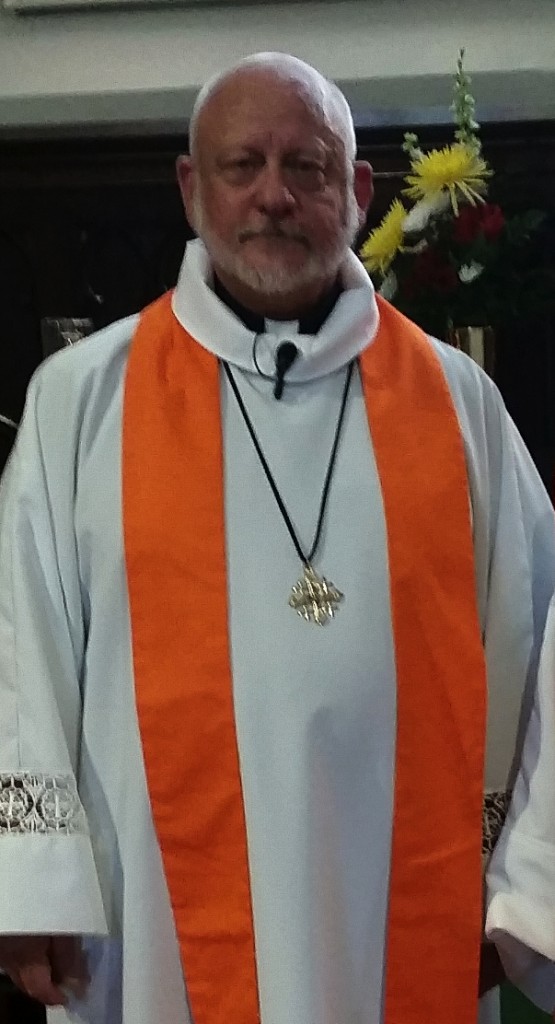
EricOrangeStoleTwenty-four years and 363 days ago I was made a priest; some what more than a year more than that, I have been a deacon. I have been in parish ministry for more than 26 years and on Tuesday I will celebrate the 25th anniversary of my ordination to the Sacred Prebyterate.

I am good at what I do. I know well how to craft liturgy; I take care in what I do and the choices I make in creating the outline of a worship service, and I do a good job. I run a tight ship when it comes to parish administration and management of the church’s resources.

I have been a Diocesan Chancellor, and served on Diocesan Councils, Standing Committees, Commissions on Ministry, Constitution and Canons Committees, and other interim bodies of the church. I have been a deputy to General Convention, an alternate Deputy, and a participant in the church’s deliberative and legislative processes.

I have shepherded aspirants through the church’s ordination process and mentored the newly ordained and the newly assigned; one of my apprentices is now the rector of a major parish in this diocese; another is now bishop in an important and historical diocese; my own son is rector of an important congregation in his diocese.

People tell me I preach a pretty good sermon, though sometimes I don’t recognize the homilies they tell me I have delivered. They tell me I’m good with death, that they want me to officiate at their funerals when the time comes. Others compliment me on the beauty of weddings at which I preside.

I’m a good priest.

And yet I have my demons. Visiting someone in the hospital, or sitting with a family planning a funeral, or counseling a couple prepare for marriage (or a couple in the midst of a marriage possibly coming to an end) … I’m never sure that I have said the right thing. In fact, I’m often positive that I’ve been a complete failure, that nothing I’ve said has made any difference, except perhaps to have made things worse.

Sometimes I get cards, or letters, or emails thanking me for my ministry. I treasure those; I keep them in a special drawer in my desk. More often, I get letters and emails telling me how I have failed, how someone is disappointed in what I have said or done or failed to say or haven’t done, or (worse) I am forwarded a note or email telling someone else like a church warden or a vestry member what a disappointment the rector is.

I don’t keep those – I don’t have to; every single one of them is etched into my consciousness, engraved on my heart; every single one of them hurts as much today as when first read however recent or long ago it may have been. Every one of them is a constant reminder of how I have failed to live up to my ordination vows.

But I’m a good priest; I know I’m a good priest.

I love the people of my parish – you. Sometimes, I don’t like some of you very much, but I love you. I pray for you every morning; I lay awake at night worrying about you; I cry myself to sleep when I feel that I have failed you.

I love you, but I don’t do what I do for you. And when I fail you, when I don’t live up to you expectations, when I preach a word that discomfits you and you push back … it isn’t you to whom I answer. It is the one who sets me free from my demons.

Jesus says to me, as he said Gerasene demoniac, “What is your name?” And demons begin to name themselves, “Parishioner complaint. Parishioner disappointment. Self-criticism.” And then, of course, there’s “Disappointing son. Inadequate father. Second-rate spouse. Poor excuse for an attorney.” The demons are legion. And Jesus gives me permission to let go of them, and gives them permission to leave. Because what I do, I do for him. I do what I do for God. I don’t know where those names, those demons go … maybe into a herd of swine; I don’t know. They go away … sometimes they seem to come back, but mostly they go away.

And sometimes I just want to go away, too; I want to go away with Jesus. I beg that I might just go away and be with him; but Jesus won’t let me. He says to me, “Return to your home, and declare how much God has done for you.” So I preach. I preach about gun violence; I preach about mental health; I preach about community, and fellowship, and love; and I preach about what I read in the newspaper and what I read in the Scriptures. But always, no matter what the subject may seem to be, I preach about how much Jesus has done for me. For 25 years.

For 25 years. And I’m grateful to Jesus who called me to this ministry, who has sustains me in this vocation, and who frees me from my demons. Because of him, I’m a good priest.

====================

A request to my readers: I’m trying to build the readership of this blog and I’d very much appreciate your help in doing so. If you find something here that is of value, please share it with others. If you are on Facebook, “like” the posts on your page so others can see them. If you are following me on Twitter, please “retweet” the notices of these meditations. If you have a blog of your own, please include mine in your links (a favor I will gladly reciprocate). Many thanks!

====================

Father Funston is the rector of St. Paul’s Episcopal Church, Medina, Ohio.

No Grief So Profound: Sermon for Pentecost 3, Proper 5C (5 June 2016)

====================

A sermon offered by the Rev. Dr. C. Eric Funston on the Third Sunday after Pentecost, June 5, 2016, to the people of St. Paul’s Episcopal Church, Medina, Ohio, where Fr. Funston is rector.

(The lessons for the day are Proper 5C of the Revised Common Lectionary: 1 Kings 17:17-24; Psalm 30; Galatians 1:11-24; and St. Luke 7:11-17. These lessons may be found at The Lectionary Page.)

====================

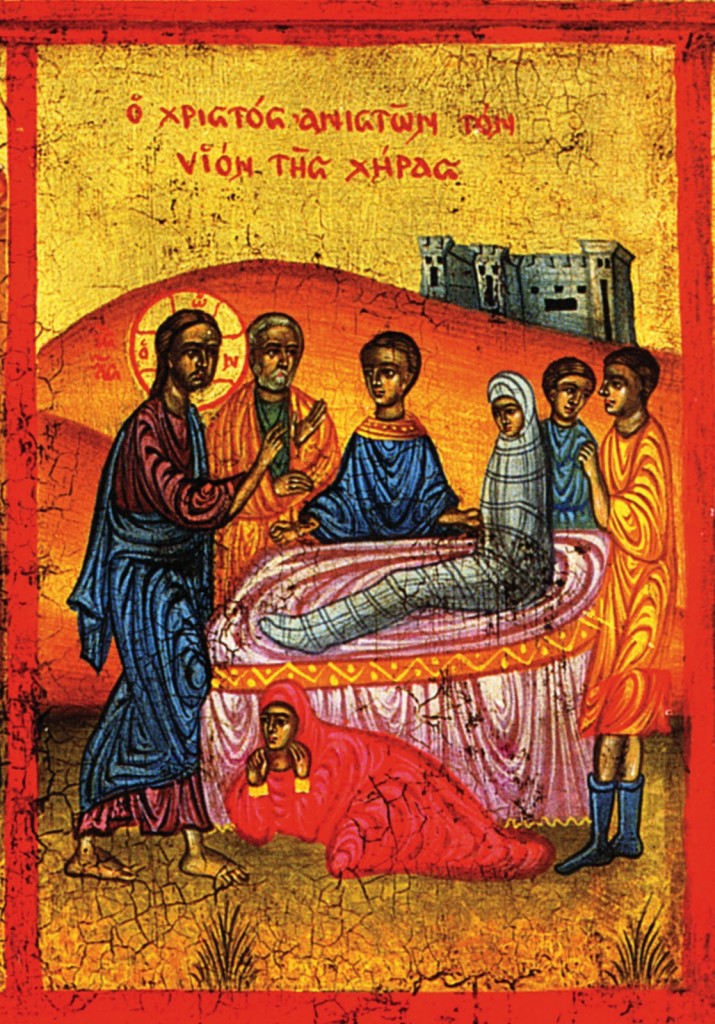
raisingthewidowssonI am convinced that there is no grief quite so profound as that of a mother whose child has died. I know that fathers in the same situation feel a nearly as intense sorrow at the death of their sons or daughters, but having spent time with grieving parents, I am convinced that the grief of a mother faced with the loss of her child is the deepest sadness in human experience.

About nine hundred years before the time of Jesus of Nazareth, the prophet Elijah spoke the word of God during the reign of King Ahab and Queen Jezebel. Jezebel was a foreigner who worshipped the god Ba’al and this was an abomination in Elijah’s eyes, and he was not remiss in letting the queen and everyone else know what he thought of that. He challenged Ahab about his wife and her religion, something the king did not appreciate. So Elijah fled the country; the First Book of Kings tells us that he did so at the command of God, who apparently wished to preserve the life of his prophet.

God sent Elijah during a time of famine to a widow in the Phoenician town of Zarephath. The woman was surprised by Elijah’s demand, pointing out that she had just enough flour and oil to make a last meal for her and her son, after which they expected to die of starvation. Elijah (as we heard) told her not to worry, that if she would feed Elijah, her canister of flour and her flask of oil would never run out until the famine ended. Sure enough that proved to be true. But not long after that meal, her son died.

In anger, out of the depths of that profound sorrow, she lashed out at Elijah: “What have you against me, O man of God? You have come to me to bring my sin to remembrance, and to cause the death of my son!” Elijah, faced with his hostess’s grief and anger, was also angered by the boy’s death. “He cried out to the Lord, ‘O Lord my God, have you brought calamity even upon the widow with whom I am staying, by killing her son?’”

Nearly a millennium later, Luke tells us that Jesus also encountered another grieving mother. Entering the town of Nain, he encountered a funeral procession for a young man and was confronted by the deep maternal sorrow of his widowed mother. In our English translation, Luke says that Jesus felt compassion for the woman. The Greek word is a little earthier: splagchnizomai. It is derived from the word splagchna, which means “entrails” or “intestines”. It means, literally, to have one’s gut wrenched; it says that one has a feeling deep in one’s gut, the deepest of all human emotions, the kind of feeling that is physical as much as emotive. The best definition I’ve ever heard of splagchnizomai is that it is a lurching feeling deep in your gut that compels you to do something. That is a great description for both Jesus’ compassion for the widow of Nain and Elijah’s anger at the death of the son of the widow of Zarephath.

Today, in follow up to our Ninth Annual Gentlemen’s Cake Auction, we welcome and honor Michelle Powell, a single mother of two, who in the summer of 2000, had that sort of feeling deep in her gut that compelled her to do something. With limited resources, offering nothing more than a simple meal and a game of kickball at the local park, she started Let’s Make a Difference and began a journey that would ultimately change her life and positively impact the lives of many at-risk children in need in the Medina community. The mission of Let’s Make a Difference is “to provide positive social growth in the lives of children in need through educational, spiritual and creative experiences, promoting the fact that each person can make a difference.” This summer Let’s Make a Difference will offer character development activities, field trips, academic enrichment, arts and crafts, games and lots of fun, and make a huge difference in the lives of many of Medina’s underprivileged children.

We also welcome and pay tribute to retired educator Carol Andregg. In 2007, as an outgrowth of Let’s Make a Difference, Michelle and Carol started an after-school program for students at Claggett Middle School. Called Achieving Connections through Education (or “ACE”), the program assists students on four days of a typical five-day school week with daily homework assignments, longer term projects, behavioral issues, and developing respect for self and others. ACE has made a significant impact in the lives of their students, many of whom have successfully completed high school and gone on to college. Today, we honor and support Michelle, Carol, Let’s Make a Difference, and Achieving Connections through Education with a grant of $2,635, the total amount raised through this year’s cake auction. (See the Let’s Make a Difference Website)

Writing about the gospel story we have heard this morning, the Rev. Lia Scholl, pastor at Richmond Mennonite Fellowship in Richmond, Virginia, has offered what she calls a four-lesson, do-it-yourself guide to healing like Jesus.

#1: Pay Attention

The first lesson? We have to be paying attention. Jesus is walking along, sees a funeral procession and notices the mother of the deceased boy or man. He notices her.

#2: Give a Crap

The second lesson? Give a crap. How easy it would have been for Jesus to just walk on by. No one expected him to heal every sick or dead person who crossed his path. Jesus gave a crap.

#3: Be Willing to Feel

The third lesson? We have to be willing to feel. The NIV translates this passage as “his heart went out to her.” We have to be willing to hurt. That’s what compassion is. To share in someone’s pain.

#4: Healing Can Happen

The fourth lesson? We just walk up to someone who is dead and we command that they get better. It works! It really works. No, it doesn’t.

The fourth lesson is that healing can happen if the other things are in place. It may not be supernatural, immediate healing. But healing can happen . . . .

(How to Heal Like Jesus: Luke’s DIY Guide to Healing People)

I think Pastor Scholl has pretty well encapsulated everything we need to learn from these stories of mothers whose children died and from the ministry done in each case by Elijah and Jesus: pay attention, care so much you do something, be willing to be hurt, and trust that healing can happen. That’s what Michelle and Carol have done and why Let’s Make a Difference is making a difference. That’s what good people throughout time have done.

polio-deaths2The year that I was born was the worst of the mid-20th Century polio epidemic; about 55,000 Americans contracted the disease that year and more than 3,100 died, mostly children. As a society, we decided that that much illness and death was simply unacceptable, and an all-out effort was underway to put an end to it. Within just a few years, Jonas Salk and his team developed the vaccine which ended the epidemic; a few years later, the Sabin oral vaccine was developed and polio has been just about eradicated throughout the world. (Graphic from Polio Cases, Deaths, and Vaccination Rates.)

We are now in the midst of an even more deadly epidemic in this country, an epidemic of gun violence, and that is the point of the odd-colored stole I am wearing today.

Wear_Orange_InstagramOn January 21, 2013, Hadiya Pendleton, a 15-year-old high school student from the south side of Chicago, marched with her school’s band in President Obama’s second inaugural parade. One week later, Hadiya was shot and killed. She was shot in the back while standing with friends inside Harsh Park in Kenwood, Chicago, after taking her final exams. She was not the intended victim; the perpetrator, a gang member, had mistaken her group of friends for a rival gang.

On Hadiya’s birthday, June 2, her friends chose to wear orange, the color hunters wear in the woods to protect themselves, to remember her life. What started in a south side high school to celebrate Hadiya has turned into a nationwide movement to honor all lives cut short by gun violence. Now, June 2 each year is National Gun Violence Awareness Day, and those who participate wear orange to celebrate of life, to raise awareness of the scourge of gun violence, and to call for action to help save other lives from gunfire. (See Wear Orange)

This year, beginning here in Ohio, Episcopal clergy and clergy of many other denominations, including many of our bishops, have decided to wear out-of-the-ordinary orange vestments for the same purpose. (See Episcopal News Service) Too many of us have sat with and held the hands of too many mothers, too many fathers whose children have died, too many widows of Zarephath, too many widows of Nain. We have felt the rage of Elijah and the gut-wrenching compassion of Jesus but, unlike them, we are unable to change the circumstances. If we could have prevented those deaths, we would; if we could raise those dead children, we would. We can’t. But what we can do is raise awareness.

Here are just a few of the realities of the gun violence epidemic in this country:

  • On an average day in America, 91 people die from gun shots. If you compute that out, you’ll find that the number of deaths per year is more than 33,000; that is ten times the number of deaths from polio in the worst year of that epidemic. (See Everytown for Gun Safety)
  • Sometimes we hear people claim that the risk of gun death, especially the risk to children and teens, is higher in urban areas than in the suburbs or in rural communities. The fact is that the risk of gun death is the same in all areas, although the underlying reason for the death may be different: “Youth (ages 0 to 19) in the most rural U.S. counties are as likely to die from a gunshot as those living in the most urban counties. Rural children die of more gun suicides and unintentional shooting deaths. Urban children die more often of gun homicides.” (See Brady Campaign: About Gun Violence)
  • 64% of all gun deaths are suicides. (See Everytown for Gun Safety) “Someone with access to firearms is three times more likely to commit suicide” than someone living in a home where there are no guns. (See Access to Guns Increases Risk of Suicide)
  • Last week there was an enormous amount of news coverage about the shooting and killing of the silver-back ape Harambe at the Cincinnati Zoo. While that was a tragedy, I suggest to you that even more tragic were the three shootings of human beings in Ohio which were statistically likely to have happened the same day. Did you know that? That, statistically, an Ohio resident is shot to death every eight hours? In 2011 in this state “an average of one aggravated assault with a firearm [occurred] every two and a half hours.” (See Fact Sheet: Ohio Gun Violence)
  • Did you know that during the current year alone there have been 121 mass shootings (in which four or more persons were injured or killed) in the United States? That’s more than five per week, and more than half of those were the result of a family or domestic dispute; very many of the victims of those shootings were children. (See Gun Violence Archive)
  • Did you know that since the Sandy Hook school shooting in Newtown, Connecticut, on December 14, 2012, there has been at least one on-campus shooting in a school or college nearly every week? More than 160 incidents in which 59 people were killed and 124 were injured. (See Analysis of School Shootings)
  • Did you know that seven children and teens (age 19 or under) are killed with guns in the U.S. on an average day? (See Brady Campaign: About Gun Violence)

Seven mothers every day suffer the profound, gut-wrenching, soul-deep sorrow of the widows of Zarephath and Nain because of the preventable deaths of their children.

Gun violence is an epidemic far worse than the polio epidemic. Unlike the polio epidemic, however, it is one about which we need do no research to stem! We know the cause and we know how to stop it. If guns were a disease that killed 30,000 or more, this epidemic would have ended long ago. And yet we take no action to put an end to it.

Scholars often debate the historical accuracy of stories from the Bible; these two stories today get a lot of attention in that regard. But whether they are historically accurate or not is really not the point. These stories have a lesson to teach. As theologian Bill Loader says,

Whether or not one wants to defend the historicity of such accounts or is happy to see them as legendary expressions of faith, they still have a role within a broader perspective. [The story of Jesus raising the son of the widow of Nain], in particular, deserves to be allowed its symbolic potential. The ministry of Jesus and ours is about addressing real human need and it is about compassion. This is indeed his mission, God’s mission.

Such compassion and caring in action has few short-cuts to success, if any. A cross stands in the road, which unveils reality for both the carers and the world in need of care. In the midst of the complexity of human need is hope and the possibility of renewal and life. It is built on the foundation that all people are of value and none is to be dismissed or despised. Our world still needs that kind of good news and our challenge is to become it and help others become it. (First Thoughts on Year C Gospel Passages from the Lectionary)

Our gift to the good people of Let’s Make a Difference and the marvelous work they do with at-risk children in Medina is a significant step in God’s mission of compassion, but it is only one step. These children, our children, our grandchildren are at risk every day from dangers, some of which we cannot know or imagine, but one of which we know all too well, the epidemic of preventable gun violence.

About the story of Elijah and the dead boy in Zarephath, Presbyterian pastor MaryAnn McKibben Dana, author of Sabbath in the Suburbs, writes:

As a minister of the gospel, I cannot bring ailing boys back to life – how I wish I could. But this story convicts me that while I am called to offer presence and a message of grace to people hungering for wholeness and justice, presence and eloquent words are not enough. This widow would surely offer an “Amen” to James when he wrote, “If a brother or sister is naked and lacks daily food, and one of you says to them, ‘Go in peace; keep warm and eat your fill’, and yet you do not supply their bodily needs, what is the good of that?” Elijah is not off the hook simply because the jars of meal and oil have not run out. He must do all he can for the continued well-being of her son. (Political Theology Today)

We are not let off the hook by our grant to Let’s Make a Difference; we must do all we can for the continued well-being of the children they serve and of all the children of our community and our nation. That means being aware of and working for the end of the epidemic of gun violence which threatens them.

Carolyn Winfrey Gillette is another Presbyterian elder who writes hymns. Her hymn God of Mercy, You Have Shown Us was written at the request of the Presbyterian Peacemaking Program for an International Peace Day in September, 2009. I will close with her lyrics as a prayer:

God of mercy, you have shown us ways of living that are good:
Work for justice, treasure kindness, humbly journey with the Lord.
Yet your people here are grieving, hurt by weapons that destroy.
Help us turn to you, believing in your way that brings us joy.

On a street where neighbors gather, shots are heard; a young girl dies.
On a campus, students scatter as the violence claims more lives.
In a family filled with anger, tempers flare and shots resound.
God of love, we weep and wonder at the violence all around.

God, we pray for those who suffer when this world seems so unfair;
May your church be quick to offer loving comfort, gentle care.
And we pray: Amid the violence, may we speak your truth, O Lord!
Give us strength to break the silence, saying, “This can be no more!”

God, renew our faith and vision, make us those who boldly lead!
May we work for just decisions that bring true security.
Help us change this violent culture based on idols, built on fear.
Help us build a peaceful future with your world of people here.

(Gun Violence Prevention: Worship Resources)

There is no grief so profound as that of the widows of Zarephath and Nain, the grief a mother whose child has died. Let us do all in our power to prevent that grief whenever we can. Let us learn from Jesus: pay attention to what is happening, care so much we do something, be willing to be hurt, and trust that this epidemic can be healed. And let us make a difference! Amen.

====================

A request to my readers: I’m trying to build the readership of this blog and I’d very much appreciate your help in doing so. If you find something here that is of value, please share it with others. If you are on Facebook, “like” the posts on your page so others can see them. If you are following me on Twitter, please “retweet” the notices of these meditations. If you have a blog of your own, please include mine in your links (a favor I will gladly reciprocate). Many thanks!

====================

Father Funston is the rector of St. Paul’s Episcopal Church, Medina, Ohio.

A Wedding Homily – Sunday, 15 May 2016

====================

A homily offered by the Rev. Dr. C. Eric Funston at the Blessing of the Civil Marriage of Christopher William White and Robert William Powell, May 15, 2016, to the people assembled at First Congregational Church, 91 South Main Street, Sunderland, MA.

(The lessons for the service were: the poem who are you, little i by e.e. cummings; an excerpt from The Velveteen Rabbit by Margery Williams; and a portion of the Beatitudes (Matthew 5:1–10, NRSV). These lessons are set out below after the sermon.)

====================

marriagestoleWhy are we here? Well, for a wedding, of course. But, more specifically, you may be wondering why an old Episcopal priest from Ohio is here in an 18th Century Puritan meeting house trying to do 21st Century Anglo-Catholic ritual. The short answer is that Chris asked me to. Chris was my music director at St Paul’s Church in Medina, Ohio, when he was a student at Oberlin (which his mother reminded me yesterday was just a few weeks ago), and we’ve been friends ever since.
The long answer to why we are all here is that we love these two men, that we wish them well, that we want to support them in this endeavor called “marriage,” and that we are asking God to bless them today and throughout their life together which (we hope) will be for life.

We’ve been treated to some readings, not all from Scripture, which they have chosen and which speak to them and to us about this thing they are doing.

First, that delightful little poem by e.e. cummings, who are you little, i – a bit of verse which reminds us of the magic of childhood which we sometimes seem to lose as we age. Cummings reminds us that it is never lost, but that it does often get buried under the pressures of adult life, and as anyone who is married will tell us, there are few adult demands more pressing than those of marriage. Chris and Rob have each just promised “to love [the other], comfort him, honor and keep him, in sickness and in health,” and to be faithful to him for life. Those are heavy promises, heavy obligations; they can weigh us down and bury the “little, i”. Another poet, Mary Oliver, has an answer to that concern which I will share with you in a moment.

Then we heard that wonderful excerpt from everyone’s favorite childhood book, Margery Williams’ The Velveteen Rabbit in which the Skin Horse observes that love is what makes us real and that people with hard edges or sharp corners, or break easily, seldom become real, and in which we see the Rabbit become real as his hair is loved off, his tail becomes unsewn, and the pink is kissed off his nose.

Chris and Rob have paired these readings with the Beatitudes, Jesus’ list of people who are blessed not because of anything they do but because of who they are. This is not Jesus’ social program; he’s not laying out a course of conduct by which we can earn blessedness. It occurred to me as I went over these three readings that what Jesus is doing is describing people whose “little, i” has not been buried (or, if it was buried at one time, it has been dug up again); he describing those who either never had sharp edges, or whose sharp edges have been softened and worn away, whose hair has been loved off by others, who have been hugged by others so tightly that their joints are loose and shabby, whom people have kissed so often that the pink has rubbed off their noses. And he is here promising that the reward for being loved like that is blessedness, what the Skin Horse calls “reality.” That is what we hope for Rob and for Chris when we ask God to bless them in this thing, this relationship we call “marriage.”

Marriage in the eyes of the State is a contract; two people make mutual promises and if they fail live up to those promises, the law will take action. If one or both of them later decide they don’t want to honor the contract, they have to go to court to be relieved of its obligations. In the eyes of the church, however, marriage is much more – it is what we call a “sacrament.” A sacrament, we say, is “an outward and visible sign of an inward and spiritual grace.”

So what is the outward and visible sign of marriage? When I ask that question in confirmation classes, the most common answer is “the rings.” Good answer, but not exactly right.

I’m wearing stole which has on it three symbols connected with marriage. The interlocked rings, a funny looking thing that looks like a capitol-P with a crossbar, and palm branch. Although the rings are not the outward and visible sign, on this stole they represent that sign, which is the couple themselves. The sacramental sign of marriage is the two people who live together in the sacramental relationship; they symbolize the grace of human companionship, the possibility of love and peace between individuals so deep and so profound that they (in Jesus’ words) “become one flesh.” They are living symbols of the hope and possibility that all humanity can do that as a world-wide community. In the Skin Horse’s word, they make it real.

But they do not do that as a couple alone, they do that with through the grace and empowerment of God; thus, the second symbol, which isn’t a P-with-a-crossbar. This symbol is a stylized combination of the Greek letter Chi and Rho, the first two letters of the word “Christ”. It reminds us that God a part of, a party to, and a partner in every marriage. In token of that reality, Chris and Rob will share the sacrament of the Eucharist today, another sacrament reminding us of Jesus’ words “Remember, I am with you to the end of the ages.”

The third emblem on my stole is a palm branch. Some of you will remember the story of Jesus’ triumphal entry into Jerusalem which the church celebrates every year on the day called “Palm Sunday.” The people along his path from the Mount of Olives, through the Kidron Valley, and into the Holy City spread his path with branches of palm and waved branches as they sang “Hosanna!” and wished him well. On this stole, this palm branch represents the crowds who support Chris and Rob; in other words, you and all the people you represent! A marriage does not exist in a vacuum; it is a social contract, a sacrament, a way of life lived out in the context of a community and the married couple rely upon that community. Each of these men will not be able to live up to that promise to love, comfort, honor, keep and be faithful to the other unless you help them do it. That’s why we began this service not just with their vows, but with yours. You were asked: “Will all of you witnessing these promises do all in your power to uphold these two persons in their marriage?” and you answered loudly and whole-heartedly, “We will!” They are going to rely on that promise . . . a lot!

So, I suggested that e.e. cummings’ concern about our buried “little, i” has been answered by another poet, Mary Oliver. I will close with her answer, the poem “I worried.”

I worried a lot. Will the garden grow, will the rivers
flow in the right direction, will the earth turn
as it was taught, and if not how shall
I correct it?

Was I right, was I wrong, will I be forgiven,
can I do better?

Will I ever be able to sing, even the sparrows
can do it and I am, well,
hopeless.

Is my eyesight fading or am I just imagining it,
am I going to get rheumatism,
lockjaw, dementia?

Finally I saw that worrying had come to nothing.
And gave it up. And took my old body
and went out into the morning,
and sang.

Chris . . . Rob . . . your “little, i” (like all of ours) is in constant danger of being buried under the concerns of life, none of which are heavier than the promises you have made to be responsible in love to and for one other special person. But you have not made those promises alone; you have the grace and support of God, and you have the love and support of this community of family and friends. So don’t let that heaviness bury you . . . just love one another through rheumatism and lockjaw and dementia and hair being rubbed off and the pink being kissed away; just get up every day and go out into the morning and sing.

The Readings:

who are you, little i by e.e. cummings

who are you, little i

(five or six years old)
peering from some high

window; at the gold

of November sunset

(and feeling: that if day
has to become night

this is a beautiful way)

From The Velveteen Rabbit by Margery Williams

“What is REAL?” asked the Rabbit one day, when they were lying side by side near the nursery fender, before Nana came to tidy the room. “Does it mean having things that buzz inside you and a stick-out handle?”

“Real isn’t how you are made,” said the Skin Horse. “It’s a thing that happens to you. When a child loves you for a long, long time, not just to play with, but REALLY loves you, then you become Real.”

“Does it hurt?” asked the Rabbit.

“Sometimes,” said the Skin Horse, for he was always truthful. “When you are Real you don’t mind being hurt.”

“Does it happen all at once, like being wound up,” he asked, “or bit by bit?”

“It doesn’t happen all at once,” said the Skin Horse. “You become. It takes a long time. That’s why it doesn’t happen often to people who break easily, or have sharp edges, or who have to be carefully kept. Generally, by the time you are Real, most of your hair has been loved off, and your eyes drop out and you get loose in the joints and very shabby. But these things don’t matter at all, because once you are Real you can’t be ugly, except to people who don’t understand.”

That night, and for many nights after, the Velveteen Rabbit slept in the Boy’s bed. At first he found it rather uncomfortable, for the Boy hugged him very tight, and sometimes he rolled over on him, and sometimes he pushed him so far under the pillow that the Rabbit could scarcely breathe… But very soon he grew to like it, for the Boy used to talk to him, and made nice tunnels for him under the bedclothes that he said were like the burrows the real rabbits lived in. And they had splendid games together, in whispers… And when the Boy dropped off to sleep, the Rabbit would snuggle down close under his little warm chin and dream, with the Boy’s hands clasped close round him all night long.

And so time went on, and the little Rabbit was very happy-so happy that he never noticed how his beautiful velveteen fur was getting shabbier and shabbier, and his tail becoming unsewn, and all the pink rubbed off his nose where the Boy had kissed him.

And one night Nana grumbled as she cleaned the rabbit off with a corner of her apron. “You must have your old Bunny!” she said. “Fancy all that fuss!”

The Boy sat up in bed and stretched out his hands. “Give me my Bunny!” he said. “You mustn’t say that…. He’s REAL!

The Beatitudes (Matthew 5:1-10, NRSV)

1 When Jesus saw the crowds, he went up the mountain; and after he sat down, his disciples came to him.

2 Then he began to speak, and taught them, saying:

3 “Blessed are the poor in spirit, for theirs is the kingdom of heaven.

4 “Blessed are those who mourn, for they will be comforted.

5 “Blessed are the meek, for they will inherit the earth.

6 “Blessed are those who hunger and thirst for righteousness, for they will be filled.

7 “Blessed are the merciful, for they will receive mercy.

8 “Blessed are the pure in heart, for they will see God.

9 “Blessed are the peacemakers, for they will be called children of God.

10 “Blessed are those who are persecuted for righteousness’ sake, for theirs is the kingdom of heaven.”

====================

A request to my readers: I’m trying to build the readership of this blog and I’d very much appreciate your help in doing so. If you find something here that is of value, please share it with others. If you are on Facebook, “like” the posts on your page so others can see them. If you are following me on Twitter, please “retweet” the notices of these meditations. If you have a blog of your own, please include mine in your links (a favor I will gladly reciprocate). Many thanks!

====================

Father Funston is the rector of St. Paul’s Episcopal Church, Medina, Ohio.

Wear Orange Sunday, June 5, 2016

I just banged out this little “press release” for use by Everytown for Gun Safety and others. Thanks to the Rev. Rosalind Hughes for picking up on my off-the-cuff remark about Gun Violence Awareness Day, goading me into making this happen, and doing the sewing so there are orange stoles to wear on what will now be Wear Orange Sunday, June 5, 2016. Thanks, too, to my colleagues who agreed to join me in wearing orange and to the Rev. Jeff Bunke who took our picture.

==========================================

Wear Orange Sunday, June 5

“One should learn not to make off-the-cuff remarks on Facebook,” the Rev. Dr. C. Eric Funston, rector of St. Paul’s Episcopal Church, Medina, Ohio, told a gathering of clergy in the Episcopal Diocese of Ohio. “It only seems to create more to do.”

In late April, Funston had seen Everytown for Gun Safety’s announcement of Gun Violence Awareness Day on June 2 and the Wear Orange campaign to draw attention to it. He shared the post on his Facebook page and commented, “Perhaps I can find an orange stole to wear on the Sunday after.”

His colleague the Rev. Rosalind Hughes of Church of the Epiphany, Euclid, saw the remark and offered to make an orange stole for him, as well as any other clergy in the diocese who might be interested. Hughes wrote a blog post about the idea and shared it with the diocesan clergy. One thing led to another and by the time of the diocesan clergy conference in early May at least a dozen clergy had expressed an interest. Hughes went to work finding some hunters’ “safety orange” fabric and sewing the stoles; she had completed sixteen by the conference.

Meanwhile, Funston contacted Everytown for Gun Safety and its partner organization, [Episcopal] Bishops United Against Gun Violence, to inquire whether there would be interest in the idea beyond Ohio. He was assured by Travis Hirschbach, Everytown’s Political and Elections Coordinator, that there would be and, thus, Gun Violence Awareness or “Wear Orange” Sunday was born.

The Rev. Ms. Hughes wrote in her blog that the “orange stole is not a statement that I want you to see me. It is a plea and a penance and a proclamation: that we have something to say about this, we people of faith. That we have something to say to the violence of death and destruction. That we have seen, and noticed, and that we are not unchanged, unturned, unmoved, we who are alive.” The Episcopal Diocese of Long Island, where Bishop Larry Provenzano is a member of Bishops United, posted recently, “Priests are encouraged to wear orange stoles at church on June 5,” citing Ms. Hughes’ essay.

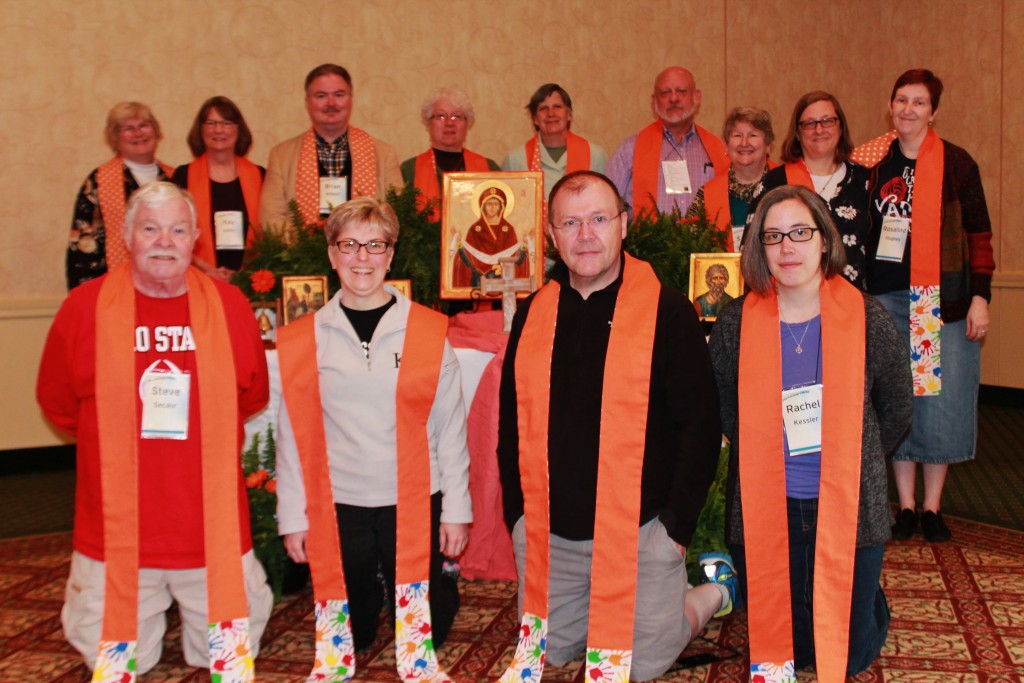
Ms. Hughes brought twelve of the completed stoles to the diocesan clergy conference (four had already been given to clergy who couldn’t be there). Funston shared their story with the gathered priests and invited any who wished to participate to take one. A dozen clergy did so, committing to wear them as a witness to gun safety on June 5, 2016. The participating clergy are pictured in the accompanying photograph: (Back Row) Mary L. Staley of St. Paul’s, Put-in-Bay; Kay N. Ashby of St. Matthew’s, Ashland; Brian K. Wilbert of Christ Church, Oberlin; June Hardy Dorsey of St. Andrew’s, Elyria; Beth Frank of New Life, Uniontown; C. Eric Funston of St. Paul’s, Ohio; Sarah Shofstall of St. Barnabas, Bay Village; Gayle L. Catinella of St John’s, Youngstown; Rosalind Hughes of Epiphany, Euclid. (Front Row) Stephen Secaur of St. Bartholomew, Mayfield Village; Mary C. Carson of Redeemer, Lorain; Christopher McCann of St. Luke’s, Chardon; Rachel C. Kessler of Harcourt Parish, Gambier. (Photo taken by the Rev. Jeff Bunke, Perrysburg, Ohio)

WearOrangeClergy

These clergy of the Episcopal Diocese of Ohio invite clergy everywhere to join them in making their congregations aware of the problem of gun violence in our society.

“In Order That” – Sermon for Easter 5C – April 24, 2016

====================

A sermon offered by the Rev. Dr. C. Eric Funston on the Fifth Sunday of Easter, April 24, 2016, to the people of St. Paul’s Episcopal Church, Medina, Ohio, where Fr. Funston is rector.

(The lessons for the day are Acts 11:1-18; Psalm 148; Revelation 21:1-6; and St. John 13:31-35. These lessons may be found at The Lectionary Page.)

====================

janitorbucketDr. Robert Waldinger is the current director of the Harvard Study of Adult Development which is something called “a longitudinal cohort study” in which the same individuals are observed over a long study period. It is the longest running study of this kind in history. For 75 years researchers have tracked the lives of 724 men from all walks of life.

Last November, Dr. Waldinger gave a TED talk entitled What makes a good life? in which he drew on the results of the Harvard study. This is some of what he said:

The clearest message that we get from this 75-year study is this: Good relationships keep us happier and healthier. Period.

We’ve learned three big lessons about relationships. The first is that social connections are really good for us, and that loneliness kills.

And we know that you can be lonely in a crowd and you can be lonely in a marriage, so the second big lesson that we learned is that it’s not just the number of friends you have, and it’s not whether or not you’re in a committed relationship, but it’s the quality of your close relationships that matters. It turns out that living in the midst of conflict is really bad for our health.

And the third big lesson that we learned about relationships and our health is that good relationships don’t just protect our bodies, they protect our brains.

Over and over, over these 75 years, our study has shown that the people who fared the best were the people who leaned into relationships, with family, with friends, with community.

The good life is built with good relationships.

So . . . last week I began my sermon by trying to sing Led Zeppelin’s classic rock song Stairway to Heaven and, in the homily, I suggested to you that, unlike the lady in the song, we do not need to buy or build such a stairway because the good news of Jesus’ Gospel is that heaven is already here: “The kingdom of heaven has come near.” (Mt 10:7) “The kingdom of God has come to you.” (Mt 12:28) It’s here; we don’t need to worry about getting there. And later in the week I got some feedback about that sermon; two people asked questions about it.

One asked, “Don’t you believe in an afterlife?” That’s the easy question to answer, “Yes, I do. But I’m not concerned about it.” I trust that Jesus was telling the thief on the other cross the truth when he said, “Today you will be with me in Paradise.” (Lk 23:4) I believe he was telling the truth to the disciples when, speaking of his own death, he told them “I go to prepare a place for you.” (Jn 14:2) I believe that the afterlife is a given and that there is nothing we need to do, indeed there is nothing we can do, to “earn” it. As the Eucharistic preface used during a requiem in the Episcopal Church says, “to [God’s] faithful people . . . life is changed, not ended; and when our mortal body lies in death, there is prepared for us a dwelling place eternal in the heavens.” (BCP 1979, page 382)

The second question was a little tougher: “What about someone whose life just sucks? How can you say to someone like that that heaven is here?” Now that’s a good question. And the answer lies in that research done by Dr. Waldinger and his colleagues and their predecessors, and in today’s Gospel lesson, particularly in Jesus’ words, “I give you a new commandment, that you love one another. Just as I have loved you, you also should love one another.” (Jn 13:34) – This is the way our New Revised Standard Version translates the Greek. There may be a better way to translate it, but let’s go with this for the moment.

Seminary professor Karoline Lewis writes of today’s Lectionary reading:

Jesus’ command to love one another is dangerously out of context. Read without its literary framework, it becomes another biblical platitude quoted by those who think it’s easy and who rarely stick to it themselves. It ends up on posters with the backdrop being some sort of idyllic scene of an ocean, snow-capped mountains, a rushing waterfall, or birds flying across a bright blue sky. It actually seems doable. (Resurrection Is Love)

But, she points out, lovely scenery and idyllic circumstances are not the context of this “new commandment.” Rather, it was given to the disciples at a time when evil seemed to be getting its way. It was spoken at the end of the Last Supper when someone Jesus and the others thought they could trust had just left to betray especially him and in reality all of them. Jesus commanded his followers to love at time “when the actions and words of others clearly [came] from hate and suspicion and prejudice;” in the words of my questioner, at a time when life sucked!

Jesus’ “new commandment,” says Prof. Lewis, “remind[s us] to choose love when evil seems to be having its way,” when life sucks. “And,” she says, “our decision to choose love does not even have to be in the face of the most overt and blatant expressions of its opposite. Our lives are full of minor incidents, if you will, when we can decide to come from a place of love rather than one of frustration and anger and judgment.”

Theologians sometimes use the word irruption when talking about the Kingdom of God. It is a word related to such ideas as eruption (a breaking out of something) and disruption (a breaking apart). Irruption means “to break into.” It conveys the idea that God’s rule, the kingdom of heaven, has broken into our reality. “The kingdom of God has come to you.” When we make the choice of love, we actualize that irruption; we make that in-breaking of heaven apparent and perceivable in a world which seems very much to the contrary.

But we are left, still, with a very serious question: How do we do that? If the “new commandment” is that we are to love one another, what does that mean? How are we to love one another? What are to be the manifestations of this love we are commanded to have?

Elizabeth Johnson, who teaches theology in Cameroon, points out that in John’s narrative the “new commandment” is bracketed by two stories of action. (Commentary) The first is Jesus washing the feet of his disciples about which he says: “If I, your Lord and Teacher, have washed your feet, you also ought to wash one another’s feet. For I have set you an example, that you also should do as I have done to you.” (Jn 13:13-15) The second is the crucifixion about which Jesus says: “No one has greater love than this, to lay down one’s life for one’s friends. You are my friends if you do what I command you.” (Jn 15:13-14)

These two actions parallel and help to flesh out the meaning of the “new commandment”. On the one hand, “love one another” compels us to “heroic acts of great risk; it extends even to the point of giving one’s life for another.” On the other, “loving one another as Jesus has loved encompasses the mundane; it means serving one another, even in the most menial tasks.”

So that’s one way to understand the “new commandment” – that we are commanded to love one another and to act out that love in these sorts of ways. But some will object that love cannot be commanded, and that telling someone to love another and demanding that the one serve the other only breeds resentment and contempt. I know this from experience and I suspect you do, as well.

For that reason, I find the work of a Presbyterian pastor named Mark Davis compelling. Pastor Davis has a Ph.D. in theology and is very accomplished in the study and translation of Greek. He has recently made the argument that our typical translation of John is wrong and that, as a result, we haven’t properly understood the “new commandment.” It’s easier to show you his argument than it is to tell it, so I’m going to put a slide up on the big screen TV. (Commanding Love; see also ‘In Order That’ You May Love)

Here’s what we’ve got:

greekcolorcode

This is John 13:34 in the original Greek, and the lower color-coded text is Dr. Davis’s translation. The color coding helps to explain his argument.

Dr. Davis first points out that the original Greek is one sentence, not two. The translation in the New Revised Standard Version breaks it into two sentences. Second, he points out that the Greek is written in a poetic form called “parallelism,” which is the balanced and symmetrical repetition of a thought or idea in slightly different forms as a way to emphasize the message. The New Revised Standard fails to honor the parallelism and, in fact, adds an imperative that simply isn’t there. Third, he points out that the Greek word “hina” (which he has color-coded in red) has been either overlooked or possibly mistranslated.

This third point is really the most important. Pointing out that the word “hina” can be translated either as “that” or as “in order that,” and that “hina” is normally understood to specify purpose, Dr. Davis suggests the second translation, as shown here, is the better choice.

Thus, the “new commandment” is not simply “love one another.” The “new commandment” is something else that Jesus has said, done, or taught which enables us to love one another in the same way that his empowering love enables us to do so.

Therefore, Dr. Davis’ asks, “What is the new command ([of] which loving one another is the result)?” and answers his own question, “I would suggest that the whole demonstration of Jesus washing the disciples’ feet is the command.” In other words, the “new commandment” is not to love one another, it is to do what Dr. Johnson called those “mundane, menial tasks” and from that work will flow the capacity for and the actuality of loving one another, from that work will flow the actualizing and appreciation of the irruption the kingdom of God, from that work will flow the realization that “the kingdom of heaven has come near.” I know, from personal experience, that this is true.

In the spring of 1971, I was 18 years old and finishing my sophomore year of college. And I was failing, badly. So I dropped out. I went to work in a hospital where I eventually worked as an orderly, but I didn’t start out as an orderly. I started out as a janitor. Once I had learned how to clean toilets and mop floors in proper hospital fashion, I was turned loose to take care of the common areas and of the patient rooms.

Early in my employment, I became acquainted with Mr. Aronson. I have no idea what Mr. Aronson’s medical problem was . . . all I know is that whatever it was it made Mr. Aronson’s life miserable. Mr. Aronson’s digestive system was out of control. If he ate, he vomited and he had diarrhea. His doctors were trying to treat this, of course, and he had to eat to see of the treatment was working, and most of the time it seemed it wasn’t. Nearly every day I would get a call to go to Mr. Aronson’s room where I had to mop the floor of either puke or feces and to gather up soiled bed linens. I hated getting those calls. I hated going to that room. I hated mopping that smelly floor and packing up those stinking linens and, I’m sorry to say, I hated Mr. Aronson. His life sucked and it was making my life suck.

And he knew it. He knew his life miserable and that his misery was negatively impacting everyone around him. But he must have known something else because he never acted that way. He was always gracious and he was always grateful. I’d show up with my 18-year-old “I hate being here” attitude, and if he was awake he would greet me courteously. I’d mop up his puke and his diarrhea, and stuff his soiled linens into a laundry bag, and he’d thank me. I didn’t want to be there; I didn’t want to deal with his mess or his smelly sheets; and I didn’t want his gratitude. But, when you’re employed as a hospital janitor, that’s what you do.

And after several days of doing that, you stopped noticing the smell and the misery. Instead, you looked forward to the greeting and you were grateful for the gratitude. And when, after a few weeks, Mr. Aronson died because they couldn’t fix whatever was wrong with him, you wept because, you discovered, you no longer hated Mr. Aronson. You loved Mr. Aronson; he had become your friend, and your friend was gone.

Mr. Aronson, it turned out, was the rabbi of the local Reform Jewish synagogue. His wife invited all of the hospital employees who had taken care of him, even us janitors, to attend his funeral, and it was there that I first heard and first recited the prayer called The Mourner’s Kaddish:

Glorified and sanctified be God’s great name throughout the world
which He has created according to His will.
May He establish His kingdom in your lifetime and during your days,
and within the life of the entire House of Israel, speedily and soon;
and say, Amen.
May His great name be blessed forever and to all eternity.
Blessed and praised, glorified and exalted, extolled and honored,
adored and lauded be the name of the Holy One, blessed be He,
beyond all the blessings and hymns, praises and consolations that
are ever spoken in the world; and say, Amen.
May there be abundant peace from heaven, and life, for us
and for all Israel; and say, Amen.
He who creates peace in His celestial heights,
may He create peace for us and for all Israel;
and say, Amen.

I think that what Mr. Aronson knew that allowed him to be gracious and grateful is what I have come to know and believe: that if we will just take care of one another doing whatever mundane, menial tasks are needed, God will establish his kingdom in our lifetime and there will be abundant peace from heaven and life for all of us. From those mundane, menial tasks flows the capacity for and the actuality of loving one another, and that from that love flows the realization that “the kingdom of heaven has come near.”

Whether we understand the “new commandment” to be “love one another” or to be “do these things in order that love for one another can grow,” the point of Jesus’ “new commandment” is to foster good relationships between people, those good relationships that Dr. Waldinger’s research has shown are the foundation of a good life. I have faith that sometime in the future the kingdom of heaven will be complete and God will exercise a gracious and just control over everything in (and outside of) time and space, but I know that right now heaven is close at hand through Christians and other good people, individually and collectively, engaging the world in acts of love, both mundane and heroic.

Jesus insists that the kingdom of heaven is close at hand when we love one another. Medical science has proved it: “The good life is built with good relationships.” So I can say with confidence that heaven is here now, even for the person whose life sucks. Mr. Aronson taught me that. Amen.

====================

A request to my readers: I’m trying to build the readership of this blog and I’d very much appreciate your help in doing so. If you find something here that is of value, please share it with others. If you are on Facebook, “like” the posts on your page so others can see them. If you are following me on Twitter, please “retweet” the notices of these meditations. If you have a blog of your own, please include mine in your links (a favor I will gladly reciprocate). Many thanks!

====================

Father Funston is the rector of St. Paul’s Episcopal Church, Medina, Ohio.

Stairway to Heaven – Sermon for Easter 4C – April 17, 2016

====================

A sermon offered by the Rev. Dr. C. Eric Funston on the Fourth Sunday of Easter, April 17, 2016, to the people of St. Paul’s Episcopal Church, Medina, Ohio, where Fr. Funston is rector.

(The lessons for the day are Acts 9:36-43, Psalm 23, Revelation 7:9-17, and St. John 10:22-30. These lessons may be found at The Lectionary Page.)

====================

Stairway to HeavenThere’s a lady who’s sure
All that glitters is gold
And she’s buying a stairway to heaven
When she gets there she knows
If the stores are all closed
With a word she can get what she came for . . .

As I read and pondered both the vision of heaven in John of Patmos’ Revelation and the words of Jesus – “My sheep hear my voice. I know them, and they follow me” (Jn 10:27) – I could not get the words of Led Zeppelin’s Stairway to Heaven out of my head!

The metaphor of God’s Presence – and of our future and eternal life with God – in a place “beyond the sky” may be the oldest metaphor in the human lexicon. It is shared, in some form, by every culture on earth. Our distant ancestors standing at night and gazing at the moon and the stars, watching the sun as “wide he goes through empty heaven with repose” (RL Stevenson, Summer Sun), or facing “the fierce wind, while mid-day lightnings prowl [and] untimely thunders growl” (Wm Wordsworth, Composed During A Storm) conceived of the sky as a place of unspeakable and unimaginable power, the dwelling place of the gods.

But we have been there; we “have slipped the surly bonds of earth, and danced the skies on laughter-silvered wings;” we have “trod the high untrespassed sanctity of space.” (JG Magee, Jr, High Flight) Men have walked on the moon and our machines are even now wondering the surface of Mars; our probes have studied the moons of Jupiter and the rings of Saturn, and then left the planetary system entirely moving on “through corridors sublime, the [realms] of interstellar space and [the passageways] of time.” (And Have the Bright Immensities, The [Episcopal] Hymnal 1982, Hymn 459) We know that beyond the blue dome of our earthly sky is not some otherworldly domain filled with angels and gods, but the physical reality of the Solar System, the Milky Way galaxy, and the limitless universe. And, yet, the metaphor of heaven up there beyond the sky where we may get to go when we die, that metaphor still captures our imaginations and our spirits.

Our lesson from the Book of Revelation today is the second half of a two-part vision shown to John in Chapter 7 of the book; it begins with the words “After this. . . .” – “After what?” we may ask. In the first eight verses of the chapter, John is shown the “servants of our God [marked] with a seal on their foreheads,” an army numbering 144,000 – 12,000 from each of the Twelve Tribes of Israel. These represent what we traditionally call “the church militant,” defined theologically as Christ’s “disciples [who] are pilgrims on earth” (CCC 954), who are “engaged in constant warfare against the world, the flesh and the devil” (Turner, H.M., The Genius and Theory of Methodist Polity, A.M.E. Church, Philadelphia:1885, online). In other words, you and me and every other Christian currently alive, the people doing Jesus’ work on earth right now. Bible commentator Christopher C. Rowland of Oxford University tells us that the number, 144,000, is neither exclusive nor limiting; instead, like all of the numbers and measures in the book, it is a sign of God’s possession and ownership of the earth and its people. John’s numbers are not “a measure of the success of human endeavours.” (NIB, Vol. XII, page 620)

It is after this part of the vision that John then sees the “great multitude that no one could count, from every nation, from all tribes and peoples and languages, standing before the throne and before the Lamb.” (Rev. 7:9) This is “the church triumphant,” those who have died and “are in glory, contemplating ‘in full light, God himself triune and one, exactly as he is.’” (CCC 954) In a word, these are the “saints in heaven.”

John says that “one of the elders” in his vision describes them as those “who have come out of the great ordeal.” (vv 13-14) Early translations use the term “great tribulation” and many have suggested that this refers to some kind of organized persecution that may have been experienced by John’s original audience. But other scholars suggest that “the ‘tribulation’ (thlipsis) of Revelation’s [original] audience was not state-sponsored persecution but rather the social, economic, and religious marginalization of those who refused to participate in the Roman imperial system.” (Barbara Rossing) Thus, the lesson for us “is not that all Christians must shed blood as a form of testimony but rather, all Christians are candidates for tribulation in some form or the other, and in whatever comes their way, it is paramount to follow the Lamb’s way.” (Israel Kamudzandu)

Laurence Hull Stookey, Professor at Wesley Theological Seminary in Washington, D.C, in his book on the liturgical calendar, reminds us that these saints seen by John are not there by their own merit: “Men and women do not by sheer determination and self-discipline become saints. Sanctity is a divine gift. It is indeed the power of the resurrection at work in human lives. * * * We are saints because God’s sanctity is at work in us, not because on our own we have come to great spiritual attainment.” (Calendar: Christ’s Time for the Church, Abingdon Press, Nashville:1996, pp. 141-42)

In terms of Led Zeppelin’s famous song, we cannot build or buy a stairway to heaven on our own; we can only get there by “follow[ing] the Lamb’s way,” by hearing the Shepherd’s voice, being known by him, and following him. But if we listen to the Shepherd, what do we learn about heaven? What do we learn about where and when it is? Is it, as John’s vision suggests, only accessible after death? Is it, as John’s vision and Led Zep’s song and all the myths and legends of heaven suggest someplace beyond the sky?

Here’s an interesting thing . . . look the word “heaven” up in the New Testament and review all the times Jesus uses it and you will notice something fascinating: Jesus never refers to heaven in anything other than the present tense. Heaven is always now, never then. It’s not in the past; it’s not in the future; it’s now. And the other thing you will notice is that it is not far away: “The good news [is that]‘The kingdom of heaven has come near.’” (Mt 10:7) “The kingdom of God has come to you.” (Mt 12:28) “The time is fulfilled, and the kingdom of God has come near.” (Mk 1:15) “Blessed are you who are poor, for yours is the kingdom of God.” (Lk 6:20)

In today’s Gospel lesson, Jesus says, “My sheep hear my voice. I know them, and they follow me.” (Jn 10:27) He’s really just repeating something he said earlier in this same chapter: “I am the good shepherd. I know my own and my own know me, just as the Father knows me and I know the Father.” (Jn. 10:14-15) In John’s Gospel, “knowledge is not a cognitive category, but is a category of relationship.” (O’Day, Gail R., NIB, Vol. IX, p. 670) Those who hear his voice and follow him belong to Jesus and are in relationship with him in the same way that Jesus is in relationship with the Father. This kind of relationship “does not mean to be acquainted; rather, it means to have a living bond.” (Haenchen, Ernst, Commentary on the Gospel of John, Fortress Press, Philadelphia:1984, Vol. 2, p. 48)

And what is that “living bond”? Bishop Charles Grafton, early 20th Century bishop of the Episcopal Diocese of Fond du Lac, answered that in his commentary on the Catechism: “The Holy Spirit is the living bond which unites us in Baptism to Christ’s nature.” (Grafton, Charles C., A Catholic Atlas: Or Digest of Catholic Theology, Longmans Green, New York:1914, Vol. III, p. 112) It is through the action of the Holy Spirit that we are in relationship with Jesus and hear the voice of our Shepherd, or as the great 17th Century bible commentator Matthew Henry put it: “The great Shepherd of the sheep knows all that are his, guards them by his providence, guides them by his Spirit….” (Matthew Henry’s Commentary, online) The Spirit, as Jesus reminded Nicodemus late one night, “blows where it chooses, and you hear the sound of it, but you do not know where it comes from or where it goes.” (Jn 3:8) So we must listen carefully to hear the voice of our Shepherd.

“It is [a] voice which is especially precious in times of struggle and pain. And it is one we sometimes have to work harder to hear in better times when other voices especially seem to drown it out.” (Janet Hunt) Thus, “we tend to hear God’s voice better when we do so in community with others than when we are listening alone.” (Eric Mathis)

Led Zeppelin’s Stairway to Heaven ends with these words:

Dear lady, can you hear the wind blow
And did you know
Your stairway lies on the whispering wind
And as we wind on down the road
Our shadows taller than our soul
There walks a lady we all know
Who shines white light and wants to show
How everything still turns to gold
And if you listen very hard
The tune will come to you at last
When all are one and one is all
To be a rock and not to roll

Our “stairway to heaven” lies on the wind; it depends on the Spirit, who blows where she will and cannot be controlled, but who conveys to us the voice of our Shepherd. “And as we wind on down the road,” as we follow our Shepherd on the path he sets, “all are one and one is all;” we are all in that relationship, that living bond, with God and with one another. And we are not in want. We are cared for and protected, for our Shepherd is also our “strong rock, a castle to keep [us] safe . . . [our] crag and [our] stronghold.” (Ps 31:3) A rock that will not roll.

This is the kingdom of heaven – where we are – on the path with our Shepherd, hearing his voice, and being in relationship with him. We need not buy or build, indeed we cannot buy or build a stairway to get there; we are already here. “The kingdom of God has come to [us].” (Mt 12:28) When the Shepherd speaks and we hear his voice and follow, heaven it is not far away; it is here, always here, never there. Heaven is not in the past, nor is it in the future. It’s always now, never then. It’s here and it’s now.

Let me close by quoting a song about a hundred years older than Stairway to Heaven, a hymn first published in 1883:

Oh, not in far-off realms of space,
the spirit hath its throne;
in every heart, it findeth place,
and waiteth to be known.

Thought answereth alone to thought,
and soul with soul hath kin;
the outward God he findeth not
who finds not God within.

And if the vision come to thee,
revealed by inward sign,
earth will be full of Deity,
and with his glory shine.

Thou shalt not wait for company,
nor pitch thy tent alone:
the indwelling God will go with thee,
and show thee of his own.

O gift of gifts, O grace of grace!
That God should condescend
to make thy heart his dwelling-place,
and be thy daily friend.

(Hosmer, F.L., The Indwelling God, in Sacred Songs For Public Worship, Savage, M. J., ed., Geo. H. Ellis, Boston:1883, p. 35)

Rejoice! The kingdom of heaven has come to you! No stairway required. Amen.

====================

A request to my readers: I’m trying to build the readership of this blog and I’d very much appreciate your help in doing so. If you find something here that is of value, please share it with others. If you are on Facebook, “like” the posts on your page so others can see them. If you are following me on Twitter, please “retweet” the notices of these meditations. If you have a blog of your own, please include mine in your links (a favor I will gladly reciprocate). Many thanks!

====================

Father Funston is the rector of St. Paul’s Episcopal Church, Medina, Ohio.

Between Two Fires – Sermon for the 3rd Sunday of Easter – 10 April 2016

====================

A sermon offered by the Rev. Dr. C. Eric Funston on the Third Sunday of Easter, April 10, 2016, to the people of St. Paul’s Episcopal Church, Medina, Ohio, where Fr. Funston is rector.

(The lessons for the day are Acts 9:1-20, Psalm 30, Revelation 5:11-14, and St. John 21:1-19. These lessons may be found at The Lectionary Page.)

====================

https://upload.wikimedia.org/wikipedia/commons/thumb/5/5b/Church_of_Saint_Peter_in_Gallicantu.jpg/1200px-Church_of_Saint_Peter_in_Gallicantu.jpgIn Jerusalem, just outside the walled Old City to the south is a church built on the place where the house of Caiaphas, the high priest who oversaw Jesus’ crucifixion, is believed to have been. The church is named St. Peter in Gallicantu; the name is from the Latin meaning, “St. Peter where the rooster crowed.” It is a reference, of course, to Peter’s three denials of Christ in the courtyard of the high priest’s house.

In the interior of the church, in niches on either side of the altar, are two icons. One depicts that episode which gives the church its name; the other, the story which we heard in today’s gospel lesson. The icons are similar in that they both depict Peter and Jesus on either side of a charcoal fire.

In the first, the fire is quite small and several other people are gathered around it. Jesus and Peter are in the foreground. Jesus is bound and looking directly at Peter; Peter’s eyes, on the other hand, are downcast and he is holding up one hand, palm toward Jesus as if to fend him off. The icon is captioned in Latin “Non novi illum” (Lk 22:57) – “I do not know him.”

In the second, the fire is much larger and is accompanied by baskets of fish and bread. There are no other people around the fire; the other disciples are still in the boat some distance off shore. Jesus, again, is looking directly at Peter. Peter, in this picture, is looking directly at Jesus and holding his hand out to Jesus to receive a shepherd’s staff which Jesus is handing to him. This icon is also captioned, again in Latin, “Domine tu omnia scis tu scis quia amo te” (Jn 21:17) – “Lord, you know everything; you know that I love you.”

Some bible scholars believe that Chapter 21 of John’s Gospel is an add-on, that the original text of this gospel ended with the statement at the end of Chapter 20: “Now Jesus did many other signs in the presence of his disciples, which are not written in this book. But these are written so that you may come to believe that Jesus is the Messiah, the Son of God, and that through believing you may have life in his name.” (vv 30-31) These scholars argue, and I think we have to admit, that that sounds pretty much like a definitive conclusion to the book. Thus, they argue that Chapter 21 from which we have heard today is either an afterthought that John felt compelled to add or the work of a second author, a false John who was apparently unsatisfied with the original text. However, I would suggest that Chapter 21 is neither an afterthought of John’s nor the forged addition of another: it is connected to the main body of John’s gospel by those charcoal fires and the number three.

Non novi illumOn that awful night, as all was being lost and his rabbi was being tried, mocked, and ultimately killed, Peter stood at that first charcoal fire and denied Jesus three times. As John tells the story in Chapter 18, Judas led the authorities to Jesus in the Garden of Gethsemane. Jesus was then taken away to Caiaphas’s courtyard and Peter, who had sworn that he would never deny Jesus, followed. The maid who watched the gate to the courtyard saw Peter and said to him, “Aren’t you one of this man’s disciples?”

Peter replied, “No, I’m not.”

John then tells us, “Now the slaves and the police had made a charcoal fire because it was cold, and they were standing around it and warming themselves. Peter also was standing with them and warming himself.” (Jn 18:18) There and here in today’s story in Chapter 21 are the only two places in all of the New Testament that fires are specifically described as being a “charcoal fire.” John is very deliberately contrasting these two scenes in his gospel.

A bit later, those with whom Peter was standing and keeping warm by the fire asked him if he were one of Jesus’ disciples; he replied, “No, I am not.” (Jn 18:25) And immediately another person asked Peter the same question and again Peter replied, “No.”

Just then, while Peter was still standing next to the charcoal fire in the courtyard, is when the crowed, confirming Jesus’ earlier word to Peter that Peter would deny him three times before the rooster’s call. Luke’s account tells us that at that moment, “the Lord turned and looked at Peter.” (Lk 22:61) That was when Peter realized what he had done and he was devastated: this is the moment depicted in the first icon in the Church of St. Peter in Gallicantu.

Peter left that first charcoal fire a broken man, weeping bitterly, and all alone. Eventually, he would re-connect with his fellow disciples. Eventually, with them, he would witness the empty tomb and encounter the Resurrected Jesus. Eventually, with Thomas, Nathaniel, James, John, and two others John does not name, he would go fishing. Eventually, he would come to this beach and to the second charcoal fire.

Domine tu omnia scisLooking at Peter across this charcoal fire after their breakfast of grilled fish, Jesus would begin a conversation of three questions and three answers: “Simon, son of John, do you love me more than these?” (Jn 21:15)

What Jesus is asking is if Peter loves Jesus more than the other disciples love Jesus. That is, after all, what Peter had said at dinner that night when he said that even if the others deserted Jesus he would never do that. But that, of course, is exactly what he did and more; he denied even knowing Jesus. So it must have been difficult for Peter to have this conversation at this charcoal fire remembering what happened at that charcoal fire.

Nonetheless, he answered, “Yes, Lord, you know that I love you.” In words that can only be taken as a clear sign of forgiveness as much as they are of empowerment and commissioning, Jesus responded, “Feed my lambs.” But that doesn’t end the conversation!

Jesus asked Peter a second time, “Simon son of John, do you love me?” Peter must have wondered, and certainly we wonder, why Jesus would ask him the same question. Again, he answered, “Yes, Lord; you know that I love you,” and again Jesus commissioned him, “Tend my sheep.”

And then, yet again, Jesus asked, “Simon son of John, do you love me?” (John changes the Greek verb here from agápe used in the first two questions to philía, naming in some circumstances a different sort of love, but whether that has any theological significance is a matter of debate. For us, today, it does not, but we should be aware of that change.)

John tells us that this third time, the question stings Peter. Says John, “Peter felt hurt . . . and he said to him, ‘Lord, you know everything; you know that I love you.'” (v 17) And again, Jesus commissioned Peter, “Feed my sheep” but this time with a warning saying, in essence, “It will be dangerous and you will suffer at the hands of others.”

Jesus then ended the conversation with a simple, “Follow me,” an invitation ripe with forgiveness; whatever had happened at that first charcoal fire, it is put behind them; it does not matter. The three denials have been wiped away by three declarations of love and three commissions to service. All that matters now is that Peter follow his Master and live out the task he has been given.

The second icon illustrates this as Jesus passes the pastoral staff, the shepherd’s crook, to Peter who reaches out to receive it.

In Section IV of T.S. Elliot’s poem Little Gidding the poet writes that we will all be “consumed by either fire or fire:”

The dove descending breaks the air
With flame of incandescent terror
Of which the tongues declare
The one dischage from sin and error.
The only hope, or else despair
Lies in the choice of pyre or pyre –
To be redeemed from fire by fire.

Who then devised the torment? Love.
Love is the unfamiliar Name
Behind the hands that wove
The intolerable shirt of flame
Which human power cannot remove.
We only live, only suspire
Consumed by either fire or fire.

The two charcoal fires of John’s Gospel, the two charcoal fires in the Gallicantu icons, show us the two fires of Elliot’s poem: the destructive fire of denial, or the life-giving, nourishing fire of resurrection, reconciliation, and forgiveness. The genius of the Church of St. Peter in Gallicantu is that it is in the space between these fires, between the two icons, between these two stories in John’s Gospel that the people’s worship takes place, that our lives as the people of God are lived, wearing that “intolerable shirt of flame which human power cannot remove.”

What that placement of worship between those two icons says is that Peter represents all of us, that in a sense we are all Peters. All of us have committed ourselves, like Simon Peter, to follow Jesus. That commitment was made at our baptism and again at our confirmation; it has been reaffirmed again and again, as it was on Easter morning in the reaffirmation of the baptismal covenant, as it was last week when we joined in baptizing Anthony Jon and Laura May on whose behalf the promises of that covenant were made for the first time. But, just like Peter, we have all of us betrayed that covenant, broken those promises, and denied the Lord we have sworn to follow. But then comes that gentle but supreme act of absolution, uttered from the cross: “Forgive them, Father, they don’t know what they are doing.” (Lk 23:34)

The image of the charcoal fires in the Gospel of John becomes an image of that divine mercy. One moment we’re warming ourselves at the fire of denial, potentially destroyed by the poor decisions we make, decisions that break our covenant promises. The next moment we’re with Jesus as he feeds us at the fire of mercy and forgiveness. The Lord is faithful to us even when we have not been faithful to him, and it is through his faith that we are healed and restored, and eventually, like him and with him, risen to new life.

Thanks be to God. Amen.

====================

A request to my readers: I’m trying to build the readership of this blog and I’d very much appreciate your help in doing so. If you find something here that is of value, please share it with others. If you are on Facebook, “like” the posts on your page so others can see them. If you are following me on Twitter, please “retweet” the notices of these meditations. If you have a blog of your own, please include mine in your links (a favor I will gladly reciprocate). Many thanks!

====================

Father Funston is the rector of St. Paul’s Episcopal Church, Medina, Ohio.

God Is the Question – Sermon for Easter 2, Year C (3 April 2016)

====================

A sermon offered by the Rev. Dr. C. Eric Funston on the Second Sunday of Easter, April 3, 2016, to the people of St. Paul’s Episcopal Church, Medina, Ohio, where Fr. Funston is rector.

(The lessons for the day are Acts 5:27-32; Psalm 150; Revelation 1:4-8; and St. John 20:19-31. These lessons may be found at The Lectionary Page.)

====================

The-Doubt-of-St_Thomas-300x300Every year on the Second Sunday of the Easter season, we read the story from John’s Gospel of Thomas’s refusal to accept the testimony of his fellow disciples, but in each year of the Lectionary Cycle, it is coupled with different lessons from the Book of Acts and a different epistle lesson. So this year, in Year C of the cycle, we have heard of the confrontation between Peter and the high priest about the apostles’ teaching in the Temple, and we have heard part of the introduction of John of Patmos’ Revelation.

In the first, we see the clash between two parties each absolutely convinced of the truth of their conception of God: the high priest, speaking for the council, is absolutely sure that his God, the God of the Hebrew Scriptures, had nothing to do with the itinerant rabbi from Galilee; Peter, speaking for the fledgling Christian community, is just as certain that his God, the Father of Jesus Christ, had everything to do with him. There is no way to avoid conflict between these two camps, their spokesmen, and their very different understandings.

In the reading from Revelation, John of Patmos gives us yet another view of God, whom he quotes as saying, “I am the Alpha and the Omega,” and who (says John) is and was and is to come. John’s God is a god of multiple times, multiple places, and multiple possibilities.

These lessons encourage us to grapple with the story and example of Thomas, the apostle whose insistence on solid evidence of Jesus’ Resurrection earned him the epithet “the Doubter,” but who in fact made the first post-Resurrection statement of convicted faith, crying out “My Lord and my God!” upon seeing Jesus.

My friend David Henson, a priest and journalist in North Carolina, says that “it hardly seems fair” to brand Thomas as “the archetypal doubter, the skeptic that demanded proof.” “He wasn’t the only disciple in the Christian gospels to express disbelief or doubt at the reports of resurrection.” (Easter for Doubters: The Unexpected Faith of Thomas, Patheos, April 1, 2013) And Professor David Lose, president of Lutheran Seminary in Philadelphia, agrees with him:

When you read through the resurrection accounts of all four gospels, you quickly realize that Thomas is not alone in his doubt. In fact, doubt isn’t the exception but the rule. No one – even after all the predictions – no one says, “Welcome back.” Or “We knew it.” Or even “What took you so long?” No. No one anticipates Jesus return and when he shows up, everyone doubts. Everyone.

Which makes me think that maybe doubt isn’t the opposite of faith but, actually, part of it, maybe even an essential part of it. (Faith and Doubt, Dear Working Preacher, April 8, 2012)

Last week in The New York Times, William Irwin, professor of philosophy at King’s College, a Roman Catholic school in Wilkes-Barre, PA, wrote an op-ed piece entitled God Is a Question, Not an Answer (The New York Times Opinionator Blog, March 26, 2016). In it he said:

People who claim certainty about God worry me, both those who believe and those who don’t believe. They do not really listen to the other side of conversations, and they are too ready to impose their views on others. It is impossible to be certain about God.

***

We should all feel and express humility in the face of the question even if we think the odds are tilted heavily in favor of a particular answer.

Thus, Prof. Irwin says, “The believer should concede that she does not know with certainty that God exists. There is no faith without doubt.”

Today, we will baptize Laura May and Anthony Jon, and welcome them into the household of faith, into the community which believes not only that there is a God, but that that God is most fully revealed to humankind in the life, ministry, death, and resurrection of Jesus of Nazareth. Over the course of their lifetimes, they will explore with us what that means.

We could tell them, as many Christian preachers do, that “God is the answer.” They will encounter people like the Christian writer Dana Gatlin who begins one of her books with this firm statement and admonition:

In every human difficulty I have learned to center on God as the way out. God is the answer! ~ Center on God quickly, completely. God cannot fail! God loves you, right now is waiting to help you, and if you really put your trust in Him with all your heart, He will not fail you. Trusting in Him utterly, you cannot fail! ~ Whatever your dilemma or need may be, God is the answer. (God Is the Answer, Kansas City: Unity School of Christianity, 1940, p 7)

And they will encounter many others who witness that many in this life do in fact fail and that there always seem to be dilemmas which cannot be resolved and needs that are never met, and thus just as firmly assert that not only is God not the answer, but that there is no God. This conflict of certainties is not unlike that between Peter and the high priest about which we heard in the reading from the Book of Acts.

In this Easter season of alleluias we can sometimes be blinded to the reality of human doubts, fears, and pain, even our own. We tend to forget, as Professor Lose reminded us, that for the first disciples, for every one of them, not just Thomas, there was fear, doubt, pain, and confusion before there was understanding and joy at what had taken place. The loud alleluias of Easter can make us forget that, as Prof. Irwin suggests, we “all exist along a continuum of doubt. Some of us will approach religious certainty at one extreme and others will approach atheistic certainty at the other extreme. Many of us will slide back and forth over time.” The story and example of Thomas serves as a reminder.

Poet Denise Levertov in her poem St. Thomas Didymus remembers another man in scripture who, like Thomas, expressed his doubts, a father who came to Jesus in the midst of fear and pain seeking healing for his child. Mark tells us the story of the man who brought his son to Jesus saying, “Teacher, I brought you my son; he has a spirit that makes him unable to speak; and whenever it seizes him, it dashes him down; and he foams and grinds his teeth and becomes rigid. * * * If you are able to do anything, have pity on us and help us.” Jesus replied, “All things can be done for the one who believes.” In answer, the man cried out, “I believe; help my unbelief!” (Mark 9:17-24)

Levertov imagines that Thomas witnessed this encounter and, remembering that Thomas’s name means, “the Twin,” names the father as Thomas’s “spiritual twin.” Her poem gives voice to Thomas’s doubts and their resolution:

In the hot street at noon I saw him
a small man
gray but vivid, standing forth
beyond the crowd’s buzzing
holding in desperate grip his shaking
teeth-gnashing son,

and thought him my brother.

I heard him cry out, weeping and speak
those words,
Lord, I believe, help thou
mine unbelief,

and knew him
my twin:

a man whose entire being
had knotted itself
into the one tight-drawn question,
Why,
why has this child lost his childhood in suffering,
why is this child who will soon be a man
tormented, torn, twisted?
Why is he cruelly punished
who has done nothing except be born?

The twin of my birth
was not so close
as that man I heard
say what my heart
sighed with each beat, my breath silently
cried in and out,
in and out.

After the healing,
he, with his wondering
newly peaceful boy, receded;
no one
dwells on the gratitude, the astonished joy,
the swift
acceptance and forgetting.
I did not follow
to see their changed lives.
What I retained
was the flash of kinship.
Despite
all that I witnessed,
his question remained
my question, throbbed like a stealthy cancer,
known
only to doctor and patient. To others
I seemed well enough.

So it was
that after Golgotha
my spirit in secret
lurched in the same convulsed writhings
that tore that child
before he was healed.
And after the empty tomb
when they told me that He lived, had spoken to Magdalen,
told me
that though He had passed through the door like a ghost
He had breathed on them
the breath of a living man –
even then
when hope tried with a flutter of wings
to lift me –
still, alone with myself,
my heavy cry was the same: Lord
I believe,
help thou mine unbelief.

I needed
blood to tell me the truth,
the touch
of blood. Even
my sight of the dark crust of it
round the nailholes
didn’t thrust its meaning all the way through
to that manifold knot in me
that willed to possess all knowledge,
refusing to loosen
unless that insistence won
the battle I fought with life.

But when my hand
led by His hand’s firm clasp
entered the unhealed wound,
my fingers encountering
rib-bone and pulsing heat,
what I felt was not
scalding pain, shame for my
obstinate need,
but light, light streaming
into me, over me, filling the room
as I had lived till then
in a cold cave, and now
coming forth for the first time,
the knot that bound me unravelling,
I witnessed
all things quicken to color, to form,
my question
not answered but given
its part
in a vast unfolding design lit
by a risen sun.

(St. Thomas Didymus in Denise Levertov, The Stream and the Sapphire; Selected Poems on Religious Themes, New York: New Directions Books, 1997, p 81)

In a moment, we will baptize Laura May and Anthony Jon. Before we do so, their parents and Godparents will make some promises and commitments on their behalf and then, as the presiding priest, I will ask them and you some questions about belief: “Do you believe in God the Father?” “Do you believe in Jesus Christ, the Son of God?” “Do you believe in God the Holy Spirit?” And each time the answer will be, “I believe.”

Perhaps for some of us, perhaps sometimes for all of us, the unspoken answer will be “I believe, help thou mine unbelief.” The affirmations of the Creed, which is what those answers are, are not statements of certainty like those of Peter or the high priest, of the author who asserts that “God is the answer,” or of the atheist who insists there is no God. They are, rather, statements of faith, statements of hope, statements of trust in the God who is the Alpha and the Omega, who is and was and is to come, the God of multiple times, multiple places, and multiple possibilities.

The Trappist monk Thomas Merton wrote, “You cannot be a [person] of faith unless you know how to doubt. You cannot believe in God unless you are capable of questioning . . . .” Therefore, he said, religious faith “is a decision, a judgment that is fully and deliberately taken in the light of a truth that cannot be proven.” (Thomas Merton, New Seeds of Contemplation, New York: New Directions Books, 2007, p 105)

It is said that when the early 20th Century novelist and poet Gertrude Stein lay on her deathbed, her life partner Alice B. Toklas at her bedside, Stein roused herself and asked, “What is the answer?” Toklas was unable to respond and sat there silent. “In that case,” Stein said, “What is the question?”

The question is God. God is the Question. When we welcome Laura May and Anthony Jon into the household of faith, we welcome them not to a life of nailed down certainty, but to a life of exploring the Question, in the course of which some lesser questions may be answered, but for the most part they will find that, like Levertov’s Thomas, their questions (and ours) will not so much answered as given their part in a vast unfolding design lit by the risen Son. Amen.

====================

The illustration is “The Doubt of St. Thomas” by the Chinese artist He Qi.

A request to my readers: I’m trying to build the readership of this blog and I’d very much appreciate your help in doing so. If you find something here that is of value, please share it with others. If you are on Facebook, “like” the posts on your page so others can see them. If you are following me on Twitter, please “retweet” the notices of these meditations. If you have a blog of your own, please include mine in your links (a favor I will gladly reciprocate). Many thanks!

====================

Father Funston is the rector of St. Paul’s Episcopal Church, Medina, Ohio.

Meeting the Author – Sermon for Easter Morning (RCL Year C), 27 March 2016

====================

A sermon offered by the Rev. Dr. C. Eric Funston on Resurrection Sunday, March 27, 2016, to the people of St. Paul’s Episcopal Church, Medina, Ohio, where Fr. Funston is rector.

(The lessons for the day are Isaiah 65:17-25; Psalm 118:1-2,14-24; 1 Corinthians 15:19-26; and St. Luke 24:1-12. These lessons may be found at The Lectionary Page.)

====================
Anastasis IconLitigation attorneys and fishermen have something in common… We like to tell stories. Fishermen tell about “the one that got away.” Trial lawyers prefer to tell about the ones we got!

So … although it may not seem to have much to do with faith or religion or Easter … I’m going to tell you about the last medical malpractice claim I defended before retiring from active law practice.

Here’s what happened. A guy was out fishing at Lake Mead, the big reservoir on the Colorado River behind Boulder Dam in Southern Nevada, and stupidly scooped a rattlesnake out the lake (they swim … but you didn’t know that). Of course, it bit him on the forearm.

So he was taken to Boulder City Hospital where my client was an emergency physician.

Now you may not know this, but in most small proprietary hospitals, the emergency room doctors are not members of the hospital’s medical staff; they are contractors and they don’t have admitting privileges. So after he did what he thought was appropriate treatment (which was to stabilize the patient and administer ten vials of antivenom), he transferred the man’s care to the next available physician on the staff. That doctor, unfortunately, did not continue the antivenom therapy and the patient’s forearm muscle eventually necrotized and he lost much of the use of his arm. So, of course, he sued.

His attorney, who was an old friend of mine (we’d been associates together in the same law firm), named just about everyone you could think of as defendants in the law suit: the ambulance service, the hospital, my doctor, the second doctor, and a few other people. When I got the case from my client’s malpractice insurer, the first thing I did was call my colleague and do a little bit of what we call “informal discovery,” you know, just ask him about the case, about his evidence, his theory of liability, and so forth. I asked him if he was relying on any medical texts and he told me that he was using the third edition of the book Snake Venom Poisoning by Dr. Findlay E. Russell.

After our conversation, I went down to the University Medical Center, where I had library privileges, to see if they had the book; I discovered that there was a fourth edition which they had, so I checked it out. Back at my office reading the foreword, I learned that Dr. Russell was a faculty member at the University of Arizona Medical School in Tucson, so I called him on the phone. “Dr. Russell,” I said, “my name’s Eric Funston and I’m a lawyer in Las Vegas, Nevada. I’m defending an emergency physician in a snake bite case. May I ask if anyone has contacted you on behalf any of these people?” and I list the plaintiff and all the defendants. “No,” was Dr. Russell’s answer. “In that case, sir, may I retain your services as a consultant and possibly as an expert witness?”

Long story short, Dr. Russell, who Wikipedia even today says “was widely acknowledged as one of the world’s leading authorities on snakes and the pharmacology of snake venoms,” reviewed my case and said that my client had done everything to the highest standard of care. My old friend, the plaintiff’s attorney, agreed to dismiss the claim against my client, hired Dr. Russell to testify on the plaintiff’s behalf, and got a big verdict against the hospital staff doctor whose care was, in Fin Russell’s opinion, abysmally bad.

Now, I’m sure, you’re really wondering what that has to do with Easter. Bear with me, we’ll get to that. But before we do, let’s take a look at the way Luke tells the story of Jesus’ Resurrection.

He tells us that “the women who had come with Jesus from Galilee came to the tomb;” these would be “Mary Magdalene, Joanna, Mary the mother of James, and” others. The find the tomb open and empty, and they are spoken to by “two men in dazzling clothes,” who ask them, “Why do you look for the living among the dead? He is not here, but has risen.” Terrified, the run to find the disciples and tell them what has happened. Luke doesn’t tell us about that conversation, but John tells us, that “Mary Magdalene went and announced to the disciples, ‘I have seen the Lord.’” Luke then says that “these words seemed to [the disciples] an idle tale, and they did not believe [the women].” Our translation is rather generous and understated, by the way; the original Greek implies that they thought what she and the other women said was delirious, lunatic insanity, stark raving madness. They thought it was like a fairy tale out of a story book!

And, for us, that’s pretty much what it is, isn’t it? It’s something we know about only because it’s in this book of stories. Frankly, it is a little unbelievable; it’s hard to accept because it challenges and undermines everything we expect of reality. As Professor Anna Carter Florence, who teaches preaching at Columbia Theological Seminary, said in an interview a few years ago, “If the dead don’t stay dead, what can you count on?” No wonder the disciples did not believe the “idle tale” of Mary Magdalene and the other women. So, folks, if you have a hard time with this notion of resurrection, that’s OK! You’re in good company. In fact, you’re probably in better company than the people who point to the story book and say, “I believe it because it’s in the Bible,” and then “urge you to get acquainted with the Bible personally” because “God [will] speak to you through its pages.” (Answers by Billy Graham) That may well be, but I tend to agree with Dr. David Lose, the president of Lutheran Seminary in Philadelphia, who said, “If you don’t find resurrection at least a little hard to believe, you probably aren’t taking it very seriously!”

What John tells us Mary Magdalene said to the disciples that first Easter morning may well have been the best sermon ever preached. Five short words, “I have seen the Lord.” “It’s hard to imagine a better sermon than [this]. Short and memorable and to the point. Mary’s sermon is a homiletical gem – and maybe the truest sermon ever preached.” (Karoline Lewis) And this is where my snake bite case informs my understanding of Easter and Christ’s Resurrection.

Mary Magdalene said, “I have seen the Lord.” She did not say, “Some men told….” She did not say, “I am personally acquainted with the Bible.” She said, “I have seen the Lord. I have seen ‘the author of peace and lover of concord.’ I have seen ‘the one through whom all things were made.’ I have ‘the author of our salvation.’”

Like my fellow attorney, the apostles had the book; they knew their Scriptures well. But Mary Magdalen had the Person; she had seen the Lord. As Marcus Borg says, “It as a fact of history that Jesus was experienced after his death as a living figure of the present and not just as a dearly-remembered figure of the past.” We can read the story book over and over again, until we know everything there is to know about Jesus as “a dearly-remembered figure of the past,” but until his Resurrection becomes more than a third-person account, until it is a first-person experience, there will always be that lingering doubt. This is why Peter Lockhart, a theologian in the Uniting Church of Australia, insists that the Resurrection “should be an intensely personal thing; that each one of us should feel and know and celebrate the mystery of the resurrection of Jesus.” Easter is the gift of encountering the resurrected Jesus in our own lives now, of entering into the eternal divine life now, of experiencing the power of the Holy Spirit now.

Like my colleague, we can read the book and be content, if a little doubtful, about what we read there. Or … we can search out the Author. From the very beginning, those who wish to be disciples of Jesus have had good reason to wonder about and even doubt the truth of the Resurrection, especially those who have only become “acquainted with the Bible.” But if we limit ourselves to that, to reading the stories of long ago, we ought to hear those two men in dazzling clothes asking us, as they asked the women, “Why do you look for the living among the dead?” Look into the future among the living, move into that future! We know there will be tragedy, and trauma, and tedium, and disappointment; there will also be joy, and wonder, and love, and laughter. And in all of them, there will be Jesus. The Risen Christ, the author of peace and lover of concord, the one through whom all things were made, the author of our salvation, will be present. He will prevail in our individual lives, in the church, and in the world. For those who have made the effort to meet the Author, there is no doubt at all.

Resurrection is more than a third-person account, more than a story in a book; it is … it can be … it should be … a first-person experience, a meeting with the Author.

Alleluia! Christ is risen!

The Lord is risen indeed! Alleluia!

====================

A request to my readers: I’m trying to build the readership of this blog and I’d very much appreciate your help in doing so. If you find something here that is of value, please share it with others. If you are on Facebook, “like” the posts on your page so others can see them. If you are following me on Twitter, please “retweet” the notices of these meditations. If you have a blog of your own, please include mine in your links (a favor I will gladly reciprocate). Many thanks!

====================

Father Funston is the rector of St. Paul’s Episcopal Church, Medina, Ohio.

« Older posts Newer posts »