 I’m wearing an orange stole today and a couple of you asked me on the way into church, “What season is orange?” Well, it’s not a seasonal stole … although I suppose we could say it commemorates the season of unregulated and out of control gun violence. A few years ago, a young woman named Hadiya Pendleton was shot and killed in Chicago; her friends began wearing orange, like hunters wear for safety, in her honor on her birthday in June. A couple of years ago, Bishops Against Gun Violence, an Episcopal group, became a co-sponsor of Wear Orange Day and some of us clergy here in Ohio decided to make and wear orange stoles on the following Sunday. Our decision got press notice and spread to clergy of several denominations all over the country.
Today, after what happened last Sunday in my hometown, I decided to wear my orange stole as a witness to my belief in the need for sensible, strict, and enforceable regulations on gun manufacture and sale, on gun ownership and use. But I am not going to preach about that; I did so after the Sandy Hook school shooting in Newtown, Connecticut, after the Mother Emmanuel church schooting in Charlotte, SC, after the Pulse dance club shooting in Orlando, FL. We talk about it and pray about it and preach about it after each incident and nothing changes and there’s nothing left to say. If we didn’t change things after the murders of children, after the murders of a bible study group, or after murders of people out nightclubbing, we aren’t going to change anything after 58 people get murdered (and one commits suicide) in Las Vegas. We just aren’t, and nothing I might say in a sermon will change that.
So . . .
Continue reading
 The theme for today’s lessons is clear . . . we are almost “hit upside head” with the concept of Sabbath. Our reading from Deuteronomy is the law establishing the mandatory day of rest:
 Today we are welcoming Reed C_____ F_____ into the Household of God through the Sacrament of Holy Baptism. We are also commemorating Dame Julian of Norwich, one of the medieval saints of English Christianity. Twenty-eight years ago I was ordained a deacon on Julian’s feast day which is actually on Tuesday, May 8. So the lessons we heard this morning, and the second of the two collect I offered after the Gloria in Excelsis, were from the propers for Dame Julian’s celebration. But I would like to read you also the brief Gospel lesson appointed for the Sixth Sunday of Easter, which is also from John’s Gospel
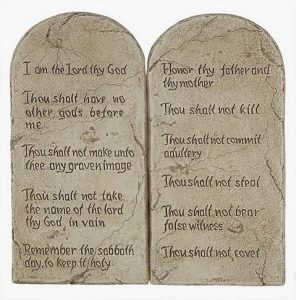
 Here they are. The “Big Ten”! The words of Exodus
 I’m a great fan of Sesame Street. The generation after mine in the Funston family, my niece Saskia, my nephew York, and my own children, Patrick and Caitlin, grew up with that show and it taught them a lot of good things. The show taught my kids literacy, counting, simple logic, and social skills. It did so using a rapid-fire mix of puppetry, animation, and short films. Created in 1969, “it was designed to deliberately mimic the fast pace and style of TV advertising in order to ‘sell’ learning to kids: An Aesop-friendly story featuring the recurring characters on the Street would be intercut with rapid-fire ‘commercials’ for that day’s ‘sponsors’ (‘Sesame Street has been brought to you today by the letters A and S, and the number 7…’).”
 A couple of months ago, I was part of a conversation among several parishioners about the set-up for our celebrations of the Nativity. We looking at our plans for Christmas services, and a member of our altar guild exclaimed, “That’s the problem! Things are always changing around here!”
 A lawyer asked Jesus a question to test him. “Teacher, which commandment in the law is the greatest?” He said to him, “’You shall love the Lord your God with all your heart, and with all your soul, and with all your mind.’ This is the greatest and first commandment. And a second is like it: ‘You shall love your neighbor as yourself.’ On these two commandments hang all the law and the prophets.”
 As I pondered our scriptures for today I was struck by how different, how utterly foreign, one might most accurately use the word “alien,” the social landscape of the bible is from our own. We, children of a post-Enlightenment Constitution which makes a clear delineation, almost a compartmentalization, between the civic and the religious, simply cannot quickly envision the extent to which those areas of human existence were entangled and intertwined for those who wrote and whose lives are described in both the Old and New Testaments. I tried to think of an easy metaphor to help illustrate the difference between our worldview and that of either the ancient wandering Hebrews represented by Moses in the lesson from Exodus or of the first Century Palestinians and Romans characterized by Jesus, the temple authorities, and Paul.
 Authority. The authority of Jesus Christ is what Paul writes about in the letter to the Philippians, in which he quotes a liturgical hymn sung in the early Christian communities:

