Occasional thoughts of an Anglican Episcopal priest

Category: Lectionary (Page 71 of 100)

Monstrous Relief – Sermon for Resurrection Sunday – March 31, 2013

====================

This sermon was preached on Resurrection Sunday, March 31, 2013, at St. Paul’s Episcopal Church, Medina, Ohio, where Fr. Funston is rector.

(Revised Common Lectionary, First Sunday of Easter: Isaiah 65:17-25; Psalm 118:1-2,14-24; 1 Corinthians 15:19-26; and John 20:1-18 . These lessons can be read at The Lectionary Page.)

====================
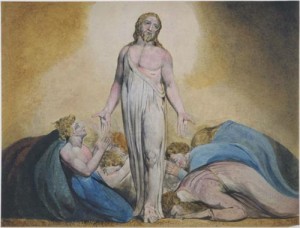
Christ Appearing to His Disciples after the Resurrection by Wm Blake

Make no mistake: if He rose at all
it was as His body;
if the cells’ dissolution did not reverse, the molecules
reknit, the amino acids rekindle,
the Church will fall.

So writes novelist and poet John Updike in the first of his Seven Stanzas at Easter from the collection Telephone Poles and Other Poems. Here is the rest of the poem:

It was not as the flowers,
each soft Spring recurrent;
it was not as His Spirit in the mouths and fuddled
eyes of the eleven apostles;
it was as His Flesh: ours.

The same hinged thumbs and toes,
the same valved heart
that – pierced – died, withered, paused, and then
regathered out of enduring Might
new strength to enclose.

Let us not mock God with metaphor,
analogy, sidestepping transcendence;
making of the event a parable, a sign painted in the
faded credulity of earlier ages:
let us walk through the door.

The stone is rolled back, not papier-mache,
not a stone in a story,
but the vast rock of materiality that in the slow
grinding of time will eclipse for each of us
the wide light of day.

And if we will have an angel at the tomb,
make it a real angel,
weighty with Max Planck’s quanta, vivid with hair,
opaque in the dawn light, robed in real linen
spun on a definite loom.

Let us not seek to make it less monstrous,
for our own convenience, our own sense of beauty,
lest, awakened in one unthinkable hour, we are
embarrassed by the miracle,
and crushed by remonstrance.

“Let us not seek to make it less monstrous!” I love that line!

Only a poet like John Updike could use the word monstrous to describe the Resurrection of Christ and, in spite of its shock value, or perhaps because of it, it is the perfect word, an ambiguous word that captures the essence of the entire Palm Sunday – Maundy Thursday – Good Friday – Resurrection Day event. Monstrous can, and usually does, mean something like “frightful or hideous; extremely ugly; shocking or revolting; awful or horrible,” and those are certainly good words to describe the way the people of Jerusalem turned on Jesus, the way his disciple Judas betrayed him, the way his other followers denied and abandoned him, the way the authorities both Jewish and Roman abused and killed him. It was all monstrous; there’s no doubt about that!

Monstrous, however, can also mean “extraordinarily great; huge; immense; outrageous; overwhelming.” And those are superlative ways to describe the fact of Christ’s Resurrection from the dead! It is a huge thing! It is immense, outrageous, overwhelming! Yes, the Resurrection is monstrous!

I have been thinking a lot recently about two people who are hardly ever thought of in all the drama and majesty of Holy Week and Easter: one of them is mentioned briefly only by John in his story of Jesus’ Crucifixion; the other isn’t named at all. I refer to Mary and Joseph, Jesus’ mother and foster father.

Of course, we know nothing of Joseph during Jesus’ adult ministry; after that event in the Jerusalem Temple when Jesus was about 13, Joseph is never again mentioned in the Gospels. Some suppose this is because he had passed away, but I like to think that he was just back home in Nazareth working the family carpentry business, making tables and chairs, supervising construction of homes, building hope chests, keeping the family provided for so that Jesus could go about his ministry and Mary could accompany him.

Mary is mentioned in John’s story of the Crucifixion as standing at the foot of the cross and being entrusted by Jesus to the disciple whom he loved. And the legend from which we get the 14th Station of the Stations of the Cross, and which Michelangelo’s exquisitely beautiful Pieta depicts, is that when his body was removed from the cross she held him, dead, in her arms. But there is no mention of her or of Joseph at Jesus’ burial, nor are they mentioned in any of the accounts of Christ’s post-resurrection appearances.

That omission, for I am sure that is what it is, an omission, disturbs me. Yesterday, was the 55th anniversary of my father’s accidental death at the age of 39. His mother and father, my grandparents, were in their sixties when he died. One of my clearest memories of childhood is his funeral. I remember how, as we were leaving the graveside, my grandparents hung back, how they could not step away from nor turn their backs on the grave that held their child’s lifeless body. When, at last, they accepted my Uncle Scott’s physical encouragement to do so, my grandmother said to my mother, “A mother should not outlive her child.” She would know that feeling again just a few years later when my Uncle Scott died of cancer.

And my mother would know it, as well, when in 1993 my only sibling, my older brother Rick, died of brain cancer. I vividly remember doing exactly what my uncle had done, physically moving my mother and stepfather away from the grave, the grave they could not leave on their own. Later that day, my mother said to me, “You’re grandmother was right. A parent should not outlive her child.”

Having seen my grandparents and my parents at the graves of their children, I cannot believe that Mary and Joseph were not there when the stone was rolled into place, when Jesus was buried in that borrowed tomb.

Updike’s description of the Resurrection and his admonition to us, “Let us not seek to make it less monstrous,” so aptly describes the entire event of Holy Week and Easter, because we cannot appreciate the overwhelming wonder of the Resurrection, without taking into account the horror and ugliness of the whole thing, Judas’ betrayal, the other disciples abandonment, Peter’s denial, the trial before Pilate, Christ’s scourging and humiliation, his bitter agony on the Cross, his final self-emptying in death, and his burial at which I cannot but believe his mother and foster father were present. It is all monstrous; painful and ugly and awful in the first sense of that wonderfully ambiguous adjective.

I thought that I had some sense of that because I had witnessed my grandparents’ and my parents’ anguish at the deaths of their children; I thought I understood what old Simeon had said to Mary when Jesus was dedicated in the Temple as an infant, his disturbing prophecy, “A sword will pierce your own soul, too.” (Luke 2:35) I thought that I had understood all that until a couple of weeks ago.

As some of you know, two weeks ago Good Friday, sixteen days ago, our daughter disappeared. She stopped posting things to Facebook, which she had been in the habit of doing almost hourly from her cell phone. She stopped answering her cell phone; calls would go directly to voicemail. Her friends checked her home and found her car gone and no one there. She wasn’t at her place of work; she wasn’t at her school; she wasn’t at any of her usual hangouts. My wife, our son, our daughter-in-law, and several of our daughter’s friends looked everywhere they could think of in the area of St. Louis, Missouri, where her apartment is. I played the role of information central, receiving their reports and letting everyone know what everyone knew, which was nothing. We went to bed that night knowing nothing.

Family systems therapists have discovered that patterns of events run in families. Not just habits or ways of handling things, not just customs or traditions, but actual life events repeat from generation to generation. I went to bed convinced that the pattern of a child predeceasing his or her parents was playing out again. I knew in the very depths of my being that my daughter was dead.

Let me tell you, old Simeon in that Temple proved himself a master of understatement. That sword of grief does not simply pierce a parent’s soul; it rips the soul to shreds. That, I now know, is why my grandparents and my parents could not leave those graves, and that is why I cannot believe that Mary and Joseph were not there in that garden when Joseph of Arimathea and Nicodemus buried their child.

Now, lest you believe that this is a funeral oration rather than an Easter homily, let me assure you that our daughter is not dead! As it turned out (Thanks be to God!), she had gone to Kansas City on a personal errand and, while there, had become acutely ill and been admitted to a local hospital on an emergency basis. She had lost her cell phone and because she hadn’t memorized our telephone numbers, she couldn’t call us. (One of the dangers of cell phones, it turns out, is relying on its memory of stored numbers instead of one’s own memory!) On Saturday morning, through a friend, she got word to her mother about where she was, and then her mother called me. Our daughter is now out of the hospital, is back in St. Louis, and is back to her usual occupations. But I cannot tell you how relieved her mother and I were on that Saturday morning! All of the anguish and fear and sorrow and grief of the night before drained away. I cannot say that we were joyful or happy, but we were profoundly, overwhelmingly, monstrously relieved.

Which brings me back to Mary and Joseph and the first Easter morning . . . . I have an entirely new understanding of the Resurrection story. Preachers and theologians toss around a funny word to describe the way we view and interpret Holy Scripture. The word is hermeneutic. It means, basically, the method or principle through which we understand the text; it is the filter through which we appreciate its meaning. There are shared, intellectual hermeneutics, but there are also highly personal hermeneutics. I share my grandparents’ and my parents’ and my family’s recent experiences with you so that I can also share with you, and you can enter into, my new personal hermeneutic for grasping the impact of the Day of Christ’s Resurrection.

Just as I am puzzled by the absence of almost any mention of Mary and Joseph in the narrative of Christ’s death and burial, and I am astounded that there is no allusion to them in the Gospel accounts of that first Easter morning or any time after his Resurrection! The only word about either of them is in the first chapter of the Book of Acts and, again, it’s only Mary who gets mentioned. Luke, the author of Acts, says that following Christ’s Ascension forty days after his Resurrection the apostles “were constantly devoting themselves to prayer, together with certain women, including Mary the mother of Jesus, as well as his brothers.” (Acts 1:14) That’s it, that one mention! I find that astonishing! Apparently so have many Christians throughout the ages, because there is an extra-biblical tradition that the Virgin Mary was the first person to witness our Lord’s Resurrection.

The Golden Legend, which is a medieval collection of stories about the saints, says that the first appearance of the resurrected Christ on Easter Day was to the Virgin Mary:

It is believed to have taken place before all the others, although the evangelists say nothing about it.. . . . [I]f this is not to be believed, on the ground that no evangelist testifies to it . . . perish the thought that such a son would fail to honor such a mother by being so negligent! . . . Christ must first of all have made his mother happy over his resurrection, since she certainly grieved over his death more than the others. He would not have neglected his mother while he hastened to console others.

St. Ignatius of Antioch (1st C.) claimed it was so, as did St. Ambrose of Milan (4th C.), St. Paulinus of Nola (4th C.), the poet Sedulius (5th C.), St. Anselm of Canterbury (11th C.), St. Albertus Magnus (13th C.), St. Bernardino da Siena (15th C.), and the bible scholar Juan Maldonado (16th C.)

Most recently, the late Bishop of Rome, his Holiness John Paul II, in a general audience in 1997 expressed this opinion:

The Gospels mention various appearances of the risen Christ, but not a meeting between Jesus and his Mother. This silence must not lead to the conclusion that after the Resurrection Christ did not appear to Mary . . . . Indeed, it is legitimate to think that [his] Mother was probably the first person to whom the risen Jesus appeared. Could not Mary’s absence from the group of women who went to the tomb at dawn indicate that she had already met Jesus? This inference would also be confirmed by the fact that the first witnesses of the Resurrection, by Jesus’ will, were the women who had remained faithful at the foot of the Cross and therefore were more steadfast in faith. (Gen. Aud., Wednesday, 21 May 1997)

I cannot but believe that the Risen Christ appeared to Mary and Joseph (if he was present as I prefer to think he was), and that they would have been at least as profoundly, overwhelmingly, monstrously relieved as my wife and I were two weeks ago yesterday, if not more so!

So here’s my new thought, my new hermeneutic of Easter Day. I think that the overwhelming initial response, especially of Mary and Joseph, but also of Mary Magdalene, of Peter, of the disciple whom Jesus loved, of all the others, to the fact of Jesus’ Resurrection was not, as we are usually told at Easter Services, joyfulness! I think it was relief. The dictionary defines relief as “alleviation of pain, as the easing of anxiety, as deliverance from distress.” This is the appropriate experience and emotion of Easter Day, profound relief, not immediate joy or gladness; I think that comes later in the Easter Season and that it comes later in life as we live out our Easter faith. But in the immediate aftermath of the monstrous-ness of Holy Week, in the wake of the horrible ugliness of death, Christ’s or anyone else’s, one is simply not ready to be jubilant and happy. In the face of our own sinfulness and spiritual dysfunction, we are not ready for joy and gladness. But the fact of Christ’s Resurrection relieves us of grief and sorrow; it relieves us of sin and death. The experience and impact of Easter Day is one of profound, overwhelming, (one might even say) monstrous relief.

Perhaps that is why Jesus stuck around for forty days, to continually reassure and sustain the disciples in their relief from fear and sorrow and grief, so that they could move into joy and gladness as time went on. Perhaps that is why Easter is not a single day, but a season of fifty days, so that as it progresses we can . . . like Mary and Joseph, like the Magdalen and Peter, like the disciple whom Jesus loved and all the apostles . . . move from relief into Resurrection joy, so that it provides a pattern with which we can handle the inevitable losses in our lives. As life goes on and as the victory of life over death sinks in, Easter relief grows into Easter joy, something that propels us toward action and compels us to invite others into the Resurrected life of our Risen Lord.

As Christians, we have access through the relief of Christ’s Resurrection into a joy that is unshakable. We must remember, however, that joy is really not an emotion — it is a virtue. Easter joy does not mean being happy all the time or being fine when times are difficult; Easter joy means being sustained by the power of the Resurrection. What Easter joy means is that in the depths of our being, despite the circumstances we may face, despite any fears we may have, despite whatever may be tearing up our souls, despite whatever sin or spiritual malaise we may be in, we are able to get through them, to let go of them, and to find relief and eternal life in the Resurrected Christ, a life into which we invite others.

John tells us that on that first Easter morning, when Jesus called the Magdalen by name, “she turned and said to him in Hebrew, ‘Rabbouni!’ (which means Teacher).” I do not hear joy and happiness in the voice of this woman who had just been weeping in grief and confusion at his grave; I do hear relief. She was so comforted that she grabbed on to him, but he said to her, “Do not hold on to me . . . . .” It has been said that joy comes from letting go — letting go of our attachments, letting go of any thoughts that the present moment should or even could be different than it is, letting go of our expectations. Joy is the virtue of celebrating present, of living in the moment, something to which we come through a process of detachment and release. Resurrection Day is not the end of the process; it is the beginning. “Do not hold on to me,” Jesus said to Mary Magdalen, “But go to my brothers . . . .” Go and invite them into the outrageous reality of which you are now a part.

Easter Day brings relief, overwhelming relief! Through that relief we are able to let go, to release our fears, our griefs, our worries, and our sorrows with absolute abandon, to be completely freed of our sinfulness! In letting go as the Easter Season and as our Easter faith progress, we ultimately find joy, unutterably ecstatic joy, huge, overwhelming, outrageous joy into which we are compelled to invite others!

“Let us not seek to make it less monstrous!”

Alleluia! Christ is risen!

====================

A request to my readers: I’m trying to build the readership of this blog and I’d very much appreciate your help in doing so. If you find something here that is of value, please share it with others. If you are on Facebook, “like” the posts on your page so others can see them. If you are following me on Twitter, please “retweet” the notices of these meditations. If you have a blog of your own, please include mine in your links (a favor I will gladly reciprocate). Many thanks!

====================

Father Funston is the rector of St. Paul’s Episcopal Church, Medina, Ohio.

When I Needed a Neighbor – From the Daily Office – March 21, 2013

From the Gospel according to John:

At that time the festival of the Dedication took place in Jerusalem. It was winter, and Jesus was walking in the temple, in the portico of Solomon. So the Jews gathered around him and said to him, “How long will you keep us in suspense? If you are the Messiah, tell us plainly.” Jesus answered, “I have told you, and you do not believe. The works that I do in my Father’s name testify to me; but you do not believe, because you do not belong to my sheep. My sheep hear my voice. I know them, and they follow me. I give them eternal life, and they will never perish. No one will snatch them out of my hand. What my Father has given me is greater than all else, and no one can snatch it out of the Father’s hand. The Father and I are one.”

(From the Daily Office Lectionary – John 10:22-30 (NRSV) – March 21, 2013.)

“I have told you, and you do not believe.”

Jesus Walks in the Portico of Solomon by James J TissotWhat does it mean to believe? That is really the crux of the matter and the stumbling block for 21st Century folks. In modern American English, the dictionary tells us, the the verb to believe means, “to accept a statement, supposition, or opinion as true.” Is this what Jesus is saying to the Jewish authorities in the Jerusalem Temple? “I have told you and you do not accept my statements, suppositions, and opinions as true.” Somehow, I don’t think so.

The Greek-English lexicon, in quite a contrast to the modern English dictionary, tells us that the Greek verb pisteuo, used in the original Greek of the New Testament and translated here and elsewhere into English as to believe, is “used in the [New Testament] of the conviction and trust to which a [person] is impelled by a certain inner and higher prerogative and law of soul to trust in Jesus or God as able to aid either in obtaining or in doing something: saving faith.” This is what Jesus is saying to the Temple authorities: “I have told you and you do not have that inner certainty which impels you to trust, with your soul, in God.”

In the same way, I was once told that the Latin verb credere, which is also translated to believe and from which we get our words credo, creed, and credibility, is related to the Latin word for “heart” (cardia) and can be understood as meaning “to put one’s heart upon.”

So religious belief, Christian belief is more than simply intellectual assent to a statement, supposition, or opinion. Religious belief is a matter of heart and soul, a matter of trust and conviction, not simply a matter of the head but of the whole person. This is what the Temple authorities lacked, this whole-person trust in and commitment to God. Jesus had told them, and they did not believe.

In recent days, I have had to put that kind of trust into people I have never before met. I have had to hand over to them and entrust them with one of the most precious things in my life. Not only have I had to accept their statements that they know what to do and have the skills and wherewithal to do it, I have had to steel my soul and my heart with the conviction, the inner certainty that they do. I have never doubted in God; in these days, I have had to not doubt these neighbors who, like the Samaritan, are ministering to my and my family’s needs. When they have told me what they know and understand, what they believe (in the modern English sense) needs to be done, I have had to believe it, too (in every sense of the word).

The experience of these days has reminded me of a lovely English hymn entitled When I needed a neighbour:

When I needed a neighbour were you there, were you there?
When I needed a neighbour were you there?
[Refrain:]
And the creed and the colour and the name won’t matter,
were you there?

I was hungry and thirsty, were you there, were you there?
I was hungry and thirsty, were you there? [Refrain]

I was cold, I was naked, were you there, were you there?
I was cold, I was naked, were you there? [Refrain]

When I needed a shelter were you there, were you there?
When I needed a shelter were you there? [Refrain]

When I needed a healer were you there, were you there?
When I needed a healer were you there? [Refrain]

Wherever you travel I’ll be there, I’ll be there,
Wherever you travel I’ll be there.
And the creed and the colour and the name won’t matter,
I’ll be there.

I do believe that what Jesus was really saying to the Temple authorities was, “I have told you to be neighbors to those around you, to those in need, and you have not done that; you have not committed yourself heart and soul to the love and care of others.” When I needed a neighbor, many were there. When I needed an answer to prayer, it came through these neighbors. Thanks be to God.

====================

A request to my readers: I’m trying to build the readership of this blog and I’d very much appreciate your help in doing so. If you find something here that is of value, please share it with others. If you are on Facebook, “like” the posts on your page so others can see them. If you are following me on Twitter, please “retweet” the notices of these meditations. If you have a blog of your own, please include mine in your links (a favor I will gladly reciprocate). Many thanks!

====================

Father Funston is the rector of St. Paul’s Episcopal Church, Medina, Ohio.

Be a Llama in the Lord’s Flock – From the Daily Office – March 20, 2013

From the Gospel according to John:

So again Jesus said to them, “Very truly, I tell you, I am the gate for the sheep. All who came before me are thieves and bandits; but the sheep did not listen to them. I am the gate. Whoever enters by me will be saved, and will come in and go out and find pasture. The thief comes only to steal and kill and destroy. I came that they may have life, and have it abundantly.”

(From the Daily Office Lectionary – John 10:7-10 (NRSV) – March 20, 2013.)

Llama with Sheep“The thief comes only to steal and kill and destroy.” This sentence really hit me today for a lot of very personal reasons I won’t get into. As I was doing my morning ablutions, I thought of the thieves who have stolen in and taken away loved ones, family members, and friends. I thought of how obvious those thieves were about it, and yet we passed those thieves off as simple eccentricities and odd behaviors.

The thieves of which I speak have names . . . names like Alzheimer’s, schizophrenia, glioblastoma, alcoholism, bipolar disorder, drug abuse, and the list goes on and on. When I think of these thieves and the havoc they wreak, I think of my cousin who served honorably in the U.S. Navy and then, after his discharge, slipped away from the family into the embrace of schizophrenia never to be seen again. I think of my father whose alcoholism led him away to death in a one-car motor vehicle accident. I think of my brother whose slightly strange behavior in speaking Italian to his spouse – who didn’t speak Italian – was the first sign of the glioblastoma (brain cancer) that took his life. I think of my mother-in-law whose occasional lapses of memory were the first steps of a slow downhill dance into the darkness of Alzheimer’s Disease. I think of the people I see in shabby clothing pushing supermarket trollies down the street muttering to themselves. They have all been stolen away by thieves, leaving behind families who grieve their loss and who may be in ignorance wondering where their loved ones are.

These thieves slip into the fold under the disguises of eccentricity, oddness, unconventionality, quirkiness, and peculiarity, none of which are the least bit objectionable in themselves. But in someone who isn’t or hasn’t been eccentric or quirky, they are the warning signs, the masks warn by the thieves.

In Nevada where I was born and raised, there was a thriving sheep industry at one time. (There may still be; I haven’t lived in Nevada for many years and really don’t know.) That is the reason there are so many people of Basque descent in Nevada and neighboring states; the Basque shepherds came to tend the flocks. I remember years ago reading that one of the things the shepherds had learned was the use of llamas as guard animals for their flocks. Llamas are accepted by the sheep as one of their own; the sheep are much more comfortable with the llamas than they are with sheepdogs. The llamas can mingle with the sheep and not upset them.

Llamas, however, are very different from sheep. Sheep, of course, are timid and easily frightened; sheep will run from something or someone strange. Llamas, on the other hand, are intensely curious animals and when something unknown approaches the flock, they will go toward it to see what’s up. If a coyote (the most common predator in the Nevada desert) approaches the flock, a llama will move toward it. Predators find this behavior disconcerting and even deadly! They will run away and not bother the sheep.

Llamas react to coyotes threatening the flock in a variety of ways. They begin with with an alert and attentive posture which alarms others in the herd or flock. The animal then makes a special alarm cry and often runs toward the threat. If the llama closes with the coyote, it will place itself between it and the flock, and even kick at the predator. Coyotes have been injured and even killed by llamas. Many shepherds who use llamas as guard animals have reported a 100 percent reduction in predator losses after employing the llamas.

We need to be like llamas. When we observe eccentricity, oddness, unconventional behavior, and peculiar conduct, deportment that is out of the ordinary in friends and loved ones, we need to move toward it, take a good look at it, figure it out. Is it just quirkiness? Or is it the mask of the thief of mental or physical illness.

Our Shepherd has come to give us life and give it abundantly, but there are thieves and predators prowling around – substance addictions, brain dysfunctions, emotional illnesses among them. They threaten to take us and those we love away from the abundant life our Shepherd promises. We can be the llamas in the flock, vigilant, curious, on guard, working with the Shepherd to prevent them from taking away his sheep. Be a llama for your loved ones! Be a llama in the Lord’s flock!

====================

A request to my readers: I’m trying to build the readership of this blog and I’d very much appreciate your help in doing so. If you find something here that is of value, please share it with others. If you are on Facebook, “like” the posts on your page so others can see them. If you are following me on Twitter, please “retweet” the notices of these meditations. If you have a blog of your own, please include mine in your links (a favor I will gladly reciprocate). Many thanks!

====================

Father Funston is the rector of St. Paul’s Episcopal Church, Medina, Ohio.

The Leaflet in the Lou – From the Daily Office – March 19, 2013

From the Letter to the Romans:

But what does it say? “The word is near you, on your lips and in your heart” (that is, the word of faith that we proclaim); because if you confess with your lips that Jesus is Lord and believe in your heart that God raised him from the dead, you will be saved. For one believes with the heart and so is justified, and one confesses with the mouth and so is saved. The scripture says, “No one who believes in him will be put to shame.” For there is no distinction between Jew and Greek; the same Lord is Lord of all and is generous to all who call on him. For, “Everyone who calls on the name of the Lord shall be saved.”

(From the Daily Office Lectionary – Romans 10:8-13 (NRSV) – March 19, 2013.)

Public Restroom SinksIn my opinion there is probably no more misused piece of writing in all of Holy Scripture, unless perhaps it is Paul’s other toss-off line (in this same epistle): “For we hold that a person is justified by faith apart from works prescribed by the law.” (Rom. 3:28 NRSV) Both of them have led people to a religion that is all talk and no walk, which I am quite sure was not Paul’s intention at all!

I went to high school pretty much in the absolute middle of the United States. The geographic center of the U.S. is just outside the small town of Lebanon, Kansas. I went to high school in Salina, Kansas, about 100 miles away. At the time, and probably to this day, it is pretty much conservative, evangelical Christian territory. There are a few nutty Episcopalians, but not many; a few more good German Lutherans and just about as many good German Catholics. But the conservative, evangelical traditions rule the roost.

One of the things I most remember about my high school years in the center of the country are the evangelical Christian pamphlets that one would find distributed in, of all places, the public restrooms of filling stations and coffee shops. I know that sounds weird, and frankly it is weird! But almost without fail, anytime I would make use of such public facilities in the late 1960s I would find a small pamphlet on the wash basin counter, on the back of the toilet, or on top of the urinal telling me that all I needed to do to be saved and escaped the fires of Hell was “confess with your lips that Jesus is Lord and believe in your heart that God raised him from the dead.” That’s all. Nothing more.

That always struck me as nonsense. Even to a 14-year-old high school freshman, it just seemed like there ought to be more to it than the five-step outline for salvation set out in the public restroom pamphlet (and which I’ve subsequently seen enumerated elsewhere):

  1. Hear the Gospel (Romans 10:17)
  2. Believe the Gospel (Mark 16:16)
  3. Repent of sins (Luke 13:3)
  4. Confess Christ. (Matthew 10:32)
  5. Be Baptized for the remission of sins (Acts 2:38).

It seemed like poppycock because pretty regularly the priest in my church would recite other passages of Scripture: “Not every one that saith unto me, Lord, Lord, shall enter into the kingdom of heaven; but he that doeth the will of my Father which is in heaven.” (Matt. 7:21 KJV) was his favorite offertory sentence. And I recall more than one sermon in which he made reference to the Letter of James with its (to me, at least) cogent reasoning:

What good is it, my brothers and sisters, if you say you have faith but do not have works? Can faith save you? If a brother or sister is naked and lacks daily food, and one of you says to them, “Go in peace; keep warm and eat your fill,” and yet you do not supply their bodily needs, what is the good of that? So faith by itself, if it has no works, is dead. But someone will say, “You have faith and I have works.” Show me your faith apart from your works, and I by my works will show you my faith.

The leaflet in the lou seemed not even to require faith. I know it says that one step is to “Believe the Gospel” and another to “Confess Christ,” but those only require intellectual ascent, not faith. Just because one accepts the factuality of the Jesus story, and possibly even tells others about it, doesn’t mean that one trusts in Jesus as Lord and Savior. So even though it might have been parroting Paul in the 10th chapter of Romans, it seemed to have overlooked the 3rd chapter. And it’s authors had clearly dismissed James’s conclusion that “faith by itself, if it has no works, is dead.”

It’s not that the five steps in the bathroom broadside are wrong. It’s that they are incomplete. There are so many more steps – feeding the hungry, clothing the naked, caring for the ill, visiting the prisoners, housing the homeless, selling everything you own and giving the money to the poor, not being a stumbling block to others, loving your neighbor, and many many more. One can’t just talk the talk; one must walk the walk; one must take the journey.

Salvation is a journey of many steps through many places doing many things. Salvation is not achieved with five simple steps communicated through a community water closet!

====================

A request to my readers: I’m trying to build the readership of this blog and I’d very much appreciate your help in doing so. If you find something here that is of value, please share it with others. If you are on Facebook, “like” the posts on your page so others can see them. If you are following me on Twitter, please “retweet” the notices of these meditations. If you have a blog of your own, please include mine in your links (a favor I will gladly reciprocate). Many thanks!

====================

Father Funston is the rector of St. Paul’s Episcopal Church, Medina, Ohio.

Blindness and Sour Grapes – From the Daily Office – March 18, 2013

From the Gospel according to John:

As Jesus walked along, he saw a man blind from birth. His disciples asked him, “Rabbi, who sinned, this man or his parents, that he was born blind?” Jesus answered, “Neither this man nor his parents sinned; he was born blind so that God’s works might be revealed in him.”

(From the Daily Office Lectionary – John 9:1-3 (NRSV) – March 18, 2013.)

Sour GrapesI’m not the least bit sure I like the last thought of Jesus reply . . . Is he suggesting that a loving God caused this innocent man’s blindness so that Jesus could come along and heal him with some mud made of spittle and demonstrate his power? I mean, really, is he? I don’t want to get into that today, but surely there must be another interpretation for Jesus words and perhaps someday I’ll explore that.

Today, I want to focus on the first clause of his answer, which is basically just a wordy, “No.” As a parent, I cannot tell you how happy it makes me that the man’s blindness was not his parents’ fault! Because accepting that blame is all too often our parental response when things go wrong in our children’s lives . . . . It doesn’t really matter what it is – accident, illness, bad grades, suspension from school, trouble with the law, break-up with their partner or spouse – it doesn’t matter what it is, when something goes wrong in our children’s lives a parent’s response is often an overwhelming sense of guilt. “What did I do wrong that this happened to my child?”

This is, after all, a perfectly acceptable biblical view! In the Book of Exodus, Moses told the Hebrews that God does not “clear the guilty, but visits the iniquity of the parents upon the children and the children’s children, to the third and the fourth generation.” (Exod. 34:7 NRSV) And again the same words are reported the Book of Numbers: “The Lord is slow to anger, and abounding in steadfast love, forgiving iniquity and transgression, but by no means clearing the guilty, visiting the iniquity of the parents upon the children to the third and the fourth generation.” (Numb. 14:18 NRSV) And, again, in Deuteronomy, Moses says, “Be careful to obey all these words that I command you today, so that it may go well with you and with your children after you forever, because you will be doing what is good and right in the sight of the Lord your God” (Deut. 12:28 NRSV) implying that disobedience would mean things wouldn’t go well for the kids! Finally, there is that great biblical proverb reported by both Jeremiah and Ezekiel: “The parents have eaten sour grapes, and the children’s teeth are set on edge.” (Jer. 31:29 and Ezek. 18:2 NRSV)

So there is plenty of biblical support for our parental guilt pangs! But here is Jesus saying that the sins of parents are not responsible for the misfortune of their son. Thanks be to God! What that says to me is that we need to start looking at our feelings of parental remorse in a different way.

Not that those feelings are “wrong” or “bad.” Guilt is a basic human emotion. Everyone feels it and, when it comes to parenting, whatever we do is liable to cause us a little bit of guilty self-reproach because it sometimes seems that “you’re damned if you do and you’re damned if you don’t.” What if, instead of beating ourselves up over these things, we think of what feels like guilt as simply evidence that we are being good parents, good enough to be constantly thinking about what we’re doing and how we’re doing it? We care enough to do our best at the very important, frequently frustrating, often terrifying, and even more often incredibly rewarding job of raising children we love more than we will ever be able to tell them. No parent is perfect, but the ones who worry about whether they are doing it well, probably are doing it well, really well.

Here’s something I know. During the past sixty or so years that I’ve been alive, I’ve had a lot of rough patches, a lot of problems. I’ve done some bonehead things and made some really stupid mistakes. I’ve been in trouble with various authorities, and broken up with lovers and partners. And you know what? Very little of any of that was my parents’ fault! On the other hand, I’ve gotten through those rough spots. I’ve solved the problems. I’ve learned from my mistakes and avoided doing even more boneheaded stuff. I’ve made up with the lovers and, if I haven’t made up with the authorities, at least I’ve figured out how to work with them. And you know what? Most of my ability to do so is due to what I learned from my parents, from what I observed of the way they lived their lives and from the values they taught me. They may have eaten some sour grapes, I don’t know, but my teeth were not set on edge.

I love my kids a whole lot more than I can ever tell them, and I can only hope they have learned from me the way I learned from my folks.

====================

A request to my readers: I’m trying to build the readership of this blog and I’d very much appreciate your help in doing so. If you find something here that is of value, please share it with others. If you are on Facebook, “like” the posts on your page so others can see them. If you are following me on Twitter, please “retweet” the notices of these meditations. If you have a blog of your own, please include mine in your links (a favor I will gladly reciprocate). Many thanks!

====================

Father Funston is the rector of St. Paul’s Episcopal Church, Medina, Ohio.

The Whole World is Irish on March 17 – Sermon for the Feast of St. Patrick – March 17, 2013

====================

This sermon was preached on Sunday, March 17, 2013, at St. Paul’s Episcopal Church, Medina, Ohio, where Fr. Funston is rector.

(Episcopal Sanctorale Lectionary, Patrick of Ireland: Psalm 97:1-2,7-12; Ezekiel 36:33-38; and Matthew 28:16-20. These lessons can be read at The Lectionary. At St. Paul’s Parish, during Lent, we are using the Daily Office of Morning Prayer as our antecommunion; therefore, only these two lessons and the psalm were read. The Epistle lesson, 1 Thessalonians 2:2b-12, was not used.)

====================

Icon of St. Patrick of IrelandIn Ainm an Athar, agus an Mhic, agus an Spioraid Naoimh. Áiméan.
Dia dhaoibh ar maidin, gach duine. Beannachtaí na fheile Padraig oraibh.

That’s more Irish than I’ve spoken in nearly two years! What I said was, “God be with you this morning, everyone. The blessings of the Feast of St. Patrick be with you.” In other words, Happy St. Paddy’s Day!

Everyone loves to be Irish on St. Paddy’s Day. Even though we Funstons being descendants of Anglican Irish (or as the Irish would say, “Protestants”) did not have much, if anything, to do with the Irish communities of my childhood, we still (like everyone else) enjoyed St. Patrick’s Day. We would go to the parades, see and hear the pipe-and-drum corps, and all the other traditional sorts of things. On the evening news, we would see the reports of parades in other places, especially the big one down Fifth Avenue in New York City. And we would usually have corned beef and cabbage for dinner.

I have no problem with people dressing kilts (which aren’t really Irish, at all), putting green food coloring in beer, eating corned beef and cabbage (which is also not really Irish), or any of the other silly things people do on this day. It’s all part of the fun. Many like to watch Irish-themed movies on St. Patrick’s Day. My favorite is the heartwarming tale of a boxer’s return home in The Quiet Man, but I also like the mythical nonsense of Darby O’Gill and the Little People, or the intense drama of The Field, or the whacky comedy of Waking Ned Devine. Those movies are the only times I hear anyone say, “Top o’ the mornin’ to ye” or “Faith and begorrah.” At least, I’ve never heard anyone say those things during any of my trips to Ireland.

The worship committee thought we ought to step away from Lent for a day (because March 17 today falls on Sunday) and celebrate St. Patrick. After all, on March 17, the whole world is Irish . . . but the man we commemorate wasn’t Irish and it would be much truer to his memory if on his feast day all the world tried to be not Irish, but Christian.

Patrick, who was a Romano-Brit (meaning a Roman who lived in Britain) was the son of a minor imperial official named Calpornius, who was also a deacon in the church; his grandfather Potitus was a priest. Around the year 406 A.D., at the age of 16, Patrick was kidnapped and made a slave in Ireland to a minor tribal king. After six years, he escaped and returned home to Britain, and then went to Rome. There he was ordained a priest and a bishop and, according to the chronicle of Prosper of Aquitane, was appointed bishop to the Irish by Pope Celestine I; he arrived back in Ireland in 432 A.D. He landed near modern-day Belfast and set up his principal foundation in Armagh, which is now considered the Primatial See of Ireland. He ministered primarily in that part of the country known as Ulster. Patrick was not the first bishop appointed to bring the Christian faith to the people of Ireland. Ciaran and Palladius came before him, but their mission (primarily in Munster and Leinster, further south) did not bear the same fruits as Patrick’s. So today, what we celebrate is not Irish identity or heritage; today, we celebrate the success of a mission to spread the Christian faith.

The choir is going sing a poetic prayer or lorica attributed to Patrick, the famous St. Patrick’s Breastplate, as their anthem. It is attributed to him, but there is disagreement as to whether he actually wrote it. But he did write this prayer:

I give thanks to the one who strengthened me in all things, so that he would not impede me in the course I had undertaken and from the works also which I had learned from Christ my Lord. Rather, I sensed in myself no little strength from him, and my faith passed the test before God and people. (The Confession of St. Patrick)

For St. Patrick it seems the faith which passed the test was deeply Trinitarian and deeply evangelical. He is credited with using the shamrock, now one of the national emblems of Ireland, as an illustration of the Trinity – three lobes, yet one leaf – although that is probably an 18th Century legend rather than a historical fact. And as you heard, the Gospel lesson for his commemoration is the Great Commission: “Go therefore and make disciples of all nations, baptizing them in the name of the Father and of the Son and of the Holy Spirit, and teaching them to obey everything that I have commanded you.” Christ’s final words to his apostles before ascending into Heaven. This evangelical, Trinitarian faith — not green beer nor Celtic music nor corned beef and cabbage nor Irish-ness itself — but trust in God the Father, God the Son, and God the Holy Spirit shared with and commended to everyone around us, this is what we celebrate when we celebrate the Feast of St. Patrick.

I thought perhaps the lesson from Ezekiel was chosen for his feast because, with its “forty shades of green,” Ireland might make one think of the garden of Eden, and in Ireland there are both ruined towns and towns that are inhabited, some of both walled and fortified. But I think rather that it was chosen because, just as the nations around Israel came to know the Lord, the God of Israel, so the nations to which Irish missionaries went came to know the Lord Jesus Christ. What Patrick started in Ireland in 5th Century by the mid 6th Century was spreading to northern Europe, carried there by Irish priests and monks practicing what was called “white martyrdom.” The term comes from a 7th Century Irish sermon called the Cambrai homily:

Now there are three kinds of martyrdom that are counted as a cross to us, namely, white, blue, and red martyrdom.
It is white martyrdom for a man when he separates from everything that he loves for God, although he does not endure fasting and labor thereby.
The blue martyrdom is when through fasting and hard work they control their desires or struggle in penance and repentance.
The red martyrdom is when they endure a cross or destruction for Christ’s sake, as happened to the Apostles when they were persecuted the wicked and taught the law of God. (O. Davis, Celtic Spirituality, Paulist Press: 1999)

The white martyrs left everything dear to them — homes, families, familiar surroundings, even Ireland itself — to spread the Gospel in distant lands; white martyrdom was a pilgrimage on behalf of Christ that might be extended permanently so that they would never again see their homeland. They went first to Scotland and the north of England, but then further afield to Holland, Germany, Scandinavia, Switzerland, and even further. Like the man who had brought Christianity to their homeland, they held a deeply Trinitarian and deeply evangelical faith; and it is that faith which we celebrate when we celebrate St. Patrick’s Day.

It is that faith we all claim and, when we commemorate Patrick, it is to the spread of that faith that we dedicate ourselves. On the first day of Lent, Ash Wednesday, a special Litany of Penance is recited in Episcopal Churches. Among the confessions of that Litany we find this petition: “Our negligence in prayer and worship, and our failure to commend the faith that is in us, we confess to you, Lord.” (BCP 1979, page 268)

Let us remember that confession on St. Patrick’s Day and try not so much to be Irish, but try to be better Christians. Let us be like Patrick, who was not Irish, but Christian, and like him let us follow Christ’s Great Commission. If we must be Irish on this day, let us be like those Irish white martyrs of old, and commend the faith that is in us, a faith that is deeply Trinitarian and deeply evangelical.

Let us remember, also, a petition from the Great Litany which we recited on the First Sunday in Lent four weeks ago:

That it may please thee to inspire us, in our several callings, to do the work which thou givest us to do with singleness of heart as thy servants, and for the common good, we beseech thee to hear us, good Lord. (BCP 1979, page 151)

Let us pray:

Everliving God, whose will it is that all should come to you through your Son Jesus Christ: Inspire our witness to him, that all may know the power of his forgiveness and the hope of his resurrection; who lives and reigns with you and the Holy Spirit, one God, now and for ever. Amen.

====================

A request to my readers: I’m trying to build the readership of this blog and I’d very much appreciate your help in doing so. If you find something here that is of value, please share it with others. If you are on Facebook, “like” the posts on your page so others can see them. If you are following me on Twitter, please “retweet” the notices of these meditations. If you have a blog of your own, please include mine in your links (a favor I will gladly reciprocate). Many thanks!

====================

Father Funston is the rector of St. Paul’s Episcopal Church, Medina, Ohio.

Pope Francis – From the Daily Office – March 14, 2013

From Paul’s Letter to the Church in Rome:

So then, brothers and sisters, we are debtors, not to the flesh, to live according to the flesh — for if you live according to the flesh, you will die; but if by the Spirit you put to death the deeds of the body, you will live. For all who are led by the Spirit of God are children of God. For you did not receive a spirit of slavery to fall back into fear, but you have received a spirit of adoption. When we cry, “Abba! Father!” it is that very Spirit bearing witness with our spirit that we are children of God, and if children, then heirs, heirs of God and joint heirs with Christ — if, in fact, we suffer with him so that we may also be glorified with him.

(From the Daily Office Lectionary – Romans 8:12-17 (NRSV) – March 14, 2013.)

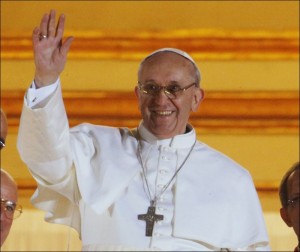
Pope FrancisThere were two things about which I was unaware when I wrote yesterday’s meditation referring to the folk chorus Abba, Father. First of all, I didn’t know that today’s readings would include Paul’s comments to the Romans on that form of addressing God. Secondly, I had no idea that the modern day Romans (in the form of the Papal Conclave) would have elected a new pope by today.

Today the entire world, Protestant, Anglican, and Orthodox Christians, as well as those of other religions, together with the world’s Roman Catholics, are taking stock of the newest successor of St. Peter, trying to figure out who Pope Francis is and what his election means. According to all the news reports I’ve seen, he is a humble man with much concern for the poor and the economically oppressed. On the other hand, he is apparently a doctrinal conservative who has had some pretty negative things to say about contraception, a woman’s right to reproductive choice, and the legalization of abortion, as well as about the LGBT community and the rights of gay, lesbian, and transgendered persons. How this will all shake out in his leadership of the Roman Catholic Church is anyone’s guess.

I hope that he will listen to what Paul has to say in his letter to the Roman church of long ago. I hope that he will acknowledge that “all who are led by the Spirit of God are children of God,” even though that Spirit may be leading them in non-Christian directions. I hope that he will consider the suggestion of his fellow Jesuit, Avery Dulles, who wrote: “On Christian grounds, it may be held that the divine person who appears in Jesus is not exhausted by that historical appearance. The symbols and myths of other religions may point to the one who Christians recognize as the Christ.” (Revelation and the Religions, Quaker Universalist Fellowship: 1999)

It is my understanding of basic Christian doctrine that the Holy Spirit may act wherever and whenever she chooses. If we presume to constrain the activity of the Holy Spirit, if our doctrinal predisposition is to limit God to only our particular religious assumptions, then we are not faithful to the Truth. Christian tradition recognizes a mandate to seek Truth wherever it may be found and to follow the Holy Spirit wherever she may lead, even if that may be into consideration of other religions or non-Christian philosophies. I hope his Holiness will be of the same understanding and seek interfaith dialogue.

Even more, I hope that he will seek common cause with non-Roman Christians, even when our ecclesiologies and theologies may not agree with those of the Holy See. I pray that he will acknowledge that Protestants, Anglicans, and Orthodox Christians are “children of God, and if children, then heirs, heirs of God and joint heirs with Christ.” It was a great disappointment when his predecessor, Benedict XVI, ratified and confirmed a statement that “those Christian Communities born out of the Reformation of the sixteenth century . . . because of the absence of the sacramental priesthood, have not preserved the genuine and integral substance of the Eucharistic Mystery [and] cannot, according to Catholic doctrine, be called ‘Churches’ in the proper sense.” (Responsa Quaestiones, June 29, 2007) As an Anglican, especially, I would dispute the basic assumptions about the priesthood and the Eucharist, but even without regard to that quibble, to deny that any group of Christians is the church seems to me to be an unnecessary stumbling block to ecumenical relations. Hopefully, Pope Francis will be more gracious than his predecessor in acknowledging that “where two or three are gathered in [his] name, [Christ is] there among them.” (Matt. 18:20 NRSV)

Which brings me back to the folk chorus Abba, Father and yesterday’s meditation. The petition of the song is

Mold us, mold us and
Fashion us,
Into the image,
Of Jesus your Son
Of Jesus your Son.
Father, may we be one in you,
May we be one in you,
As he is in you,
And you are in him.

God the potter is constantly molding the church. May Pope Francis’s election be an opportunity not only for the Roman Catholic Church to be molded anew, may it also be an occasion for the whole of the Christ’s universal church, and God’s people of other faiths, to be molded together into a new ecumenical and interfaith cooperation.

====================

A request to my readers: I’m trying to build the readership of this blog and I’d very much appreciate your help in doing so. If you find something here that is of value, please share it with others. If you are on Facebook, “like” the posts on your page so others can see them. If you are following me on Twitter, please “retweet” the notices of these meditations. If you have a blog of your own, please include mine in your links (a favor I will gladly reciprocate). Many thanks!

====================

Father Funston is the rector of St. Paul’s Episcopal Church, Medina, Ohio.

God’s Annoying Accent – From the Daily Office – March 13, 2013

From the Prophet Jeremiah:

The word that came to Jeremiah from the Lord: “Come, go down to the potter’s house, and there I will let you hear my words.” So I went down to the potter’s house, and there he was working at his wheel. The vessel he was making of clay was spoiled in the potter’s hand, and he reworked it into another vessel, as seemed good to him. Then the word of the Lord came to me: Can I not do with you, O house of Israel, just as this potter has done? says the Lord. Just like the clay in the potter’s hand, so are you in my hand, O house of Israel. At one moment I may declare concerning a nation or a kingdom, that I will pluck up and break down and destroy it, but if that nation, concerning which I have spoken, turns from its evil, I will change my mind about the disaster that I intended to bring on it. And at another moment I may declare concerning a nation or a kingdom that I will build and plant it, but if it does evil in my sight, not listening to my voice, then I will change my mind about the good that I had intended to do to it. Now, therefore, say to the people of Judah and the inhabitants of Jerusalem: Thus says the Lord: Look, I am a potter shaping evil against you and devising a plan against you. Turn now, all of you from your evil way, and amend your ways and your doings.

(From the Daily Office Lectionary – Jeremiah 18:1-11 (NRSV) – March 13, 2013.)

Potters Hands at WheelYears ago, my wife and I were active in the Cursillo community in another state. In fact, we met through that community, so it was very important to us. We participated in the three-day weekends; we took part in the reunions; we even had the “De Colores” bumper-stickers on our cars. At that time, folk masses and simple guitar-accompanied choruses were also popular in the Episcopal Church and a lot of the music used in the Cursillo movement spilled over into church on Sundays and at other times. A favorite of many people was a tune which mixed Jeremiah’s potter metaphor with some of Jesus’ language from the Gospels:

Abba, Abba Father
You are the potter
And we are the clay,
The work of your hands
Mold us, mold us and
Fashion us,
Into the image,
Of Jesus your Son
Of Jesus your Son.
Father, may we be one in you,
May we be one in you,
As he is in you,
And you are in him
Glory, glory and praise to you
Glory and praise to you
Forever amen….

I remember sitting with my table groups during the Cursillo weekends and at nearly every one one of the speakers would ask that we sing this song, and then would talk about how God molds each individual into a Christ-like figure. But that isn’t what the song says, at all! Nor is it what Jeremiah prophesies in this pericope! This isn’t about individuals.

The song, following Jeremiah’s lead, speaks of a group being molded: “Mold us . . . Fashion us.” Us not me. God the potter in Jeremiah’s prophecy molds “the house of Israel,” a nation, a kingdom, not the individual residents of that house or nation. Certainly, as a part of that group each member may be, must be changed, but the emphasis is on and the prophecy is about systemic, group-wide change, not individual transformation.

When a potter molds a pot, a drinking vessel, a piece of sculpture, he works with a mass of clay. The mass is made up of molecules, but the potter does not concern himself with these small, constituent bits. He does not work with each molecule. He pushes this way and that on the mass, and the individual molecules, most of which are never directly manipulated by the potter, move and change as the mass moves; most are shoved about not by the potter but by their neighbors. The potter may, from time to time, work with smaller bits, but always with the intention that that bit will add to the value or beauty of the whole. His concern is with the larger work.

Of course, Jesus was concerned about individual people. He loved the one lost sheep separated from the ninety-nine; he searched for the one of ten coins that was missing. His reason for doing so, however, was restoration of the community. The ninety-nine were incomplete without the missing lamb; the “round ten” were not round without the missing coin. He sent the Samaritan women at the well back into her city (John 4); he rescued the woman caught in adultery from being stoned, but sent her back into her community, saying “Go your way” (John 8); he raised a little girl from death, restoring her to her family whom he instructed to nourish her (Mark 5).

Jesus was concerned about individuals, but he was committed to the ideal of community in which there would be a close relationship between members. His disciples were related not just individually to him, but also to one another. He formed them into a group that would give itself mutual support, a community that would reach out to others and invite them in. Yes, he said, the first commandment is to love God, but there is a second, equal commandment — Love your neighbor as yourself. (Matt. 22:37-39 NRSV)

St. Paul used the metaphor of “the body of Christ” to describe the church: “Now you are the body of Christ and individually members of it.” (1 Cor. 12:27 NRSV) God the potter molds the church and each of us get shoved into our proper place as the potter works. At times, the potter may work with an individual bit, but the potter’s attention is on the whole. God the potter’s concern was with “the house of Israel;” God the potter’s concern is with the Body of Christ, the church.

It’s too bad modern English doesn’t have a clearly plural form of the pronoun you. That used to be the plural pronoun and thou was the singular. Perhaps we should create a new plural form or borrow one to use in translating Scripture. We could render God the potter as sounding like a Southerner: ” Can I not do with y’all just as this potter has done?” Or like a Pittsburgher: “Can I not do with youse just as this potter has done?” We might find God’s accent annoying, but at least we would understand what was meant!

====================

A request to my readers: I’m trying to build the readership of this blog and I’d very much appreciate your help in doing so. If you find something here that is of value, please share it with others. If you are on Facebook, “like” the posts on your page so others can see them. If you are following me on Twitter, please “retweet” the notices of these meditations. If you have a blog of your own, please include mine in your links (a favor I will gladly reciprocate). Many thanks!

====================

Father Funston is the rector of St. Paul’s Episcopal Church, Medina, Ohio.

Fanfare for the Common Man – From the Daily Office – March 12, 2013

From the Paul’s Letter to the Romans:

I do not understand my own actions. For I do not do what I want, but I do the very thing I hate. Now if I do what I do not want, I agree that the law is good. But in fact it is no longer I that do it, but sin that dwells within me. For I know that nothing good dwells within me, that is, in my flesh. I can will what is right, but I cannot do it. For I do not do the good I want, but the evil I do not want is what I do. Now if I do what I do not want, it is no longer I that do it, but sin that dwells within me. So I find it to be a law that when I want to do what is good, evil lies close at hand. For I delight in the law of God in my inmost self, but I see in my members another law at war with the law of my mind, making me captive to the law of sin that dwells in my members. Wretched man that I am! Who will rescue me from this body of death? Thanks be to God through Jesus Christ our Lord!

(From the Daily Office Lectionary – Romans 7:15-25 (NRSV) – March 12, 2013.)

Trumpet FanfareSt. Paul wrote some great stuff. He’s treatise on love in the thirteenth chapter of the first letter to the church in Corinth is brilliant! He wrote (or, at least, is blamed for) some incredibly stupid stuff, too: telling women to be silent in the very next chapter of First Corinthians, for example, or sending Onesimus back to Philemon without clearly denouncing the institution of slavery.

But I think nothing may have been as damaging to Christian spirituality and theology than this little bit from the letter to the church in Rome. We don’t know what Paul’s personal problem was – an addiction, a sexual dysfunction, OCD, who knows? – but whatever it may have been he attributes it to his own sinfulness and then (here’s the really damaging thing) he universalizes his experience. He claims that everyone is like him, that every single human being who ever lived and everyone who will come after him has been, is, and will be “captive to the law of sin” and completely unable to do anything about it.

Find something like that in the Gospels! Read every word of the four Gospels and see if there is anything like that coming from Jesus’ mouth! There isn’t. Sure, Jesus suggested that we are all sinners (particularly when he breaks up the execution party and prevents the woman taken in adultery from being stoned in John 7:53-8:11), but he never suggests that we have no power to do anything about our sinful behavior. In fact, quite the opposite. Jesus makes it clear that we have the ability to choose to do good, and again and again he commends that choice to us.

Today is the 70th anniversary of the premier of one of my favorite pieces of music, Aaron Copland’s Fanfare for the Common Man. It was commissioned in 1942 by the Cincinnati Symphony Orchestra and its conductor Eugene Goossens as one of eighteen fanfares to begin the next year’s concert performances as an orchestral support for and tribute to the United States effort in World War II. Copland named to piece after a line in a speech by Vice-President Henry A. Wallace proclaiming the arrival of “the century of the Common Man.” Goossens was surprised by the title and wrote to Copland, “Its title is as original as its music, and I think it is so telling that it deserves a special occasion for its performance. If it is agreeable to you, we will premiere it 12 March 1943 at income tax time”. Copland replied, “I [am] all for honoring the common man at income tax time.”

I find the Fanfare to be stirring and uplifting and full of affirmation of the goodness of everyday human beings, a great musical antidote to Paul’s dreary, pessimistic, and almost self-defeating assessment of his (and everyone else’s) inner nature.

Lent is a time of self-evaluation and, sure, we all have our dysfunctions to be honest about and to work on. But I find it impossible to believe that (as the collect for the third Sunday in Lent puts it, paraphrasing Paul) “we have no power in ourselves to help ourselves.” (BCP 1979, page 218). We do have that power; what we don’t have is the strength of will or the stick-to-itiveness to sustain the effort. That’s how I understand that prayer, not that we asking for some sort of magic pill to give us something we lack, but rather that we are seeking support and help to keep us going through the darkest of times. It’s not simply that we shrug our shoulders and say, “We can’t do this. You take care of it, God.” Instead, we are asking that our own power be supplemented and strengthened by the power, the presence, and the pardon of God, our God who “saw everything that he had made [including humankind], and indeed, it was very good.” (Gen. 1:31)

I, for one, find no help in Paul’s words to the Romans in today’s lesson. But on this anniversary of the first performance of the soaring strains of Copland’s Fanfare for the Common Man, I find in that music the voice of hope, the voice of God urging me on.

====================

A request to my readers: I’m trying to build the readership of this blog and I’d very much appreciate your help in doing so. If you find something here that is of value, please share it with others. If you are on Facebook, “like” the posts on your page so others can see them. If you are following me on Twitter, please “retweet” the notices of these meditations. If you have a blog of your own, please include mine in your links (a favor I will gladly reciprocate). Many thanks!

====================

Father Funston is the rector of St. Paul’s Episcopal Church, Medina, Ohio.

A Community of Fishers – From the Daily Office – March 11, 2013

From the Prophet Jeremiah:

I am now sending for many fishermen, says the Lord, and they shall catch them; and afterwards I will send for many hunters, and they shall hunt them from every mountain and every hill, and out of the clefts of the rocks. For my eyes are on all their ways; they are not hidden from my presence, nor is their iniquity concealed from my sight. And I will doubly repay their iniquity and their sin, because they have polluted my land with the carcasses of their detestable idols, and have filled my inheritance with their abominations.

(From the Daily Office Lectionary – Jeremiah 16:16-18 (NRSV) – March 11, 2013.)

Still from A River Runs Through ItI wonder if Jesus had this prophecy in mind when he called Andrew and Peter and said to them, “Follow me, and I will make you fish for people.” (Matt. 4:19)

When we modern, urban Americans read biblical references to fishermen, I suspect that a majority of us picture someone sitting lazily on the banks of a river with a pole stuck in the soil next to them, a line trailing off to a bobbing float; or perhaps we imagine Tom Skerrit standing in the Blackfoot River casting hand-tied flies trying to snag a large trout. Although hook-and-line fishing was not unknown in the ancient world, it was then, as now, a recreational sort of fishing. When God says through Jeremiah that he is sending fishermen to catch the wayward people of Israel, when Jesus tells his new disciples that they will become fishers of people, the reference is a very different sort of fishing.

The image we should have is of net fishing, probably using either a dragnet or a cast net. The dragnet is one of the oldest of fishing dating from the third millennium B.C. in Egypt. The dragnet, perhaps 250 to 300 yards long, and varing in height from 3 to 8 yards, would be taken out from the shore by boat which would proceed straight out for a distance, then turn parallel to the shore for a bit, and then turn back to the shore. The bottom of the net would be weighted with sinkers, and the top would have cork floats attached. Tow lines attached to each end of the net were hauled in by a teams of sixteen men for large nets, fewer for for smaller nets. This method of fishing is described in the books of Habakkuk, Ezekiel, and Matthew.

A cast net was, as the name suggests, thrown or cast onto the waters by one man either from shore or from a boat. After it had sunk to the bottom, trapping fish within it, the caster and others would dive down to it and either retrieve the fish individually placing them into pouches, or they would gather the footrope of the net, gathering the fish into a sort of purse formed by the net and bring them up together.

In either event, the picture we get is of teamwork. Biblical fishing was a community activity, something that required cooperation to be effective. So, although God promised to send a single shepherd, the Messiah, God in this prophecy of Jeremiah also promised to send a working party.

And, one wonders, who might that be? The church? All the baptized? No doubt. God’s team is made up of the spiritual descendants of the ones to whom Jesus said, “Follow me, and I will make you fish for people.” Midway through Lent as we are, this might be a good time to turn from individual self-examination and consider how well we are doing as a community of fishers.

====================

A request to my readers: I’m trying to build the readership of this blog and I’d very much appreciate your help in doing so. If you find something here that is of value, please share it with others. If you are on Facebook, “like” the posts on your page so others can see them. If you are following me on Twitter, please “retweet” the notices of these meditations. If you have a blog of your own, please include mine in your links (a favor I will gladly reciprocate). Many thanks!

====================

Father Funston is the rector of St. Paul’s Episcopal Church, Medina, Ohio.

« Older posts Newer posts »