Occasional thoughts of an Anglican Episcopal priest

Category: Lectionary (Page 80 of 100)

Pluck the Fruit, Pay Attention: Sermon for Advent 1, Year C – December 2, 2012

====================

This sermon was preached on Sunday, December 2, 2012, at St. Paul’s Episcopal Church, Medina, Ohio, where Fr. Funston is rector.

(Revised Common Lectionary, Advent 1, Year C: Jeremiah 33:14-16; Psalm 25:1-9; 1 Thessalonians 3:9-13; and Luke 21:25-36. These lessons can be read at The Lectionary Page.)

====================

Fig Tree (Ficus Carica)“The days are surely coming….”

“Be blameless before our God and Father at the coming of our Lord Jesus….”

“There will be signs in the sun, the moon, and the stars….”

“Heaven and earth will pass away….”

The End Is Near!

We don’t actually pay much heed or give much credence to crazy talk like that now, do we? We’ve heard plenty of preachers on street corners, on the radio, on the television predicting the end of the world. Remember Harold Camping last year? And, of course, the so-called Mayan prediction that we all have only nineteen days left now. We’ve heard these sorts of things often enough over the years that we just don’t pay any attention to them.

On top of that, we’ve become thoroughly scientific and modern. Everything has an explanation. We know how the world works. And we’ve turned all of it into a product; everything is for sale in one way or another. There seems to be no more mystery in anything. Our materialistic progress has almost overshadowed any sense of the spiritual. We have analyzed, demystified, commodified, and commercialized everything. In 1802 William Wordsworth wrote a sonnet bemoaning exactly that:

The world is too much with us; late and soon,
Getting and spending, we lay waste our powers;
Little we see in Nature that is ours;
We have given our hearts away, a sordid boon!
This Sea that bares her bosom to the moon,
The winds that will be howling at all hours,
And are up-gathered now like sleeping flowers,
For this, for everything, we are out of tune;
It moves us not. – Great God! I’d rather be
A Pagan suckled in a creed outworn;
So might I, standing on this pleasant lea,
Have glimpses that would make me less forlorn;
Have sight of Proteus rising from the sea;
Or hear old Triton blow his wreathed horn.

“Great God! I’d rather be a Pagan!” wrote Wordsworth more than 200 years ago. We modern Christians, he said, “have given our hearts away. We are out of tune” with the rhythms of the world. We no longer see the signs in the natural world. But here they are in scripture, the signs of the end of the world, reportedly predicted by Jesus himself. “Look at the fig tree and all the trees,” he says, “as soon as they sprout leaves you can see for yourselves and know that summer is already near. So also, when you see these things taking place [these signs in the sun, the moon, and the stars], you know that the kingdom of God is near.”

We human beings, whether Pagan or Christian, have proven incredibly bad at understanding the signs of the times insofar as they apply on a global, or universal, or apocalyptic scale. We keep getting it wrong. You’ve probably heard someone say something like this: “The Earth is degenerating today. Bribery and corruption abound. Children no longer obey their parents, and it is evident that the end of the world is fast approaching.” Those particular words were found inscribed on a clay tablet from ancient Assyria, a tablet dating from about 2800 BC, and there are similar words on a grafitto on a wall in ancient Pompeii – so I’m not sure Wordsworth was all that right about the pagans. They weren’t any better at it than we are.

But here’s the thing. Jesus didn’t tell us to look at the forest. He told us to look at the trees, at individual trees, at the fig tree in particular. The end of the world doesn’t come, or at least it hasn’t come, in a big global, universal apocalypse. It comes to each of us individually. Today is the end of the world, right now, for somebody. All over the world, today is the day of judgment. For thousands, possibly millions, of individual people today is the end of the world; they will die today. For millions of others, there will be some important turning point their lives. For each of those people, the end – in some way or another – is close at hand.

Why do you suppose church tradition has us thinking about such things at the beginning of the Christian year, the First Sunday of Advent, with only twenty-two days until Christmas Eve, getting ready for one of the most joyous events of our year? Well, it’s because Advent isn’t just about getting ready for Christmas; it’s not even primarily about getting ready for Christmas. It’s about getting ready for Christ’s Return; it’s about getting ready for the Second Coming. Advent, in fact, means “coming” and the season is about getting ready for the coming of Judgment Day, the end of this life.

And how do we do that? By paying attention and by praying. As Jesus says, “Be alert at all times, praying . . . . ”

During this season while we get ready for Christmas, try not to get all caught up in the commodification and commercialization of everything. A friend of mine, Fr. Marshall Scott, who’s a hospital chaplain in Kansas City, commented recently, “It seems to me that the problem is not too little Christ in Christmas. The problem is too many ads in Advent.” Don’t get caught up in all of that! Take a breath; pay attention to the rest of life. I’m tempted to say, “Pay attention the real things in life.” Take time to pray, today; take time to give thanks, today. Because, although it sounds like a cliché, it’s the truth of Advent, today may be the end. And if it is, be assured that at the end stands Jesus.

So live expectantly; fill each day with meaningful activity. “Stand up and raise your heads, because your redemption is drawing near.”

The 20th Century poet Denise Levertov penned an answer to Wordsworth. Where he wrote, ” The world is too much with us,” in her poem O Taste and See she wrote, “The world is not with us enough.” This is her poem:

The world
is not with us enough.
O taste and see
the subway Bible poster said,
meaning The Lord, meaning
if anything all that lives
to the imagination’s tongue,
grief, mercy, language,
tangerine, weather, to
breathe them, bite,
savor, chew, swallow, transform
into our flesh our
deaths, crossing the street, plum, quince
living in the orchard and being
hungry, and plucking
the fruit.

That is Advent’s message: taste and see, bite and savor, cross the street, pluck the fruit, stand up, raise your head, pay attention, be alert. Amen.

Say a Little Prayer . . . for Yourself – From the Daily Office – December 2, 2102

From Matthew’s Gospel:

Jesus said, “Then the kingdom of heaven will be like this. Ten bridesmaids took their lamps and went to meet the bridegroom. Five of them were foolish, and five were wise. When the foolish took their lamps, they took no oil with them; but the wise took flasks of oil with their lamps. As the bridegroom was delayed, all of them became drowsy and slept. But at midnight there was a shout, ‘Look! Here is the bridegroom! Come out to meet him.’ Then all those bridesmaids got up and trimmed their lamps. The foolish said to the wise, ‘Give us some of your oil, for our lamps are going out.’ But the wise replied, ‘No! there will not be enough for you and for us; you had better go to the dealers and buy some for yourselves.’ And while they went to buy it, the bridegroom came, and those who were ready went with him into the wedding banquet; and the door was shut. Later the other bridesmaids came also, saying, ‘Lord, lord, open to us.’ But he replied, ‘Truly I tell you, I do not know you.’ Keep awake therefore, for you know neither the day nor the hour.”

(From the Daily Office Lectionary – Matthew 25:1-13 (NRSV) – December 2, 2012. Please note, this is the Daily Office gospel for today, a Sunday, not the gospel from the Eucharistic lectionary.)
 
Clay Oil LampI have to admit that I’ve never liked this parable! I mean, isn’t the point of the gospel of Jesus Christ that we are “all in this together” and that we’re supposed to help one another, share what we have, take care of our brothers and sisters who have less than we do? But here “wisdom” of five bridesmaids is to be selfish and not share their oil! That just doesn’t sit well with me.

But, of course, that’s not the point of the parable, is it? The thing about parables is that they are are extremely limited in their application. Parables, especially Jesus’ parables, are usually intended to make a single important point, and living in community, sharing what we have, and helping one another is definitely not the point of this parable. This little story is about being ready, being prepared, getting one’s act together.

As a reminder for the first day of the new Christian year, the first Sunday of the season of Advent, this story is most apt. In the midst of all the running about that most of us are doing at this time of year, buying presents, decorating homes and businesses, planning liturgies (those of us in the church business), planning menus, baking fruit cakes, making candy, taking care of travel arrangements . . . the list of pre-Christmas activities goes on and on . . . it is good to take a moment to look beyond the big day. Are we ready for something else? Are we ready for what lies beyond Christmas? Beyond this life? Are we ready for the bridegroom’s return? Will the bridegroom know you when he comes back?

The way to be known to cultivate a relationship; the way we do that with Christ is through prayer. Forty-five years ago this month, Dionne Warwick made the charts with the Burt Bacharach tune I Say a Little Prayer. The song describes several times each day, during every day activities, when the singer said a short prayer for her beloved. That’s really all it takes, a short prayer in the midst everyday life.

Here’s a simple exercise in tending one’s lamp and making sure one’s stock of oil is filled: each time you get into or out of your car say this words – “Jesus Christ, Son of God, have mercy on me.” Nine short words. Say them in connection with that one specific action. It won’t take long but it will cultivate the habit of prayer; it will add a little oil to your store; it will trim the wick of your lamp just a little.

====================

A request to my readers: I’m trying to build the readership of this blog and I’d very much appreciate your help in doing so. If you find something here that is of value, please share it with others. If you are on Facebook, “like” the posts on your page so others can see them. If you are following me on Twitter, please “retweet” the notices of these meditations. If you have a blog of your own, please include mine in your links (a favor I will gladly reciprocate). Many thanks!

====================

Father Funston is the rector of St. Paul’s Episcopal Church, Medina, Ohio.

An Angry Jesus – From the Daily Office – December 1, 2012

From Luke’s Gospel:

As Jesus came near and saw the city, he wept over it, saying, “If you, even you, had only recognized on this day the things that make for peace! But now they are hidden from your eyes. Indeed, the days will come upon you, when your enemies will set up ramparts around you and surround you, and hem you in on every side. They will crush you to the ground, you and your children within you, and they will not leave within you one stone upon another; because you did not recognize the time of your visitation from God.” Then he entered the temple and began to drive out those who were selling things there; and he said, “It is written, “My house shall be a house of prayer’; but you have made it a den of robbers.” Every day he was teaching in the temple. The chief priests, the scribes, and the leaders of the people kept looking for a way to kill him; but they did not find anything they could do, for all the people were spellbound by what they heard.

(From the Daily Office Lectionary – Luke 19:41-48 (NRSV) – December 1, 2012)
 
Detail from "Christ Cleansing the Temple" by Carl Heinrich Bloch, 1875When I was eight years old, my grandparents gave me an illustrated copy of the King James Version of the Holy Bible. More than 50 years later, I still have it. It is rather small, a little bigger than a standard paper-back novel, and has a zippered leather cover. There are perhaps thirty glossy color plates with (one must admit) mediocre depictions of various biblical events. My favorite has always been the depiction of Jesus cleansing the Temple.

In that picture (not the picture I’ve appended to this post, I’m sorry to say), Jesus stands like some comic-book superhero, eyes blazing with righteous fury, his hair and the skirts of his robe flaring out as if he were some rapidly pirouetting dancer, arms outstretched, cat-o-nine-tails whipping about his head. Tables are crashing to the ground, animals are scattering, and the money changers and merchants are fleeing in terror. You can almost hear the panicked cries of the animals and the men.

Throughout the years, as I would go to Sunday School (not very often) or take confirmation instruction (required at my parochial high school) or attend college classes on “the bible as literature”, I would use that bible and look at those pictures, especially that one. I couldn’t really relate to the wise and gentle Jesus sitting on a hillside rock preaching the Beatitudes, nor to the suffering victim hanging on the cross under a stormy and darkling sky. But I could relate to the superhero furiously chasing the bad guys out of the Temple.

Many years later, I was practicing law as a trial lawyer and serving as the chancellor of my diocese. An older priest of the church during some council or committee meeting, or perhaps during the annual diocesan convention, in support of some position or other on some important issue of the day made the assertion that, “of course, Jesus never lost his temper.” What? thought I. You’ve got to be kidding! I’d grown up with a picture of a very angry Jesus kicking butt in Jerusalem!

But . . . as the years have passed, I have seen his point. Jesus was angry, but Jesus didn’t lose his temper. To be angry, even demonstrably angry is one thing; to lose one’s temper, however, suggests something more. Consider the synonymous descriptions we use: blow a fuse, fly into a rage, hit the roof, hit the ceiling, have a cow, have a fit, go ballistic, fly off the handle, flip one’s wig, flip one’s lid, blow one’s stack, throw a fit, blow up. They all describe a loss of control.

That’s the point, I believe, my older, more seasoned colleague was making. Jesus was angry, but Jesus was not out of control. Luke does not elaborate in his description of the cleansing of the Temple, nor do Mark or Matthew other than to add that he overturned the merchants’ tables. John, however, has a more interesting description:

In the temple he found people selling cattle, sheep, and doves, and the money changers seated at their tables. Making a whip of cords, he drove all of them out of the temple, both the sheep and the cattle. He also poured out the coins of the money changers and overturned their tables. He told those who were selling the doves, “Take these things out of here! Stop making my Father’s house a marketplace!” (John 2:14-16)

Jesus was angry, but he was not out of control. He did not “lose his temper”. What he did was deliberate and determined. This was an incident of symbolic prophetic action, like Jeremiah breaking a clay pot, Isaiah walking naked through the city, or Hosea marrying a prostitute. This is Jesus very carefully and very consciously acting out the last verse of the prophecy of Zechariah: “There shall no longer be traders in the house of the Lord of hosts on that day.” (Zech. 14:21)

So, after all these years, even though that superhero picture in my illustrated bible remains my favorite, I think the artist was wrong in his or her depiction of Jesus. If I were going to paint that scene now, everything might be the same except for Jesus’ eyes. I would not paint them flashing with terrible, uncontrolled rage; I would show in them the same kind of disappointed, almost sad, displeasure I sometimes saw in my parents’ eyes. That’s the only sort of anger I can imagine Jesus expressing . . . controlled, deliberate, and so very, very disappointed.

====================

A request to my readers: I’m trying to build the readership of this blog and I’d very much appreciate your help in doing so. If you find something here that is of value, please share it with others. If you are on Facebook, “like” the posts on your page so others can see them. If you are following me on Twitter, please “retweet” the notices of these meditations. If you have a blog of your own, please include mine in your links (a favor I will gladly reciprocate). Many thanks!

====================

Father Funston is the rector of St. Paul’s Episcopal Church, Medina, Ohio.

Shouting Stones – From the Daily Office – November 30, 2012

From Luke’s Gospel:

They brought [a colt] to Jesus; and after throwing their cloaks on the colt, they set Jesus on it. As he rode along, people kept spreading their cloaks on the road. As he was now approaching the path down from the Mount of Olives, the whole multitude of the disciples began to praise God joyfully with a loud voice for all the deeds of power that they had seen, saying,
“Blessed is the king who comes in the name of the Lord!
Peace in heaven, and glory in the highest heaven!”
Some of the Pharisees in the crowd said to him, “Teacher, order your disciples to stop.” He answered, “I tell you, if these were silent, the stones would shout out.”

(From the Daily Office Lectionary – Luke 19:35-40 (NRSV) – November 30, 2012)
 

Duddo Stone Circle

Duddo Stone Circle

In the rock opera Jesus Christ, Superstar Jesus’ triumphal entry into Jerusalem is set to music in the song Hey Sanna Hosanna . In it, Jesus’ reply to the Pharisees is set in rhythm:

Why waste your breath moaning at the crowd?
Nothing can be done to stop the shouting.
If every tongue were stilled
The noise would still continue.
The rocks and stones themselves would start to sing

That’s one of my favorite verses of scripture and one of my favorite songs and, whenever I’m traveling and come across a stone monument of some sort, the image of shouting stones and the music of Andrew Lloyd Webber and Tim Rice pop into my head.

In northeastern England there is a circle of standing stones at Duddo in Northumberland. I visited those stones in the summer of 2011, spending a lonely afternoon with them, loudly singing the music of Superstar all by myself in the English countryside. To reach the circle, you park your car at the side of a narrow country road and hike through a farmer’s fields for the better part of 40 minutes.

No one is quite sure what the Duddo Stone Circle is all about. It may have marked a burial site, but that cannot be proven because Victorian and early 20th Century excavations disturbed any cremation chamber that may have been there. It may have been a religious site of some sort, but who can tell? It is dated to the Bronze Age principally because of its size. Archeologists tell us that the final phase of stone circle building occurred during the early to middle Bronze Age (c. 2200–1500 BCE) which saw the construction of small circles like Duddo, probably by family groups or clans rather than the larger population groups needed to build the larger circles and henges, such as Stonehenge or huge stone circle that encompasses the village of Avebury in Wiltshire.

The purpose of stone circles and henges is forever lost to us. They may have been religious; they have been astrological or astronomical observatories of a sort; they have been talismanic. Still, whatever their purpose and whoever their builders, they remain today as monuments to community and cooperation, to the human need to communicate and connect with that which is greater than the individual. Though the stones at Duddo have fallen and been stood up again over time, they continue (perhaps 4,000 years after their initial placement on that hillside in Northumbria) to shout that message of human need.

I think that’s what Jesus’ answer to the Pharisees is all about. It’s an acknowledgement that our human need to connect with that which is larger than ourselves can never be silenced. Standing circles, henges, temples, church buildings, cathedrals are all evidence of that, even though they are nothing more than stones. They are stones artfully arranged to shout out, to sing glory to the heavens, to celebrate our connection to the infinite. Even when we are silent, like the long-gone builders of the Duddo Stone Circle, the stones themselves continue to cry out.

====================

A request to my readers: I’m trying to build the readership of this blog and I’d very much appreciate your help in doing so. If you find something here that is of value, please share it with others. If you are on Facebook, “like” the posts on your page so others can see them. If you are following me on Twitter, please “retweet” the notices of these meditations. If you have a blog of your own, please include mine in your links (a favor I will gladly reciprocate). Many thanks!

====================

Father Funston is the rector of St. Paul’s Episcopal Church, Medina, Ohio.

The Wounds on my Chest – From the Daily Office – November 29, 2012

From the Prophet Zechariah:

On that day, says the Lord of hosts, I will cut off the names of the idols from the land, so that they shall be remembered no more; and also I will remove from the land the prophets and the unclean spirit. And if any prophets appear again, their fathers and mothers who bore them will say to them, “You shall not live, for you speak lies in the name of the Lord”; and their fathers and their mothers who bore them shall pierce them through when they prophesy. On that day the prophets will be ashamed, every one, of their visions when they prophesy; they will not put on a hairy mantle in order to deceive, but each of them will say, “I am no prophet, I am a tiller of the soil; for the land has been my possession since my youth.” And if anyone asks them, “What are these wounds on your chest?” the answer will be “The wounds I received in the house of my friends.”

(From the Daily Office Lectionary – Zechariah 13:2-6 (NRSV) – November 29, 2012)
 
Chest WoundI know I’ve read this bit of Zechariah before, but I don’t think I’ve ever paid any attention to it. This morning, the image of parents “piercing” their own children who happen to be prophets and that of “the wounds I received in the house of my friends” really hit home! Strife within families and between friends is here the recompense paid by God to false prophets, but it seems to be the lot of the prophet, the priest, or the ardent advocate in any age. I am reminded of Jesus’ quoting Micah to the effect that “your enemies are members of your own household.” (Micah 7:6; cf Matt. 10:35-36 and Luke 12:52-53) Speaking on behalf of God or any god or any cause is never easy; it leads to misunderstanding and conflict – just look at what happened in many families during the recently passed political campaigns.
That strife and that wounding seem to happen most severely when someone is focused on a particular issue of great importance to them to the exclusion of all others. We referred to them as “single-issue voters” during the election. In recent years that single-issue in politics has been abortion, but the phenomenon is not limited to that particular matter.

I have a friend who is particularly dedicated to the cause of marriage equality. He is a faithful member of an Episcopal parish where he regularly worships, but because of the failure of the 2012 General Convention to adopt a rite for marriage of same-sex couples for use across the church without restriction he has vowed to give nothing of his time, talent, or treasure to the Episcopal Church. The issue came up in our conversation because of a church appeal for donations to assist those affected by Hurricane Sandy. He refused, “Not one red cent.”

That refusal felt like a stab in the gut, like a wound on the chest! We, the church, do so many things that are worthwhile and yet, because of his principled stand on that single issue, they are treated as nothing, as worthless, as unworthy of his consideration. He is unwilling to contribute to the support of what I dedicate my life to everyday. I understand why he is doing so; I even share his position on the marriage equality question. And yet I feel wounded by his refusal.

I would have to have a lot more fingers and toes to count all the times this sort of thing has happened in the church through the years over much less serious matters and much less principled positions. People, myself included, get bent out of shape over silly things – the kind music chosen for a service, the type or color of flowers on the altar, you name it – and the next thing you know parishioners are withholding contributions, or not attending worship, or even transferring their membership. Piercings! Gut stabs! Chest wounds!

I do not claim the mantle of prophecy by any stretch of the imagination, but I can surely relate to Zechariah’s oracle! Years ago, when I would bring up these sorts of things with my spiritual director (who was a parish priest of many years experience), he would just look at me with gentle eyes and ask, “And how did they treat Jesus?” In comparison, although they hurt, I guess I can live with the wounds on my chest.

====================

A request to my readers: I’m trying to build the readership of this blog and I’d very much appreciate your help in doing so. If you find something here that is of value, please share it with others. If you are on Facebook, “like” the posts on your page so others can see them. If you are following me on Twitter, please “retweet” the notices of these meditations. If you have a blog of your own, please include mine in your links (a favor I will gladly reciprocate). Many thanks!

====================

Father Funston is the rector of St. Paul’s Episcopal Church, Medina, Ohio.

Scattered Thoughts about Trees – From the Daily Office – November 28, 2012

From Luke’s Gospel:

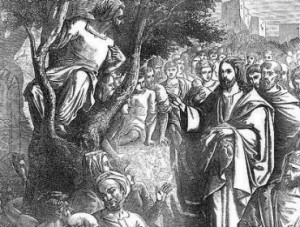
Jesus entered Jericho and was passing through it. A man was there named Zacchaeus; he was a chief tax collector and was rich. He was trying to see who Jesus was, but on account of the crowd he could not, because he was short in stature. So he ran ahead and climbed a sycamore tree to see him, because he was going to pass that way.

(From the Daily Office Lectionary – Luke 19:1-4 (NRSV) – November 28, 2012)
 
Jesus Addresses Zacchaeus in the Sycamore TreeZacchaeus climbs a tree to see Jesus. So today’s reading got me thinking scattered thoughts about trees. The weeping willow in my childhood backyard. The peach and cherry trees in my grandfather’s garden. The pinion pines of my native Nevada. The eucalyptus trees that were everywhere on my college campus. The huge ornamental pepper tree that shaded the first house my wife and I bought. I close my eyes, think of those trees, and I see my parents, my childhood friends, my college roommates. Trees are filled with meaning and memory; they bear the fruits of remembrance.
Zacchaeus hung in a tree to see Jesus. It won’t be too long before Jesus will be hung on a tree. Paul will write to the Galatian church, “Christ redeemed us from the curse of the law by becoming a curse for us – for it is written, ‘Cursed is everyone who hangs on a tree.'” (Gal. 3:13)

The tree Zacchaeus climbs is a Ficus Sycomorus. This tree produces an edible fruit, an inferior fig which the poor gathered. When I think of trees bearing fruit, I sometimes remember my grandfather’s peach and cherry trees. I sometimes remember the orange orchards around my parents’ retirement home. I sometimes remember the apple trees in my yard in Kansas that enticed my neighbor’s cows to break down the fence. And I sometimes remember a song sung by Billie Holiday; I remembered it as I thought of Zacchaeus and Jesus and the trees on which they hung. The song is entitled Strange Fruit and concerns the lynching of blacks in the American South:

Southern trees bear a strange fruit,
Blood on the leaves and blood at the root,
Black bodies swinging in the southern breeze,
Strange fruit hanging from the poplar trees.

Pastoral scene of the gallant south,
The bulging eyes and the twisted mouth,
Scent of magnolias, sweet and fresh,
Then the sudden smell of burning flesh.

Here is fruit for the crows to pluck,
For the rain to gather, for the wind to suck,
For the sun to rot, for the trees to drop,
Here is a strange and bitter crop.

Words by Abel Meeropol.

The tree on Calvary bore a strange fruit, too. It bore the fruit of salvation. Because of that fruit, in a few weeks Americans will place trees in their homes (if they haven’t already) to commemorate the birth of the One who hung on that tree and offered that fruit to all. Those evergreens in American homes will also bear fruit. The fruit of good will, of families gathered in love, of traditions and family customs. Some will bear bitter fruit; not every family gathering will be happy, not every family will join in love. Families, like trees, bear different kinds of fruit, some good, some not so good, some downright bad. But the fruit borne by the tree on Calvary is for all, and that’s why we bring trees into our houses at Christmas. Those trees, like Zacchaeus’s sycamore, help us to see Jesus.

Scattered thoughts about trees. Trees fill our lives and we seldom notice them, but they bear all sorts of fruits. Strange fruits. Fruits of emotion and memory. Fruits of salvation. Zacchaeus climbed a tree to see Jesus.

====================

A request to my readers: I’m trying to build the readership of this blog and I’d very much appreciate your help in doing so. If you find something here that is of value, please share it with others. If you are on Facebook, “like” the posts on your page so others can see them. If you are following me on Twitter, please “retweet” the notices of these meditations. If you have a blog of your own, please include mine in your links (a favor I will gladly reciprocate). Many thanks!

====================

Father Funston is the rector of St. Paul’s Episcopal Church, Medina, Ohio.

Who Is You? – From the Daily Office – November 27, 2012

From the First Letter to the Corinthians:

Do you not know that you are God’s temple and that God’s Spirit dwells in you? If anyone destroys God’s temple, God will destroy that person. For God’s temple is holy, and you are that temple.

(From the Daily Office Lectionary – 1 Corinthians 3:16-17 (NRSV) – November 27, 2012)
 
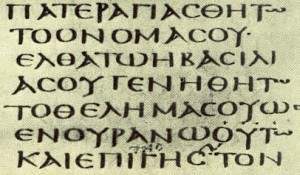
Greek Text from the Codex Sinaiticus, Gospel of LukeWho is you? That’s not a grammatically incorrect question. It’s a deeply important question in our study and understanding of scripture.
Who is the “you” in these words from Paul’s first letter to the Church in Corinth? Is it the individual believer? Is it the church collectively? In English, it just isn’t clear and, thus, these verses are frequently misunderstood and wrongly preached. For example, I recently read a meditation by another American clergyman (from another denominational tradition) who wrote:

The Apostle says that the believer is a temple of God. This means that our bodies are sacred and belong not to ourselves, but to God. Given the gift of the Holy Spirit in our baptism and chrismation, we are to manifest holiness in our lives – in how we act and speak and think, in how we treat ourselves and in how we treat others. Our life is to be one of self-offering, our hearts and minds given over to the sacrifice of praise and worship and thanksgiving to God and loving sacrificial service to our neighbor.

While this writer may be correct that we are to demonstrate holiness in our lives and treat ourselves and others with respect, that is manifestly not Paul is speaking about in this letter! Paul is not saying “that the believer is a temple of God” and exhorting the individual to proper conduct. The “you” in these verses is not singular; it is plural.

In the koine Greek of the New Testament there were a singular “you” – su – and a plural “you” – humin. In these verses, Paul uses the latter. He is speaking of the whole body of the church as being the temple of God, not of the individual believer. Paul is addressing an issue of corporate solidarity, not individual holiness.

Our English language used to have these forms. “You” was the plural form; “thou” was the singular. Like in modern French, the plural “you” was also used as a formal singular, used with those one did not know personally or with superiors. “Thou” was reserved for familiar usage with intimate friends and family members. As modern English evolved, “thou” was dropped from everyday usage and “you” became the only form of the pronoun for all uses save one, worship. God continued to be addressed as an intimate friend.

Societies and their collective consciences change. Overtime, we came to understand “thou” as the formal word because we applied it only to God. When our Episcopal Church liturgy was modernized and “you” replaced “thou” in reference to God, one of the complaints about the contemporary English service was that it made God seem too familiar! In truth, that had already happened through the misreading of “you” in bible passages like today’s from First Corinthians.

Misunderstanding that “you” to be an individual and personal pronoun, like the clergyman I quoted above, American Christians had come to understand their religion as a “me and Jesus” affair, something highly personalized and individualized between the believer and God. Religion was privatized with each person having their own peculiar and idiosyncratic relationship with the Almighty. Nothing could have been more familiar to the believer than his or her own independent connection to God.

At the General Convention of 2009 our Presiding Bishop said that this is “the great Western heresy – that we can be saved as individuals, that any of us alone can be in right relationship with God.” She was roundly criticized by Evangelicals but, frankly, she was right. Her statement is still true. Throughout scripture there are singular “yous” and there are plural “yous” and the meaning and application of the text may hinge on knowing which was originally intended. Reading all of the “yous” in the scriptures as singular is not simply misinterpretation of language, it is misinterpretation of religion and that, by definition, is heresy. So, too, would be reading them all as plural!

When we read the bible we must get behind the words. The text was not originally written in English, so we cannot trust the English we read to be entirely accurate. We must look behind it to the original Hebrew or Greek. We must determine, for example, whether “you” is “all of you together” (humin) or “each of you individually” (su). We need to ask, “Who is you?”

====================

A request to my readers: I’m trying to build the readership of this blog and I’d very much appreciate your help in doing so. If you find something here that is of value, please share it with others. If you are on Facebook, “like” the posts on your page so others can see them. If you are following me on Twitter, please “retweet” the notices of these meditations. If you have a blog of your own, please include mine in your links (a favor I will gladly reciprocate). Many thanks!

====================

Father Funston is the rector of St. Paul’s Episcopal Church, Medina, Ohio.

Giving It All Up, Getting Back Very Much More – From the Daily Office Lectionary – November 26, 2012

From Luke’s Gospel:

Jesus said, “It is easier for a camel to go through the eye of a needle than for someone who is rich to enter the kingdom of God. Those who heard it said, “Then who can be saved?” He replied, “What is impossible for mortals is possible for God.” Then Peter said, “Look, we have left our homes and followed you.” And he said to them, “Truly I tell you, there is no one who has left house or wife or brothers or parents or children, for the sake of the kingdom of God, who will not get back very much more in this age, and in the age to come eternal life.”

(From the Daily Office Lectionary – Luke 18:25-30 (NRSV) – November 26, 2012)
 
Jesus Talking to the DisciplesDo you ever wish someone whom you respect and admire hadn’t said what they said, because what they said is so hard to explain to someone who doesn’t respect and admire them, and what they said just sounds wrong, even to you? Then you know how I feel about the last response of Jesus in this conversation with Peter!

Jesus has just answered the question of someone Luke calls “a certain ruler” (in Mark’s Gospel he is described as a “rich young man”) about how to inherit eternal life with the famous reply, “Sell everything you own and give the money to the poor.” The disciples (more people than the Twelve, I think) are as unhappy with this hyperbolic response as the original questioner, and Peter seems downright outraged. “What are you saying?” I can almost hear him shouting at Jesus. “We have given up everything for you!” Is Jesus simply placating him with the promise of pie-in-the-sky-by-and-by? That’s what it sounds like. “Don’t worry! You’ll get it all back and get to live forever, too!”

Of course, I’m pretty certain that’s not what Jesus meant, but it’s so hard to explain that to someone who is skeptical of this whole God-Incarnate thing to begin with.

The reason I’m pretty certain that that’s not what Jesus meant is that here, unlike in the Markan version of this story, he doesn’t say, “You’ll get back a lot more of the things you gave up.” In Mark he does say pretty much that: “Truly I tell you, there is no one who has left house or brothers or sisters or mother or father or children or fields, for my sake and for the sake of the good news, who will not receive a hundredfold now in this age – houses, brothers and sisters, mothers and children, and fields, with persecutions – and in the age to come eternal life.” (Mark 10:29-30) Gave something up? Get a hundred more back. That’s what Mark’s Jesus says. But in Luke’s version of the story all that Jesus promises is “very much more.” I think that here there is a qualitative rather than quantitative difference in the promised return. In Mark, Jesus promises his follower will get a lot of the same stuff but at a price, i.e., persecutions; here, something better is promised . . . maybe peace, contentment, love, blessing, the Presence of God, the gifts of Holy Spirit . . . one doesn’t know, but it will be “very much more” than what was sacrificed. Are Mark and Luke trying to say the same thing? Are the things they report Jesus promising as rewards to the faithful follower equivalent? I don’t know; I hope they are, but the texts don’t make it easy to tell. And neither text makes it easy to explain to the skeptical unbeliever.

And the icing on the cake in both versions is the promise of “eternal life” in “the age to come”! It looks like a promise of immortality in the future, but (again) I’m not so sure. Both of these are coded phrases. The second one is found in lots of rabbinic literature, some contemporary with Jesus, some from later periods. It doesn’t necessarily mean the future; it means the time when God’s rule directs human affairs. That can be at any time when a person or persons give up their falsely perceived autonomy and live in accordance with God’s will. “The age to come” can (and does) exist concurrently with “this age”. It’s like that both-and, here-and-not-here, within-you-but-also-only-nearby thing that Jesus announced, the Kingdom of God. “Eternal life” is also not a future thing. For Jesus “eternal life” doesn’t mean immortality; it means life in eternity, where eternity is God’s Presence. “Eternal life” means living in God’s Presence with full awareness.

So the promised reward (whether it includes a hundred houses or not) is a qualitatively different life. Whatever we are called to give up in order to live a faithful life, possibly the hyperbolic “everything” that Jesus and Peter mention in this text, the reward of such a life is “very much more.” Which brings me back to how to explain it to the unbeliever . . . and the truth is that I don’t think it can be explained. It can only be lived and when it is lived, it becomes very apparent to someone not living it. An old friend of mine used to say this was the very best form of evangelism, to live the Christian life so well that one fairly glows with peace, contentment, love, blessing, the Presence of God, and the gifts of Holy Spirit. Others will see that and think, “I want that.” Then we don’t have to explain it, just offer it. Give it all up; get back so very much more.

====================

A request to my readers: I’m trying to build the readership of this blog and I’d very much appreciate your help in doing so. If you find something here that is of value, please share it with others. If you are on Facebook, “like” the posts on your page so others can see them. If you are following me on Twitter, please “retweet” the notices of these meditations. If you have a blog of your own, please include mine in your links (a favor I will gladly reciprocate). Many thanks!

====================

Father Funston is the rector of St. Paul’s Episcopal Church, Medina, Ohio.

Is go dtí tú mo mhuirnin slán

Christ the King Among the Amish – From the Daily Office – November 25, 2012

From Peter’s First Letter:

In your hearts sanctify Christ as Lord. Always be ready to make your defence to anyone who demands from you an account of the hope that is in you; yet do it with gentleness and respect.

(From the Daily Office Lectionary – 1 Peter 3:15-16 (NRSV) – November 25, 2012)
 
Amish Buggy and Cart in OhioToday is the last Sunday after Pentecost called “the Feast of Christ the King.” A relatively new feast on the calendar of the church, it was instituted by a 20th Century pope and originally set in late October as a response to the Protestant celebration of “Reformation Sunday” on the Sunday closest to October 31, the anniversary of Luther’s posting on the Wittenburg chapel door. The latter, I would suppose, started with the Lutherans but has spread throughout American Protestantism; I know of Presbyterian, Reformed, UCC, and Methodist churches that mark it. I know of no Episcopal congregations that do so. Episcopalians did take to Christ the King, however, and since Paul VI moved it to the last Sunday of the Christian year, every congregation I’ve been a part of has celebrated it. With the adoption of the Revised Common Lectionary, it is now an official part of our tradition.

Today, my congregation will be celebrating it without me. My spouse and I have taken a break and, since Friday, have been staying in a retreat facility not that far away from our home geographically, but mentally, emotionally, and spiritually a very, very long distance separate this place from that. We spent yesterday indulging our hobby of “antiquing” – wandering aimlessly through several of the amazing collections of junk one finds in the abandoned supermarkets, retired barns, and former garages now called “antique malls.” There are several in the Amish Country of Ohio, where we are.

The Amish are an interesting people. They quietly and steadfastly maintain a traditional way life hundreds of years old, one dating back to their formation as a Protestant sect in German-speaking Switzerland. Eschewing automobiles, they drive boxy black buggies down the state highways and country roads. Claiming not to use electricity, they have gas lights or kerosene lanterns in their homes and businesses, except when they don’t – I admit to being befuddled by this; I can’t figure out when it is OK to use electricity and when it isn’t. And then there is the use of batteries by those who “have no electricity” (as one shopkeeper put it); batteries power buggy lights and sometimes business lighting (but “we have no electricity”). I don’t get it it, but that’s OK – that’s not what this meditation is about.

What makes the Amish most interesting is that they go about this odd, set-apart way of life “with gentleness and respect.” I nearly wrote above that they maintain their traditions “unobtrusively,” but that really wouldn’t have been accurate. They are obtrusive! Come upon a horse-drawn farm cart plodding along a 55-mph-speed-limit highway or a buggy on a 35-mph country lane, roads which are winding and hilly and have limited visibility, and (believe me) it’s an obtrusion! Often a deadly one for the Amish if the automobile driver doing so is not paying attention or has poor reactions.

In stores, the Amish men with their broad-brimmed hats, long beards, and plain rugged clothing, and the Amish ladies with their long skirts, dark sweaters, and hair done up in buns under starched linen caps, are very noticeable, whether they are service personnel or are themselves customers. In restaurants, which they rarely but occasionally patronize, their large families pausing to say grace in antiquated German before eating are a reminder that while they are sanctifying the Lord, we are not. That’s obtrusive . . . but oh so gentle and respectful.

That is the nature of the King whom we sanctify today on this special day of remembering his lordship. He gave vent to flashes of anger, of course, and there are plenty of hints throughout the Gospels that he was, rather often, frustrated and unhappy with this followers, but we mostly remember him as gentle and reverent. “Gentle Jesus, meek and mild” is a phrase I remember from a hymn we learned in my Methodist Sunday School days of long ago.

The Gospel lesson for today’s celebrations of the Holy Eucharist is from John: Pilate questioning Jesus before his crucifixion. Jesus, the epitome of gentleness and respect, answers Pilate calmly, or stands silently, when he could have taken complete control of the situation, called down the wrath of God, and established an earthly kingdom right then and there. Instead, he takes complete control of the situation in another way, the way of gentleness and peace.

I think that’s what I find most compelling and oddly attractive about the Amish. They are in complete control of their lives, as narrow and confined as they may seem to a modern outsider like myself. They go about their traditional ways in the midst of the madness around them, the speeding cars, the frantic shoppers, the hurried diners too busy to say grace; they don’t give in to modern pressures. They just keep plodding along like the horses pulling their carts and buggies, doing faithfully what they know they are called to do. They are a Protestant’s Protestants, children of the Reformation started when Martin Luther nailed those theses to the Wittenburg door, but more than any Solemnity declared by pope or any dictate of the lectionary, they stand testimony to the power of gentleness and respect, a potent reminder of Christ the King.

====================

A request to my readers: I’m trying to build the readership of this blog and I’d very much appreciate your help in doing so. If you find something here that is of value, please share it with others. If you are on Facebook, “like” the posts on your page so others can see them. If you are following me on Twitter, please “retweet” the notices of these meditations. If you have a blog of your own, please include mine in your links (a favor I will gladly reciprocate). Many thanks!

====================

Father Funston is the rector of St. Paul’s Episcopal Church, Medina, Ohio.

Putting God to the Test – From the Daily Office – November 23, 2012

From the Prophet Malachi:

Will anyone rob God? Yet you are robbing me! But you say, “How are we robbing you?” In your tithes and offerings! You are cursed with a curse, for you are robbing me – the whole nation of you! Bring the full tithe into the storehouse, so that there may be food in my house, and thus put me to the test, says the Lord of hosts; see if I will not open the windows of heaven for you and pour down for you an overflowing blessing.

(From the Daily Office Lectionary – Malachi 3:8-10 (NRSV) – November 23, 2012)
 
Dear God Black Friday memeThis “test me and see” verse is a favorite of preachers of the so-called “prosperity gospel” (of course, it’s not from a gospel, but that doesn’t seem to bother them). To have it turn up in the Daily Office readings the day after the United States celebrated Thanksgiving Day is a real eye-opener! On Face Book this morning, a humorous “meme”* showed up picturing a young woman at prayer holding a credit card with this caption: “Dear God, we are so thankful for all we have . . . now, if you excuse us, we’ve got to go get more stuff. There’s a great Black Friday sale at Best Buy!” Could there have been a better juxtaposition?

Malachi says pretty bluntly that we are robbing God. Stealing from God is not something to be taken lightly. Many preachers cite this text about robbing God in the context of stewardship sermons. We rob God, they say, when we deny God what is rightfully God’s. We rob God, they say, when we fail to tithe, to make an offering of 1/10, or 10%, of our income. But it seems to me Malachi is more concerned about attitude than with particular actions like paying or not paying the biblical tithe.

Essentially, it comes down to our attitude about who owns what. If we believe (as most Americans seem to) that we have earned all we have, that we are entirely responsible for our prosperity, then we will have an ungenerous attitude toward everyone, including God. If we take a step back and realize that God is responsible for our well-being, we are more likely to be generous. The question is, “Who owns my possessions, bank account, and even my life?” To whom are we truly thankful for what we have?

Jesus told a story about a rich man who had a lot of stuff, so much stuff that he had to build a bigger barn for it all. When he had built the barn and stored the stuff, he sat back content. But just then God said to him, “You fool! This very night your life is being demanded of you. And the things you have prepared, whose will they be?” (Luke 12:20) Jesus’ point (and Malachi’s) is that we have no control over our possessions, our money, or our life. Anything and everything may be lost at any time. The truth is that we don’t own anything, not even ourselves. God owns it all.

When we fail to use it to benefit others around us, when we fail to hold it in trust for God with the proper attitude of generosity, we rob God. If, on the other hand, we use what we have to do what good we can, if we have an attitude of gratitude (the one we claimed we had yesterday), we will benefit as much as if not more than those around us. “Put me to the test and see,” says God.

So, today, what’s it to be? Rush off to the Black Friday sales putting Thanksgiving behind us, or rather making thanksgiving a way of life, not just a day on the calendar? Either way, we put God to the test . . . .

*An internet meme is a concept that spreads via the internet often taking the form of a captioned image.

====================

A request to my readers: I’m trying to build the readership of this blog and I’d very much appreciate your help in doing so. If you find something here that is of value, please share it with others. If you are on Facebook, “like” the posts on your page so others can see them. If you are following me on Twitter, please “retweet” the notices of these meditations. If you have a blog of your own, please include mine in your links (a favor I will gladly reciprocate). Many thanks!

====================

Father Funston is the rector of St. Paul’s Episcopal Church, Medina, Ohio.

« Older posts Newer posts »