====================
This sermon was preached on Sunday, August 19, 2012, at St. Paul’s Episcopal Church, Medina, Ohio, where Fr. Funston is rector.
(Revised Common Lectionary, Proper 15B: Proverbs 9:1-6; Psalm 34:9-14; Ephesians 5:15-20; and John 6:51-58)
====================
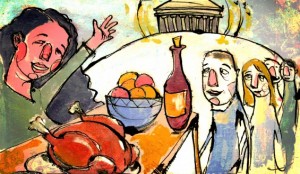 As I may have mentioned here before, I spent many of my childhood summers in the southeastern Kansas town of Winfield with my paternal grandparents, C.E. and Edna Funston. Winfield was my parents’ hometown, both of them were raised there and my mother had been born there. Her maternal grandparents, Hinrich and Harmke Buss, were immigrants from that area of Germany right next to Holland called “Ostfriesland”. My father was born in Dodge City, and he and his folks moved to Winfield when he was just a few months old; they were relative newcomers but my grandfather soon became a prominent citizen.
Anyway, one of the things I remember about Winfield is the way newcomers, or anyone someone was meeting for the first time, were almost invariably asked two questions. I once discussed this with a friend who was born and raised in South Carolina and she said it was the same in her hometown, that these are what she called “very Southern questions.” That makes sense because in an odd way, southeastern Kansas is much more Southern than it is midwestern. My mother used to all that part of Kansas “lap land” – meaning that it is were Oklahoma and Arkansas lap over into Kansas.
So there were these two questions that people asked when first meeting another person. The first was, “Who are your people?” Winfield was an agricultural center and not much else. There was no industry or manufacturing that would bring people to town. There was farming and the businesses that support farming, all of which were family owned. So if somebody new came to town to work in on a farm or in a farm-supporting business, it was assumed you must be part of the family. So, who are your people? The answer placed you in a particular social context. So I would say, “Well, my mother is Betty Sargent, one of the Buss cousins.” Anyone local would then know I was a descendant of Henry Buss. My greatgrandfather had had two families. One set of children were born to first wife Mary – she had 14 kids who lived; another set of 13 living children were born to Harmke, my greatgrandmother. According to his obituary, all of those children were alive when Henry died and he left approximately 200 acres of land to each of them. Doing the math, you get the idea that he had acquired a lot of farmland (something over 5,000 acres) and that he (and his children after him) were influential in the local economy. As I mentioned before, on the paternal side my grandparents were comparatively new to the town, but they had become very active members of the Methodist Church and my grandfather, an active Mason, had risen in those ranks as well. So if I continued to my inquirer, “And my father is C.E. and Edna Funston’s youngest son,” he or she would immediately know I was related to a Past Master of the Lodge and an elder in the Methodist Church.
Because of that, I wasn’t often asked the second question, “Where do you go to church?” But I could have been because it really wasn’t a given that I would have been a Methodist. The Busses were members of the Dutch Reformed Church and the Sargents belonged to the Disciples of Christ; I could have been either of those – but the truth was, except for those summer months with the Funstons at the Methodist Church, I really didn’t go to church as a kid.
In any event, those questions served to place someone in a social context, to define in the questioner’s mind who they were and where the fit. And the truth is they aren’t just “Kansas questions” or “Southern questions”. They are everywhere questions. In the fall of 2005, Evie and I took our first trip to Ireland and, as part of that trip, visited County Donegal as I was in search of Funstons in the area where I believe my Funston great-greatgrandfather originated. In Donegal Town itself, we happened to stop into a woolen sweater store run by a man named Sean McGinty. Mr. McGinty asked about our trip and I was explaining to him my family connection to the area. He turned to his wife Mary and said, “You’re from Pettigo; weren’t there some Funstons in Pettego.” She thought for a moment and replied, “Yes . . . . but they weren’t our people.” — They weren’t our people, meaning they weren’t Roman Catholic. The Irish Funstons were and still are Church of Ireland – Anglicans . . . Protestants. “Who are your people?” “Where do you go to church?” They or something like them are human questions; the help us to put people in their place, to categorize one another, to define each other. They are human questions.
But they are not God’s questions! Long before St. Paul would write to the Galatians that in Christ “there is neither Jew nor Greek, there is neither slave nor free man, there is neither male nor female,” (Gal. 3:28) the compiler of the Book of Proverbs would make the same point in the 8th and 9th Chapters of that book, part of which we read today. In these chapters we read of Lady Wisdom, one of the most intriguing characters in all of the Old Testament. In the 8th Chapter, before the part we heard this morning, she tells us herself:
When [God] established the heavens, I was there, when he drew a circle on the face of the deep, when he made firm the skies above, when he established the fountains of the deep, when he assigned to the sea its limit, so that the waters might not transgress his command, when he marked out the foundations of the earth, then I was beside him, like a master worker; and I was daily his delight, rejoicing before him always, rejoicing in his inhabited world and delighting in the human race. (Prov. 8:27-31)
She was, she tells us, a “master worker” helping God to create all that is. And in our reading this morning from Chapter 9, we see her as “the hostess with the mostest” who is ready to throw a party, to do the honors at a great feast. She has “slaughtered her animals, she has mixed her wine, she has . . . set her table,” and she sent her servants out to invite her guests. In fact, she herself stands in her doorway, in the highest places of the town calling,
“You that are simple, turn in here!” To those without sense she says, “Come, eat of my bread and drink of the wine I have mixed. Lay aside immaturity, and live, and walk in the way of insight.” (Prov. 9:4-6)
Note that she doesn’t ask, “Who are your people? Where do you go to church?” She doesn’t ask if any are Jew or Greek, slave or free, black or white, straight or gay, Republican or Democrat, Catholic or Protestant, none of that matters . . . all she asks is that we be “simple” and “without sense.”
Now that’s a bit disconcerting and, frankly, I think the translation belies the true meaning of the invitation. The Hebrew here is, “Mi-phethi yasur henah chasar-leb ‘am’rah lo.” The word translated as “simple” (and sometimes as “naive”) is phethi. It’s root is the word pawthaw, which means “wide open”. An alternative and more positive understanding of this word is “open-minded”. The term “without sense” (sometimes rendered “lacking understanding”) is chasar-leb. Chasar means “without” or “lacking”. Leb (rendered here as “sense” or “understanding”) is most often translated as “heart” because in the ancient Hebrew understanding the heart was believed to be the seat of comprehension and emotion. This is not simple understanding or sense, this is passionate belief, enthusiastic commitment; in a negative sense we might say “bias” or “prejudice”.
Lady Wisdom is not inviting simpletons or the foolishly naive into her parlor; she is inviting the open-minded, those who have no preconceptions, no intolerant prepossessions. Lady Wisdom, God’s master worker, does not care if you are Jew or Greek, Irish or German, black or white or Asian or Native American, straight or gay or lesbian or transgendered, Democrat or Republican or Socialist or Libertarian. Lady Wisdom, God’s master worker, doesn’t care who your people are; she cares about whose you are! She doesn’t care where you go to church; she cares that you are the church, the People of God! She wants you to be open-minded, to come without prejudice or preconception. Her invitation is reminiscent of the Prophet Isaiah’s, “Come now, and let us reason together, saith the Lord.” (Isaiah 1:18 – KJV) She invites us to come and learn.
She has set her table; she is ready to host her party. “Come, [she says] eat of my bread and drink of the wine I have mixed. Lay aside immaturity, and live, and walk in the way of insight.” Lady Wisdom’s celebration is the marriage feast of the Lamb; her invitation is to that very supper Jesus would share with his disciples and shares with us throughout all the ages. St. Paul wrote to the Corinthians the words we recite each time we gather at this Table:
. . . that the Lord Jesus on the night when he was betrayed took a loaf of bread, and when he had given thanks, he broke it and said, “This is my body that is for you. Do this in remembrance of me.” In the same way he took the cup also, after supper, saying, “This cup is the new covenant in my blood. Do this, as often as you drink it, in remembrance of me.” (1 Cor. 11:23-2)
And here in John’s Gospel today he promises that “those who eat my flesh and drink my blood have eternal life, and I will raise them up on the last day; for my flesh is true food and my blood is true drink. Those who eat my flesh and drink my blood abide in me, and I in them.” (John 6:54-56)
To this Feast we are all invited without regard to who our people may be, without regard to where we go to church. To this Feast today we welcome Nathan Joseph Daley who is to be baptized. No one here will ask, “Who are your people?” but if anyone ever does, Nathan can answer “The People of God” . . . and if he wants to be more specific, he can say “The Episcopalians!” No one here will ask, “Where do you go to church?” but if anyone ever does, Nathan can answer, “St. Paul’s!”
Someone else may ask those questions of Nathan or of you or me, but God is never going to ask them! God will ask, “Are you open-minded? Are you free of bias and prejudice?” God will ask, “Are you filled with the Spirit? Do you sing psalms and hymns and spiritual songs? Do you sing and make melody to the Lord in your heart? Do you give thanks at all times and for everything in the name of our Lord Jesus Christ?” (Questions drawn from Ephesians 5:18-20) God will ask, “Do you seek and serve Christ in all persons, loving your neighbor as yourself? Do you strive for justice and peace among all people? Do you respect the dignity of every human being?” (Questions drawn from the Baptismal Covenant in the Book of Common Prayer, pg. 305)
With God’s help, Nathan and we will grow and learn to do these; through God’s grace, he and we will feast on Bread and Wine, and “lay aside immaturity, and live and walk in the way of insight.”
Let us pray:
Grant, Lord God, to Nathan who is about to be baptized into the death and resurrection of your Son Jesus Christ, and to those who already have been baptized, that, as we have put away the old life of sin, so we may be renewed in the spirit of our minds, lay aside immaturity, and live and walk in the way of insight, righteousness, and true holiness; through Jesus Christ our Lord, who lives and reigns with you, in the unity of the Holy Spirit, one God, now and for ever. Amen.
 A later selection from the Book of Job was called up by the Sunday Eucharistic Lectionary several weeks ago. In my sermon I said to the congregation that the Book of Job is fiction (which it is). You should have seen the look on one of my parishioners’ face! There’s a fellow in the congregation who is, shall we say, conservative with regard to the Bible. While I don’t believe he actually considers the Bible to be the inerrant word of God per se, he’s pretty sure that it is to be taken with the highest degree of certainty and words like “myth” or “fiction” applied to Scripture are not to his liking. I swear I thought he might have an apoplectic fit right there in his pew! But let’s be honest: do we really think that God and Satan are engaged (or have ever been engaged) in a game of chance involving the lives of human beings?
 Psalm 130 is one of the seven “pentitential psalms” of the church (Psalms 6, 32, 38, 51, 102, 130, and 143), a tradition that stretches back to the Sixth Century if not earlier. It is also one of the “songs of ascents” (Psalms 120-134) that are believed to have been sung by pilgrims making their way up to Jerusalem or possibly when climbing up the Temple Mount for festival celebrations. Somehow it strikes me as both odd and poignant that a song or poem beginning “Out of the depths” is called a song of “ascent” – from the deepest sloughs of despond the poet calls out the Highest. Ascent, indeed!
 I think this may be my favorite psalm. It is the psalm appointed for use on the feast of St. Francis of Assisi. It is one of the psalms approved in The Book of Common Prayer for use at a funeral; it was selected by my mother to be used at her funeral.
  Saint Stephen, one of the first deacons of the church, has just preached a sermon in which he has reminded his hearers, Jewish authorities in Jerusalem, that the Jews had a history of mistreatment of prophets, Their ancestors, he has said, “killed those who foretold the coming of the Righteous One, and now [his listeners] have become his betrayers and murderers.” No wonder they were angry with him.
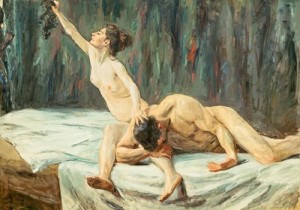 It may be a sign of my age or a condemnation of my cultural up-bringing, but I cannot read any of the story of Samson and Delilah without hearing Tom Jones’ voice sining, “Why? Why? Why, Delilah? My, my, my Delilah?” Silly, I know, but it sort of fits with this bit from the Old Testament lesson from today’s lectionary readings.
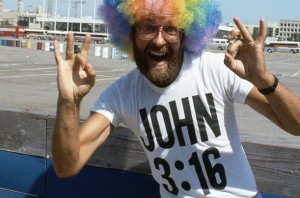 A very familiar quotation from Scripture that second verse: anyone who has ever attended a sporting event in the United States (or watched one on television) as seen someone holding up a sign with “John 3:16” emblazoned on it. Often that person is wearing a rainbow-colored “Afro” wig. Anytime I have witnessed that spectical I’ve wondered, “Has anyone ever become a follower of Jesus because of that sign?” I’m pretty certain the answer is “No.”
 This short passage from the Book of Acts describes the sort of world Jesus intended. Not just the sort of church . . . . the sort of world, the sort of human society, a complete community in which no one claims private ownership (it’s all God’s remember) and where there are no needy persons because what is needed is distributed equitably.
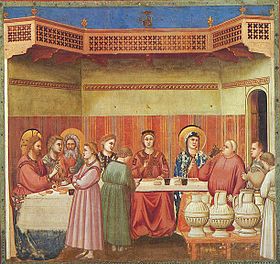 A year ago I was in Ireland, camped out in a cottage outside of the village of Banagher, County Offaly, on sabbatical. As my study project, I was translating old Irish hymns into metrical, rhyming English such that they could be sung to the music of the original. The hymns were published in the early 20th Century in a collection titled Dánta Dé Idir Sean agus Nuadh compiled by Uná ní Ógáin. Dánta Dé includes a communion hymn which elaborates on John’s story of the wedding feast; it is entitled The Blessed Wedding at Cana and is attributed to Maighréad ní Annagáin. I found I could not directly translate the hymn, so instead I wrote a poem of my own. Reading this story today, I recall working on that piece and offer it again.
 OK. I know I shouldn’t get into this . . . I know that someone is going to give me a hard time; I can almost predict that someone will tell me they are planning to “leave the church” over this. But here goes.

