Occasional thoughts of an Anglican Episcopal priest

Category: Politics (Page 13 of 23)

Bless [All] the People of Israel – From the Daily Office – July 23, 2014

From the Book of Joshua:

All Israel, alien as well as citizen, with their elders and officers and their judges, stood on opposite sides of the ark in front of the levitical priests who carried the ark of the covenant of the Lord, half of them in front of Mount Gerizim and half of them in front of Mount Ebal, as Moses the servant of the Lord had commanded at the first, that they should bless the people of Israel.

(From the Daily Office Lectionary – Joshua 8:33 (NRSV) – July 23, 2014)

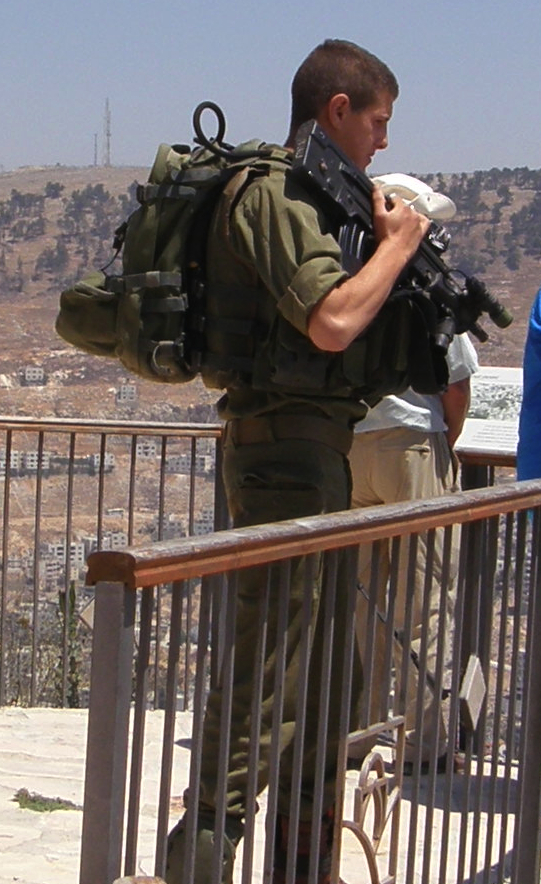
Soldier at Mt GerizimTwo weeks ago, I stood on Mt. Gerizim with 17 friends looking over to Mt. Ebal. We read this text; we read Deuteronomy 27 in which the explicit curses to be read from Mt. Ebal are set forth. We pondered what it means for a people to live in a land divided by blessings and curses. Lost in our thoughts, we were startled when we turned around and found a young Israeli soldier standing behind us in full battle gear, an Uzi loaded and held at the ready.

Some of us found him threatening, but we were told that he was there for our protection. The lookout is a spot where Jewish pilgrims also like to come and remember their heritage; it is in full view of the Arab city of Nablus and a sniper on the city’s outskirts with a high-powered rifle could pick off someone standing at the lookout. I don’t know if that has ever happened, but the young soldier was there to make sure it didn’t or that, if it did, the gunfire would be answered.

I’m sure there might be some radical lunatic who might try such a thing, but in the three days we spent in Nablus, walking its streets, eating in its restaurants, greeting its people, I certainly never met or encountered anyone whom I thought to be such a threat.

In any event, I wonder about that young soldier now. Has he been transferred the fifty or so miles from his outpost on the ancient mountain to the modern battleground on the border with the Gaza Strip? Is he safe? Has he been wounded or killed? Is he preparing for a ground battle in Gaza? I’ll never know, of course, but I wonder.

There was a report recently that in Sderot, an Israeli community less than three miles from the Gaza community of Beit Hanoun, the Jewish residents sat in their lawn chairs watching the bombing of their Palestinian neighbors, laughing and cheering as the bombs exploded. An Australian CNN reporter filmed them doing so.

I couldn’t help but think about that when I read today’s story of Joshua. I couldn’t help but remember standing on Mt. Gerizim and wondering what it must have been like to hear from the mountain across the valley the voices of Joshua and others yelling out the curses. Ancient Jews on a hillside pronouncing curses on the land a couple of miles away; modern Jews on a hillside laughing derision and cheering destruction on the land a couple of miles away. Ancient history come to life in modern Palestine; an ancient ritual now played out as if in some obscene parody with modern weapons of terrible vengeance. Would the residents of Sderot have laughed and cheered if they knew that young soldier might be in danger where those bombs were exploding? Did it matter to them that other young soldiers, not to mention women, children, elderly people, disabled people, and other civilians, were dying where those bombs were exploding?

I don’t ask to imply or suggest any condemnation of them. God knows Americans have no high moral ground to stand on in this regard! It’s a well-known fact of American history that the residents of Washington DC took picnic baskets out to the hillside overlooking Bull Run to watch what became the first Civil War battle at that site. And, more recently, many of us cheered and partied in the streets when we learned of the death of Osama bin Laden. Laughing derision and cheering the destruction of those we consider our enemies is a universal human behavior. We just don’t consider them to be quite like us.

But they are like us. They have lives like ours. As Shakespeare’s Shylock pointed out when contemplating the differences (or lack of differences) between Jew and Gentile:

I am a Jew. Hath not a Jew eyes? Hath not a Jew hands, organs, dimensions, senses, affections, passions? Fed with the same food, hurt with the same weapons, subject to the same diseases, healed by the same means, warmed and cooled by the same winter and summer as a Christian is? If you prick us, do we not bleed? If you tickle us, do we not laugh? If you poison us, do we not die? And if you wrong us, shall we not revenge? If we are like you in the rest, we will resemble you in that. If a Jew wrong a Christian, what is his humility? Revenge. If a Christian wrong a Jew, what should his sufferance be by Christian example? Why, revenge. The villainy you teach me I will execute — and it shall go hard but I will better the instruction. (Merchant of Venice, Act 3, Scene 1)

Is that what is happening now? In unknowingly acting out that bizarre caricature of the curses from Mt. Ebal, in carrying out their “containment” of the Palestinians behind a “security barricade,” in bombing the herded-together densely-packed residents of Gaza (1.8 million people on a piece of land only 139 square miles in size; 13,000 people per square mile) is that what Israel is doing? Bettering the instruction that Gentile society, Christian Europe specifically, has taught the Jews? Is that what is happening? The abused become the abuser and doing it “better”? The accursed become the curser and doing it “better”?

I am commended by Scripture to “bless the people of Israel.” I am commended by Scripture to pray for the peace of Jerusalem. I can only do so if I include in my blessing all the people of Israel, Jew and Arab, Muslim and Christian, secular Jew and Orthodox, Amenians and Greeks, all the people of the land. I can only do so if my prayer is for a peace which is just to all and in which all are secure, “alien as well as citizen.”

Bless the people of Israel and pray for the peace of Jerusalem.

====================

A request to my readers: I’m trying to build the readership of this blog and I’d very much appreciate your help in doing so. If you find something here that is of value, please share it with others. If you are on Facebook, “like” the posts on your page so others can see them. If you are following me on Twitter, please “retweet” the notices of these meditations. If you have a blog of your own, please include mine in your links (a favor I will gladly reciprocate). Many thanks!

====================

Father Funston is the rector of St. Paul’s Episcopal Church, Medina, Ohio.

Particular Social Groups – From the Daily Office – July 16, 2014

From the Gospel according to Matthew:

Jesus said: “When the Son of Man comes in his glory, and all the angels with him, then he will sit on the throne of his glory. All the nations will be gathered before him, and he will separate people one from another as a shepherd separates the sheep from the goats, and he will put the sheep at his right hand and the goats at the left. Then the king will say to those at his right hand, ‘Come, you that are blessed by my Father, inherit the kingdom prepared for you from the foundation of the world; for I was hungry and you gave me food, I was thirsty and you gave me something to drink, I was a stranger and you welcomed me, I was naked and you gave me clothing, I was sick and you took care of me, I was in prison and you visited me.’ Then the righteous will answer him, ‘Lord, when was it that we saw you hungry and gave you food, or thirsty and gave you something to drink? And when was it that we saw you a stranger and welcomed you, or naked and gave you clothing? And when was it that we saw you sick or in prison and visited you?’ And the king will answer them, ‘Truly I tell you, just as you did it to one of the least of these who are members of my family, you did it to me.’ Then he will say to those at his left hand, ‘You that are accursed, depart from me into the eternal fire prepared for the devil and his angels; for I was hungry and you gave me no food, I was thirsty and you gave me nothing to drink, I was a stranger and you did not welcome me, naked and you did not give me clothing, sick and in prison and you did not visit me.’ Then they also will answer, Lord, when was it that we saw you hungry or thirsty or a stranger or naked or sick or in prison, and did not take care of you?’ Then he will answer them, ‘Truly I tell you, just as you did not do it to one of the least of these, you did not do it to me.’ And these will go away into eternal punishment, but the righteous into eternal life.”

(From the Daily Office Lectionary – Matthew 25:31-46 (NRSV) – July 16, 2014)

Social GroupsI don’t usually quote the entire Daily Office Lectionary lesson in these meditations, I try to focus on one image, one metaphor, one statement in one or two verses from one of the lessons or psalms for the day, but today it just seems right to set out the whole end-time, judgment day, sheep-and-goats story that Jesus tells of the Last Day. Here’s why:
A couple of days ago a friend and colleague in ordained ministry posted a link to an essay on her Facebook page. The essay concerned the difficulty the essayist felt in being what he called “a liberal Christian.” He complained (rightly, in my experience) about the fact that among his politically liberal (and not uncommonly agnostic or atheist) friends, he found himself criticized and even ridiculed for his religious faith, while among his religiously Christian (and not uncommonly politically conservative) friends, he found himself criticized and even rejected because of his liberal politics. (The essay is here.)

The very first comment posted by any of her Facebook friends was this, “Chaplain, why not just preach The Word without regard for particular social groups?” (My friend has spent most of her ordained ministry in uniform ministering to American armed forces personnel, which explains why she is addressed as “Chaplain” by the commenter.)

Apart from the ambiguity of whatever it may be that the commenter means by “The Word,” which would be a subject for another meditation perhaps, my reaction to the suggestion was, “Is that even possible?” My faith is a social one (I’m even tempted to say “a political one”); “the word” (here, I mean “the bible”) is almost exclusively about God’s dealing with “particular social groups.” Whenever the prophets of the Old Testament speak, they speak to social classes (usually the ruling class) about the treatment of “particular social groups” (usually the poor). When Jesus deals with individuals (apart from the healing stories), it is usually not about their individual faith or personal behavior, and if it is, it’s almost always about how that behavior affects others.

For example, although in his conversation with the Samaritan woman at Jacob’s Well he and she do mention her personal life he does not focus on that. Instead, he turns the conversation toward the propriety of worship by groups (her Samaritans, his Jews, and eventually “true worshipers”) in various places and at various times. (Jn 4) When the Canaanite (or Syrophoenician) woman seeks healing for her daughter, neither the nature of the illness nor the personal behavior of the woman or the child are the subject of conversation; the discussion focuses on the targets of Jesus’ ministry (“the children” – i.e., the Jews – or “the dogs” – i.e., the Gentiles). (Mt 15:22-28) When Jesus does address matters of individual religious practice, it is usually to criticize it for taking the believer’s attention away from the needs of “particular social groups”:

The Pharisees and the scribes asked him, “Why do your disciples not live according to the tradition of the elders, but eat with defiled hands?” He said to them, “Isaiah prophesied rightly about you hypocrites, as it is written, ‘This people honors me with their lips, but their hearts are far from me; in vain do they worship me, teaching human precepts as doctrines.’ You abandon the commandment of God and hold to human tradition.” Then he said to them, “You have a fine way of rejecting the commandment of God in order to keep your tradition! For Moses said, ‘Honor your father and your mother’; and, ‘Whoever speaks evil of father or mother must surely die.’ But you say that if anyone tells father or mother, ‘Whatever support you might have had from me is Corban’ (that is, an offering to God ) — then you no longer permit doing anything for a father or mother, thus making void the word of God through your tradition that you have handed on. And you do many things like this.” (Mk 7:5-13)

And then today’s Daily Office gospel lesson. How can one “preach The Word without regard for particular social groups” when the Word Incarnate does not do so? Here he specifically tells us that his followers will be (are they not already?) divided into “particular social groups” at the day of judgment, into the “sheep” on his right and the “goats” on his left. And he will address each group with regard to how they treated other “particular social groups” — the naked, the hungry, the thirsty, the sick, the imprisoned, the “members of my family.”

I cannot see any way to “preach The Word without regard for particular social groups.” Neither Judaism nor Christianity is an individual faith; neither is concerned exclusively, nor even primarily, with individual behavior and practice, with the individual’s relationship with God. Both have major social components; both are concerned with human beings living in community, in covenant relationship with other human beings, in “particular social groups.” The Jews are nowhere described as “the chosen individuals of God;” they are the People of God. Christians were not told that where one is praying Jesus would be there, but “where two or three are gathered.” (Mt 18:20) Ours is a social, even a political, faith concerned with “particular social groups.”

====================

A request to my readers: I’m trying to build the readership of this blog and I’d very much appreciate your help in doing so. If you find something here that is of value, please share it with others. If you are on Facebook, “like” the posts on your page so others can see them. If you are following me on Twitter, please “retweet” the notices of these meditations. If you have a blog of your own, please include mine in your links (a favor I will gladly reciprocate). Many thanks!

====================

Father Funston is the rector of St. Paul’s Episcopal Church, Medina, Ohio.

Following Our Own Devices Doesn’t Work – From the Daily Office – July 12, 2014

From the Letter to the Romans:

Of Israel he says, “All day long I have held out my hands to a disobedient and contrary people.”

(From the Daily Office Lectionary – Romans 10:21 (NRSV) – July 12, 2014)

Israeli Security Barricade in BethlehemPaul quotes Isaiah here. His translation was obviously rather different from the rendering in the New Revised Standard Version, but the meaning is the same: “I held out my hands all day long to a rebellious people, who walk in a way that is not good, following their own devices.” (Isa 65:2)

The point cannot be made strongly enough nor forcefully enough nor clearly enough that the modern nation-state of Israel is not the biblical people of Israel, and yet these words of condemnation can be fully understood to apply to the modern country.

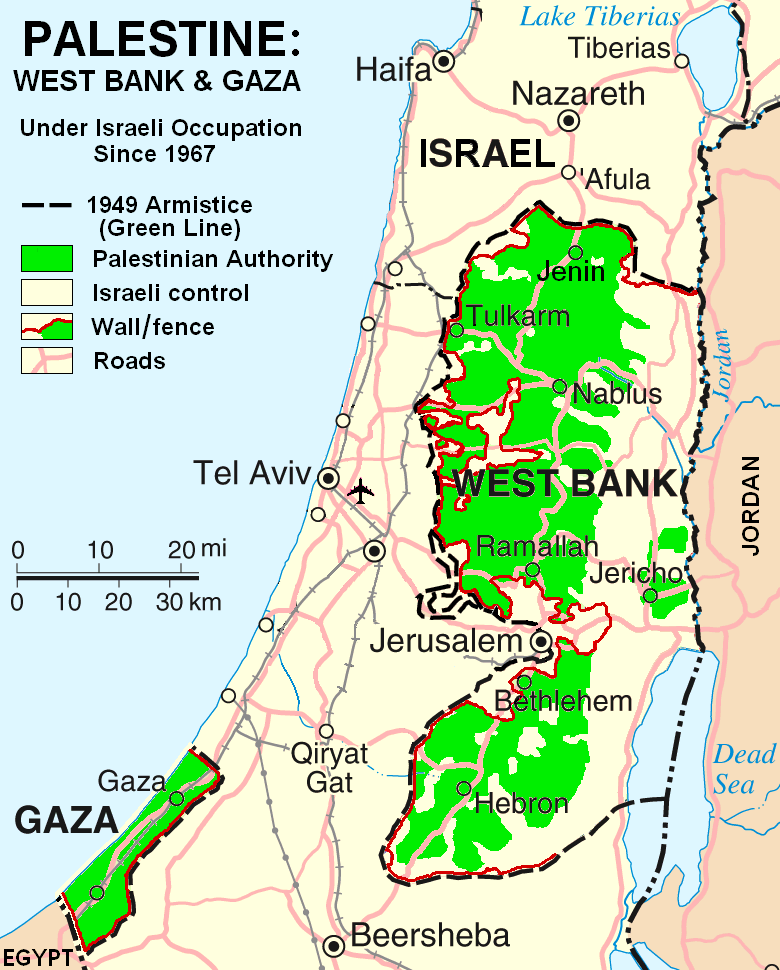
Having spent two weeks in the Holy Land, I’ve seen what the nation of Israel is doing to the Palestinian people, and I can fully understand (if not entirely sympathize with) the anger and frustration that have overflowed into violence. I understand the intifadas.

I have walked beside the tall, concrete, barbed-wire-topped, machine-gun-equipped, guard-tower-punctuated, grafitti-defaced wall that Israel has built through the Palestinian homeland. Israel calls it a “security barricade,” and its defenders like to point out that many stretches of it are “simply a fence” (a barbed-wire and chain-link fence, one notes). Whatever one calls it, it has ghettoized Palestinians (both Muslims and Christians), created what are essentially “reservations” of Arabs (not unlike the reservations the United States created for Native Americans), and separated people from their loved ones and their livelihoods (many farmers, herd and flock owners, and orchard owners have been cut off from and denied access to their fields, their pastures, and their orchards). Those who build such things “walk in a way that is not good” and “follow their own devices.”

The barricade is just one part of a much larger social program of oppression being practiced by the Israelis against the original inhabitants of the land they moved onto in 1948 and the lands they have occupied since 1967: poor schools, inadequate social services, intermittent (or non-existent) provision of utilities, segregation, creation of high quality roads on which it is illegal for Palestinians to travel through their own country, denial of import and export rights to Palestinian business, and the list could go on.

Why? As I listened to Israeli Jews defend this state of affairs, the bottom-line justification always seems to come back to the Holocaust. “Never again,” they say. And what they seem to mean is, “Never again to us . . . so we do it to someone else.” That’s what it is, a paying forward of bad stuff, really truly awful stuff!, done to them. When it was done to them, it was the paying forward of bad stuff done to Germany in the aftermath of the First World War. When it was done to Germany, it was a paying forward of bad stuff done to other Europeans. And one could probably trace it all back and back and back to first bad stuff done by someone to someone.

Will it stop here? If (as an Israeli commander is recently quoted as saying) the Israelis “wipe out” people seen as “enemies of God” (they aren’t, by the way) will it end? No, obviously not. Genocide has been tried before and it doesn’t work. No people can “wipe out” another, and in the current context that is painfully obvious. The Palestinian diaspora will still be there and eventually they would pay it back to Israel or pay it forward to someone else.

It will only stop, it will only end if all the people of God, all the children of Abraham — Jewish, Muslim, and Christian — can come together as equals and agree to stop it. So long as we rely on our own devices, so long as we are contrary and disobedient the conflict and the killing will go on. Only by relying on the faithfulness of God can this horror be brought to an end. As the last of today’s evening Psalms says:

Praise the Lord, all you nations;
laud him, all you peoples.
For his loving-kindness toward us is great,
and the faithfulness of the Lord endures for ever.
Hallelujah!
(Ps 117, BCP Version)

Following our own devices doesn’t and won’t work. Only relying on God’s faithfulness can and will.

====================

A request to my readers: I’m trying to build the readership of this blog and I’d very much appreciate your help in doing so. If you find something here that is of value, please share it with others. If you are on Facebook, “like” the posts on your page so others can see them. If you are following me on Twitter, please “retweet” the notices of these meditations. If you have a blog of your own, please include mine in your links (a favor I will gladly reciprocate). Many thanks!

====================

Father Funston is the rector of St. Paul’s Episcopal Church, Medina, Ohio.

Uplifted Hands: Dashed Expectations in the Holy Land – From the Daily Office – July 4, 2014

From the Psalter:

Let my prayer be set forth in your sight as incense,
the lifting up of my hands as the evening sacrifice.

(From the Daily Office Lectionary – Psalm 141:2 (BCP Version) – July 4, 2014)

Today, we lifted up our hands for prayer in two important places: on Mt. Gerzim where the Hebrews confirmed their covenant with God by affirming the blessings and curses commanded by Moses, and at Jacob’s Well where Jesus talked with the Samaritan woman.

Today, is the Fourth of July! In this part of the world, it is remembered as the anniversary of the defeat of the Crusaders at the Horns of Hittim by Salah Eddin (“Saladin”) in 1187. There were fireworks last night and will be again tonight, but those are for Ramadan and will continue every night for the month. In any event, happy Fourth!

Our day began with an interesting drive to the top of Mt. Gerizim where most of the few remaining Samaritans (a community of 776 people at this time) now live. The drive was “interesting” in the sense of the old Chinese curse, “May you live in interesting times.” We drove through narrow, winding, climbing city streets; our driver Ismain’s skill in piloting this large travel coach is phenomenal. He takes it places where I would simply say “No,” and not take my Honda Pilot!

Part way up the mountain we found the road blocked by a double line of large stones across the pavement. Ismain, Keith, and Mark got off and kicked the stones out of the way, then Ismain was confronted by a mute who demanded money — he gave him a dollar bill (US currency is widely used here) and then the mute grabbed several pieces of candy from a basked Ismain keeps on the dash. Further up the road, we encountered a third row of stones — Mark and Keith moved those aside without further trouble.

Through a gate (and past an Israeli “settlement” — they are literally everywhere and in the most inappropriate locations) we entered a village of modern stone buildings. Not what I had expected the Samaritan town to be. My expectations were even further dashed when we parked, got off the bus, and walked to the Samaritan Museum. The door was locked, but an elderly man in a long grey gown and a red Fez-like hat quickly came and unliked the door. This turned out to be Priest Husney Cohen, one of the Samaritan priests and general manager of the museum. Inviting us to take a seat in the several chairs set up lecture-hall style, he began turning on flat-screen TVs, satellite receivers, and other high tech equipment, waving a universal remote control about like a magic wand! So much for my expectations of an “ancient religion”!

He was, nonetheless, a gracious and ingratiating informant about the Samaritan people and their religion. His brother (who is 80) is the current High Priest; Husney (who is 70) is next in line, and his sister’s husband would come after him. The High Priest is always the oldest male in his family. He told us that when he succeeds his brother, he will be the 164th High Priest in direct line of descent from Adam!

He showed us the ancient Hebrew Torah scroll maintained by the Samaritans, explained how their worship and beliefs differ from those of the Judeans (the Jews), and showed us other implements of their worship, including a huge canopy of fruits made by their women for the Feast of Sukkot (Tabernacles). He also explained how their understanding of the Hebrew language is slightly different from that of the Jews. “We,” he said, “are the real Israelites.” He made the claim (with some historical validity) that the Jews of the southern kingdom are the descendants of only two of the original twelve tribes of Israel, Judah and Benjamin, while the Samaritans are the descendants of the other ten tribes who broke from the kingship of the Davidic dynasty and created the northern kingdom (which called itself “Samaria”).

Following his presentation, I was able to chat with him about his life and family. I asked if he had children and it turns out he has two sons and three daughters. One of his daughters runs a nursery school, one is a pharmacist, and one works for Hewlitt-Packard. I asked if his sons would succeed him as priest and he said, “Oh, no! Because they are tall like me, they are professional basketball players.” That “ancient religious community” expectation was not only dashed, it was completely obliterated!

Bidding Priest Husney farewell, we made our way to almost the top of the mountain where there is an outlook over the valley toward Mount Ebol. This is the place on which Joshua and the Hebrews, following a commandment of Moses, performed the ritual of the Blessings and Curses. We read both the Deuteronomy passage (Moses’ words) and the Joshua passage (recording the actual event). As we were doing so, an Israeli soldier appeared seemingly out of nowhere fully armed and armored for battle! Mark told us he was there for our protection because Jewish groups often come to this place to recall their heritage and might be targets for a “crazy sniper” in the city below.

We returned to the Samaritan village and to a cafe next door to the museum where we had a lunch of the usual salads and some very tasty, very tender roast chicken.

After lunch we returned to Nablus to visit the Greek Orthodox Basilica of St. Photini. “Photini” (which means “enlightened”) is the name given by the Greek tradition to the Samaritan woman Jesus met at Jacob’s Well. The Basilica is built over Jacob’s Well which is accessible in a lower church chapel; we actually drank water from the Well! It is cold and sweet. The well is (as the woman told Jesus) very deep!

The Bailica is an amazing place. It has been restored by the current priest, Fr Justinus, who wrote most of the icons on its walls — he is a very talented iconographer. For me, the most moving — and the most troubling — is one of his immediate predecessor Fr Philomenas who was martyred by Israeli settlers. He was hacked to death with axes and cut into pieces! The icon depicting this is painted on a pillar in the church. I asked if there were reproductions among the several icons for sale, but the Arab caretaker (with a sad, ironic look) said, “We are not allowed to.” Such is life in Israeli occupied Palestine.

Fr. Justinus, deeply aware of the transitory nature of life, in his restoration of the church built into it (in the entrace courtyard) his own tomb. He walks past it everyday as it is between the priest’s residence and the door of the church.

Our visit to St. Photini was all-at-once spiritual, moving, and disconcerting. To lift our spirits, and to celebrate Independence Day, Iyad (who is still not back with us) treated us to a sweet — some kunafeh — at a local shop. I’m growing quite fond of this sweet, flowery, goat cheese dessert. I’m going to have to learn to make it.

After that — it was back to the hotel for a rest, then dinner, and then a night on the town … except that I begged off the late-night outing. I just wasn’t up for it.

So it was a day of humorously dashed expectations and of sadly bittersweet reality. I’m amused by the image of the Samaritan priest defending his ancient faith, his belief in his descent from Adam, his insistence that his small remnant people are the true Israel, while at the same time exhibiting astonishing proficiency with modern technology. Did I mention that he has a Facebook page and a Twitter feed? On the other hand, I’m deeply troubled by the martyrdom of Fr Philomenas, by the senselessness of Israeli settler violence against innocent people simply because they are Arabs, by the Arabs need for vengeance. My expectations of a peaceful, purely spiritual pilgrimage and retreat are equally, much less humorously, dashed.

I lift up my hands, O Lord. Let my cry come to you. Let there be peace in this land.

====================

A request to my readers: I’m trying to build the readership of this blog and I’d very much appreciate your help in doing so. If you find something here that is of value, please share it with others. If you are on Facebook, “like” the posts on your page so others can see them. If you are following me on Twitter, please “retweet” the notices of these meditations. If you have a blog of your own, please include mine in your links (a favor I will gladly reciprocate). Many thanks!

====================

Father Funston is the rector of St. Paul’s Episcopal Church, Medina, Ohio.

Pray for the Peace of Jerusalem – From the Daily Office – June 30, 2014

From the Psalter:

I was glad when they said to me, “Let us go to the house of the Lord.” Now our feet are standing within your gates, O Jerusalem.

(From the Daily Office Lectionary – Psalm 122:1-2 (BCP Version) – June 30, 2014)

Our feet left Jerusalem today and went to Bethlehem, and what a day of varied impressions. We began in Manger Square (which is more like a parking lot than a town square) with Iyad’s presentation on the history of the Church of the Nativity, then we entered the building. It is currently under restoration, so there is scaffolding everywhere! The pillars in the nave are wrapped in cloth and banded with wood to protect them (apparently they are painted). Electric construction lighting hangs from the ceiling. The place looks like (and is) a construction zone.

Yet in the midst of this the various denominations (the Greeks, Latins, and Armenians share the space) go about their daily round of services and devotions. As we were entering, the Greeks were completing their worship in the upper church (ground floor, above the crypt of the Nativity). We were led passed them and into the adjoining more modern Church of St. Catherine, the local Franciscan (Roman Catholic) parish. Mass was just being completed there, as well.

On the right side of the Nave is a stairway leading down to some crypts adjacent to the crypt of the Nativity. Here it is said that St. Jerome translated the Vulgate (Latin) version of the scriptures. Here, also, is a crypt where the bones of several infants were found and tradition teaches the infants killed in the slaughter of the Holy Innocents were buried. There is a shrine to St. Jerome, another to the Holy Innocents, and a chapel of the Nativity whose backwall is the common wall to the crypt of the Nativity.

We gathered in this chapel, read the story of the Lord’s birth, sang What Child Is This? and O Little Town of Bethlehem. As we were finishing, the Greeks were completing their time in the crypt (down the tunnel from our chapel) and the sound of the bells (jingle bells) on the Greek thurible added to the “Christmas feel” of what we had just done.

Afterward, we went back up to St. Catherine’s where we waited for the Franciscans to begin their time in the crypt. We had been invited to participate in their Eucharist, which we believed would be in either English or Italian. As it turned out, it was in Spanish. Two young Mexican deacons were ordained yesterday and were serving their first Mass today. A group of pilgrims from Mexico (probably family members or members of their home parishes) were on hand. It was a lovely service and it was a privilege to receive communion in the Crypt, as it was to venerate the star over the place of Christ’s birth. But our few minutes of singing together in the side chapel next door was more meaningful for me.

As we left the Church, the Armenians were getting ready for their turn in the Crypt and I made note the beautiful, exceptionally celtic carving on the doors of their sacristy. Fr. Keith Owen said, “Those Celts! They got everywhere!” Indeed.

After the Mass, we traveled to another part of Bethlehem to do some souvenir shopping at a store known to our guide. (Evie and I bought only a few olive wood items. The sales staff were exceptionally pushy and while I might have bought something, my obstinate contrariness kicks in when I’m being pressured so they lost a sale. But, hey, as we keep saying, “It’s the middle east.”) The shop is in a part of the city very much affected by the Israeli security barrier; it is very much “in your face” in this section. One house (which was reported on by 60 Minutes in 2013 is almost completely surrounded by the wall!

We walked along the wall for about half a mile and really got a feel for its impact on the lives of the people of Bethlehem. I took several pictures of posters and grafitti that have been put on barricade.

After that, we drove to Beit Sahour (“House of the Angel”) a city about two miles from Bethlehem where the Shepherd’s Field (one of them, anyway) is located. There we had a great lunch of beef and chicken kabobs, and then walked to the Shepherd’s Field.

Another small Barluzzi church is located there – with a great statue of an angel over the door. We sat around the altar in the church and sang Angels We Have Heard on High and O Little Town of Bethlehem. Then we went down the hill to an archaeological excavation (on the Shepherd’s Field property) of some caves which were probably inhabited in the First Century. The cave opened to the public really gives a great sense of what the cave where Jesus was born would have been like. (He wasn’t born in an “inn” despite centuries of mistranslation of the Greek word kataluma.)

After Beit Sahour, we went to Ein Karem (“Vineyard Spring”) where it is believed that John the Baptist’s parents, Zechariah and Elizabeth, lived. Another Barluzzi church is found here commemorating the Visitation of the Blessed Virgin Mary. Here, we hiked up the hill to the church, saw its lovely murals, statuary, and other objects. On the way back down, we stopped at a gelateria and got a dish or cone of gelato (Italian ice cream). I had Belgian chocolate and berries – it was wonderful!

It was an exceptionally full day! Psalm 122 (one of the several morning psalms for today) concludes:

Pray for the peace of Jerusalem:
“May they prosper who love you.

Peace be within your walls
and quietness within your towers.

For my brethren and companions’ sake,
I pray for your prosperity.

Because of the house of the LORD our God, *
I will seek to do you good.”

(vv. 6-9; BCP Version)

The biggest impression of the day was, as it has been on other days, not the religious sites, but the political sights: the wall, the grafitti on it, the posters put there by the Wall Museum, the disruption of people’s lives, the separation of famers from their fields and orchards, the utter contempt of Israel for the Palestinian Arabs that it represents. How can there ever be peace when people are treated like this? I have spent the day with 17 other good Christian people trying to follow the Prince of Peace in a land torn by conflict. I have no answers. I have only prayers. I will pray for the peace of Jerusalem!

====================

A request to my readers: I’m trying to build the readership of this blog and I’d very much appreciate your help in doing so. If you find something here that is of value, please share it with others. If you are on Facebook, “like” the posts on your page so others can see them. If you are following me on Twitter, please “retweet” the notices of these meditations. If you have a blog of your own, please include mine in your links (a favor I will gladly reciprocate). Many thanks!

====================

Father Funston is the rector of St. Paul’s Episcopal Church, Medina, Ohio.

All God’s Children: Day Four in Jerusalem – From the Daily Office – June 29, 2014

From the Acts of the Apostles:

Paul stood in front of the Areopagus and said, “Athenians, I see how extremely religious you are in every way. For as I went through the city and looked carefully at the objects of your worship, I found among them an altar with the inscription, ‘To an unknown god.’ What therefore you worship as unknown, this I proclaim to you. The God who made the world and everything in it, he who is Lord of heaven and earth, does not live in shrines made by human hands, nor is he served by human hands, as though he needed anything, since he himself gives to all mortals life and breath and all things. From one ancestor he made all nations to inhabit the whole earth, and he allotted the times of their existence and the boundaries of the places where they would live, so that they would search for God and perhaps grope for him and find him — though indeed he is not far from each one of us. For ‘In him we live and move and have our being;’ as even some of your own poets have said, ‘For we too are his offspring.’ “

(From the Daily Office Lectionary – Acts 17:22-28 (NRSV) – June 29, 2014)

Always one of my favorite stories of the Apostle Paul, this incident is depicted in the stained glass altar window of my church (St. Paul’s Episcopal Church in Medina, Ohio). I chose to use it as my focus scripture to introduce a summary of our Holy Land Pilgrimage activities today because Paul’s message of unity – that in God we all live and move and have our being, and that we are all God’s offspring – is one that needs badly to be heard in Israel and Palestine and, if the statistics we are hearing about Christian population in these countries are correct, it is one that won’t be heard very loudly or at all. Down from as high at 35% at the time of the British Mandate and the establishment of the state of Israel in 1948, the Christian population of Israel and Palestine today is less than 2%.

We began our day early with breakfast at 5:30 a.m. — to the usual assortment of olives, pickled eggplant, humus, labneh, yogurt, cheeses, and so forth was added a flaky, cheese-stuffed pastry, a sort of savory popover. Washed down with several cups of instant coffee (instant is all they serve here), this got us fortified for a morning of cultural fascination and disappointment.

First, we rode our bus to the Dung Gate of the old city, a pretty awful but ancient name for the southern gate in the city wall which derives from the refuse dumped here in ancient times; presumably, the prevailing winds would carry odors away. (“I went out by night by the Valley Gate past the Dragon’s Spring and to the Dung Gate, and I inspected the walls of Jerusalem that had been broken down and its gates that had been destroyed by fire.” Neh 2:13) This gate leads directly to the Western Wall and an archaeological park located at the south end of the Temple Mount.

We stood on line for nearly an hour waiting for Israeli security to open the gate that leads to the only access non-Muslims have to the top of the Temple Mount (which Muslims call “the Noble Sanctuary), the Al-Aqsah Mosque, and the Dome of the Rock. Above this gate is a sign reading, “According to Torah Law, entering the Temple Mount area is strictly forbidden due to the holiness of the site. [signed] The Chief Rabbinate of Israel” Both the Ashkenazi and Sephardi Chief Rabbis have signed this statement which was first issued by the Ashkenazi rabbi in 1935; both reiterated this prohibition in 2013.

Ignoring the Chief Rabbinate, a group of Israeli “settlers” stood in the line in front of us waiting to gain access to the Temple Mount.

Finally, security opened the gate and we were ushered through. The settlers were given a thorough search, however. From the covered wooden walkway from the security point to the actual gate of the Mount, we were able to take some good photographs of the crowd of Jews at the Wailing Wall. Directly under us, a large group of Jewish women were singing a hymn at the Wall. Directly in front of us, at the end of the covered walkway, Israeli security stored their heavy plexiglass riot shields, a visible sign to anyone entering that the police were prepared.

We entered the Noble Sanctuary and found a spot in the shade where Iyad could tell us about its history, ancient and modern. While he was talking some young adult tourists (American or Canadian college kids?) came onto the Mount and an old Muslim man began to berate them for being immodestly dressed. (We’d been told ahead of time that should wear long pants and long- or short-sleeve shirts, no tank tops; women should be in dresses or pants to the ankle, long-sleeved blouses, and scarves or veils. Why their guide hadn’t done the same, I have no idea.) An argument erupted between the old man and the Israeli police guards about who had authority to tell tourists whether they could enter and what the should wear. Eventually the college kids got themselves properly attired (using towels and large scarves) and walked on, but I know they took away an image of Muslim intractability.

Shortly after that, the settlers we’d seen at the security gate entered, to boos, hoots, catcalls, and other shouts of protest (or of “Allah hu akbar” – God is great) from the Muslims. They either offered a prayer or held a short conversation just inside the gate, then made a bee-line for an exit (passing us and wishing us “Shalom” as they did so). They had no reason to be there, other than to be provocative.

We spent some time walking through the area and seeing its sights. Unfortunately, since September 2000 when Israeli prime minister Ariel Sharon “visited” the Temple Mount, an act scene by many as provoking the second Intifada, no non-Muslim has been permitted to enter the Al Aq-sah Mosque or the Dome of the Rock, so we could not see in the insides of the buildings.

After that we left the Noble Sanctuary by another gate (one can leave by any of the twelve gates, but non-Muslims can enter by only the one). We made our way to St. Anne’s Church at the Pools of Bethesda. A short visit to the pools and archeological site was followed by our entering the church and, as a group, singing Seek Ye First before the altar. The church, which is a crusader construction of limestone, has marvelous accoustics and we really sounded good. (The church is well preserved because it was turned into a Muslim school at one point. This is why it has no windows; those were replaced by the Muslims with plaster filigree. It also has a verse from the Qur’an carved in the stone over the front door.) After that, we made our way back to the bus which took us back to St. George’s Cathedral.

We gathered in a rather full church for the Eucharist, celebrated in both English and Arabic — and interesting experience reciting the creed and other parts of the canon in English while others were doing so in Arabic. Bishop Suheil Dawani presided; Canon Naim Atik preached. The canon focused on Jesus’ reference to rewards in the reading from Matthew’s Gospel and tied it to the recent vote by the Presbyterian Church USA to divest itself of stock in companies doing business in occupied Palestine, which he praised. I really didn’t follow the connection, however.

A short coffee hour (the coffee was “Turkish” or Arabic coffee – strong and sweet in tiny cups) and then a conversation with the bishop. He told us about his diocese’s ministries (education and health care) carried on by 30 diocesan institutions in five countries; the diocese covers Israel, Palestine, Lebanon, Syria, and Jordan! He also told us about the shrinking of the Christian community in the Holy Land: the cathedral had been full, but that fullness was made up of two pilgrimage groups – ours and a larger group from Canada – and one group of scholars at St. George’s College. The indigenous members of the congregation this morning numbered only about twelve! He pleaded with us to support the work of the church in Jerusalem and beyond.

Lunch followed, after which we went to the Israel Museum to see a scale model of what Second Temple (First Century) Jerusalem is believed to have been, and an exhibit of the Dead Sea Scrolls. Both were very impressive. More impressive was the unfortunate and unnecessary way in which Iyad was hastled by the guards at the museum’s entrance. He was clearly made to feel unwelcome.

On our return to the Guest House we had some free time and then had a conversation with a Jewish scholar who described himself as a “Jewish Zionist Leftist who sympathizes with the Palestinians and believes they have a right to self-determination.” He laid out for us in very a honest and nuanced way the differing Jewish perceptions of the difficulties in Israel and Palestine. He personalized the struggle in this land by telling us stories of the ways in which he, his wife, and his children had been accosted by Muslims, among whom they live! He teared up telling us of an incident involving his 9-year-old son, and yet he still urged us to not take sides and he still takes the view that the Palestinian Arabs have an equal right to a homeland.

He advised us to “not take the conflict home with you” and to support Christians in this country. Noting that they are (as stated above) down to less than 2% of the population, he opined that their absence would be tragic for the country. They are a force for peace, he said, and without them the possibility of armed conflict increases. Asked what we could do, his answer was the same as the bishops – support the Christians.

A tasty dinner of spiced beef and then Compline finished the day.

Take away from this day – Paul is correct; we are all the children of one God and those of us of the Abrahamic faiths ought to be able to demonstrate that to the rest of the world. But, for whatever reasons, we seem unable to do that. Everywhere we go in this country we find Israeli Jews provoking Palestinian Muslims; clearly it is a minority doing so blatantly, but the government seems to do so as well in more subtle ways. We find Palestinians, both Muslims and Christians, angry at the Israelis. We find Christians unable to work together (even though their bishops, Bishop Dawani told us, meet together frequently for mutual support and consultation). We hear Arabs talk of “peace and justice” and Jews talk of “peace with security,” but there is very little talk of reconciliation. There are some beginnings of grass-roots efforts at reconciliation, but it is not happening in the secular political world nor in the religious hierarchies. “Pray for the peace of Jerusalem: ‘May they prosper who love you. Peace be within your walls and quietness within your towers.’ ” (Ps 122:6-7)

====================

A request to my readers: I’m trying to build the readership of this blog and I’d very much appreciate your help in doing so. If you find something here that is of value, please share it with others. If you are on Facebook, “like” the posts on your page so others can see them. If you are following me on Twitter, please “retweet” the notices of these meditations. If you have a blog of your own, please include mine in your links (a favor I will gladly reciprocate). Many thanks!

====================

Father Funston is the rector of St. Paul’s Episcopal Church, Medina, Ohio.

Internal Polling – From the Daily Office – June 11, 2014

From Ecclesiastes:

Again I saw that under the sun the race is not to the swift, nor the battle to the strong, nor bread to the wise, nor riches to the intelligent, nor favor to the skillful; but time and chance happen to them all. For no one can anticipate the time of disaster. Like fish taken in a cruel net, and like birds caught in a snare, so mortals are snared at a time of calamity, when it suddenly falls upon them.

(From the Daily Office Lectionary – Ecclesiastes 9:11-12 (NRSV) – June 11, 2014)

Meaningless Bar GraphWe got up this morning to the startling news that a major political figure had been defeated in his party’s primary by a candidate supported by what I would call an extremist fringe element of the party, a group which has gained more say and more influence in the party than it should have. I didn’t write a lectionary reflection until late in the day because, political news junkie that I am, I spent the morning listening to the radio pundits and perusing the on-line publications. Over and over I found the commentators using hyperbolic metaphors — earthquake, tornado, disaster, calamity — and asserting that the defeat was entirely unforeseen. “Wow!” I thought, “They sound like Qoheleth in today’s reading from Ecclesiastes!”

One of the reasons given for the failure of the losing politician and his handlers to have foreseen the potential (now actual) loss was that they relied (to quote one news source) “on their own internal polling.” When I heard those words I remembered the last presidential election. In that election, the losing candidate and his party also were supremely confident of victory based on their “own internal polling.” One of his operatives went so far as to argue with a supportive news organization when its analysts came to the (accurate) conclusion that the current president was the winner.

It occurs to me that reliance on one’s “own internal polling” is a dangerous thing. The words “own internal polling” might be code for “self-deluding fantasy.”

We have much better predictive abilities now than in the time of King Solomon of Israel (who is reputed to have been the preacher who authored Ecclesiastes). We have a reasonable ability to foretell the weather, although tornadoes still surprise us. Hurricanes and major weather fronts, storm surges of the sea, and dry hot winds that fan forest fires can all be tracked and prepared for. Earthquakes and volcanic eruptions are beyond our prophetic capabilities, though scientists seem to be closing in on ways to prognosticate seismic activity.

We have a better ability to prepare for calamities and disasters — better means of food preservation, faster ways to evacuate potentially affected areas, swifter communication. We can prevent plagues and epidemics through vaccination, and we can treat them with antibiotics and other medications.

What we seem no better at doing is avoiding self-delusion. We still (all of us, not just politicians) rely a too much on our “own internal polling.” And when we do, we get overtaken by surprise, by events that seem to be (or, at least, are described as) disastrous and calamitous. Perhaps we should be listening to more than those internal polls?

It seems to me that those losing politicians might have been better served by taking a look at the polling numbers of independent opinion surveys and not relying so heavily on their “own internal polling.” They may not have been able to change the outcome, but at least they would have been better prepared for it; it would not have been such a surprise, such a “disaster” or “calamity.”

A few days ago, I was in conversation with a bible study group considering the question “How do you know you are responding to God’s call?” Nearly everyone’s initial response was, “Well, when it feels right,” but after discussion we came to the realization that our internal feelings, our “own internal polling,” aren’t often accurate. A better barometer of God’s call to us, of God’s will for us, is the discernment of the community. Checking one’s feelings with others turned out to be our consensus as to how to know whether we are answering that call, checking some independent rather than internal polling.

Qoheleth concludes today’s reverie with a couple of proverbs, one of which is political: “The quiet words of the wise are more to be heeded than the shouting of a ruler among fools.” (v. 17) Given today’s political news, we might say that the quiet words of others are more to be heeded than one’s “own internal polling.”

====================

A request to my readers: I’m trying to build the readership of this blog and I’d very much appreciate your help in doing so. If you find something here that is of value, please share it with others. If you are on Facebook, “like” the posts on your page so others can see them. If you are following me on Twitter, please “retweet” the notices of these meditations. If you have a blog of your own, please include mine in your links (a favor I will gladly reciprocate). Many thanks!

====================

Father Funston is the rector of St. Paul’s Episcopal Church, Medina, Ohio.

Partial Truths and Hamster Wheels – From the Daily Office – June 9, 2014

From the Letter to the Galatians:

Have I now become your enemy by telling you the truth?

(From the Daily Office Lectionary – Galatians 4:16 (NRSV) – June 9, 2014)

Hamster in a Wheel“What is truth?” asked Pilate. (Jn 18:38)

“The truth will set you free,” said Jesus. (Jn 8:32)

“You can’t handle the truth,” shouted Col. Nathan R. Jessup (Jack Nicholson’s character in A Few Good Men).

“Partial truths or half-truths are often more insidious than total falsehoods,” wrote political scientist Samuel P. Huntington (Reconsidering Immigration, November 2000).

Poor Paul! He’s just telling the Galatians the truth and they hate him for it. Thank heaven he didn’t say some post-modern nonsense about “what is true for you isn’t necessarily true for me!” But in his correspondence with these Gentile Christians, is the good apostle communicating the whole truth, or a partial truth? I’m not asking if Paul is being dishonest; I’m asking if, as a rhetorician making a point, is he constructing a narrative with some, but not all, of the pertinent facts. It’s hard to tell from his letter and it’s even harder to determine because we have only his side of the correspondence. But, I suggest, it’s a very valid inquiry because partial truths can create (or exacerbate) discord and enmity.

Recently on our local NPR station, a panel of journalists were discussing a bill recently passed by the Ohio legislature. One insightfully noted that each side of the debate over the bill presented facts in support of its position; each constructed a narrative from easily verifiable data; and each arrived at a “truth” that was convincing to its followers. The “truths” they presented, however, were diametrically opposite in the conclusion to which they led as to whether or not to support the legislation. Why? Because each was partial, each conveniently overlooked facts contradictory to its narrative, and each was partisan. Neither was factually inaccurate, but neither was entirely true.

Fully investigating and fully presenting all the facts of any situation takes time, effort, and resources, and might lead to some conclusion other than that which a partisan is trying to argue. And, anyway, it is much easier to simply go with a few critical facts supporting a partial truth; it lends itself to brevity of argument and to sound-bite news coverage. Furthermore, partial truths are inflammatory; they excite people, rally the troops, and build the cadre of (ill-informed?) supporters. Partial truths do not set free; they entrap and they entangle.

Partial truths make enemies (or, at least, opponents). And this is where we seem to be in American politics and society at the moment. We are in a battle of partial truths. Jon Stewart on The Daily Show recently made the point that partial truths about the Second Amendment have brought us to an intersection “of Open Carry Road and Stand Your Ground Place. * * * You have a right to carry a weapon that may cause a reasonable person to believe they are in danger of great bodily injury, and they have a right, if they feel that way, to respond with deadly force. It’s a perpetual violence machine.” And, I would suggest, the same is true in many other areas of our political and social life. Competing partial truths trap us in perpetual cycles preventing any advance; society ends up like a hamster in an exercise wheel, running to beat the band but going nowhere.

If the truth is really going to set us free, if we are going to be able to handle the truth, we must first determine what it is. In any discussion, listening to any news report, reading any newspaper, one should ask whether important facts have been left out or not, particularly if the report is inflammatory or clearly partisan. It is always wise to pause and consider that not all the facts may be given and that some additional data is likely to change the story significantly. This is worth the effort.

What is truth? It is more than few carefully chosen facts and a well-constructed narrative. The whole truth can set us free and, I believe, we can handle it. We have to make the choice, however, to get out of the hamster wheel and get all the facts.

====================

A request to my readers: I’m trying to build the readership of this blog and I’d very much appreciate your help in doing so. If you find something here that is of value, please share it with others. If you are on Facebook, “like” the posts on your page so others can see them. If you are following me on Twitter, please “retweet” the notices of these meditations. If you have a blog of your own, please include mine in your links (a favor I will gladly reciprocate). Many thanks!

====================

Father Funston is the rector of St. Paul’s Episcopal Church, Medina, Ohio.

We Are One . . . NOT! – From the Daily Office – June 4, 2014

From the Letter to the Ephesians:

There is one body and one Spirit, just as you were called to the one hope of your calling, one Lord, one faith, one baptism, one God and Father of all, who is above all and through all and in all.

(From the Daily Office Lectionary – Ephesians 4:4-6 (NRSV) – June 4, 2014)

Fractured SocietyHere is another piece of Paul’s writing that the Episcopal Church has lifted out of the bible and plugged into The Book of Common Prayer. It is used as the opening dialog of the church’ baptismal service. After a seasonally appropriate greeting, the presider and people converse:

Celebrant — There is one Body and one Spirit;
People — There is one hope in God’s call to us;
Celebrant — One Lord, one Faith, one Baptism;
People — One God and Father of all.
(BCP 1979, page 301)

I must confess that every time I engage in this dialog I am reminded of, and (almost) have to stop myself from singing, a particularly bad example of the sort of music the church produced in the late 1960s, a song entitled We Are One in the Spirit:

We are One in The Spirit,
We are One in The Lord.
We are One in The Spirit,
We are One in The Lord.
And we pray that all unity may one day be restored.
[Chorus]
And they’ll know we are Christians by our love,
By our Love,
Yes they’ll know we are Christians by our love.
(©Peter Scholte 1966)

I don’t think that song is bad musically: the tune is catchy; the accompaniment is rather easy; congregations (even those who don’t read music) can pick it up quickly and sing it with gusto. What’s bad about the song is that it’s what I would call ecclesio-narcissistic: it’s all about us! There’s not a single word of praise for God, of thanksgiving, of intercession or petition. It’s all “we are” . . . “we will” . . . we we we: “aren’t we great?” As if we are capable of attaining unity on our own . . . . which is, thank heaven, not the overt message of the baptismal service (although it may be its implication).

Unity, however, is not something human beings seem capable of achieving unaided, especially not the unity-in-diversity which is supposed to be the hallmark of the Christian church. Remember, Paul again: “There is no longer Jew or Greek, there is no longer slave or free, there is no longer male and female; for all of you are one in Christ Jesus.” (Gal 3:28)

This is also supposed to be the strength of the United States. We are supposed to be the great “melting pot” society, a nation of immigrants coming together not around ethnicity or some other ancient exclusive and divisive characteristic but around notions of freedom and justice. But just look at us! Torn apart by wing-nut ideologies on both Right and Left. We can’t even be united about the retrieval of an American soldier from enemy hands: I believe that every American, regardless of their politics, should be overjoyed that Bowe Bergdahl is out of Taliban captivity. But that ain’t so . . . and it isn’t so because, left to our own devices (and now we have so many of them) we not only can’t achieve unity, we revel in our fractured disunity. (A friend whose politics are on the Left published a Facebook link to what she call an “epic rant” on this subject, and it is something. Although politically I agree with its premise, as a Christian American I’m saddened by the witness it makes to our brokenness. I’m sure there are equally visceral rants from the Right; I just haven’t seen them. For any who want to read it, here is the link, Stonekettle Station. A word of warning: it’s heated, it’s vulgar, and it’s long.)

In a recent conversation with some members of my parish’s Altar Guild about attending funerals and weddings in other denominations, one of the ladies asked why some (particularly the Roman Catholic Church and the Lutheran Church – Missouri Synod) exclude non-members from Holy Communion. As we explored the meaning of the Eucharist, I suggested that (among other reasons) it might be because in such churches Communion is seen as a sacrament of unity achieved while in the Episcopal Church it is considered a sacrament of unity hoped for. If it is the former, then someone not a part of that “unity” is not welcome; if it is the latter, then everyone who comes seeking Christ, whether member or not, is accepted at the Table.

This can be, should be the churches’ great witness to a fractured secular society, that unity is possible through the grace of God, “who is above all and through all and in all.” Alas, in our fracture ecclesial state, contrary to that ecclesio-narcissistic song, we are unable to make that witness. We are not one! Although we keep hoping . . . .

====================

A request to my readers: I’m trying to build the readership of this blog and I’d very much appreciate your help in doing so. If you find something here that is of value, please share it with others. If you are on Facebook, “like” the posts on your page so others can see them. If you are following me on Twitter, please “retweet” the notices of these meditations. If you have a blog of your own, please include mine in your links (a favor I will gladly reciprocate). Many thanks!

====================

Father Funston is the rector of St. Paul’s Episcopal Church, Medina, Ohio.

La La La, I Can’t Hear You – From the Daily Office – May 30, 2014

From the First Book of Samuel:

Hannah prayed and said,
“There is no Holy One like the Lord,
no one besides you;
there is no Rock like our God.
Talk no more so very proudly,
let not arrogance come from your mouth;
for the Lord is a God of knowledge,
and by him actions are weighed.”

(From the Daily Office Lectionary – 1 Samuel 2:2-3 (NRSV) – May 30, 2014)

I Can't Hear You T-Shirt Advertisement“The Lord is a God of knowledge” may be the most important assertion in Hannah’s song. Many bible scholars believe her song to be the model of Mary’s song, The Magnificat. Both are sung by pregnant women; both extol the might and power of God; both confirm God’s preference for the poor and lowly over the rich and powerful. Only Hannah’s song, however, includes this description and her accompanying admonition to her hearers to not speak arrogantly. The translation in The Complete Jewish Bible renders her words in this way: “Stop your proud boasting! Don’t let arrogance come from your mouth! For ADONAI is a God of knowledge, and he appraises actions.”

The clear import of Hannah’s words is that actions speak louder than words and that God, “a God of knowledge,” knows both our words and our actions; if our words and actions are not in accord, God will know and judge according to the former no matter what we may say.

This morning, however, the depiction of Yahweh as “a God of knowledge” appealed to me in a different way, not as a description of an attribute of God, but as a statement of what God encourages in others. This is the God who gave human beings the capacity to learn, to engage in science and research, to explore new things, and (most importantly) to reason and apply what they have learned. And this God expects us to use this capacity, to actually do these things. As Galileo Galilei said in a letter written in 1651, “I do not feel obliged to believe that the same God who has endowed us with senses, reason, and intellect has intended us to forgo their use and by some other means to give us knowledge which we can attain by them.”

We are not to remain ignorant, either of the nature of the world around us or of the nature of God. In moral theology ignorance is described as either invincible and vincible. Ignorance is considered invincible if a person cannot not overcome it by applying reasonable diligence in seeking its remedy. Ignorance is vincible if the application of reasonable diligence could remove it. (Reasonable diligence is that effort that a conscientious person would exert in seeking the correct answer to a question given (a) the gravity of the question and (b) the particular resources available.)

We seem to live in an age of pretend invincible ignorance. One of my favorite science fiction authors, the late Dr. Isaac Asimov, wrote in an essay for Newsweek magazine in 1980, “There is a cult of ignorance in the United States, and there has always been. The strain of anti-intellectualism has been a constant thread winding its way through our political and cultural life, nurtured by the false notion that democracy means that ‘my ignorance is just as good as your knowledge.’” In the three decades since, things have gotten worse.

Contemporary logicians, in fact, now use the term to describe what might be the simplest of all logical fallacies, the refusal to face facts, the insistence on the legitimacy of one’s position in the face of contradictory evidence. It’s a pretty good clue that someone is engaging in this fallacy if they say something like “I really don’t care what the experts say; no one is going to convince me that I’m wrong” or “Nothing you say is going to change my mind” or even “Yeah, okay, whatever!”

Children arguing with one another stick their fingers in their ears and shout, “La la la, I can’t hear you.” We live in a world when adults seem to believe this is a proper form of political or religious or scientific argument. It’s not. This is not the invincible ignorance of moral theology, but it is immoral. This is willful ignorance, and willful ignorance is sinful. As Thomas Aquinas wrote in the Summa Theologica:

It is clear that not every kind of ignorance is the cause of a sin, but that alone which removes the knowledge which would prevent the sinful act. … This may happen on the part of the ignorance itself, because, to wit, this ignorance is voluntary, either directly, as when a man wishes of set purpose to be ignorant of certain things that he may sin the more freely; or indirectly, as when a man, through stress of work or other occupations, neglects to acquire the knowledge which would restrain him from sin. For such like negligence renders the ignorance itself voluntary and sinful, provided it be about matters one is bound and able to know.” (Summa, I-II, q. 76, a. 1, a. 3)

The Lord is a God of knowledge; the Lord is not impressed with “La la la, I can’t hear you.”

====================

A request to my readers: I’m trying to build the readership of this blog and I’d very much appreciate your help in doing so. If you find something here that is of value, please share it with others. If you are on Facebook, “like” the posts on your page so others can see them. If you are following me on Twitter, please “retweet” the notices of these meditations. If you have a blog of your own, please include mine in your links (a favor I will gladly reciprocate). Many thanks!

====================

Father Funston is the rector of St. Paul’s Episcopal Church, Medina, Ohio.

« Older posts Newer posts »