Occasional thoughts of an Anglican Episcopal priest

Category: Politics (Page 15 of 23)

Political Calculation – From the Daily Office – February 26, 2014

From the Gospel of John:

You do not understand that it is better for you to have one man die for the people than to have the whole nation destroyed.

(From the Daily Office Lectionary – John 11:50 (NRSV) – February 26, 2014.)

Broken GlassThe words of Caiaphas the high priest are reported by John as a prophecy that Jesus’ death would be an atoning sacrifice, that he would “die for the nation, and not for the nation only, but to gather into one the dispersed children of God.” (vv. 51-52) But I read them this morning as nothing more than political calculation.

More years ago than I care to remember I took a college class in political history. One of the things I learned is that nearly all decisions of government include two major components: political calculation, which is always based on past experience, and profound ignorance of current conditions and future potentials. Despite prodigious amounts of fact finding and data gathering, that ignorance remains a factor. There is always “one more fact” that could have been learned. And, more often than not, a “known fact” is not appreciated because prejudice, preconception, or inexperience blinds the decision-maker to its importance.

I suspect the lawmakers in Kansas and Arizona, where legislation has recently been enacted by one or both houses of the state legislatures permitting service providers, both private and public, to refuse service to gay, lesbian, and transgendered persons on the basis of “sincerely held religious belief,” have been surprised by the responses their actions elicited. They may have expected some reaction from the political left. It’s possible they anticipated some objection from more liberal religious bodies (such as the Episcopal Church). I don’t think they had a clue that the business community, represented by Apple, Delta, American Airlines, and other corporations, would oppose their action. I don’t know what data gathering they did before enacting those proposed laws, but they either failed to get the business data or failed to understand the data they got.

I could criticize what they did — these bills are, in my opinion, deeply flawed in several respects — but my thought today is that in our personal lives we do much the same thing. We make personal decisions on the basis of past experience in an atmosphere of profound ignorance; there is always something we don’t know. St. Paul was speaking of the eschaton, the end of time, about which we can know nothing when he wrote, “We see through a glass, darkly” (1 Cor. 13:12, KJV) but the truth is that our vision is always obscured. The glass through which we look at the present or the future is always darkened; there is always something we don’t see, some fact or bit of data of which we are ignorant either through lack or through misinterpretation.

So what does one do? Fail to decide? Fail to act? No, one cannot be paralyzed by fear. The only answer is to decide, to move forward in faith, to hope for the best. I don’t fault Caiaphas for his political calculation or for his ignorance; I am no different. I can hope I make better choices, but the process by which and environment in which human decisions are made has not changed in 2,000 years. Political calculation and profound ignorance are still the norm and probably will be until we get to the other side of Paul’s darkened glass.

====================

Father Funston is the rector of St. Paul’s Episcopal Church, Medina, Ohio.

The Issue – From the Daily Office – February 22, 2014

From the First Letter of John:

How does God’s love abide in anyone who has the world’s goods and sees a brother or sister in need and yet refuses help?

(From the Daily Office Lectionary – 1 John 3:17 (NRSV) – February 22, 2014.)

Feet of the PoorThis, for me, is the issue of our day. It is the religious issue. It is the economic issue. It is the political issue. It is the moral issue. I think the answer to John’s question is, “It doesn’t.”

And anyone who claims to be Christian and yet supports policies that do not help those in need is not, in fact, a Christian.

Nor is such a person a moral or ethical person.

I cannot say anything more than that.

====================

A request to my readers: I’m trying to build the readership of this blog and I’d very much appreciate your help in doing so. If you find something here that is of value, please share it with others. If you are on Facebook, “like” the posts on your page so others can see them. If you are following me on Twitter, please “retweet” the notices of these meditations. If you have a blog of your own, please include mine in your links (a favor I will gladly reciprocate). Many thanks!

====================

Father Funston is the rector of St. Paul’s Episcopal Church, Medina, Ohio.

Bravo! Bishops of Kansas – From the Daily Office – February 15, 2015

From the Letter to the Romans:

Why do you pass judgment on your brother or sister? Or you, why do you despise your brother or sister? For we will all stand before the judgment seat of God. For it is written, “As I live, says the Lord, every knee shall bow to me, and every tongue shall give praise to God.” So then, each of us will be accountable to God. Let us therefore no longer pass judgment on one another, but resolve instead never to put a stumbling block or hindrance in the way of another.

(From the Daily Office Lectionary – Romans 14:10-13 (NRSV) – February 15, 2014.)

Kansas MapA few days ago, the Kansas state house of representatives did a horrendous thing. They passed HB 2453 granting public and private employees the right to deny services, including unemployment benefits and foster care, to same-sex couples on the basis of “religious freedom.” When I read this morning’s words from St. Paul to the Romans, I wanted to address that legislation. However, two other Episcopalians had already done so with more authority than I could muster and said precisely what I would have wanted to say. The bishops of the Episcopal Diocese of Kansas and the Episcopal Diocese of Western Kansas issued a joint statement apropos of this legislation:

Some people regularly suggest that the Church should stay out of politics, but we regret to observe that the current political agenda is encroaching upon fundamental principles that Christians, and people of all faiths, hold dear: compassion for the poor, safety for all people and equality for everyone.

House Bill 2453, which is currently before the Kansas Senate, proposes to legalize discrimination against gay and lesbian couples, attributing the excuse for such discrimination as “religious freedom.” In truth, this bill is not about religious freedom but is aimed at creating state-authorized bias and inequality.

Under this bill, government employees could refuse to offer services to their fellow citizens and taxpayers, while claiming religious motives. Business owners could refuse goods and services to people they perceive to be partnered gay or lesbians without repercussion. This proposed legislation is reminiscent of the worst laws that permitted discrimination against people on the basis of color, sex or nation of origin. The intent of this bill is an affront to the beliefs of all Kansans who support equal treatment under the law for every human being.

Kansas history is filled with examples of standing up for the expansion of rights – in our abolitionist, free state roots; as the first state in the country to elect a woman to a political office; and as a place identified with contributing to the end of school desegregation. We have a high calling to provide equality and equal opportunity to everyone.

For Episcopalians, our faith is unequivocal. Our Baptismal Covenant asks, “Will you seek and serve Christ in all persons, loving your neighbor as yourself? Will you strive for justice and peace among all people and respect the dignity of every human being?” Promising to strive for justice and peace among all people and to respect the dignity of every human being requires us to be adamantly opposed to legislation that does none of these things.

Our biblically based faith calls us to live out the command of Jesus Christ to love one another. You cannot love your fellow Kansans and deny them the rights that belong to everyone else.

We urge the rejection of this bill so that our great state might continue to stand for justice, dignity and equality.

In Christ,

The Right Reverend Dean E. Wolfe
Ninth Bishop
The Episcopal Diocese of Kansas

The Right Reverend Michael P. Milliken
Fifth Bishop
The Episcopal Diocese of Western Kansas

Well done, bishops! Bravo!

====================

A request to my readers: I’m trying to build the readership of this blog and I’d very much appreciate your help in doing so. If you find something here that is of value, please share it with others. If you are on Facebook, “like” the posts on your page so others can see them. If you are following me on Twitter, please “retweet” the notices of these meditations. If you have a blog of your own, please include mine in your links (a favor I will gladly reciprocate). Many thanks!

====================

Father Funston is the rector of St. Paul’s Episcopal Church, Medina, Ohio.

City on the Hill, Obscured – Sermon for the 5th Sunday after Epiphany, Year A – February 9, 2014

====================

This sermon was preached on the Fifth Sunday after Epiphany, February 9, 2014, at St. Paul’s Episcopal Church, Medina, Ohio, where Fr. Funston is rector.

(The lessons for the day were: Isaiah 58:1-12; Psalm 112:1-10; 1 Corinthians 2:1-16; and Matthew 5:13-20. These lessons can be read at The Lectionary Page.)

====================

The Mythical City on the Hill by Colej_ukListen again to the words of the Prophet Isaiah:

Is not this the fast that I choose:
to loose the bonds of injustice,
to undo the thongs of the yoke,
to let the oppressed go free,
and to break every yoke?
Is it not to share your bread with the hungry,
and bring the homeless poor into your house;
when you see the naked, to cover them,
and not to hide yourself from your own kin?
Then your light shall break forth like the dawn,
and your healing shall spring up quickly;
your vindicator shall go before you,
the glory of the Lord shall be your rear guard.
Then you shall call, and the Lord will answer;
you shall cry for help, and he will say, Here I am.
If you remove the yoke from among you,
the pointing of the finger, the speaking of evil,
if you offer your food to the hungry
and satisfy the needs of the afflicted,
then your light shall rise in the darkness
and your gloom be like the noonday.

Listen again to the words of our Savior Jesus Christ:

You are the salt of the earth; but if salt has lost its taste, how can its saltiness be restored? It is no longer good for anything, but is thrown out and trampled under foot. You are the light of the world. A city built on a hill cannot be hid. No one after lighting a lamp puts it under the bushel basket, but on the lampstand, and it gives light to all in the house. In the same way, let your light shine before others, so that they may see your good works and give glory to your Father in heaven.

If you read my blog of meditations on the Daily Office readings which I post to the internet everyday and offer to this parish and to others through Facebook, you will already have read some of what I have to say this morning. This is because earlier this week the Daily Office lectionary included the story of the near-sacrifice of Isaac by his father Abraham, at the end of which, after Abraham has shown himself willing to do this humanly unthinkable thing at the command of God and thus demonstrated his faithfulness to God, the angel of the Lord addresses Abraham saying, “By your offspring shall all the nations of the earth gain blessing for themselves, because you have obeyed my voice.” It is the first mention in Scripture of the over-arching purpose of God’s People, the ministry that will be Israel’s and then will be the church’s: to be a source of blessing for all people, not just to be the recipients of blessing, but to be the source of blessing for all nations, to be (as Jesus says in this morning’s gospel) salt and light for the world.

This is and has always been the mission of God’s People; it is repeated again and again throughout the Old Testament. Isaiah prophesied to Israel that “in days to come the mountain of the Lord’s house shall be established as the highest of the mountains, and shall be raised above the hills; all the nations shall stream to it.” (Isa. 2:2) Psalm 72 includes the prayer for the king of Israel that all nations may be blessed in him (v. 17), and Psalm 87 proclaims that God will say of all people from every nation that “this one was born” in Zion (v. 6). Ben Sira refers to the promise to Abraham when he writes, “To Isaac also he gave the same assurance for the sake of his father Abraham. The blessing of all people and the covenant he made to rest on the head of Jacob.” (Ecclus. 44:22-23)

We were reminded last Sunday that this mission was inherited by Jesus when old Simeon took the infant Christ in his arms and proclaimed that he was to be “a light for revelation to the Gentiles and for glory to your people Israel.” (Lk 2:32) And now this week, as an adult rabbi, Jesus passes on that mission to his church, the new Israel (as St. Paul would later call it). Jesus instructs his disciples, those present at the Sermon on the Mount and all those to follow them through the ages, right down to you and me, to “let your light shine before others, so that they may see your good works and give glory to your Father in heaven.” (Mt 5:16) He has commissioned us to be “the salt of the earth” and “the light of the world,” and reminds us that “a city built on a hill cannot be hid.” (v. 14)

The Puritan preacher John Winthrop, who became governor of the Massachusetts Bay Colony, took up that image when he proclaimed the Puritan colonists’ covenant aboard the vessel Arbella in 1630; he admonished his band of pilgrims to set an example of righteousness for the world. He concluded a very long sermon with these words:

Now the only way . . . to provide for our posterity, is to follow the counsel of Micah, to do justly, to love mercy, to walk humbly with our God. For this end, we must be knit together, in this work, as one man. We must entertain each other in brotherly affection. We must be willing to abridge ourselves of our superfluities, for the supply of others’ necessities. We must uphold a familiar commerce together in all meekness, gentleness, patience, and liberality. We must delight in each other; make others’ conditions our own; rejoice together, mourn together, labor and suffer together, always having before our eyes our commission and community in the work, as members of the same body. So shall we keep the unity of the spirit in the bond of peace. The Lord will be our God, and delight to dwell among us, as His own people, and will command a blessing upon us in all our ways, so that we shall see much more of His wisdom, power, goodness, and truth, than formerly we have been acquainted with. We shall find that the God of Israel is among us, when ten of us shall be able to resist a thousand of our enemies; when He shall make us a praise and glory that men shall say of succeeding plantations, “may the Lord make it like that of New England.” For we must consider that we shall be as a city upon a hill. The eyes of all people are upon us. So that if we shall deal falsely with our God in this work we have undertaken, and so cause Him to withdraw His present help from us, we shall be made a story and a by-word through the world. We shall open the mouths of enemies to speak evil of the ways of God, and all professors for God’s sake. We shall shame the faces of many of God’s worthy servants, and cause their prayers to be turned into curses upon us till we be consumed out of the good land whither we are going.

And to shut this discourse with that exhortation of Moses, that faithful servant of the Lord, in his last farewell to Israel, Deut. 30. “Beloved, there is now set before us life and death, good and evil,” in that we are commanded this day to love the Lord our God, and to love one another, to walk in his ways and to keep his Commandments and his ordinance and his laws, and the articles of our Covenant with Him, that we may live and be multiplied, and that the Lord our God may bless us in the land whither we go to possess it. But if our hearts shall turn away, so that we will not obey, but shall be seduced, and worship other Gods, our pleasure and profits, and serve them; it is propounded unto us this day, we shall surely perish out of the good land whither we pass over this vast sea to possess it.

Therefore let us choose life,
that we and our seed may live,
by obeying His voice and cleaving to Him,
for He is our life and our prosperity.

Presidents John F. Kennedy and Ronald Reagan made use of the “city on the hill” metaphor in their inaugural addresses; Reagan conflated it with Jesus’ lamp on a lampstand by adding the adjective “shining” . . . America, said President Reagan, should be a “shining city on the hill.”

Now, I would be the last person to stand in a pulpit and tell you that I believe the United States of America was founded to be a “Christian nation.” I know my history far too well to offer that canard. America was not founded to be a Christian nation; it was founded to be a religiously free nation, a pluralist nation, a spiritually diverse nation. But America is a Christian majority country; it is a nation in which Christians have had influence; it is a nation in which Christians still have influence; and it is a nation in which Christians should act like Christians! It is we, the Christians — the followers of Jesus Christ — to whom Jesus gave the mission to be the “city on the hill,” to “let our light shine before others.”

Governor Winthrop, in his address to Puritan pilgrims, made reference to the Prophet Micah and made specific reference to that prophet’s proclamation: “[God] has told you, O mortal, what is good; and what does the Lord require of you but to do justice, and to love kindness, and to walk humbly with your God?” (Mic. 6:8) Isaiah’s prophecy read today puts flesh on the bones of Micah’s admonition: we do justice, love kindness, and walk with God when we feed the hungry, house the homeless, and clothe the naked.

We Episcopalians are pretty good at those material things. We run food pantries like our own Free Farmers’ Market. We run soup kitchens like the phenomenal ministry at Church of the Holy Apostles in New York City. We plant public gardens like our brothers and sisters at our own diocesan cathedral have done. We support shelters for the homeless and the abused, like our local Battered Women’s Shelter. We provide financial backing and volunteer labor to programs like Habitat for Humanity. Our own youth group and their adult supporters have traveled on mission trips to the Gulf Coast, to Appalachia, to central Pennsylvania, and to north-central Ohio to participate in housing improvement projects. We participate in Blanket Sunday programs to provide warm blankets and clothing to those in need. Our own knitting groups make shawls for the sick, and mittens, scarves, and woolen caps for merchant seamen. And we are just one of thousands of parishes around the country doing these things and many others.

We Episcopalians are pretty good, really, at the material mercies of feeding, housing, and clothing those in need.

But Isaiah didn’t stop fleshing out Micah’s call to justice, kindness, and humility with only those material ministries. He added that we have to “remove the yoke from among [us], the pointing of the finger, [and] the speaking of evil.” This is what Governor Winthrop was addressing when he said:

We must uphold a familiar commerce together in all meekness, gentleness, patience, and liberality. We must delight in each other; make others’ conditions our own; rejoice together, mourn together, labor and suffer together, always having before our eyes our commission and community in the work, as members of the same body. So shall we keep the unity of the spirit in the bond of peace.

I’m not so sure we Episcopalians . . . I’m not so sure that we mainstream American Christians of any denomination . . . have done such a good job in these areas.

Last Sunday was notable not only as the Feast of the Presentation, on which we heard that story of Simeon declaring the infant Jesus to be the light of the world, it was also Super Bowl Sunday. During the broadcast of that game, Coca-Cola offered an advertisement featuring several people of differing ethnicities singing in a variety of languages a rendition of the song America the Beautiful. It was, I thought, a lovely commercial. I enjoyed it. It reminded me of the same company’s ad from nearly 40 years ago when a crowd of folks on hillside proclaimed their desire to “teach the world to sing in perfect harmony.”

Apparently, however, there were others who saw the ad differently. Almost immediately after its showing, the internet social media was flooded with statements of outrage demanding that the Coca-Cola singers “speak American,” condemning the singing of “our national anthem” in any language other than English, and threatening a boycott of Coke. (As much as I might want to, I’m not going to address the issues that are raised by someone referring to the English language as “American” or by someone not knowing that America the Beautiful is not the national anthem of the United States.)

I must admit that I was both shocked and puzzled that people whom I believe would claim to be Christian, and who clearly claim to be Americans, would be upset with a successful American corporation advertising its product in a commercial in which people from all over the world extol the beauty of our country. The only explanation I can conceive is some sort of misunderstanding of what national unity is, and a misapprehension that uniformity of language promotes such unity. Indeed, that is the tenor of many remarks I’ve seen in the internet social media since the Super Bowl advertisement was aired. In many of those comments, the old image of America as a “melting pot” has been invoked.

Many of us may remember that image from grade school and junior high civics lessons; I remember a junior high school civics and history instructor who suggested another image. Our society is not and never has been a melting pot, he told us. A melting pot, he said, blends everything together. If our country was a melting pot, there wouldn’t be Hispanic barrios, black ghettos, Little Italies, Chinatowns, Levittowns, lace-curtain Irish neighborhoods, and all the other ethnic enclaves that have existed for decades and even centuries. We’re not a melting pot, he said. We are a tossed salad, a lively, tasty, vibrant, salty (to use Jesus’ metaphor) tossed salad. It is our diversity that makes us exciting and makes us strong, unity in diversity, not uniformity, which is what the critics of the Coca-Cola ad seem to want.

Ethnic diversity, however, is the biblical model. All the nations of the world receive a blessing through Abraham and his descendants, but they do not become Israel; they do not become Jews. Even as the nations stream to the mountain of God as Isaiah prophesied, even as God enrolls them as Psalm 87 describes declaring their birth in Zion, they remain Rahab, Babylon, Philistia, Tyre, Ethiopia, and all the other nations of the world. As immigrants come to be part of America, even as they may become naturalized citizens, they retain their histories and identities as Moroccan, Thai, Xosa, French, Maori, and all the rest, with cultural heritages to be honored, languages to be spoken and sung, and diversity to be celebrated. The shining city on the hill shines with diversity, the diversity shown in the Coke commercial!

I hope you saw the ad. I hope you enjoyed as much as I did. I hope you didn’t send any of those tweets and other messages condemning it and calling for people to “speak American.” I hope you didn’t receive any of those messages from acquaintances, but I have to tell you that I did. And I have to confess to you that it wasn’t until a few days later that I was able to reply to them. I have to confess to you that in failing to immediately respond and to gently rebuke, I failed to “remove the yoke from among [us], the pointing of the finger, [and] the speaking of evil.” I failed to “uphold a familiar commerce in meekness, gentleness, patience, and liberality.” I failed to “keep the unity of the spirit in the bond of peace.” And in that failure I allowed the bushel of hatred and malice to cover the light set upon the lampstand; I allowed the darkness of injustice and oppression to obscure the city on the hill.

And . . . I’m sorry to say . . . I don’t think I’m untypical as an Episcopalian, even as a mainstream American Christian. We are very good at the material ministries of food, housing, and clothing. Not so good at the spiritual ministries of unity and peace. We need to get better — I need to get better — at expressing the Christian faith in public. When someone tells a joke that is racist or sexist or homophobic, when someone makes a statement that demeans another, when someone speaks in any way that promotes injustice or oppression, we need — I need — to not be silent, but to respond immediately with “all meekness, gentleness, patience, and liberality.” Otherwise all of our material works of mercy, all the feeding, all the housing, all the clothing, will be obscured; the city on the hill will be hidden; our light will not shine for all to see; and none will glorify our Father in heaven.

Let us pray:

Grant, O God, that your holy and life-giving Spirit may so move every human heart and especially the hearts of Christian people throughout our country — especially our own hearts — that any barriers which divide us may crumble, suspicions disappear, and hatreds cease; that we recognize that diversity is not division and that unity does not require uniformity. Help us to confront injustice and oppression without hatred or bitterness, to struggle for justice and truth with gentleness and patience, and to work with everyone with forbearance and respect, that our city on the hill may not be obscured and that our light may shine before others so that they glorify you, our Father in heaven, through your Son, our Savior Jesus Christ. Amen.

====================

A request to my readers: I’m trying to build the readership of this blog and I’d very much appreciate your help in doing so. If you find something here that is of value, please share it with others. If you are on Facebook, “like” the posts on your page so others can see them. If you are following me on Twitter, please “retweet” the notices of these meditations. If you have a blog of your own, please include mine in your links (a favor I will gladly reciprocate). Many thanks!

====================

Father Funston is the rector of St. Paul’s Episcopal Church, Medina, Ohio.

Geographic Assumptions – From the Daily Office – January 16, 2014

From John’s Gospel:

Nathanael said to [Philip], “Can anything good come out of Nazareth?” Philip said to him, “Come and see.”

(From the Daily Office Lectionary – John 1:46 (NRSV) – January 16, 2014.)

Map  of StereotypesWe make many assumptions based on geography. Think of the all the comedians who make a living in North America by joking about stereotypes of Canadians — the television program South Park has made a running gag of Canadian stereotypes for years! Just try saying, as I truthfully can, “I was born in Las Vegas.” You’ll be very surprised by the reactions and the seriously ridiculous comments (I no longer am).
Although my wife is not a Las Vegan (she’s from a town in northeastern Nevada), we met and were married there. When I say that to someone in her presence — “We were married in Las Vegas” — she always adds “in a large church wedding.” She knows full well that the immediate assumption raised by my statement is that our marriage took place at the Little Chapel in the Parking Lot Behind Caesar’s Palace or some similar establishment.

Nathanael is voicing geographic assumptions in his question to Philip. In word, he is stereotyping.

Nazareth in Galilee, north of Jerusalem, was a nothing town, a poor, back water village of maybe 500 people ignored by nearly everyone, not only the Roman Empire but even by its nearby neighbors. Its residents were the First Century Jewish equivalent of hillbillies. It was not the sort of place from which one expected anything great, or anything at all . . . even an inhabitant of a similar neighboring town (like Bethsaida) could turn his nose up at it!

There are plenty of such places in the world today; there are many, many modern-day Nazareths. Every empire has its left-behind, forgotten, impoverished villages, its places from which no one expects any good thing to come. The spirit of Nazareth lives on in the slums and abandoned neighborhoods of Detroit, of Rio de Janeiro, of Calcutta, of hundreds of cities and towns around the globe.

“Can anything good come from [fill in the blank . . . I’m sure you know a place]?”

Philip’s answer to Nathanael is “Come and see.” God has two answers. The obvious answer: Yes! The less obvious answer is an admonition to stop stereotyping. If we can learn to take off the blinders of our geographic (and other) assumptions, if we can give up the habit of stereotyping, we will see greater things.

====================

A request to my readers: I’m trying to build the readership of this blog and I’d very much appreciate your help in doing so. If you find something here that is of value, please share it with others. If you are on Facebook, “like” the posts on your page so others can see them. If you are following me on Twitter, please “retweet” the notices of these meditations. If you have a blog of your own, please include mine in your links (a favor I will gladly reciprocate). Many thanks!

====================

Father Funston is the rector of St. Paul’s Episcopal Church, Medina, Ohio.

Holy Innocence – From the Daily Office – December 28, 2013

From the Prophet Isaiah:

Sing, O barren one who did not bear;
burst into song and shout,
you who have not been in labor!

(From the Daily Office Lectionary – Isaiah 54:1a (NRSV) – December 28, 2013.)

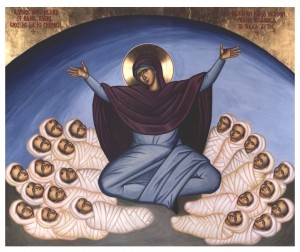
Holy Innocents IconOne knows exactly why this lesson was chosen for this day and it’s in this verse and it’s immeasurably depressing!

Today is the Feast of the Holy Innocents, my least favorite of all the commemorations on the church’s sanctoral calender, the day when we pay homage to all the little boys of Bethlehem whose lives were cruelly ended by Herod and his army. There are ways to pay tribute to martyrs and martyrdom; there are ways to honor the loss of life of those killed for their faith. None of them are appropriate to this day, I think. There is nothing noble about this story. These children did not die for a faith or commitment; they were too young to make such a stand. They died simply because of the brutal nature of human government, because men (and women) who have power do not want to give it up and will lash out when their possession of it is threatened.

Worst of all would be the sort of reaction to the slaughter that this verse would seem to encourage! (And I hasten to say that I realize the prophet was not doing so, that the rest of chapter 54 makes that clear. However, I have my doubts about the lectionary editors . . . .)

I cannot sing worth a damn! I was never gifted with the ear or voice for reproducing music. Suppose someone should somehow deprive a great singer of his or her voice — say Andrea Bocelli or Kiri Te Kanawa — should I exult because of their loss? I cannot dance, not a step. Suppose all the members of the Alvin Ailey company should lose their coordination and be unable to take another step — should I exult because of their loss?

Should the barren have exulted that they could not suffer the loss of those with children when those children were slaughtered? Should they? Or should they rather have joined in the weeping for the loss was not a personal one to each parent or pair of parents, it was the loss of the community . . . of the nation. It was not simply the loss of innocents; it was the loss of innocence. Again. Yet, again.

It had happened before and it would happen again. Innocence is constantly lost, sometimes found but never regained, never retained. Nazi doctors experiment on Jewish children; Alawite armies gas Sunni children; the American congress cuts funding for food assistance to women and children. In the end, the result is the same — the sin is merely a matter of degree — innocents are lost and innocence is lost, and simply because I am not affected is there reason for me to exult? Should I not rather mourn?

Perhaps we should rename this day on the sanctoral calendar. Not Holy Innocents, but Holy Innocence — the children are only the most visible casualties.

====================

A request to my readers: I’m trying to build the readership of this blog and I’d very much appreciate your help in doing so. If you find something here that is of value, please share it with others. If you are on Facebook, “like” the posts on your page so others can see them. If you are following me on Twitter, please “retweet” the notices of these meditations. If you have a blog of your own, please include mine in your links (a favor I will gladly reciprocate). Many thanks!

====================

Father Funston is the rector of St. Paul’s Episcopal Church, Medina, Ohio.

What’s the Point? – Sermon for Midnight Mass, Christmas Eve – December 24, 2013

====================

This sermon was preached at Christmas Eve Midnight Mass, December 24, 2013, at St. Paul’s Episcopal Church, Medina, Ohio, where Fr. Funston is rector.

(The Revised Common Lectionary, Christmas II: Isaiah 62:6-12; Psalm 97; Titus 3:4-7; and Luke 2:1-20. These lessons can be read at The Lectionary Page.)

====================

Charlie Brown Christmas DollA few weeks ago, I was shopping at Giant Eagle and I wondered down the seasonal products aisle, which had been rapidly cycling through Halloween, then Thanksgiving, and now Christmas. On one shelf, I spotted something that pulled me up short; I had to have it and I knew that it would influence my Christmas Eve sermon. It was this Charlie Brown Christmas doll.

That same day, a ministry colleague who runs a tongue-in-cheek Facebook group entitled “The Society for the Prevention of Tacky Vestments” posted a picture of a clergy stole — this one — covered with pictures of the Peanuts gang opening presents around a Christmas tree. I knew I had to have it! I asked her where she’d found it and she directed me to an eBay page where I ordered it. It is truly tacky! It’s got all the wrong colors — it’s mostly red, the color of martyrdom — and sends all the wrong messages — it’s crassly commercial; it’s all about the worst of the secular observance of Christmas; it’s got nothing religious on it at all. (It made me sort of wonder: if your Christmas fabric has nothing about Jesus on it, what’s the point of making a stole out of it?) Nonetheless, I had to have it and I knew that, together with Charlie Brown here, it would influence this Christmas Eve sermon. Let me tell you why . . . .

When I was seven years old, about a month or so into the first semester of Second Grade, my mother decided that we (she and I) would take an extended Thanksgiving-through-Christmas holiday with her parents in Long Beach, California. At the time, we were still living in my hometown, Las Vegas, Nevada. My father had died a year and a half before; my older brother was living with our other grandparents in Kansas. So, it was just the two of us.

I guess she had made arrangements with her employer to take an extended leave, and with my school because I was going to have to do reading and arithmetic assignments while we were gone, but that was OK with me. At least I wouldn’t have to go to school and endure the daily routine with Mrs. Dougherty!

So for a little more than a month encompassing those two major holidays, we shared my grandparents’ second floor walk-up a block from the beach and the Nu-Pike amusement park in Long Beach. On the ground floor of the building where they lived were two businesses: a dentist’s office and my grandfather’s barbershop. For some reason, the barbershop was closed! My grandfather had packed up his tools (they were now in a case in the front hall closet of the apartment) and put the business up for sale.

I was later to learn that he had done so because he was suffering with late-stage colon cancer; he was struggling to wrap up his affairs and make sure my grandmother would be provided for after his anticipated death, which came just a few months later in March of the next year. What was an extended holiday vacation for me, was anything but for my mother. She was there to spend a last Christmas with her father, and to help him deal with all the messy reality at the end of human life.

Sometime during the week before Christmas, my grandmother and my mother went off to do some shopping, and my grandfather got it into his head that my hair was too long. (I had hair in those days and it was sort of longish.) So he set a stool in the bathtub, told me to sit on it, draped me with one of his barber’s capes, got his tools from the front hall closet, and went to work. The reason he could no longer barber became painfully obvious as the haircut progressed.

He suffered from recurrent stabbing gut pain because of the cancer, and while he was cutting my hair one of these occurred. He flinched and made a mis-cut with his electric barber sheers. He didn’t cut me, but he did shave a 2-inch stripe up the back of my neck and across the top of my head! There was nothing to be done for it but to shave the rest of my head . . . . so that I ended up looking pretty much the way I look now, without the beard, of course.

A few days later, my brother joined us for the holidays and his first words on seeing me were, “You look just like Charlie Brown!” referring to this character from the Peanuts comic strip which had been our late father’s favorite. For the rest of that holiday week, that’s what he (and everyone else) called me.

Eventually my hair grew back and the haircut was forgotten. But that name stuck, and for the rest of my childhood and youth, my family nickname was “Charlie Brown.” So when I saw these Peanuts-related Christmas things, I knew I had to have them; and I knew that I would preach about them tonight.

The Peanuts franchise proved to be even more durable than my nickname. In 1965 it was the source of one of the most memorable and still best-loved Christmas specials on TV, A Charlie Brown Christmas; in fact, it was rebroadcast by ABC just last Thursday. 48 years after its debut and 13 years after the death of its creator, Charles Schulz, that cartoon Christmas special continues to touch hearts. In part because of its endurance, TV Guide has ranked Peanuts as the 4th greatest television cartoon of all time. (The top three are The Simpsons, The Flintstones, and the original Looney Toons series.)

If you’ve seen the Peanuts Christmas special, you know that there is a point in the story — which revolves around the kids putting on a Christmas play with a subplot involving Charlie Brown’s forlorn-looking little Christmas tree — there is a point in the story when Charlie cries out, “Isn’t there anyone who knows what Christmas is all about?” Linus replies, “Sure, Charlie Brown, I can tell you what Christmas is all about,” and walks out onto the stage where the play is to be performed. He calls for a spot light, and then begins to recite St. Luke’s nativity narrative, the same Gospel story we just heard. He ends with the message of the angels, “Glory to God in the highest and, on earth, peace, goodwill towards men.” As he walks back over to Charlie Brown, he says, “That’s what Christmas is all about, Charlie Brown.”

David Michaelis, in his biography of Charles Schulz entitled Schulz and Peanuts, tells the story behind this. During development meetings early in the production of the special, Schulz “proudly announced” that there would be “one whole minute” of Linus reciting the Gospel. The producer, Bill Melendez, tried to talk him out of it. But Schulz, who was an active “lay preacher” in the Church of God, insisted, “We can’t avoid it — we have to get the passage of St. Luke in there somehow. Bill, if we don’t do it, who will?” Schulz was asking, as I had asked about my Peanuts-inspired stole, “If Jesus isn’t in Christmas, what’s the point?”

Peanuts StoleAnd it seems to me that that question, raised by Peanuts and Charlie Brown, by this doll and that special, by this silly stole that I will never wear again, is one we really need to think about: If Jesus isn’t in Christmas, what’s the point?

Now, I’m not a proponent of the nonsense that Bill O’Reilly and others put out about some mythical “war on Christmas.” There isn’t one. A war on Christmas might actually be a good thing: the history of the church throughout the world, from its founding by the Apostles to the present day, demonstrates that where the church is actively persecuted, where there is a war against the church and its message, the faith is strong and grows. The 2nd Century Church Father Tertullian wrote that “the blood of martyrs is the seed of the Church.” A real war on Christmas would be a good thing! But there isn’t one.

What there is, I think, is not so much a war on Christmas, as an indifference towards Jesus! There’s plenty of holiday music on the radio and in the stores, but precious little of it mentions Jesus! There are yard displays galore, although there are a lot more Santas, Frosties, Grinches, and elves than baby Jesuses and Holy Families! There are scores of people attending parties, concerts, and special programs, many more at those venues then there are in churches like this. The winter solstice is being celebrated all over the place and the world around us is calling it “Christmas,” while exhibiting a gross indifference to Jesus . . . but if Jesus isn’t in Christmas, what’s the point?

Christmas, as Linus told Charlie Brown and reminded us, ought to be about Jesus being born in a stable in Bethlehem. Born there because the emperor had declared a census, a crucial element in the Roman empire’s system of taxation. In the ancient world, taxes were profoundly oppressive, especially in an economic system filled, as our own increasingly is, with individuals living at the very edge of survival. In a world full of working poor with very little to spare, the insatiable appetites of Roman military might and power, like the insatiable appetites of today’s government-subsidized corporations, cost ordinary people a great deal.

From his very first breath, Jesus’ life was shaped by oppressive power. His very existence was threatened by distant rulers, by Herod who would try to kill him as an infant, and by the Roman empire which would one day work his death, a death he would conquer and in conquering give meaning to his birth and his life.

In a very real sense, Jesus was born homeless. If Jesus were to be born today, he would likely be found in a tent city, under a turnpike overpass, in a city-center shelter, not in the safety of a maternity ward. If Jesus were to be born today, he would be found among those who suffer most but hope for much better, with those who rely on the kindness of strangers, on the goodness of the society around them to survive.

Jesus’ birth, as Linus told Charlie Brown and reminded us, was announced to shepherds. The announcement did not ring in the throne room of Caesar, nor that of Herod, nor even in the city council chambers of Bethlehem. The good news was first heard by powerless, anonymous people in a dirty camp watching their sheep and yearning for something better.

The world around us is indifferent to these realities of Jesus’ birth. The world around us, filled with those who are desperately poor, encourages us to ignore them, to make merry with an abundance of glitz and glamor rather than exhibit a generosity of spirit. The world around us, filled with those who have nowhere to live, encourages us to disregard them, to celebrate consumption and excess rather than the sufficiency of family and faith. The world around us, filled with powerless people whose lives are a mess, encourages to take no notice, to revel in plastic perfection instead of the complicated, beautiful reality of untidy human life.

Sunday evening our Church School children performed their annual Christmas pageant. It was fun and funny. It was lovely and it was sweet. The kids did a good job and everyone had a good time, but as I watched it I was struck by how little of Jesus there was in it. In fact, when it was all over, one of the parents in the audience asked, “But where’s Jesus?” Joseph (who was a 15-year-old boy who stands about 6′ 3″) held up a small doll which had been tucked away out of sight in an over-sized manger crib. It was a funny moment, but it underscored our question: If Jesus isn’t in Christmas, what’s the point?

In Linus’s brief one-minute of Gospel recited in the middle of what was otherwise a cute children’s Christmas cartoon, the Peanuts Christmas special reminded us that Jesus is in Christmas and that at its core Christmas is not a holiday for children! The secular celebration of the winter solstice with its parties, with its gift giving (and receiving), with its glitz and glamor and plastic perfection — that is a holiday for children and for those who act like children. But the commemoration of the poor, homeless, messy birth of Jesus, given meaning by his poor, homeless, messy death, redeemed by his glorious and life-affirming resurrection, this Christmas is a holy day for grown-ups!

A little more than a decade ago, a priest of our church named Fleming Rutledge suggested that the idea that Christmas is entirely for children encourages spiritual immaturity. She wrote:

In these stress-filled times, virtually all of us, as we get older, will seek relief by visiting, in our imaginations, a childhood Christmas of impossible perfection. These longings are powerful and can easily deceive us into grasping for a new toy, new car, new house, new spouse to fill up the empty spaces where unconventional love belongs. Our longings are powerful, our needs bottomless, our cravings insatiable, our follies numberless. For those who cannot or will not look deeply into the human condition, sentiment and nostalgia can masquerade as strategies for coping quite successfully for a while — but because it is all based on illusion and unreality, it cannot be a lasting foundation for generations to come. (For Grown-Ups)

In other words, if Jesus isn’t in Christmas, what’s the point?

In the 4th Century, St. Augustine of Hippo wrote a prayer in his autobiographical Confessions. “You,” he wrote to God, “have made us for yourself, O Lord, and our hearts are restless until they rest in you.” If we are honest, we all have that deep longing — that sense of something missing in our lives. It comes with maturity and is a sort of nagging feeling that something about us is incomplete. We grown-ups, unlike children, are consciously aware of how fragile life is; we know how limited and unfinished we are. We know that if Jesus isn’t in Christmas, there is no point!

Samuel Wells, the dean of the chapel at Duke University, wrote an article a few years ago about his experience attending a Christmas pageant at a church in Delhi, India, where the parts were all played by adults. (Christmas Is Really for the Grown-Ups) His initial reaction, he said, was to be flabbergasted: “Everyone knows the unique charm of Christmas is lost if adults take it too seriously. I sat there in Delhi and thought, Don’t these people realize that Christmas is really for the children?” (Emphasis his.) But as the play went on his perception changed: “[W]hen you see a nativity play performed by adults in a country like India, . . . you see for a start that Christmas is about suffering people.”

“This is a story,” he wrote, “about political oppression, harsh taxes, displaced people, homelessness, unemployment, vulnerable refugees and asylum-seekers. That’s the danger of performing it in a place like Delhi and having it acted out by adults who themselves know the very real possibility of any or all of these realities. We might have to recognize what it’s really about.”

And there’s more. Making note of the biblical account of Elizabeth’s barrenness, Mary’s unplanned pregnancy, Joseph’s confusion and possible humiliation, Wells comments, “The Christmas story’s teeming with personal grief, unresolved longings, uncomfortable secrets, shabby compromises, intense fears, social humiliation, and aching hurts.”

“When you sit in a market square in Delhi and see adults performing the Christmas story in an open-air nativity play. . . . . You see that Christmas is about people struggling, not just politically, but personally. Everywhere you look in the Christmas story you see people clinging on with their fingertips to life, to sanity, to respectability, to hope.”

Then Wells considers the wise men scanning the heavens and making their pilgrimage to Bethlehem; he points to the shepherds shivering on the hillside and, later, to Anna and Simeon waiting in the Temple. “When you see adults performing a nativity play, not for their grandparents’ camera-shots but in order genuinely to inhabit the story and make it their own, you see people not just suffering, not just struggling, but also searching. . . . . The nativity story is full of people searching, people yearning, people wanting to believe there’s more than just appearances and surviving and making a living and staying cheerful.”

When we consider the Christmas narrative as a story for adults, says Wells, it “encourage[s] us to name and explore the edges of our own faith, and commitments, and convictions, and questions.” Christmas as a story for grown ups encourages us to get in touch with the suffering in the story, the discrimination in our own culture, the political oppression in our own world. Christmas encourages us as adults to get in touch with the struggling in the story, the disappointment, distress, and despair in the lives of the Holy Family, the wise men, the shepherds, and all the others, and to recognize their struggle in our own lives and in the lives of those around us. Christmas encourages us grown-ups to get in touch with the searching in the story, with the nagging incompleteness of human life, the unresolved questions of faith, the yearning of people aching for truth, longing for meaning, waiting for hope, reaching out for God.

The adults acting out the Nativity play in India and the Peanuts gang (especially Linus) putting on their Christmas pageant in the television special both underscore the importance of our question: if Jesus isn’t in Christmas, what’s the point?

Christmas is not a holiday entirely for children, but it is a holiday entirely about a Child, the child Jesus who is God Incarnate, the Son of God who chose to become as limited, as fragile, as human as we are.

Charlie Brown’s question, “What’s it all about?” is our question, and Jesus, the Child born in the stable, is our answer. Our lives, with all their nagging incompleteness, are in the hands of a God who became human, who was born poor and homeless, who joined us in all the messiness of human life. The God who comforts us and lifts us up when we can’t lift ourselves up became Jesus, the Child born in a stable and laid in a manger, an infant who could not lift himself up, who needed to be comforted and lifted up by others, and thus inspires us to comfort and lift up others — the ones he would call members of his family: the poor, the homeless, the suffering, the struggling, the searching, the ones who live in the messiness and incompleteness of our world.

Without Jesus in Christmas, there is no point, because Jesus is the point! In the end Jesus is the good news of Christmas: that God, made fully known in Jesus, is with us, in all our suffering, in all our struggling, in all our searching, in all the messy incomplete reality of grown-up human existence.

Linus answering Charlie Brown by reciting that one-minute of Gospel in the middle of what is otherwise simply a cute children’s Christmas cartoon reminds us that Christmas really isn’t for children. It’s for adults.

It’s for you.

====================

A request to my readers: I’m trying to build the readership of this blog and I’d very much appreciate your help in doing so. If you find something here that is of value, please share it with others. If you are on Facebook, “like” the posts on your page so others can see them. If you are following me on Twitter, please “retweet” the notices of these meditations. If you have a blog of your own, please include mine in your links (a favor I will gladly reciprocate). Many thanks!

====================

Father Funston is the rector of St. Paul’s Episcopal Church, Medina, Ohio.

Corporate Responsibility – From the Daily Office – December 16, 2013

From the Psalter:

We have heard with our ears, O God, our forefathers have told us,
the deeds you did in their days, in the days of old.

(From the Daily Office Lectionary – Psalm 44:1 (NRSV) – December 16, 2013.)

Mouth Speaking into EarToday’s evening psalm begins with a verse reminiscent of the psalm verse from which my blog takes its name:

That which we have heard and known,
and what our forefathers have told us, *
we will not hide from their children. (Ps 78:3)

These psalms speak to the obligation of the generations to communicate from one to another the lore of the faith, the stories that make us who we are, the tales that cement the People of God together. This is a duty which is common across the gulfs of religion, culture, and nationality; any group of people which considers itself a unified society must communicate generation to generation the knowledge and the values around which the society coheres. One generation must tell and the next must listen; the older must teach; the younger, learn.

In the past few days two news items caught my attention. The first was a report of findings of sociologists that Americans are less mobile in the second decade of the 21st Century than we were 20 or 30 or 40 years ago. People in our country are not moving from place to place, not changing residences as frequently as they used to. Those doing the research did not venture an explanation of why this is, but they offered possible reasons including the much higher costs of relocation, the change from a manufacturing to a service economy, and the homogeneity of both the current workforce and the current job market. Whatever the reasons, the nation seems to be returning to a more settled way of life, perhaps one similar in some ways to the agrarian society of the nation’s youth. This means that stories of affinity and location, the tales that form neighborhoods and cultures, the social economy of the small community will become more important.

The second news item, however, suggests that settled communities and social economies are not forming, that they are instead being destroyed. The story concerned the way in which the large corporations that form the basis of our service and information based economy (Facebook, Google, Twitter, cell phone companies, and so forth) are moving into and taking over the urban landscape. Because these companies need large amounts of space, their entry into the urban real estate market as buyers drives up the cost of office and commercial space, often to a rate that small retailers, cafes, restaurants, and other local businesses cannot afford. This, in turn, leads those smaller businesses to go out of operation. In addition, these corporations are providing “full service campuses” for their employees – providing gymnasiums and recreational facilities, dining facilities, all the ancillary services previously provided by the smaller businesses. This exacerbates the small, local businesses’ problem and accelerates their demise. The full-service corporate campuses and the absence of those small retail firms, cafes, and restaurants mean that the normal “meeting places” of society are disappearing. The employees of different businesses, the constituencies of competing corporate societies no longer have either need or place to interact.

These two trends seem to me to be incompatible. As we become more settled and have greater need for the organs of society that create communal coherence, we are also being fractured by the economic engines driving us to be more settled; the corporations which undergird the service-information economy are (perhaps inadvertently) demolishing the small-business economy that fosters human community in settled societies.

Now someone will say, “But there is the internet. Those service-information corporations, through the internet, provide an alternative to the public spaces, the small-business and social interactions of earlier settled communities.” Yes, to an extent that is so. But the internet and social media cannot replace the one-on-one, the one-with-many flesh-and-blood interactions of humankind. We need those in-the-flesh moments, to see another’s face, to hear his or her inflections, tones-of-voice, sighs, and chuckles, even to smell his or her sweat, breath, or perfume.

I am not blaming the Googles, the Twitters, the Facebooks for the loss of what sociologist Robert Putnam called “social capital” (see Bowling Alone), but I am suggesting that it is our responsibility to use the technologies and media they offer in appropriate ways, ways that enhance rather than disrupt the formation and sustaining of human community. I am suggesting that the owners, executives, managers, employees, and customers of those corporations share in that responsibility.

We cannot with integrity and authenticity say that we “have heard with our ears [what] our forefathers have told us” if we have only seen a Tweet, viewed a Facebook page, or read a blog entry. We cannot with integrity and authenticity say that we are not hiding the story of our community from our children if we are not sharing that story with one another in person. If we are to sing these psalms authentically, we must tell with our own voices, hear with our own ears, see with our own eyes, not with those of technology. It is our corporate responsibility.

====================

A request to my readers: I’m trying to build the readership of this blog and I’d very much appreciate your help in doing so. If you find something here that is of value, please share it with others. If you are on Facebook, “like” the posts on your page so others can see them. If you are following me on Twitter, please “retweet” the notices of these meditations. If you have a blog of your own, please include mine in your links (a favor I will gladly reciprocate). Many thanks!

====================

Father Funston is the rector of St. Paul’s Episcopal Church, Medina, Ohio.

Cleaning Cups – From the Daily Office – December 12, 2013

From Matthew’s Gospel:

[Jesus said:] “Woe to you, scribes and Pharisees, hypocrites! For you clean the outside of the cup and of the plate, but inside they are full of greed and self-indulgence.”

(From the Daily Office Lectionary – Matt. 23:25 (NRSV) – December 12, 2013.)

Dirty CupThe devisers of our Episcopal Church Daily Office Lectionary were a clever bunch, weren’t they?

Here we are less than two weeks from Christmas Day, in the middle of that great orgy of greed and indulgence which is the holiday gift buying season, and they give us Jesus saying this!

Yesterday, TIME Magazine announced that their selection of the 2013 Person of the Year is Pope Francis, the current Bishop of Rome and Supreme Pontiff of the Roman Catholic Church. Interesting choice, especially at this time of year given that less than a month ago he said:

The worship of the ancient golden calf has returned in a new and ruthless guise in the idolatry of money and the dictatorship of an impersonal economy lacking a truly human purpose. The worldwide crisis affecting finance and the economy lays bare their imbalances and, above all, their lack of real concern for human beings; man is reduced to one of his needs alone: consumption. (Evangelii Gaudium, published 24 November 2013, Paragraph 55)

I am not a Roman Catholic, but I find myself fully in agreement with the pope’s insistence that unfettered capitalism and unrestrained “free markets” are contrary to the Gospel mandate. His insistence that the church and society are called by Christ, compelled by the Spirit to help “those who are in thrall to an individualistic, indifferent and self-centered mentality to be freed from those unworthy chains and to attain a way of living and thinking which is more humane, noble and fruitful, and which will bring dignity to their presence on this earth (Para. 208),” is fully in accord with what I understand Jesus to be saying in this (and other) verses of Scripture.

There is little that any one person can do in this regard. I’ve done this Advent what I can — I stayed away from all retail activity on Thanksgiving and Black Friday, not giving into or being part of the feeding frenzy of “holiday sales” — I am trying to “buy local” both for gifts and for personal needs — I do my banking at a local financial institution, not with one of the national conglomerates — I plan to give few gifts this year, but instead to make dedicated contributions to Episcopal Relief & Development, Médecins sans Frontières, Habitat for Humanity, and similar organizations.

These are small things. In the vast, global financial network that is our dysfunctional economy, they are a drop in the ocean. But they are something. The American Unitarian clergyman Edward Everett Hale is quoted as saying, “I am only one, but I am one. I can’t do everything, but I can do something. The something I ought to do, I can do. And by the grace of God, I will.” If each of us does something to clean the inside of the cup which is our economy of greed and indulgence, perhaps we can change it.

The clever compilers of our lectionary and the pope have reminded us that Jesus calls us to do so. This Advent, I am doing what I can.

====================

A request to my readers: I’m trying to build the readership of this blog and I’d very much appreciate your help in doing so. If you find something here that is of value, please share it with others. If you are on Facebook, “like” the posts on your page so others can see them. If you are following me on Twitter, please “retweet” the notices of these meditations. If you have a blog of your own, please include mine in your links (a favor I will gladly reciprocate). Many thanks!

====================

Father Funston is the rector of St. Paul’s Episcopal Church, Medina, Ohio.

« Older posts Newer posts »