Occasional thoughts of an Anglican Episcopal priest

Category: Politics (Page 20 of 23)

You’ve Got to Be Carefully Taught – From the Daily Office – November 24, 2012

From Luke’s Gospel:

Jesus told this parable to some who trusted in themselves that they were righteous and regarded others with contempt: “Two men went up to the temple to pray, one a Pharisee and the other a tax-collector. The Pharisee, standing by himself, was praying thus, ‘God, I thank you that I am not like other people: thieves, rogues, adulterers, or even like this tax-collector. I fast twice a week; I give a tenth of all my income.’ But the tax-collector, standing far off, would not even look up to heaven, but was beating his breast and saying, ‘God, be merciful to me, a sinner!’ I tell you, this man went down to his home justified rather than the other; for all who exalt themselves will be humbled, but all who humble themselves will be exalted.”

(From the Daily Office Lectionary – Luke 8:9-14 (NRSV) – November 24, 2012)
 
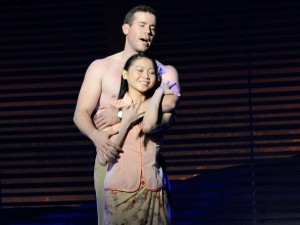
Lieutenant Cable and Liat from "South Pacific"Although from a modern perspective, the prayer of the Pharisee is rather bigoted, but we should try to see it from his perspective and from within his culture, which Jesus shares. When we do so, we can see that Jesus is not criticizing the individual, but rather condemning an entire system of religion which divides and categorizes people. Jesus is denouncing any system, religious, social, or political, which separates people on the basis of bigotry and fear.
We know that from the early Second Century some rabbis taught that every Jewish man was obligated to recite three blessings daily, and it is not too much of a stretch to imagine that these, or some earlier version, were in use in Jesus’ time. These three blessings express gratitude to God for one’s status or position through negative comparisons with others. The man blessed God that God had not made him a gentile, a woman, or a slave (or, alternatively, a boor). Modern scholars call these the “blessings of identity.” They may not have been universally required prayers at first, but we know that by the Fifth Century they were part of Judaism’s most authoritative teaching, The Babylonian Talmud, and at the end of the first millennium they had become part of the preliminary prayers of the Jewish daily morning service. So, again, it doesn’t take much imagination to think that perhaps Jewish men were saying something similar in the time of Jesus.

And they weren’t alone! Such divisive, negative, comparative thanksgiving was not and is not limited to the Jews. Thales of Miletus (d. 546 BC), traditionally the first of the Greek philosophers, reportedly gave thanks to Tyche, the goddess of fortune, “that I was born a human and not a beast, a man and not a woman, a Greek and not a barbarian.” Similar sentiments have been credited to Socrates (d. 399 BC) and Plato (d. 348 BC)! Scholars have wondered whether the blessings of identity might actually be of Greek origin, a bit of Greek philosophy that was “Judaized” and crept into the Jewish morning prayers by the First Century.

Whether of Greek or Jewish origin, it is this sort of divisive thinking that Jesus condemns in today’s Daily Office gospel lesson, not merely the self-congratulatory, self-righteous, and fine-tuned religious conceit of the Pharisee. It’s not pride that Jesus denounces; it’s bigotry. Paul would be the first to understand this well and spread Jesus’ gospel beyond its Jewish origins. To the Romans he would write, “There is no distinction between Jew and Greek; the same Lord is Lord of all and is generous to all who call on him.” (Rom. 10:12) To the Colossians, “There is no longer Greek and Jew, circumcised and uncircumcised, barbarian, Scythian, slave and free; but Christ is all and in all!” (Col. 3:11) And famously to the Galatians, “There is no longer Jew or Greek, there is no longer slave or free, there is no longer male and female; for all of you are one in Christ Jesus.” (Gal. 3:28) A modern 20th Century hymn familiar to all Episcopalians picks up the strain:

In Christ there is no East or West,
in him no South or North,
but one great fellowship of love
throughout the whole wide earth.

In him shall true hearts everywhere
their high communion find,
his service is the golden cord
close-binding all mankind.

Join hands, disciples of the faith,
whate’er your race may be!
Who serves my Father as a son
is surely kin to me.

In Christ now meet both East and West,
in him meet South and North,
all Christly souls are one in him,
throughout the whole wide earth.

(Words by John Oxenham, 1908)

The Jew praying in the temple was doing only what he’d been taught, but that is the nature of bigotry. Bigotry, prejudice, fear and hatred of the other are not natural. They have to be taught. There’s a short, little remembered song from the musical South Pacific by Rodgers and Hammerstein. Sung by the character Lieutenant Cable as he struggles with whether to marry Liat, an Asian woman with whom he has fallen in love, You’ve Got to Be Carefully Taught may be the most powerful song of the show:

You’ve got to be taught
To hate and fear,
You’ve got to be taught
From year to year,
It’s got to be drummed
In your dear little ear
You’ve got to be carefully taught.

You’ve got to be taught to be afraid
Of people whose eyes are oddly made,
And people whose skin is a diff’rent shade,
You’ve got to be carefully taught.

You’ve got to be taught before it’s too late,
Before you are six or seven or eight,
To hate all the people your relatives hate,
You’ve got to be carefully taught!

Well . . . this is getting a bit long for a simple morning meditation, but the point is that Jesus isn’t simply comparing two individuals and saying one is better than the other. That would be no different from the divisive prayer he condemns. Jesus is denouncing a religious system, any system, that builds up some at the expense of others. Better to stand before God and acknowledge who we are, and where we fall short of God’s expectations, than to enlarge ourselves through negative (and most often wrong) comparisons with those who are different from us. To do either, however, requires that we be taught to do so. You’ve got to be carefully taught.

====================

A request to my readers: I’m trying to build the readership of this blog and I’d very much appreciate your help in doing so. If you find something here that is of value, please share it with others. If you are on Facebook, “like” the posts on your page so others can see them. If you are following me on Twitter, please “retweet” the notices of these meditations. If you have a blog of your own, please include mine in your links (a favor I will gladly reciprocate). Many thanks!

====================

Father Funston is the rector of St. Paul’s Episcopal Church, Medina, Ohio.

The Most Important Election . . . NOT! – Sermon for Election Day – November 6, 2012

====================

This sermon was preached on Tuesday, November 6, 2012, at St. Paul’s Episcopal Church, Medina, Ohio, where Fr. Funston is rector.

(Lessons selected for the Mass were Isaiah 26:1-8, Romans 13:1-10, and Mark 12:13-17, from the Episcopal Book of Common Prayer’s lectionary for various occasions, “For the Nation”; the gradual, Psalm 146, was selected by the preacher.)

====================

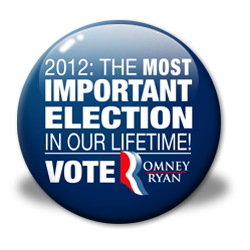
Romney Campaign Button "Most Important Election"“This election is the most important, ever. If that candidate is elected, it will be the end of the world!” The first time I heard that was during the campaign of the first presidential election I paid attention to: the race between John F. Kennedy and Richard Nixon in 1960. I heard it as my family watched the televised debate; it was said by my older brother who was then a freshman studying history and political science at the University of Texas, so of course he knew everything. “That candidate,” by the way, was Richard Nixon. We heard it again in 1964; remember the television commercial with the little girl plucking petals from a daisy and the atomic explosion? “If Barry Goldwater is elected,” it suggested none too subtly, “it will be the end of the world.” We hear it every election, “This election is the most important election of our lifetimes.” And, to be honest, that is a correct statement. Those in the past are no longer important; they’re done and other with. Only this election can impact the future so, at this time, up to now, it is the most important. But truth be told . . . none of them, including this election, are really all that important in the grand scheme of things.

In the Daily Office Lectionary of the Episcopal Church, the cycle of bible readings to be read each morning, today’s New Testament reading was from the Book of Revelation which records the vision St. John of Patmos had of “the new Jerusalem,” of heaven. In the lesson, this is what John reports:

I saw what appeared to be a sea of glass mixed with fire, and those who had conquered the beast and its image and the number of its name standing beside the sea of glass with harps of God in their hands. And they sing the song of Moses, the servant of God, and the song of the Lamb:
“Great and amazing are your deeds,
Lord God the Almighty!
Just and true are your ways,
King of the nations!
Lord, who will not fear
and glorify your name?
For you alone are holy.
All nations will come
and worship before you,
for your judgments have been revealed.” (Revelation 15:2-4)

This song of praise was a wonderful reminder with which to begin Election Day: God is the king of the nations; he alone is holy. As we went to the polls today, we were casting our ballots for political leaders, not religious ones, and certainly not a savior. Today we chose between candidates for various offices, all of whom are simply human beings like ourselves, fallible human beings whom we hope will strive to overcome whatever their faults and frailties may be, and govern to the best of their abilities. Whether the candidates for whom you or I happened to vote are elected is not, at this point, of any real importance; what is of importance is that we respect and honor our system of governance, and support and pray for whichever candidates are ultimately placed in office.

The Psalm which we recited just a few minutes ago reminds us:

Put not your trust in rulers, nor in any child of earth, for there is no help in them.
When they breathe their last, they return to earth, and in that day their thoughts perish.
(Ps. 146:2-3, BCP version)

We are admonished not to rely, although we surely do, on our earthly leaders. We repose more trust, and certainly more expectation, than we ought in our elected leaders, forgetting that they are no different from, nor more perfect than we.

This evening we do not celebrate nor do we extol any political party, any platform, any candidate, any elected office holder. Instead, we give thanks for the freedoms we enjoy, for the country we love, and for the electoral process which allows us to maintain both through peaceful changes in government. We give thanks for the wisdom of our Founding Fathers, for the insight of the framers of the Constitution, for the bravery and sacrifice of those who have defended our rights and liberties, and for the commitment of our fellow citizens who have participated in our democracy and voted in this election. We give thanks for all these things to the one upon whom all this rests, to the one who is the foundation of our existence, to the one who is our ultimate concern, to the one in whose service we find perfect freedom.

When we gather to give thanks for and to pray for our national life, the lectionary of our church asks us to hear and consider the story of the Pharisees and Herodians asking Jesus about taxes: Is it lawful to pay them to Caesar? To which Jesus’ makes his famous reply, “Render to Caesar the things that are Caesar’s and to God the things that are God’s.” This gospel story, says theologian Daniel Deffenbaugh

. . . calls us to be neither enemies of the state nor its staunch allies. Rather, we should think of ourselves, in the words of Stanley Hauerwas, as “resident aliens. ” We do not refuse to give to the emperor the things that are the emperor’s, even when – much to our dismay – their utilization defies our most deeply held convictions. This is as true of the right as it is of the left, and in this we can take some solace. But the affections of our hearts and minds must always, and with greater fervor, be focused on the more urgent clause in Jesus’ directive: “give to God the things that are God’s.” (Allies or Enemies?

This, he says, leaves us in a “posture of perpetual discernment,” constantly trying to distinguish our steadfast devotion to God from our obligations to the nation.
The Cathechism of the Roman Catholic Church interprets this gospel tale as teaching that we should “give to God everything, but give Caesar his due.” Thus, we are called to take part in our national culture for the common good. “It is necessary that all participate, each according to his position and role, in promoting the common good. This obligation is inherent in the dignity of the human person.” (CCC 1913) To the best of our ability, we should all participate in the public arena for the good of the society. Jesus’ answer to the Pharisees and Herodians gives each person freedom to act in that public sphere, but with that freedom come awesome responsibilities, none more awesome than the privilege and obligation to participate in democratic elections, even if we do so in a “posture of perpetual discernment.”

We do our best in that state of constant decision-making. We study the issues and the candidates. We make our choices. We participate in the public arena. We vote. And then we trust . . . not in rulers, not in political parties, not in the candidates, not in any child of earth . . . We render our trust not to Caesar nor anything that is Caesar’s, but to God. It is not that our vote is unimportant, but it is not of ultimate concern.

In the Anglican Communion on November 6, we commemorate one of our greatest theologians, Archbishop William Temple, who served as Archbishop of Canterbury near the Second World War. He served in that post only two years, from his appointment in 1942 to his death in October, 1944. He served in the episcopate for 23 of his 63 years, first as Bishop of Manchester, then as Archbishop of York, and finally in the See of Canterbury. Throughout his life, he was a prolific author of philosophy and theology.

While serving in York, he addressed the 1938 Lambeth Conference, the decennial gathering of Anglican bishops, with these words which, I think, are a good reminder for us today:

While we deliberate, God reigns.
When we decide wisely, God reigns.
When we decide foolishly, God reigns.
When we serve God in humble loyalty, God reigns.
When we serve God self-assertively, God reigns.
When we rebel and seek to withhold our service, God reigns –
The Alpha and the Omega, which is and which was,
And which is to come, the Almighty.

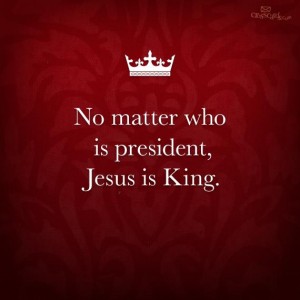
John of Patmos in his apocalypse, the Psalmist in Psalm 146, Archbishop Temple in his address to the gathered bishops . . . they all remind us that no matter how we decide, no matter who is elected today, God reigns. As the graphic on the cover of our bulletin says, “No matter who is president, Jesus is king.”

Let us pray.

O God of light and love, inspire us, we pray, that we may rejoice with courage, confidence, and faith in the Word made flesh, Jesus our King, and that through our participation in our national culture and our democratic processes we may establish that society which has justice for its foundation and love for its law; through the same Jesus Christ, our Lord, who lives and reigns with you and the Holy Spirit, one God, now and for ever. Amen.

====================

A request to my readers: I’m trying to build the readership of this blog and I’d very much appreciate your help in doing so. If you find something here that is of value, please share it with others. If you are on Facebook, “like” the posts on your page so others can see them. If you are following me on Twitter, please “retweet” the notices of these meditations. If you have a blog of your own, please include mine in your links (a favor I will gladly reciprocate). Many thanks!

====================

Father Funston is the rector of St. Paul’s Episcopal Church, Medina, Ohio.

The Sun Will Rise on Wednesday – From the Daily Office – November 6, 2012

From the Book of Revelation:

I saw what appeared to be a sea of glass mixed with fire, and those who had conquered the beast and its image and the number of its name standing beside the sea of glass with harps of God in their hands. And they sing the song of Moses, the servant of God, and the song of the Lamb:
“Great and amazing are your deeds,
Lord God the Almighty!
Just and true are your ways,
King of the nations!
Lord, who will not fear
and glorify your name?
For you alone are holy.
All nations will come
and worship before you,
for your judgements have been revealed.”

(From the Daily Office Lectionary – Revelation 15:2-4 – November 6, 2012)
 
No Matter Who Is President, Jesus is KingThis song of praise from the Revelation to St. John of Patmos is a wonderful reminder on Election Day: God is the king of the nations; he alone is holy. Remember that when you go to the polls today. We are electing political leaders, not religious ones, and certainly not a savior.

In the Psalms there is another such reminder:

Put not your trust in rulers, nor in any child of earth, for there is no help in them.
When they breathe their last, they return to earth, and in that day their thoughts perish.
(Ps. 146:2-3, BCP version)

Today just happens to be the commemoration of one of Anglicanism’s greatest theologians, Archbishop William Temple, who served as archbishop of Canterbury near the end of the Second World War. He served in that post only two years, from his appointment in 1942 to his death in October, 1944. He was a prolific author of philosophy and theology, and served in the episcopate for over twenty years (Bishop of Manchester, 1921-29, and Archbishop of York, 1929-42).

Addressing the 1938 Lambeth Conference (a decennial gathering of Anglican bishops), he said:

While we deliberate, God reigns.
When we decide wisely, God reigns.
When we decide foolishly, God reigns.
When we serve God in humble loyalty, God reigns.
When we serve God self-assertively, God reigns.
When we rebel and seek to withhold our service God reigns –
The Alpha and the Omega, which is and which was,
And which is to come, the Almighty.

John of Patmos, the Psalmist, Archbishop Temple . . . they all remind us, as does the graphic annexed to this little bit of prose, that no matter who is elected, Jesus is king; no matter how we decide, God reigns.

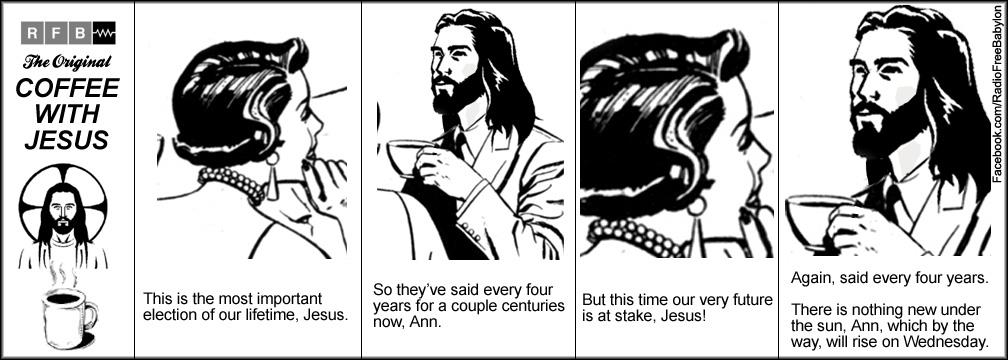
Or as Jesus would say, the sun will rise on Wednesday.

The Most Important Election

====================

Coffee with Jesus is from Radio Free Babylon’s Facebook page.

A request to my readers: I’m trying to build the readership of this blog and I’d very much appreciate your help in doing so. If you find something here that is of value, please share it with others. If you are on Facebook, “like” the posts on your page so others can see them. If you are following me on Twitter, please “retweet” the notices of these meditations. If you have a blog of your own, please include mine in your links (a favor I will gladly reciprocate). Many thanks!

====================

Father Funston is the rector of St. Paul’s Episcopal Church, Medina, Ohio.

Gentle Partisanship – From the Daily Office – October 31, 2012

From the Book of Ben Sira:

Many have fallen by the edge of the sword,
but not as many as have fallen because of the tongue.
Happy is one who is protected from it,
who has not been exposed to its anger,
who has not borne its yoke,
and has not been bound with its fetters.
For its yoke is a yoke of iron,
and its fetters are fetters of bronze;
its death is an evil death,
and Hades is preferable to it.
* * *
Take care not to err with your tongue,
and fall victim to one lying in wait.

(From the Daily Office Lectionary – Sirach 28:18-21,26 – October 31, 2012)

PartisanshipI am a political junkie (to use a term probably copyrighted by the NPR radio show Talk of the Nation). I love the democratic political process by which we in the United States choose our leadership. I don’t, however, love what it sometimes makes me become – a hyperpartisan. Once I have considered the issues and the candidates, once I have decided for which candidate or party or side of an issue I am going to vote, I am decidedly opinionated and not shy about sharing that opinion.
The reading from Ben Sira today concerns slander rather than opinion (or at least that is how the translators have rendered the original which literally means “a third tongue”). I don’t think I have ever actually slandered any politician, but I will admit that my opinionated descriptions of some have been less than kind. I think Ben Sira’s admonitions may nonetheless apply.

Recently my friend Sarah, who is a priest and a military chaplain, posted this reflection as her Facebook status:

I have been avoiding overtly political posts since I love and serve a broad cross-section of the population and will not host hostility in my home or on my fb page. As a spiritual guide, it is time for me to openly say something about the things people of faith must consider if they are to follow the shared fundamental ethics of the major world religions. As a priest and minister of the Gospel of Jesus Christ, it is time for me to say something about what it means to vote Gospel values. It means voting for whomsoever has a preferential option for the poor, the widowed, the orphaned, the outcast. It means voting for whomsoever has demonstrated consistent concern for bringing high places low, for straightening crooked paths, for feeding the hungry, honoring the despised, protecting the least of these. We are a community, and while rugged individualism may be an American value, it is not a Christian value. If you want to vote your values, vote out of the conviction that God can and will honor self-sacrifice out of love for “the least of these.” If you want to live your values, practice love and not vitriol. If you want to vote your values, do not try to force your personal moral practices about things related to sex into the laws of the land. Instead, make this country a great place for all people from all socioeconomic classes to be married and raise children. Continuing praying for God’s love to prevail even if it costs you and me and us everything. If you pray for God’s love to prevail, share that love, including love for your enemies. This means action in word and deeds, including how we regard those who believe differently than we do. It means a return to civility and bipartisanship. As one of my medical colleagues (who, by the way, I imagine will vote quite differently than I would like him to!) lives by: “charity faileth never.”

I agree with Sarah wholeheartedly as to what it means to vote one’s values and what it means to vote as a follower of Jesus Christ. It’s those last couple of lines in her Facebook status that call me up short! It’s the embodying of those same values in our political discourse as well as in our vote that I have trouble with. It’s the “words and actions,” the “civility and bipartisanship”, the never-failing charity part.

I try, Lord knows, I try to be like Sarah. I try to follow Ben Sira’s admonitions. I don’t always (in fact, I seldom) succeed. But I hope that Thomas Merton was right, that the desire to please God does in fact please God, that though we do not succeed there is merit in the attempt. (The Merton Prayer)

I will always love politics. I will always be partisan. God grant that in my partisanship I can be gentle, or at least try to be . . . and I hope that that is enough.

====================

A request to my readers: I’m trying to build the readership of this blog and I’d very much appreciate your help in doing so. If you find something here that is of value, please share it with others. If you are on Facebook, “like” the posts on your page so others can see them. If you are following me on Twitter, please “retweet” the notices of these meditations. If you have a blog of your own, please include mine in your links (a favor I will gladly reciprocate). Many thanks!

====================

Father Funston is the rector of St. Paul’s Episcopal Church, Medina, Ohio.

Theodicy and Abortion – From the Daily Office – October 27, 2012

From the Book of Ben Sira:

It was he who created humankind in the beginning,
and he left them in the power of their own free choice.
If you choose, you can keep the commandments,
and to act faithfully is a matter of your own choice.
He has placed before you fire and water;
stretch out your hand for whichever you choose.
Before each person are life and death,
and whichever one chooses will be given.

(From the Daily Office Lectionary – Sirach 15:14-17 – October 27, 2012)

Grief (watercolor wash, artist unknown)Well, there it is! Bigger than life! Free will! Of course, I know that as an Anglican I am not supposed to use this text, or any part of the Deuterocanon, to settle matters of doctrine, but only read them ” for example of life and instruction of manners.” [Articles of Religion, Article VI, BCP 1979, page 868] But come on! There it is!
I probably shouldn’t go there, but the past 48 hours have made it impossible not to think about free will without thinking of Indiana senate candidate Richard Mourdock who stirred up controversy when he said during a debate that “even when life begins in that horrible situation of rape, that is something that God intended to happen.” He tried to explain himself later saying, “God creates life, and that was my point,. God does not want rape, and by no means was I suggesting that he does. Rape is a horrible thing.” He only dug a deeper hole. If it is true that politics and religion don’t mix, it is even more true that politics and the problem of theodicy don’t mix!

“Theodicy” is a little-used word theologians coined to describe what is generally called “the problem of evil.” It posits this rational conundrum:

  1. God is all-powerful.
  2. God is all-good.
  3. God is all-knowing.
  4. Evil exists.

Only three of these four propositions (says the issue of theodicy) can be true; since we know that evil exists, then one of the other three statements must be false. Many philosophers and theologians have wrestled with this issue and I’m not going to get into it in a brief meditation on the daily office lessons, other than to acknowledge that it exists and that one way it is answered is the very subject Jesus son of Sirach brings up in this reading: free will. In other words, in making the universe (and humankind within it) free, the all-powerful, all-loving, all-knowing God allows the possibility that evil may occur.

St. Thomas Aquinas affirmed in the Summa Theologica that God’s ultimate purpose for creation is so good, so great that it involves “allowing” the possibility of evil, but (as Aquinas points out) to “allow” is not the same as to “cause”. Furthermore, the enduring good that allows evil includes the possibility that good can redeem evil; because of this remaining good, a return path to good is always possible. I think this is the theological concept candidate Mourdock was trying to articulate, but doing so badly and causing himself and his party a good deal of trouble.

I can agree with Mr. Mourdock up to a point, but not about the conclusion he ultimately reaches. In his view, apparently, the return to good, the redemption of the evil of rape, is found in the conception of life which may result. For him, that redemption is (apparently) automatic and, thus, a pregnancy resulting from rape is redemptive; it is a good so great that it cannot be aborted. But neither Aquinas nor any theologian has ever argued that the return to good is automatic; it is always and only contingent – it is possible but never guaranteed. Furthermore, there is the counter possibility in the circumstance of a rape that further evil, not good, could result from the pregnancy and later birth. Indeed, the experience of women who have born the children conceived in rape shows a wide variety of outcomes, many extremely negative, many a continuation of the evil done to them.

That is why I cannot come to the theological conclusion reached by candidate Mourdock, nor to the political conclusion to which he comes, i.e., that abortion should be outlawed with no exception provided for conceptions resulting from rape. Indeed, I cannot come to any conclusion which entirely outlaws abortion. To do so denies to women the freedom of will given humankind from the beginning about which Ben Sira writes; this is a matter about which women should decide for themselves “in the power of their own free choice.” Therefore, abortion should be safe. It can only be safe if it is legal and regulated; if it is outlawed, it will nonetheless continue. The choice for our society is not between abortion and no abortion; it is between abortion which is safe and abortion which is deadly.

I cannot say that I would never, as a priest, counsel a woman to undergo an abortion, but I would nearly always argue for an alternative. In the end, however, it would not be my decision; it would be hers. And if she chooses to abort the fetus, then it is her right to have that procedure done in the safest way possible. Years ago, I participated in a panel discussion with an Eastern Orthodox colleague ordained many years longer than me. During the presentations he said, “I would rather console a woman who’s had a safe, legal abortion, than bury one who’s had an illegal abortion. And I’ve done both.” Unlike my colleague, I have not, thank God, buried the victim of an illegal abortion, and certainly I never want to.

We will always wrestle with the problem of theodicy, but we should do so in the context of theological schools and churches. It is not an issue to be solved in the halls of congress, nor in the operating suites of hospitals, nor in the offices of obstetricians, nor with the bodies of women whom God made free to act as a matter of their own choice.

====================

A request to my readers: I’m trying to build the readership of this blog and I’d very much appreciate your help in doing so. If you find something here that is of value, please share it with others. If you are on Facebook, “like” the posts on your page so others can see them. If you are following me on Twitter, please “retweet” the notices of these meditations. If you have a blog of your own, please include mine in your links (a favor I will gladly reciprocate). Many thanks!

====================

Father Funston is the rector of St. Paul’s Episcopal Church, Medina, Ohio.

How Not to Converse – From the Daily Office – October 26, 2012

From the Book of Ben Sira:

Do not find fault before you investigate;
examine first, and then criticize.
Do not answer before you listen,
and do not interrupt when another is speaking.

(From the Daily Office Lectionary – Sirach 11:7-8 – October 26, 2012)

Conversation Skills CartoonJesus son of Sirach offered a lot of good advice in his little book sometimes called Liber Eccesiasticus, a book not included in the canon of inspired Scripture recognized by Protestants, but found in that selection of texts called the Apocrypha. Anglicans decline to use these texts to settle matters of doctrine, but read them ” for example of life and instruction of manners.” (Articles of Religion, Article VI, BCP 1979, page 868)

None of that advice, it seems to me, is better, nor more timely, than these verses from today’s Old Testament reading: investigate before speaking; listen before answering. The so-called “debates” (which were anything but) between the candidates for the presidency and vice-presidency of this country were exercises in how not to have a constructive and productive conversation. In whatever the format, none of which worked, these “debates” were showcases of people whose ears were hardly ever engaged, who weren’t examining things before criticizing and who weren’t listening before answering, and who definitely were interrupting when others were speaking.

I may use YouTube snippets of the debates in my pre-marital counseling of engaged couples! In that counseling, I talk with the couples about effective communication and problem solving and always, always encourage two things: active listening and assertiveness (which is very different from aggressiveness). Active listening means paying attention, not interrupting, and restating what you have heard so that you confirm your understanding; it means taking personal responsibility for getting what you hear from the other person right. Assertiveness means getting what the other hears from you right. It means taking responsibility for your feelings by using “I” statements; it means stating your position clearly and directly, not relying on the other to read your mind.

Obviously, the need for good interpersonal communications skills has been around as long as there have been people and the advice I give these couples is nothing new. Jesus Ben Sira was giving the same advice, how not to converse, a couple of millennia ago!

====================

A request to my readers: I’m trying to build the readership of this blog and I’d very much appreciate your help in doing so. If you find something here that is of value, please share it with others. If you are on Facebook, “like” the posts on your page so others can see them. If you are following me on Twitter, please “retweet” the notices of these meditations. If you have a blog of your own, please include mine in your links (a favor I will gladly reciprocate). Many thanks!

====================

Father Funston is the rector of St. Paul’s Episcopal Church, Medina, Ohio.

The Better Angels of Our Nature – From the Daily Office – October 24, 2012

From the Book of Ben Sira:

Do not seek from the Lord high office,
or the seat of honor from the king.
Do not assert your righteousness before the Lord,
or display your wisdom before the king.
Do not seek to become a judge,
or you may be unable to root out injustice;
you may be partial to the powerful,
and so mar your integrity.
Commit no offense against the public,
and do not disgrace yourself among the people.

(From the Daily Office Lectionary – Ben Sira 7:4-7 – October 24, 2012)

Abraham LincolnThere are a few folks flying all over the U.S. recently (and promising to do so for the next couple of weeks) who have not followed Ben Sira’s advice! Everyday for the past few weeks my mailbox has contained at least one and more commonly three or more expensively produced, glossy, color flyers extolling the virtues of one or the other of the political parties or candidates, or more often tearing down the other guys. Everyday for the past few weeks my voicemail has recorded a robo-call from some politician or political action group. Everyday at any hour of the day that I care to turn on my television set, I am treated to political advertisements and “news” shows. Someone is not following Ben Sira’s advice to “not seek high office or the seat of honor”! And we as a society are, I’m sad to say, disgraced among the nations by the spectacle of our electioneering.

And how could it be otherwise in a society like ours? In a culture in which the People are the sovereign, charged with choosing our leaders by popular vote, how could it be otherwise? We could, I suppose, try to limit the period of campaigning. We could, I suppose, try to limit the amount spent on political advertisements. I’m not sure these or other measures would work, but we could try.

What might work better is for everyone, more the People than the politicians, to remember and meditate upon the closing words of Abraham Lincoln’s first inaugural address:

We are not enemies, but friends. We must not be enemies. Though passion may have strained, it must not break our bonds of affection. The mystic chords of memory, stretching from every battle-field, and patriot grave, to every living heart and hearth-stone, all over this broad land, will yet swell the chorus of the Union, when again touched, as surely they will be, by the better angels of our nature.

If we and those who seek our votes would simply remember that we are not enemies, and let ourselves be touched “by the better angels of our nature,” if we and those who seek our votes would focus on truth and on laying out a vision for our country and our world instead of tearing down the other candidate, if we and those who seek our votes would carry out our democratic processes in humility, then perhaps we would not need Ben Sira’s injunction to “commit no offense against the public,” perhaps we could be assured that our election cycles do not disgrace ourselves among the nations.

Until then, though, Ben Sira’s words are not merely an injunction; they stand as stark indictment of our political campaigns. God grant that when it is all over, the better angels of our nature can unite us again.

====================

A request to my readers: I’m trying to build the readership of this blog and I’d very much appreciate your help in doing so. If you find something here that is of value, please share it with others. If you are on Facebook, “like” the posts on your page so others can see them. If you are following me on Twitter, please “retweet” the notices of these meditations. If you have a blog of your own, please include mine in your links (a favor I will gladly reciprocate). Many thanks!

====================

Father Funston is the rector of St. Paul’s Episcopal Church, Medina, Ohio.

God At My Right Hand – From the Daily Office – October 19, 2012

From the Psalms:

I have set the Lord always before me; because he is at my right hand I shall not fall.
My heart, therefore, is glad, and my spirit rejoices; my body also shall rest in hope.

(From the Daily Office Lectionary – Psalm 16:8-9 (BCP Version) – October 19, 2012)

Vitruvian Man by Leonardo da VinciHeart, spirit, body. These two verses speak to me of the necessary investment of one’s whole self, the whole person, into the spiritual and religious life. One of the most influential lay theologians of the middle 20th Century, William Stringfellow wrote: “Spiritual maturity or spiritual fulfillment necessarily involves the whole person – body, mind and soul, place, relationships – in connection with the whole of creation throughout the era of time . . . . Spirituality encompasses the whole person in the totality of existence in the world, not some fragment or scrap or incident of a person.” (The Politics of Spirituality, Westminster John Knox: 1984, p. 22) If Stringfellow is right, and I think he is, then a plan for spiritual growth should follow the Psalmist example and “set the Lord always before” the person seeking to grow. Always . . . not just an hour or so on Sunday morning.

Consider all the areas of life in which a modern person lives, all the activities that fill our days, all the commitments to self and others that we juggle: marriage (or other significant relationship), family (nuclear and extended), friends and coworkers, employment, finances, health, entertainment, volunteer service . . . everyone who makes such a list creates different or additional categories, but the point is that life is (always has been) a bundle of stuff. However one subsections one’s life, there are going to be one or two areas that are just wonderful, and one or two areas that aren’t so good; there are parts of our lives that fill us spiritually and other parts that drain us. Good spiritual practice attends to both sorts of life activities.

Some questions I ask myself on a regular basis are: What has been going well? What hasn’t? What can I do to pour-over the strengthening aspects of the fulfilling areas of life into those that are draining? What are some achieveable goals for filling up those less-than-rewarding aspects? Who is speaking in these areas of my life? Is God? Who else needs to join the conversation?

That last one for me is a big one. The Psalmist said, “Because God is at my right hand I shall not fall.” I often wonder how he knew that. The only way I know that God is present with me is through the presence of other people. For me the presence of God is mediated through the community of faith. In his first catholic epistle, St. John wrote: “No one has ever seen God; if we love one another, God lives in us, and his love is perfected in us. By this we know that we abide in him and he in us, because he has given us of his Spirit.” (1 Jn 4:12-13) I only know that God is at my side when God is there in the presence of a brother or sister in Christ. So the question of who else should be engaged in my spiritual conversation is very important.

The gospel lesson for today is St. Luke’s story of the Transfiguration. Having seen Jesus transformed, Peter, James, and John are overshadowed by a cloud from which they hear a voice say, “This is my Son, my Chosen; listen to him.” (Lk 9:35) That doesn’t happen to most of us very often, if at all. But Christ does come to each of us through those around us; we should engage him in conversation and listen to him. Only in that way will we be assured, like the Psalmist, that God is at our right hand.

====================

A request to my readers: I’m trying to build the readership of this blog and I’d very much appreciate your help in doing so. If you find something here that is of value, please share it with others. If you are on Facebook, “like” the posts on your page so others can see them. If you are following me on Twitter, please “retweet” the notices of these meditations. If you have a blog of your own, please include mine in your links (a favor I will gladly reciprocate). Many thanks!

====================

Father Funston is the rector of St. Paul’s Episcopal Church, Medina, Ohio.

In God We Trust – From the Daily Office – October 15, 2012

From the Prophet Micah:

Put no trust in a friend,
have no confidence in a loved one;
guard the doors of your mouth
from her who lies in your embrace;
for the son treats the father with contempt,
the daughter rises up against her mother,
the daughter-in-law against her mother-in-law;
your enemies are members of your own household.
But as for me, I will look to the Lord,
I will wait for the God of my salvation;
my God will hear me.

(From the Daily Office Lectionary – Micah 7:5-7 – October 15, 2012)

In God We Trust on Dollar BillSound familiar? Jesus sounded a lot like Micah at times:

Do not think that I have come to bring peace to the earth; I have not come to bring peace, but a sword. For I have come to set a man against his father, and a daughter against her mother, and a daughter-in-law against her mother-in-law; and one’s foes will be members of one’s own household. (Matt. 10:34-36; cf. Luke 12:51-53)

Micah is the same prophet who authored what may be my favorite verse in all of the Old Testament: “He has told you, O mortal, what is good; and what does the Lord require of you but to do justice, and to love kindness, and to walk humbly with your God?” (6:8) And Jesus is the same preacher who said “Love your neighbor as yourself” was one of the greatest commandments. (Mark 12:31) How does one reconcile these admonitions with advice to put no trust in friend or loved one and promises to bring enmity between family members?

The answer lies in the last part of the above quotation from Micah: Trust in God. In the 1950s the U.S. Congress decided to emblazon “In God We Trust” across American currency as a response to the rise of “Godless communism” in the Soviet Union and its sphere of influence. One may debate whether it was appropriate under the U.S. Constitution, or whether it has since had any salutary effect, but it is what Micah models here, and it is the message of Scripture and of Jesus. “Don’t trust human beings! Trust God!”

In the last weeks of the U.S. presidential campaign, as political debates lead to family arguments and people begin to see the members of their own households as political enemies, it is well to remember this. Human beings, even the best of us, are fallible and untrustworthy, especially the ones we put on pedestals and look to to solve the problems of our nation or our world. As the Psalmist (echoing Micah’s sentiment) reminded us, “Put not your trust in rulers, nor in any child of earth, for there is no help in them.” (Ps. 146:2, BCP version)

It may sound trite. It may be misplaced on our currency. But it is the only solution: “In God We Trust.” If we remember that, maybe we can all just get along . . . .

====================

A request to my readers: I’m trying to build the readership of this blog and I’d very much appreciate your help in doing so. If you find something here that is of value, please share it with others. If you are on Facebook, “like” the posts on your page so others can see them. If you are following me on Twitter, please “retweet” the notices of these meditations. If you have a blog of your own, please include mine in your links (a favor I will gladly reciprocate). Many thanks!

====================

Father Funston is the rector of St. Paul’s Episcopal Church, Medina, Ohio.

Political Speech: Prophetic or Nasty? – From the Daily Office – October 11, 2012

From the Prophet Micah:

And I said:
Listen, you heads of Jacob
and rulers of the house of Israel!
Should you not know justice?—
you who hate the good and love the evil,
who tear the skin off my people,
and the flesh off their bones;
who eat the flesh of my people,
flay their skin off them,
break their bones in pieces,
and chop them up like meat in a kettle,
like flesh in a cauldron.

(From the Daily Office Lectionary – Micah 3:1-3 – October 11, 2012)

Cannibalism, Copper Engraving by Theodore de BryMicah gets just a wee bit graphic here with his metaphors, with his condemnation of political leaders, don’t you think? He has accused them of being cannibals! He describes them as treating the people like meat for a meal; they have butchered them, flayed them, broken their bones, and chopped them up for stew meat! It’s awful!

In the midst of our political campaign, I am intrigued by the awfulness of Micah’s prose as it compares to the things we are seeing about the candidates, about President Obama, about Governor Romney, and on the local level about those running for the Senate, for the House, and for state and local offices, though those are not quite as bad as the presidential advertisements, commercials, and so forth. Worse than the television advertisements and radio spots are the things that others (the superPACs and the partisan websites) are throwing up on the internet, on Facebook, on Twitter. Some of it truly awful. Like Micah’s prose.

Where does one draw the line? Each week in our Prayers of the People, my parish includes a petition that political discourse during the election campaign will be civil, courteous, and productive. So far, I’m sad to say, it seems to be none of those things. I think many people would agree that it is excessively negative, but has it crossed the line? I believe that it has; it always does – this election is no different from any other of my adult life, to be honest. Every election year seems to bring out the worst in people.

Why do we feel justified in uttering such terrible things about others, especially about those who are our leaders or those who would like to be our leaders? And is there any difference between our election year condemnations of incumbents and challengers, Micah’s prophetic condemnations of the leaders of Jacob, the rulers of Israel? Are we following in a prophetic tradition when we call them out in such “purple prose” for what we believe are their failings?

Are we being prophetic like Micah and his colleagues in Scripture? Or was Micah just being nasty like us and our neighbors? Is there a difference? I wish I knew.

====================

A request to my readers: I’m trying to build the readership of this blog and I’d very much appreciate your help in doing so. If you find something here that is of value, please share it with others. If you are on Facebook, “like” the posts on your page so others can see them. If you are following me on Twitter, please “retweet” the notices of these meditations. If you have a blog of your own, please include mine in your links (a favor I will gladly reciprocate). Many thanks!

====================

Father Funston is the rector of St. Paul’s Episcopal Church, Medina, Ohio.

« Older posts Newer posts »