Occasional thoughts of an Anglican Episcopal priest

Category: Politics (Page 7 of 24)

Praying for Presidents: Sermon for Epiphany 2, Year A – 15 January 2017

====================

A homily offered by the Rev. Dr. C. Eric Funston on the 2nd Sunday after the Epiphany, January 15, 2017, to the people of St. Paul’s Episcopal Church, Medina, Ohio, where Fr. Funston is rector.

(The lessons for the day are from the Revised Common Lectionary, Year A: Isaiah 49:1-7; Psalm 40:1-12; 1 Corinthians 1:1-9; and St. John 1:29-42. These lessons can be read at The Lectionary Page.)

====================
prayer-in-church“The Lord called me before I was born, while I was in my mother’s womb he named me.” (Isa. 49:1b) What a powerful statement that is that the prophet makes in today’s reading. We name this prophet Isaiah; scholars name him Deutero-Isaiah or Second Isaiah. We don’t really know his name . . . but God did! God named him before he was born. Gave him personhood and human identity.

In many ancient and pre-scientific cultures names hold a very special significance; this was so in the near-Eastern cultures from which our Bible comes at the time of Second Isaiah and right down to and after the time of Jesus. Far from merely identifying a person, names in ancient Jewish culture revealed a person’s essential character and, it was believed, their destiny. So it is that this same Second Isaiah prophesies the name of the messiah, Immanuel – “God with us” (Isa 7:14), and the angel of the Annunciation instructs Joseph to name Mary’s child Jesus – “God saves” (Matt 1:21). Jesus does this with Simon in today’s Gospel lesson when he tells him: “You are to be called Cephas (which is translated Peter).” (Jn 1:42) This name, Cephas or Peter, means “rock” and Simon Peter did, indeed, become a rock anchoring the fledgling Christian church after Jesus’ death, resurrection, and ascension.

Furthermore, it was believed that to know a person’s name was to have a certain power over that person. This is why the name of God is never spoken by devout Jews; indeed, it is never read even when written in Scripture. We Anglicans have continued that tradition even into our Prayer Book and our service bulletins; if you look at today’s Gradual, Psalm 67, in the Book of Common Prayer, and as we have reprinted it in today’s bulletin, you will see that the word “LORD” is printed in all upper-case letters.

The reason for this is that Jews developed the idea that God’s name was so holy that it could not be uttered. When Jews read from the Hebrew Scriptures and get to the name of God, written only with four consonants and no vowels, “YHWH,” they will not try to pronounce it as “Yahweh;” instead, they will say “Adonai,” which means “Lord.” The Psalter in the Book of Common Prayer continues this tradition.

When the Old Testament was translated into English, the translators continued to signify the holiness of God’s name: when they came to “YHWH” in the Hebrew text, they wrote “LORD” instead. If you look through the Authorized Version of the Old Testament you will see this done many times – over 6000 times in fact. In every case, the original Hebrew says “YHWH,” but it is translated “LORD.”

In the Gospel lesson today, John the Baptizer names Jesus, “the Lamb of God who takes away the sin of the world.” (Jn 1:29) If ever there was a naming which revealed a destiny, that was it. Names have power. To know and to use someone’s name, or to refuse to use someone’s name, is always an act of power: sometimes an act of domination; sometimes an act of submission; sometimes an act of collaboration; and sometimes an act of dismissal.

Rabbi Andrew Davids, head of the Beit Rabban Jewish School in New York, commenting on the first few chapters of the Book of Genesis, writes:

God gave human beings the ability and power to name. Just as God separates light from darkness and dry land from water, [the biblical creation story] affirms that humans – created in the image of God – may seek to bring order to our chaotic and dynamic world through the process of naming. The power to name can be experienced in our everyday lives; for example, nothing grabs the attention of a misbehaving child more effectively than a parent – the bestower of the child’s names – calling him [or her] by . . . first, middle, and last names.

The rabbis caution us, however, to use the power of our voices and our words wisely. We must make certain that we use the divine gift of naming in a moral, appropriate, and thoughtful manner. (The Power Of A Name: The Power Of Naming)

In a commentary on that event recorded in Genesis when Jacob wrestles with the Angel of God and gets his named changed to Israel (“one who wrestles with God and prevails”), David Lose, President of Lutheran Theological Seminary in Philadelphia, challenged preachers to challenge their congregations about names. He wrote:

The task before us . . . Working Preacher, is to invite our people to confess their names. Whether silently or by writing them down on a paper, ask them first to answer this one question: Who are you? Really. What is your name? What is it that others call you? More importantly, what is it that you call yourself? What is that name you can scarce speak for fear or shame? Scoundrel, cheat, or phony like Jacob? Unworthy, irresponsible, unfaithful? Discouraged or burnt-out? Divorced, deserted, or widowed? Coward or bully? Unloved or unloving? Disappointed or disappointing? Abused or abuser? Ugly or abnormal? (Working Preacher Commentary, October 14, 2013)

And he continues, “Names, as we know, can limit us, hurt us, even kill. But so also can they heal and make alive. And so a part of what [the church does each week], is to invite people to come and be reminded once again of our true name and new identity so that we may go out into the world as new persons, as God’s own beloved child.”

One of the things that happens when human beings are angry with one another is that we stop using names; by doing so, we deprive the other of personhood. One of the greatest offenses you can give a person is to not use their name. It’s dehumanizing. It takes away that precious gift that God gave to Second Isaiah even before he was born! So, in my pastoral counseling with persons dealing with anger issues, one of the first things I suggest to them is to pray for the person with whom they are angry by name. Nothing elaborate, just a simple prayer; something as simple as, “Lord, I pray for [fill in the blank].” Doing so does not endorse the person’s behavior or validate what it is about them that has angered you, but it does create an intimacy which can defuse the anger. Praying for the person by name, naming the person, brings them into your sphere of being.

One of the saints of our church, Dr. James DeKoven, a priest who taught Church history at Nashotah House seminary in Wisconsin in the 19th Century, wrote that prayer brings the one for whom we pray present to us “in the deep, hidden bonds” that link persons together. (From a letter written just before his death, March 1879.) Although he was writing of prayer for deceased loved ones, I believe his observation is true of prayers for the living, as well.

I bring this up because an event is about to happen which has caused some consternation and debate in our denomination and in others. It is something that we have already addressed in this congregation and which we will not change so long as I am the rector and the one charged by tradition and canon with making liturgical decisions.

When I came to St. Paul’s Parish in the summer of 2003, although the President of the United States was being prayed for in the generic manner set out in the standard forms of the Prayer Book, George W. Bush (who was then the president) was not being named. I began to name him and to instruct prayer leaders to do so. Some people not of Mr. Bush’s political persuasion objected. When he left office and Barack Obama was elected, we began praying for him by name. Some people not of Mr. Obama’s political persuasion objected. When we started distributing the sheets with the additional petitions to be read by members of the congregation, some people refused to read the petition including Mr. Obama’s name. Now that Donald Trump has been elected and we have added his name as president-elect, some people have refused to read that petition.

On Friday, Mr. Trump will be sworn in as the 45th President of the United States. Some of us are pleased as punch about that. Some of us are appalled. Most of us are somewhere in between. And many are debating about whether or not to pray for him by name. What an incredibly silly thing to argue about! And what a terrible thing to do, to refuse to pray for someone by name.

In St. Paul’s First Letter to Timothy, he writes:

First of all, then, I urge that supplications, prayers, intercessions, and thanksgivings be made for everyone, for kings and all who are in high positions, so that we may lead a quiet and peaceable life in all godliness and dignity. This is right and is acceptable in the sight of God our Savior, who desires everyone to be saved and to come to the knowledge of the truth. For there is one God; there is also one mediator between God and humankind, Christ Jesus . . . . (1 Tim. 2:1-5)

In this parish on Sunday morning, as a congregation, will pray for the president and “all who are in high positions” by name. To do otherwise is to deprive them personhood, to dehumanize them, and in doing that we dehumanize ourselves.

In our Gospel lesson today, when the Baptizer named Jesus the Lamb of God, two of John’s disciples took off following Jesus. They asked him what to us sounds like an impertinent, but really quite inessential, question, “Rabbi, where are you staying?” (Jn 1:38)

[T]he English obscures the significance of the phrase. The Greek verb is meno: abide, remain, endure, continue, dwell, in the sense of permanence or stability. John the Baptist recognizes Jesus when the Holy Spirit remains (meno) upon him (John 1:32). After Jesus provides bread enough to satisfy a crowd, with plenty left over, he cautions the people to work not for the food that perishes, but for the food that endures (meno) for eternal life (John 6:27). He promises that he will abide (meno) in those who abide (meno) in him (John 15:4-10). Wherever Jesus stays (meno), people have the opportunity to believe (John 4:40; 10:40). (Audrey West, Working Preacher Commentary, January 15, 2017)

The Lord abides; the Lord endures: earthly rulers do not. The Psalms remind us:

It is better to rely on the LORD *
than to put any trust in flesh.
It is better to rely on the LORD *
than to put any trust in rulers. (Ps 118:8-9)

and again

Put not your trust in rulers, nor in any child of earth, *
for there is no help in them. (Ps 146:2)

Presidents come and presidents go; Jesus Christ, “the Lamb of God who takes away the sin of the world,” endures. (The dude abides!) “He will . . . strengthen [us] to the end.” (1 Cor 1:8) So we rely on the Lord . . . and we pray for presidents.

By name.

Amen.

====================

Father Funston is the rector of St. Paul’s Episcopal Church, Medina, Ohio.
Our Immigrant Lord: For the Parish Newsletter, December 2016

====================

A “Rector’s Reflection” offered by the Rev. Dr. C. Eric Funston in the December 2016 issue of The Epistle, the newsletter of St. Paul’s Episcopal Church, Medina, Ohio, where Fr. Funston is rector.

====================

thirstednot-jesusindesert2A few years ago I read an essay about the trials and tribulations of relocation, particularly from region to region within our country. In it the author made the comment that when relocating to the South, there were two invariably asked questions of the newcomer: “Who are your people?” and “Where do you go to church?” These, he said, are quintessentially Southern inquiries which serve to position the interrogated in a place’s social network and milieu. The assumptions, of course, are that no one would relocate to a town where they did not have “people” (i.e., family members) and that everyone goes to church somewhere.

I’m not sure, after making several regional locations myself, that those are only Southern questions. They seem to be universally asked, in one form or another, of newcomers to every American community. In fact, they may be quintessentially human questions asked around the world!

In 2005, when Evelyn and I made our first trip to Ireland, one of my goals was to find distant relatives, members of the Funston clan whose ancestors had stayed there when my great-great-grandfather had come to America. So we visited the places I believed he might have come from, the Funston township lands of Counties Donegal, Tyrone, and Fermanagh. During our stay in the city of Donegal we happened to visit a woolen goods store run by a delightful man named Sean McGinty. We entered the shop just as Sean was closing up for the day and he graciously stayed open so we could peruse his sweaters, tweeds, and other goods. Of course, that meant he was going to be late to dinner . . . and, as a result, his wife Mary came looking for him.

We’d been in conversation with Sean before Mary arrived and told him of my search for Funstons. He said he thought there might be some living in Pettigo, a small village on the border of County Donegal and County Fermanagh. When Mary came into the shop, he drew her into our conversation and asked her, “Mary, you’re from Pettigo. Were there any Funstons living there?” She thought for a moment and then replied, “Aye! But they weren’t our people.” I knew immediately what she meant: they weren’t members of the Catholic Church. And that would have been right! My ancestor was a member of the Anglican Church of Ireland and his descendants are still Anglicans!

So there were those same two concerns: “Who are your people?” and “Where do you go to church?” They are the questions still being asked of newcomers to our communities wherever we may be, whether we are in the South of the United States, in Ohio, or somewhere in Europe. As so many people are on the move because of war, political unrest, and economic necessity, as so many are labeled “immigrant” and “refugee,” they are increasingly divisive and exclusive questions.

“Who are your people?” . . . “Where do you worship?” . . . What is your ethnic background? . . . What is your religion? . . . Instead of being asked to position the newcomer within the social milieu of his or her new home, the questions and their answers too often lead to the erection of social barriers, sometimes even physical walls. Instead of being welcoming questions of inclusion, they are the defensive or belligerent interrogations of exclusion.

Recently in the Christian press, particularly those journals which cater to a more conservative audience, there has been a lot of discussion about the assertion that Jesus was an immigrant and refugee. It is a common enough hermeneutic drawn from the story of the Holy Innocents and the flight of the Holy Family into Egypt as related in Matthew’s Gospel: “An angel of the Lord appeared to Joseph in a dream and said, “Get up, take the child and his mother, and flee to Egypt, and remain there until I tell you; for Herod is about to search for the child, to destroy him.” (Matt 23:13 NRSV) It occurred to me that it may be a useful reminder that the Son of God was an immigrant from the very start, that he was not and is not a native resident of our world; he is from elsewhere, from heaven, from the very Throne of God.

As Dr. John Marshall, a Southern Baptist minister in Missouri, recently wrote: “Our Savior was an immigrant. He left His home in Heaven to become a stranger in the very world He created. There was no room for Him in the Bethlehem inn (Lk 2:7). He came to His own people, but they received Him not (Jn 1:11).” (Marshall) As we prepare once again to welcome him in the annual celebration of his Incarnation, we do well to remember that and to remember that he remained an immigrant and a refugee throughout his life.

Jesus was born in Bethlehem of Judea, a land dominated by the Roman empire through a client ruler named Herod the Great. Apparently Mary, Joseph, and Jesus remained there for a couple of years before fleeing to Egypt where they lived until Herod died about four to six years after that. When they left Egypt, they returned not to Bethlehem but to Nazareth in Galilee, which was under the rule of Herod’s son, Herod Antipas, Tetrarch of Galilee. Jesus grew up, then, as a resident of Galilee; when he undertook his ministry to Jerusalem (which is in Judea), although he was returning to the country of his birth, he was an immigrant into Judea.

Judea, by the way, during Jesus’ life and ministry was ruled not by a local king but directly by the Romans. Herod the Great was succeeded by his son Archelaus, who had the title of “Ethnarch of Judea.” Archelaus died less than ten years after succeeding his father. After his death, a series of Roman governors or “Prefects” ruled, the last of whom during Jesus’ life was Pontius Pilate.

In truth, Jesus spent most of his time on the move. Both Matthew and Luke report him saying to a potential follower, “Foxes have holes, and birds of the air have nests; but the Son of Man has nowhere to lay his head.” (Matt 8:20; Lk 9:58) Jesus was not a settled person and, interestingly enough, neither are his followers (us) supposed to be. This goes back to the Jewish roots of our faith, a reminder of which is found in the Torah’s instructions for eating the Passover feast: “You shall eat it [with] your loins girded, your sandals on your feet, and your staff in your hand; and you shall eat it hurriedly.” (Ex 12:11) We are always to be ready to be on the move.

Our parish patron, St. Paul, takes up this theme in his letters. He reminded the Philippians that we are not to set our mind on earthly things because “our citizenship is in heaven.” (Philip 3:19-20) And he promised the Ephesians that we are “citizens with the saints and also members of the household of God.” (Eph 2:19) Theologians Stanley Hauerwas and William Willimon expanded on this notion in their book Resident Aliens (Abingdon, 1989), arguing that today the church is not “a service club within a generally Christian culture,” but rather “a colony within an alien society.” (pg. 115)

How might this inform and shape our Advent preparations and our Christmas celebrations? What if we understood that we are not getting ready to welcome Jesus into our settled existence, our cozy homes and our warm hearths, our abundant feasts and our lovely dining rooms? Rather, we should be preparing for our immigrant Lord Jesus to invite us to join him on the road, to eat with him hastily consumed meals wearing our sandals and holding our walking sticks, to sleep with him in places where we have no place to put our heads. What might we do differently to get ready for the anniversary of his Incarnation and for his promised return? What might we do differently for all who, like him, are refugees and immigrants?

Who are our people? The people of God whoever they are and wherever they may be, temporarily settled in “a colony within an alien society” or on the road. Where do we worship? Wherever we find our Lord, in church, in a refugee camp, in places we cannot even imagine. Every year Advent and Christmas challenge us with what Hauerwas and Willimon call “the greatest challenge facing the church in any age” which is to be “a living, breathing, witnessing colony of truth.”

May that challenge be our blessing in 2016! May each of us, and all of us together, be living, breathing witnesses to the Truth!

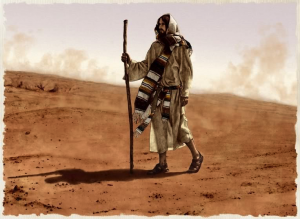
(Note: The image is a digital painting by an internet blogger calling himself Horseman. I could find no further information about it or him.)
====================

A request to my readers: I’m trying to build the readership of this blog and I’d very much appreciate your help in doing so. If you find something here that is of value, please share it with others. If you are on Facebook, “like” the posts on your page so others can see them. If you are following me on Twitter, please “retweet” the notices of these meditations. If you have a blog of your own, please include mine in your links (a favor I will gladly reciprocate). Many thanks!

====================

Father Funston is the rector of St. Paul’s Episcopal Church, Medina, Ohio.

Faith Leaders Call on Congress to reject Mr. Trump’s Cabinet of Bigotry

Faith Leaders Call on Congress to reject Mr. Trump’s Cabinet of Bigotry

Note: This is a Google Document which you can join in signing by clicking the above title.

Dear Members of Congress,

As a community of faith, we stand firmly and morally opposed to the dangerous and divisive voices that President-elect Trump is elevating into positions of great power. White supremacy has no place in the West Wing or any other rung of leadership.

We object not only to one individual, but to a clear pattern that Mr. Trump is building a cabinet founded on bigotry and a racial ideology that degrades religious minorities, immigrants and people of color.

Senator Jeff Sessions has a long history of bigoted comments towards people of color and civil rights organizations, including the NAACP and the Southern Christian Leadership Conference. In 1984 Sen. Sessions tried to prosecute three Alabama civil rights workers for their voter registration work. This politically motivated case not only failed, but also led to Congress rejecting him as unfit for judicial office. It is an outrage for Sessions to oversee the civil rights division of the Department of Justice.

Steve Bannon, formerly led the far-right website Breitbart News, which has ceaselessly promoted racist, sexist, anti-Semitic and homophobic rhetoric that degrades the human dignity of millions of Americans.

Kris Kobach, a member of Mr. Trump’s transition team, has a horrifying record on civil rights and has advanced policies that disenfranchise people of color and discriminate against immigrants, and has called for a registry that would single out Muslims and other religious minorities.

While we respect Michael Flynn’s military service, he has called Islam ‘a Cancer’ and used social media to stoke fears of Jews and Muslims. National security experts know that such divisive fear-fueled rhetoric only leads to senseless hate crimes here in America, and needlessly puts at risk our men and women in uniform.

As proud Americans committed to defending the Bill of Rights and freedom of religion, we oppose putting in powerful positions these individuals who have stoked truly dangerous bigotry.

All of our faith traditions teach us to love our neighbors as we love ourselves. After a painful and contentious election, the future of our nation rests in our ability to unite and work collaboratively for the common good of all people. But we cannot coalesce around these ambassadors of hatred, bigotry and intimidation.

We are a country founded on the principle that all people are created equal. As the future of our nation is shaped by its new president, we must cling strongly to those values that make our nation great — liberty, justice and freedom for all.

In the coming days, our prayer is that you call on President-elect Trump to reject these white supremacists and appoint advisers who understand that forging a more tolerant, united and inclusive America is the best way forward. We urge you not to remain silent at such a time as this for through your silence you suggest agreement.

Click here to sign this document.

God Reigns: Sermon for the Feast of Christ the King, 20 November 2016

====================

A homily offered by the Rev. Dr. C. Eric Funston on Christ the King Sunday, November 20, 2016, to the people of St. Paul’s Episcopal Church, Medina, Ohio, where Fr. Funston is rector.

(The lessons for the day are from the Revised Common Lectionary for Proper 29 in Year C: Jeremiah 23:1-6; Psalm 46 or Canticle 16 (Luke 1: 68-79); Colossians 1:11-20; and St. Luke 23:33-43 These lessons can be read at The Lectionary Page.)

====================

Christ the KingIt’s the last Sunday of the Christian year, sort of a New Year’s Eve for the church. We call it “the Feast of Christ the King” and we celebrate it by remembering his enthronement. As Pope Francis reminded the faithful in his Palm Sunday homily a few years ago, “It is precisely here that his kingship shines forth in godly fashion: his royal throne is the wood of the Cross!” (Francis)

My friend Malcolm Guite, a priest of the Church of England and a remarkable poet, has written a lovely sonnet for this feast:

Our King is calling from the hungry furrows
Whilst we are cruising through the aisles of plenty,
Our hoardings screen us from the man of sorrows,
Our soundtracks drown his murmur: ‘I am thirsty’.
He stands in line to sign in as a stranger
And seek a welcome from the world he made,
We see him only as a threat, a danger,
He asks for clothes, we strip-search him instead.
And if he should fall sick then we take care
That he does not infect our private health,
We lock him in the prisons of our fear
Lest he unlock the prison of our wealth.
But still on Sunday we shall stand and sing
The praises of our hidden Lord and King.

Each year on Christ the King Sunday we read some part of the crucifixion story. As we do so, I wish I could think in the terms of Malcolm’s beautiful poem, but I seldom do. This year, for example, we get the story of Jesus’ surprisingly calm conversation with the thief crucified next to him; these three men hanging in agony on crosses carry on a remarkably clear and lucid discussion. It’s probably my own sinful nature or my warped sense of humor or my attention deficit disorder or something, but I cannot read this gospel lesson with flashing to the crucifixion scene at the end of Monty Python’s “The Life of Brian” in which a chorus of two or three dozen crucified men, led by Eric Idle, address the lead character (who is also crucified) in song:

Cheer up, Brian. You know what they say.
Some things in life are bad.
They can really make you mad.
Other things just make you swear and curse.
When you’re chewing on life’s gristle,
Don’t grumble. Give a whistle.
And this’ll help things turn out for the best.
And…
Always look on the bright side of life.

If life seems jolly rotten,
There’s something you’ve forgotten,
And that’s to laugh and smile and dance and sing.
When you’re feeling in the dumps,
Don’t be silly chumps.
Just purse your lips and whistle. That’s the thing.
And…
Always look on the bright side of life.

A few stanzas later, the chorus sneaks in the line “Always look on the bright side of death.”

That scene, indeed the whole movie, is disrespectful, sacrilegious, and very funny . . . and in that particular scene it is theologically profound. Because that is precisely the meaning of Jesus’ words to the thief, “Today you will be with me in paradise.” That is precisely the meaning the Christian faith, that beyond the darkness of death, beyond the darkness of the tomb, there is a brighter side, there is paradise and resurrection. On the other side of human decisions that sometimes produce bad consequences or unacceptable results, whether intended or not, there is the reign of God.

Growing up, as most of us have, in a constitutional democracy without a monarch, our basic idea of kingship today is probably somewhere between Disney and Queen Elizabeth of England, somewhere between fairytale and figurehead. Today, we probably conceive of kingship as a life of luxury were everything goes well and people write books (or tabloid headlines) about you.

Well, Jesus, Christ the King, is not that sort of monarch (or ruler or president or whatever). Instead, he is something utterly different, a king who ushers in an entirely new order – a world characterized by new life, hope, grace, and above all love – the kind of love that never wearies pointing to and inviting beyond the darkness to the brighter side, to paradise and resurrection.

That seems to be a message a lot of people need to hear today; it’s the message that we as the church need to speak to our society loudly and clearly because many people are frightened by the outcome of our presidential election. And many other people are taking its result as permission to do some very unpleasant things.

On the day after the general election, a Presbyterian clergyman in Iowa, a married gay man, found a computer-printed note tucked under his car’s windshield wiper addressed to “Father Homo.” The text of the note began with the question “How does it feel to have Trump as your president?” and was both belittling and threatening. The same day a softball dugout in Island Park in Wellsville, New York, was defaced with graffiti reading “Make America White Again,” accompanied by a large swastika. The next day, students at nearby Canisius College, a Jesuit institution, found a black baby doll with a noose tied around its neck in the freshman dormitory elevator, and students at Wellesley College in Massachusetts witnessed two young white men drive a truck through their campus flying a Trump campaign banner, yelling “Make American Great Again,” and spitting on African-American young women.
Last Sunday, St. David’s Episcopal Church in Bean Blossom, Indiana, was vandalized by someone who painted a swastika, an anti-gay slur, and the words “Heil Trump,” on its walls, and in Silver Spring, Maryland, a sign for the Episcopal Church of Our Saviour’s Spanish-language service was marked with the words “Trump nation. Whites only.”

Disruptive responses are not limited to those on the so-called “alt-right” side of things, however. Thousands of people have taken to the streets in New York City, Los Angeles, San Francisco, Chicago, Portland, Atlanta, Miami, and even Akron, Ohio, brandishing signs reading “Not My President” and “Dump Trump.” And there have been reports of violence and destruction of property associated with some of these marches.

We, as the church of Christ the King, need to say to both sides, “Enough!” We need to remind everyone that, regardless of what side they may have been on in the election or what side they believe they are on now, on the other side of every human decision, every human decision, including elections, there is the bright side, the reign of God, paradise and resurrection. In 1930, Archbishop William Temple preached at the opening of the seventh Lambeth Conference, assuring his colleagues:

While we deliberate, God reigns;
When we decide wisely, God reigns;
When we decide foolishly, God reigns;
When we serve God in humble loyalty, God reigns;
When we serve God self-assertively, God reigns;
When we rebel and seek to withhold our service, God reigns –
the Alpha and the Omega, which is, and which was,
and which is to come, the Almighty.
We decide however we decide . . .
but Almighty God will always reign!

That is the meaning of this day and that must always be the message of the church: “Our God, the God who said, ‘Love your neighbor as yourself,’ reigns!” Amen.

====================

Father Funston is the rector of St. Paul’s Episcopal Church, Medina, Ohio.

An Unpreached Clergy Installation Sermon in the Time of Donald Trump

====================

A homily which will NOT be offered by the Rev. Dr. C. Eric Funston on Friday, November 18, 2016, to the people of a neighboring parish in Ohio, at the celebration of the new ministry of the Rev. George ___________ as rector. (I have not disclosed names or locations as they are, frankly, irrelevant to this soon-to-be-unpreached sermon.)

(The lessons on which this sermon is based are Joshua 1:7-9; Psalm 134; Ephesians 4:7,11-16; and St. John 15:9-16)

====================

Note: When first asked to preach at George’s celebration of new ministry, I penned this sermon. After a few days, I decided to go in a different direction and, using only a few bits and pieces of what I had written here, cobbled together with other material, I crafted another sermon which I will preach. Nonetheless, I believe this homily to have merit and, therefore, publish it here. (I will publish the actual sermon once it has been delivered.)

donald-trump-prune-faceOn the day after the general election, a Presbyterian clergyman in Iowa, a married gay man, found a computer-printed note tucked under his car’s windshield wiper addressed to “Father Homo.” The text of the note began with the question “How does it feel to have Trump as your president?” and was both belittling and threatening. The same day a softball dugout in Island Park in Wellsville, New York, was defaced with graffiti reading “Make America White Again,” accompanied by a large swastika. The next day, students at nearby Canisius College, a Jesuit institution, found a black baby doll with a noose tied around its neck in the freshman dormitory elevator, and students at Wellesley College in Massachusetts witnessed two young white men drive a truck through their campus flying a Trump campaign banner, yelling “Make American Great Again,” and spitting on African-American young women.

Last Sunday, St. David’s Episcopal Church in Bean Blossom, Indiana, was vandalized by someone who painted a swastika, an anti-gay slur, and the words “Heil Trump,” on its walls, and in Silver Spring, Maryland, a sign for the Episcopal Church of Our Saviour’s Spanish-language service was marked with the words “Trump nation. Whites only.”

Meanwhile, thousands of people have taken to the streets in New York City, Los Angeles, San Francisco, Chicago, Portland, Atlanta, Miami, and even Akron, Ohio, brandishing signs reading “Not My President” and “Dump Trump.”

“Now, wait,” you’re probably thinking, “none of that has happened here (where we are celebrating), nor in Medina (where my church is), so why are you bringing it up?”

Well, in the three verses which precede the opening sentence of our Epistle Lesson this evening, St. Paul wrote these words which will, I think, be very familiar to all of you:

There is one body and one Spirit, just as you were called to the one hope of your calling, one Lord, one faith, one baptism, one God and Father of all, who is above all and through all and in all. (Eph. 4:4-6)

The primary focus of the letter to the Ephesians is the church’s ministry of reconciliation and our call to unity. The letter stresses that members of the church are to make “every effort to maintain the unity of the Spirit in the bond of peace.” (4:3) We are all given gifts, as we heard in the portion read tonight, to equip the saints for ministry “until all of us come to the unity of the faith and of the knowledge of the Son of God, to maturity, to the measure of the full stature of Christ.” (4:13)

And we are to do that in the context of a nation in which threatening notes are left on minister’s cars, public recreation facilities are defaced with messages of racial hatred, students are made to feel unsafe on their college campuses, and churches are tagged with anti-gay or anti-immigrant graffiti, a nation where thousands protest because they cannot accept the outcome of a national election. We are called to be a community of unity (not of uniformity, but of unity), a community of reconciliation in a context of division and conflict.

It is within this wider context that the community of St. [Swithun’s], has called the Rev. George __________ to be its rector.

In those three verses, which form a sort of explanatory preamble to the first verse we heard read (verse 7), the word “one” is used seven times! It is the drum-beat of a hymn to the church’s unity which crescendos with the oneness of God, the “Father of all, who is above all and through all and in all.” In the first three chapters of the letter, Paul has identified God as the source of the church’s identity; here, he identifies the oneness of God as the source, foundation, and ultimate goal of the church’s unity and our ministry of reconciliation.

In the Greek, verse 7 (the first verse we heard from the letter) also begins with the word “one.” It’s not possible to translate that parallelism into English, but to fully appreciate Paul’s thrust we might add a couple of words to our translation. We might underscore Paul’s point by rendering it not simply as “each of us was given” but more emphatically as “each one of us was given” a gift of grace for this work. Paul is bringing his notion of oneness back to our individual experience – each one of us experiences God’s grace in the larger context of the church’s ministry and goal of unity and reconciliation.

In an opinion piece published Monday in the Bethlehem, Pennsylvania, Morning Call, the provisional bishop of Bethlehem and Bishop of Northwest Pennsylvania, the Rt. Rev. Sean Rowe, wrote:

[T]he news is full of public figures talking about reconciliation. *** [B]ut before we strike up a rousing chorus of “Kumbaya,” I hope we will pause to make sure we understand that real reconciliation requires deep self-examination, an ability to acknowledge both when one has been wronged and when one has done wrong, and the willingness to behave and communicate in new ways. (Rowe)

I believe that what Bishop Rowe is saying is an echo of God’s words to Joshua as he took over leadership of the Hebrews from Moses: “Be strong, be courageous, be careful; do not turn to the right or to the left.” (Josh 1:7) That’s hard work, but God’s message to Joshua is God’s message to us: “Be strong and courageous; do not be frightened or dismayed, for the Lord your God is with you wherever you go.” (1:9)

While no one, at least so far as I am aware, has tagged any churches in this community with anti-gay or anti-immigrant or pro-Trump graffiti, and while no one, at least so far as I am aware, has marched through the streets of this town in protest of the election’s results, I would be willing to bet that this community, and even this parish, has within it both those who voted for Trump and are rejoicing, and those who voted for Clinton and are in grief. This is the reality of human community and of the church; as I said a moment ago, we are a community of unity not of uniformity, called to be a community of reconciliation in a context of such division and conflict.

I don’t know and don’t really care how any of you voted; I don’t know and don’t really care how Father George voted. There have always been divisions and differences of opinion within the church; there have always been black and white and several shades of grey and many colors in between; there have always been yesses and there have always been noes; there have always been those who want to push forward and those who want to hold back. And regardless of where a rector may personally stand on any of those spectra, he or she is called into the midst of them to be pastor, guide, companion, and counselor to the whole of the community.

Because no matter what may be happening in the larger world, babies are still being born, children are still growing up, teens and young adults are still going through the changes and passages of life, young men and women are still getting married, older people are, too! And people are still getting sick and dying . . . and, George, they are counting on you to be their pastor, guide, companion, and counselor through it all. No matter where they or you stand on those many spectra of opinion, demographics, politics, or economics, they will invite you into some of the most intimate and sacred moments of their lives.

And it is in those intimate and sacred moments that the reality of reconciliation occurs. Connections, sacramental connections are made between people at different points on those various spectra of opinion; a web of relationship comes into being which fosters and upholds the work of reconciliation to which all are called.

So, George, “Be strong and courageous; do not be frightened or dismayed, for the Lord your God is with you wherever you go.” Or, as the apostle Paul wrote to the young bishop Timothy for whom this parish is named, “God [does] not give us a spirit of cowardice, but rather a spirit of power and of love and of self-discipline.” (2 Timothy 1:7)

But, good people of St. [Swithun’s], George does not do this alone! As St. Paul continues in his letter to the church in Ephesus, while some are given the charism of being pastors and teachers, to “each [and every one] of us [grace is given] according to the measure of Christ’s gift . . . to equip the saints for the work of ministry, for building up the body of Christ.”

“Who are the ministers of the Church?” asks our Catechism. “The ministers of the Church,” it answers, “are lay persons, bishops, priests, and deacons.” The ministry of the laity, it continues

is to represent Christ and his Church; to bear witness to him wherever they may be; and, according to the gifts given them, to carry on Christ’s work of reconciliation in the world; and to take their place in the life, worship, and governance of the Church. (BCP 1979, page 855)

“To carry on Christ’s work of reconciliation in the world . . .” and we are right back where we began: we are called to be a community of reconciliation in a context of division and conflict. In a world where so many are “tossed to and fro and blown about by every wind of doctrine, by people’s trickery, by their craftiness in deceitful scheming,” we, all of us, are call to “speak[] the truth in love.” (Eph. 4:14-15) George will do that; so must you.

George, as you may know, is named for the Patron Saint of England whose red cross emblazons our Episcopal Church flag and shield. What you may not know is that St. George is also the patron saint of Palestine. A few years ago, my wife and I were privileged to make a pilgrimage to the Holy Land and among the places we visited was the village of Burkin which sits on the boundary between Samaria and Galilee.

There, we visited the tiny Church of St. George, which commemorates the spot on which Jesus healed ten lepers. (Luke 17:12-19) It is the fourth oldest continuously in use worship space in the world! There has been a church on that spot since the early Fourth Century! It is under the jurisdiction of the Greek Orthodox Patriarchate of Jerusalem.

Our host was Usama, a member of the Greek Orthodox congregation. One could tell that he and the other members of St. George’s Church are very proud of their heritage. Their worship space is immaculate. The silver is polished; the cloth hangings and altar vestments are clean and bright; the icons are dusted. Pride of place is patent in every corner.

The worship space is tiny – our group of eighteen people more than half filled it. It is probably very crowded on Sundays for the Divine Liturgy and at other times of Orthodox worship. This congregation has a membership of 65 people. They are the only Christians in a town of over 7,000 population. Their witness is astounding!

Usama and his wife Nadija hosted us to lunch in their home. The tables were filled with tomato and cucumber salad, yoghurt, pita, and chicken and lamb shwarma served on heaping platters of seasoned rice. There was enough to feed a group five times our size.

Several of us had two or three helpings of the delicious food when Usama’s wife, Nadija, came around and piled one more serving on everyone’s plate: “Eat,” she said, “how do I know you liked it if you leave some behind?” It was all in good fun, and the graciousness and vibrancy of their hospitality was overwhelming.

We talked with them about the dwindling of their congregation, what it is like to be a Christian minority in an overwhelmingly Muslim community. Someone in our group asked if they had ever considered leaving Burkin. “No,” Nadija replied quickly, “If we left, who would be the church?”

It was a brilliant response, “Who would be the church?” Not ”Who would take care of the church?” Not “Who would polish the silver?” Not “Who would do whatever ….” but “Who would be the church?” Who would be the community of reconciliation in that context of division and conflict?

Usama and Nadija and their brothers and sisters in Burkin are called to be that community there; you and George are called to be that community here. So I want to be very clear what it means to be a community of reconciliation in a world of division and conflict. It does not mean to simply make nice and live in an uneasy peace with those with whom we disagree; it does not mean to accept what cannot be accepted; it does not mean to approve what cannot be approved.

Reconciliation does not take place in a vacuum, nor in a fog of niceness; reconciliation can only take place within a context of, and when it incorporates the elements of, repentance, forgiveness, restitution, justice, amendment of life, and the healing of relationships.

In the sacramental rite of reconciliation, “evidence of due contrition” must be shown and the Confessor may require that “something to be done as a sign of penitence and [an] act of thanksgiving.” (BCP 1979 page 446) In the invitation to the general confession in our older prayer books and in Rite One of the current Prayer Book, the presider calls on those

. . . who do truly and earnestly repent you of your sins, and are in love and charity with your neighbors, and intend to lead a new life, following the commandments of God, and walking from henceforth in his holy ways. (BCP 1979 page 330).

This is the prophet’s call to change. Standing in the web of reconciliation, addressing one another and those outside our community who stand at different points on the various spectra of politics, economics, and demography, our work of reconciliation is the work of a prophet.

For example, the Old Testament law commands, “The alien who resides with you shall be to you as the citizen among you; you shall love the alien as yourself, for you were aliens in the land of Egypt.” (Leviticus 19:34) As ministers of reconciliation we are obligated by our baptismal promises to treat resident aliens in this way, to call others to do so, and to resist those who would treat immigrants, refugees, or ethnic minorities in any other way.

The prophet Micah told us that what is required of us is “to do justice, and to love kindness, and to walk humbly with your God.” (Micah 6:8) As Christian ministers of reconciliation it is incumbent upon us to do so, to encourage others to do so, and to seek to change systems and practices that do not promote justice and loving kindness.

Jesus was once asked, “Which commandment in the law is the greatest?” And he replied “‘You shall love the Lord your God with all your heart, and with all your soul, and with all your mind.’ This is the greatest and first commandment. And a second is like it: ‘You shall love your neighbor as yourself.’” (Matthew 22:36-39) In fulfillment of these commandments, our ministry of reconciliation requires that we “strive for justice and peace among all people, and respect the dignity of every human being,” (BCP 1979, Page 305) call others to do so, and oppose those who would thwart those goals.

Jesus suggested that the Father blesses those who feed the hungry, give drink to the thirsty, welcome strangers, clothe the naked, take care of the sick, and visit those in prison, and turns away those who fail to do such things. (See Matt. 25:32-46) Our ministry of reconciliation demands that, like Jesus, we say to those who refuse to do these things “Depart from me, I do not know you,” until they change and do what they can for the least of his brothers and sisters.

When Jesus was arrested, one of his disciples drew a sword and cut off someone’s ear, but Jesus said, “Put your sword back into its place; for all who take the sword will perish by the sword.” (Matt. 26:52). Our ministry of reconciliation must include a prophetic echo of Isaiah and Micah calling on the manufacturers, purveyors, and wielders of weapons to “beat their swords into plowshares, and their spears into pruning hooks.” (Isaiah 2:4; Micah 4:3)

You, good people of St. [Swithun’s], have called George to join you in this prophetic ministry of reconciliation; with him you are called to be the church in this place at this time, a community of unity and reconciliation in the larger conflicted and divisive context of this age. To you, Jesus says, just as surely as he said to his first disciples, “You did not choose me but I chose you. …. Go and bear fruit that will last,” the fruit of the prophetic ministry of reconciliation.

It is common at the end of these sorts of homilies to give a specific charge to the clergy person whose new ministry is being celebrated so, George, I invite you to stand, and as friend to friend, presbyter to presbyter, long-winded preacher to long-winded preacher, I can offer no better advice than that given by St. Paul in his first letter to a new pastor, Timothy:

Pursue righteousness, godliness, faith, love, endurance, [and] gentleness. Fight the good fight of the faith; take hold of the eternal life . . . keep the commandment without spot or blame . . . [and] guard what has been entrusted to you. (1 Tim. 6:11-12,14,20)

Amen.

====================

Father Funston is the rector of St. Paul’s Episcopal Church, Medina, Ohio.

The photograph of President-elect Donald J. Trump is from the Library Grape website.

A Saintly Obligation: Sermon for All Saints Sunday – November 6, 2016 (RCL Year A)

====================

A homily offered by the Rev. Dr. C. Eric Funston on All Saints Sunday, November 6, 2016, to the people of St. Paul’s Episcopal Church, Medina, Ohio, where Fr. Funston is rector.

(The lessons for the day are from the Revised Common Lectionary for All Saints Day in Year C: Daniel 7:1-3,15-18; Psalm 149; Ephesians 1:11-23; and St. Luke 6:20-31. These lessons can be read at The Lectionary Page.)

====================

un-rockwell-mos-largeTuesday was the Feast of All Saints (which we are commemorating today, as is permitted by tradition, by translating the feast to the following Sunday). Traditionally, All Saints Day (or All Saints Sunday) commemorates the departed members of the Christian church who are believed to have attained heaven (it is not limited to those officially canonized by a church hierarchy).

It recognizes the reality that:

Our ancestors are sacred and their resting place is hallowed ground. *** Our religion is the traditions of our ancestors – the dreams of our old men, given them in solemn hours of the night . . . and the visions of our [sages], and is written in the hearts of our people. (Chief Seattle, Native American)

It looks to and gives thanks for the example of those who knew that “it is easy enough to be friendly to one’s friends but to befriend one who regards himself as your enemy is the quintessence of true religion.” (M.K. Gandhi, Hindu) And it is underscored by the Christian community’s certainty “that in the religion of Love there are no believers and unbelievers. Love embraces all.” (Rumi, Sufi Muslim)

It is a Christian holy day, but I have just described it in three quotes from notable sages none of whom were Christians. The description of our ancestors as sacred and of religion as written on the hearts of the people is from Chief Seattle, the 19th Century leader of Suquamish and Duwamish nations of the northwest, a man who followed the religion of his ancestors. The observation about befriending one’s enemies is from Mohandas K. “Mahatma” Gandhi, a Hindu from India. And the statement about the religion of love is from Jal?l ad-D?n Muhammad R?m?, a 13th Century Muslim Sufi mystic and poet.

I quote from these three men because I’ve come to believe that in our commemoration of all the saints, we should include those who are recognized as “holy” or “saintly” in other religious traditions, as well. There is, I believe, nothing in what these saintly men said that could be disagreed with by anyone of any differing religious or philosophical background. Nonetheless, I am sure that there are some (perhaps many) who would reject their words entirely, with little or no thought, as a sort of knee-jerk reaction simply because they were not Christian, despite the wisdom, morality, and generosity of spirit which they displayed.

Such is the world and the nation in which we celebrate All Saints Day this year, two days before the voters of the United States will select a new chief executive for our country. We are a society divided, polarized, and given to knee-jerk reactions. It is in this context that our Lectionary today asks us to read and consider a portion of the Book of Daniel, the only piece of apocalyptic literature in the Hebrew Scriptures, a book which focuses the reader’s attention on “the relationship between earthly and heavenly rule, emphasizing that the sovereign authority of earthly [rulers] depends upon the will of God.” (Portier-Young)

In the vision shown to Daniel, God gave sovereignty to “one like a Son of Man,” one like a human being in response to the suffering of God’s people under the domination of the Persian, Median, Macedonian, Seleucid, and Ptolemaic empires. Professor Anathea Portier-Young of Duke Divinity School argues that in so doing, God sought to free the oppressed from political domination, state terror, and persecution, to empower them to exercise authority and participate willingly in the political systems in which they live, and to inaugurate just rule on earth as in heaven. (Ibid.)

The culmination of Daniel’s vision is the handing of the earthly over to “the holy ones of the Most High.” Historically, these “holy ones” may have been understood as divine beings, but from the perspective of the Christian Gospel, the “holy ones of God” are those good people who were deeply engagement in the power struggles of their day and time, those divided, polarized, and knee-jerk reactive struggles that threatened to change to course of history. (Davidson) The “holy ones of the Most High” are those who, in the midst of a highly troubled and dangerous world, know that God is present and that God is more powerful than all the unjust empires and political systems human beings can devise. The saints, of whatever religious tradition, know that God loves and nourishes us, and gives us hope and meaning, life and salvation, gives us “the kingdom [to] possess . . . for ever – for ever and ever.” (Gaiser)

In our context, we have been given not a kingdom, but a participative democracy in which we have the same obligation as the saints of old to be deeply engaged in the struggle for justice to which Jesus calls us in today’s reading from the Gospel according to Luke, the blessings and woes from the Sermon on the Plain. We are to remember the poor and the hungry, those who weep, and those who are hated, reviled, and excluded. We are to love our enemies, do good to those who hate us, bless those who curse us, and pray for those who abuse us. We are to follow what has come to be called “the Golden Rule:” “Do to others as you would have them do to you.” These are not merely good ideas to be followed sometimes; they are moral imperatives which are to inform every activity of our lives, including our participation – wisely, morally, and with generosity of spirit – in the democracy we have been given.

As I wrote in our parish newsletter this month, I believe that voting is more than a privilege, more than a right; it is, I believe, an ethical, moral obligation. It is, for me as a Christian, an exercise in stewardship. We have been given this country and its governance by our forebears – and even, if Daniel’s vision is true (and I believe it is), by God – and we have the obligation to participate in its democratic processes, preserve it, and pass it on to our children, grandchildren, and more distant descendants.

We have heard too much cynicism in this election season. We have been told again and again how the candidates nominated by our two major parties are both deeply disliked and deeply distrusted by the electorate. On November 1, All Saints Day itself, the United Kingdom’s Independent newspaper reported that 60 per cent of likely voters view Mrs. Clinton negatively and a similar percentage dislike Mr. Trump. In a pastoral letter to his flock last weekend, the Most Rev. Paul S. Coakley, Roman Catholic Archbishop of Oklahoma, wrote, “Our major party candidates are both deeply flawed.” (Patheos)

Well, I have some news for the Archbishop: that is just the way people, all people, are. He might just as well have written, “Our major party candidates are both human beings.” When the Roman Catholic Church began the process to canonize Pope John Paul II as a Capital-S Saint, the popular Jesuit author James Martin wrote an article responding to those who objected because they felt the late pope was insufficiently perfect to warrant it. Martin wrote of the saints:

[E]ven after their decisions to amend their lives, the saints remained stubbornly imperfect. In other words: human. And the history of sinful saints begins right at the start of Christianity. St. Peter, traditionally described as the “first pope,” denied knowing Jesus three times before the Crucifixion.

After cataloguing the indiscretions of several well-known saints, Martin commented:

All these men and women were holy, striving to devote their lives to God. They were also human. And they knew it, too. Of all people, the saints were the most cognizant of their flawed humanity, which served as a reminder of their reliance on God. (Slate)

Yes, our candidates are deeply flawed human beings. But to slightly misquote Jesus, “Let the one who is without sin cast the first ballot.” (See John 8:7)

I believe Archbishop Coakley was correct in writing that “what we most need is a renewed commitment to the pursuit of virtue, to seek the good and adhere to the truth as inscribed in our hearts by our Creator” and that “[v]oting is a moral act. It ought to be guided by prayer and an evaluation not only of the political, but also the moral implications of our decisions.” (Patheos)

In today’s reading from Paul’s letter to the church in Ephesus, the Apostle writes of the church and the Christian faith being “an inheritance” for which the saints are to praise God. As I have said, I believe this nation and our participative democracy are likewise an inheritance. As Paul prayed for the Ephesians, so I pray for all of us, especially this week, that God may give us a spirit of wisdom and revelation, that the eyes of our hearts may be enlightened, and that we may know what is the hope to which God has called us. None of us, not our candidates, not our neighbors, not our fellow voters, and especially not ourselves . . . none of us is perfect; we are all deeply flawed human beings. But we are also saints like the saints of old whom we commemorate today and like them we have been given the kingdom, on earth as in heaven, to possess and to participate in for ever – for ever and ever.

It is a saintly obligation. May we exercise it wisely, morally, and will generosity of spirit.

Let us pray:

Almighty God, to whom we must account for all our powers and privileges: Guide the people of the United States in the election of officials and representatives; that, by faithful administration and wise laws, the rights of all may be protected and our nation be enabled to fulfill your purposes; through Jesus Christ our Lord. Amen. (BCP Page 822)

====================

Father Funston is the rector of St. Paul’s Episcopal Church, Medina, Ohio.

Tithing and Voting: A Rector’s Reflection (for the November 2016 parish newsletter)

====================

A “Rector’s Reflection” offered by the Rev. Dr. C. Eric Funston in the November 2016 issue of The Epistle, the newsletter of St. Paul’s Episcopal Church, Medina, Ohio, where Fr. Funston is rector.

====================

livinggenerously2Living Generously!

I wrote in a recent weekly parish up-date email about disciplined generosity and liberation, and made reference to prayer that has been in Episcopal and Anglican Prayer Books for generations:

O God, who art the author of peace and lover of concord, in knowledge of whom standeth our eternal life, whose service is perfect freedom: Defend us, thy humble servants, in all assaults of our enemies; that we, surely trusting in thy defense, may not fear the power of any adversaries; through the might of Jesus Christ our Lord. Amen.

Tithing is a way of living a disciplined and generous life without fear of any adversary and trusting in God. It is a way of claiming that perfect freedom which God offers us.

Tithe, a five-letter word, is as close as you can get in the Christian church to a four-letter word – mention it and Christians rise up in protest! However, it is Episcopalian. At the 1982 General Convention and at conventions ever since, the following resolution was passed: “The tithe is the minimum standard of giving by Episcopalians for God’s work.” Tithing is a way to live a life of disciplined generosity.

Each Sunday, we pass the alms basins and give our offerings. The question we all need to answer for ourselves and our families is: “How much should we give out of all that has been given us for God’s work?” As that General Convention resolution says, our church uses the standard of “the biblical tithe” as the minimum guide for our giving. I pray that that standard is now our standard, or that we are moving toward that tithe. When our ushers pass the collection plates among us each Sunday and we place our offerings to God in them, I hope you will consider the tithe to be your minimum standard for financial support of God’s work, because we do believe that we are doing God’s work here at St. Paul’s Parish.

The vestry and officers, as well as the pastoral staff, ask you to live generously, with disciplined generosity, to support this congregation so that all of us – leadership, clergy, staff, and members – may continue in the tasks and ministries we are given. We thank you for choosing St. Paul’s Parish as your primary way of returning to God a portion of what has been given to you.

As important as the work we do through the church is, another and better reason to live generously, giving a tithe or working toward it, is that it is liberating. A former suffragan bishop of the Diocese of Maryland, the Rt. Rev. Charles L. Longest, described the benefits of disciplined generosity this way:

God is the source of all things. God calls us to be accountable, as any steward is accountable, for all the things that God has given us. We are accountable for 100 percent of all that we have in our possession. That means all of our time, our talents or gifts, and our money. Tithing helps us to manage better that 100 percent. To be able to tithe absolutely requires that we learn to manage well all that we have and all that we are. Every one of us can learn about money, about ourselves, about God as we grow in our ability to be good stewards of all that God has given us.

Financial guru Dave Ramsey, whose Financial Peace University has been offered here several times, says of tithing and disciplined giving:

Giving liberates the soul of the giver. You never walk away feeling badly. Whether through a tithe, charitable contribution, or gift to a friend in need, give away at least some of your money. Not only does it generate good, but it generates contentment. *** Tithing was created for our benefit. It is to teach us how to keep God first in our lives and how to be unselfish people.

And, Ramsey says, unselfish people are better, freer people!

Live generously and live into liberation! As that ancient prayer in our Prayer Book says, God is the author of peace and lover of concord in whose service we find perfect freedom. Tithing is a way of claiming that God-given liberation

ballot-boxThe Up-Coming Election

Early this month will be Election Day, November 8. All elections are important, but a presidential election seems especially so. I believe that voting is more than a privilege, more than a right. There is, I believe, an ethical, moral obligation to vote. It is, for me as a Christian, an exercise in stewardship. We have been given this country and it governance by our forebears and we have the obligation to participate in its democratic processes, preserve it, and pass it on to our children, grandchildren, and more distant descendants.

As your pastor, it is not my place to champion a particular candidate or party. It is my place to share with you how I understand our shared faith to impact my vote, how I try to apply the Christian faith to my electoral responsibility.

Recently, for another purpose, I wrote an essay entitled My Religion Is My Politics in which I said that, because my faith impacts my political decisions, I cannot “keep religion out of politics” as some of my secular friends argue. Here are some factors I consider in voting:

  1. The Old Testament law commands, “The alien who resides with you shall be to you as the citizen among you; you shall love the alien as yourself, for you were aliens in the land of Egypt.” (Leviticus 19:34) I believe I am obligated by my baptismal promises to vote for candidates or parties most likely to treat resident aliens in this way.
  2. The prophet Micah told us that what is required of us is “to do justice, and to love kindness, and to walk humbly with your God.” (Micah 6:8) I think it irrelevant to our secular system whether any candidate “walks humbly with God,” but it matters to my politics as a Christian that I do so and cast my vote in a manner that reflects that. Thus, it matters to my politics which candidate’s or party’s platforms and policies come closest to doing justice and loving kindness.
  3. Jesus was once asked, “Which commandment in the law is the greatest?” And he replied “‘You shall love the Lord your God with all your heart, and with all your soul, and with all your mind.’ This is the greatest and first commandment. And a second is like it: ‘You shall love your neighbor as yourself.’” (Matthew 22:36-39) Thus, the way candidates or parties treat other people is significant. Again, I think it irrelevant to our secular system whether any candidate follows the first of these commandments, but it matters to my politics as a Christian whether he or she comes close to living up to the second.
  4. Jesus suggested that the Father blesses those who feed the hungry, give drink to the thirsty, welcome strangers, clothe the naked, take care of the sick, and visit those in prison, and turns away those who fail to do such things. (See Matt. 25:32-46) I vote for those candidates and parties whose platforms, proposed programs, and policies come closest to accomplishing those things.
  5. When Jesus was arrested, one of his disciples drew a sword and cut off someone’s ear, but Jesus said, “Put your sword back into its place; for all who take the sword will perish by the sword.” (Matt. 26:52). I believe I should vote for the candidate and the party less likely to make use of the modern day equivalent of a sword in our country’s statecraft and international diplomacy.

I do not vote for religion to have a place in American politics. I need not do so; like it or not, it already does because it informs the vote of many of the electorate, including me. I am voting in accordance with my understanding of the Christian faith, because my religion has a place in my politics. My religion is my politics.

I encourage you to wrestle with these and the many other issues that our elections present us. I encourage you to vote according to your conscience as it is informed by your understanding of our shared faith in Jesus Christ.

Mostly, I encourage you to vote. It is a right; it is a privilege, and, I believe, it is a sacred duty.

====================

A request to my readers: I’m trying to build the readership of this blog and I’d very much appreciate your help in doing so. If you find something here that is of value, please share it with others. If you are on Facebook, “like” the posts on your page so others can see them. If you are following me on Twitter, please “retweet” the notices of these meditations. If you have a blog of your own, please include mine in your links (a favor I will gladly reciprocate). Many thanks!

====================

Father Funston is the rector of St. Paul’s Episcopal Church, Medina, Ohio.

Two Hours in October: A Poem (18 October 2016)

steaming-cup-of-joe

Two Hours in October

Between cancer treatment and Irish class,
a soul deepened by the darkness of childhood
ponders the technologies of repression,
leaves, windblown, aimlessly circle the patio,
an English horn chuckles
amused by the scent of coffee
carried on an air conditioned breeze,
and women study ephemeral images
that have settled into their laps.
How can one study theology
in such a place?
It is better suited
to maniacal laughter and
paranoid delusions of rigged elections.

= C. Eric Funston
18 October 2016

A Sad and Irrational Irony: A Poem – 7 October 2016

trumptshirt

NOTE: I do not support Mr. Trump!

A Sad and Irrational Irony

Inaction fostered by division
grinds the nation down.
A sad and irrational irony
grips the nation
angered by inaction.
Anger fosters division
Division fosters inaction
Inaction fosters anger
“I’m not angry!”
shouts the parking lot youth
spittle spraying from his lips
“I’m not angry!”
“I’m not!”
“I’m . . . .”
A sad and irrational irony
grips the nation
ground down
ground
background
In the background
the theologian says
God is the ground of being
infinitely transcending
that of which
God is the ground.
A nation
angered by
division
inaction
ground down
to the ground
an irrational irony
no longer sad

= C. Eric Funston
7 October 2016

Inspired by a story told on Facebook by Connie Schultz.

NOTE: I repeat, I do not support Mr. Trump!

My Religion Is My Politics (13 September 2016)

religion-politicsMy Religion Is My Politics

I posted a Facebook status a little earlier (on September 12, 2016) that basically said I’m not going to play with Trumpeters, Gary Johnson’s Libertarians, or so-called progressives who say they’re voting for Jill Stein of the Green Party. I’m not going to engage in debate with them about Mrs. Clinton’s honesty, nor discuss their chosen candidates, at all. Not Trump, not Johnson, not Stein. If they post too much on my wall about such things, I will unfriend or block them, end of discussion.

I was taken to task by a friend. (We are friends only in that Facebook sense that we have agreed to allow each other to read and comment our posts, tag us, post things to each other’s Timeline, etc. We actually don’t know one another in the “real” world.) My friend said I was “cutting off dialogue.” I agreed, but suggested that the time for dialogue is past; we’ve done that. We are not going to convince one another, or anyone else, to change our minds and make another political decision in this election.

I also suggested that there are those who claim to have not yet decided; that simply cannot be. Such people are either being obstreporous and stubborn with no goal other than to kick up a fuss and call attention to themselves, or they are being irresponsibly disinterested, hiding their heads in the sand, so to speak, and pretending the world of politics has no importance for or impact upon them.

I am reminded of college friends back in the rebellious 60s and the stoned 70s who said they were simply going to refuse to decide about some issues, who claimed that they would not be responsible for the outcome of whatever the issue was because they weren’t participating in the decision-making process. I often argued back then, and still believe, that not deciding is simply not possible, to “not decide” is, in fact, to choose whatever the default outcome will be, to accept someone else’s decision as your own.

My friend who took me to task is (I believe) a college instructor and so should be familiar with the concept of a forced-choice test. Usually in such a test there are only two alternatives, yes or no, A or B, on or off, hot or cold, and so forth. Test respondents may not like either of the options offered and, in fact, the options may distort the outcome. A well known example is, “Have you stopped beating your wife? Yes or no?” This kind of closed-end question sometimes puts the respondent in the difficult position of having to choose one response from two unacceptable alternatives. That is often what life is like and very often (if not always) what elections are like.

I think we are obligated to make the hard choice even when both alternatives are unacceptable; one is always less objectionable than the other. Vote for that one. Any other action is an abdication of responsibility. My particular brand of Christianity asserts that every member of the church is to represent Christ and his Church by bearing witness to him wherever they may be, according to the gifts given them; failing to vote would not, in my opinion, be doing a very good job of representing Christ. Likewise, although other choices are allegedly being given us, casting a vote that would have no real effect, or worse might paradoxically lead to the least desirable outcome, would also be a failure of this obligation.

One might, I suppose, argue that some third-party candidate more closely represented one’s Christian beliefs (I don’t know of one that does, but you might make that argument). I ask in all sincerity: if your vote for that third-party candidate means that the better choice of the two majority party candidates doesn’t get your vote and the worse choice wins by one vote, have you in fact voted for best achievable Christian outcome? We live with a binary, force-choice political system. There are no real third choice alternatives, only illusory ones.

Over the years, people have tried to game our two-party, forced-choice presidential election system and present alternatives to the two dominant party choices, i.e., third-party candidates. For at least 170 years no third-party candidate has had the slightest chance of being elected, but it is possible that in some instances third-party candidates have caused one or the other of the major party candidates to win when that person might not otherwise have done so. Most political scientists agree that in the 1912 election Woodrow Wilson would not have been elected if Theodore Roosevelt had not run on a third-party ticket and drawn votes away from William Howard Taft. Many believe (although the evidence is mixed) that Ralph Nader drew votes from Al Gore giving the presidency to George W. Bush in 2000.

This year we have not one but two third-party candidates. (Does that make one of them a fourth-party candidate?) Possibly drawing votes from the Republican candidate is a Libertarian; possibly drawing votes from the Democrat is a Green Party nominee. Neither of them have a whisper of a chance of being elected, especially not the Green Party candidate who has never polled a sufficient percentage of respondents to have a chance at a seat at the presidential debates; the Libertarian, however, seems to be drawing enough support that he might get to take part in the debates but even he is doubtful.

The presence of these two additional candidates seems to transform the forced choice election into a multiple choice election, but our system is not set up to handle multiple choice elections! It would be nice if we could handle a multiple candidate election, as with (for example) an instant-runoff style of balloting, but we don’t currently have such a set-up and, short of a revolution or a new constitutional convention, we are unlikely to get one.

So even with the “participation” of third-party candidates, the electorate really has only three choices: cast a meaningful ballot for a Republican, cast a meaningful ballot for a Democrat, or don’t participate. Casting a ballot for a third-party (or fourth-party) candidate is tantamount to not participating; such a voter knows going in that their candidate will not win – cannot win, that they are throwing their vote away and they might as well not vote because that is, in essence, what they are doing. Worse, if their candidate really does have the potential to be a “spoiler candidate,” they might be throwing the election to the least desirable of the two truly possible victors, the one they would least like to see elected.

Let’s boil it down in terms of the current election. Here are the multiple-choice answers we are given in this life test:

A. Donald Trump (R)
B. Hillary Clinton (D)
C. Gary Johnson (L)
D. Jill Stein (G)
E. None of the above (i.e., not voting)

Taking these from bottom to top, Choice E is the “I’m not going to choose” option, the one I argued about with my college friends. This person is a non-participatory drone; they don’t care about the leadership and direction of their society; they’ll just go along with whatever.

Choices C and D are the illusory choices; these voters look like they’re participating but they and we know damned good and well that they are not. Their votes aren’t going to matter. They are “grandstanding,” making a show. They are like children looking at a dinner menu and not liking the available choices and so demanding something that the kitchen isn’t preparing.

It occurred to me that the ballot in this election might be compared to those reply cards for a banquet event where you can choose your entrée. There’s a choice of a chicken entrée or a steak; people who make these choices also get the full range of side dishes and the opportunity to participate in the dancing and entertainment that will be offered. There’s also a vegetarian option and a fish dinner, but neither of these includes the side dishes or the dessert, and those who take them are also unable to join in the dancing. That is what’s going to happen. These voters will vote for Johnson or Stein, but that’s it. There’s nothing else for them. There are no Green or Libertarian state governors; there are no Green or Libertarian members of the Senate or the House. Neither of the likely successful candidates is going to appoint a Green or a Libertarian to the cabinet or to the bench at any level of the Federal judiciary. There’s no dessert and no dancing that comes with those options!

So, in reality, Choice C or D are just about functionally equivalent to Choice E. They’re sitting at the table in the banquet hall, but they aren’t really taking part. There’s simply no point in differentiating them because the outcome is the same.

That leaves A or B. Republican or Democrat. Trump or Clinton. Pick one.

If like me, you’re a Christian, what criteria are you going to use? I’ve got a few suggestions:

(a) The Old Testament law commands, “The alien who resides with you shall be to you as the citizen among you; you shall love the alien as yourself, for you were aliens in the land of Egypt.” (Leviticus 19:34) Which candidate is most likely to treat resident aliens in this way?

(b) The prophet Micah told us that what is required of us is “to do justice, and to love kindness, and to walk humbly with your God.” (Micah 6:8) I think it irrelevant to our secular system whether any candidate “walks humbly with God,” but it matters to my politics as a Christian that I do so and cast my vote in a manner that reflects that. Thus, it matters to my politics which candidate’s behavior and policies come closest to doing justice and loving kindness.

(c) Jesus was once asked, “Which commandment in the law is the greatest?” And he replied “‘You shall love the Lord your God with all your heart, and with all your soul, and with all your mind.’ This is the greatest and first commandment. And a second is like it: ‘You shall love your neighbor as yourself.'” (Matthew 22:36-39) Which candidates treatment of other people throughout life has been more in tune with that second commandment? Again, I think it irrelevant to our secular system whether any candidate follows the first, but it matters to my politics as a Christian whether he or she comes close to living up to the second.

(d) Jesus suggested that the Father blesses those who feed the hungry, give drink to the thirsty, welcome strangers, clothe the naked, take care of the sick, and visit those in prison, and turns away those who fail to do such things. (See Matt. 25:32-46) Which candidate’s and which party’s proposed programs and policies come closest to accomplishing those things?

(e) When Jesus was arrested, one of his disciples drew a sword and cut off someone’s ear, but Jesus said, “Put your sword back into its place; for all who take the sword will perish by the sword.” (Matt. 26:52). Granted that neither candidate does very well on this question, but which one is less likely to make use of the modern day equivalent of a sword in his or her statecraft and international diplomacy?

I could go on, but I think my point is made. I am not voting for religion to have a place in American politics; like it or not, it already does because it informs the vote of many of the electorate, including me. I am voting in accordance with my religion, because my religion has a place in my politics. My religion is my politics. And in my politics, I cannot not vote; to do so would be to fail my religion. And I cannot throw my vote away on a third-party candidate with no chance of holding office because, again, that would be a failure of my religion. I believe I am called to take actions which have real consequences, not just make philosophical stands, especially if to do so could result in the least acceptable candidate getting elected, which is all that third-party candidate votes can accomplish; that is all they have ever accomplished.

It is for this reason that I have decided to no longer countenance, or participate in, arguments about this election on my Facebook page. I will continue to post to my Facebook page news articles about the candidates and to comment upon those reports, but I will not engage in debate. I will not engage with those who claim to be still undecided – in my opinion, we have all that we need on which to make a choice – nor will I engage with those who champion the third-party and fourth-party candidates; in my opinion, that would be a waste of time for all of us and would not be conducive to my loving them, my neighbors, as I am supposed to.

« Older posts Newer posts »