Occasional thoughts of an Anglican Episcopal priest

Category: Prayer (Page 30 of 47)

God Our Mother — Sermon for the 11th Sunday after Pentecost (Proper 13C) — August 4, 2013

====================

This sermon was preached on the Eleventh Sunday after Pentecost, August 4, 2013, at St. Paul’s Episcopal Church, Medina, Ohio, where Fr. Funston is rector.

(Revised Common Lectionary, Pentecost 11 (Proper 13, Year C): Hosea 11:1-11; Psalm 107:1-9, 43; Colossians 3:1-11; and Luke 12:13-21. These lessons can be read at The Lectionary Page.)

====================
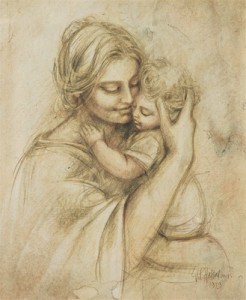
Drawing of Mother Holding Baby, Artist UnknownThis passage is one of my favorites in the book of the prophet Hosea. Hosea’s major metaphor for the relationship of God with Israel, as we learned last week, is that of marriage. Hosea portrayed God as Israel’s “husband” and condemned the nation because of the “adulterous” relationship it had had with other gods. As a “prophetic act” Hosea married a prostitute named Gomer, with whom his relationship parallels that of God with Israel. He tells of Gomer running away from him and having sex with another man, but he loves her and forgives her. Similarly, even though the people of Israel worshiped other gods, Hosea prophesied that Yahweh continues to love his people and does not abandon God’s covenant with them. This passage, however, departs from that metaphor and presents, instead, an image of God as Divine Parent, an image which is surprisingly feminine and maternal.

When Israel was a child, I loved him,
and out of Egypt I called my son.
* * *
It was I who taught Ephraim to walk,
I took them up in my arms;
but they did not know that I healed them.
I led them with cords of human kindness,
with bands of love.

In these verses God is portrayed as an adoptive parent. God’s lovingly brought Israel out of Egypt, cared for Israel, taught, comforted, healed, and nurtured Israel. The Divine Adoptive Parent nurtured this child, taught the child to walk, held this child in times of suffering and anguish, offered healing when he was injured. But just as Hosea’s earlier metaphor likened God to a cuckolded husband, God is now an abandoned parent.

Israel’s disobedient and defiant nature becomes clear as God offers a general indictment against Israel’s idolatry.

The more I called them,
the more they went from me;
they kept sacrificing to the Baals,
and offering incense to idols.

The Baals are competitor gods to Yahweh. They were local gods, represented by fertile fields, jars of olive oil, the smell of baking bread, the aroma of roasting meat. They appealed to the senses and to one’s immediate sense of satisfaction and well-being. In the Spring, the followers of the Baals would cry “Baal is alive” through the villages, and the worshipers of Yahweh would joined; they were hedging their bets hoping to ensure a bounteous crop and a satisfied family. The cult of Yahweh demanded worship in sometimes far-away sacred places. Sacrificial worship hadn’t yet been centralized at Jerusalem, but there were only a few places where it cold be offered. The Baals were more immediate so many Israelites would take out a little insurance and serenade Baal along with the neighbors. After all, where was YHWH anyway and what has he done for you recently?

These Baals of satisfaction and well-being are precisely the “gods” which got the attention of the rich man in the Gospel parable Jesus tells today.

The land of a rich man produced abundantly. And he thought to himself, ‘What should I do, for I have no place to store my crops?’ Then he said, ‘I will do this: I will pull down my barns and build larger ones, and there I will store all my grain and my goods. And I will say to my soul, ‘Soul, you have ample goods laid up for many years; relax, eat, drink, be merry.’ But God said to him, ‘You fool! This very night your life is being demanded of you. And the things you have prepared, whose will they be?’ So it is with those who store up treasures for themselves but are not rich toward God.

And so it was with the people of ancient Israel:

They shall return to the land of Egypt,
and Assyria shall be their king,
because they have refused to return to me.
The sword rages in their cities,
it consumes their oracle-priests,
and devours because of their schemes.
My people are bent on turning away from me.
To the Most High they call,
but he does not raise them up at all.

It was not the Baals who accomplished those things that many believed they had done; it was not they who were nurturing Israel; it was Yahweh! And like a spurned husband, like a rejected parent, Yahweh was angry! God, rejected and spurned, is furious and, frankly, vindictive. God will throw Israel out of the promised land. God will send them back to Egypt or turn them over to the invading Assyrians. God will allow war to consume the people and their lying priests. God is disgusted by their schemes. They think they have ample goods laid up for many years, so that they can relax, eat, drink, and be merry. God will show them what fools they are! God feels the indignation and rage that any parent might toward a disrespectful child.

Bu then, God rises above this anguish and anger; we are privileged to witness Yahweh’s churning emotional conflict commitment, the turmoil deep within God’s heart:

How can I give you up, Ephraim?
How can I hand you over, O Israel?
* * *
My heart recoils within me;
my compassion grows warm and tender.
I will not execute my fierce anger;
I will not again destroy Ephraim;
for I am God and no mortal,
the Holy One in your midst,
and I will not come in wrath.

At the heart of this passage are two Hebrew words, one of which is translated as “heart”; the other, as “compassion”. The first is leb and in Judaic understanding it refers not merely to the body’s physical heart, but to the innermost being of the human person. It refers to the center of personal life, to a human being’s psychic and spiritual energies upon which the whole moral and religious condition of a person completely depends. Here, it is God who has this sort of inner core of being, and the center of God’s Being is inextricably linked in Hosea’s prophecy with God’s compassion, not with Yahweh’s righteous anger and wrath . . . God’s essential Being is eternally and indelibly characterized by love and compassion.

Our English word compassion derives from the Latin for “suffering together”; compassion is the ability to share in the suffering of another, to be empathetic. There are two Hebrew words translated as “compassion;” Hosea uses them both. Although in this passage he uses is nichuwm, which has its root in the concept of regret or sorrow, elsewhere he describes God’s compassion using the synonym rechemet, which comes from the Hebrew root rechem which literally means “womb”. The Hebrew understanding of compassion is deeply maternal, rooted in a profound metaphor of birthing and motherhood; compassion in Hebrew thought might best be conceived not as “shared suffering”, but as “womb love”.

This word applied to God conjurs a beautiful image of God as our mother doing all the amazing and miraculous things a life-giving, nurturing mother does. She protects her child; she nourishes, cradles, and prepares her child. Whether she gives birth to the child or adopts the child, how can she give up or forget her child? “Can a woman forget her nursing child, or show no compassion for the child of her womb?” asks God in book of the prophet Isaiah, “Even these may forget, yet I will never forget you.” (Isaiah 49:15)

The 14th Century mystic and saint, Dame Julian of Norwich (1342-1416), wrote of God our Mother with these words:

It is a characteristic of God to overcome evil with good.

Jesus Christ therefore, who himself overcame evil with good, is our true Mother. We received our ‘Being’ from Him ­ and this is where His Maternity starts ­ And with it comes the gentle Protection and Guard of Love which will never ceases to surround us.

Just as God is our Father, so God is also our Mother.

And He showed me this truth in all things, but especially in those sweet words when He says: “It is I”.

As if to say, I am the power and the Goodness of the Father, I am the Wisdom of the Mother, I am the Light and the Grace which is blessed love, I am the Trinity, I am the Unity, I am the supreme Goodness of all kind of things, I am the One who makes you love, I am the One who makes you desire, I am the never-ending fulfillment of all true desires. (…)

Our highest Father, God Almighty, who is ‘Being’, has always known us and loved us: because of this knowledge, through his marvelous and deep charity and with the unanimous consent of the Blessed Trinity, He wanted the Second Person to become our Mother, our Brother, our Savior.

It is thus logical that God, being our Father, be also our Mother. Our Father desires, our Mother operates and our good Lord the Holy Ghost confirms; we are thus well advised to love our God through whom we have our being, to thank him reverently and to praise him for having created us and to pray fervently to our Mother, so as to obtain mercy and compassion, and to pray to our Lord, the Holy Ghost, to obtain help and grace. (From “Revelations of Divine Love”, LIX, LXXXVI).

We may, like the ancient Israelites or like the man in Christ’s gospel parable this morning, be tempted away from God by those things which seem to satisfy our immediate needs, by fertile fields, jars of olive oil, the smell of baking bread, the aroma of roasting meat; we may believe that we have ample goods laid up for many years, and so be tempted to relax, eat, drink, and be merry. But let us never forget the source of all those things. As the Psalm today recalls to us, it is God who puts our feet on a straight path; it is the Lord who does wonders for his children; it is God who satisfies the thirsty and fills the hungry with good things. Hosea reminds us that we are God’s children and that at the center of God’s Being is the womb-love of a mother for her child, for us.

Whoever is wise will ponder these things,
and consider well the mercies of the Lord.

Amen.

====================

A request to my readers: I’m trying to build the readership of this blog and I’d very much appreciate your help in doing so. If you find something here that is of value, please share it with others. If you are on Facebook, “like” the posts on your page so others can see them. If you are following me on Twitter, please “retweet” the notices of these meditations. If you have a blog of your own, please include mine in your links (a favor I will gladly reciprocate). Many thanks!

====================

Father Funston is the rector of St. Paul’s Episcopal Church, Medina, Ohio.

God’s Faithfulness Prevails — Sermon for the 10th Sunday after Pentecost (Proper 12C) — July 28, 2013

====================

This sermon was preached on the Tenth Sunday after Pentecost, July 28, 2013, at St. Paul’s Episcopal Church, Medina, Ohio, where Fr. Funston is rector.

(Revised Common Lectionary, Pentecost 10 (Proper 12, Year C): Hosea 1:2-10; Psalm 85; Colossians 2:6-19; and Luke 11:1-13. These lessons can be read at The Lectionary Page.)

====================

Baptism“Name this child.” That’s what I say to parents of infant baptismal candidates as I take their children from them. The words are not actually written in the baptismal service of The Book of Common Prayer as they are in some other traditions’ liturgies, but there is a rubric on page 307 that says, “Each candidate is presented by name to the Celebrant . . . .” so asking for the child’s name is a practical way of seeing that done. It’s practical, but it’s also a theological statement.
There is a common religious belief found in nearly all cultures that knowing the name of a thing or a person gives one power over that thing or person. One finds this belief among African and North American indigenous tribes, as well as in ancient Egyptian, Vedic, and Hindu traditions; it is also present in all three of the Abrahamic religions, Judaism, Christianity, and Islam.

The naming we do at baptism echoes the naming that takes place in Jesus’ tradition as a faithful Jew. In Judaism, when a male infant is circumcised on the eighth day after his birth, the mohel who performs the brit milah prays, “Our God and God of our fathers, preserve this child for his father and mother, and his name in Israel shall be called ________” and the prayer continues that, by his naming, the infant will be enrolled in the covenant of God with Israel. The same thing is done when a girl is named in the ceremony called zeved habat, or “presentation of the daughter” at the first formal reading of the Torah following her birth. In baptism, we do the same; the church says to its newest member, “This is who you are: washed in the waters of baptism, sealed by the Holy Spirit, and marked as Christ’s own forever,” a brother or sister in the church, a fellow member of the household of God.

To give a name to anything, especially to another human being, is a powerful thing! In the first verses of Genesis we are told, “God said ‘Let there be Light’ and there was light.” (Gen. 1:3) God named the light before it was created; this process continues through the rest of the story. God says, “Let there be” and names the thing which will come into existence; the naming seems a necessary first step in creation. There is a sense in which the name given shapes the future of the thing, or of the person, named.

So this morning I will ask that question of Danny and Nikki ___________ (parents) and of Peter ___________ (Godfather) who will name Ryan George __________ (infant) as a child of God, and of Mary __________ (sponsor) who will name Jacqueline Ann ____________ (adult) as a child of God, and through baptism we all will welcome Ryan and Jackie into the household of faith, into a covenant relationship with Almighty God and with each of us.

In today’s lesson from the Prophet Hosea, we find God instructing the prophet to give strange and bewildering names to his children as powerful, prophetic signs of Israel’s broken relationship with God. Hosea’s firstborn son is to be named Jezreel, which refers to the location of a particularly brutal and bloody massacre of Israelite royalty; his daughter is to be called, Lo-ruhamah, which means “no pity,” as a sign that God will have no compassion for his people who have gone astray; and a second son is to be named, Lo-ammi, which means “no people,” to let the Israelites know they are no longer God’s people.

Preachers often use their children as sermon illustrations, but what God demands of Hosea seems a little extreme. These poor kids aren’t going to have to live merely with the embarrassment of a single sermon, they are going to live with these names, these prophetic, judgmental names for their entire lives! But as bad as that is, giving these awful names to his children is not the hardest thing God demands of Hosea. No, the hardest thing is marrying their mother, Gomer.

Hosea is ordered by God to (in the words of our NRSV translation) “take for yourself a wife of whoredom and have children of whoredom.” He is to marry a prostitute who will continue in her scandalous and adulterous behavior, even though Hosea will be faithful to her throughout the marriage. Why? Because it is a prophetic sign, a prophetic action symbolizing the way in which Israel has dealt with God: because “the land commits great whoredom by forsaking the Lord.” God loves Israel with all the passion and loyalty of a faithful husband, but Israel, like a promiscuous wife, has been unfaithful to God.

It is an unfortunate prophetic metaphor, for it is misogynistic to the core! Portraying God as a faithful (but dominant) husband and Israel as a supposed-to-be obedient (and submissive) wife perpetuates a patriarchalism that is inappropriate to our society. As a metaphor it may have communicated clearly to its ancient Israelite audience, but it doesn’t communicate quite so clearly to us, clouded as it is with its ancient cultural bias. So as we read and seek to understand Hosea’s message in our day and age, we must extract the meaning from the metaphor and then, perhaps, cast the metaphor aside, separating the kernel of truth from the chaff of historical baggage.

In the modern world, marriage is not the patriarchal, male-dominated institution it was in Hosea’s time, but the metaphor can still work for us. In our Prayer Book, the meaning of marriage is summarized in the introductory comments with which the presiding minister begins the ceremony. We are told that it is a bond and covenant established by God in creation and that the union of the parties “in heart, body, and mind is intended by God for their mutual joy [and] for the help and comfort given one another in prosperity and adversity.” (BCP 1979, page 423)

Later in the service, just before the Nuptial Blessing is given, we pray for the couple that “each may be to the other a strength in need, a counselor in perplexity, a comfort in sorrow, and a companion in joy,” and that “their life together [may be] a sign of Christ’s love to this sinful and broken world, that unity may overcome estrangement, forgiveness heal guilt, and joy conquer despair.” (Page 429) In such a relationship neither party dominates the other, neither is submissive; it is a mutual and interdependent bond of covenant obligations, one to the other.

When Hosea’s prophetic metaphor is understood in these terms, it emphasizes that God is angry with God’s people for abandoning the covenant obligations they had to God, even as God remained faithful. What Hosea’s marriage metaphor communicates to us, as it did to his ancient audience, is that it is divine fidelity, not human inconstancy, that will ultimately save the relationship. It is God’s faithfulness, not our own, which prevails and redeems our relationship with God.

This is also the message of the author of the Letter to the Colossians, an epistle traditionally said to have been written by St. Paul, but which is now no longer believed to be of his authorship. The reason for that is in the very part of the text on which I want to focus our attention, the sentence where the author writes: “When you were buried with [Christ] in baptism, you were also raised with him through faith in the power of God, who raised him from the dead.” The author seems to echo Paul’s understanding of baptism in the Letter to the Romans, particularly a section we read every year on Easter Sunday. Paul writes, “Do you not know that all of us who have been baptized into Christ Jesus were baptized into his death? . . . . If we have been united with him in a death like his, we will certainly be united with him in a resurrection like his.” (6:3,5) The theology is similar, but note the significant shift: in Romans, Paul writes that we will be raised with Christ, whereas the author of Colossians asserts that our resurrection with Christ has already happened by reason of baptism. These two passages reflect the wonderful here-but-not-quite-here mysterious paradox of Christianity; we both celebrate the present reality of and anticipate the future consummation of our salvation in Christ. The victory has already been won, but not yet.

Now, what I really want to focus on is why our resurrection, our salvation, whether it is a present reality or something yet to occur, should happen at all! In Romans, Paul says that it happens “by the glory of the Father.” (v. 4) The author of Colossians asserts that it is “through faith in the power of God” according to our translation; that would seem to imply that our faith is somehow responsible for our salvation, that the means for our resurrection is our fidelity. But there is a growing body of scholarship which suggests that this is a misunderstanding of the original Greek of the text. The Greek is dia te pisteo te energeia tou theou . . . literally: “through the faith the working of God.” Traditional English translations add the preposition “in” into the interpretation which would imply that this powerful, operative faith is ours, but the Greek can also be understood to mean not “faith in” but rather “faith of” – in other words, it is God’s faith!

The 18th Century Lutheran translator Johann Albrecht Bengel suggested exactly this in his Annotations on the New Testament when he translated this text to say that our salvation, our resurrection comes about through faith which is a work of God. This text, he says, is “a remarkable expression: faith is of Divine operation.” (Gnomon of the New Testament, A. Fausset, tr., Clark:Edinburgh 1858, page 171, emphasis in original) Our resurrection with Christ is not brought about because of our faith; it is not because of us, or anything we do or believe! We are saved through the faithfulness of God who, by his glory and power, raised Christ from the dead.

It is also God’s faithfulness to which Jesus alludes in the parental metaphor which he uses in his instruction about prayer: “Is there anyone among you who, if your child asks for a fish, will give a snake instead of a fish? Or if the child asks for an egg, will give a scorpion? If you then, who are evil, know how to give good gifts to your children, how much more will the heavenly Father give the Holy Spirit to those who ask him!” God is the faithful parent who always responds when we ask, who is always there to be found when we search, who always opens the door when we knock. It is God’s faithfulness, not our own, which prevails and redeems our relationship with God.

On this we can rely; in this faithful God, we can have faith.

So let’s go back to Hosea’s marriage metaphor. The Lutheran Book of Worship, used by our brothers and sisters in the Evangelical Lutheran Church in America, with whom we enjoy a relationship of full communion, says this about marriage: “The Lord God in his goodness created us . . . and by the gift of marriage founded human community in a joy that begins now and is brought to perfection in the life to come. Because of sin, our age-old rebellion, the gladness of marriage can be overcast, and the gift of the family can become a burden. But because God, who established marriage, continues still to bless it with his abundant and ever-present support, we can be sustained in our weariness and have our joy restored.” (LBW 1978, page 203)

It is into the household of God, the community of joy restored, the covenant of mutual help and comfort sustained by the faithfulness of God, that we welcome Ryan George and Jacqueline Ann this morning. They (and we together with them) will make the statements of belief and the promises of action set out in the Baptismal Covenant (BCP 1979, pages 304-04), and they (and we) will try faithfully to keep them. Fortunately, however, it is God’s faithfulness, not theirs (nor ours), which will prevail and redeem them (and us), and their (and our) relationship with God.

Let us pray:

Almighty God, by our baptism into the death and resurrection of your Son Jesus Christ, you turn us from the old life of sin: Grant that we, being reborn to new life in him, may live in righteousness and holiness all our days; through Jesus Christ our Lord, who lives and reigns with you and the Holy Spirit, one God, now and for ever. Amen. (BCP 1979, page 254)

====================

A request to my readers: I’m trying to build the readership of this blog and I’d very much appreciate your help in doing so. If you find something here that is of value, please share it with others. If you are on Facebook, “like” the posts on your page so others can see them. If you are following me on Twitter, please “retweet” the notices of these meditations. If you have a blog of your own, please include mine in your links (a favor I will gladly reciprocate). Many thanks!

====================

Father Funston is the rector of St. Paul’s Episcopal Church, Medina, Ohio.

Passing On the Stories – From the Daily Office – July 22, 2013

From the Psalter:

We have heard with our ears, O God, our forefathers have told us,
the deeds you did in their days, in the days of old.

(From the Daily Office Lectionary – Psalm 44:1 (BCP Version) – July 22, 2013.)

Bible Title PageI am often complimented on my knowledge of biblical history, especially the lesser known stories of the Old Testament. Some members of my parish tell me how much they enjoy it when I make an exegetical digression in a sermon to explain the background of some bit of text. Yesterday, a retired clergy colleague extended the compliment to “your seminary professors,” who, he was sure, did a much better job of teaching the Scriptures than had his own mentors.
Responsibility for what I know of the Bible (and I consider my depth of knowledge shallow and inadequate) cannot be laid at the feet of my seminary professors. As many know, I read for Holy Orders rather than attend seminary and obtain the typical three year Master of Divinity degree. After being ordained a deacon, I went to a seminary for one academic year, during which I took only a New Testament survey course and a Greek language course which used the Epistle of James as its principal text. No . . . what little knowledge of Scripture I have is not a result of a seminary education.

There is one person who can claim the credit, my grandfather Charles Edgar Funston, Jr. My grandfather was a Methodist layman who spent nearly fifty years teaching Sunday School to all age groups in his local parish. During the summers of my childhood, which my four cousins and I spent living with our grandparents, he drilled his grandchildren in bible study. We heard with our ears what our grandfather told us, the deeds God did in the days of old.

One ritual, in particular, which committed bible verses to memory during those summer sojourns in our grandparents’ home was grace at the evening meal. Each morning before he went to work and we went to do whatever chore or mischief was on our agenda, C.E. (as my grandfather was called) would give us each a verse to contemplate and memorize during the day, and he would tell us something of its context. At supper, he would call upon one of us to offer a grace which was to incorporate the verse; we were not simply to parrot back the Scripture, but to use it or paraphrase it in a thanksgiving prayer of our own creation. We never knew whom he might call upon, so all of us had to be prepared. If you weren’t, there was no penalty . . . except Granddad’s disappointment, and no one wanted to risk that!

I suspect that that sort of familial instruction in the Holy Scriptures was rare enough at that time, and that it is practically nonexistent in today’s world. Few folks in my generation, or our children’s and grandchildren’s cohorts, will have received biblical education in the church, let alone at the feet of a grandparent. I find that most congregations to whom I preach are, as a result, largely biblically illiterate. Reciting Psalm 44 today for most people will not be a statement of their personal reality, merely an historical curiosity out of the Hebrew past. That’s a tragedy, I think.

I’ve long forgotten the exact words of many (indeed, nearly all) of those verses of the King James Bible memorized during those childhood summers, but a general knowledge of the stories of Scripture remains. More importantly, my grandfather provided me with a foundation on which to build the structure of faith, a knowledge of the past from which to move into the future. Sometimes I wonder, how is the faith community to move into the future? How is it to transmit the faith if children do not hear with their ears, from their forebears, the deeds of God did in days of old? How are children do develop the same sort of foundation if they do not learn those stories? And how can they hear those tales if their parents and grandparents themselves don’t know them?

The church’s task of Christian formation and Christian education gets more and more difficult with each passing year, each passing generation, as fewer and fewer people know the stories of faith. Those who do know them have an enormous responsibility to become storytellers and pass them on, so that recitation of this psalm becomes a reflection of reality, not merely an historical, liturgical curiosity.

====================

A request to my readers: I’m trying to build the readership of this blog and I’d very much appreciate your help in doing so. If you find something here that is of value, please share it with others. If you are on Facebook, “like” the posts on your page so others can see them. If you are following me on Twitter, please “retweet” the notices of these meditations. If you have a blog of your own, please include mine in your links (a favor I will gladly reciprocate). Many thanks!

====================

Father Funston is the rector of St. Paul’s Episcopal Church, Medina, Ohio.

Tribalism and an Illustration of Compromise – From the Daily Office – July 18, 2013

From the Gospel according to Mark:

The Pharisees went out and immediately conspired with the Herodians against [Jesus], how to destroy him.

(From the Daily Office Lectionary – Mark 2:6 (NRSV) – July 18, 2013.)

Three Elders ConspiringJesus had healed someone on the sabbath; that’s the simple back ground to the Pharisees and Herodians conspiracy against Jesus. This alliance is an interesting one since in generally the two groups hated one another! But their fear of Jesus apparently was enough to get them to work together against him.

It’s an odd alliance, particularly if looked at from the view point of the Pharisees. Their name is taken from the Hebrew word parash meaning “to separate;” they adhered to a strict piety and disciplined adherence to the Torah. They refused to associate with Gentiles or any “unclean” person or thing. They exhibited all of the characteristics of what, in our modern world politics, has come to be called “tribalism.”

Recently a friend and colleague bemoaned what she called “the tyranny of liberalism” noting that those on the political left were “wasting precious energy and time beating each other up.” I suggested to her that the problem is not with liberalism (nor, indeed, with conservatism). Rather the issue in modern society is the “tribalism” that seems to have taken over all of American social thought and civic behavior (including behavior in the church).

Tribes (like the Pharisees) group around and define membership on the basis of some type of purity – purity of thought, purity of belief, purity of blood, purity of precious bodily fluids, purity of whatever. Stray even a little bit from that purity and, like white blood cells, other members of the tribe will attack. A liberal voicing illiberal opinions, a conservative embracing a liberal point . . . they will be pilloried by their co-tribalists much faster than by the “opposition.”

This kind of tribal thinking has infected both political parties, many churches, the liberal and conservative political camps . . . name some segment of current American society and you can identify its tribal attributes. There are Pharisees of all stripes in our national community today. Both houses of our nation’s legislature have succumbed to a deeply seated “us versus them” mentality of political tribalism that goes beyond even traditional partisanship; nothing is getting done and so long as this persists nothing is likely to get done.

Not a single one of us is immune to tribalism; none of us avoids it entirely. However, we can do something about it. We can become aware of it. We can identify our own biases and question our own motivation. We can confess our own sinfulness in this regard and repent, turning away from it in favor of a more constructive way of working together.

In the second chapter of his catholic epistle, James addresses the issue of favoritism:

If a man comes into your assembly with a gold ring and dressed in fine clothes, and there also comes in a poor man in dirty clothes, and you pay special attention to the one who is wearing the fine clothes, and say, “You sit here in a good place,” and you say to the poor man, “You stand over there, or sit down by my footstool,” have you not made distinctions among yourselves, and become judges with evil motives? (James 2:2-4)

He then condemns this favoritism as sinful: “If you show partiality, you are committing sin and are convicted by the law as transgressors.” (v. 9) It is, he says, a violation of what Christ called the second great commandment: Love your neighbor as yourself. Partisan tribalism, I would suggest, is simply a political form of the favoritism scripture here condemns.

I remember reading once that Christians are called to pledge unwavering allegiance to the Lamb, not to the donkey or the elephant. We are bidden by scripture to pray for our governments and our leaders without regard to their politics or our own. If we will do that, while becoming aware of our own motives and biases, we can eschew tribalism and model a way of doing social business, of being community that will benefit all.

The alliance between the Herodians and the Pharisees, even though it was against Jesus, demonstrates that even those with the most tribal of instincts can compromise and work together. We should foster and encourage such behavior, even if this example might not the best illustration to use.

====================

A request to my readers: I’m trying to build the readership of this blog and I’d very much appreciate your help in doing so. If you find something here that is of value, please share it with others. If you are on Facebook, “like” the posts on your page so others can see them. If you are following me on Twitter, please “retweet” the notices of these meditations. If you have a blog of your own, please include mine in your links (a favor I will gladly reciprocate). Many thanks!

====================

Father Funston is the rector of St. Paul’s Episcopal Church, Medina, Ohio.

A Pew Poll, A Praying Mantis, And A Toad – From the Daily Office – July 16, 2013

From the Psalter:

As for me, I will live with integrity;
redeem me, O Lord, and have pity on me.
My foot stands on level ground;
in the full assembly I will bless the Lord.

(From the Daily Office Lectionary – Psalm 26:11-12 (BCP Version) – July 16, 2013.)

Praying MantisLast week, The Pew Forum on Religion and Public Life published the results of a survey testing the esteem in which Americans hold members of ten professions.
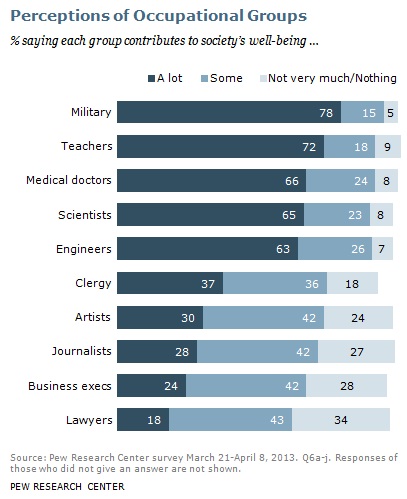
Respondents where asked say to what extent each group contributes to the well-being of American society: the possible responses ranged from “a lot” to “not at all.”

The professions were then ranked by the percentage of respondents who said they contributed “a lot” to our societal welfare. Topping the list were members of the military; at the bottom, lawyers. The graphic below shows the rankings of the ten professions (clipped from the Pew Forum article).

Pew Poll

A retired colleague reading the article commented that he had concluded in his personal career that clergy made a low impact on people’s lives and that that contributed to his decision to retire (or, as he put it, “give up”). “I’m told I’m a great preacher,” he said, “but my preaching didn’t seem to change people’s lives. Near as I could tell they were just indifferent.” I sympathize, in fact I often identify with my friend’s comments. There are days when being a clergy person is awful; there are times when one feels (and even worse times when one is told in no uncertain terms) that not only is one not contributing to society’s welfare, one is making it worse!

On the other hand, I rather enjoyed the fact that my current profession ranks above my former career as a lawyer!

Sunday after church I mowed the lawn. I didn’t want to mow the lawn, but I really had no choice. It has rained here quite a bit during the past three weeks and that rain had both encourage the grass to grow and prevented me from mowing the grass. So my one-third of an acre (on a steep hillside, by the way) was beginning to look like native grass pasture land rather than a suburban lawn. Normally, I can cut the grass in about an hour and, if I have to do it, I can get the “weed whacking” and edging done in another thirty minutes. On Sunday, because I had to mow twice (once with the mower deck at high setting followed by another pass at a lower level, both passes going relatively slowly), it took a bit longer. I started at 2:30 p.m. and finished at 6:19 p.m.

On my first pass through the back yard I noticed a bright, lime-green praying mantis struggling through the grass; the insect seemed to be injured, but I couldn’t tell. He (or she) was in the section I would mow on my next pass, so I kept an eye out and, sure enough, there it was in front of the mower when I pushed it back that direction. I stopped and let the mantis move out of the way, headed for the bushes at the edge of the lawn.

A couple of hours later, string trimmer in hand, I was whacking the tall growth around the stone-edged planters, the mail box, and the fire hydrant in the tree lawn, when I came across a small brown-green toad in among the plants I was about the decimate with .93 “fishing line.” I nudged the toad away with my toe (I was going to say I “toed away the toad” but that would be too cute, wouldn’t it?), moving it to safety before I continued trimming the grass.

Earlier in the day I had preached about a familiar parable. The gospel lesson appointed in the Revised Common Lectionary for the day was the story of the Good Samaritan, the story of a man on a journey, a man with a purpose of his own to accomplish, stopping to aid a fellow traveler in distress. Stopping to let an insect move out of danger or encouraging a toad to move out of harm’s way is not, I don’t think, equivalent, but the spirit is the same. And as I spent time in meditation trudging along behind the lawn mower, it occurred to me that all three actions provide a response to the Pew Research poll.

Clergy don’t, generally, make a big splash in the world, and the ones who do usually, it seems, do so to the detriment of our collective reputations! Sure, there are the exceptional clerics like Pope Francis, or Archbishop Desmond Tutu, or the Dalai Lama, but in general most clergy do small things in small congregations in small communities. We don’t make a difference in society at large; if we make any sort of contribution at all, it is in the lives of individual people – sitting at a hospital bedside, baptizing an infant, counseling two people about to get married, celebrating a teenager’s graduation from high school. The church as a whole is supposed to make a contribution to society; the clergy’s job is make a difference in the lives of the people who make up the church.

So, although I do understand my friend-and-colleague’s angst about indifference in society and that low 37% rating by the Pew Research folks, I’d encourage him and other clergy not to give it too much attention. Attend to the praying mantises and the toads, to the poor beggars in the roadside ditches, to the hospital patients and the babies and the newlyweds and the new graduates; do your best to make a difference in the lives of individuals. Do that and you’ll have lived with integrity and you’ll have something to tell about in the great congregation, something about which to bless the Lord in midst of full assembly. Then send the assembly out to contribute to the well-being of society: “Go in peace to love and serve the Lord!” It’s really their job!

====================

A request to my readers: I’m trying to build the readership of this blog and I’d very much appreciate your help in doing so. If you find something here that is of value, please share it with others. If you are on Facebook, “like” the posts on your page so others can see them. If you are following me on Twitter, please “retweet” the notices of these meditations. If you have a blog of your own, please include mine in your links (a favor I will gladly reciprocate). Many thanks!

====================

Father Funston is the rector of St. Paul’s Episcopal Church, Medina, Ohio.

Honor Upon the Lawgiver – From the Daily Office – July 4, 2013

From the Book of Sirach:

A wise magistrate educates his people,
and the rule of an intelligent person is well ordered.
As the people’s judge is, so are his officials;
as the ruler of the city is, so are all its inhabitants.
An undisciplined king ruins his people,
but a city becomes fit to live in through the understanding of its rulers.
The government of the earth is in the hand of the Lord,
and over it he will raise up the right leader for the time.
Human success is in the hand of the Lord,
and it is he who confers honor upon the lawgiver.

(From the Daily Office Lectionary – Sirach 10:1-5 (NRSV) – July 4, 2013.)

American FlagIndependence Day is one of the few secular holidays to have lessons of its own in both the Eucharistic and Daily Office Lectionaries of the Episcopal Church. There is a set of lessons in the regular Daily Office schedule of readings for today, as well, and I am intrigued that the way the calendar falls this year the Gospel for that set is the unjust trial of Jesus. One could meditate for hours on the meaning to be drawn from that juxtaposition.
However, the reading from the apocryphal book The Wisdom of Jesus, Son of Sirach (a book also called “Ecclesiasticus”) has caught my attention because of a recent (and unfortunately repeated) incident at my church. The lines of particular import are: “As the ruler of the city is, so are all its inhabitants;” and “It is [God] who confers honor upon the lawgiver.”

In every form of the Prayers of the People in the American Book of Common Prayer (1979) there is a petition included for our civil leaders. According to the rubric in the service of Holy Communion (page 359 of the BCP), we are bidden to pray for “the Nation and all in authority.” At my church, we do so by name, listing our president, state governor, and city mayor, and conclude with a general petition for other elected legislators, judges, and executive department officials.

At my church, as well, we share leadership of the prayers. A single person reads the major biddings of the various forms, but additional petitions are read by members of the congregation. As worshipers arrive, our ushers and greeters ask if they would like to read a sentence or two of additional intercessions. Most readily agree.

However, from time to time someone will decline to do so and occasionally someone will specifically (and sometimes venomously) refuse to read the petition naming the president. This has only happened since the election of the current incumbent. My heart sinks when I hear these refusals or when I am told about them later. It’s an indication of how poorly I have taught the Christian ethos to this congregation.

“As the ruler of the city is, so are all its inhabitants.” If Jesus ben Sirach is correct, then we should very definitely be praying for our rulers and leaders, for they set the example and the tone for the entire populace. And yet people decline to do so . . . .

My parish is dedicated to St. Paul, the writer of most of the New Testament, and Paul was very clear on the duty Christian folk have with respect to secular authorities and civic leaders. He wrote to the young bishop, Titus of Crete, instructing him to teach his congregation to respect civil rulers:

Remind them to be subject to rulers and authorities, to be obedient, to be ready for every good work, to speak evil of no one, to avoid quarreling, to be gentle, and to show every courtesy to everyone. For we ourselves were once foolish, disobedient, led astray, slaves to various passions and pleasures, passing our days in malice and envy, despicable, hating one another. But when the goodness and loving kindness of God our Savior appeared, he saved us, not because of any works of righteousness that we had done, but according to his mercy, through the water of rebirth and renewal by the Holy Spirit. (Titus 3:1-5)

He wrote to the Romans in a similar vein:

Let every person be subject to the governing authorities; for there is no authority except from God, and those authorities that exist have been instituted by God. Therefore whoever resists authority resists what God has appointed, and those who resist will incur judgment. For rulers are not a terror to good conduct, but to bad. Do you wish to have no fear of the authority? Then do what is good, and you will receive its approval; for it is God’s servant for your good. But if you do what is wrong, you should be afraid, for the authority does not bear the sword in vain! It is the servant of God to execute wrath on the wrongdoer. Therefore one must be subject, not only because of wrath but also because of conscience. For the same reason you also pay taxes, for the authorities are God’s servants, busy with this very thing. (Romans 13:1-6)

And with regard to praying for our secular leadership, he was very clear in his instructions to another young bishop, Timothy of Ephesus:

First of all, then, I urge that supplications, prayers, intercessions, and thanksgivings be made for everyone, for kings and all who are in high positions, so that we may lead a quiet and peaceable life in all godliness and dignity. This is right and is acceptable in the sight of God our Savior, who desires everyone to be saved and to come to the knowledge of the truth. (1 Timothy 2:1-4)

I quite understand disliking secular authorities; I don’t understand disliking one so much that we refuse to follow the clear mandate of Holy Scripture and the tradition of our church! Anyone who has ever had even the shortest political conversation with me knows that, in my opinion, George W. Bush was the worst president in U.S. history. Nonetheless, every day of his eight years in office I prayed for him by name, twice a day. (I even pray for the vice-president by name and during those years that was an even more difficult thing to do!) I prayed for Bill Clinton even though his sexual pecadillo with Monica Lewinsky was more than a little off-putting. I pray for Barack Obama even though I am very disappointed with many aspects of his performance as president.

The point is that my prayers have nothing to do with my personal dislike or approval of any of these politicians. My prayers have nothing to do with them at all! My prayers have everything to do with me and my discipline as a follower of Jesus Christ. I am pretty sure that Jesus had some personal problem with the political authorities of his day, with Caiaphas the High Priest, with Herod the Tetrarch, with Pilate the Roman governor, and yet he prayed for them: “Father, forgive them; for they do not know what they are doing.” (Luke 23:34) As a disciple of Christ, I can do no less than to pray for the civil authorities in power over me!

“As the ruler of the city is, so are all its inhabitants.” If Jesus ben Sirach is correct, and I think he is, our prayer for our leaders is a prayer for ourselves. Any prayer is, in truth, a prayer for ourselves. We do not pray to bring to God’s attention something God has overlooked, nor do we pray to change God’s mind about something, to get God to do what we want. We pray to conform our wills to God’s Will; we pray that we might have what Paul called “the mind of Christ.” (1 Cor. 2:16) We pray that we might be like him who, on the cross, prayed for the civil authorities who hung him there.

On this day especially, let us pray for the Nation and all in authority; let us pray for them by name! For “human success is in the hand of the Lord, and it is he who confers honor upon the lawgiver.”

====================

A request to my readers: I’m trying to build the readership of this blog and I’d very much appreciate your help in doing so. If you find something here that is of value, please share it with others. If you are on Facebook, “like” the posts on your page so others can see them. If you are following me on Twitter, please “retweet” the notices of these meditations. If you have a blog of your own, please include mine in your links (a favor I will gladly reciprocate). Many thanks!

====================

Father Funston is the rector of St. Paul’s Episcopal Church, Medina, Ohio.

Seven Times a Day? – From the Daily Office – July 3, 2013

From the Psalter:

Seven times a day do I praise you, because of your righteous judgments.

(From the Daily Office Lectionary – Psalm 119:164 (BCP Version) – July, 2013.)

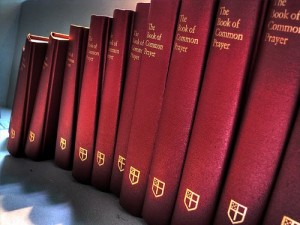
Book of Common Prayer (1979)The Book of Acts, the earliest church history, tells us that the followers of Jesus practiced daily prayer: “Day by day, as they spent much time together in the temple, they broke bread at home and ate their food with glad and generous hearts.” (Acts 2:46) Eventually, the Christians were excluded from Jewish worship assemblies, either by their own choice or by action of the authorities, and in an unrelated development, the Temple was destroyed in 70 AD. Where, then, did Christians pray together? Or, for that matter, alone?

It is likely that there were ascetics who sought solitude away from the cities and what they perceived as a sinful society around them from the start of the Christian community. They may have emulated John the Baptizer and his followers, the Jewish Essenes, or other esoteric communities. However, the first historically verifiable hermit (or “anchorite”) seems to be St. Anthony of Egypt. Unfortunately for him, others were attracted to his lifestyle and he found himself surrounded by disciples following his example. During Anthony’s lifetime, one of his followers, St. Pachomius established the first community for ascetics living together, “cenobites,” during the early part of the Fourth Century. By the end of the Fifth Century, these monks had developed the practice of gathering together for prayer and the early outlines of a Liturgy of the Hours composed of seven “offices” had emerged. It is possible that number of services was chosen because of this (and similar) verses in Scripture.

The foundation of modern western monasticism was the Rule of St. Benedict, authored by Benedict of Nursia in the 6th century. As part of his design for monks living in community, he adopted the practice of regular hours of prayer, adding an eighth. The eight monastic hours are the following:

  • Matins (during the night, usually at midnight; sometimes called Nocturns)
  • Lauds (at dawn, or 3 a.m.)
  • Prime (approximately 6 a.m.; this is the hour added by Benedict)
  • Terce (approximately 9 a.m.)
  • Sext (approximately 12 noon)
  • None (approximately 3 p.m.)
  • Vespers (approximately 6 p.m., “at the lighting of the lamps”)
  • Compline (approximately 9 p.m., before retiring)

Archbishop Thomas Cranmer, the genius behind the Anglican Prayer Book tradition, took bits and pieces of these monastic hours to create the offices of Daily Morning Prayer and Daily Evening Prayer included in The Book of Common Prayer of 1549 and in every revision of the Prayer Book since. It was Cranmer’s idea that individuals and families, like monks in community, would say these offices every day, coming together with others on Sundays to celebrate the Holy Communion.

It was, I’m afraid, a wonderful but never realized vision; I doubt very seriously that there has ever been a time since the Reformation when Anglicans, in general, stop during their days for even a single instance of regular, corporate, liturgical prayer, let alone twice a day, let alone seven or eight times a day. Nonetheless, the Anglican ethos is one of constant daily prayer deriving from the Scriptural witness of the Psalms.

It is my practice to say the Daily Offices at morning and evening and, occasionally, Compline before retiring. The current American Prayer Book of 1979 includes two forms of Morning Prayer, an office for Noonday Prayer, two forms of Evening Prayer, an order for Compline, and four short forms for individual prayer throughout the day. Our tradition is steeped in the monastic tradition!

But how many of us can say this verse of Psalm 119 with complete authenticity? I know that I can’t! Two times a day? Usually. Seven times a day? It just doesn’t happen! It probably should, but it doesn’t.

====================

A request to my readers: I’m trying to build the readership of this blog and I’d very much appreciate your help in doing so. If you find something here that is of value, please share it with others. If you are on Facebook, “like” the posts on your page so others can see them. If you are following me on Twitter, please “retweet” the notices of these meditations. If you have a blog of your own, please include mine in your links (a favor I will gladly reciprocate). Many thanks!

====================

Father Funston is the rector of St. Paul’s Episcopal Church, Medina, Ohio.

Taking the Train to God’s Picnic: A Homily for a Requiem – June 25, 2013

====================

This sermon was preached at the Requiem Mass on June 25, 2013, for Charlie Stehno, a member of St. Paul’s Episcopal Church, Medina, Ohio, where Fr. Funston is rector.

(Episcopal Church Lectionary, For Burials: Isaiah 25:6-9; Psalms 23; Revelation 21:2-7; and John 14:1-6. These lessons were selected by the family from among the options set forth in The Book of Common Prayer. All options can be found at The Lectionary Page.)

====================

Steam LocomotiveAre you familiar with those visions of the afterlife in which the dearly departed, clothed in flowing white robes lounge around on fluffy, white cotton clouds playing harps? I have to be honest with you that I cherish a very dear hope that such visions are 100% absolutely wrong! I cannot imagine any existence more boring than an eternity of cloud-floating and harp-playing, and if my ten years of knowing Charlie Stehno have given me a clue of anything about Charlie it is that he would most likely feel the same way. If he has gotten to the Great Hereafter only to find himself fitted out with a flowing white robe and issued a harp to play and cloud to lounge upon, I suspect that he is (as my grandmother would say) “fit to be tied.”

But I don’t really think there’s any danger of that! I believe that larger life in God’s Presence is quite a bit different from that beatific vision of robe wearing, harp playing, and cloud floating. As I spent the past few days contemplating the lessons that Kathy selected for today’s Requiem — this wonderful vision of Isaiah’s of a feast on a mountain top; John of Patmos’s vision of the new Jerusalem where our home will be with God, where hunger and thirst will be no more, where there will be these wonderful springs overflowing with the water of life, and where God will wipe away every tear; and most importantly Jesus’ promise that in God’s home there is a place for all of us — as I contemplated these readings and as I thought about Charlie’s life selling the heavy machinery that moved the rolling stock on the railways of this and several other countries, I kept having a childhood memory. It is a memory that informs my vision heaven, that shapes my belief about what lies through that doorway of death. I’d like to share it with you, so I hope you’ll forgive me if I spend a few minutes sharing something about my family as a means to come to terms with the grief and loss experienced by the Stehno family.

My parents were raised in a small town in southeastern Kansas and when I was very young my paternal grandparents and many members of my extended family on both sides still lived in and around that town. On my mother’s mother’s side, my great-grandfather, Hinrich Buss, had emigrated from the German farm country of Ostfriesland in the 1860s when he was about 20 years old. He settled in that area of Kansas and homesteaded several thousand acres, raising not one but three families. I am descended from him and his third wife, Harmke (who bore Hinrich 15 children who lived to adulthood).

Each summer of my childhood I would spend several weeks with my father’s parents, but for one day of each summer I would cease being a “Funston” and, instead, I become one of the several hundred “Buss cousins.” That one day was like a parenthetical note in my life: “This is Eric Funston – open parenthesis – who is also a Buss – close parenthesis.” Those parentheses were, if you will, represented by railroad journeys.

That day would start early in the morning when my great-uncle and great-aunt Roy and Blanche Buss would collect me from my Funston grandparents’ home and we would drive to the Santa Fe Train Station and catch the Atchison, Topeka & Santa Fe Railroad for the ancestral home, which was outside the next town to the west, an hour’s train ride away. Open parenthesis! When the train pulled out of station, I was no longer a Funston; I was a Buss.

When the train arrived, we would disembark to be picked up by other Buss cousins and driven to the farmhouse which had been and still was (and still is) the Buss family home.

As soon as we arrived, Blanche would join the other women in the farmhouse kitchen; Roy would go off with the other men to walk the fields and look at the livestock and smoke cigarettes and talk about the news of the day; and I would join the other kids swimming in the farm pond (which, to be honest, was pretty yucky, but we were kids, we didn’t care).

Around midday trestle tables would be set up in the yard and in pretty short order they would be overflowing with sauerbraten, and schnitzel, and wursts of all sorts, with sauerkraut and potato salad and fresh garden tomatoes, and more kinds of homemade bread and rolls and biscuits than you can imagine. Someone would say a prayer, and we would all dig in and eat way more than we should and, afterward, fall asleep in the shade of the barn.

A little later the older kids and the younger men would get up a football game. Because there were more of us descended from Greatgramma Harmke than from Hinrich’s first two wives it was usually organized as the third family against the first two. And there would be much cheering and yelling and arguing over plays and goals and whether someone is in-bounds or out; you know the sort of thing that happens in those sorts of games.

Sometime during the fourth quarter, the women would disappear back into that farmhouse kitchen and as the game came to its inevitable end, those trestle tables would again be loaded to overflowing, but this time with homemade pies, and cakes, and cookies, and even homemade ice cream. And, once again, we would all eat way more than a person ought . . . .

But in not-too-long a time, the sun would begin to set. And that would be the signal that Great-uncle Roy and Great-aunt Blanche and I would have to leave. We’d be driven back into town to catch the evening train back to my parents’ hometown. When we got there, I went back to being a Funston. That eastbound train ride was the end of my day of being a “Buss cousin.” Close parenthesis.

You know, there are a lot of songs about trains, and among those are a lot of songs about trains going to heaven. That’s another thing that kept coming to mind as I thought about what I might say here today. There’s Woody Guthrie’s familiar tune:

This train is bound for glory, this train.
This train is bound for glory,
Don’t carry nothing but the righteous and the holy.
This train is bound for glory, this train.

And there’s Boxcar Willie’s wonderful song of a hobo’s last train ride:

I’ll ride that last train to heaven
On rails of solid gold
In a boxcar lined with satin
Where the nights are never cold
Where a hobo’s always welcome
Even in his ragged clothes
I’ll ride that last train to heaven
When the final whistle blows.

And my personal favorite is Curtis Mayfield’s great song:

People get ready there’s a train comin’;
You don’t need no baggage, just get on board.
All you need is faith to hear the diesels hummin’;
You don’t need no ticket, just thank the Lord.

In the 23rd Psalm, David thanks the Lord for shepherding us as we walk through the valley of the shadow of death, for setting an abundant table for us in the midst of our enemies, and for pledging in God’s mercy and goodness that we will dwell in the house of the Lord for ever. Jesus affirms that in that home there are rooms for all of us, and both Isaiah and John of Patmos assure us that the abundance of that table will continue, that God will lay out a feast of “rich food . . . and well-aged wines strained clear,” that there will no hunger or thirst of any kind.

It will be like a family reunion, God’s family reunion, where everyone we’ve ever loved is present, and everyone they’ve ever loved (including us) eventually will be, “where sorrow and pain are no more, neither sighing, but life everlasting,” and where “God will wipe away the tears from all faces.” St. Paul, the patron of this parish, explained it this way in his First Letter to the Corinthians:

Since death came through a human being, the resurrection of the dead has also come through a human being; for as all die in Adam, so all will be made alive in Christ. But each in his own order: Christ the first fruits, then at his coming those who belong to Christ. Then comes the end, when he hands over the kingdom to God the Father, after he has destroyed every ruler and every authority and power. For he must reign until he has put all his enemies under his feet. The last enemy to be destroyed is death. (1 Cor. 15:21-26)

As a song I know was special to Charlie might put it:

The enemy must yield,
We’ll fight just like our ancestors
and march right down the field!
(University of Toledo Fight Song; Charlie was an alumnus and former football start of Toledo U.)

Charlie has marched down that field; he has finished his walk through the valley of the shadow of death. He has won the victory! He has gotten on board that train bound for glory, that last train to heaven; he’s left this life’s crippling, painful baggage behind, and he has arrived in that larger life where, as Isaiah assures us, he has not found a cloud or a harp.

No, he’s taken that train to a great family reunion, where the picnic tables are eternally laden with God’s overflowing abundance, where the faithful swim not in some yucky farm pond but in the clear river that flows from the springs of the water of life, where the family home has room for everyone, and where (if there isn’t one already, Charlie will make sure) there’s a football game going on.

And the greatest and most wonderful thing is that there will be no sunset and there will be no train going back to anywhere; there will be no “close parenthesis.”

Thanks be to God! Amen.

====================

A request to my readers: I’m trying to build the readership of this blog and I’d very much appreciate your help in doing so. If you find something here that is of value, please share it with others. If you are on Facebook, “like” the posts on your page so others can see them. If you are following me on Twitter, please “retweet” the notices of these meditations. If you have a blog of your own, please include mine in your links (a favor I will gladly reciprocate). Many thanks!

====================

Father Funston is the rector of St. Paul’s Episcopal Church, Medina, Ohio.

Legion . . . Silence: A Contrast – Sermon for the 5th Sunday after Pentecost (Proper 7C) – June 23, 2013

====================

This sermon was preached on the Fifth Sunday after Pentecost, June 23, 2013, at St. Paul’s Episcopal Church, Medina, Ohio, where Fr. Funston is rector.

(Revised Common Lectionary, Pentecost 5 (Proper 7, Year C): 1 Kings 19:1-15a; Psalms 42 and 43; Galatians 3:23-29; and Luke 8:26-39. These lessons can be read at The Lectionary Page.)

====================

Schizophrenia Illustration from Vimeo At the beginning of the sermon, following the reading of Gospel lesson, five readers scattered among the congregation, rose and loudly read the following five passages simultaneously:

Voice One: “Four score and seven years ago our fathers brought forth on this continent a new nation, conceived in liberty, and dedicated to the proposition that all men are created equal. Now we are engaged in a great civil war, testing whether that nation, or any nation so conceived and so dedicated, can long endure.”

Voice Two: “We the people of the United States, in order to form a more perfect union, establish justice, insure domestic tranquility, provide for the common defense, promote the general welfare, and secure the blessings of liberty to ourselves and our posterity, do ordain and establish this Constitution for the United States of America.”

Voice Three: “You can’t do anything right and never will be able to. Everyone hates you. You have no friends. You are the most useless, worthless human being on the planet. You know this is true, and you are powerless to change it. You should just end it right now. There’s no reason for you to keep living.”

Voice Four: “In a large bowl, beat together eggs, oil, white sugar and two teaspoons vanilla. Mix in flour, baking soda, baking powder, salt and cinnamon. Stir in carrots. Fold in pecans. Pour into prepared pan. Bake in the preheated oven for 40 to 50 minutes, or until a toothpick inserted into the center of the cake comes out clean.”

Voice Five “Mr. Dursley, a well-off Englishman, notices strange happenings on his way to work one day. That night, Albus Dumbledore, the head of a wizardry academy called Hogwarts, meets Professor McGonagall, who also teaches at Hogwarts, and a giant named Hagrid outside the Dursley home. Dumbledore tells McGonagall that someone named Voldemort has killed a Mr. and Mrs. Potter and tried unsuccessfully to kill their baby son, Harry.”

One of the many ways in which modern scholars try to make sense of the story of the Gerasene Demoniac is the suggestion that he was, in fact, schizophrenic. For example, the Dean of St. Alban’s Cathedral in England, Jeffrey John, writes:

Anyone presenting the symptoms of the Gerasene demoniac today would be rapidly committed for treatment of multiple schizophrenia – and quite rightly. It would be very foolish to do otherwise, or to discount the huge, God-given progress that has been made in our understanding and treatment of mental illness since biblical times. (The Meaning in the Miracles, p. 91, Eerdmans:2004)

A Roman Catholic writer who identifies himself only as “John” tells of accompanying a priest making his Eucharistic ministry rounds at a psychiatric hospital. He describes what happened when they arrived at the ward where the most seriously disturbed patients were housed:

My friend began to say the prayers and all was relatively calm until he raised the Eucharist. This very motion acted like a trigger for one of the patients who began to shout expletives, spit and hiss. This set off most of the others; he had to be restrained while we administered the Eucharist to those who wanted it and lined up to receive it. Amidst the cacophony I heard one thing that he shouted which remains with me to this day; he shouted “why are you coming in here tormenting us?” (John’s Ramblings)

He then comments, “It wasn’t until some time later that when meditating on the Healing of the Gerasene Demoniac . . . that I shuddered to a halt and recalled that event in the psychiatric hospital.”

Schizophrenics hear voices. This is the most common type of hallucination in schizophrenia. The voices may talk to the person about his or her behavior; they may order the person to do things; they may speak warnings of danger. Sometimes the voices talk to each other; sometimes they talk over one another, several voices speaking at once. What we experienced as these five people read these differing texts was a crude demonstration of what some schizophrenics experience, or what the Gerasene Demoniac seems to have suffered.

The great English author, C. S. Lewis, once wrote that we human beings are a “myriad of impulses, a cauldron of evil desires.” The Gerasene Demoniac certainly was. When Jesus asked him (or the demon within him) his name, the answer was, “We are legion.”

That is a very scary answer! That word, legion, is a Roman military term. In the Roman army, a legion consisted of six thousand men. We heard only five voices in our little demonstration. Can you imagine what it must have been like to hear thousands upon thousands of demonic voices? No wonder he would break his chains and shackles and run into the wilds to live in the cemetery among the tombs!

John, the Roman Catholic blogger, suggests that “all disorder, all conflict whether we call it civil, political, doctrinal, psychiatric, psychological, social or personal disorder, . . . anything that creates or contributes to disorder or conflict is the presence of evil at work in the world.” I believe he is correct, the message of the Prophets is that that disorder, that chaos is not, and never will be, the last word.

As dramatic counterpoint to the Gospel story today, we have another story of the Prophet Elijah. The Lectionary, as you remember, has had us bouncing around in the First Book of Kings reading stories of Elijah, but not in the order they are presented in that book. Instead, we have been getting the texts from First Kings as they may relate to the stories from Luke’s Gospel; today’s pairing seems to be a good example. What we see here is the stark difference between the chaotic disorder of evil, represented by demon possession (or schizophrenia), and the order of holiness, represented by the “sheer silence” in which Elijah encounters God.

You recall the story. Elijah has just killed the 450 prophets of Ba’al, which has royally angered the wicked Queen Jezebel. She has sent word to Elijah saying, “So may the gods do to me, and more also, if I do not make your life like the life of one of them by this time tomorrow.” In other words, “Look out, Dude! I’m gonna kill you!” So Elijah, in fear, flees into the desert and in a fit of depression prays that God will take his life. However, an angel appears and tells him that’s not going to happen. He is instructed to eat something and then travel to “Horeb, the mount of God.” This is understood to be the very same place where Moses received the Tablets of the Law. When he gets there, God asks what his problem is: “What are you doing here, Elijah?” Elijah answers that all the prophets of Yahweh have been killed (by Queen Jezebel and her army) and only he is left. So God tells him to stand at the mouth of his cave because God will pass by.

He does so and there is a storm, and then an earthquake, and then a fire. All of these things represent that disordered chaos which the Demoniac in the Gospel experiences, and God is in none of them. Instead, God is in the “sheer silence,” as the New Revised Standard Version translates the Hebrew. A literal translation of the Hebrew would be “the sound of gentle blowing,” and the King James Version translated this by that wonderful turn of phrase “a still small voice.”

So we have this wonderful juxtaposition of an image of loud, confusing, demonic chaos — the Gerasene Demoniac, a person in a situation which is overwhelmingly evil, permeated with and being buffeted by a legion of devils, thousands of incoherent voices, pulling him in every direction, ruining his life — with an image of calm, peaceful, gentleness — the still small voice of God present in sound of sheer silence, the sound of gentle blowing.

We, I hope, are not possessed of demons, nor suffering from schizophrenia or some other form of delusional mental illness. But we all inhabit a world of many, many voices, all talking to us, all telling us what to think, or do, or say. No matter how old we are, we will always have the voices of parents and grandparents playing in our heads; we have the voices of politicians, news reporters, bosses, spouses, our own children, their teachers, doctors, lawyers, tax advisers . . . and occasionally preachers . . . all telling us what to do. There are times when all of that noise can get us down, when we can all relate personally to the lament in today’s gradual psalm: “Why are you so full of heaviness, O my soul, and why are you so disquieted within me?”

Several years ago, there was a job opening on a cruise ship; a new communications officer was need. There were several applicants seeking the position and all were told to come to a particular office at the same time on the same day. They arrived and were shown in to a waiting room. While they waited to be interviewed, the conversed with one another and soon the room was filled with the sounds of conversation. After quite a long wait, another applicant who was late came in and sat down; everyone else was busy talking, so she just quietly waited for a few minutes, but then suddenly, she jumped up and walked through a door marked “Private.” A few minutes the personnel manager walked out of that door and announced that the position had been filled; the late-arriving applicant had been hired. The other applicants were extremely angry, “We were here first! How could she go ahead of us and get the job?” To which the personnel manager replied, “Any of you could have gotten the job if you had just been quiet long enough to pay attention to the message on the intercom.” “What message?” “All the time you were talking the intercom was broadcasting in Morse Code, ‘A ship’s communications officer must always be on the alert. The first person who gets this message and comes directly into my office will get the job.'”

I believe that God’s still small voice is like that coded message. It’s there if we will but take a few moments of silence and listen for it. And if it seems like we do not have the power to do so on our own, if we are unable to still the storms, the earthquakes, the fires, the voices . . . the story of the Gerasene Demoniac reminds us that Jesus can, because personal exorcism is not what this story is really about. “Rather,” as Jeffrey John reminds us, “it is about the promise . . . of God’s ability to defeat and re-order the disordered powers that afflict both individuals and communities.”

Life can sometimes, indeed, life can often be permeated with great evil that is almost beyond human comprehension and beyond our ability to handle. In those moments, we may be tempted to just give up and give in to the intensity of evil around us. Like the Psalmist we may cry out, “Why are you so full of heaviness, O my soul, and why are you so disquieted within me?” Like Elijah we may be tempted to just sit down in the desert and say, “Let me die.” But God does not give up; Jesus does not give up. Jesus faces the demons with his healing and his peace. There is no situation so bad that Jesus cannot or will not bring his healing power.

Why are you so full of heaviness, O my soul?
and why are you so disquieted within me?
Put your trust in God;
for I will yet give thanks to him,
who is the help of my countenance, and my God.
Amen.

====================

A request to my readers: I’m trying to build the readership of this blog and I’d very much appreciate your help in doing so. If you find something here that is of value, please share it with others. If you are on Facebook, “like” the posts on your page so others can see them. If you are following me on Twitter, please “retweet” the notices of these meditations. If you have a blog of your own, please include mine in your links (a favor I will gladly reciprocate). Many thanks!

====================

Father Funston is the rector of St. Paul’s Episcopal Church, Medina, Ohio.

Nominate, Pray, Take Your Chances – From the Daily Office – June 18, 2013

From the Book of Acts:

So they proposed two, Joseph called Barsabbas, who was also known as Justus, and Matthias. Then they prayed and said, “Lord, you know everyone’s heart. Show us which one of these two you have chosen to take the place in this ministry and apostleship from which Judas turned aside to go to his own place.” And they cast lots for them, and the lot fell on Matthias; and he was added to the eleven apostles.

(From the Daily Office Lectionary – Acts 1:23-26 (NRSV) – June 18, 2013.)

Note: This blog has been “silent” the past few days for a variety of reasons. It was John Lennon, I believe, who observed that “life is what happens to you while you’re busy making other plans.” The past half-week or so has certainly been an example of that!

Drawing StrawsToday’s reading from Luke’s history of the early church details the method by which the eleven remaining apostles chose someone to replace Judas. It was a simple method: (a) identify the candidates; (b) pray; (c) take your chances. They drew lots, but they might have thrown dice, cut a deck of cards, flipped a coin, or done any number of other things that would have randomized the outcome.

There is something instructive in this lesson for Episcopalians who are now preparing for the 2015 meeting of the General Convention of the Episcopal Church at which a new Presiding Bishop will be chosen.

The Presiding Bishop is the Episcopal Church’s chief pastor (“head cook and bottle-washer” my late stepfather would have said). He or she (our current PB is a woman) is the Primate and Metropolitan of the church, equal in rank to the Archbishop of Canterbury and the other head pastors of the several autocephalic (independent and self-governing, though related and interdependent) provinces of the Anglican Communion.

How the Presiding Bishop is selected has changed three times in the 200-plus years of the American church’s existence. Under the original 1789 constitution of the church, the Presiding Bishop was simply the senior bishop in order of consecration. He (back then it was always “he”) served until death or retirement, when the next senior bishop took over; the Presiding Bishop retained his diocesan position (and in those days a bishop was also a parish rector). His only real duties were to be chief consecrator of new bishops and to preside at meetings of the House of Bishops; there was no national church administration and, to be honest, no Anglican Communion with which to interact. Eventually, the office was made elective in 1919. The archives of the Episcopal Church tell us:

The first election of a Presiding Bishop by General Convention took place in 1925. Since 1943 the Presiding Bishop has been required to resign diocesan jurisdiction upon election. In 1967 the duties of the office were significantly enhanced. As “Chief Pastor,” the Presiding Bishop is charged with initiating and developing church policy and strategy, speaking God’s Word to the church and the world, and visiting every diocese of the church. The title “Primate” was added in 1982. The Cathedral of Saint Peter and Saint Paul in Washington, D.C., is the official seat of the Presiding Bishop. The office of the Presiding Bishop is located at the Episcopal Church Center in New York City. The present term of office for the Presiding Bishop is nine years.

A term limitation was first imposed in 1976 when the canons were amended to provide for a twelve-year term (four triennia); this was amended in 1994 when the term was shortened to nine years. Our current Presiding Bishop was elected in 2006 and her term will end at the General Convention of 2015 when her successor will be elected.

In the past, the election has been by the House of Bishops with the House of Deputies concurring. Nominees were selected by the Bishops and the method of nomination and the balloting kept secret. At the last General Convention, it was decided that the whole church should be involved in the nomination process and a “joint commission” was created to select nominees consisting laity, clergy, and bishops. In the current budget of the church the princely sum of $226,000 is set aside for the expenses of this nominating committee. At the 2015 convention, because there has been no change in the Constitution or canons governing the process, the House of Bishops will elect and the election will be reported to the House of Deputies for its concurrence. Laity and clergy will not actually vote for the Presiding Bishop; they will “rubber stamp” the House of Bishops choice — the House of Deputies has never failed to concur in a Presiding Bishop election.

There are calls now to democratize the process further by amending the canons to provide that the PB be elected by both Houses of the General Convention, the House of Deputies voting “by orders” (which means the lay deputies and clergy deputies vote separately); to be selected, a nominee would need a majority of the votes of the bishops, a majority of clergy votes, and a majority of lay votes. (A “vote by orders” in the House of Deputies is a complicated and structurally conservative process actually requiring more than a simple majority, but that’s too much to think about this morning.)

I read about the drawing of lots by the Apostles in the first chapter of Acts and I begin to question the complication and expense of the processes we have devised . . . . Do they really work any better?

Praying and “taking your chances” has worked for the People of God throughout history, and random chance has been used to discern the divine will in many religions. For example, the I Ching (The Book of Changes) of China seeks guidance using the random tossing of yarrow stocks or the flipping of three coins to produce “hexagrams,” the meanings of which are recorded in the book. In the ancient Jewish religion, the High Priest carried two stones (or possible wooden or bone plates) in his breastplate, the Urim and Thummim, which were used to divine God’s Will; exactly what they were and how they were used is lost to history, but one speculation is that they were a sort of “holy dice” which would be cast and a message or meaning derived therefrom.

I have been told that in the tradition of some Eastern or Oriental Orthodox churches (particularly the Ethiopian church) bishops are selected by chance: the names of the eligible candidates are written on slips of paper which are put into a chalice and then one is randomly pulled out by a child. I’ve also been told that a similar method is (or was) used by the Moravians to select bishops with the interesting addition of a blank paper which, if drawn, would indicate that God was not satisfied with any of the named candidates and that the church should consider additional nominees.

It seems to me that these methods are equally as “democratic” as the expensive and complicated processes now underway in (or proposed for the future of) the Episcopal Church. We all share in such a random chance process!

Why not simply put the names of all eligible diocesan bishops (every bishop who has been in office at least five years and who will not reach mandatory retirement age before the end of the nine-year term) into a large chalice, pray, and let the youngest deputy present draw out a name? Presiding Bishop selected, complicated process and exorbitant expense avoided, and (by the way) the example of Scripture honored and followed.

Nominate, pray, take your chances! It worked for the Apostles. Surely it could work for us.

====================

A request to my readers: I’m trying to build the readership of this blog and I’d very much appreciate your help in doing so. If you find something here that is of value, please share it with others. If you are on Facebook, “like” the posts on your page so others can see them. If you are following me on Twitter, please “retweet” the notices of these meditations. If you have a blog of your own, please include mine in your links (a favor I will gladly reciprocate). Many thanks!

====================

Father Funston is the rector of St. Paul’s Episcopal Church, Medina, Ohio.

« Older posts Newer posts »