Occasional thoughts of an Anglican Episcopal priest

Category: Prayer (Page 34 of 47)

The Whole World is Irish on March 17 – Sermon for the Feast of St. Patrick – March 17, 2013

====================

This sermon was preached on Sunday, March 17, 2013, at St. Paul’s Episcopal Church, Medina, Ohio, where Fr. Funston is rector.

(Episcopal Sanctorale Lectionary, Patrick of Ireland: Psalm 97:1-2,7-12; Ezekiel 36:33-38; and Matthew 28:16-20. These lessons can be read at The Lectionary. At St. Paul’s Parish, during Lent, we are using the Daily Office of Morning Prayer as our antecommunion; therefore, only these two lessons and the psalm were read. The Epistle lesson, 1 Thessalonians 2:2b-12, was not used.)

====================

Icon of St. Patrick of IrelandIn Ainm an Athar, agus an Mhic, agus an Spioraid Naoimh. Áiméan.

Dia dhaoibh ar maidin, gach duine. Beannachtaí na fheile Padraig oraibh.

That’s more Irish than I’ve spoken in nearly two years! What I said was, “God be with you this morning, everyone. The blessings of the Feast of St. Patrick be with you.” In other words, Happy St. Paddy’s Day!

Everyone loves to be Irish on St. Paddy’s Day. Even though we Funstons being descendants of Anglican Irish (or as the Irish would say, “Protestants”) did not have much, if anything, to do with the Irish communities of my childhood, we still (like everyone else) enjoyed St. Patrick’s Day. We would go to the parades, see and hear the pipe-and-drum corps, and all the other traditional sorts of things. On the evening news, we would see the reports of parades in other places, especially the big one down Fifth Avenue in New York City. And we would usually have corned beef and cabbage for dinner.

I have no problem with people dressing kilts (which aren’t really Irish, at all), putting green food coloring in beer, eating corned beef and cabbage (which is also not really Irish), or any of the other silly things people do on this day. It’s all part of the fun. Many like to watch Irish-themed movies on St. Patrick’s Day. My favorite is the heartwarming tale of a boxer’s return home in The Quiet Man, but I also like the mythical nonsense of Darby O’Gill and the Little People, or the intense drama of The Field, or the whacky comedy of Waking Ned Devine. Those movies are the only times I hear anyone say, “Top o’ the mornin’ to ye” or “Faith and begorrah.” At least, I’ve never heard anyone say those things during any of my trips to Ireland.

The worship committee thought we ought to step away from Lent for a day (because March 17 today falls on Sunday) and celebrate St. Patrick. After all, on March 17, the whole world is Irish . . . but the man we commemorate wasn’t Irish and it would be much truer to his memory if on his feast day all the world tried to be not Irish, but Christian.

Patrick, who was a Romano-Brit (meaning a Roman who lived in Britain) was the son of a minor imperial official named Calpornius, who was also a deacon in the church; his grandfather Potitus was a priest. Around the year 406 A.D., at the age of 16, Patrick was kidnapped and made a slave in Ireland to a minor tribal king. After six years, he escaped and returned home to Britain, and then went to Rome. There he was ordained a priest and a bishop and, according to the chronicle of Prosper of Aquitane, was appointed bishop to the Irish by Pope Celestine I; he arrived back in Ireland in 432 A.D. He landed near modern-day Belfast and set up his principal foundation in Armagh, which is now considered the Primatial See of Ireland. He ministered primarily in that part of the country known as Ulster. Patrick was not the first bishop appointed to bring the Christian faith to the people of Ireland. Ciaran and Palladius came before him, but their mission (primarily in Munster and Leinster, further south) did not bear the same fruits as Patrick’s. So today, what we celebrate is not Irish identity or heritage; today, we celebrate the success of a mission to spread the Christian faith.

The choir is going sing a poetic prayer or lorica attributed to Patrick, the famous St. Patrick’s Breastplate, as their anthem. It is attributed to him, but there is disagreement as to whether he actually wrote it. But he did write this prayer:

I give thanks to the one who strengthened me in all things, so that he would not impede me in the course I had undertaken and from the works also which I had learned from Christ my Lord. Rather, I sensed in myself no little strength from him, and my faith passed the test before God and people. (The Confession of St. Patrick)

For St. Patrick it seems the faith which passed the test was deeply Trinitarian and deeply evangelical. He is credited with using the shamrock, now one of the national emblems of Ireland, as an illustration of the Trinity – three lobes, yet one leaf – although that is probably an 18th Century legend rather than a historical fact. And as you heard, the Gospel lesson for his commemoration is the Great Commission: “Go therefore and make disciples of all nations, baptizing them in the name of the Father and of the Son and of the Holy Spirit, and teaching them to obey everything that I have commanded you.” Christ’s final words to his apostles before ascending into Heaven. This evangelical, Trinitarian faith — not green beer nor Celtic music nor corned beef and cabbage nor Irish-ness itself — but trust in God the Father, God the Son, and God the Holy Spirit shared with and commended to everyone around us, this is what we celebrate when we celebrate the Feast of St. Patrick.

I thought perhaps the lesson from Ezekiel was chosen for his feast because, with its “forty shades of green,” Ireland might make one think of the garden of Eden, and in Ireland there are both ruined towns and towns that are inhabited, some of both walled and fortified. But I think rather that it was chosen because, just as the nations around Israel came to know the Lord, the God of Israel, so the nations to which Irish missionaries went came to know the Lord Jesus Christ. What Patrick started in Ireland in 5th Century by the mid 6th Century was spreading to northern Europe, carried there by Irish priests and monks practicing what was called “white martyrdom.” The term comes from a 7th Century Irish sermon called the Cambrai homily:

Now there are three kinds of martyrdom that are counted as a cross to us, namely, white, blue, and red martyrdom.
It is white martyrdom for a man when he separates from everything that he loves for God, although he does not endure fasting and labor thereby.
The blue martyrdom is when through fasting and hard work they control their desires or struggle in penance and repentance.
The red martyrdom is when they endure a cross or destruction for Christ’s sake, as happened to the Apostles when they were persecuted the wicked and taught the law of God. (O. Davis, Celtic Spirituality, Paulist Press: 1999)

The white martyrs left everything dear to them — homes, families, familiar surroundings, even Ireland itself — to spread the Gospel in distant lands; white martyrdom was a pilgrimage on behalf of Christ that might be extended permanently so that they would never again see their homeland. They went first to Scotland and the north of England, but then further afield to Holland, Germany, Scandinavia, Switzerland, and even further. Like the man who had brought Christianity to their homeland, they held a deeply Trinitarian and deeply evangelical faith; and it is that faith which we celebrate when we celebrate St. Patrick’s Day.

It is that faith we all claim and, when we commemorate Patrick, it is to the spread of that faith that we dedicate ourselves. On the first day of Lent, Ash Wednesday, a special Litany of Penance is recited in Episcopal Churches. Among the confessions of that Litany we find this petition: “Our negligence in prayer and worship, and our failure to commend the faith that is in us, we confess to you, Lord.” (BCP 1979, page 268)

Let us remember that confession on St. Patrick’s Day and try not so much to be Irish, but try to be better Christians. Let us be like Patrick, who was not Irish, but Christian, and like him let us follow Christ’s Great Commission. If we must be Irish on this day, let us be like those Irish white martyrs of old, and commend the faith that is in us, a faith that is deeply Trinitarian and deeply evangelical.

Let us remember, also, a petition from the Great Litany which we recited on the First Sunday in Lent four weeks ago:

That it may please thee to inspire us, in our several callings, to do the work which thou givest us to do with singleness of heart as thy servants, and for the common good, we beseech thee to hear us, good Lord. (BCP 1979, page 151)

Let us pray:

Everliving God, whose will it is that all should come to you through your Son Jesus Christ: Inspire our witness to him, that all may know the power of his forgiveness and the hope of his resurrection; who lives and reigns with you and the Holy Spirit, one God, now and for ever. Amen.

====================

A request to my readers: I’m trying to build the readership of this blog and I’d very much appreciate your help in doing so. If you find something here that is of value, please share it with others. If you are on Facebook, “like” the posts on your page so others can see them. If you are following me on Twitter, please “retweet” the notices of these meditations. If you have a blog of your own, please include mine in your links (a favor I will gladly reciprocate). Many thanks!

====================

Father Funston is the rector of St. Paul’s Episcopal Church, Medina, Ohio.
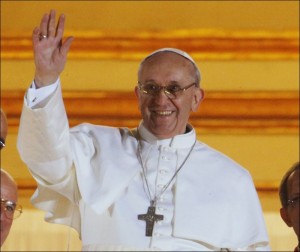
Pope Francis – From the Daily Office – March 14, 2013

From Paul’s Letter to the Church in Rome:

So then, brothers and sisters, we are debtors, not to the flesh, to live according to the flesh — for if you live according to the flesh, you will die; but if by the Spirit you put to death the deeds of the body, you will live. For all who are led by the Spirit of God are children of God. For you did not receive a spirit of slavery to fall back into fear, but you have received a spirit of adoption. When we cry, “Abba! Father!” it is that very Spirit bearing witness with our spirit that we are children of God, and if children, then heirs, heirs of God and joint heirs with Christ — if, in fact, we suffer with him so that we may also be glorified with him.

(From the Daily Office Lectionary – Romans 8:12-17 (NRSV) – March 14, 2013.)

Pope FrancisThere were two things about which I was unaware when I wrote yesterday’s meditation referring to the folk chorus Abba, Father. First of all, I didn’t know that today’s readings would include Paul’s comments to the Romans on that form of addressing God. Secondly, I had no idea that the modern day Romans (in the form of the Papal Conclave) would have elected a new pope by today.

Today the entire world, Protestant, Anglican, and Orthodox Christians, as well as those of other religions, together with the world’s Roman Catholics, are taking stock of the newest successor of St. Peter, trying to figure out who Pope Francis is and what his election means. According to all the news reports I’ve seen, he is a humble man with much concern for the poor and the economically oppressed. On the other hand, he is apparently a doctrinal conservative who has had some pretty negative things to say about contraception, a woman’s right to reproductive choice, and the legalization of abortion, as well as about the LGBT community and the rights of gay, lesbian, and transgendered persons. How this will all shake out in his leadership of the Roman Catholic Church is anyone’s guess.

I hope that he will listen to what Paul has to say in his letter to the Roman church of long ago. I hope that he will acknowledge that “all who are led by the Spirit of God are children of God,” even though that Spirit may be leading them in non-Christian directions. I hope that he will consider the suggestion of his fellow Jesuit, Avery Dulles, who wrote: “On Christian grounds, it may be held that the divine person who appears in Jesus is not exhausted by that historical appearance. The symbols and myths of other religions may point to the one who Christians recognize as the Christ.” (Revelation and the Religions, Quaker Universalist Fellowship: 1999)

It is my understanding of basic Christian doctrine that the Holy Spirit may act wherever and whenever she chooses. If we presume to constrain the activity of the Holy Spirit, if our doctrinal predisposition is to limit God to only our particular religious assumptions, then we are not faithful to the Truth. Christian tradition recognizes a mandate to seek Truth wherever it may be found and to follow the Holy Spirit wherever she may lead, even if that may be into consideration of other religions or non-Christian philosophies. I hope his Holiness will be of the same understanding and seek interfaith dialogue.

Even more, I hope that he will seek common cause with non-Roman Christians, even when our ecclesiologies and theologies may not agree with those of the Holy See. I pray that he will acknowledge that Protestants, Anglicans, and Orthodox Christians are “children of God, and if children, then heirs, heirs of God and joint heirs with Christ.” It was a great disappointment when his predecessor, Benedict XVI, ratified and confirmed a statement that “those Christian Communities born out of the Reformation of the sixteenth century . . . because of the absence of the sacramental priesthood, have not preserved the genuine and integral substance of the Eucharistic Mystery [and] cannot, according to Catholic doctrine, be called ‘Churches’ in the proper sense.” (Responsa Quaestiones, June 29, 2007) As an Anglican, especially, I would dispute the basic assumptions about the priesthood and the Eucharist, but even without regard to that quibble, to deny that any group of Christians is the church seems to me to be an unnecessary stumbling block to ecumenical relations. Hopefully, Pope Francis will be more gracious than his predecessor in acknowledging that “where two or three are gathered in [his] name, [Christ is] there among them.” (Matt. 18:20 NRSV)

Which brings me back to the folk chorus Abba, Father and yesterday’s meditation. The petition of the song is

Mold us, mold us and
Fashion us,
Into the image,
Of Jesus your Son
Of Jesus your Son.
Father, may we be one in you,
May we be one in you,
As he is in you,
And you are in him.

God the potter is constantly molding the church. May Pope Francis’s election be an opportunity not only for the Roman Catholic Church to be molded anew, may it also be an occasion for the whole of the Christ’s universal church, and God’s people of other faiths, to be molded together into a new ecumenical and interfaith cooperation.

====================

A request to my readers: I’m trying to build the readership of this blog and I’d very much appreciate your help in doing so. If you find something here that is of value, please share it with others. If you are on Facebook, “like” the posts on your page so others can see them. If you are following me on Twitter, please “retweet” the notices of these meditations. If you have a blog of your own, please include mine in your links (a favor I will gladly reciprocate). Many thanks!

====================

Father Funston is the rector of St. Paul’s Episcopal Church, Medina, Ohio.

Fanfare for the Common Man – From the Daily Office – March 12, 2013

From the Paul’s Letter to the Romans:

I do not understand my own actions. For I do not do what I want, but I do the very thing I hate. Now if I do what I do not want, I agree that the law is good. But in fact it is no longer I that do it, but sin that dwells within me. For I know that nothing good dwells within me, that is, in my flesh. I can will what is right, but I cannot do it. For I do not do the good I want, but the evil I do not want is what I do. Now if I do what I do not want, it is no longer I that do it, but sin that dwells within me. So I find it to be a law that when I want to do what is good, evil lies close at hand. For I delight in the law of God in my inmost self, but I see in my members another law at war with the law of my mind, making me captive to the law of sin that dwells in my members. Wretched man that I am! Who will rescue me from this body of death? Thanks be to God through Jesus Christ our Lord!

(From the Daily Office Lectionary – Romans 7:15-25 (NRSV) – March 12, 2013.)

Trumpet FanfareSt. Paul wrote some great stuff. He’s treatise on love in the thirteenth chapter of the first letter to the church in Corinth is brilliant! He wrote (or, at least, is blamed for) some incredibly stupid stuff, too: telling women to be silent in the very next chapter of First Corinthians, for example, or sending Onesimus back to Philemon without clearly denouncing the institution of slavery.

But I think nothing may have been as damaging to Christian spirituality and theology than this little bit from the letter to the church in Rome. We don’t know what Paul’s personal problem was – an addiction, a sexual dysfunction, OCD, who knows? – but whatever it may have been he attributes it to his own sinfulness and then (here’s the really damaging thing) he universalizes his experience. He claims that everyone is like him, that every single human being who ever lived and everyone who will come after him has been, is, and will be “captive to the law of sin” and completely unable to do anything about it.

Find something like that in the Gospels! Read every word of the four Gospels and see if there is anything like that coming from Jesus’ mouth! There isn’t. Sure, Jesus suggested that we are all sinners (particularly when he breaks up the execution party and prevents the woman taken in adultery from being stoned in John 7:53-8:11), but he never suggests that we have no power to do anything about our sinful behavior. In fact, quite the opposite. Jesus makes it clear that we have the ability to choose to do good, and again and again he commends that choice to us.

Today is the 70th anniversary of the premier of one of my favorite pieces of music, Aaron Copland’s Fanfare for the Common Man. It was commissioned in 1942 by the Cincinnati Symphony Orchestra and its conductor Eugene Goossens as one of eighteen fanfares to begin the next year’s concert performances as an orchestral support for and tribute to the United States effort in World War II. Copland named to piece after a line in a speech by Vice-President Henry A. Wallace proclaiming the arrival of “the century of the Common Man.” Goossens was surprised by the title and wrote to Copland, “Its title is as original as its music, and I think it is so telling that it deserves a special occasion for its performance. If it is agreeable to you, we will premiere it 12 March 1943 at income tax time”. Copland replied, “I [am] all for honoring the common man at income tax time.”

I find the Fanfare to be stirring and uplifting and full of affirmation of the goodness of everyday human beings, a great musical antidote to Paul’s dreary, pessimistic, and almost self-defeating assessment of his (and everyone else’s) inner nature.

Lent is a time of self-evaluation and, sure, we all have our dysfunctions to be honest about and to work on. But I find it impossible to believe that (as the collect for the third Sunday in Lent puts it, paraphrasing Paul) “we have no power in ourselves to help ourselves.” (BCP 1979, page 218). We do have that power; what we don’t have is the strength of will or the stick-to-itiveness to sustain the effort. That’s how I understand that prayer, not that we asking for some sort of magic pill to give us something we lack, but rather that we are seeking support and help to keep us going through the darkest of times. It’s not simply that we shrug our shoulders and say, “We can’t do this. You take care of it, God.” Instead, we are asking that our own power be supplemented and strengthened by the power, the presence, and the pardon of God, our God who “saw everything that he had made [including humankind], and indeed, it was very good.” (Gen. 1:31)

I, for one, find no help in Paul’s words to the Romans in today’s lesson. But on this anniversary of the first performance of the soaring strains of Copland’s Fanfare for the Common Man, I find in that music the voice of hope, the voice of God urging me on.

====================

A request to my readers: I’m trying to build the readership of this blog and I’d very much appreciate your help in doing so. If you find something here that is of value, please share it with others. If you are on Facebook, “like” the posts on your page so others can see them. If you are following me on Twitter, please “retweet” the notices of these meditations. If you have a blog of your own, please include mine in your links (a favor I will gladly reciprocate). Many thanks!

====================

Father Funston is the rector of St. Paul’s Episcopal Church, Medina, Ohio.

God’s Underwear – From the Daily Office – March 9, 2013

From the Prophet Jeremiah:

Thus said the Lord to me, “Go and buy yourself a linen loincloth, and put it on your loins, but do not dip it in water.” So I bought a loincloth according to the word of the Lord, and put it on my loins. And the word of the Lord came to me a second time, saying, “Take the loincloth that you bought and are wearing, and go now to the Euphrates, and hide it there in a cleft of the rock.” So I went, and hid it by the Euphrates, as the Lord commanded me. And after many days the Lord said to me, “Go now to the Euphrates, and take from there the loincloth that I commanded you to hide there.” Then I went to the Euphrates, and dug, and I took the loincloth from the place where I had hidden it. But now the loincloth was ruined; it was good for nothing. Then the word of the Lord came to me: Thus says the Lord: Just so I will ruin the pride of Judah and the great pride of Jerusalem. This evil people, who refuse to hear my words, who stubbornly follow their own will and have gone after other gods to serve them and worship them, shall be like this loincloth, which is good for nothing. For as the loincloth clings to one’s loins, so I made the whole house of Israel and the whole house of Judah cling to me, says the Lord, in order that they might be for me a people, a name, a praise, and a glory. But they would not listen.

(From the Daily Office Lectionary – Jeremiah 13:1-11 (NRSV) – March 9, 2013.)

Cotton BriefsAccording to Wikipedia:

Loincloths are being and have been worn:

  • in societies where no other clothing is needed or wanted
  • as an undergarment or swimsuit
  • by the farmers in paddy fields in Sri Lanka and India, especially when they are working with mud

The loincloth or breechcloth is a basic form of dress, often worn as an only garment. Men have worn a loincloth or breechcloth as a fundamental piece of clothing which covers their genitals – not the buttocks – in most societies throughout human history which disapproved of genital nakedness. The loincloth is in essence a piece of material, bark-bast, leather or cloth, passed between the legs covering the genitals.

As a metaphor for the relationship of God and God’s People, this has to be one of the most bizarre. We can readily understand the spousal metaphor of Hosea, the body metaphor used by Paul in First Corinthians, or Peter’s spiritual house. We’re familiar with shepherds and their sheep, gardeners and their fig trees, vine dressers and their grapevines, hens with their chicks, parents with their children, and princes and their people; they all make sense as ways to understand our relationship to God. But underwear? Seriously? Underwear???

The beat poet Lawrence Ferlinghetti (still going strong at nearly 94 year of age) wrote a poem about underwear (entitled Underwear) published in 1961:

I didn’t get much sleep last night
thinking about underwear
Have you ever stopped to consider
underwear in the abstract
When you really dig into it
some shocking problems are raised
Underwear is something
we all have to deal with
Everyone wears
some kind of underwear
The Pope wears underwear I hope
The Governor of Louisiana
wears underwear
I saw him on TV
He must have had tight underwear
He squirmed a lot
Underwear can really get you in a bind
You have seen the underwear ads
for men and women
so alike but so different
Women’s underwear holds things up
Men’s underwear holds things down
Underwear is one thing
men and women have in common
Underwear is all we have between us
You have seen the three-color pictures
with crotches encircled
to show the areas of extra strength
and three-way stretch
promising full freedom of action
Don’t be deceived
It’s all based on the two-party system
which doesn’t allow much freedom of choice
the way things are set up
America in its Underwear
struggles thru the night
Underwear controls everything in the end
Take foundation garments for instance
They are really fascist forms
of underground government
making people believe
something but the truth
telling you what you can or can’t do
Did you ever try to get around a girdle
Perhaps Non-Violent Action
is the only answer
Did Gandhi wear a girdle?
Did Lady Macbeth wear a girdle?
Was that why Macbeth murdered sleep?
And that spot she was always rubbing—
Was it really in her underwear?
Modern anglosaxon ladies
must have huge guilt complexes
always washing and washing and washing
Out damned spot
Underwear with spots very suspicious
Underwear with bulges very shocking
Underwear on clothesline a great flag of freedom
Someone has escaped his Underwear
May be naked somewhere
Help!
But don’t worry
Everybody’s still hung up in it
There won’t be no real revolution
And poetry still the underwear of the soul
And underwear still covering
a multitude of faults
in the geological sense—
strange sedimentary stones, inscrutable cracks!
If I were you I’d keep aside
an oversize pair of winter underwear
Do not go naked into that good night
And in the meantime
keep calm and warm and dry
No use stirring ourselves up prematurely
‘over Nothing’
Move forward with dignity
hand in vest
Don’t get emotional
And death shall have no dominion
There’s plenty of time my darling
Are we not still young and easy
Don’t shout

There are observations in that poem that help me get into prophet’s metaphor:

“Underwear can really get you in a bind” — God talks about the loincloth clinging. Our relationship with God is to be intimate; we are to be closely bound to our Creator; we are to cling to God tightly.

“Underwear is one thing men and women have in common” — Boxers or briefs or bikini panties, tightie-whities or long-johns, underwear is a shared experience, although for each wearer there are unique peculiarities. Our individual relationships with God, our personal spiritualities, are like that; there is a commonality of experience, but there are also profound differences. We learn about God as we share and discuss those likenesses and unlikenesses.

“Underwear on clothesline a great flag of freedom” — Anglican prayer books include a collect for peace which, in its modern form in the 1979 Book of Common Prayer of the Episcopal Church petitions, “O God, the author of peace and lover of concord, to know you is eternal life and to serve you is perfect freedom . . . .” (pg. 99) The last phrase is derived from the Latin cui servire, regnare est, “whom to serve is to reign,” attributed to St. Augustine. This metaphor as a flag of freedom reminds me that “if we have died with him, we will also live with him; if we endure, we will also reign with him.” (2 Tim. 2:11-12)

While I don’t expect God’s underwear to make it into the next prayer book or the next liturgical supplement the way other biblical metaphors have done, it’s one I could wish had more exposure. It’s certainly startling and thought provoking.

====================

A request to my readers: I’m trying to build the readership of this blog and I’d very much appreciate your help in doing so. If you find something here that is of value, please share it with others. If you are on Facebook, “like” the posts on your page so others can see them. If you are following me on Twitter, please “retweet” the notices of these meditations. If you have a blog of your own, please include mine in your links (a favor I will gladly reciprocate). Many thanks!

====================

Father Funston is the rector of St. Paul’s Episcopal Church, Medina, Ohio.

Wells of Spirituality – From the Daily Office – March 5, 2013

From the Gospel according to John:

On the last day of the festival, the great day, while Jesus was standing there, he cried out, “Let anyone who is thirsty come to me, and let the one who believes in me drink. As the scripture has said, ‘Out of the believer’s heart shall flow rivers of living water.'”

(From the Daily Office Lectionary – John 7:37-38 (NRSV) – March 5, 2013.)

St Mary's Well Cefn Meiriadog WalesScholars and commentators seem to agree (and a computer search of various translations confirms) that there is no single verse of the Hebrew scriptures saying what John says Jesus quoted. It seems to be an amalgam or summary of several different bits of the prophets. When I read this story of John’s, however, it isn’t a prophet that comes immediately to mind. Instead, I think of a portrayal of Lady Wisdom in the Book of Proverbs:

Wisdom has built her house, she has hewn her seven pillars. She has slaughtered her animals, she has mixed her wine, she has also set her table. She has sent out her servant-girls, she calls from the highest places in the town, “You that are simple, turn in here!” To those without sense she says, “Come, eat of my bread and drink of the wine I have mixed. Lay aside immaturity, and live, and walk in the way of insight.” (Proverbs 9:1-6 NRSV)

John’s picture of Jesus standing in the streets of Jerusalem calling out an invitation to all comers is very reminiscent of Proverbs’ picture of Wisdom calling “from the highest places in the town.” They may be using different metaphors for spiritual nourishment, but the offer is the same. And, since John has clearly dipped into the Wisdom tradition in Jewish thought in his Prologue (John 1:1-18), the parallel imagery is understandable.

Of course, a prophet, Isaiah, also comes to mind especially when this Gospel is read in the context of Morning Prayer. The canticle called The First Song of Isaiah (Isaiah 12:2-6) includes these words:

Surely, it is God who saves me; *
I will trust in him and not be afraid.
For the Lord is my stronghold and my sure defense, *
and he will be my Savior.
Therefore you shall draw water with rejoicing *
from the springs of salvation. (BCP translation)

When I consider the words of this Gospel together with Isaiah’s song, I come to the conclusion that the springs of salvation are in the believer’s heart, that we draw living waters from deep inside ourselves. I must confess that I am predisposed to that conclusion. Several years ago I was introduced to the observation of St. Bernard of Clairvaux, “Everyone has to drink from his own well,” by the writing of liberation theologian Gustavo Gutierrez. In his book We Drink from Our Own Wells, Gutierrez wrote, “Spirituality is like living water that springs up in the very depths of the experience of faith.” From that deep experience we “live, and walk in the way of insight.”

Frank Griswold, a former Presiding Bishop of the Episcopal Church, once said that Anglican spirituality emphasizes the progressive nature of grace, carefully considering our human experience of the divine. “Christ happens to us over time,” he wrote. “The One who makes use of water, bread and wine to mediate his presence can make use of the stuff of our lives and relationships to address us and draw us more deeply into his life, death, and resurrection.” From being drawn deeply into the on-going life of Christ we drink from that well, we develop insight, and “the stuff of our lives” becomes the spring from which the living waters of grace flow out to others.

====================

A request to my readers: I’m trying to build the readership of this blog and I’d very much appreciate your help in doing so. If you find something here that is of value, please share it with others. If you are on Facebook, “like” the posts on your page so others can see them. If you are following me on Twitter, please “retweet” the notices of these meditations. If you have a blog of your own, please include mine in your links (a favor I will gladly reciprocate). Many thanks!

====================

Father Funston is the rector of St. Paul’s Episcopal Church, Medina, Ohio.

Reverence and Intimacy: The Burning Bush – Sermon for the Third Sunday in Lent – March 3, 2013

====================

This sermon was preached on Sunday, March 3, 2013, at St. Paul’s Episcopal Church, Medina, Ohio, where Fr. Funston is rector.

(Revised Common Lectionary, Lent 3, Year C: Exodus 3:1-15; Psalm 63:1-8; and Luke 13:1-9. These lessons can be read at The Lectionary Page. At St. Paul’s Parish, during Lent, we are using the Daily Office of Morning Prayer as our antecommunion; therefore, only these two lessons and the psalm were read. The epistle lesson, 1 Corinthians 10:1-13, was not used.)

====================

Red Berry BushSome years ago, during the summer of 2000 to be exact, I was one of about a dozen adults who chaperoned 87 teenagers on a ten-day tour of northern Italy. One of the pieces of advice given our group by the organizing tour guide was that the young ladies would not be allowed into Italian cathedrals wearing shorts or tank-tops. She suggested that they take with them, and always have on hand a light-weight over-blouse and a large scarf that they could tie around their waist to form a sort of skirt. This caused no amount of amusement among our group 17- and 18-year-old, Twenty-First Century, American girls, but it only took one time being escorted out of a church by a stern Italian nun for them to realize how serious the advice was and to never again forget to put on their overshirts and their wrap-around skirts.
On one occasion at the Duomo in Milan, I had to intercede when one of our young ladies was being hustled out of the church even though she appeared to be appropriately dressed. It turned out that she had slipped off her shoes to cool her feet on the chilly marble floor. Bare feet, it seemed, were as unacceptable as bare legs or bare shoulders.

Continue reading

(Re)Learning Stewardship of Space – From the Daily Office – February 28, 2013

From the Psalms:

Your adversaries roared in your holy place;
they set up their banners as tokens of victory.
They were like men coming up with axes to a grove of trees;
they broke down all your carved work with hatchets and hammers.
They set fire to your holy place;
they defiled the dwelling-place of your Name and razed it to the ground.
They said to themselves, “Let us destroy them altogether.”
They burned down all the meeting-places of God in the land.
There are no signs for us to see; there is no prophet left;
there is not one among us who knows how long.
How long, O God, will the adversary scoff?
will the enemy blaspheme your Name for ever?

(From the Daily Office Lectionary – Psalm 74:4-9 (BCP version) – February 28, 2013.)

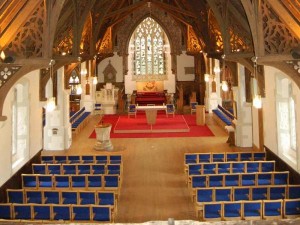
St Margaret’s Church, Leiston, UKDespite the tradition that the Psalms were written by King David, any good commentary will tell you that this Psalm was written probably in the first decades of the Sixth Century BC, at around the time of the fall of Jerusalem to the Babylonians circa 598 BC. Some scholars would even suggest that it was written as late as the Maccabean era (circa 165 BC). Personally, I tend to go with the earlier date; the Psalm’s description of wide spread destruction of religious meeting places seems more in line with the pre-Exilic invasion.
The first deportation of the Jewish leadership followed almost immediately; two more deportations would occur. Those who were taken away were separated from their land and from the temple, central elements in their identity as the People of God. Loss of their homeland and, more importantly, the loss of their exclusive worship space, the temple made a critical impact on their experience and understanding of God. Could they worship God in a foreign land? Where was God in this alien land? For that matter, who was God? Their confusion is expressed in Psalm 137:

By the waters of Babylon we sat down and wept,
when we remembered you, O Zion.
. . .
How shall we sing the Lord’s song
upon an alien soil? (vv. 1,4 BCP version)

Today’s evening Psalm expresses the dismay of those left behind, those who are still in the land but whose places of assembly and worship have been destroyed. Both groups face the same issue: how to worship God without the traditional, exclusive-use worship spaces? Could it even be done?

They learned the lesson that God is not tied to land or temple, that God’s rule extends everywhere. They learned that their appreciation of God’s presence was not dependent on there being the traditional, exclusive-use worship place, that they could worship God anywhere. This is, unfortunately, a lesson that God’s People have forgotten and need to learn again.

We in the Christian church are tied to our buildings, especially those of us who are part of highly liturgical traditions. Our custom (or perhaps we would be better to call it a habit or even an addiction) of structured, even majestic worship with processions, high altars, choirs, fancily vested clergy, and pipe organs seems to demand special spaces in which to indulge it. We forget that these spaces are simply tools for ministry; instead, we treat them as holy themselves and we use them exclusively for worship. We call them “houses of worship” or, even more telling, “houses of the Lord.”

In the spring of 2009 in Cleveland, Ohio, near where I live, the Roman Catholic bishop announced the closure of 52 parish church buildings because the parishes were deemed financially nonviable. The outcry was deafening; the members of many of these congregations could not imagine being the church without their historic building. The Cleveland Plain Dealer reported that the pastor of one of the closed churches tried to teach his flock that the “building is a beautiful building. A magnificent building, but the bottom line is, it isn’t the church. We are.”

Buildings are simply tools and tools should be properly used. While they are useful tools, the loss of buildings and property could actually be a blessing in disguise to such congregations. In American church culture, many churches, like these Roman Catholic parishes, have developed an unwholesome attachment to their buildings and locations. Loss of their building and property could free a congregation to discover its identity as the Body of Christ. The threat of loss could also be salutary; it can encourage a rethinking of our stewardship and use of space.

Proper stewardship of space would encourage the use of our worship locations for other, additional purposes. Flexible space could allow the area used for worship a few hours each Sunday to be used, for example, as a soup kitchen on weekdays. This is exactly what an historic Episcopal church in New York has done. Church of the Holy Apostles‘ nave becomes a dining room where thousands of people are fed. The church which worships there has come to understand that space is not holy because “God lives there.” It is holy because they worship there, and it is no less holy when used for other purposes, such as feeding the poor. After all, “just as you did it to one of the least of these who are members of my family, you did it to me.” (Matthew 25:40 NRSV) Thirteen of the closed Roman Catholic parishes successfully appealed the closure order to the Vatican and the bishop was ordered to reopen the buildings, which occurred late in 2012. Whether the parishes will make any changes in the way they do outreach ministries in their neighborhoods remains to be seen.

The Babylonians destroyed the holy places, but the People of God learned a lesson about their need of holy space . . . that they didn’t need an exclusive-use worship space . . . and they lived on. Today’s economy is, perhaps, making exclusive worship places nonviable, but the People of God can live on without them, or they can live on while making faithful multiple uses of them. The lesson learned by the Jews during the Exile must constantly be relearned.

====================

A request to my readers: I’m trying to build the readership of this blog and I’d very much appreciate your help in doing so. If you find something here that is of value, please share it with others. If you are on Facebook, “like” the posts on your page so others can see them. If you are following me on Twitter, please “retweet” the notices of these meditations. If you have a blog of your own, please include mine in your links (a favor I will gladly reciprocate). Many thanks!

====================

Father Funston is the rector of St. Paul’s Episcopal Church, Medina, Ohio.

Holy Wit: Humor in the Bible – From the Daily Office – February 25, 2013

From the Prophet Jeremiah:

The word of the Lord came to me, saying, “Jeremiah, what do you see?” And I said, “I see a branch of an almond tree.” Then the Lord said to me, “You have seen well, for I am watching over my word to perform it.”

(From the Daily Office Lectionary – Jeremiah 1:11-12 (NRSV) – February 25, 2013.)

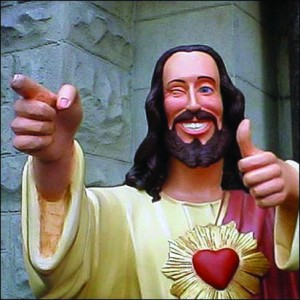
Buddy Jesus, from the movie DogmaThese two verses have probably caused any number of people to scratch their heads in bewilderment over the centuries. Those who read them in English without looking behind the translation to the original language wonder, “What on earth does this mean?” Those who read them in Hebrew wonder, “How can God have such a terrible sense of humor?”

This is a pun. The Hebrew word for “almond” or “almond tree” is shaqed, while that for “watching” is shaqad. God is playing with words and images in order to impress upon Jeremiah’s mind the seriousness of God’s watchfulness. It worked; Jeremiah remembered (and wrote about) it.

The Irish satirist (and Anglican clergyman) Jonathan Swift said of punning that it “is an art of harmonious jingling upon words, which, passing in at the ears, excites a titillary motion in those parts; and this, being conveyed by the animal spirits into the muscles of the face, raises the cockles of the heart.” Essayist Charles Lamb considered the pun “a noble thing per se. It fills the mind, it is as perfect as a sonnet; better.”

Such praise, however, is far from universal. Often quoted is English poet John Dryden’s aphorism that the pun is the “lowest and most groveling kind of wit,” or Ambrose Bierce’s derision of it as a “form of wit to which wise men stoop and fools aspire.” In all of her work, Jane Austen includes puns in only one, Mansfield Park, and there only to demonstrate the low moral character of the offender, the shallow and evil Mary Crawford.

Holy Scripture, on the other hand, is full of puns and other word play, such as double-entendres. The Law and the Prophets are full of them; Jesus uses them in the Gospels. The problem for modern American readers, however, is that they are in Hebrew and Greek, and simply don’t translate into English. In addition, Scripture is chock full of other forms of humor, including sarcasm and irony, humorous imagery and exaggerations, and plays on the names of people and places. Again, these do not translate well from one language to another.

Although there are no jokes per se in the Bible, the Scriptures are replete with humor; there is an abundance of wit in Holy Writ. Perhaps not all, but most of this humor can only be appreciated if read in the original Hebrew or Greek. To the believer, the conservative believer especially, the Bible is a moral document, not a storybook, so the presence of humor in it comes as a shock to many; in fact, some would deny that there is anything funny about the Holy Book. The philosopher Alfred North Whitehead, for example, claimed that “the total absence of humour from the Bible is one of the most singular things in all of literature.” Many Christians seem to think the Bible is only a solemn and serious book, full of timeless wisdom but definitely containing nothing even remotely funny. I recently read a sermon by a preacher from the “Christian Right” which derided the use of humor in preaching; among his assertions was this:

There is no amusement in Jesus, nor is there in any of the 66 books of the Bible. God expects his saints to be quite content with straight forward fellowship and sound teaching. Any time the saints seem to get overloaded with good things, the solution is to sing Psalms and spiritual songs. Anything else is mongrel Christianity.

I remember reading a report a couple of years ago of a study by two psychologists which suggested that political conservatives have much less of a sense of humor than do liberals, and another which, disturbingly, showed that conservative evangelical Christians are more likely than not to support torture of suspected terrorists. And I wonder if there is some connection between failure to appreciate the humor in Holy Scripture and Christian conservatism.

As a Christian who generally leans towards political liberalism, I enjoy the word play, the sarcasm, the irony, and all the other humor in the Bible. I believe that humor brings us closer to God and that the holy wit in Holy Writ brings God closer to humankind. The Protestant theologian Karl Barth is reported to have said, “Laughter is the closest thing to the grace of God.” And the Catholic theologian and writer G.K. Chesterton wrote, “It is the test of a good religion whether you can joke about it.” I believe they are right, because “he whose throne is in heaven is laughing.” (Psalm 2:4a, BCP translation)

Maybe God’s doing so because of all those awful puns one finds in God’s book.

====================

A request to my readers: I’m trying to build the readership of this blog and I’d very much appreciate your help in doing so. If you find something here that is of value, please share it with others. If you are on Facebook, “like” the posts on your page so others can see them. If you are following me on Twitter, please “retweet” the notices of these meditations. If you have a blog of your own, please include mine in your links (a favor I will gladly reciprocate). Many thanks!

====================

Father Funston is the rector of St. Paul’s Episcopal Church, Medina, Ohio.

A Promise Beyond the Horizon – Sermon for the Second Sunday in Lent – February 24, 2013

====================

This sermon was preached on Sunday, February 24, 2013, at St. Paul’s Episcopal Church, Medina, Ohio, where Fr. Funston is rector.

(Revised Common Lectionary, Lent 2, Year C: Genesis 15:1-12,17-18; Psalm 27; and Luke 13:31-35. These lessons can be read at The Lectionary Page. At St. Paul’s Parish, during Lent, we are using the Daily Office of Morning Prayer as our antecommunion; therefore, only these two lessons and the psalm were read. The epistle lesson, Philippians 3:17-4:1, was not used.)

====================

Abraham Friend of God, artist unknownSeveral years ago – 33 to be exact – Bruce Dern starred in a little-remarked movie entitled Middle Age Crazy; it dealt with the main character’s midlife crisis of turning 40 years of age.

Dern’s character is a construction company owner who has made it big by building taco stands for a successful chain. He’s married to Anne-Margaret (at least, Anne-Margaret plays his wife). He has a nice car, a nice house, a swimming pool and (as a friend reminds him) a jacuzzi. By the standards of success in 1980, he’s doing very well. But turning 40 has him questioning all of that.

At one point during the movie, he is attending his son’s high school graduation and begins to fantasize what he would say to the graduating class. He would start, he thinks, by criticizing graduation speeches that tell the kids they are “the future.” That’s nonsense, he says: “You can’t all be the future. There’s not that much future to go around.”

“If you’ve got any sense,” he tells the high school seniors, “give ’em back their [bleep] diplomas. Give ’em back their silly [bleep] hats and stay 18 for the rest of your life. You don’t want to be the future. No, no. Forget the future.” The future, he tells, them is absolutely awful! In the context of a story about a man dealing with a midlife crisis, it’s a very funny scene . . . but the truth is, it’s a tragic speech. (You can see the speech on YouTube. Be warned, however, I’ve cleaned up the quotations; Dern drops the “f-bomb” several times.)

It not only fails to be forward and future looking, it positively rejects the future, preferring a static and juvenile present. That is a tragedy!

In contrast, we have our spiritual ancestor Abram . . . 75-year-old Abram, as-good-as-dead Abram (according to both Paul and the writer of the Letter to the Hebrews), set-in-his-ways Abram, but willing-to-move-into-the-future Abram.

In Chapter 12 of the Book of Genesis, Abram is told by God to leave his home in Ur and travel to a land that God will give to him and to his offspring, and that God will make him the ancestor of many nations, and Abram does as he is told. But after journeying through several lands, all the way down into Egypt and then back up into Canaan, Abram and Sarai still have not had any children, so we find him in today’s reading in Chapter 15 a little bit anxious about that. He is afraid that this “offspring” are really going to be the children of his servant Eliezer of Damascus.

Abram said, “O Lord God, what will you give me, for I continue childless, and the heir of my house is Eliezer of Damascus?” And Abram said, “You have given me no offspring, and so a slave born in my house is to be my heir.” But the word of the Lord came to him, “This man shall not be your heir; no one but your very own issue shall be your heir.” He brought him outside and said, “Look toward heaven and count the stars, if you are able to count them.” Then he said to him, “So shall your descendants be.” And he believed the Lord; and the Lord reckoned it to him as righteousness. (Gen. 15:2-6)

There are the important words in this story: “He believed the Lord, and the Lord reckoned it to him as righteousness.”

Unlike the character in Middle Age Crazy, Abram trusted in the promise of the future. The trouble with promises, of course, is that they entail waiting. No one likes to wait, but Abram is content to do so. Waiting on a promise of God, trusting in God, is what we call “faith”. Abram, or Abraham as he came to be known, is the prophet of faith; in fact, one of the titles given him in religious tradition is “the Father of Faith”.

Several years ago when our children were very young, we took a family “road trip” from our home in the Kansas City area back to Las Vegas so I could take part in a friend’s wedding. We stopped along the way to see the sights such as the Palo Verde Canyon in Texas, the Acama Pueblo in New Mexico, the Grand Canyon in Arizona, and so forth. Each morning we would tell the kids where we were going and what we expected to see and, of course, not long after we hit the road each day one of them would ask, “When will we get there? Are we there yet?” I don’t recall when I finally lost my patience with their impatience, but somewhere along the way I cautioned them as they got into the car, “We will get there when we get there. Don’t keep asking if we are there yet – understand?” We’d driven for a while, maybe an hour or two, when our son Patrick spoke up and asked, “Will I still be alive when we get there?” A promise of the future entails waiting, and sometimes we are just too impatient to wait.

Abraham the prophet of faith is presented to us in Lent, I think, as a challenge. Abraham’s faith in God’s promise that he would have offspring, despite all appearances to the contrary, challenges us to ask whether we have believed in the future God promises us with the kind of belief that can be reckoned as righteousness.

Now, please note one thing. Abraham believed God about the promise of offspring, but still asked God how he could know that the promise of possession of the land would be fulfilled. And God accepted his questioning, and offered as proof a demonstration of God’s power: “Bring me,” said God, “a heifer three years old, a female goat three years old, a ram three years old, a turtledove, and a young pigeon.” (Gen. 15:9) Abraham did so, and when it was dark, “a smoking fire pot and a flaming torch passed between [the] pieces” Abraham had prepared from the sacrificial animals. At that point, God said to Abraham, “To your descendants I give this land, from the river of Egypt to the great river, the river Euphrates.” (vv. 17-18)

There are two things about this promise: first, it is for a future Abraham would never see because it is to his descendants that the land will be given; second, it is a promise of something that cannot be fully seen by anyone. This tract of land stretches from the Nile in the southwest to the Euphrates in the northeast; wherever one may be in this vast territory, most of the promised area is beyond the horizon.

This text reminds us that a life of faith, a life lived in reliance on God’s promise is not about immediate gratification nor even about our own benefit. Living a faithful, righteous life is about moving forward into a vision that extends beyond our own lives. A faithful, righteous life is lived in deep expectation coupled with patient belief that God’s promises will be fulfilled.

This is the life to which the People of God are called, all of the descendants of Abraham, not only the Hebrews, not only the people of ancient Israel and Judah, not only the Chosen People of the Covenant, but also ourselves. For as St. Paul assured the Galatians, “those who believe are the descendants of Abraham.” (Gal. 3:7) And it is the failure of God’s People to believe in and trust that promise that the prophets decried in ancient Israel. When the prophets declared God’s judgment, it was their intent that those upon whom the judgment would fall might know their predicament, repent, and be rehabilitated. The prophets pronounced judgment in the hope of salvation. When the prophets lamented over Jerusalem, their sadness over a distressing state of affairs assumed that God would hear their cry and has turn that which was lamentable into something good.

The powers-that-were in Jerusalem, of course, did not want to hear this. They had no more patience with the future, no more vision for it, than did Bruce Dern’s character in Middle Age Crazy. They were perfectly happy with the status quo and, like that character, wanted to stay 18 forever! In terms of Jesus metaphor in the gospel lesson today (Luke 13:31-35), they wanted to remain chicks forever!

That is an extraordinary metaphor, by the way. As theologian William Loader says, “It speaks of being like a hen seeking to gather chicks throughout Jerusalem’s history. It cannot refer to Jesus’ short ministry. How can he speak as though he has been regularly present in Jerusalem over centuries? The context indicates that each prophet has been an embodiment of the hen gathering her chicks.” As the Logos of God from the beginning of time, Christ was present in the prophets. Jerusalem, the center of political and religious power, refused to heed the prophets in whom Christ himself was present; instead, it killed them. Unlike their ancestor, the descendants of Abraham were not people of faith who believed the promise and waited patiently for its fulfillment.

Dr. Arland Hultgren, a Lutheran theologian, says, “It is right, even inevitable, when dealing with this text, to ask about the present. Who or what is the ‘Jerusalem’ of the day in which one lives? Is it the political and civic sphere? Is it the religious sphere? Or is it both?” Maybe it’s us . . . .

Lent gives us the opportunity to reflect upon that question, to examine our own lives; it permits us to heed God’s call to live a faithful life, a life moving forward into God’s vision for us, for our church, for the world, knowing (as Abraham knew) that that vision may extend far beyond the horizon of our own lives. And, God assures us, it will be reckoned to us as righteousness and the promise will be fulfilled. Amen.

====================

A request to my readers: I’m trying to build the readership of this blog and I’d very much appreciate your help in doing so. If you find something here that is of value, please share it with others. If you are on Facebook, “like” the posts on your page so others can see them. If you are following me on Twitter, please “retweet” the notices of these meditations. If you have a blog of your own, please include mine in your links (a favor I will gladly reciprocate). Many thanks!

====================

Father Funston is the rector of St. Paul’s Episcopal Church, Medina, Ohio.

The Possibility Is Just Too Wonderful – From the Daily Office – February 23, 2013

From the Psalms:

Lord, you have searched me out and known me;
you know my sitting down and my rising up;
you discern my thoughts from afar.
You trace my journeys and my resting-places
and are acquainted with all my ways.
Indeed, there is not a word on my lips,
but you, O Lord, know it altogether.
You press upon me behind and before
and lay your hand upon me.
Such knowledge is too wonderful for me;
it is so high that I cannot attain to it.
Where can I go then from your Spirit?
where can I flee from your presence?
If I climb up to heaven, you are there;
if I make the grave my bed, you are there also.
If I take the wings of the morning
and dwell in the uttermost parts of the sea,
Even there your hand will lead me
and your right hand hold me fast.

(From the Daily Office Lectionary – Psalm 139:1-9 (BCP version) – February 23, 2013.)

Multiple Worlds IllustrationA few days ago I wrote about my interest in superstring theory, m-theory, and the multiverse concept which springs from my life-long love of science fiction and the especially the “alternate reality” sorts of tales. I suggested that Jesus’ miracles might have been accomplished by his somehow accessing an alternate reality to affect this world; that would imply some sort of access to knowledge of those other universes.

I’ve never believed that the human Jesus had access to the divine mind in that way, so I’m not sure how I feel about that implication. Or maybe a spiritual connection to another reality doesn’t require that; perhaps that sense of and access to a healthier reality is what the Celts are onto with their idea of a “thin place”. Perhaps there are places where the divisions between the universes are permeable, and perhaps there are people who, like Jesus can sense that, and draw the realities together. Perhaps the ability to do this is what Jesus promised his disciples when he said, “If you do not doubt in your heart, but believe that what you say will come to pass, it will be done for you. So I tell you, whatever you ask for in prayer, believe that you have received it, and it will be yours.” (Mark 11:23-24) I know that’s a lot of “perhapses” . . . . but that’s part of what meditation is all about, imagining the possibilities.

And it is possibilities and alternate realities, and the question of God’s knowledge of them, that grab my attention today as I consider the evening psalm. The psalmist sings of God’s knowledge, which is all encompassing; God’s understanding of the psalmist’s existence is inescapable. In theology this is call “omniscience”; God is described as “all knowing.”

If there is only a universe, a single reality, this would mean that God knows the past, the present, and the future of the one-and-only timeline, and this gives rise to the doctrine of predestination, a sort of determinism: if God knows ahead of time what will happen, then events in the universe are effectively predetermined from God’s point of view. I have a lot of difficulty with predestination because, if it is true, then Jesus promise that “the truth will make you free” (John 8:32) is hollow. There is no freedom in a single universe whose future is determined.

But what if m-theory is right and there are alternative realities, an infinity of them? What if what God “knows” is not the future of a single reality, but all the multiplicity of possible outcomes? What God “knows” in that case is not what must be, but what might be. God knows, for example, what will become of Schrödinger’s cat . . . in every possible outcome there may be.

The multiverse theory is much too complicated to lay out in a brief theological reflection (and I’m certainly not the theoretical mathematician who could do so, in any case), but at its highest level it simply postulates that any universe that is mathematically possible has equal possibility of actually existing: if the physicists and mathematicians can get it to work out on paper, even if it can’t exist in this universe, it would exist “somewhere”. And, I would suggest, the God of possibilities would know about that universe.

God’s omniscience over a multiverse reality truly is “too wonderful for me.” It is also, from my point of view, much more exciting than any deterministic, single-universe idea that God simply knows the future of a solitary timeline. It means that God is the God of possibility. “For God all things are possible,” said Jesus (Matt. 19:26) And again, “What is impossible for mortals is possible for God.” (Luke 18:27) And again, “Abba, Father, for you all things are possible.” (Mark 14:36)

Søren Kierkegaard wrote, “Inasmuch as for God all things are possible, it may be said that this is what God is: one for whom all things are possible . . . God is that all things are possible, and that all things are possible is the existence of God.” (The Sickness Unto Death) For Kierkegaard, human existence is not confined to the known, to one concrete, “factual” reality; a multitude of possibilities is fundamental to human life. The human soul is released by possibility; it is possibility that makes us free.

Superstring theory, m-theory, the multiverse hypothesis . . . these are the new science of possibility. Our omniscient God is the God of possibility. And possibility is the truth that sets us free! That is just too wonderful!

====================

A request to my readers: I’m trying to build the readership of this blog and I’d very much appreciate your help in doing so. If you find something here that is of value, please share it with others. If you are on Facebook, “like” the posts on your page so others can see them. If you are following me on Twitter, please “retweet” the notices of these meditations. If you have a blog of your own, please include mine in your links (a favor I will gladly reciprocate). Many thanks!

====================

Father Funston is the rector of St. Paul’s Episcopal Church, Medina, Ohio.

« Older posts Newer posts »