Occasional thoughts of an Anglican Episcopal priest

Category: Prayer (Page 40 of 47)

The Audience of One – From the Daily Office – December 4, 2012

From First Thessalonians:

We have been approved by God to be entrusted with the message of the gospel, even so we speak, not to please mortals, but to please God who tests our hearts. As you know and as God is our witness, we never came with words of flattery or with a pretext for greed; nor did we seek praise from mortals, whether from you or from others.

(From the Daily Office Lectionary – 1 Thess. 2:4-6 (NRSV) – December 4, 2012.)

Audience of OneI would like to have a word with the clergy, music directors, musicians, choir directors, altar guild mistresses, sacristans, choristers, Sunday School superintendents, lay readers, acolytes, and a score of others about all the things many of us are doing to get ready for Christmas.

I’m sure that you, like my colleagues and me, are planning liturgies, choosing music, decorating sanctuaries, casting church school pageants, rehearsing anthems, laundering vestments, practicing readings, learning how to swing thuribles, and doing dozens of other preparatory tasks as the special events of the holiday loom every closer. Your looking forward to your Sunday School Pageant, to the Christmas Cantata, the Christmas Eve Family Service, the Midnight Mass, or whatever the “big event” may be in your congregation. You’re hoping, expecting that there will be a large turnout of appreciative people, probably many who only show up at Christmas (or maybe also at Easter), but you’re really hoping that a big crowd of parishioners will be there.

Last Sunday evening my parish’s choir did a wonderful job of offering a service of Lessons and Carols. It was the shorter version of that model of worship: six lessons each followed by a hymn or choral offering. Other music included a prelude, a couple of additional hymns at the beginning and end, an offertory anthem, and a postlude. A chanted vesper responsory and a few chanted collects were thrown in for good measure. The music was beautifully performed. The six readers of the lessons had obviously practiced and all read very well. Members of the choir had provided, and some non-choir volunteers had laid out, finger food and snacks for a reception in the parish hall following the service.

Barely 40 people attended. Not even a quarter of the Nave was filled. Those who attended all praised the choir’s, the officiant’s, and the readers’ efforts; they said it was a lovely experience. A couple of people said something to this effect, “It’s too bad more people weren’t here.” The spouse of a chorister was rather more critical and wondered why everyone had even bothered with all the planning, all the rehearsals, or the offering of the service when so few parishioners turned out.

Why? Paul directly answers that question in this bit from his first letter to the church in Thessalonika: “We [do it], not to please mortals, but to please God.” We do it for an audience of One.

A service of worship has many of the elements of a dramatic presentation or a musical concert, and much of the preparation we do for worship is the same as is done for those sorts of events. In many ways, worship is a drama . . . but in one important way it is very different. There is no difference between performer and audience; there is, in fact, no human audience. Every man, woman, and child who participates is an actor, not an observer.

For generations the church has acted as if these were roles of worship: The worship leaders (clergy and liturgical assistants, choir, liturgical musicians) are the performers of worship; the congregation is the audience; and God is the prompter of worship, i.e., God tells the worship leaders what to do. My favorite theologian-philosopher Soren Kierkegaard in the 19th Century wrote that that was all wrong. In corporate worship, he suggested, the people should be the performers, the worship leaders are to be the prompters, and God is the audience.

It doesn’t matter that only a few people turned out for the service of lessons and carols, or for any service. If we do all these things we are doing, all the liturgical design, all the musical rehearsal, all the polishing of silver and decorating of the church, and no one shows up on Christmas Eve but ourselves, it will not be for nothing. We do what we do, not to please mortals, but to please God.

So clergy, music directors, musicians, choir directors, altar guild mistresses, sacristans, choristers, Sunday School superintendents, lay readers, acolytes, and the scores of others doing all the things we are all doing to get ready for Christmas . . . do them to the best of your ability. We are doing them for the audience of One.
====================

A request to my readers: I’m trying to build the readership of this blog and I’d very much appreciate your help in doing so. If you find something here that is of value, please share it with others. If you are on Facebook, “like” the posts on your page so others can see them. If you are following me on Twitter, please “retweet” the notices of these meditations. If you have a blog of your own, please include mine in your links (a favor I will gladly reciprocate). Many thanks!

====================

Father Funston is the rector of St. Paul’s Episcopal Church, Medina, Ohio.

Advent Cleansing – From the Daily Office – December 3, 2012

From the Prophet Isaiah:

Wash yourselves; make yourselves clean;
remove the evil of your doings
from before my eyes;
cease to do evil,
learn to do good;
seek justice,
rescue the oppressed,
defend the orphan,
plead for the widow.

(From the Daily Office Lectionary – Isaiah 1:16-17 (NRSV) – December 3, 2012.)
 
Washing Behind th EarsAdvent is a time of preparation. We are getting ready for the annual feast of remembrance of the birth of Christ; we are getting ready for that unknown time that will come like a thief in the night when the Lord returns in glory to judge the living and the dead.

When I was a kid one of the rituals associated with going to visit someone, or when someone was going to come visit us, was the cleaning up. Taking a bath or shower, scrubbing behind one’s ears, brushing one’s teeth. The latter I could understand; bad breath was to be avoided. But the cleaning behind the ears . . . was somebody going to look at the backs of my ears? Were the people we were going to visit, or the person coming to visit us, really going to inspecting my ears?

Those childhood pre-visit baths come to mind when I read Isaiah’s admonition to “wash yourselves” and “make yourselves clean.” Of course, ears are not the issue here; personal spirits, individual consciences, and social injustices are. What can I do this Advent to seek justice? How can I rescue the oppressed? What measures can I take to defend and plead for the orphan and the widow? Each of us must answer these questions for ourselves, and then act on them. In the midst of shopping, baking, partying, gift-wrapping, decorating, and all the rest, we need to find time to do more than throw a few coins in a red bucket. That may be a start, but earlier in this reading today, the Lord says clearly that “bringing offerings is futile.” (v. 13)

When the king returns, he will be looking at our lives, not our offerings (as important as those may be to us). It is not enough to pay someone else, even a church or a well-deserving charity, to take care of the poor. When the king like a shepherd separates the sheep from the goats, to those on his right hand he will say, “You gave me something to eat or drink or to wear. You visited me.” He will not say, “You paid for someone else to do these things.” That won’t have been enough; it has to be personal. Each of us must undertake personal actions of justice and kindness; this is how we make ourselves clean.

====================

A request to my readers: I’m trying to build the readership of this blog and I’d very much appreciate your help in doing so. If you find something here that is of value, please share it with others. If you are on Facebook, “like” the posts on your page so others can see them. If you are following me on Twitter, please “retweet” the notices of these meditations. If you have a blog of your own, please include mine in your links (a favor I will gladly reciprocate). Many thanks!

====================

Father Funston is the rector of St. Paul’s Episcopal Church, Medina, Ohio.

Pluck the Fruit, Pay Attention: Sermon for Advent 1, Year C – December 2, 2012

====================

This sermon was preached on Sunday, December 2, 2012, at St. Paul’s Episcopal Church, Medina, Ohio, where Fr. Funston is rector.

(Revised Common Lectionary, Advent 1, Year C: Jeremiah 33:14-16; Psalm 25:1-9; 1 Thessalonians 3:9-13; and Luke 21:25-36. These lessons can be read at The Lectionary Page.)

====================

Fig Tree (Ficus Carica)“The days are surely coming….”

“Be blameless before our God and Father at the coming of our Lord Jesus….”

“There will be signs in the sun, the moon, and the stars….”

“Heaven and earth will pass away….”

The End Is Near!

We don’t actually pay much heed or give much credence to crazy talk like that now, do we? We’ve heard plenty of preachers on street corners, on the radio, on the television predicting the end of the world. Remember Harold Camping last year? And, of course, the so-called Mayan prediction that we all have only nineteen days left now. We’ve heard these sorts of things often enough over the years that we just don’t pay any attention to them.

On top of that, we’ve become thoroughly scientific and modern. Everything has an explanation. We know how the world works. And we’ve turned all of it into a product; everything is for sale in one way or another. There seems to be no more mystery in anything. Our materialistic progress has almost overshadowed any sense of the spiritual. We have analyzed, demystified, commodified, and commercialized everything. In 1802 William Wordsworth wrote a sonnet bemoaning exactly that:

The world is too much with us; late and soon,
Getting and spending, we lay waste our powers;
Little we see in Nature that is ours;
We have given our hearts away, a sordid boon!
This Sea that bares her bosom to the moon,
The winds that will be howling at all hours,
And are up-gathered now like sleeping flowers,
For this, for everything, we are out of tune;
It moves us not. – Great God! I’d rather be
A Pagan suckled in a creed outworn;
So might I, standing on this pleasant lea,
Have glimpses that would make me less forlorn;
Have sight of Proteus rising from the sea;
Or hear old Triton blow his wreathed horn.

“Great God! I’d rather be a Pagan!” wrote Wordsworth more than 200 years ago. We modern Christians, he said, “have given our hearts away. We are out of tune” with the rhythms of the world. We no longer see the signs in the natural world. But here they are in scripture, the signs of the end of the world, reportedly predicted by Jesus himself. “Look at the fig tree and all the trees,” he says, “as soon as they sprout leaves you can see for yourselves and know that summer is already near. So also, when you see these things taking place [these signs in the sun, the moon, and the stars], you know that the kingdom of God is near.”

We human beings, whether Pagan or Christian, have proven incredibly bad at understanding the signs of the times insofar as they apply on a global, or universal, or apocalyptic scale. We keep getting it wrong. You’ve probably heard someone say something like this: “The Earth is degenerating today. Bribery and corruption abound. Children no longer obey their parents, and it is evident that the end of the world is fast approaching.” Those particular words were found inscribed on a clay tablet from ancient Assyria, a tablet dating from about 2800 BC, and there are similar words on a grafitto on a wall in ancient Pompeii – so I’m not sure Wordsworth was all that right about the pagans. They weren’t any better at it than we are.

But here’s the thing. Jesus didn’t tell us to look at the forest. He told us to look at the trees, at individual trees, at the fig tree in particular. The end of the world doesn’t come, or at least it hasn’t come, in a big global, universal apocalypse. It comes to each of us individually. Today is the end of the world, right now, for somebody. All over the world, today is the day of judgment. For thousands, possibly millions, of individual people today is the end of the world; they will die today. For millions of others, there will be some important turning point their lives. For each of those people, the end – in some way or another – is close at hand.

Why do you suppose church tradition has us thinking about such things at the beginning of the Christian year, the First Sunday of Advent, with only twenty-two days until Christmas Eve, getting ready for one of the most joyous events of our year? Well, it’s because Advent isn’t just about getting ready for Christmas; it’s not even primarily about getting ready for Christmas. It’s about getting ready for Christ’s Return; it’s about getting ready for the Second Coming. Advent, in fact, means “coming” and the season is about getting ready for the coming of Judgment Day, the end of this life.

And how do we do that? By paying attention and by praying. As Jesus says, “Be alert at all times, praying . . . . ”

During this season while we get ready for Christmas, try not to get all caught up in the commodification and commercialization of everything. A friend of mine, Fr. Marshall Scott, who’s a hospital chaplain in Kansas City, commented recently, “It seems to me that the problem is not too little Christ in Christmas. The problem is too many ads in Advent.” Don’t get caught up in all of that! Take a breath; pay attention to the rest of life. I’m tempted to say, “Pay attention the real things in life.” Take time to pray, today; take time to give thanks, today. Because, although it sounds like a cliché, it’s the truth of Advent, today may be the end. And if it is, be assured that at the end stands Jesus.

So live expectantly; fill each day with meaningful activity. “Stand up and raise your heads, because your redemption is drawing near.”

The 20th Century poet Denise Levertov penned an answer to Wordsworth. Where he wrote, ” The world is too much with us,” in her poem O Taste and See she wrote, “The world is not with us enough.” This is her poem:

The world
is not with us enough.
O taste and see
the subway Bible poster said,
meaning The Lord, meaning
if anything all that lives
to the imagination’s tongue,
grief, mercy, language,
tangerine, weather, to
breathe them, bite,
savor, chew, swallow, transform
into our flesh our
deaths, crossing the street, plum, quince
living in the orchard and being
hungry, and plucking
the fruit.

That is Advent’s message: taste and see, bite and savor, cross the street, pluck the fruit, stand up, raise your head, pay attention, be alert. Amen.

Say a Little Prayer . . . for Yourself – From the Daily Office – December 2, 2102

From Matthew’s Gospel:

Jesus said, “Then the kingdom of heaven will be like this. Ten bridesmaids took their lamps and went to meet the bridegroom. Five of them were foolish, and five were wise. When the foolish took their lamps, they took no oil with them; but the wise took flasks of oil with their lamps. As the bridegroom was delayed, all of them became drowsy and slept. But at midnight there was a shout, ‘Look! Here is the bridegroom! Come out to meet him.’ Then all those bridesmaids got up and trimmed their lamps. The foolish said to the wise, ‘Give us some of your oil, for our lamps are going out.’ But the wise replied, ‘No! there will not be enough for you and for us; you had better go to the dealers and buy some for yourselves.’ And while they went to buy it, the bridegroom came, and those who were ready went with him into the wedding banquet; and the door was shut. Later the other bridesmaids came also, saying, ‘Lord, lord, open to us.’ But he replied, ‘Truly I tell you, I do not know you.’ Keep awake therefore, for you know neither the day nor the hour.”

(From the Daily Office Lectionary – Matthew 25:1-13 (NRSV) – December 2, 2012. Please note, this is the Daily Office gospel for today, a Sunday, not the gospel from the Eucharistic lectionary.)
 
Clay Oil LampI have to admit that I’ve never liked this parable! I mean, isn’t the point of the gospel of Jesus Christ that we are “all in this together” and that we’re supposed to help one another, share what we have, take care of our brothers and sisters who have less than we do? But here “wisdom” of five bridesmaids is to be selfish and not share their oil! That just doesn’t sit well with me.

But, of course, that’s not the point of the parable, is it? The thing about parables is that they are are extremely limited in their application. Parables, especially Jesus’ parables, are usually intended to make a single important point, and living in community, sharing what we have, and helping one another is definitely not the point of this parable. This little story is about being ready, being prepared, getting one’s act together.

As a reminder for the first day of the new Christian year, the first Sunday of the season of Advent, this story is most apt. In the midst of all the running about that most of us are doing at this time of year, buying presents, decorating homes and businesses, planning liturgies (those of us in the church business), planning menus, baking fruit cakes, making candy, taking care of travel arrangements . . . the list of pre-Christmas activities goes on and on . . . it is good to take a moment to look beyond the big day. Are we ready for something else? Are we ready for what lies beyond Christmas? Beyond this life? Are we ready for the bridegroom’s return? Will the bridegroom know you when he comes back?

The way to be known to cultivate a relationship; the way we do that with Christ is through prayer. Forty-five years ago this month, Dionne Warwick made the charts with the Burt Bacharach tune I Say a Little Prayer. The song describes several times each day, during every day activities, when the singer said a short prayer for her beloved. That’s really all it takes, a short prayer in the midst everyday life.

Here’s a simple exercise in tending one’s lamp and making sure one’s stock of oil is filled: each time you get into or out of your car say this words – “Jesus Christ, Son of God, have mercy on me.” Nine short words. Say them in connection with that one specific action. It won’t take long but it will cultivate the habit of prayer; it will add a little oil to your store; it will trim the wick of your lamp just a little.

====================

A request to my readers: I’m trying to build the readership of this blog and I’d very much appreciate your help in doing so. If you find something here that is of value, please share it with others. If you are on Facebook, “like” the posts on your page so others can see them. If you are following me on Twitter, please “retweet” the notices of these meditations. If you have a blog of your own, please include mine in your links (a favor I will gladly reciprocate). Many thanks!

====================

Father Funston is the rector of St. Paul’s Episcopal Church, Medina, Ohio.

Shouting Stones – From the Daily Office – November 30, 2012

From Luke’s Gospel:

They brought [a colt] to Jesus; and after throwing their cloaks on the colt, they set Jesus on it. As he rode along, people kept spreading their cloaks on the road. As he was now approaching the path down from the Mount of Olives, the whole multitude of the disciples began to praise God joyfully with a loud voice for all the deeds of power that they had seen, saying,
“Blessed is the king who comes in the name of the Lord!
Peace in heaven, and glory in the highest heaven!”
Some of the Pharisees in the crowd said to him, “Teacher, order your disciples to stop.” He answered, “I tell you, if these were silent, the stones would shout out.”

(From the Daily Office Lectionary – Luke 19:35-40 (NRSV) – November 30, 2012)
 

Duddo Stone Circle

Duddo Stone Circle

In the rock opera Jesus Christ, Superstar Jesus’ triumphal entry into Jerusalem is set to music in the song Hey Sanna Hosanna . In it, Jesus’ reply to the Pharisees is set in rhythm:

Why waste your breath moaning at the crowd?
Nothing can be done to stop the shouting.
If every tongue were stilled
The noise would still continue.
The rocks and stones themselves would start to sing

That’s one of my favorite verses of scripture and one of my favorite songs and, whenever I’m traveling and come across a stone monument of some sort, the image of shouting stones and the music of Andrew Lloyd Webber and Tim Rice pop into my head.

In northeastern England there is a circle of standing stones at Duddo in Northumberland. I visited those stones in the summer of 2011, spending a lonely afternoon with them, loudly singing the music of Superstar all by myself in the English countryside. To reach the circle, you park your car at the side of a narrow country road and hike through a farmer’s fields for the better part of 40 minutes.

No one is quite sure what the Duddo Stone Circle is all about. It may have marked a burial site, but that cannot be proven because Victorian and early 20th Century excavations disturbed any cremation chamber that may have been there. It may have been a religious site of some sort, but who can tell? It is dated to the Bronze Age principally because of its size. Archeologists tell us that the final phase of stone circle building occurred during the early to middle Bronze Age (c. 2200–1500 BCE) which saw the construction of small circles like Duddo, probably by family groups or clans rather than the larger population groups needed to build the larger circles and henges, such as Stonehenge or huge stone circle that encompasses the village of Avebury in Wiltshire.

The purpose of stone circles and henges is forever lost to us. They may have been religious; they have been astrological or astronomical observatories of a sort; they have been talismanic. Still, whatever their purpose and whoever their builders, they remain today as monuments to community and cooperation, to the human need to communicate and connect with that which is greater than the individual. Though the stones at Duddo have fallen and been stood up again over time, they continue (perhaps 4,000 years after their initial placement on that hillside in Northumbria) to shout that message of human need.

I think that’s what Jesus’ answer to the Pharisees is all about. It’s an acknowledgement that our human need to connect with that which is larger than ourselves can never be silenced. Standing circles, henges, temples, church buildings, cathedrals are all evidence of that, even though they are nothing more than stones. They are stones artfully arranged to shout out, to sing glory to the heavens, to celebrate our connection to the infinite. Even when we are silent, like the long-gone builders of the Duddo Stone Circle, the stones themselves continue to cry out.

====================

A request to my readers: I’m trying to build the readership of this blog and I’d very much appreciate your help in doing so. If you find something here that is of value, please share it with others. If you are on Facebook, “like” the posts on your page so others can see them. If you are following me on Twitter, please “retweet” the notices of these meditations. If you have a blog of your own, please include mine in your links (a favor I will gladly reciprocate). Many thanks!

====================

Father Funston is the rector of St. Paul’s Episcopal Church, Medina, Ohio.

Scattered Thoughts about Trees – From the Daily Office – November 28, 2012

From Luke’s Gospel:

Jesus entered Jericho and was passing through it. A man was there named Zacchaeus; he was a chief tax collector and was rich. He was trying to see who Jesus was, but on account of the crowd he could not, because he was short in stature. So he ran ahead and climbed a sycamore tree to see him, because he was going to pass that way.

(From the Daily Office Lectionary – Luke 19:1-4 (NRSV) – November 28, 2012)
 
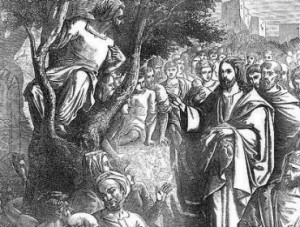
Jesus Addresses Zacchaeus in the Sycamore TreeZacchaeus climbs a tree to see Jesus. So today’s reading got me thinking scattered thoughts about trees. The weeping willow in my childhood backyard. The peach and cherry trees in my grandfather’s garden. The pinion pines of my native Nevada. The eucalyptus trees that were everywhere on my college campus. The huge ornamental pepper tree that shaded the first house my wife and I bought. I close my eyes, think of those trees, and I see my parents, my childhood friends, my college roommates. Trees are filled with meaning and memory; they bear the fruits of remembrance.

Zacchaeus hung in a tree to see Jesus. It won’t be too long before Jesus will be hung on a tree. Paul will write to the Galatian church, “Christ redeemed us from the curse of the law by becoming a curse for us – for it is written, ‘Cursed is everyone who hangs on a tree.'” (Gal. 3:13)

The tree Zacchaeus climbs is a Ficus Sycomorus. This tree produces an edible fruit, an inferior fig which the poor gathered. When I think of trees bearing fruit, I sometimes remember my grandfather’s peach and cherry trees. I sometimes remember the orange orchards around my parents’ retirement home. I sometimes remember the apple trees in my yard in Kansas that enticed my neighbor’s cows to break down the fence. And I sometimes remember a song sung by Billie Holiday; I remembered it as I thought of Zacchaeus and Jesus and the trees on which they hung. The song is entitled Strange Fruit and concerns the lynching of blacks in the American South:

Southern trees bear a strange fruit,
Blood on the leaves and blood at the root,
Black bodies swinging in the southern breeze,
Strange fruit hanging from the poplar trees.

Pastoral scene of the gallant south,
The bulging eyes and the twisted mouth,
Scent of magnolias, sweet and fresh,
Then the sudden smell of burning flesh.

Here is fruit for the crows to pluck,
For the rain to gather, for the wind to suck,
For the sun to rot, for the trees to drop,
Here is a strange and bitter crop.

Words by Abel Meeropol.

The tree on Calvary bore a strange fruit, too. It bore the fruit of salvation. Because of that fruit, in a few weeks Americans will place trees in their homes (if they haven’t already) to commemorate the birth of the One who hung on that tree and offered that fruit to all. Those evergreens in American homes will also bear fruit. The fruit of good will, of families gathered in love, of traditions and family customs. Some will bear bitter fruit; not every family gathering will be happy, not every family will join in love. Families, like trees, bear different kinds of fruit, some good, some not so good, some downright bad. But the fruit borne by the tree on Calvary is for all, and that’s why we bring trees into our houses at Christmas. Those trees, like Zacchaeus’s sycamore, help us to see Jesus.

Scattered thoughts about trees. Trees fill our lives and we seldom notice them, but they bear all sorts of fruits. Strange fruits. Fruits of emotion and memory. Fruits of salvation. Zacchaeus climbed a tree to see Jesus.

====================

A request to my readers: I’m trying to build the readership of this blog and I’d very much appreciate your help in doing so. If you find something here that is of value, please share it with others. If you are on Facebook, “like” the posts on your page so others can see them. If you are following me on Twitter, please “retweet” the notices of these meditations. If you have a blog of your own, please include mine in your links (a favor I will gladly reciprocate). Many thanks!

====================

Father Funston is the rector of St. Paul’s Episcopal Church, Medina, Ohio.
Giving It All Up, Getting Back Very Much More – From the Daily Office Lectionary – November 26, 2012

From Luke’s Gospel:

Jesus said, “It is easier for a camel to go through the eye of a needle than for someone who is rich to enter the kingdom of God. Those who heard it said, “Then who can be saved?” He replied, “What is impossible for mortals is possible for God.” Then Peter said, “Look, we have left our homes and followed you.” And he said to them, “Truly I tell you, there is no one who has left house or wife or brothers or parents or children, for the sake of the kingdom of God, who will not get back very much more in this age, and in the age to come eternal life.”

(From the Daily Office Lectionary – Luke 18:25-30 (NRSV) – November 26, 2012)
 
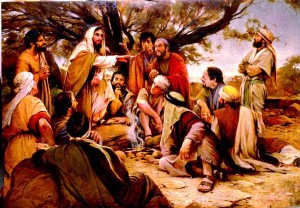
Jesus Talking to the DisciplesDo you ever wish someone whom you respect and admire hadn’t said what they said, because what they said is so hard to explain to someone who doesn’t respect and admire them, and what they said just sounds wrong, even to you? Then you know how I feel about the last response of Jesus in this conversation with Peter!
Jesus has just answered the question of someone Luke calls “a certain ruler” (in Mark’s Gospel he is described as a “rich young man”) about how to inherit eternal life with the famous reply, “Sell everything you own and give the money to the poor.” The disciples (more people than the Twelve, I think) are as unhappy with this hyperbolic response as the original questioner, and Peter seems downright outraged. “What are you saying?” I can almost hear him shouting at Jesus. “We have given up everything for you!” Is Jesus simply placating him with the promise of pie-in-the-sky-by-and-by? That’s what it sounds like. “Don’t worry! You’ll get it all back and get to live forever, too!”

Of course, I’m pretty certain that’s not what Jesus meant, but it’s so hard to explain that to someone who is skeptical of this whole God-Incarnate thing to begin with.

The reason I’m pretty certain that that’s not what Jesus meant is that here, unlike in the Markan version of this story, he doesn’t say, “You’ll get back a lot more of the things you gave up.” In Mark he does say pretty much that: “Truly I tell you, there is no one who has left house or brothers or sisters or mother or father or children or fields, for my sake and for the sake of the good news, who will not receive a hundredfold now in this age – houses, brothers and sisters, mothers and children, and fields, with persecutions – and in the age to come eternal life.” (Mark 10:29-30) Gave something up? Get a hundred more back. That’s what Mark’s Jesus says. But in Luke’s version of the story all that Jesus promises is “very much more.” I think that here there is a qualitative rather than quantitative difference in the promised return. In Mark, Jesus promises his follower will get a lot of the same stuff but at a price, i.e., persecutions; here, something better is promised . . . maybe peace, contentment, love, blessing, the Presence of God, the gifts of Holy Spirit . . . one doesn’t know, but it will be “very much more” than what was sacrificed. Are Mark and Luke trying to say the same thing? Are the things they report Jesus promising as rewards to the faithful follower equivalent? I don’t know; I hope they are, but the texts don’t make it easy to tell. And neither text makes it easy to explain to the skeptical unbeliever.

And the icing on the cake in both versions is the promise of “eternal life” in “the age to come”! It looks like a promise of immortality in the future, but (again) I’m not so sure. Both of these are coded phrases. The second one is found in lots of rabbinic literature, some contemporary with Jesus, some from later periods. It doesn’t necessarily mean the future; it means the time when God’s rule directs human affairs. That can be at any time when a person or persons give up their falsely perceived autonomy and live in accordance with God’s will. “The age to come” can (and does) exist concurrently with “this age”. It’s like that both-and, here-and-not-here, within-you-but-also-only-nearby thing that Jesus announced, the Kingdom of God. “Eternal life” is also not a future thing. For Jesus “eternal life” doesn’t mean immortality; it means life in eternity, where eternity is God’s Presence. “Eternal life” means living in God’s Presence with full awareness.

So the promised reward (whether it includes a hundred houses or not) is a qualitatively different life. Whatever we are called to give up in order to live a faithful life, possibly the hyperbolic “everything” that Jesus and Peter mention in this text, the reward of such a life is “very much more.” Which brings me back to how to explain it to the unbeliever . . . and the truth is that I don’t think it can be explained. It can only be lived and when it is lived, it becomes very apparent to someone not living it. An old friend of mine used to say this was the very best form of evangelism, to live the Christian life so well that one fairly glows with peace, contentment, love, blessing, the Presence of God, and the gifts of Holy Spirit. Others will see that and think, “I want that.” Then we don’t have to explain it, just offer it. Give it all up; get back so very much more.

====================

A request to my readers: I’m trying to build the readership of this blog and I’d very much appreciate your help in doing so. If you find something here that is of value, please share it with others. If you are on Facebook, “like” the posts on your page so others can see them. If you are following me on Twitter, please “retweet” the notices of these meditations. If you have a blog of your own, please include mine in your links (a favor I will gladly reciprocate). Many thanks!

====================

Father Funston is the rector of St. Paul’s Episcopal Church, Medina, Ohio.

Is go dtí tú mo mhuirnin slán

You’ve Got to Be Carefully Taught – From the Daily Office – November 24, 2012

From Luke’s Gospel:

Jesus told this parable to some who trusted in themselves that they were righteous and regarded others with contempt: “Two men went up to the temple to pray, one a Pharisee and the other a tax-collector. The Pharisee, standing by himself, was praying thus, ‘God, I thank you that I am not like other people: thieves, rogues, adulterers, or even like this tax-collector. I fast twice a week; I give a tenth of all my income.’ But the tax-collector, standing far off, would not even look up to heaven, but was beating his breast and saying, ‘God, be merciful to me, a sinner!’ I tell you, this man went down to his home justified rather than the other; for all who exalt themselves will be humbled, but all who humble themselves will be exalted.”

(From the Daily Office Lectionary – Luke 8:9-14 (NRSV) – November 24, 2012)
 
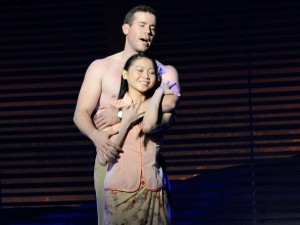
Lieutenant Cable and Liat from "South Pacific"Although from a modern perspective, the prayer of the Pharisee is rather bigoted, but we should try to see it from his perspective and from within his culture, which Jesus shares. When we do so, we can see that Jesus is not criticizing the individual, but rather condemning an entire system of religion which divides and categorizes people. Jesus is denouncing any system, religious, social, or political, which separates people on the basis of bigotry and fear.

We know that from the early Second Century some rabbis taught that every Jewish man was obligated to recite three blessings daily, and it is not too much of a stretch to imagine that these, or some earlier version, were in use in Jesus’ time. These three blessings express gratitude to God for one’s status or position through negative comparisons with others. The man blessed God that God had not made him a gentile, a woman, or a slave (or, alternatively, a boor). Modern scholars call these the “blessings of identity.” They may not have been universally required prayers at first, but we know that by the Fifth Century they were part of Judaism’s most authoritative teaching, The Babylonian Talmud, and at the end of the first millennium they had become part of the preliminary prayers of the Jewish daily morning service. So, again, it doesn’t take much imagination to think that perhaps Jewish men were saying something similar in the time of Jesus.

And they weren’t alone! Such divisive, negative, comparative thanksgiving was not and is not limited to the Jews. Thales of Miletus (d. 546 BC), traditionally the first of the Greek philosophers, reportedly gave thanks to Tyche, the goddess of fortune, “that I was born a human and not a beast, a man and not a woman, a Greek and not a barbarian.” Similar sentiments have been credited to Socrates (d. 399 BC) and Plato (d. 348 BC)! Scholars have wondered whether the blessings of identity might actually be of Greek origin, a bit of Greek philosophy that was “Judaized” and crept into the Jewish morning prayers by the First Century.

Whether of Greek or Jewish origin, it is this sort of divisive thinking that Jesus condemns in today’s Daily Office gospel lesson, not merely the self-congratulatory, self-righteous, and fine-tuned religious conceit of the Pharisee. It’s not pride that Jesus denounces; it’s bigotry. Paul would be the first to understand this well and spread Jesus’ gospel beyond its Jewish origins. To the Romans he would write, “There is no distinction between Jew and Greek; the same Lord is Lord of all and is generous to all who call on him.” (Rom. 10:12) To the Colossians, “There is no longer Greek and Jew, circumcised and uncircumcised, barbarian, Scythian, slave and free; but Christ is all and in all!” (Col. 3:11) And famously to the Galatians, “There is no longer Jew or Greek, there is no longer slave or free, there is no longer male and female; for all of you are one in Christ Jesus.” (Gal. 3:28) A modern 20th Century hymn familiar to all Episcopalians picks up the strain:

In Christ there is no East or West,
in him no South or North,
but one great fellowship of love
throughout the whole wide earth.

In him shall true hearts everywhere
their high communion find,
his service is the golden cord
close-binding all mankind.

Join hands, disciples of the faith,
whate’er your race may be!
Who serves my Father as a son
is surely kin to me.

In Christ now meet both East and West,
in him meet South and North,
all Christly souls are one in him,
throughout the whole wide earth.

(Words by John Oxenham, 1908)

The Jew praying in the temple was doing only what he’d been taught, but that is the nature of bigotry. Bigotry, prejudice, fear and hatred of the other are not natural. They have to be taught. There’s a short, little remembered song from the musical South Pacific by Rodgers and Hammerstein. Sung by the character Lieutenant Cable as he struggles with whether to marry Liat, an Asian woman with whom he has fallen in love, You’ve Got to Be Carefully Taught may be the most powerful song of the show:

You’ve got to be taught
To hate and fear,
You’ve got to be taught
From year to year,
It’s got to be drummed
In your dear little ear
You’ve got to be carefully taught.

You’ve got to be taught to be afraid
Of people whose eyes are oddly made,
And people whose skin is a diff’rent shade,
You’ve got to be carefully taught.

You’ve got to be taught before it’s too late,
Before you are six or seven or eight,
To hate all the people your relatives hate,
You’ve got to be carefully taught!

Well . . . this is getting a bit long for a simple morning meditation, but the point is that Jesus isn’t simply comparing two individuals and saying one is better than the other. That would be no different from the divisive prayer he condemns. Jesus is denouncing a religious system, any system, that builds up some at the expense of others. Better to stand before God and acknowledge who we are, and where we fall short of God’s expectations, than to enlarge ourselves through negative (and most often wrong) comparisons with those who are different from us. To do either, however, requires that we be taught to do so. You’ve got to be carefully taught.

====================

A request to my readers: I’m trying to build the readership of this blog and I’d very much appreciate your help in doing so. If you find something here that is of value, please share it with others. If you are on Facebook, “like” the posts on your page so others can see them. If you are following me on Twitter, please “retweet” the notices of these meditations. If you have a blog of your own, please include mine in your links (a favor I will gladly reciprocate). Many thanks!

====================

Father Funston is the rector of St. Paul’s Episcopal Church, Medina, Ohio.

Putting God to the Test – From the Daily Office – November 23, 2012

From the Prophet Malachi:

Will anyone rob God? Yet you are robbing me! But you say, “How are we robbing you?” In your tithes and offerings! You are cursed with a curse, for you are robbing me – the whole nation of you! Bring the full tithe into the storehouse, so that there may be food in my house, and thus put me to the test, says the Lord of hosts; see if I will not open the windows of heaven for you and pour down for you an overflowing blessing.

(From the Daily Office Lectionary – Malachi 3:8-10 (NRSV) – November 23, 2012)
 
Dear God Black Friday memeThis “test me and see” verse is a favorite of preachers of the so-called “prosperity gospel” (of course, it’s not from a gospel, but that doesn’t seem to bother them). To have it turn up in the Daily Office readings the day after the United States celebrated Thanksgiving Day is a real eye-opener! On Face Book this morning, a humorous “meme”* showed up picturing a young woman at prayer holding a credit card with this caption: “Dear God, we are so thankful for all we have . . . now, if you excuse us, we’ve got to go get more stuff. There’s a great Black Friday sale at Best Buy!” Could there have been a better juxtaposition?

Malachi says pretty bluntly that we are robbing God. Stealing from God is not something to be taken lightly. Many preachers cite this text about robbing God in the context of stewardship sermons. We rob God, they say, when we deny God what is rightfully God’s. We rob God, they say, when we fail to tithe, to make an offering of 1/10, or 10%, of our income. But it seems to me Malachi is more concerned about attitude than with particular actions like paying or not paying the biblical tithe.

Essentially, it comes down to our attitude about who owns what. If we believe (as most Americans seem to) that we have earned all we have, that we are entirely responsible for our prosperity, then we will have an ungenerous attitude toward everyone, including God. If we take a step back and realize that God is responsible for our well-being, we are more likely to be generous. The question is, “Who owns my possessions, bank account, and even my life?” To whom are we truly thankful for what we have?

Jesus told a story about a rich man who had a lot of stuff, so much stuff that he had to build a bigger barn for it all. When he had built the barn and stored the stuff, he sat back content. But just then God said to him, “You fool! This very night your life is being demanded of you. And the things you have prepared, whose will they be?” (Luke 12:20) Jesus’ point (and Malachi’s) is that we have no control over our possessions, our money, or our life. Anything and everything may be lost at any time. The truth is that we don’t own anything, not even ourselves. God owns it all.

When we fail to use it to benefit others around us, when we fail to hold it in trust for God with the proper attitude of generosity, we rob God. If, on the other hand, we use what we have to do what good we can, if we have an attitude of gratitude (the one we claimed we had yesterday), we will benefit as much as if not more than those around us. “Put me to the test and see,” says God.

So, today, what’s it to be? Rush off to the Black Friday sales putting Thanksgiving behind us, or rather making thanksgiving a way of life, not just a day on the calendar? Either way, we put God to the test . . . .

*An internet meme is a concept that spreads via the internet often taking the form of a captioned image.

====================

A request to my readers: I’m trying to build the readership of this blog and I’d very much appreciate your help in doing so. If you find something here that is of value, please share it with others. If you are on Facebook, “like” the posts on your page so others can see them. If you are following me on Twitter, please “retweet” the notices of these meditations. If you have a blog of your own, please include mine in your links (a favor I will gladly reciprocate). Many thanks!

====================

Father Funston is the rector of St. Paul’s Episcopal Church, Medina, Ohio.

A Sober Thanksgiving Reminder – From the Daily Office – November 22, 2012

From the Letter of James:

Come now, you rich people, weep and wail for the miseries that are coming to you. Your riches have rotted, and your clothes are moth-eaten. Your gold and silver have rusted, and their rust will be evidence against you, and it will eat your flesh like fire. You have laid up treasure for the last days. Listen! The wages of the laborers who mowed your fields, which you kept back by fraud, cry out, and the cries of the harvesters have reached the ears of the Lord of hosts. You have lived on the earth in luxury and in pleasure; you have fattened your hearts on a day of slaughter.

(From the Daily Office Lectionary – James 5:1-5 (NRSV) – November 22, 2012)
 
Thanksgiving CornucopiaIt may be the United States’ holiday of Thanksgiving Day, but the Daily Office continues at this time of year delivering its message of repentance rather than encouraging thanksgiving. The Old Testament lesson is another from Malachi in which the Lord speaking to the priests says that he has spread dung on their faces and put them out of his presence! The gospel lesson from Luke has Jesus predicting the end of the world. And then there’s this epistle lesson which condemns the wealthy. Just not a lot of giving thanks!

On the other hand, Jame’s warning about the dangers of wealth is perhaps a fitting counterpoint to the day. During the past several days, the international news services to which I subscribe on the internet have shown pictures not seen on American television or in the US papers, pictures of dead Palestinian children stacked like so much cordwood in makeshift morgues, pictures of children in temporary hospitals missing legs and arms. My throat kept constricting and my tears kept flowing, and in the back of my mind I kept hearing a phrase my step-father often used – “And here we sit – fat, dumb, and happy.”

The President of Egypt and the American Secretary of State have, the news reports, brokered a ceasefire. It’s not peace, but at least the shelling and the missile launches have stopped. At least the 75,000 Israeli reservists activated by their government will not be leaving their families and marching into Gaza. For that we can and surely should be thankful.

I don’t mean to put a damper on the day, and the lectionary pointing us to James’s letter and the other lessons today is simply coincidence. But they are a reminder to pause in the midst of our family gatherings, to eschew being “fat, dumb, and happy,” and to think of things for which we should be truly thankful – love, peace, family, friends – not merely the stuff we possess – the riches, the clothes, the gold, the silver. A sober reminder to pause yet again and “pray for the peace of Jerusalem.” (Ps. 122:6)

====================

A request to my readers: I’m trying to build the readership of this blog and I’d very much appreciate your help in doing so. If you find something here that is of value, please share it with others. If you are on Facebook, “like” the posts on your page so others can see them. If you are following me on Twitter, please “retweet” the notices of these meditations. If you have a blog of your own, please include mine in your links (a favor I will gladly reciprocate). Many thanks!

====================

Father Funston is the rector of St. Paul’s Episcopal Church, Medina, Ohio.

« Older posts Newer posts »