Occasional thoughts of an Anglican Episcopal priest

Category: Prayer (Page 45 of 47)

Will God Dwell on the Moon? – Sermon for Pentecost 13, Proper 16B – August 26, 2012

====================

This sermon was preached on Sunday, August 26, 2012, at St. Paul’s Episcopal Church, Medina, Ohio, where Fr. Funston is rector.

(Revised Common Lectionary, Proper 16B: 1 Kings 8:1,6,10-11,22-30,41-43; Psalm 84; Ephesians 6:10-20; and John 6:56-69.)

====================
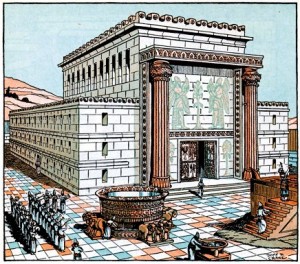
Temple of SolomonOn the cover of our worship bulletin this morning is a depiction of King Solomon’s Temple. It’s an artist’s rendering of someone’s reconstruction of the Temple based on the description of its construction in the Old Testament record. Our first reading today (from the First Book of Kings), as long as it was, is just a small part of the dedicatory prayer that King Solomon offers when the Temple is finished and consecrated.

The building of the Temple marked a very significant change in the Jewish religion. Well, really, let’s not call it the Jewish religion because it wasn’t that, yet. Let’s just say, “The religion of the people of Israel.” These people were not, though we often imagine them to be, strict monotheists. Even in this prayer Solomon leaves open the question of whether there might be gods other than their God: “O Lord, God of Israel, there is no God like you in heaven above or on earth beneath.” There might be other gods, lesser gods perhaps, demigods, or even demons, part of a heavenly pantheon of gods, but this God, the God of the People of Israel is greater than any of those others.

At this time, all the different nations, sometimes even different clans or families, had their own religions, their own gods. And nearly all of these religions believed the gods to be sort of tied to the land. If you moved from one place to another, you stopped worshiping the god of the first place and took up the worship of the god of your new residence. If a woman married outside of her family or tribe, married into a different clan, she would give up the religion of her family and take up that of her husband.

The People of Israel’s God, however, was different. Their God was not tied to a particular place. Their God was connected to a holy object, instead. God was associated with the Ark of the Covenant which they had created in the desert to contain God’s holy relics, the tablets of the Law given to Moses at Sinai (together with a pot of manna and Aaron’s staff). They carried the Ark with them, actually before them, as they traveled through the desert, as they crossed into the Holy Land, as they conquered the Canaanites and took possession of the country.

You may recall that in those first years, the People of Israel had no monarch: they considered God to be their king. The histories are silent as to where the Ark was kept during the period of the Judges, or during the reign of the first monarch, King Saul. But we know that David wanted to build a permanent location for it; he wanted to build a Temple. But God refused. He told David, through the prophet Nathan,

Are you the one to build me a house to live in? I have not lived in a house since the day I brought up the people of Israel from Egypt to this day, but I have been moving about in a tent and a tabernacle. (2 Sam. 7:5-6)

So David did not build the Temple, but he did build a special tent in his city, Bethlehem, and brought the Ark there. We are told

David danced before the Lord with all his might; David was girded with a linen ephod. So David and all the house of Israel brought up the ark of the Lord with shouting, and with the sound of the trumpet. . . . They brought in the ark of the Lord, and set it in its place, inside the tent that David had pitched for it. (2 Sam. 6:15, 17)

David designed the Temple, but he never built it. His son Solomon was the one to do that.

So the Temple was finished, the sacred implements from David’s tent had been moved into it, the Ark of the Covenant was installed into the Holy of Holies where only the High Priest would be allowed to go and Solomon offers this long prayer of dedication. In it he asks a very important question: “But will God indeed dwell on the earth?” (1 Kings 8:27) By building the Temple, Solomon sought to provide God a place to dwell on earth and, in so doing, he made the religion of his people more like that of their neighbors than it had been.

Remember their religions had tied their gods to particular places whereas the God of Israel had moved about the countryside with his People. Now God had a permanent home and, over time, the Jews would centralize God’s worship in the Temple and they would eventually decree, in the Book of Deuteronomy, that the cultic part of their faith could only be performed in that place. Sure, people could gather anywhere for prayer, they could go synagogues for religious instruction, but they could only offer sacrifice and perform the Temple rites in the Temple at Jerusalem. God had become tied to a place. (This was one of the differences the Jews had with Samaritans with whom they shared a devotion to God and who also followed the Law as set out in Genesis, Exodus, Numbers, and Leviticus, but who rejected the restrictions of Deuteronomy and had their own temples, primarily at Mt. Gerazim.)

By the time of Jesus, Solomon’s question had been firmly answered by the Jews. Yes, said their religion, God will dwell on earth, in this place, this Temple in Jerusalem. In the birth of Jesus, however, God gave a different answer: God will not dwell in a building in a particular place; God will dwell with and among God’s People: as the Gospel of John affirms, “The Word became flesh and lived among us.” (John 1:14) Will God indeed dwell on earth? Yes, God will live among God’s people as one of us. God lived among us as an infant born in Bethlehem. God lived among us as an itinerant rabbi who had no home. God lived among us as a rabbi accused of being a rabble-rouser. God lived among us as a rabble-rouser condemned to die a criminal’s death. God lived among us as a criminal executed on a cross.

On the night before he died, he gathered with his friends for a Passover meal. There is some debate as to whether it was a Seder, the sacred meal of Judaism, but if it was he radically changed its nature, just as Solomon building the Temple had radically changed the nature of the religion of Israel. In the Passover meal, Jews become one with their ancestors; the Passover story is brought present to them in the ritual of the Seder and they, in turn, live through the Passover story, but the meal does not bring God into their midst. When Jesus took the bread of affliction and said, “This is my body,” when he took the cup of blessing and said, “This is my blood,” when he told his followers, “Do this when you remember me,” when he promised, “Where two or three gather, I am there,” Jesus gave us a power and an obligation unlike any given before to any people by God. We have the privilege to bring God present among us in the Bread and Wine of the Eucharist, the Christ’s Body and Blood.
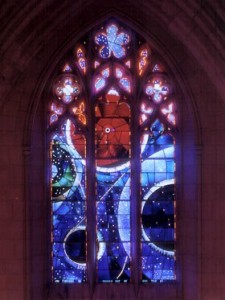
Moon Rock Window, Washington D.C. National CathedralWhere were you on July 20, 1969? In July of 1969 I was living in a boarding house and studying in Florence, Italy. The boarding house or pensione in which I lived, Pensione Frati, did not have a television. My landlord, Colonello Roberto Frati, arranged for me and the other Americans living there to go to his sister-in-law’s home where we could watch Neil Armstrong’s and Buzz Aldrin’s moon landing on her TV – this great big box of a television set with a tiny black-and-white screen. We all gathered around that box peering into that tiny screen listening to the Italian news commentators and struggling to hear the American commentary behind them. I’m sure that when we heard of Commander Armstrong’s death we all thought about wherever we were on that day at that moment when he stepped out of the lunar lander and became the first human being to walk on another world.

What almost nobody knew until a long time afterward was that something else happened on the moon that day. Buzz Aldrin, a devout Christian and an ordained elder in his Presbyterian congregation, had taken a communion kit with some bread and wine to the moon. In the Presbyterian Church, the lay elders of the church who serve a function similar to our vestry members, are actually ordained by their congregation, and that ordination empowers them to bless the elements of Holy Communion. At the time Aldrin and Armstrong landed on the moon, the pastor and members of his Presbyterian church were watching TV but unlike most of us, they were also celebrating communion. Armstrong joined them across space, blessing the bread and wine on the moon and partaking there of Holy Communion.

In the act of Holy Communion we are joined with Christians everywhere and everywhen — with all those in every place who also take part in the Eucharistic feast, with all those who have done so at ever Eucharist since Christ’s last supper with his disciples, with all those who will celebration Communion in the future. We are joined with them and we are joined with God in Christ as we eat of his Body and drink of his Blood, no matter where we are on earth or even on the moon.

Will God indeed dwell on the earth? Yes! Will God dwell on the moon? Yes! God dwells with God’s People wherever the memory of Jesus is invoked in the Holy Communion, wherever bread and wine are blessed and consecrated the Body and Blood of God incarnate in Christ. God will dwell with God’s People across time and across space, even on the moon, and wherever else in this Solar System or beyond we may go, so long as we do this in memory of Jesus. Amen.

God! You Need to Change! – From the Daily Office – August 24, 2012

From the Book of Job:
 

One day the heavenly beings came to present themselves before the Lord, and Satan also came among them to present himself before the Lord. The Lord said to Satan, “Where have you come from?” Satan answered the Lord, “From going to and fro on the earth, and from walking up and down on it.” The Lord said to Satan, “Have you considered my servant Job? There is no one like him on the earth, a blameless and upright man who fears God and turns away from evil. He still persists in his integrity, although you incited me against him, to destroy him for no reason.” Then Satan answered the Lord, “Skin for skin! All that people have they will give to save their lives. But stretch out your hand now and touch his bone and his flesh, and he will curse you to your face.” The Lord said to Satan, “Very well, he is in your power; only spare his life.”

(From the Daily Office Lectionary – Job 2:1-6 – August 24, 2012)
 
Time for ChangeWow! Does this look familiar? The second chapter of Job begins with a scene nearly identical to that which we considered yesterday. Satan (with other heavenly beings) presents himself in the heavenly throne room and, once again, God and Satan have a conversation about Job and, once again, the bet is made. In fact, it’s sort of “double down” time! Yesterday, I argued that although the Book of Job is fiction it (like the other forms of literature found in Holy Scripture) embodies truth.

So what is the truth behind this scene? It’s a legitimate question. This picture of God wagering with Satan is important enough to the story that it is repeated. It must be telling us something. As I ponder it, I am struck by a “What if . . . . ?” A big “What if . . . . ?” What if God really does gamble with our lives? What if God really is a . . . jerk? Now, understand please, I don’t think that that is the truth behind this fictional scene, but what if . . . . ?

When I was reading theology in preparation for ordination, one of the modern theologians I most related to was the French Reformed theologian Jacques Ellul. My favorite of his works was L’Esperance Oubliee (“Hope Forgotten”) which was published in English under the title Hope in a Time of Abandonment. Writing from a conviction that “we have entered upon the age of abandonment, that God has turned away from us,” Ellul nonetheless asserts, “Hope is a protest before this God, who is leaving us without miracles and without conversions, that he is not keeping his Word … It is Job’s great declaration, ‘my eye pours out tears to God, that he would maintain the right of a man with God’ (Job 16:20-21).” Prayer, says Ellul, is how we give voice to this hopeful protest; prayer is how we, empowered by hope, insist that God fulfill God’s promise. Hope and prayer is how we demand that

It is God who needs to change. It is God who must return to enlighten his Church and to make our hearts shout for joy . . . It is God who has to change, and hope is the resolute will to make God change . . . It is to bring about once again the implementation of that wonderful statement of the Old Testament, “and God repented”.

If God (to return to my “What if . . . . ?”) is being a jerk, we have the hopeful protesting power to say, “God! You need to change!”

====================

Father Funston is the rector of St. Paul’s Episcopal Church, Medina, Ohio.

Straining to See God – From the Daily Office – August 22, 2012

From the Psalms:

Out of the depths have I called to you, O Lord; Lord, hear my voice;
let your ears consider well the voice of my supplication.

If you, Lord, were to note what is done amiss,
O Lord, who could stand?

For there is forgiveness with you;
therefore you shall be feared.

I wait for the Lord; my soul waits for him;
in his word is my hope.

My soul waits for the Lord, more than watchmen for the morning,
more than watchmen for the morning.

O Israel, wait for the Lord,
for with the Lord there is mercy;

With him there is plenteous redemption,
and he shall redeem Israel from all their sins.

(From the Daily Office Lectionary – Psalm 130 (BCP version) – August 22, 2012)

Marble Arch Cave, County Fermanagh, IrelandPsalm 130 is one of the seven “pentitential psalms” of the church (Psalms 6, 32, 38, 51, 102, 130, and 143), a tradition that stretches back to the Sixth Century if not earlier. It is also one of the “songs of ascents” (Psalms 120-134) that are believed to have been sung by pilgrims making their way up to Jerusalem or possibly when climbing up the Temple Mount for festival celebrations. Somehow it strikes me as both odd and poignant that a song or poem beginning “Out of the depths” is called a song of “ascent” – from the deepest sloughs of despond the poet calls out the Highest. Ascent, indeed!

This is a song of longing: my favorite verse is Verse 5, “My soul waits for the Lord, more than watchmen for the morning, more than watchmen for the morning.” Sometimes when this psalm is sung or chanted I find myself wanting just to stop at the verse. In the repetition of the words “more than watchman for the morning” I want to lower my voice, slow my words, shake my head, stare into space, give play to the longing in my soul, sigh deeply, acknowledge the sense that God sometimes seems to be absent, wallow in abandonment.

And yet it is not a psalm of resignation and surrender. It does not end with those words, but forcefully pleads its case that God will appear, that God will have mercy, that God will offer redemption. This is a song of God’s Presence, not of God’s absence. Even in the depths, God in some way is there.

Last year my daughter and I toured the Marble Arch Caves in County Fermanagh, Northern Ireland. At one point during the tour, the guides extinguished all of the lights and we were plunged into the deepest darkness I have ever experienced. But in that blackness the eye continues to seek for light; you can almost feel the optic nerves at the back of your eyeballs, the rods and cones of the retina, straining to find light. This psalm is like that; the soul of the psalmist is convinced, even in that deepest, darkest, pitch black slough of despond, that the Light of God is still to be found. The soul strains to see God.

====================

Father Funston is the rector of St. Paul’s Episcopal Church, Medina, Ohio.

He Will Not Let Your Foot Be Moved – From the Daily Office – August 21, 2012

From the Psalms:

I lift up my eyes to the hills;
from where is my help to come?

My help comes from the Lord,
the maker of heaven and earth.

He will not let your foot be moved
and he who watches over you will not fall asleep.

Behold, he who keeps watch over Israel
shall neither slumber nor sleep;

The Lord himself watches over you;
the Lord is your shade at your right hand,

So that the sun shall not strike you by day,
nor the moon by night.

The Lord shall preserve you from all evil;
it is he who shall keep you safe.

The Lord shall watch over your going out and your coming in,
from this time forth for evermore.

(From the Daily Office Lecionary – Psalm 121 (BCP Version) – August 21, 2012)

Rocky Mountain TrailI think this may be my favorite psalm. It is the psalm appointed for use on the feast of St. Francis of Assisi. It is one of the psalms approved in The Book of Common Prayer for use at a funeral; it was selected by my mother to be used at her funeral.
It is one of the most intimate of the psalms for it constantly names God; each time the words “the Lord” appear in this English translation, the Hebrew actually sets out the Tetragrammaton, YHWH, the Name of God. The translation follows the Jewish custom of never saying that Name, of replacing the Name with other words to avoid any hint of familiarity with or disrespect for the Lord. Although I understand the piety behind that tradition, I find it here to be a bit sad, for in following it one loses the intimacy which makes this psalm so powerful.

As a college student, one of my recreations was hiking and camping; my circle of friends and I would take off for some wilderness area or mountain range for a weekend, backpacking all of our needs and supplies, exploring trails and seeing sights many people never see. In Southern California, many of the mountain trails are quite treacherous. The soil is rocky and loose and one can easily slip and lose one’s footing. The pathways are not unlike those of the Holy Land – steep, rocky, covered with loose stones and gravel, footing unsure. For safety and support, we often walked close together, helping one other up or down steep slopes.

I thought of those hikes recently when, in my own backyard (which is on a rather steep slope) I slipped while doing yard work, went down, and tore the meniscus of my right knee necessitating surgery. No one else was home and I had to crawl back to the house by myself. If that had happened in the Southern California wilderness, it could have been disastrous. That’s why we supported one another, and that’s why the third verse of this psalm speaks so loudly to me. “He will not let your foot be moved.” Yahweh is with us, close to us, supporting us in the same way my hiking companions were with me on those college-day backpacking trips.

And that’s why I find it sad that the psalm does not name God. You don’t refer to or address the one who supports you along a steep, slippery slope by formal titles. Your companion on the difficult path is your buddy, your friend, your intimate companion. As the opening anthem of the Burial Office in The Book of Common Prayer says of God, he is “my friend and not a stranger.” He is Yahweh, and he will not let my foot be moved.

====================

Father Funston is the rector of St. Paul’s Episcopal Church, Medina, Ohio.

Lady Wisdom & Questions God Is Never Going to Ask – Sermon for Pentecost 12, Proper 15B – August 19, 2012

====================

This sermon was preached on Sunday, August 19, 2012, at St. Paul’s Episcopal Church, Medina, Ohio, where Fr. Funston is rector.

(Revised Common Lectionary, Proper 15B: Proverbs 9:1-6; Psalm 34:9-14; Ephesians 5:15-20; and John 6:51-58)

====================

Proverbs 9 by David WierzbickiAs I may have mentioned here before, I spent many of my childhood summers in the southeastern Kansas town of Winfield with my paternal grandparents, C.E. and Edna Funston. Winfield was my parents’ hometown, both of them were raised there and my mother had been born there. Her maternal grandparents, Hinrich and Harmke Buss, were immigrants from that area of Germany right next to Holland called “Ostfriesland”. My father was born in Dodge City, and he and his folks moved to Winfield when he was just a few months old; they were relative newcomers but my grandfather soon became a prominent citizen.

Anyway, one of the things I remember about Winfield is the way newcomers, or anyone someone was meeting for the first time, were almost invariably asked two questions. I once discussed this with a friend who was born and raised in South Carolina and she said it was the same in her hometown, that these are what she called “very Southern questions.” That makes sense because in an odd way, southeastern Kansas is much more Southern than it is midwestern. My mother used to all that part of Kansas “lap land” – meaning that it is were Oklahoma and Arkansas lap over into Kansas.

So there were these two questions that people asked when first meeting another person. The first was, “Who are your people?” Winfield was an agricultural center and not much else. There was no industry or manufacturing that would bring people to town. There was farming and the businesses that support farming, all of which were family owned. So if somebody new came to town to work in on a farm or in a farm-supporting business, it was assumed you must be part of the family. So, who are your people? The answer placed you in a particular social context. So I would say, “Well, my mother is Betty Sargent, one of the Buss cousins.” Anyone local would then know I was a descendant of Henry Buss. My greatgrandfather had had two families. One set of children were born to first wife Mary – she had 14 kids who lived; another set of 13 living children were born to Harmke, my greatgrandmother. According to his obituary, all of those children were alive when Henry died and he left approximately 200 acres of land to each of them. Doing the math, you get the idea that he had acquired a lot of farmland (something over 5,000 acres) and that he (and his children after him) were influential in the local economy. As I mentioned before, on the paternal side my grandparents were comparatively new to the town, but they had become very active members of the Methodist Church and my grandfather, an active Mason, had risen in those ranks as well. So if I continued to my inquirer, “And my father is C.E. and Edna Funston’s youngest son,” he or she would immediately know I was related to a Past Master of the Lodge and an elder in the Methodist Church.

Because of that, I wasn’t often asked the second question, “Where do you go to church?” But I could have been because it really wasn’t a given that I would have been a Methodist. The Busses were members of the Dutch Reformed Church and the Sargents belonged to the Disciples of Christ; I could have been either of those – but the truth was, except for those summer months with the Funstons at the Methodist Church, I really didn’t go to church as a kid.

In any event, those questions served to place someone in a social context, to define in the questioner’s mind who they were and where the fit. And the truth is they aren’t just “Kansas questions” or “Southern questions”. They are everywhere questions. In the fall of 2005, Evie and I took our first trip to Ireland and, as part of that trip, visited County Donegal as I was in search of Funstons in the area where I believe my Funston great-greatgrandfather originated. In Donegal Town itself, we happened to stop into a woolen sweater store run by a man named Sean McGinty. Mr. McGinty asked about our trip and I was explaining to him my family connection to the area. He turned to his wife Mary and said, “You’re from Pettigo; weren’t there some Funstons in Pettego.” She thought for a moment and replied, “Yes . . . . but they weren’t our people.” — They weren’t our people, meaning they weren’t Roman Catholic. The Irish Funstons were and still are Church of Ireland – Anglicans . . . Protestants. “Who are your people?” “Where do you go to church?” They or something like them are human questions; the help us to put people in their place, to categorize one another, to define each other. They are human questions.

But they are not God’s questions! Long before St. Paul would write to the Galatians that in Christ “there is neither Jew nor Greek, there is neither slave nor free man, there is neither male nor female,” (Gal. 3:28) the compiler of the Book of Proverbs would make the same point in the 8th and 9th Chapters of that book, part of which we read today. In these chapters we read of Lady Wisdom, one of the most intriguing characters in all of the Old Testament. In the 8th Chapter, before the part we heard this morning, she tells us herself:

When [God] established the heavens, I was there, when he drew a circle on the face of the deep, when he made firm the skies above, when he established the fountains of the deep, when he assigned to the sea its limit, so that the waters might not transgress his command, when he marked out the foundations of the earth, then I was beside him, like a master worker; and I was daily his delight, rejoicing before him always, rejoicing in his inhabited world and delighting in the human race. (Prov. 8:27-31)

She was, she tells us, a “master worker” helping God to create all that is. And in our reading this morning from Chapter 9, we see her as “the hostess with the mostest” who is ready to throw a party, to do the honors at a great feast. She has “slaughtered her animals, she has mixed her wine, she has . . . set her table,” and she sent her servants out to invite her guests. In fact, she herself stands in her doorway, in the highest places of the town calling,

“You that are simple, turn in here!” To those without sense she says, “Come, eat of my bread and drink of the wine I have mixed. Lay aside immaturity, and live, and walk in the way of insight.” (Prov. 9:4-6)

Note that she doesn’t ask, “Who are your people? Where do you go to church?” She doesn’t ask if any are Jew or Greek, slave or free, black or white, straight or gay, Republican or Democrat, Catholic or Protestant, none of that matters . . . all she asks is that we be “simple” and “without sense.”

Now that’s a bit disconcerting and, frankly, I think the translation belies the true meaning of the invitation. The Hebrew here is, “Mi-phethi yasur henah chasar-leb ‘am’rah lo.” The word translated as “simple” (and sometimes as “naive”) is phethi. It’s root is the word pawthaw, which means “wide open”. An alternative and more positive understanding of this word is “open-minded”. The term “without sense” (sometimes rendered “lacking understanding”) is chasar-leb. Chasar means “without” or “lacking”. Leb (rendered here as “sense” or “understanding”) is most often translated as “heart” because in the ancient Hebrew understanding the heart was believed to be the seat of comprehension and emotion. This is not simple understanding or sense, this is passionate belief, enthusiastic commitment; in a negative sense we might say “bias” or “prejudice”.

Lady Wisdom is not inviting simpletons or the foolishly naive into her parlor; she is inviting the open-minded, those who have no preconceptions, no intolerant prepossessions. Lady Wisdom, God’s master worker, does not care if you are Jew or Greek, Irish or German, black or white or Asian or Native American, straight or gay or lesbian or transgendered, Democrat or Republican or Socialist or Libertarian. Lady Wisdom, God’s master worker, doesn’t care who your people are; she cares about whose you are! She doesn’t care where you go to church; she cares that you are the church, the People of God! She wants you to be open-minded, to come without prejudice or preconception. Her invitation is reminiscent of the Prophet Isaiah’s, “Come now, and let us reason together, saith the Lord.” (Isaiah 1:18 – KJV) She invites us to come and learn.

She has set her table; she is ready to host her party. “Come, [she says] eat of my bread and drink of the wine I have mixed. Lay aside immaturity, and live, and walk in the way of insight.” Lady Wisdom’s celebration is the marriage feast of the Lamb; her invitation is to that very supper Jesus would share with his disciples and shares with us throughout all the ages. St. Paul wrote to the Corinthians the words we recite each time we gather at this Table:

. . . that the Lord Jesus on the night when he was betrayed took a loaf of bread, and when he had given thanks, he broke it and said, “This is my body that is for you. Do this in remembrance of me.” In the same way he took the cup also, after supper, saying, “This cup is the new covenant in my blood. Do this, as often as you drink it, in remembrance of me.” (1 Cor. 11:23-2)

And here in John’s Gospel today he promises that “those who eat my flesh and drink my blood have eternal life, and I will raise them up on the last day; for my flesh is true food and my blood is true drink. Those who eat my flesh and drink my blood abide in me, and I in them.” (John 6:54-56)

To this Feast we are all invited without regard to who our people may be, without regard to where we go to church. To this Feast today we welcome Nathan Joseph Daley who is to be baptized. No one here will ask, “Who are your people?” but if anyone ever does, Nathan can answer “The People of God” . . . and if he wants to be more specific, he can say “The Episcopalians!” No one here will ask, “Where do you go to church?” but if anyone ever does, Nathan can answer, “St. Paul’s!”

Someone else may ask those questions of Nathan or of you or me, but God is never going to ask them! God will ask, “Are you open-minded? Are you free of bias and prejudice?” God will ask, “Are you filled with the Spirit? Do you sing psalms and hymns and spiritual songs? Do you sing and make melody to the Lord in your heart? Do you give thanks at all times and for everything in the name of our Lord Jesus Christ?” (Questions drawn from Ephesians 5:18-20) God will ask, “Do you seek and serve Christ in all persons, loving your neighbor as yourself? Do you strive for justice and peace among all people? Do you respect the dignity of every human being?” (Questions drawn from the Baptismal Covenant in the Book of Common Prayer, pg. 305)

With God’s help, Nathan and we will grow and learn to do these; through God’s grace, he and we will feast on Bread and Wine, and “lay aside immaturity, and live and walk in the way of insight.”

Let us pray:

Grant, Lord God, to Nathan who is about to be baptized into the death and resurrection of your Son Jesus Christ, and to those who already have been baptized, that, as we have put away the old life of sin, so we may be renewed in the spirit of our minds, lay aside immaturity, and live and walk in the way of insight, righteousness, and true holiness; through Jesus Christ our Lord, who lives and reigns with you, in the unity of the Holy Spirit, one God, now and for ever. Amen.

The Things We Do for Love – From the Daily Office – August 18, 2012

From the Book of Judges:

Delilah said to Samson, “Please tell me what makes your strength so great, and how you could be bound, so that one could subdue you.” Samson said to her, “If they bind me with seven fresh bowstrings that are not dried out, then I shall become weak, and be like anyone else.” Then the lords of the Philistines brought her seven fresh bowstrings that had not dried out, and she bound him with them. While men were lying in wait in an inner chamber, she said to him, “The Philistines are upon you, Samson!” But he snapped the bowstrings, as a strand of fibre snaps when it touches the fire. So the secret of his strength was not known.

(From the Daily Office Lectionary – Jugest 16:6-9 – August 18, 2012)

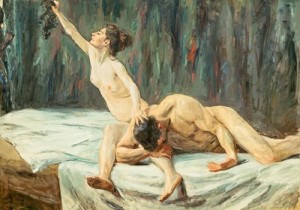
Samson and Dalilah, Max Liebermann, 1902It may be a sign of my age or a condemnation of my cultural up-bringing, but I cannot read any of the story of Samson and Delilah without hearing Tom Jones’ voice sining, “Why? Why? Why, Delilah? My, my, my Delilah?” Silly, I know, but it sort of fits with this bit from the Old Testament lesson from today’s lectionary readings.
We are told that Samson “fell in love with a woman in the valley of Sorek, whose name was Delilah,” (v. 4) and that she is then persuaded by the Philistine leadership to discover and disclose the source of Samson’s strength. So begins a series of events in which she asks Samson, he lies to her, she undertakes to betray him on the basis of the lie, and he overcomes the betrayal. After three such episodes, he finally tells her that he will lose his strength if a razor touches his head and the story proceeds as every Sunday School child remembers it.

Reading these three episodes of question, lie, and betrayal, Tom Jones’ lyric keeps ringing in my ears, “Why, why, why?” Why does Samson stay with or keep returning to this woman who is clearly in league with his enemies? Why?

I suppose the answer is in verse 4: “He fell in love with [her].” Love, or perhaps we should be honest and note that what this really is is lust or passion, does that to us; it blinds us to the faults in the beloved. “Love is blind” says the old shibboleth. Erotic love makes us overlook the obvious and do things that simply do not make sense.

One of my favorite songs of a bygone era is 10-CC’s Things We Do for Love:

Too many broken hearts have fallen in the river
Too many lonely souls have drifted out to sea
You lay your bets and then you pay the price
The things we do for love, the things we do for love

Communication is the problem to the answer
You’ve got her number and your hand is on the phone
The weather’s turned and all the lines are down
The things we do for love, the things we do for love

Like walking in the rain and the snow when there’s nowhere to go
When you’re feeling like a part of you is dying
And you’re looking for the answer in her eyes
You think you’re gonna break up
Then she says she wants to make up

Ooh you made me love you
Ooh you’ve got a way
Ooh you had me crawling on the floor

A compromise would surely help the situation
Agree to disagree but disagree to part
When after all it’s just a compromise
Of the things we do for love, the things we do for love
The things we do for love

Walking in the rain and the snow, crawling on the floor, returning again and again to a paramour whose clearly bent on betrayal . . . the soul in search of love will do a lot of silly and stupid things that make us ask “Why?” I think we know the answer, though; we’ve known it at least since St. Augustine of Hippo write his Confessions: “You have made us for yourself, Lord, and our hearts are restless until they rest in you.” Only in God do we find that love which does not betray.

====================

Father Funston is the rector of St. Paul’s Episcopal Church, Medina, Ohio.

Consequent Actions – From the Daily Office – August 13, 2012

From John’s Gospel:

Just as Moses lifted up the serpent in the wilderness, so must the Son of Man be lifted up, 15that whoever believes in him may have eternal life. For God so loved the world that he gave his only Son, so that everyone who believes in him may not perish but may have eternal life.

(From the Daily Office Lectionary – John 3:15-16 – August 13, 2012)

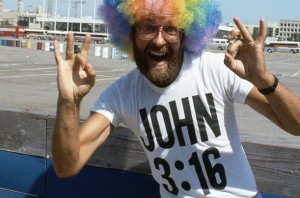
A very familiar quotation from Scripture that second verse: anyone who has ever attended a sporting event in the United States (or watched one on television) as seen someone holding up a sign with “John 3:16” emblazoned on it. Often that person is wearing a rainbow-colored “Afro” wig. Anytime I have witnessed that spectical I’ve wondered, “Has anyone ever become a follower of Jesus because of that sign?” I’m pretty certain the answer is “No.”

I’m also pretty certain that Jesus didn’t utter the words attributed to him in verse 16. I’m not alone in believing that, by the way. There are a lot of scholars who think that John’s quotation from Jesus ends with verse 15 and everything that follows is John’s commentary on what Jesus said, not the words of Jesus himself. That’s not the way most bible translations show it, however. In any event, whether the words of verse 16 are Jesus’ or John’s, another thing I’m pretty certain of is that they have nothing to do with getting into heaven!

That’s how most people understand this, I think, but I believe their understanding to be dead wrong. I use that term advisedly because the question really is about whether these words apply to what happens before we die or after we die. Believing in Jesus isn’t supposed to be some sort of eternal life insurance policy, a ticket to heaven, a pass into the new Jerusalem and all its loveliness as portrayed by another John in the Book of Revelation; it’s supposed to be about how we live in the present.

Believing in Jesus and gaining eternal life is supposed to be a present reality. “Eternal life” is John’s way of naming what the Synoptic Gospel writers called “the kingdom” (the kingdom of God or the kingdom of heaven, same thing). It’s the here-and-now transformed by our belief and not simply by our belief but by our action. We who believe in Jesus do not perish but have eternal life, life in the kingdom, because our belief compels us to work with God to create that life in the world in which we live. As another part of the Johannine literature puts it, “We know love by this, that he laid down his life for us — and we ought to lay down our lives for one another. How does God’s love abide in anyone who has the world’s goods and sees a brother or sister in need and yet refuses help? Little children, let us love, not in word or speech, but in truth and action.” (1 John 3:16-18)

In my faith tradition (the Episcopal Church) a public statement of faith at baptism is always followed by a public commitment to action. The candidate (indeed, the whole congregation) is asked if he or she believes in God the Father, God the Son, and God the Holy Spirit; the answers to these questions are simply the words of the Apostle’s Creed. The candidate and congregation are then asked to commit themselves to five consequent actions: to continue in the apostles’ teaching and fellowship, in the breaking of bread, and in the prayers; to persevere in resisting evil, and, whenever they fall into sin, to repent and return to the Lord; to proclaim by word and example the Good News of God in Christ; to seek and serve Christ in all persons, loving their neighbors as themselves; and to strive for justice and peace among all people, and respect the dignity of every human being. When asked if they will do each of these things, the candidate and the congregation respond, “I will, with God’s help.”

These are the consequences of belief in God in Jesus Christ. These are the consequent actions through which, in partnership with God, we bring the kingdom on earth as it is in heaven. These are the consequent actions through which, with God’s help, we live eternal life.

====================

Father Funston is the rector of St. Paul’s Episcopal Church, Medina, Ohio.

Citizenship and Prayer – From the Daily Office – August 11, 2012

From the Acts of the Apostles:

Now the whole group of those who believed were of one heart and soul, and no one claimed private ownership of any possessions, but everything they owned was held in common. With great power the apostles gave their testimony to the resurrection of the Lord Jesus, and great grace was upon them all. There was not a needy person among them, for as many as owned lands or houses sold them and brought the proceeds of what was sold. They laid it at the apostles’ feet, and it was distributed to each as any had need.

(From the Daily Office Lectionary – Acts 4:32-35 – August 10, 2012)

This short passage from the Book of Acts describes the sort of world Jesus intended. Not just the sort of church . . . . the sort of world, the sort of human society, a complete community in which no one claims private ownership (it’s all God’s remember) and where there are no needy persons because what is needed is distributed equitably.
Dream world, right? Never gonna happen, you say? Then what do we mean when we say (some of us everyday, but a lot of at least once a week), “Our Father in heaven . . . your kingdom come”? If we don’t mean it, if we don’t want God’s kingdom to come, why do we keep asking for it? (Jesus taught this petition to his disciples when they asked him to teach them to pray. See Matthew 6:9–13 and Luke 11:2–4.)

I got into a beef in an on-line recently because another person attributed Massachusetts Senator Scott Brown’s criticism of his state’s Department of Transitional Assistance to his Christianity. Brown was upset because the department had mailed voter registration materials to some 400,000 welfare recipients; he interpreted this as a pro-Democratic-Party action by the department. (In fact, it was in compliance with a court order regarding the state’s failure to comply with “motor voter” regulations.) Nowhere in the article to which my correspondent referred was there any mention of Brown’s Christian faith (he is reportedly a member of the conservative Christian Reformed Church) by either Brown or the reporter. I objected to this person’s statement as a gratuitous and groundless comment, and a lengthy conversation ensued. (It was eventually and abruptly terminated by my correspondent.)

It got me thinking, though, about how we characterize the actions (political or otherwise) of other people and how in modern America we seldom hear positive actions (other than those expressly undertaken by the church) characterized as Christian! Programs which aid the poor, the elderly, the very young, or others in need are criticized as “socialist” even though that is precisely what the apostles set up in their first century community (long before, it should be noted, any western European economics theorist coined the term “socialist”). They are referred to as “entitlements”, a word often said with a sneer. If they are defended, it is on the grounds not of Christian practice but of some theory of economics or general ethics. The Constitutional separation of church and state, I suppose, is at work here. But for those who do support them and are Christians, if we really mean what we pray in the Lord’s Prayer (or any prayer of intercession for the poor and the needy for that matter), shouldn’t we applaud such programs as consonant with our faith? Shouldn’t we be giving and working toward their success because they are, in fact, elements of that world Jesus intended?

My staunchly Methodist grandfather taught me a number of things. A couple of them come to mind today. He taught me to never approach the altar of God without a gift of thanksgiving. Even if you’ve already made your weekly tithe (and he insisted that one give a tithe, a tenth of income), if you attend another prayer service give another offering. Those offerings, he said, are means by which God’s church carries out God’s work and answers at least some of our prayers. He taught me the same thing about taxes. I don’t know if he was familiar with Justice Oliver Wendell Holmes’s famous statement, “Taxes are the price we pay for a civilized society,” but that was certainly his attitude. He taught me that paying one’s taxes is the way the citizen enables the government to do the work it is created to do: the Preamble to our Constitution says that that is, among other things, to “establish justice, insure domestic tranquility, provide for the common defence, promote the general welfare, and secure the blessings of liberty to ourselves and our posterity.” Providing for the poor, the elderly, the very young, and other needy persons sure seems to me to fit in there.

Another thing he taught me was never to pray for something I was not willing to work for. If you pray for someone to be healed, be willing (and available when called upon) to care for that person. If you pray for war to be ended, be willing (and available when called upon) to do the work of creating peace.

That’s what prayer was to my grandfather: giving and working. I think that’s what citizenship was to him, as well. If everyone who prays “your kingdom come” actually gave and worked toward the kingdom’s appearance, if everyone also looked at their citizenship that way, I suspect that we’d hear a lot less criticism of “entitlements” and that the world would look a lot like what is described in that short bit from the Book of Acts.

====================

Father Funston is the rector of St. Paul’s Episcopal Church, Medina, Ohio.

The Blessed Wedding at Cana – From the Daily Office Lectionary – August 10, 2012

From John’s Gospel:

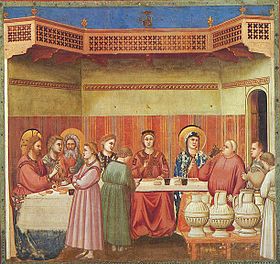
Jesus and his disciples had also been invited to the wedding. When the wine gave out, the mother of Jesus said to him, “They have no wine.” And Jesus said to her, “Woman, what concern is that to you and to me? My hour has not yet come.” His mother said to the servants, “Do whatever he tells you.” Now standing there were six stone water jars for the Jewish rites of purification, each holding twenty or thirty gallons. Jesus said to them, “Fill the jars with water.” And they filled them up to the brim. He said to them, “Now draw some out, and take it to the chief steward.” So they took it. When the steward tasted the water that had become wine, and did not know where it came from (though the servants who had drawn the water knew), the steward called the bridegroom and said to him, “Everyone serves the good wine first, and then the inferior wine after the guests have become drunk. But you have kept the good wine until now.” Jesus did this, the first of his signs, in Cana of Galilee, and revealed his glory; and his disciples believed in him.

(From the Daily Office Lectionary – John 2:2-11 – August 10, 2012)

Marriage at Cana by Giotto, 14th centuryA year ago I was in Ireland, camped out in a cottage outside of the village of Banagher, County Offaly, on sabbatical. As my study project, I was translating old Irish hymns into metrical, rhyming English such that they could be sung to the music of the original. The hymns were published in the early 20th Century in a collection titled Dánta Dé Idir Sean agus Nuadh compiled by Uná ní Ógáin. Dánta Dé includes a communion hymn which elaborates on John’s story of the wedding feast; it is entitled The Blessed Wedding at Cana and is attributed to Maighréad ní Annagáin. I found I could not directly translate the hymn, so instead I wrote a poem of my own. Reading this story today, I recall working on that piece and offer it again.

This is my poem inspired by the gospel story and the old Irish hymn:

King of love,
King of glory,
King of graces, guest at a wedding.
With his mother, with his friends,
seated at the marriage feast waiting.
Came the word: “There is a problem!”
Mary told her son to help them.
“What is this to me?” he asked her;
but to servants she was speaking.

“There is no wine
for the feast.
Do as he says, no hesitation.”
Empty vessels standing there
for the rites of purification.
“Fill them,” he says, “with plain water;
and then draw some for the steward.”
“What is this now?” asks the steward,
“Finest wine in the nation!”

Blessed Mary,
Virgin pure,
Mother of God, you knew that even
that your Jesus was the Christ;
that he was the High King of Heaven.
But did you know he would become
the free way for us to our home?
Through baptism buried with him,
we, too, shall all be risen!

O Lord Jesus,
glorious King,
holy savior who bore the Thorn Crown,
you were beaten, crucified,
killed, and buried, layed in the cold ground.
In fulfillment of the promise,
you broke the bars closed against us.
With your own blood you have freed us!
Death is conquered! Life is newfound!

Your own Body
and your Blood
give us sinners true liberation;
Bread of Heaven, Blessed Cup,
holy table, feast of salvation.
Giving blessings beyond measure;
wedding banquet, splendid treasure.
At the marriage feast of the Lamb,
we are God’s new creation!

For those interest in the hymn as Gaeilge, here is the Irish original:

Ag an bpósadh bhí i gCána bhí Rí na ngrás ann i bpearsain,
É féin is Muire Máthair, is nárbh áluinn í an bhainfheis?
Bhí cuideacht ós cionn chláir ann, agun fíon orra i n-easnamh,
‘S an t-uisge bhí h-árthaibh nár bh’áluinn é bhlaiseadh?

A Dhia dhíl, a Íosa, ‘s a Rí ghil na cruinne,
D’iomchuir an choróin spíne is iodhbairt na Croise,
A stolladh is a straoilleadh idir dhaoinibh gan cumann,
Na glasa do sgaoilis, a d’iadhadh n’ár gcoinnibh.

Is ró-bhreágh an stór tá ag Rígh na glóire dúinn i dtaisge,
A chuid fola agus feóla mar lón do na peacaigh’.
Ná cuirigidh bhur ndóchas i n-ór bhuidhe nó i rachmas
Mar is bréagán mar cheó é, seachas glóire na bhFlaitheas.

====================

Father Funston is the rector of St. Paul’s Episcopal Church, Medina, Ohio.

God, Words, Responsibility – From the Daily Office – August 6, 2012

John’s Gospel begins:

In the beginning was the Word, and the Word was with God, and the Word was God. He was in the beginning with God. All things came into being through him, and without him not one thing came into being. What has come into being in him was life, and the life was the light of all people. The light shines in the darkness, and the darkness did not overcome it.

(From the Daily Office Lectionary – John 1:1-5 – August 6, 2012)

Pulpit, Exeter CathdralReading these oh-so-familiar words in the introduction to John’s Gospel, I remember other words I read on another blog yesterday:

If the Church was meeting the deepest needs and yearnings of spiritual people, it would be a priority in their lives. But it is not, and it chooses to ignore everything except the obvious. Evelyn Underhill, the great Anglican mystic of the early 20th century, said that the “only really interesting thing about religion is God.” People aren’t staying away from the Church to play football or shop – they’re staying away because they aren’t finding God. (Do Anglican Churches Really Want to Survive?)

Reading those words I felt like I’d been gut punched, knifed, shot in the head. Not because they are wrong, but because I fear they are probably right, and I wonder what I and my fellow clergy have been doing for the past several decades.

Well, that’s not exactly true. When I read those words I didn’t wonder about other clergy at all . . . I just wondered about me. What have I been doing? Worship in the Episcopal Church takes the effort of lots of people – musicians, choir singers, lay assistants who read lessons, lead prayers, and help at the altar, sacristans who set things up and clean them up after its all done, ushers, greeters, and so forth . . . but it is the priest who designs the liturgy within the broad outlines of The Book of Common prayer, who presides at the altar, and who stands in the pulpit preaching the word. In 22 years of ordained ministry, I’ve done all of that and said a lot of words . . . a lot of words! If in what is happening on Sunday people are not finding God, it is in large part the priest’s responsibility, my responsibility.

Not solely the priest’s, by any means, but in large measure. Especially in a church which follows the catholic tradition of Holy Orders as sacramental and, by its rubrics and canons, makes the parish priest the final arbiter of all worship experiences. Yes, one could recruit and work with a worship committee, and yes, one does work with the musician and all those good volunteers, but in the final analysis, as our canons put it, the senior pastor has “full authority and responsibility for the conduct of the worship and the spiritual jurisdiction of the Parish.” There is even a canon declaring that, in regard to worship, the ordained minister in charge of a congregation, “shall have final authority in the administration of matters pertaining to music.” So I say again, if in what is happening on Sunday people are not finding God, it is in large part the priest’s responsibility.

In 22 years of ordained ministry I’ve said a lot of words, sung a lot of words, heard a lot of words, quoted a lot of words. I hope that God was in some of them.

====================

Father Funston in the rector of St. Paul’s Episcopal Church, Medina, Ohio.

« Older posts Newer posts »