From Matthew’s Gospel:
Jesus said, “Then the kingdom of heaven will be like this. Ten bridesmaids took their lamps and went to meet the bridegroom. Five of them were foolish, and five were wise. When the foolish took their lamps, they took no oil with them; but the wise took flasks of oil with their lamps. As the bridegroom was delayed, all of them became drowsy and slept. But at midnight there was a shout, ‘Look! Here is the bridegroom! Come out to meet him.’ Then all those bridesmaids got up and trimmed their lamps. The foolish said to the wise, ‘Give us some of your oil, for our lamps are going out.’ But the wise replied, ‘No! there will not be enough for you and for us; you had better go to the dealers and buy some for yourselves.’ And while they went to buy it, the bridegroom came, and those who were ready went with him into the wedding banquet; and the door was shut. Later the other bridesmaids came also, saying, ‘Lord, lord, open to us.’ But he replied, ‘Truly I tell you, I do not know you.’ Keep awake therefore, for you know neither the day nor the hour.”
(From the Daily Office Lectionary – Matthew 25:1-13 (NRSV) – December 2, 2012. Please note, this is the Daily Office gospel for today, a Sunday, not the gospel from the Eucharistic lectionary.)
 I have to admit that I’ve never liked this parable! I mean, isn’t the point of the gospel of Jesus Christ that we are “all in this together” and that we’re supposed to help one another, share what we have, take care of our brothers and sisters who have less than we do? But here “wisdom” of five bridesmaids is to be selfish and not share their oil! That just doesn’t sit well with me.
But, of course, that’s not the point of the parable, is it? The thing about parables is that they are are extremely limited in their application. Parables, especially Jesus’ parables, are usually intended to make a single important point, and living in community, sharing what we have, and helping one another is definitely not the point of this parable. This little story is about being ready, being prepared, getting one’s act together.
As a reminder for the first day of the new Christian year, the first Sunday of the season of Advent, this story is most apt. In the midst of all the running about that most of us are doing at this time of year, buying presents, decorating homes and businesses, planning liturgies (those of us in the church business), planning menus, baking fruit cakes, making candy, taking care of travel arrangements . . . the list of pre-Christmas activities goes on and on . . . it is good to take a moment to look beyond the big day. Are we ready for something else? Are we ready for what lies beyond Christmas? Beyond this life? Are we ready for the bridegroom’s return? Will the bridegroom know you when he comes back?
The way to be known to cultivate a relationship; the way we do that with Christ is through prayer. Forty-five years ago this month, Dionne Warwick made the charts with the Burt Bacharach tune I Say a Little Prayer. The song describes several times each day, during every day activities, when the singer said a short prayer for her beloved. That’s really all it takes, a short prayer in the midst everyday life.
Here’s a simple exercise in tending one’s lamp and making sure one’s stock of oil is filled: each time you get into or out of your car say this words – “Jesus Christ, Son of God, have mercy on me.” Nine short words. Say them in connection with that one specific action. It won’t take long but it will cultivate the habit of prayer; it will add a little oil to your store; it will trim the wick of your lamp just a little.
====================
A request to my readers: I’m trying to build the readership of this blog and I’d very much appreciate your help in doing so. If you find something here that is of value, please share it with others. If you are on Facebook, “like” the posts on your page so others can see them. If you are following me on Twitter, please “retweet” the notices of these meditations. If you have a blog of your own, please include mine in your links (a favor I will gladly reciprocate). Many thanks!
====================
Father Funston is the rector of St. Paul’s Episcopal Church, Medina, Ohio.


 I know I’ve read this bit of Zechariah before, but I don’t think I’ve ever paid any attention to it. This morning, the image of parents “piercing” their own children who happen to be prophets and that of “the wounds I received in the house of my friends” really hit home! Strife within families and between friends is here the recompense paid by God to false prophets, but it seems to be the lot of the prophet, the priest, or the ardent advocate in any age. I am reminded of Jesus’ quoting Micah to the effect that “your enemies are members of your own household.” (Micah 7:6; cf Matt. 10:35-36 and Luke 12:52-53) Speaking on behalf of God or any god or any cause is never easy; it leads to misunderstanding and conflict – just look at what happened in many families during the recently passed political campaigns.
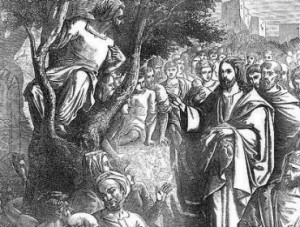 Zacchaeus climbs a tree to see Jesus. So today’s reading got me thinking scattered thoughts about trees. The weeping willow in my childhood backyard. The peach and cherry trees in my grandfather’s garden. The pinion pines of my native Nevada. The eucalyptus trees that were everywhere on my college campus. The huge ornamental pepper tree that shaded the first house my wife and I bought. I close my eyes, think of those trees, and I see my parents, my childhood friends, my college roommates. Trees are filled with meaning and memory; they bear the fruits of remembrance.
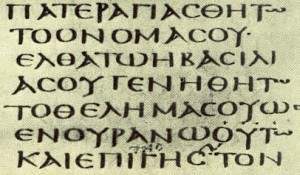 Who is you? That’s not a grammatically incorrect question. It’s a deeply important question in our study and understanding of scripture.
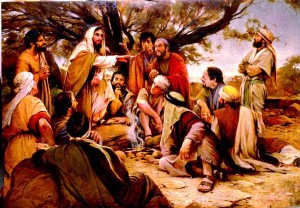 Do you ever wish someone whom you respect and admire hadn’t said what they said, because what they said is so hard to explain to someone who doesn’t respect and admire them, and what they said just sounds wrong, even to you? Then you know how I feel about the last response of Jesus in this conversation with Peter!
 Today is the last Sunday after Pentecost called “the Feast of Christ the King.” A relatively new feast on the calendar of the church, it was instituted by a 20th Century pope and originally set in late October as a response to the Protestant celebration of “Reformation Sunday” on the Sunday closest to October 31, the anniversary of Luther’s posting on the Wittenburg chapel door. The latter, I would suppose, started with the Lutherans but has spread throughout American Protestantism; I know of Presbyterian, Reformed, UCC, and Methodist churches that mark it. I know of no Episcopal congregations that do so. Episcopalians did take to Christ the King, however, and since Paul VI moved it to the last Sunday of the Christian year, every congregation I’ve been a part of has celebrated it. With the adoption of the Revised Common Lectionary, it is now an official part of our tradition.
 Although from a modern perspective, the prayer of the Pharisee is rather bigoted, but we should try to see it from his perspective and from within his culture, which Jesus shares. When we do so, we can see that Jesus is not criticizing the individual, but rather condemning an entire system of religion which divides and categorizes people. Jesus is denouncing any system, religious, social, or political, which separates people on the basis of bigotry and fear.