Occasional thoughts of an Anglican Episcopal priest

Category: Sermons (Page 32 of 40)

Taking the Train to God’s Picnic: A Homily for a Requiem – June 25, 2013

====================

This sermon was preached at the Requiem Mass on June 25, 2013, for Charlie Stehno, a member of St. Paul’s Episcopal Church, Medina, Ohio, where Fr. Funston is rector.

(Episcopal Church Lectionary, For Burials: Isaiah 25:6-9; Psalms 23; Revelation 21:2-7; and John 14:1-6. These lessons were selected by the family from among the options set forth in The Book of Common Prayer. All options can be found at The Lectionary Page.)

====================

Steam LocomotiveAre you familiar with those visions of the afterlife in which the dearly departed, clothed in flowing white robes lounge around on fluffy, white cotton clouds playing harps? I have to be honest with you that I cherish a very dear hope that such visions are 100% absolutely wrong! I cannot imagine any existence more boring than an eternity of cloud-floating and harp-playing, and if my ten years of knowing Charlie Stehno have given me a clue of anything about Charlie it is that he would most likely feel the same way. If he has gotten to the Great Hereafter only to find himself fitted out with a flowing white robe and issued a harp to play and cloud to lounge upon, I suspect that he is (as my grandmother would say) “fit to be tied.”

But I don’t really think there’s any danger of that! I believe that larger life in God’s Presence is quite a bit different from that beatific vision of robe wearing, harp playing, and cloud floating. As I spent the past few days contemplating the lessons that Kathy selected for today’s Requiem — this wonderful vision of Isaiah’s of a feast on a mountain top; John of Patmos’s vision of the new Jerusalem where our home will be with God, where hunger and thirst will be no more, where there will be these wonderful springs overflowing with the water of life, and where God will wipe away every tear; and most importantly Jesus’ promise that in God’s home there is a place for all of us — as I contemplated these readings and as I thought about Charlie’s life selling the heavy machinery that moved the rolling stock on the railways of this and several other countries, I kept having a childhood memory. It is a memory that informs my vision heaven, that shapes my belief about what lies through that doorway of death. I’d like to share it with you, so I hope you’ll forgive me if I spend a few minutes sharing something about my family as a means to come to terms with the grief and loss experienced by the Stehno family.

My parents were raised in a small town in southeastern Kansas and when I was very young my paternal grandparents and many members of my extended family on both sides still lived in and around that town. On my mother’s mother’s side, my great-grandfather, Hinrich Buss, had emigrated from the German farm country of Ostfriesland in the 1860s when he was about 20 years old. He settled in that area of Kansas and homesteaded several thousand acres, raising not one but three families. I am descended from him and his third wife, Harmke (who bore Hinrich 15 children who lived to adulthood).

Each summer of my childhood I would spend several weeks with my father’s parents, but for one day of each summer I would cease being a “Funston” and, instead, I become one of the several hundred “Buss cousins.” That one day was like a parenthetical note in my life: “This is Eric Funston – open parenthesis – who is also a Buss – close parenthesis.” Those parentheses were, if you will, represented by railroad journeys.

That day would start early in the morning when my great-uncle and great-aunt Roy and Blanche Buss would collect me from my Funston grandparents’ home and we would drive to the Santa Fe Train Station and catch the Atchison, Topeka & Santa Fe Railroad for the ancestral home, which was outside the next town to the west, an hour’s train ride away. Open parenthesis! When the train pulled out of station, I was no longer a Funston; I was a Buss.

When the train arrived, we would disembark to be picked up by other Buss cousins and driven to the farmhouse which had been and still was (and still is) the Buss family home.

As soon as we arrived, Blanche would join the other women in the farmhouse kitchen; Roy would go off with the other men to walk the fields and look at the livestock and smoke cigarettes and talk about the news of the day; and I would join the other kids swimming in the farm pond (which, to be honest, was pretty yucky, but we were kids, we didn’t care).

Around midday trestle tables would be set up in the yard and in pretty short order they would be overflowing with sauerbraten, and schnitzel, and wursts of all sorts, with sauerkraut and potato salad and fresh garden tomatoes, and more kinds of homemade bread and rolls and biscuits than you can imagine. Someone would say a prayer, and we would all dig in and eat way more than we should and, afterward, fall asleep in the shade of the barn.

A little later the older kids and the younger men would get up a football game. Because there were more of us descended from Greatgramma Harmke than from Hinrich’s first two wives it was usually organized as the third family against the first two. And there would be much cheering and yelling and arguing over plays and goals and whether someone is in-bounds or out; you know the sort of thing that happens in those sorts of games.

Sometime during the fourth quarter, the women would disappear back into that farmhouse kitchen and as the game came to its inevitable end, those trestle tables would again be loaded to overflowing, but this time with homemade pies, and cakes, and cookies, and even homemade ice cream. And, once again, we would all eat way more than a person ought . . . .

But in not-too-long a time, the sun would begin to set. And that would be the signal that Great-uncle Roy and Great-aunt Blanche and I would have to leave. We’d be driven back into town to catch the evening train back to my parents’ hometown. When we got there, I went back to being a Funston. That eastbound train ride was the end of my day of being a “Buss cousin.” Close parenthesis.

You know, there are a lot of songs about trains, and among those are a lot of songs about trains going to heaven. That’s another thing that kept coming to mind as I thought about what I might say here today. There’s Woody Guthrie’s familiar tune:

This train is bound for glory, this train.
This train is bound for glory,
Don’t carry nothing but the righteous and the holy.
This train is bound for glory, this train.

And there’s Boxcar Willie’s wonderful song of a hobo’s last train ride:

I’ll ride that last train to heaven
On rails of solid gold
In a boxcar lined with satin
Where the nights are never cold
Where a hobo’s always welcome
Even in his ragged clothes
I’ll ride that last train to heaven
When the final whistle blows.

And my personal favorite is Curtis Mayfield’s great song:

People get ready there’s a train comin’;
You don’t need no baggage, just get on board.
All you need is faith to hear the diesels hummin’;
You don’t need no ticket, just thank the Lord.

In the 23rd Psalm, David thanks the Lord for shepherding us as we walk through the valley of the shadow of death, for setting an abundant table for us in the midst of our enemies, and for pledging in God’s mercy and goodness that we will dwell in the house of the Lord for ever. Jesus affirms that in that home there are rooms for all of us, and both Isaiah and John of Patmos assure us that the abundance of that table will continue, that God will lay out a feast of “rich food . . . and well-aged wines strained clear,” that there will no hunger or thirst of any kind.

It will be like a family reunion, God’s family reunion, where everyone we’ve ever loved is present, and everyone they’ve ever loved (including us) eventually will be, “where sorrow and pain are no more, neither sighing, but life everlasting,” and where “God will wipe away the tears from all faces.” St. Paul, the patron of this parish, explained it this way in his First Letter to the Corinthians:

Since death came through a human being, the resurrection of the dead has also come through a human being; for as all die in Adam, so all will be made alive in Christ. But each in his own order: Christ the first fruits, then at his coming those who belong to Christ. Then comes the end, when he hands over the kingdom to God the Father, after he has destroyed every ruler and every authority and power. For he must reign until he has put all his enemies under his feet. The last enemy to be destroyed is death. (1 Cor. 15:21-26)

As a song I know was special to Charlie might put it:

The enemy must yield,
We’ll fight just like our ancestors
and march right down the field!
(University of Toledo Fight Song; Charlie was an alumnus and former football start of Toledo U.)

Charlie has marched down that field; he has finished his walk through the valley of the shadow of death. He has won the victory! He has gotten on board that train bound for glory, that last train to heaven; he’s left this life’s crippling, painful baggage behind, and he has arrived in that larger life where, as Isaiah assures us, he has not found a cloud or a harp.

No, he’s taken that train to a great family reunion, where the picnic tables are eternally laden with God’s overflowing abundance, where the faithful swim not in some yucky farm pond but in the clear river that flows from the springs of the water of life, where the family home has room for everyone, and where (if there isn’t one already, Charlie will make sure) there’s a football game going on.

And the greatest and most wonderful thing is that there will be no sunset and there will be no train going back to anywhere; there will be no “close parenthesis.”

Thanks be to God! Amen.

====================

A request to my readers: I’m trying to build the readership of this blog and I’d very much appreciate your help in doing so. If you find something here that is of value, please share it with others. If you are on Facebook, “like” the posts on your page so others can see them. If you are following me on Twitter, please “retweet” the notices of these meditations. If you have a blog of your own, please include mine in your links (a favor I will gladly reciprocate). Many thanks!

====================

Father Funston is the rector of St. Paul’s Episcopal Church, Medina, Ohio.

The Festal Shout – From the Daily Office – June 24, 2013

From the Psalter:

Happy are the people who know the festal shout!
they walk, O Lord, in the light of your presence.
They rejoice daily in your Name;
they are jubilant in your righteousness.

(From the Daily Office Lectionary – Psalm 89:15-16 (BCP Version) – June 24, 2013.)

Amen Corner“Festal shout” . . . the Hebrew is teruwah, a technical term for a liturgical response. (The root word is ruwa which is a verb meaning “to shout an alarm.”) It was probably something along the lines of “Hallelujah!” although it was probably not that particular Hebrew exclamation.

Episcopalians are well familiar with liturgical responses. We are almost programmed to make them. Say, “The Lord be with you,” to an Episcopalian, and it will prove very unlikely that he or she cannot help but say, “And also with you!” (Unless, of course, the person may be an old time traditional, in which case “And with thy spirit” will leap off the tongue.) However, familiar was we may be with liturgical responses, shouting them is something we simply don’t do, although in a crowded church we might be a little louder than usual.

And shouting out on our own in response to, say, a sermon? Out of the question!

Several years ago I had the privilege of preaching in a parish of the African Methodist Episcopal Church. I had gotten maybe two paragraphs into my prepared text when a member of the congregation called out, “Amen, preacher!” I must admit to being taken aback; I “stumbled” a bit, but got back on track pretty smoothly. Then it happened again! What had started as a typical Episcopal lecture-style homily turned into a dialog between the preacher and the congregation. We had fun together speaking the word of God to each other; there was joy and jubilation in that church It was great! I loved it! I’d never had a preaching experience like that before, and I’ve not had one since.

I don’t think we Episcopalians need to start shouting spontaneous responses to our sermons (although that might be fun), but I do think we need to cultivate that same sense of joy and jubilation, the vibrancy and liveliness that was evident in that AME congregation. We need to learn the “festal shout,” or at least find its spirit in our worship.

====================

A request to my readers: I’m trying to build the readership of this blog and I’d very much appreciate your help in doing so. If you find something here that is of value, please share it with others. If you are on Facebook, “like” the posts on your page so others can see them. If you are following me on Twitter, please “retweet” the notices of these meditations. If you have a blog of your own, please include mine in your links (a favor I will gladly reciprocate). Many thanks!

====================

Father Funston is the rector of St. Paul’s Episcopal Church, Medina, Ohio.

Legion . . . Silence: A Contrast – Sermon for the 5th Sunday after Pentecost (Proper 7C) – June 23, 2013

====================

This sermon was preached on the Fifth Sunday after Pentecost, June 23, 2013, at St. Paul’s Episcopal Church, Medina, Ohio, where Fr. Funston is rector.

(Revised Common Lectionary, Pentecost 5 (Proper 7, Year C): 1 Kings 19:1-15a; Psalms 42 and 43; Galatians 3:23-29; and Luke 8:26-39. These lessons can be read at The Lectionary Page.)

====================

Schizophrenia Illustration from Vimeo At the beginning of the sermon, following the reading of Gospel lesson, five readers scattered among the congregation, rose and loudly read the following five passages simultaneously:
Voice One: “Four score and seven years ago our fathers brought forth on this continent a new nation, conceived in liberty, and dedicated to the proposition that all men are created equal. Now we are engaged in a great civil war, testing whether that nation, or any nation so conceived and so dedicated, can long endure.”

Voice Two: “We the people of the United States, in order to form a more perfect union, establish justice, insure domestic tranquility, provide for the common defense, promote the general welfare, and secure the blessings of liberty to ourselves and our posterity, do ordain and establish this Constitution for the United States of America.”

Voice Three: “You can’t do anything right and never will be able to. Everyone hates you. You have no friends. You are the most useless, worthless human being on the planet. You know this is true, and you are powerless to change it. You should just end it right now. There’s no reason for you to keep living.”

Voice Four: “In a large bowl, beat together eggs, oil, white sugar and two teaspoons vanilla. Mix in flour, baking soda, baking powder, salt and cinnamon. Stir in carrots. Fold in pecans. Pour into prepared pan. Bake in the preheated oven for 40 to 50 minutes, or until a toothpick inserted into the center of the cake comes out clean.”

Voice Five “Mr. Dursley, a well-off Englishman, notices strange happenings on his way to work one day. That night, Albus Dumbledore, the head of a wizardry academy called Hogwarts, meets Professor McGonagall, who also teaches at Hogwarts, and a giant named Hagrid outside the Dursley home. Dumbledore tells McGonagall that someone named Voldemort has killed a Mr. and Mrs. Potter and tried unsuccessfully to kill their baby son, Harry.”

One of the many ways in which modern scholars try to make sense of the story of the Gerasene Demoniac is the suggestion that he was, in fact, schizophrenic. For example, the Dean of St. Alban’s Cathedral in England, Jeffrey John, writes:

Anyone presenting the symptoms of the Gerasene demoniac today would be rapidly committed for treatment of multiple schizophrenia – and quite rightly. It would be very foolish to do otherwise, or to discount the huge, God-given progress that has been made in our understanding and treatment of mental illness since biblical times. (The Meaning in the Miracles, p. 91, Eerdmans:2004)

A Roman Catholic writer who identifies himself only as “John” tells of accompanying a priest making his Eucharistic ministry rounds at a psychiatric hospital. He describes what happened when they arrived at the ward where the most seriously disturbed patients were housed:

My friend began to say the prayers and all was relatively calm until he raised the Eucharist. This very motion acted like a trigger for one of the patients who began to shout expletives, spit and hiss. This set off most of the others; he had to be restrained while we administered the Eucharist to those who wanted it and lined up to receive it. Amidst the cacophony I heard one thing that he shouted which remains with me to this day; he shouted “why are you coming in here tormenting us?” (John’s Ramblings)

He then comments, “It wasn’t until some time later that when meditating on the Healing of the Gerasene Demoniac . . . that I shuddered to a halt and recalled that event in the psychiatric hospital.”

Schizophrenics hear voices. This is the most common type of hallucination in schizophrenia. The voices may talk to the person about his or her behavior; they may order the person to do things; they may speak warnings of danger. Sometimes the voices talk to each other; sometimes they talk over one another, several voices speaking at once. What we experienced as these five people read these differing texts was a crude demonstration of what some schizophrenics experience, or what the Gerasene Demoniac seems to have suffered.

The great English author, C. S. Lewis, once wrote that we human beings are a “myriad of impulses, a cauldron of evil desires.” The Gerasene Demoniac certainly was. When Jesus asked him (or the demon within him) his name, the answer was, “We are legion.”

That is a very scary answer! That word, legion, is a Roman military term. In the Roman army, a legion consisted of six thousand men. We heard only five voices in our little demonstration. Can you imagine what it must have been like to hear thousands upon thousands of demonic voices? No wonder he would break his chains and shackles and run into the wilds to live in the cemetery among the tombs!

John, the Roman Catholic blogger, suggests that “all disorder, all conflict whether we call it civil, political, doctrinal, psychiatric, psychological, social or personal disorder, . . . anything that creates or contributes to disorder or conflict is the presence of evil at work in the world.” I believe he is correct, the message of the Prophets is that that disorder, that chaos is not, and never will be, the last word.

As dramatic counterpoint to the Gospel story today, we have another story of the Prophet Elijah. The Lectionary, as you remember, has had us bouncing around in the First Book of Kings reading stories of Elijah, but not in the order they are presented in that book. Instead, we have been getting the texts from First Kings as they may relate to the stories from Luke’s Gospel; today’s pairing seems to be a good example. What we see here is the stark difference between the chaotic disorder of evil, represented by demon possession (or schizophrenia), and the order of holiness, represented by the “sheer silence” in which Elijah encounters God.

You recall the story. Elijah has just killed the 450 prophets of Ba’al, which has royally angered the wicked Queen Jezebel. She has sent word to Elijah saying, “So may the gods do to me, and more also, if I do not make your life like the life of one of them by this time tomorrow.” In other words, “Look out, Dude! I’m gonna kill you!” So Elijah, in fear, flees into the desert and in a fit of depression prays that God will take his life. However, an angel appears and tells him that’s not going to happen. He is instructed to eat something and then travel to “Horeb, the mount of God.” This is understood to be the very same place where Moses received the Tablets of the Law. When he gets there, God asks what his problem is: “What are you doing here, Elijah?” Elijah answers that all the prophets of Yahweh have been killed (by Queen Jezebel and her army) and only he is left. So God tells him to stand at the mouth of his cave because God will pass by.

He does so and there is a storm, and then an earthquake, and then a fire. All of these things represent that disordered chaos which the Demoniac in the Gospel experiences, and God is in none of them. Instead, God is in the “sheer silence,” as the New Revised Standard Version translates the Hebrew. A literal translation of the Hebrew would be “the sound of gentle blowing,” and the King James Version translated this by that wonderful turn of phrase “a still small voice.”

So we have this wonderful juxtaposition of an image of loud, confusing, demonic chaos — the Gerasene Demoniac, a person in a situation which is overwhelmingly evil, permeated with and being buffeted by a legion of devils, thousands of incoherent voices, pulling him in every direction, ruining his life — with an image of calm, peaceful, gentleness — the still small voice of God present in sound of sheer silence, the sound of gentle blowing.

We, I hope, are not possessed of demons, nor suffering from schizophrenia or some other form of delusional mental illness. But we all inhabit a world of many, many voices, all talking to us, all telling us what to think, or do, or say. No matter how old we are, we will always have the voices of parents and grandparents playing in our heads; we have the voices of politicians, news reporters, bosses, spouses, our own children, their teachers, doctors, lawyers, tax advisers . . . and occasionally preachers . . . all telling us what to do. There are times when all of that noise can get us down, when we can all relate personally to the lament in today’s gradual psalm: “Why are you so full of heaviness, O my soul, and why are you so disquieted within me?”

Several years ago, there was a job opening on a cruise ship; a new communications officer was need. There were several applicants seeking the position and all were told to come to a particular office at the same time on the same day. They arrived and were shown in to a waiting room. While they waited to be interviewed, the conversed with one another and soon the room was filled with the sounds of conversation. After quite a long wait, another applicant who was late came in and sat down; everyone else was busy talking, so she just quietly waited for a few minutes, but then suddenly, she jumped up and walked through a door marked “Private.” A few minutes the personnel manager walked out of that door and announced that the position had been filled; the late-arriving applicant had been hired. The other applicants were extremely angry, “We were here first! How could she go ahead of us and get the job?” To which the personnel manager replied, “Any of you could have gotten the job if you had just been quiet long enough to pay attention to the message on the intercom.” “What message?” “All the time you were talking the intercom was broadcasting in Morse Code, ‘A ship’s communications officer must always be on the alert. The first person who gets this message and comes directly into my office will get the job.'”

I believe that God’s still small voice is like that coded message. It’s there if we will but take a few moments of silence and listen for it. And if it seems like we do not have the power to do so on our own, if we are unable to still the storms, the earthquakes, the fires, the voices . . . the story of the Gerasene Demoniac reminds us that Jesus can, because personal exorcism is not what this story is really about. “Rather,” as Jeffrey John reminds us, “it is about the promise . . . of God’s ability to defeat and re-order the disordered powers that afflict both individuals and communities.”

Life can sometimes, indeed, life can often be permeated with great evil that is almost beyond human comprehension and beyond our ability to handle. In those moments, we may be tempted to just give up and give in to the intensity of evil around us. Like the Psalmist we may cry out, “Why are you so full of heaviness, O my soul, and why are you so disquieted within me?” Like Elijah we may be tempted to just sit down in the desert and say, “Let me die.” But God does not give up; Jesus does not give up. Jesus faces the demons with his healing and his peace. There is no situation so bad that Jesus cannot or will not bring his healing power.

Why are you so full of heaviness, O my soul?
and why are you so disquieted within me?
Put your trust in God;
for I will yet give thanks to him,
who is the help of my countenance, and my God.
Amen.

====================

A request to my readers: I’m trying to build the readership of this blog and I’d very much appreciate your help in doing so. If you find something here that is of value, please share it with others. If you are on Facebook, “like” the posts on your page so others can see them. If you are following me on Twitter, please “retweet” the notices of these meditations. If you have a blog of your own, please include mine in your links (a favor I will gladly reciprocate). Many thanks!

====================

Father Funston is the rector of St. Paul’s Episcopal Church, Medina, Ohio.

Offal Theology Beats Awful Theology – Sermon for the 3rd Sunday after Pentecost (Proper 5C) – June 9, 2013

====================

This sermon was preached on the Third Sunday after Pentecost, June 9, 2013, at St. Paul’s Episcopal Church, Medina, Ohio, where Fr. Funston is rector.

(Revised Common Lectionary, Pentecost 3 (Proper 5, Year C): 1 Kings 17:8-24; Psalm 146; Galatians 1:11-24; and Luke 7:11-17. These lessons can be read at The Lectionary Page.)

====================

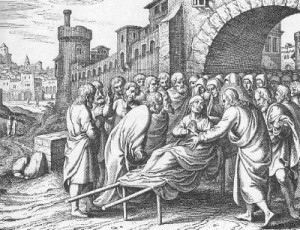
Jesus Raises the Son of the Widow of NainYou may remember that last week, as we were looking at the story of Elijah competing with the prophets of Ba’al, I said that Elijah was an unpleasant person. Well, this week we have another story of Elijah and another example of his unpleasantness. The Rev. Lia Scholl, a Mennonite pastor who writes sermon helps on a blog called The Hardest Question, said, “Every time I read this passage, my first reaction is, ‘Elijah is a jerk!'”

She points out that doesn’t ask for a drink of water or a morsel of bread, he demands them. Listen again to what the First Book of Kings says, “When [Elijah] came to the gate of [Zarephath], a widow was there gathering sticks; he called to her and said, ‘Bring me a little water in a vessel, so that I may drink.’ As she was going to bring it, he called to her and said, ‘Bring me a morsel of bread in your hand.'” He doesn’t introduce himself; he doesn’t explain himself; he just insists that the widow take care of his needs. “It’s just jerk behavior,” says the Rev. Scholl.

For the moment, though, let’s forgive Elijah his jerkiness, his unpleasant personality, and take a close look at this story. If it is an historical event (and about that there is some considerable doubt), and if the Books of Kings are intended to be a chronological record, then our lectionary has had us read about events in Elijah’s life out of sequence; this story is told one chapter before the sacrifice competition we heard about last week. The reason for us reading the stories out of order is pretty clear; our lectionary editors want us to hear and consider this story in connection with Jesus’ raising of the son of the widow of Nain.

This story about Elijah would have been very familiar to Jesus and those who witnessed what he did in Nain, and it’s possible that this Elijah story was known to Luke. They may have believed it to be an historical fact, but modern scholarship considers it unlikely that this is a factual story. It has the appearance of being a legend or folk tale intended by the author of First Kings to enhance Elijah’s standing as a prophet. First, there is the matter of the magic flask of oil and the magic container of flour, these vessels that never run out during the course of the three-year drought that is said to be affecting the land. (By the way, Elijah is credited with both causing and ending the drought with just a word, but other than this story in First Kings, there’s no evidence in any other historical or archeological record of there being a drought around his time.) Second, there is the manner in which Elijah brings the widow’s son back from the dead. Here’s the way it is described: “He [meaning Elijah] stretched himself upon the child three times.” This is what folklorists and anthropologists would call “sympathetic magic;” Elijah mimics the death of the boy, then acts out his desired resurrection, then utters some sort of magical formula, in this case a prayer to his god, Yahweh.

Now I said that those who witnessed Jesus raise the son of the widow of Nain probably knew this story and probably thought of it as factual. It is this prayer that Elijah speaks, and in fact the whole theology of the story, that makes me glad that we can look back at it and say it probably isn’t!

Listen to what the widow of Zarephath said to Elijah when her son died: “What have you against me, O man of God? You have come to me to bring my sin to remembrance, and to cause the death of my son!” This is awful theology! The widow blames herself for her child’s death. She believes that something she has done has caused her son to die. We still hear this kind of thinking today; we’ve all heard people in fits of grief cry out, “What have I done to deserve this?” Worse, she blames God because God’s prophet, Elijah, has come to her and this (she believes) has caused her sin to be recalled by God; in turn, because of that recollection, God has caused this terrible judgment (the death of her son) to happen. Now the poor woman in her grief, I suppose, can be forgiven this awful theology.

But Elijah in his prayer, his magic incantation after stretching out on the body of the deceased and enacting the boy’s resurrection, says exactly the same thing to God: “O Lord my God, have you brought calamity even upon the widow with whom I am staying, by killing her son?” According to the theology of this story, God punishes the sinful behavior (what ever it may have been) of parents by murdering their children!

I am often called upon to engage in conversation with atheists who want to tell me why they don’t believe in God. I don’t go looking for these conversations, but wearing a clerical collar in an airport or a restaurant or wherever they just seem to happen. And when they tell me why they don’t believe in God, in addition to all the allegedly scientific reasons about there being no credible experimentally verifiable evidence, there is always some variation on, “I can’t believe in a god that would allow (or cause) children to die.”

“Well, guess what?” I tell them. “I don’t either!” I don’t believe in the god that this story of Elijah portrays. I do not believe the theology of this story is correct! And that’s why I’m glad that I can say, “Modern biblical scholarship strongly suggests that this story never happened.” It was and is merely folklore preserved to enhance the reputation of this jerk Elijah as a powerful, miracle-working prophet of God.

But as I suggested, the people who witnessed Jesus’ action in raising the son of the widow of Nain revered Elijah’s memory and probably did believe it to be factual, and that’s why what Jesus did was so important. Let’s set Elijah and his awful theology aside for a moment and just focus on the gospel story.

First of all, let’s make note of the fact that this story is one of only three in which Jesus raises someone from the dead. One is the raising of the synagogue leader Jairus’s daughter told in all of the Synoptic Gospels. The second is the raising of Lazarus told only in John’s Gospel. And then there is this story told only by Luke.

In the first two, Jesus is asked by the grieving father, or by Lazarus’ grieving sisters, to come and heal their sick relative, but before he comes the patient dies. In this story, there is no request at all, and Jesus’ first knowledge of the death is when he happens upon the funeral procession. Luke writes, “As [Jesus] approached the gate of the town, a man who had died was being carried out. He was his mother’s only son, and she was a widow; and with her was a large crowd from the town. When the Lord saw her, he had compassion for her.” That’s it, that’s the key to this story. Jesus had compassion for the widow.

What does that word mean to you? When someone is said to be “compassionate,” what do you understand them to be saying? I asked some high-schoolers what it meant to them and one of them volunteered, “Well, it means you feel sorry for someone.” The rest all agreed with that. I suppose to most modern American folk that is what it means. We feel sorry for someone, so maybe we lend a hand if we have the time, or give a few dollars to charity, or if it’s someone we know we bake a casserole. The root of our word “compassion” is Latin for “feeling with” and feeling someone else’s sorrow, feeling “sorry for them” is part of that.

But that doesn’t hold a candle to the word Luke uses to describe Jesus! The Greek text here is the verb splanchnizomai. You know how some words just stick with you? When I was learning Greek that was one that did – splanchnizomai – I just loved the sound of it. It derives from the noun splanchna, which refers to offal, to inner organs – intestines, spleen, liver, kidneys – we would say “guts” today. Jesus didn’t just “feel sorry” for the widow of Nain; he felt this woman’s pain and grief down here, down deep, down in his offal, down in his guts . . . and he was determined to do something for her.

So Jesus does the unthinkable; he interrupts a funeral procession and takes hold of the corpse! In any culture that would be a violation of, at the very least, good taste, but amongst First Century Palestinian Jews this was an act of unspeakable uncleanness; it was a sacrilege! One simply did not touch, let alone grab hold of a dead body!

I was present at both my father’s and my paternal grandfather’s funerals. They were open-casket funerals because of their Lodge affiliations – my father was member of the BPOE; my grandfather, a Mason. Both groups have special funeral services that require an open casket. I remember that the morticians had arrange their hands so that they were laid across their chests, and I remember that both my mother and my grandmother at the conclusion of the services went up to the coffin, reached out, and grabbed hold of their husband’s hands. I’m certain that both of them, if they could have, would have pulled them out of those boxes and made them live again. They couldn’t, of course, but Jesus could do that for the widow of Nain. He could do it and did do it because he had compassion; he felt her pain and her grief right down there in his gut, and he gave her back her son.

And that is what makes this story so different from our Old Testament story!

The theology of the story of Elijah with widow of Zarephath tells of a god who punishes parents’ wrong doing by murdering their children. Jesus showed that theology to be not merely wrong, but awful, monstrously awful! God is a god of life, not of death. God is a god who not only does not murder children to punish their parents, God gives dead children back to their parents.

God moves powerfully beyond our theologies, especially our monstrous theologies, to give new life, to perform a new creation. God is a god of compassion, a god who feels our pain and our suffering and our grief down deep in God’s guts. (One might say that the offal theology of Jesus is beats the awful theology of Elijah.)

The Lord sets the prisoners free;
because the Lord feels their captivity in his guts.

the Lord opens the eyes of the blind; *
because the Lord feels their blindness in his guts.

the Lord lifts up those who are bowed down;
because the Lord feels their degradation in his guts.

the Lord sustains the orphan and widow.
because the Lord feels their pain and grief and loneliness in his guts.

The offal theology of Jesus beats the awful theology Elijah! Hallelujah!

====================

A request to my readers: I’m trying to build the readership of this blog and I’d very much appreciate your help in doing so. If you find something here that is of value, please share it with others. If you are on Facebook, “like” the posts on your page so others can see them. If you are following me on Twitter, please “retweet” the notices of these meditations. If you have a blog of your own, please include mine in your links (a favor I will gladly reciprocate). Many thanks!

====================

Father Funston is the rector of St. Paul’s Episcopal Church, Medina, Ohio.

Writing Sermons – From the Daily Office – June 8, 2013

From the Psalter:

Lord, you have searched me out and known me.

(From the Daily Office Lectionary – Psalm 139:1 (BCP Version) – June 8, 2013.)

to consider something deeply and thoroughlyToday, it is the evening psalm that I ponder.

The NRSV translation of the first verse of Psalm 139 is similar to that in The Book of Common Prayer: “O Lord, you have searched me and known me.” One renders the Hebrew verb chaqar as “search out;” the other as “search.” And both have always caused me to stop short and wonder, “What? The omniscient, omnipresent God has to look for me?”

Good thing chaqar has some other understandings:

  • In the First Book of Samuel, David is afraid that Saul has decided to kill him and so his friend, Saul’s son Jonathan, tells David that he will “sound out” his father. Chaqar is the verb translated as “sound out.” (1 Samuel 20:12 NRSV)
  • In the First Book of Kings, chaqar is rendered as “determined” when it is used in the story of Solomon making the bronze vessels for the Temple. They could not be weighed “because there were so many of them; the weight of the bronze was not determined.” (1 Kings 7:47 NRSV) – The New American Standard version of this verse uses “ascertained” to translate the Hebrew.
  • In the story of Job, the New American Standard translation uses “ponder” to translate chaqar when Elihu says to Job: “I waited for your words, I listened to your reasonings, while you pondered what to say.” (Job 32:11 NAS)

So “searching” or “searching out” as used in the Psalm doesn’t mean “looking for.” It means giving careful consideration, as in the weighing of precious metal vessels in the First Book of Kings. Even more, it means the give-and-take between two persons, the “sounding out” of ideas, the coming to mutual understanding as two people share their thoughts. And it means to contemplate and meditate upon what the other has revealed, to ponder what he or she has communicated.

Ponder is not a word we use much anymore in modern American English. Say the word to most people and probably the first thing that will come to their minds is the opening stanza of a famous American poem:

“Once upon a midnight dreary, while I pondered, weak and weary,
Over many a quaint and curious volume of forgotten lore,
While I nodded, nearly napping, suddenly there came a tapping,
As of some one gently rapping, rapping at my chamber door.
“Tis some visitor,” I muttered, “tapping at my chamber door —
Only this, and nothing more.”
(Edgar Allen Poe, The Raven)

Ponder, the dictionary tells us, means “to consider something deeply and thoroughly.” That is an image of God that resonates with me. I know full well that God is not an entity, not a being in the sense that God sits in heaven’s library late at night pondering over ancient tomes, leafing through the Book of Life or the Book of the Dead or the whichever book it is in which our “names are written in heaven.” (Luke 10:20) Nonetheless, I am intrigued and even comforted by that image.

Because that is precisely what I do! Especially on a Saturday when I do the final polishing of my sermon for the next day (and, if truth be told, more often than not “final polishing” actually means “start from scratch!”) Surrounded by bibles and books, my computer humming away, a cup of coffee (or other libation) nearby, I ponder God. That God might be simultaneously pondering me delights me. Together we ponder one another, we sound each other out, we ascertain our thoughts; perhaps (one hopes) we become “united in the same mind and the same purpose,” and perhaps within my mind forms “the same mind . . . that was in Christ Jesus.” (1 Cor. 1:10; Philip. 2:5) Hopefully, that gets onto the paper and into the sermon. That is, after all, the goal of writing and preaching homilies!

Lord, you have pondered me and known me; I ponder you and seek to know you . . . . and to preach your truth.

====================

A request to my readers: I’m trying to build the readership of this blog and I’d very much appreciate your help in doing so. If you find something here that is of value, please share it with others. If you are on Facebook, “like” the posts on your page so others can see them. If you are following me on Twitter, please “retweet” the notices of these meditations. If you have a blog of your own, please include mine in your links (a favor I will gladly reciprocate). Many thanks!

====================

Father Funston is the rector of St. Paul’s Episcopal Church, Medina, Ohio.

Ten Authentic Years – Sermon for Pentecost 2 (Proper 4C) – June 2, 2013

====================

This sermon was preached on the Second Sunday after Pentecost, June 2, 2013, at St. Paul’s Episcopal Church, Medina, Ohio, where Fr. Funston is rector.

(Revised Common Lectionary, Pentecost 2 (Proper 4, Year C): 1 Kings 18:20-39, Psalm 96, Galatians 1:1-12, and Luke 7:1-10. These lessons can be read at The Lectionary Page.)

====================

10th AnniversaryTen years ago yesterday, June 1, 2003, I became Rector of St. Paul’s Episcopal Church of Medina, Ohio, Inc. We didn’t celebrate that “new ministry” until sometime in October because of difficulties scheduling bishops and other dignitaries, but on Sunday, June 1, 2003, I presided at the Holy Eucharist for the first time in this space.
It was different then. One of the things we’ve done in the past ten years is remodel this space (thanks to a gift from Verna Bruckmann in memory of her late husband Jack whom many of us remember with affection). We’ve also upgraded the parish library, refurbished the dining room, and improved the parish hall (thanks to the good fund-raising efforts of the Episcopal Church Women). We’ve purchased additional real estate, torn down the derelict houses that were on it, incorporated those lots into our landscaping, and replanted nearly all of the decorative gardens, mostly with volunteer labor.

But more important than the building and the grounds are the ministries through which we have touched peoples’ lives. In these ten years, there have been more than 1,500 celebrations of the Holy Eucharist in this sanctuary! That means just here, in this space, there have been more than 250,000 administrations of Holy Communion; more than a quarter of a million times communicants have received the Blessed Sacrament, this sacrament which (as one of our prayers of thanksgiving says) is “the pledge of our redemption” through which the grace of God brings us “forgiveness of our sins, strength in our weakness, and everlasting salvation.”

During these ten years, since we started the Brown Bag Concerts in 2007, there have been more than seventy free concerts and recitals in this space, which means something on the order of 4,000 concert-goers have received the gift music which (the poet Berthold Auerbach said) “washes away from the soul the dust of everyday life.”

There have been more than seventy baptisms, more than forty-five weddings, and more funerals than I care to remember. Each summer up to fifty children have come into this worship space to sing songs, act in skits, and learn the stories of the faith at our annual Vacation Bible Schools.

And downstairs, twice month, 220 times in these ten years, the Free Farmers’ Market has opened its doors and provided sustenance to those unable to afford it in the stores. I suppose a statistician or an economist would invent some measure for what has been distributed like a “family-week of groceries” — we’ve distributed something like 16,000 or more “family-weeks” of food and other items to hundreds of needy households. All told, nearly a half-million pounds, 250 tons, of food have been given away by this parish.

And that’s just a small sample of the statistics we could boast. There have been home visits, picnics, hospital communions, confirmations, study groups, foyer groups, potluck suppers, and so much more.

It’s been a good ten years. So . . . Happy Anniversary!

I’ll come back to consideration of our decade together, but for now, let’s take a look at the lessons for today.

What we have in our three selections from Scripture this morning are stories of authority, but more than that, they are stories of authenticity. Let’s take a look at each one in turn.

First, we have the story of a competition between Elijah, a prophet of Yahweh, the God of Israel, and the priests and prophets of Ba’al, who was the god (or perhaps the pantheon of gods) of the Phoenicians. Elijah was a well-known prophet. We know that he was known in Syria and in Egypt and in other places because the Bible tells us this, that he was known as “the man of God.” Not simply as “a man of God” but as “the man of God.” He was well known as a prophet, but he was not well known as a pleasant fellow – I’ll get to that in a moment.

In our story today, “the man of God” is dealing with a competing religion. Ba’al worship had been brought to Israel when King Ahab married a woman whose name is familiar to all of us, Jezebel, the daughter of Ethbaal, King of Tyre. The marriage of their king to this Phoenician princess and his allowing her to set up temples and practices of her native religion in Shechem, the capital of the northern kingdom, caused a problem for the people of Israel. Should they continue in their old religion (represented by Elijah) or in this new religion followed by their queen and, eventually under her influence, their king? Being politically astute, they did the logical thing – a little bit of both. And this is where we enter the story in today’s reading from the First Book of Kings.

An assembly is called and Elijah says to everyone, “How long will you go limping with two different opinions? If the Lord is God, follow him; but if Ba’al, then follow him.” Nobody says a word . . . . So Elijah proposes a contest. “Let’s do this,” he says, “well set up two altars and put a bull carcass on each one. The priests of Ba’al will call on their god to consume his bull with fire and I’ll call on my god to consume his bull with fire, and the one that actually does it will be acknowledged as the god to be worshiped in this country.”

I love the way the New Revised Standard translation gives the people’s response: “Well spoken!” they say. It’s like he was just giving a speech – the Gettysburg Address or something. The actual Hebrew is “good utterance.” The American Standard translation renders it better as, “That is a good idea!” Everybody loves a sporting event; everybody loves a good contest! Good idea!

So they do it. The priests and prophets of Ba’al set up their altar and do their best. They chant and dance and even cut themselves in an attempt to get their god’s attention, but nothing. Then it’s Elijah’s turn. But before he prays, he tells those present to make it really hard to burn up the altar and the bull sacrifice – “Douse it with water,” he says, “douse it good.” Three times they flood it, until water is running everywhere and the whole place is a muddy mess.

That’s when he says, basically, “OK, God, do it!” And God does it – a lightning bolt or a pillar of fire or something – and all the wood, the water, the bull, the whole shebang is burnt up!

But this is where our lectionary gives us a false impression of the story. Our “official” reading cuts off a verse before the story actually ends. We are left hearing that all the people “fell on their faces and said, ‘The Lord indeed is God; the Lord indeed is God.'” It sounds like everybody, including the followers of Ba’al, agreed Yahweh was the real deal and lived happily ever after. Not so . . . .

The next verse:

Elijah said to them, “Seize the prophets of Baal; do not let one of them escape.” Then they seized them; and Elijah brought them down to the Wadi Kishon, and killed them there. (1 Kings 18:40)

You see, Elijah was not a particularly pleasant person. We know this from the story of Elijah cleansing the Syrian leper, the general Naaman; he wouldn’t even bother to talk to Naaman, just sent him a message to bathe in the Jordan. That really annoyed Naaman. And we see it in spades here. Elijah had won this battle. God was proven to be the true God and Ba’al was shown to be powerless. But Elijah can’t just leave it there; he has to drive the point home by slaughtering those who had served the false god. This really annoys Queen Jezebel who will send her army to find and kill Elijah. You all know the story of Elijah hiding in the cave and living through a storm, a mighty wind, and an earthquake, but finally hearing the voice of God in the silence. This little competition with and killing of the prophets of Ba’al is why he was hiding.

So this is a story of authority – the authority of Yahweh as the true god and the authority of Elijah as his prophet – but it is also a story of authenticity. Elijah made no bones about who and what he was; he was not a pleasant fellow. And everyone knew it. Nonetheless, they clearly respected him. Despite his unpleasantness, this defect in his character, they respected his role and office as a prophet of the living God. And God empowered him as and who he was.

So . . . second reading — the introduction to Paul’s Letter to the Galatians. Reading one of Paul’s letters it is always best to remember that almost all of them were written to solve problems.

Paul’s method of evangelism was to ride into town, spend time getting to know the people, gather a group of folks interested in the story of Jesus, share the gospel with them and instruct them, identify the leaders in the group, empower those leaders (ordain them, if you will) to carry on and minister within the community, and then move on to some new town and start the process all over again. What would happen then is that the community would have some problem and someone would contact Paul – “Dear Paul, you aren’t going to believe what is going on . . .” – and he would write a letter giving his advice on how to deal with it.

This is what has happened in Galatia. After Paul left, two other groups of Christian missionaries showed up and tried to convince the Galatians that Paul had been wrong. The first group were the Gnostics. The Gnostics had been around since before Jesus, but they’d sort of adopted Jesus as one of their own; some who were exposed to the Gnostic teachings found in Jesus the sort of teacher they’d had before. Gnosticism gets its name from the Greek word for “knowledge” and their approach to religion and spirituality was based on the idea that through special knowledge one could escape the evil of the material world. They thought that the material world was bad and that salvation was achieved by leaving it behind, and the only way to leave it behind was through initiation into this special or secret knowledge. Christian Gnostics taught that Jesus had given the secret knowledge to the Twelve and they had then passed it on to a few special leaders who passed it on to chosen initiates, and so forth. To them, Paul’s response was, “No way! The Gospel is open and transparent. It’s for everyone!”

The second set of folks who were causing the Galatians problems were Jewish Christians who taught that before you could be a Christian you had to be a Jew. We call them “the Judaizers.” They were teaching that a Gentile had to first convert to Jewish law and practice. Gentiles had to “keep kosher” (as we would currently say), then they could be baptized and be followers of Jesus’ Way. For example, they taught that adult males had to be circumcised. (I think it may have been one of those adult males who wrote to Paul – “You aren’t going to believe what these people are saying!”)

Paul’s response to the Judaizers was also a big “No way!” What he wrote to the Galatians was that Jesus and Jesus’ good news redeems them where and as they are. They do not need to become something else, something different. Rather, they need to be authentically themselves. It is as their authentic selves that Jesus redeems them and empowers them to be better Gentiles; they don’t have to become Jews.

Again, it is a story of authenticity and of God’s respect for people as and who they are.

Which brings us to the gospel lesson from Luke, a healing story told in both Matthew’s and Luke’s Gospels, but in Luke’s version it is unlike any other in all of the Gospels. In no other healing story does Jesus never talk to the person making the request, nor address the person being healed, nor even see (let alone touch) the person being healed, but that is exactly what happens here according to Luke. As Jesus arrives in Capernaum, some Jewish elders come to him and tell him about this Roman Centurion who has been very good to their community. Apparently there is someone in his household who is very important to him and this person is gravely ill. The Greek is unclear — the word used is pais which could mean “son” or “servant” or “slave” or, even possibly, “beloved” — but what is clear is that the Centurion would like this person healed.

Jesus is convinced by the elders to do so and sets off for the Centurion’s house. Before he gets there, however, the Roman sends messengers saying, “You don’t need to come. I’m unworthy to have you to enter my home. Just say the word and my son/servant/beloved will be healed.” Perhaps the Centurion knows of the Jewish custom forbidding an observant Jew from entering a Gentile home. In any event, his messengers convey his explanation: “Like you, Jesus, I am a man under authority. I answer to those above me, and I expect and get obedience from those below me.” He is saying that he recognizes that Jesus is under the authority of Heaven, and that as such he can expect and get the obedience of the powers of the world. Just say the word; it will be done.

In response to this message, Jesus praises the Roman’s faith: “Not even in Israel have I found such faith,” he tells the crowd. The word here translated as “faith” is pistis, the root of which is peitho which names the quality of having trust, or of being trusted, or trusthworthy, and confident. So while this, too, appears to be a story about authority it is, at its heart, a story about authenticity. This Roman was being true to who he was; not a Jew, he felt unable to appeal directly to Jesus or to have Jesus enter his home. Nonetheless, he had the confidence that Jesus would honor him and heal his son/slave/beloved. And Jesus does so. Jesus honors his honesty and authenticity.

Which brings me back to our 10th anniversary . . . .

Ten years and a few months ago we, this parish of St. Paul’s Episcopal Church of Medina, Ohio, and I began the courtship which is the way we Episcopalians pick and choose our clergy leadership. This parish, as any parish in search of a rector would do, did a self study and prepared a parish profile which was then entered in to our denominational dating computer in New York City. As a priest seeking a new call, I had done a personal profile and had it in entered into that same ecclesiastical “match-dot-com” system. The dating computer ran its algorithms and matched us up, and you all selected me as one of the priests to contact, so we started our conversations.

Now you all know that Evelyn and I are originally from Nevada, so while this was going on, she was praying that we would end up somewhere (as she put it) “western.” She didn’t disallow my consideration of a parish in Ohio, but she wasn’t really all that thrilled about it. One of the things that had attracted me to St. Paul’s Parish was your written profile, this booklet that parishes write and publish with pictures and financial reports and so forth, describing themselves, their town, the ministries they do, etc. etc. etc. Most of the time these profiles are not really very accurate; instead of being a description of the parish as it is, they describe what the congregation wants to be — they are “wish lists.” Sometimes, even worse, they are simply “what someone in the diocesan office told us we had to say if we wanted to get a priest.” St. Paul’s Parish Profile was different. It seemed to be honest and authentic. It told a story of a lot of good stuff, but it also admitted to some not very positive, not very inviting aspects of the church, as well. I remember one line, in particular, in the closing paragraphs of the booklet: “This is who we are . . . warts and all.” (I now have some suspicion about who probably wrote that line!)

At the same time, I tried to be honest and up-front with you, as well. While Evie was praying that I would get a call to someplace “western,” I kept telling her not to worry; each time I would answer one of your search committee’s requests for more information about me, or for a copy of a sermon, or for my position on some controversial issue, I would say to her, “Well, after they get this, they won’t be calling me.”

And then there was the face-to-face interview, the visit when we got to know one another. You told me what you were looking for in the future, what you hoped to be, what your problems as a church community were. I told you what my strengths and skills in ministry were and are; I told you what I didn’t (and still don’t) do well. Let’s face it — there are some things I’m pretty good at . . . and there are some things I’m really quite bad at! And after our last, extremely honest conversation, as we sat waiting to board the plane back to Kansas, I said to Evelyn one more time, “Well, after this, they won’t be calling me.” But you did.

I tell Evie that she got exactly what she prayed for! Where did we end up? In the “Western Reserve”! (I tell her now that she has to be more specific in her requests of God.)

Throughout our so-far-ten-year relationship we’ve stayed honest and up-front and authentic with one another. I think that’s how we’ve been able to accomplish the things we’ve done. And let’s be very honest about that — all of those statistics, the hundreds of worship services, the thousands of communions, the dozens of concerts, the tons of food distributed, I can’t take responsibility for those. I believe we have been able to do all of that because we have been authentic; I believe that God blesses those who are authentic, open, honest, and up-front with themselves, with one another, with the world around them, and with God. Just as Yahweh answered Elijah’s prayer, just as Jesus blessed the Centurion and healed his son/slave/beloved, God has answered our prayers and blessed our ministries.

I didn’t do those things. You did them. We did them together. About the only thing I can lay entirely at my own feet, the only statistic that I can take full responsibility for over the past ten years, is that I have gained about 70 pounds! I’m not happy about that, and I intend to change that.

But we together have done a lot, and I believe we have a lot more to do, and I believe that we will accomplish it together – openly, honestly, and authentically. It’s been a great ten years! Let’s have ten more! Amen.

====================

A request to my readers: I’m trying to build the readership of this blog and I’d very much appreciate your help in doing so. If you find something here that is of value, please share it with others. If you are on Facebook, “like” the posts on your page so others can see them. If you are following me on Twitter, please “retweet” the notices of these meditations. If you have a blog of your own, please include mine in your links (a favor I will gladly reciprocate). Many thanks!

====================

Father Funston is the rector of St. Paul’s Episcopal Church, Medina, Ohio.

Mystery and Community: Trinity Sunday and Memorial Day – Sermon for May 26, 2013

====================

This sermon was preached on the Feast of the Holy Trinity, May 26, 2013, at St. Paul’s Episcopal Church, Medina, Ohio, where Fr. Funston is rector.

(Revised Common Lectionary, Trinity (Year C): Proverbs 8:1-4,22-31; Canticle 13 (Song of the Three Young Men, 29-34); Romans 5:1-5; and John 16:12-15. These lessons can be read at The Lectionary Page.)

====================

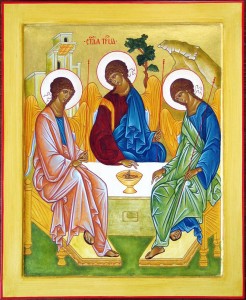
Andrei Rublev Icon of the Holy TrinityI’d like you to take out a pen (there are some in the pew racks if you don’t have one of your own) and on a blank piece of paper, or an empty spot on your service bulletin, I’d like you write down these numbers:

1,016,823
116,516
405,399
36,516
58,209
2,031
4,487
22
3

They are, respectively:

1,016,823 – the estimated number of war dead from the American civil war (the figures, especially for Confederate dead, are notoriously untrustworthy)
116,516 – the number of Americans who died in World War I
405,399 – the number of Americans who died in World War II
36,516 – the number of Americans who died in the Korean conflict
58,209 – the number of Americans who died in Vietnam
2,031 – the number of Americans who so far have died in Afghanistan during our so-called “war on terror”
4,487 – the number of Americans who so far have died in Iraq during our so-called “war on terror”
22 – the average number of U.S. Armed Forces veterans and active duty personnel who commit suicide every day because of combat-related PTSD
3 – the number of Persons in the One, Holy, Blessed, and Glorious Trinity

Today, our church asks us to focus our attention on the last of these numbers. Tomorrow, our country asks us to remember all the others. It is merely fortuitous that the calendar, this year, conflates the Feast of the Blessed Trinity with Memorial Day weekend, but it seems to me that the two speak to us with a united voice drawing our attention to common themes.

Memorial Day has its origins in a proclamation by General John A. Logan, commander-in-chief of the Grand Army of the Republic, the organization for Union Civil War veterans. On May 5, 1868, he called for an annual, national “Decoration Day.” It was observed for the first time that year on May 30; the date was chosen because it was not the anniversary of any particular battle and because it was the optimal date for flowers to be in bloom in most areas of the country. It was observed, that first year, in 27 states. A similar day of remembrance was held in the states of the former Confederacy on June 3, which was the birthday of Jefferson Davis, first and only President of the Confederate States of America. Beginning in the 1880s the name “Memorial Day” began to be used for these commemorations and it gradually became the more common term. For the first hundred years, these holidays were matters of state law, although in 1950 Congress issued a joint resolution requesting the President to issue a proclamation calling for a national observance on May 30 and every year since the presidents have done so. In 1967, by act of Congress, “Memorial Day” was declared the official name and May 30 the official date under Federal law. The following year, Congress passed the Uniform Monday Holiday Act, which moved Memorial Day, together with Washington’s birthday, Labor Day, Columbus Day, and Veterans Day, from their traditional dates to specified Mondays in order to create convenient three-day weekends.

The Veterans of Foreign Wars, by the way, opposed that change and has publicly stated its position that, “Changing the date merely to create three-day weekends has undermined the very meaning of the day.” Throughout his career in the Senate, the late Senator from Hawaii Daniel Inouye, a World War II veteran, annually introduced a measure to return Memorial Day to its traditional date of May 30. Obviously, his efforts proved unsuccessful.

The Solemnity, or Principal Feast, of the Most Holy Trinity has a somewhat longer history. The Sacramentary of St. Gregory the Great (who was pope from 590 to 604) contained prayers and a Preface for a celebration of the Trinity, but specified no date. Documents from the pontificate of Gregory VII (pope from 1073 to 1085) indicate that by that time an Office of the Holy Trinity was recited on the Sunday after Pentecost in some places, but it was not a universal practice. In 1162, Thomas á Becket (1118–70) was consecrated Archbishop of Canterbury on the Sunday after Pentecost, and his first act was to proclaim that the day of his consecration should be commemorated as a new festival in honor of the Holy Trinity. This observance spread from England throughout the western Catholic world until Pope John XXII in 1334, the last year of his 18-year papacy, ordered the feast observed by the entire Church on the first Sunday after Pentecost.

I want to suggest to you today that these two observances, one secular and one religious, share two common themes, and that this year’s fortuitous coincidence of Trinity Sunday and Memorial Day weekend allows us to explore them. Those themes are community and mystery.

There is a humorous video on YouTube made by a group calling themselves Lutheran Satire in which two Irishman engage St. Patrick in a dialog about analogies for the Holy Trinity. Although at first pronouncing themselves simple and unsophisticated, the two proceed to demonstrate considerable theological acumen as they condemn Patrick as a heretic each time he tries an analogy. The famous water-ice-steam analogy, they condemn as Modalism; the analogy of the sun, with its light and heat, they denounce as Arianism; when Patrick tries to liken the Trinity to a shamrock, they stop him and criticize him for preaching Partialism. Finally, Patrick gives up and asserts:

The Trinity is a mystery which cannot be comprehended by human reason, but is understood only through faith and is best confessed in the words of the Athanasian Creed which states that we worship one God in Trinity, and Trinity in Unity, neither confusing the Persons nor dividing the Substance, that we are compelled by the Christian truth to confess that each distinct Person is God and Lord, and that the deity of the Father, the Son and the Holy Spirit is One, equal in glory, co-equal in majesty.

The two Irishman, after a moment of stunned silence, respond, “Well, why didn’t you just say that?”

So there you have it: the Trinity is a mystery and every analogy by which we try to explain how God can be one-in-three fails, every attempt to comprehend the unity in which the Father, the Son, and the Holy Spirit together are one God ends up in heresy, and every sermon about the Doctrine of the Trinity either confuses the heck out of us or bores us to tears.

Therefore, rather than try to explain or comprehend the mystery that is the Trinity, let’s focus instead on the community that is the Trinity: the paradigm and model of all human community. The early Church Fathers explored in their writings how many aspects of our humanity reveal the divine image: our ability to perceive God’s presence; our apparently innate knowledge of the spiritual realm; our intellect; our ability to freely choose; and our capacity to live lives of goodness and love. These characteristics, they taught, belong to every human being and reveal much about God.

In the twentieth-century theologians have explored the concept of human personhood. To be made in the image of God is not to be made in the image of the Father only; it is to be made in the image of the Holy Trinity, to be made in the image of the Father, and of the Son, and of the Holy Spirit. Human beings are persons intended to be, like the Persons of the Blessed Trinity, in relationship with other persons. This means that participation in community is at the heart of our humanity; our relatedness to other persons is at the very core of who we are. The three Divine Persons are forever united with each other in mutual love. They dwell within one another; they collaborate and share in all their activities; they always act in harmonious accord. This is the model for the ideal human community, the paradigm of corporate human existence.

Human beings are supposed to work together in harmony in ways that preserve and respect the equality and dignity of every person. The English Orthodox bishop and theologian Kallistos Ware put it this way in an article in the journal of the Fellowship of St Alban & St Sergius:

Each social grouping — family, parish, diocese, church council, school, office, factory, nation — has as its vocation to be transformed by grace into a living icon of [the Holy Trinity], to effect a reconciling harmony between diversity and unity, human freedom and mutual solidarity, after the pattern of the Trinity. (The Human Person as an Icon of the Trinity, Sobornost 8, 17-18)

He also wrote in a later essay:

Belief in a God who is three-in-one, whose characteristics are sharing and solidarity, has direct and practical consequences for our Christian attitude toward politics, economics, and social action, and it is our task to work out these consequences in full detail. Each form of community — the family, the school, the workplace, the local eucharistic center, the monastery, the city, the nation — has as its vocation to become, each according to its own modality, a living icon of the Holy Trinity. (The Trinity: Heart of Our Life, in Reclaiming the Great Tradition: Evangelicals, Catholics and Orthodox in Dialogue, James S. Cutsinger, ed., InterVarsity:1997, 142)

On Friday, as has been customary in this country since 1950, the president issued a proclamation designating Memorial Day tomorrow as “a day of prayer for permanent peace.” In his proclamation, President Obama said:

On Memorial Day, we remember those we have lost not only for what they fought for, but who they were: proud Americans, often far too young, guided by deep and abiding love for their families, for each other, and for this country. Our debt to them is one we can never fully repay. But we can honor their sacrifice and strive to be a Nation equal to their example. On this and every day, we must meet our obligations to families of the fallen; we must uphold our sacred trust with our veterans, our service members, and their loved ones.

Above all, we can honor those we have lost by living up to the ideals they died defending. It is our charge to preserve liberty, to advance justice, and to sow the seeds of peace. With courage and devotion worthy of the heroes we remember today, let us rededicate ourselves to those unending tasks, and prove once more that America’s best days are still ahead. Let us pray the souls of those who died in war rest in eternal peace, and let us keep them and their families close in our hearts, now and forever. (Presidential Proclamation, May 24, 2013)

In other words, Memorial Day, like Trinity Sunday, is a day whose theme is community, the nation as community, the military services as community, the family as community. Bishop Ware’s description of Trinitarian community as embracing “diversity and unity, human freedom and mutual solidarity” could as easily have been used by the president to describe the community which celebrates Memorial Day; President Obama’s words of courage and devotion, sacrifice and trust, justice and eternal peace could as easily have been used to describe the community which is an icon of the Trinity.

There is also a mystery about Memorial Day, and the mystery is this: Why must young men and now young women go to war and die? One of my favorite Celtic folk songs reflects on this mystery. It was written in 1976 by the Scottish folksinger Eric Bogle and originally entitled No Man’s Land, but it is more commonly called The Green Fields of France or Willie McBride. It is the musing of a man stopping by a grave in a World War I cemetery and wondering about the man buried there. These are the last two verses:

Ah the sun now it shines on these green fields of France,
The warm summer breeze makes the red poppies dance,
And look how the sun shines from under the clouds;
There’s no gas, no barbed wire, there’re no guns firing now.
But here in this graveyard it’s still No Man’s Land,
The countless white crosses in mute witness stand
To man’s blind indifference to his fellow man,
To a whole generation that was butchered and damned.

Ah, young Willie McBride, I can’t help wonder why,
Did all those who lay here really know why they died?
And did they believe when they answered the call,
Did they really believe that this war would end war?
For the sorrow, the suffering, the glory, the pain,
The killing and dying were all done in vain,
For, young Willie McBride, it all happened again,
And again and again and again and again.

The mystery of Memorial Day is the mystery of war. No one wants it to happen, and yet it does, again, and again, and again, and again . . . The mystery of Memorial Day is . . . why?

The mystery of the Trinity is expressed in that number 3: How can God who is One be Three? It’s a mystery which we cannot comprehend. It can be understood only through faith; it can be lived out only in community.

The mystery of Memorial Day is expressed in those other numbers: 1,016,823 — 116,516 — 405,399 — 36,516 — 58,209 — 2,031 — 4,487 — 22. It’s a mystery we must comprehend and, through our faith and in our communities, bring to an end. Please take home the paper on which you wrote those numbers and tomorrow . . . think about that.

Let us pray:

Almighty God our heavenly Father, guide the peoples and nations of the world into the way of justice and truth, and establish among them that peace which is the fruit of righteousness, that the community of humankind may become more and more an image of the community of the Holy Trinity; through our Lord and Savior Jesus Christ. Amen.

====================

A request to my readers: I’m trying to build the readership of this blog and I’d very much appreciate your help in doing so. If you find something here that is of value, please share it with others. If you are on Facebook, “like” the posts on your page so others can see them. If you are following me on Twitter, please “retweet” the notices of these meditations. If you have a blog of your own, please include mine in your links (a favor I will gladly reciprocate). Many thanks!

====================

Father Funston is the rector of St. Paul’s Episcopal Church, Medina, Ohio.

The Kingdom of God Is Like – From the Daily Office – May 22, 2013

From the Gospel according to Luke:

[Jesus] said therefore, “What is the kingdom of God like? And to what should I compare it?”

(From the Daily Office Lectionary – Luke 13:18 (NRSV) – May 22, 2013.)

Jesus used parables and metaphors and analogies to try to explain the kingdom of God to his followers and sometimes they got it and sometimes they didn’t. Those of us who follow Jesus as clergy and as preachers have joined him in that struggle for 2,000 or so years. To a greater or lesser extent, every sermon preached is an attempt to answer the question, “What is the reign of God like?” And so we clergy always seem to be on the lookout for “sermon illustrations.”

Monday’s tragic tornado in Moore, Oklahoma, in the southern suburbs of Oklahoma City, has provided two visual parables.

The kingdom of Heaven is like ten pins in a bowling alley in the midst of a tornado. The winds blew at 200 mph; debris swirled around them and buildings fell. But those pins withstood the storm and endured.

Ten Pins in Moore, Oklahoma

Then, again, the kingdom of God is like a pet found in the debris of a tornado.

Ubi caritas et amor, Deus ibi est.
Congregavit nos in unum Christi amor.
Exsultemus, et in ipso jucundemur.
Timeamus, et amemus Deum vivum.
Et ex corde diligamus nos sincero.

Where charity and love are, God is there.
Christ’s love has gathered us into one.
Let us rejoice and be pleased in Him.
Let us fear, and let us love the living God.
And may we love each other with a sincere heart.

====================

A request to my readers: I’m trying to build the readership of this blog and I’d very much appreciate your help in doing so. If you find something here that is of value, please share it with others. If you are on Facebook, “like” the posts on your page so others can see them. If you are following me on Twitter, please “retweet” the notices of these meditations. If you have a blog of your own, please include mine in your links (a favor I will gladly reciprocate). Many thanks!

====================

Father Funston is the rector of St. Paul’s Episcopal Church, Medina, Ohio.

Y’All Ain’t Gonna Believe This! – Sermon for Pentecost Sunday – May 19, 2013

====================

This sermon was preached on the Feast of Pentecost, May 19, 2013, at St. Paul’s Episcopal Church, Medina, Ohio, where Fr. Funston is rector.

(Revised Common Lectionary, Pentecost (Year C): Genesis 11:1-9; Psalm 104:25-35,37; Acts 2:1-21; and John 14:8-17,25-27. These lessons can be read at The Lectionary Page.)

====================

Iconic Fresco of the scattering at the Tower of BabelI was told once that there is a difference between Yankee fairy tales and Northern fairy tales, and the difference is found in the way they begin. Yankee fairy tales start off, “Once upon a time . . . . ” Southern fairy tales begin, “Y’all ain’t gonna believe this!”

We sort of have two stories of those sorts given to us today to go along with the lesson from the Gospel of John. Now, I’m not suggesting that the stories from Genesis and the Book of Acts are fairy tales . . . but the story of the Tower of Babel is a sort of “Once upon a time” story, and the story of the first Christian Pentecost is a “Y’all ain’t gonna believe this” story.

Sometimes I think that the entire Book of Acts was written with a sort of understood “Y’all ain’t gonna believe this” underlying all of its history of the earliest Christian community. The author of this book is the same person who wrote the Gospel of Luke, so we’ll call him “Luke”. Luke was writing to someone he addresses as “Theophilus”; I don’t know if that was his correspondent’s actual name – the word means “God lover” so it may not have been. In any case, Luke writes to Theophilus and in the introduction to Acts, Luke says something along the lines of, “In the first book, Theophilus, I wrote about all that Jesus did and taught from the beginning until the day when he was taken up to heaven, after giving instructions through the Holy Spirit to the apostles whom he had chosen.” (Acts 1:1-2) “Now, I’m going to tell you about what happened afterward with his followers . . . and y’all aint gonna believe this!” And then he goes on to tell all the things that the apostles and disciples did – healing people, raising people from the dead, living peacefully in community, supporting one another, spreading the Gospel, and growing the Christian community. It’s a pretty amazing story!

In today’s Gospel, Jesus promised Philip and the other apostles that, because he was going to the Father and because they would receive the Holy Spirit, they would do greater things than he had done. In the Book of Acts, this “ya’ll ain’t gonna believe this” story, Luke tells Theophilus that that promise had been fulfilled.

The “once upon a time” story that we get to go along with the Pentecost story is the tale of the Tower of Babel. In Jewish literature, this story is not called that. Jews prefer to call this “the story of the generation of division,” which is really a better title because it focuses on what’s important about the tale, the effect of building the tower, not the tower itself.

Now again, I’m not suggesting this is a fairy tale, but I would suggest to you that it is a myth, a word that I use in the strictest technical sense. This story is the last of the tales in what some scholars call the “prehistory” or “primeval stories” section of the Old Testament, Chapters 1 through 11 of the Book of Genesis, which deal with four large “themes” or theological issues at the heart of the Jewish faith and, thus, of our Christian religion, as well. They are myths in the sense that the writer Joseph Campbell hinted at when he said, “Myths are clues to the spiritual potentialities of the human life.” A myth, as defined by the Encyclopedia Britannica, is

a symbolic narrative, usually of unknown origin and at least partly traditional, that ostensibly relates actual events and that is especially associated with religious belief.

The church historian and theologian Phyllis Tickle makes a distinction between Scriptural stories which are “actual” and those which are “factual.” These mythic theological narratives of Genesis are actually true, even though they may not be factual. We don’t know when, or even if, they happened . . . “Once upon a time” . . . myths may not tell us any facts, but they convey great and central truths.

In Chapter 1 of Genesis, of course, we find the theme of creation, the great cosmic story of how everything came to exist, of how God created “in six days” all that is, seen and unseen. In Chapters 2 through 5, the story of Eden and of Adam and Eve, we learn how and why humankind is distinctive within creation; how and why men and women have knowledge, reason, and skill; how and why we are different from the other animals in the world. The themes here are knowledge and self-awareness. In part of this story, the subplot of Cain and Abel, the themes of evil and separation are brought in; the story seeks to answer the question, “Why — when given all this wonderful world, when blessed by God with memory, rationality, and talent — why do human beings nonetheless behave badly and hurt one another?” Chapters 6 through 10, the story of the Flood and of Noah and his family, the themes of obedience, disobedience, and sin, and of God’s response to them, become the focus.

And then we come to this story in Chapter 11. This story forms a sort of bridge between the mythic pre-history and the historic tales of the Jewish people themselves, beginning with the calling of Abram from his home in Ur of the Chaldees to become Abraham, the father of nations, the first of the Hebrews, and the spiritual ancestor of all Jews, Christians, and Muslims. This story treats of the question of diversity: why — if all humans came from one family, first from Adam and Eve, and then after the Flood from Noah and his brood — why are there so many different nations and races, so many different languages? But the theme here is not diversity.

Once upon a time, the story goes, all these people settled in the plain of Shinar (which would be in modern day Iraq, by the way), and they decided to build a city and, in that city, to build a tower that could reach to the heavens. They were united by one language and they shared a single purpose. But God objected! “We’re not going to allow that,” God said. One wonders, or at least I do, what’s the problem? These people are unified; they are functioning well as a community. They are doing the best they can – that’s the whole point of the storyteller pointing out that they used oven-fired bricks and “bitumen” (which is tar) to build the tower; these were the finest materials available in that place. But for some reason, God objected.

The source of God’s objection is revealed to us in the reason the people stated among themselves for undertaking this mighty building project. “Let us make a name for ourselves; otherwise we shall be scattered abroad upon the face of the whole earth.” (Gen. 11:4) This is not about unity of purpose, nor is it about religious faith, even though their goal is make a tower to reach to heaven. (Note that the Lord is not mentioned by these people, these tower-builders; God, the Lord, does not figure into their plans at all.)

No, this is not about unity, or community, or religion. This is about power. In the ancient middle east having a name meant having power. Having a name meant that you were somebody. Having a name meant that you have a position on the stage of the drama that is the world. Having a name might even mean that you were center stage. And knowing someone else’s name – that was about power, too.

Remember the story of Moses meeting God in the burning bush? Moses asks God’s name, and God basically says, “Nope. Not going to tell you. I am who I am and that’s name enough for you to use. As far as you’re concerned, that is my name for all time.” (See Exodus, Ch. 3) Knowing someone’s name in that time and place was believed to give you power over that other, and having a name of your own meant being the central power of your own life. The issue here, the great theme of this “Once upon a time” story is not about having unity; the theme is not about religion. The theme is about power and about who or what is central on the stage of human existence.

There is a secondary theme, as well, a theme that echoes the theme of the Flood story. When God created the first humans in the cosmic creation story of Genesis, Chapter 1, God commanded them: “Be fruitful and multiply, and fill the earth, and subdue it; and rule over the fish of the sea and over the birds of the sky and over every living thing that moves on the earth.” (Gen. 1:28) And after the Flood, God repeated this command to Noah and his family: ” God blessed Noah and his sons and said to them, ‘Be fruitful and multiply, and fill the earth.'” (9:1) These folks on the plain at Shinar wanted power to avoid “filling the earth.” They wanted to not be “scattered abroad,” but rather to remain in that one place; a direct violation of God’s mandate.

So God thwarted their designs. The story is a tale of folk etymology. The name of the place was “Babel” or Babylon, and no one really knows the origin of that name. But the Jews, in telling these stories, as they often did, linked the name to a word in their language, the word “balel,” a word meaning “confusion.” The story says the name of the place is “Babel” because it was there that God confused them by changing their speech, by creating a diversity of languages so that they no longer understood one another. They could not work together and in their confusion, they scattered, accomplishing God’s design that humankind fill the earth. They attempted to place themselves and their power at the center of the story, and they suffered the consequences.

The four human themes of the theological narratives of Genesis 1-11 are knowledge and self-awareness, evil and separation, obedience and sin, and power. Over-arching them all, though, is the theme of God’s creative spirit and of God’s grace. In the words of Psalm 99, “You were a forgiving God to them, and yet an avenger of their evil deeds;” the God who brought everything into being responds again and again with forgiveness and grace.

Coptic Icon of PentecostWhich brings us to the second story, the “y’all ain’t gonna believe this” story of the first Christian Pentecost. The twelve (with the addition of Matthias a few days before) who would become known as the Apostles were again together in the Upper Room, perhaps together with several other disciples including all those women, Joanna, Suzanna, Mary the mother of James, Mary Magdalen, and the other Mary, those women who “used to follow him and provided for him when he was in Galilee.” (Mark 15:41) The first ECW! They were there in that room where they’d shared that last supper, that Passover meal with Jesus, that room where they had cowered in fear on the day of the crucifixion and the next day hiding from the Jewish authorities and the Roman police, that room where the risen Jesus had come to them not once but twice and had allowed Thomas to feel his wounds, that room where Jesus had told them to wait for “the Advocate, the Holy Spirit, whom the Father will send in my name, will teach you everything, and remind you of all that I have said to you.” (John 14:26) There they were, in that room, probably as confused and bewildered as all those people on the plain at Shinar when the Lord scattered them with confused speech.
All of a sudden it happened, there was the sound a mighty rushing wind and . . . y’all ain’t gonna believe this . . . they all caught fire! Or, at least, that’s what it looked like. “Tongues, as of fire, appeared among them, and a tongue rested on each of them. All of them were filled with the Holy Spirit and began to speak in other languages.” (Acts 2:3) And they went out into the streets and began to preach the story of Jesus, the Good News of God’s salvation of humankind, to everyone there. It was the feast of Shavuot, called Pentecost in Greek. Fifty days after the Passover (that’s what Pentecost means in Greek, “fiftieth day”), this was an agricultural festival when Jews came from all over to make the offerings of the First Fruits at the Temple in Jerusalem. So there were Jews and proselytes from all the known world — from Pamphylia and Phrygia, from Egypt and Mesopotamia, from Libya and Crete, from Greece and Rome — people who spoke a bewildering variety of languages. Yet when the disciples went out into the streets, each of these heard the Gospel preached in his or her own language.

Now language, which had once divided and scattered the people, united them. The difference was in what was put at the center. Where the people on the plain at Shinar, the people who tried to build that great city and that tower reaching to the heavens, had put themselves and their own name, their own power, at the center, the disciples and those who heard their message, put God incarnate in Jesus Christ, God active in the Holy Spirit, at the center. From here they would go out — Andrew to Greece, Jude to Persia, Thomas to India, Mark to Egypt, Matthew to Ethiopia, Peter to Rome, Philip to Asia Minor, and others to many other places — they would fill the earth with the Good News of Jesus, healing the sick, raising the dead, creating the beloved community wherever they went. All because they put God at the center.

And this is the message for us in these two stories on this Pentecost Sunday, this birthday of the Church, this celebration of the coming of the Holy Spirit promised by Jesus in our reading from the Gospel of John.

Once upon a time we human beings put ourselves and our name and our power at the center of our lives . . . and look where that got us. But if we put God at the center? Y’all ain’t gonna believe this . . . . !

Amen!

====================

A request to my readers: I’m trying to build the readership of this blog and I’d very much appreciate your help in doing so. If you find something here that is of value, please share it with others. If you are on Facebook, “like” the posts on your page so others can see them. If you are following me on Twitter, please “retweet” the notices of these meditations. If you have a blog of your own, please include mine in your links (a favor I will gladly reciprocate). Many thanks!

====================

Father Funston is the rector of St. Paul’s Episcopal Church, Medina, Ohio.

One of Those Weeks (Salvation Belongs to Our God) – Sermon for the Fourth Sunday of Easter – April 21, 2013

====================

This sermon was preached on the Fourth Sunday of Easter, April 21, 2013, at St. Paul’s Episcopal Church, Medina, Ohio, where Fr. Funston is rector.

(Revised Common Lectionary, Fourth Sunday of Easter: Acts 9:36-43; Psalm 23; Revelation 7:9-17; and John 10:22-30. These lessons can be read at The Lectionary Page.)

====================

Etching of the Heavenly Throne RoomIt’s Good Shepherd Sunday . . . the Fourth Sunday of the Easter Season is always Good Shepherd Sunday. Every year, regardless of which of the three years of the Lectionary cycle we are in, we hear some lessons which mention shepherds or lambs, and we recite the 23rd Psalm as the Gradual, and we sing every “Shepherd hymn” in the hymnal. I’ve been preaching Good Shepherd sermons for 25 years, so I pretty much thought this was going to be one of those Sundays when I could just “wing it” and preach extemporaneously.

But it’s not. The events of the past week have made this a Good Shepherd Sunday unlike any that has come before. This Good Shepherd Sunday, as I read the words of the 23rd Psalm, “Though I walk through the valley of the shadow of death, I shall fear no evil,” (Ps. 23:4) I cannot help but be aware of all those who, unknowingly, were in that very place on Monday afternoon; I cannot help but think of Boylston Street, Boston, as “the valley of the shadow of death.”

Today’s Gospel lesson is John the Evangelist’s story of an event that happened before Jesus’ crucifixion, something that happened as he was teaching in the Jerusalem Temple. “The Jews,” which is John’s way of naming the temple authorities (the priests and scribes) gathered around Jesus and put him on the spot. “Are you the Messiah?” they ask, “Tell us plainly.”

Jesus’ answer is to say that he has said as much and that it is plain to those who are his sheep, because his sheep understand what he says: “My sheep hear my voice. I know them, and they follow me.” (John 10:27) They hear what I say; they understand my words; and they do what I tell them.

Well, maybe . . . .

Let’s be honest. Understanding Jesus and doing what he says aren’t always very easy. For example, St. Luke tells us that Jesus said, “Be merciful, just as your Father is merciful. Do not judge, and you will not be judged; do not condemn, and you will not be condemned. Forgive, and you will be forgiven.” (Luke 6:36-37) And St. Matthew tells us that he commanded, “Love your enemies and pray for those who persecute you.” (Matt. 5:44) I know what those words mean, but when it comes to the events of this week, they are not easy to obey.

But . . . OK . . . let’s give it a try. Our prayer book heritage gives us words to pray when we cannot think of the words ourselves, so let’s give this praying for those who hurt us a try using some of those prayers:

O God, the Father of all, whose Son commanded us to love our enemies: Lead them and us from prejudice to truth: deliver them and us from hatred, cruelty, and revenge; and in your good time enable us all to stand reconciled before you, through Jesus Christ our Lord. Amen. (Book of Common Prayer 1979, page 816)

Into your hands, O Lord, we commend Tamerlan Tsarnaev, as into the hands of a faithful Creator and most merciful Savior, praying that he may be redeemed in your sight. Wash him, we pray, in the blood of that immaculate Lamb who was slain to take away the sins of the world; that, whatever defilements he may have contracted in the midst of this earthly life being purged and done away, he may be presented before you pure and without spot; through the merits of Jesus Christ your only Son our Lord. Amen. (Adapted from the BCP 1979, page 488)

O God, whose mercy is everlasting and whose power is infinite; Look down with pity and compassion upon Dzhokhar Tsarnaev; and whether you visit him to test his fortitude or to punish his offences, enable him with your grace to submit himself willingly to your holy will and to your judgment. O Lord, go not far from him or any person whom you have laid in a place of darkness; and seeing that you have not cut him off suddenly, chasten him as a father and grant that he, duly considering your great mercies, may genuinely turn to you with true repentance and sincerity of heart; through Jesus Christ our Lord. Amen. (Adapted from the Book of Common Prayer of 1789, A Form of Prayer for the Visitation of Prisoners.)

This is what our Shepherd requires of us, that we pray for the repose of the soul of Tamerlan Tsarnaev and for the salvation Dzhokhar Tsarnaev, even though we find it very difficult to do.

When I was still practicing law, I had occasion to defend a dentist whose hobby was sculpting. One of the pieces he showed me was a very nicely done, and in most respects very traditional, Crucifix. What was nontraditional about it was the expression on Jesus’ face; it was contorted in obvious and quite extreme rage.

I asked him about that saying, “I don’t think I’ve ever seen Christ depicted in that way, and I can’t say that I’ve ever conceived of this reading any of the Gospels’ crucifixion stories.” He answered by asking me, “You know in the Gospel according to Luke when Jesus says, ‘Father, forgive them . . . . ?’ I’ve always heard that as angry, as Jesus saying to God the Father, ‘You forgive them because, right now, I can’t.'”

If you, like me, are having some difficulty in praying for those two boys, let these prayers be offered in that same spirit. We pray for God to take them, for God to forgive them, because right now, we can’t. We know exactly what Jesus meant but right now, we can’t do it. So we ask our Shepherd to do it for us. Because, as the multitude witnessed by St. John of Patmos cried so clearly, “Salvation belongs to our God who is seated on the throne, and to the Lamb!” (Rev. 7:10)

That’s one of the Good News lessons for today, for this week, I think. Jesus asks us to pray for and forgive those who do us wrong, but if we can’t, he can do it for us. We don’t need the fancy words of prayers out of the prayer book tradition. We just need Jesus’ own words, his words on the cross, “Father, forgive them.” That’s really all we need to say, “Father, forgive them.” Because even if we can’t, he can.

I think the other Good News lesson for this week is in something else Jesus says in today’s Gospel lesson: “I give them eternal life, and they will never perish. No one will snatch them out of my hand.”

Yesterday, I was at a diocesan leadership conference and, as you might expect, during the break times, our conversations centered around the events of the week.

A colleague commented at a diocesan meeting this morning, “It’s been one of those weeks.” My first thought was, “One of what weeks? There aren’t very many weeks like this!” The more I thought about it, however, I think maybe every week is like this. Every week people die. It’s an uncomfortable reality, but it’s true. Every week people die. It’s nothing to fear, however. I remember hearing a bishop (it may have been Desmond Tutu) say that being a Christian means (among other things) accepting the fact that you have already died. Certainly that is the witness of scripture: “Do you not know that all of us who have been baptized into Christ Jesus were baptized into his death? Therefore we have been buried with him by baptism into death, so that, just as Christ was raised from the dead by the glory of the Father, so we too might walk in newness of life.” (Rom. 6:3-4) And, again, “Set your minds on things that are above, not on things that are on earth, for you have died, and your life is hidden with Christ in God.” (Col. 3:2-3) And, again, “The saying is sure: If we have died with him, we will also live with him.” (2 Tim. 2:11) The very meaning of the Easter Season which we continue to celebrate is that death has been conquered, and that to God’s faithful people “life is changed, not ended; and when our mortal body lies in death, there is prepared for us a dwelling place eternal in the heavens.” (BCP 1979, page 382)

And every week people do awful things to other people. Sometimes those things are hugely catastrophic for many people, like the bombs at the marathon finish line. Sometimes those things go unseen by nearly everyone except the one injured, like the bullying that has led so many teens to commit suicide. Such things, awful things happen all the time. But . . . “Have you not known? Have you not heard? The Lord is the everlasting God, the Creator of the ends of the earth. He does not faint or grow weary; his understanding is unsearchable. He gives power to the faint, and strengthens the powerless.” (Isaiah 40:28-29) And, again, “The Lord upholds all who are falling, and raises up all who are bowed down.” (Psalm 145:14) And, again, “I can do all things through him who strengthens me.” (Philip. 4:13) The very meaning of the Easter Season which we continue to celebrate is that the power of God overcomes anything, any-awful-thing, the evildoers of this world can throw at us.

Not very long after the bombs exploded in Boston, comedian Patton Oswalt posted a reflection on his Facebook page in which he said:

I remember, when 9/11 went down, my reaction was, “Well, I’ve had it with humanity.”

But I was wrong. I don’t know what’s going to be revealed to be behind all of this mayhem — one human insect or a poisonous mass of broken sociopaths.

But here’s what I DO know. If it’s one person or a HUNDRED people, that number is not even a fraction of a fraction of a fraction of a percent of the population on this planet. You watch the videos of the carnage and there are people running TOWARDS the destruction to help out. (Thanks FAKE Gallery founder and owner Paul Kozlowski for pointing this out to me). This is a giant planet and we’re lucky to live on it but there are prices and penalties incurred for the daily miracle of existence. One of them is, every once in a while, the wiring of a tiny sliver of the species gets snarled and they’re pointed towards darkness.

But the vast majority stands against that darkness and, like white blood cells attacking a virus, they dilute and weaken and eventually wash away the evildoers and, more importantly, the damage they wreak. This is beyond religion or creed or nation. We would not be here if humanity were inherently evil. We’d have eaten ourselves alive long ago.

So when you spot violence, or bigotry, or intolerance or fear or just garden-variety misogyny, hatred or ignorance, just look it in the eye and think, “The good outnumber you, and we always will.”

I think that is the reality to which Scripture testifies; I think that is the triumph of Easter — that the good will always outnumber the evil. “I give them eternal life, and they will never perish. No one will snatch them out of my hand.”

So I guess my colleague was right. It’s been one of those weeks . . . a week when life was changed for some, a week in which the Presence of God helped people get through some really awful stuff, a week when the good outnumbered the bad. It’s been one of those weeks. Every week is. Thanks be to God!

====================

A request to my readers: I’m trying to build the readership of this blog and I’d very much appreciate your help in doing so. If you find something here that is of value, please share it with others. If you are on Facebook, “like” the posts on your page so others can see them. If you are following me on Twitter, please “retweet” the notices of these meditations. If you have a blog of your own, please include mine in your links (a favor I will gladly reciprocate). Many thanks!

====================

Father Funston is the rector of St. Paul’s Episcopal Church, Medina, Ohio.

« Older posts Newer posts »