====================
A homily offered by the Rev. Dr. C. Eric Funston on the Third Sunday after Pentecost, June 25, 2017, to the people of St. Paul’s Episcopal Church, Medina, Ohio, where Fr. Funston is rector.
(The lessons for the service are from Proper 7A (Track 1) of the Revised Common Lectionary: Genesis 21:8-21; Psalm 86:1-10,16-17; Romans 6:1b-11; and St. Matthew 10:24-39. These lessons can be read at The Lectionary Page.)
====================

Lift every voice and sing, till earth and Heaven ring,
Ring with the harmonies of liberty . . . .*
Today, June 25, is the feast day of James Weldon Johnson, the poet who penned those words, the first lines of his poem written in honor of the 100th birthday of President Abraham Lincoln. We no longer commemorate the saints on Sundays and so, instead of lessons “full of the hope that the present has brought us,” we have the lessons of our usual Sunday lectionary, including a story of slavery “full of the faith [and raising the questions] that the dark past has taught us.”
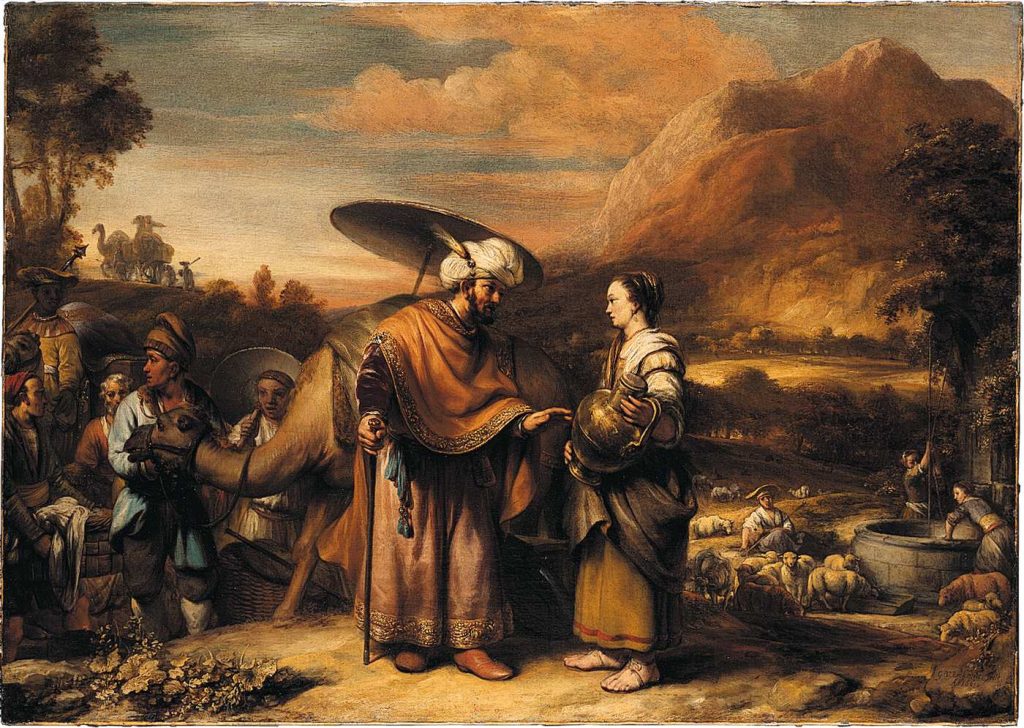
Our Old Testament Lesson today is from the 21st Chapter of Genesis, the story of the casting out of the slave woman Hagar and her son Ishmael, the first-born son of Abraham. To fully understand and appreciate the significance of this incident, however, we have to go back to the beginning of the story, even before Hagar’s name first appears in Scripture, back six chapters in Genesis. We have to go back to Abram questioning God, who has made a covenant with Abram. Abram, who is childless at that point, wants to know who his heirs will be, so God takes him out under the open sky and says, “Look toward heaven and count the stars, if you are able to count them. So shall your descendants be.” (Gen 15:5)
In the next chapter (Ch 16) we learn that ten years go by during which Abram’s wife Sarai (who ages from 65 to 75 during this decade) bears no children. So she decides to take things into her own hands help God keep God’s promise: she “[takes] Hagar the Egyptian, her slave-girl, and [gives] her to her husband Abram as a wife.” (16:3) Sure enough, Hagar gets pregnant; she is the first woman other than Eve recorded in Scriptures bearing a child.
Now, as you may know, in the ancient middle east, women had no status except that which came through marriage, gained higher status by childbearing. So Hagar, who started out as a slave with lower status than Sarai, gains greater status and their roles are reversed. Sarai begins, therefore, to “[deal] harshly with her, and she [runs] away.” (16:6) But in the desert, she encounters God who tells her to return to Sarai and Abram, and promises her that she shall have “offspring that cannot be counted for multitude.” (16:10) Hagar calls God “El-Roi,” the God who sees, thus becoming the first and only person in Scripture to give God a name. The place where this happened is named for this event; it is called Beer-lahai-roi, the well of the God who sees. She follow’s God’s instructions, returns, and gives birth to a son is named Ishmael (a name which means “God hears”). Abram is 86 years old with Ishmael is born. (16:16)
Thirteen years pass and God again appears to Abram, repeating God’s promise to make Abram “exceedingly numerous:” “You shall be the ancestor of a multitude of nations.” (17:2,4) God changes Abram’s name from Abram (meaning “exalted father”) to Abraham (“father of many nations”). God also instructs Abraham to stop calling his wife Sarai (which means “my princess”) and to call her Sarah (more generally “princess”) because, God says, “I will give her a son … and kings of peoples shall come from her.” (17:16) Abraham falls on his face laughing, as Sarah would later laugh listening behind a tent flap (18:12-25), and cries out, “Can a child be born to a man who is a hundred years old? Can Sarah, who is ninety years old, bear a child?” (v. 17) Abraham begs God to bless Ishmael as his heir (v. 18), but God declines and predicts the birth of Isaac. Although Ishmael is not to be Abraham’s personal heir, he is made an heir to the covenant when, at the end of Chapter 17, God instructs Abraham to institute the practice of circumcision including himself and all the males in his household, slaves and relatives alike, including Ishmael.
Sarah does indeed become pregnant and Isaac is born and initiated by circumcision into the covenant with his father and his half-brother (21:1-3). So in our lesson, we are another three or so years further on. Isaac has been weaned, which according to Jewish tradition as set out in the Talmud can be any time between ages two and four. This means that Ishmael is about 17 years old now.
In the ancient middle east, Jews celebrated weaning with a large festive party serving a dish of wheat cooked in sugar and cinnamon, symbolic of the baby’s first solid food. In some Jewish communities, this “first food” was provided by a neighbor. When the baby accepted the offering, the mother would say, “May this be the last time you will be supported by others.” Wheat is also symbolic of fertility, so the feast celebrated not only the child’s independence, but also greeted the possibility of a new pregnancy. It was at such a feast that Sarah saw Ishmael “the son of Hagar the Egyptian, whom she had borne to Abraham, playing with her son Isaac.” (21:9) Exhibiting the same sort of nastiness as she had when Hagar became pregnant, Sarah insists that Abraham “Cast out this slave woman with her son; for the son of this slave woman shall not inherit along with my son Isaac.” (v. 10) Abraham is distressed by this, but God tells him not to worry, that God will look after Hagar and Ishmael, and so he casts out the slave woman and her son to (in James Weldon Johnson’s memorable phrases) tread the stony road, feel the bitter chastening rod, travel a way watered with their tears, and feel that hope unborn had died . . . until they are saved when God leads Hagar to find a spring of water.
This is the last we hear of Hagar in the Jewish Scriptures, but not quite the last of Ishmael. A few chapters later on we find that Isaac and Ishmael must have achieved some sort of reconciliation, for we are told that Abraham, at the age of 175, “breathed his last and died in a good old age, an old man and full of years, and was gathered to his people. His sons Isaac and Ishmael buried him in the cave of Machpelah, in the field of Ephron son of Zohar the Hittite, east of Mamre, the field that Abraham purchased from the Hittites.” (25:8-9) Interestingly, Isaac then settles at Beer-lahai-roi, the place where Hagar named God. The Hebrew Scriptures say nothing further about Ishmael, but do take time to list the generations of his descendants.
If we want to know more about Hagar and Ishmael, we have to turn to the Muslim scriptures and traditions, to the Holy Qur’an and the Hadith of Islam. There we would learn that she and Ishmael are the ancestors of the Prophet Muhammed, that the spring described in our story today still exists, that that spring is about 20 meters away from her tomb which Abraham and Ishmael built together, that her tomb – the Kaaba – is considered the holiest place in Islam, and that making a pilgrimage to her tomb, the Hajj, at least once in one’s life, is one of the Five Pillars of Islam. She is revered as the matriarch of Islam and called “the mother of Arabs.”
Hagar, the Egyptian slave girl, and her son Ishmael, the outcast half-brother of the Patriarch Isaac and uncle of Jacob who became Israel, are our Scriptural connection to the 1.6 billion Muslims in the world who are our religious cousins, 3.3 million of whom are also our fellow Americans.
In trying to understand Hagar, I suggested to some clergy friends that she reminded me of Sally Hemming, whom I described as “the slave mistress of Thomas Jefferson.” (You may know the story of Jefferson and Hemming; she apparently bore him several children and DNA testing of some of their descendants has documented that.) My friend Wil Gaffney, who teaches Hebrew Scriptures at Brite Divinity School in Texas, took me to task. “An enslaved woman is not a mistress,” she said. “She had no legal or cultural right to refuse. Whatever consent she may have given (if she can even be said to have done so) was always constrained and negated by her enslavement.” (Facebook comment) And she’s absolutely right! We have to remember that about Hagar and about so many women in our history.
Phyllis Tribble, the late Episcopalian religious author, wrote about Hagar:
[A]ll sorts of rejected women find their stories in her. She is the faithful maid exploited, the black woman used by the male and abused by the female of the ruling class, the surrogate mother, the resident alien without legal recourse, the other woman, the runaway youth, the religious fleeing from affliction, the pregnant young woman alone, the expelled wife, the divorced mother with child, the shopping bag lady carrying bread and water, the homeless woman, the indigent relying upon handouts from the power structures, the welfare mother, and the self-effacing female whose own identity shrinks in service to others. (Texts of Terror: Literary-Feminist Readings of Biblical Narratives, Fortress Press, Philadelphia:1984, page 28)
While Sarah may be the chosen and privileged “mother of many nations,” Hagar is the prototypical working mother. She is “the first woman to hear an annunciation, the only one to received a divine promise of descendants, and the first to weep for her dying child.” (Ibid.)
I think the easy thing to do with this entire story is to focus on Sarah. It is not wrong to do so, and there is something to be learned from her role in this drama. Her part in this tale is
. . . a warning against arrogance and the human tendency to want to control others. It is a commentary about the human tendency to accept a gift from God and then to act as if it were our own to defend and protect at all costs, even at the cost of other people.
* * *
[God’s] gift of [a child] was never really for Sarah herself even though God worked the miracle in her. The gift was really for the larger world, the world that would be blessed through the community that would emerge through this child, just as God had promised Abraham. To begin claiming special status for oneself based on the gift of God is radically to misunderstand the nature of the gift. (Dennis Bratcher)
Sarah’s part in this story teaches an important lesson. Hagar’s part, however, raises questions, questions that are uncomfortable and almost unanswerable. John Holbert, who teaches at Perkins School of Theology, asks the basic question, “What are we to make of such a sordid tale, one where the joy of laughter turns into the anger of disparagement and near murder?” (Patheos)
How can we not be angry with Sarah and her manipulative arrogance? As Baptist preacher Linda Pepe asks:
How can [we] not be angry at Abraham for listening to Sarah?
How can [we] not be angry at God for letting Abraham push Hagar and his firstborn son out of his life?
How could God allow what [we] perceive to be injustice, and selfishness, and manipulation on Sarah’s part to have such an impact on the innocent? (Theological Stew)
And when we ask those questions about Abraham and Sarah or any of the other flawed human beings we find in Scripture or in church history, we find that no matter how craven or evil they seem to us we are convicted of our own sinfulness and come to understand that we are no better than they.
When we ask such questions about Abraham and Sarah and their exclusion of Hagar and Ishmael, we must ask the same questions about the way our own society excludes and mistreats the surrogate mother, the resident alien without legal recourse, the runaway youth, the pregnant young woman alone, the expelled wife, the divorced mother with child, the bag lady carrying bread and water, the homeless person, the indigent relying upon handouts from the power structures, the welfare recipient, the Arabs and other Muslims, and all those others who are their spiritual descendants. We must question our own complicity in that exclusion and mistreatment.
Naomi Steinberg, author of Kinship and Marriage in Genesis (Fortress Press, 1993), suggests that at its core, the story of Hagar and Ishmael asks the question, “What does it mean to be a member of society – who’s in, and who’s out?” (U.S. News) As Pastor Pepe acknowledged, we never get the answer to those questions in the story itself “because the text doesn’t give us anything to satisfy.” (Theological Stew)
“Do you not know?” pleads St. Paul (Rom 6:8), and sometimes we have to answer back, “No, we don’t!” We don’t know what to make of Sarah. We don’t know what to do with the story of Hagar. We don’t know how to relate to our Muslim cousins who revere her. We don’t know how to deal with the indigent, uninsured welfare mother whom Phyllis Tribble says she represents.
Perhaps the answers come when we turn our attention to the last character in the drama, who is the first . . . to the God who sees (as Hagar named God in the desert), to the God who hears (remember the meaning of Ishmael’s name?) “Keep watch over my life,” cries the Psalmist, “Give ear . . . and attend to the voice of my supplications” (Ps 86:2,6) Perhaps the answer lies in turning to the God who sees the sparrow, who counts the hairs on every head (Matt 10:29-30), those of the chosen like Abraham and Sarah, those of the excluded like Hagar and Ishmael, those of the questioning and bewildered like you and me.
Perhaps when we give up our notions of what life ought to be like, perhaps when we stop trying to manipulate things as Sarah tried to do, perhaps when we truly follow the
God of our weary years, God of our silent tears,
Thou Who hast brought us thus far on the way . . .
relying not on our own devices, but on God to “keep us forever in the path,” perhaps then we’ll find the answer. Jesus said, “Those who find their life will lose it, and those who lose their life for my sake will find it” (Matt 10:39). Perhaps when we start trying to live in that way, “true to our God,” we’ll find the answers and learn how to live with Hagar and her son and their descendants, facing with them “the rising sun of our new day begun, [and] march[ing] on till victory is won.” Amen.
* The hymn Lift Every Voice and Sing is often referred to as the “Negro National Anthem” having been so designated by the NAACP in 1919. These are the full lyrics:
Lift every voice and sing, till earth and Heaven ring,
Ring with the harmonies of liberty;
Let our rejoicing rise, high as the listening skies,
Let it resound loud as the rolling sea.
Sing a song full of the faith that the dark past has taught us,
Sing a song full of the hope that the present has brought us;
Facing the rising sun of our new day begun,
Let us march on till victory is won.
Stony the road we trod, bitter the chastening rod,
Felt in the days when hope unborn had died;
Yet with a steady beat, have not our weary feet,
Come to the place for which our fathers sighed?
We have come over a way that with tears has been watered,
We have come, treading our path through the blood of the slaughtered;
Out from the gloomy past, till now we stand at last
Where the white gleam of our bright star is cast.
God of our weary years, God of our silent tears,
Thou Who hast brought us thus far on the way;
Thou Who hast by Thy might, led us into the light,
Keep us forever in the path, we pray.
Lest our feet stray from the places, our God, where we met Thee.
Lest our hearts, drunk with the wine of the world, we forget Thee.
Shadowed beneath Thy hand, may we forever stand,
True to our God, true to our native land.
(Note: The illustration is “Hagar Offering Water to Her Son, Ishmael, in the Desert” by Charles Lock Eastlake (1793–1865) painted in 1842. It hangs in the National Trust Gallery in the Lake District, UK.)
====================
Father Funston is the rector of St. Paul’s Episcopal Church, Medina, Ohio.
 Recovery. It’s what they call the process that comes after surgery. A physician cuts you open, spends a few minutes or hours doing whatever needs to be done, sews (or staples or glues) you up, and they wheel you out of the surgical theater and into the recovery room. Recovery has started, but when you leave the recovery room it isn’t over. It goes on and on for days, weeks, even months.
 Preaching. It’s what I do.
 During my three days away taking the Education for Ministry training I needed to continue my certification as an EfM mentor this past week, I was reminded of an old story about children’s sermons:
 Have you ever had a friend try to tell you about going to see a stand-up comedian’s show? When I lived in Las Vegas, this happened fairly often in my workplace. Someone would go to see the late Robin Williams, or Jon Stewart (before he took over the Daily Show), or any of several who made regular appearances on the Strip, and then on Monday morning over coffee they would try to tell us how funny the show was.
  What do orange-haired casino owners, former First Ladies, Muslim refugee children, police officers, unborn babies, doctors and nurses who perform abortions, progressive hipsters, conservative Republicans, prosperity-gospel televangelists, members of Congress, transgender former athletes, Confederate-flag-waving white nationalists, Black Lives Matter activists, middle-of-the-road Democrats, and aging clergy all have in common?
  Again, this week, we have another familiar parable in our Gospel lesson, the story of the wheat and the weeds. I will come back to it. But first, I’d like to tell you about my older brother who died 24 years ago.
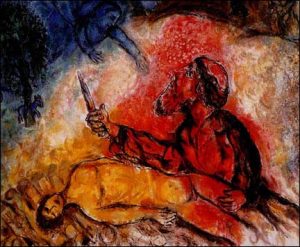 The great Anglican preacher Herbert O’Driscoll begins his reflections on our Old Testament lesson, the story of the testing of Abraham and the binding of Isaac, truthfully the near-murder of Isaac, with these words:

