From the Prophet Isaiah:
Thus says the Lord, the King of Israel
and his Redeemer, the Lord of hosts:
I am the first and I am the last;
besides me there is no god.
Who is like me? Let them proclaim it,
let them declare and set it forth before me.
Who has announced from of old the things to come?
Let them tell us what is yet to be.
Do not fear, or be afraid;
have I not told you from of old and declared it?
You are my witnesses!
Is there any god besides me?
There is no other rock; I know not one.
(From the Daily Office Lectionary – Isaiah 44:6-8 (NRSV) – December 27, 2013.)
 I took yesterday “off” and stayed away from church-related things. I read the Daily Office, of course, and thought about St. Stephen, Deacon and Martyr. I even thought about writing one of these meditations, but never got around to it. I really did nothing “religious” . . . until dinner time when I had a previously scheduled a meeting with a small group of parishioners.
We met at a local sports bar for burgers and beer, and a discussion of how to get the church out of the church and into the marketplace. Some weeks ago, one of the group had had the idea of promoting our church by offering a place to park and a breakfast to those who might attend the town’s winter festival, which is held on the town square a block from the church building and is coming up in about six weeks. “Parking and Pancakes,” he called it. Another noted that making our restrooms available might be just as big a draw, so we considered (and dismissed) retitling it “Parking, Pancakes, and Peeing.”
We kicked around the various logistical elements of the idea, handed out action assignments and report-back deadlines, used our smart-phones to get data pertinent to our discussion, ate our burgers, drank our beers, and went on our ways.
This morning I am struck by the pertinence of Isaiah’s declaration (on God’s behalf), “You are my witnesses!” and its follow-up question, “Is there any god besides me?” In a society which is increasingly religiously pluralistic and increasingly non-religious, I am heartened that at least a few members of the church are beginning to understand the role of each member, and the whole of the church community, as “witness.” We can no longer sit at the side of the road and expect passers-by to turn into our drive and knock on our door. We must go out and testify; we must open the doors of the church, stand in the road, and beckon the worn and the weary to come in for respite. Because the answer to the follow up question is no longer that proposed by Isaiah (or by God?), “There is no other rock . . . . ” There are plenty of other rocks, other gods.
Some of those other rocks are, indeed, gods – or at least religious in nature. Within not-very-many miles of our small Ohio county-town church one can find a Hindu temple, a Moslem mosque, and a Buddhist ashram. Though there is no synagogue in town, there are several within a reasonable drive. I have no interest in trying to convince the members of these faiths that they should become part of mine; they are already, in their way, in touch with the divine.
There are the “gods,” however, from which we should like to turn their followers. The gods of money, status, acquisition . . . the gods of alcohol, addiction, self-destruction . . . the gods that promise (but do not deliver) immediate satisfaction, a temporary filling of the void in human lives, the void that only the divine can fill. These gods are incredibly attractive and once a person is in their thrall getting away can be incredibly difficult, almost impossible. It takes the help of a witness, perhaps even a witness who has “been there and done that.”
That is why last night’s little meeting over burgers and beer was so important. I don’t give a damn about “growing the church.” I care very much about spreading the Good News, about helping people find a solid rock on which to ground their lives. If parking and pancakes and giving people a place to pee can do that, I’m all for it.
====================
A request to my readers: I’m trying to build the readership of this blog and I’d very much appreciate your help in doing so. If you find something here that is of value, please share it with others. If you are on Facebook, “like” the posts on your page so others can see them. If you are following me on Twitter, please “retweet” the notices of these meditations. If you have a blog of your own, please include mine in your links (a favor I will gladly reciprocate). Many thanks!
====================
Father Funston is the rector of St. Paul’s Episcopal Church, Medina, Ohio.

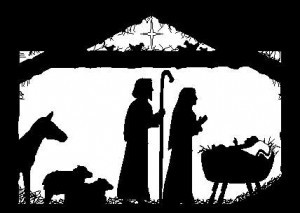 It’s Christmas Eve! Probably my busiest and longest workday of the year.
  According to the Myers-Briggs personality test, I’m a raging introvert, and I think the test is accurate. People often misuse the term “introverted” as a synonym for “shy,” but I am not a shy person. I am comfortable meeting people; I think I converse with relative ease; I have no difficulty standing before crowds and speaking. Those are probably all a good things in a parish priest (my current calling) or a trial lawyer (my former career).
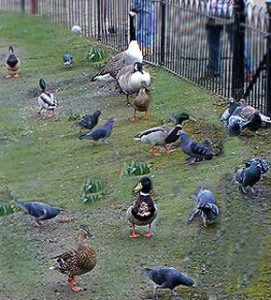 I ought to be thinking “purer thoughts” or something . . . .
  The Episcopal Church includes Psalm 51 in its liturgy of Ash Wednesday. After ashes are imposed on the faithful and just before the recitation of a litany of penitence, the psalm is recited in its entirety. It’s a perfect piece of scripture for that use with its plea for forgiveness — “Have mercy on me, O God, according to your loving-kindness” (v. 1) — its acknowledgement of sinfulness — “For I know my transgressions, and my sin is ever before me” (v. 3) — and its petition for amendment of life — “Create in me a clean heart, O God, and renew a right spirit within me (v. 11).
 The parable of the bridesmaids has always bothered me. Whenever I have to preach from it I have to get passed my first reaction, which is, “Really? People will be kept out of heaven for being stupid?” Of course, that is a misreading, or perhaps I should say “over-reading,” of the metaphor.
 Clothing is a common metaphor in Holy Scripture. Clean clothing is often a portrayal of righteousness or forgiveness. Everyone is familiar with the vision of John of Patmos recorded in the Book of Revelation:
 When I was in college I was part of group that liked to go backpacking on weekends. Because we were in Southern California, this often meant a trek into some desert wilderness where there was no local water. As a result, we each had to carry enough water for the weekend; as a rule of thumb, that would mean one gallon of water for each day of the hike.
  Today’s evening psalm begins with a verse reminiscent of the psalm verse from which my blog takes its name:

