Occasional thoughts of an Anglican Episcopal priest

Category: Daily Office (Page 42 of 70)

Blindness and Sour Grapes – From the Daily Office – March 18, 2013

From the Gospel according to John:

As Jesus walked along, he saw a man blind from birth. His disciples asked him, “Rabbi, who sinned, this man or his parents, that he was born blind?” Jesus answered, “Neither this man nor his parents sinned; he was born blind so that God’s works might be revealed in him.”

(From the Daily Office Lectionary – John 9:1-3 (NRSV) – March 18, 2013.)

Sour GrapesI’m not the least bit sure I like the last thought of Jesus reply . . . Is he suggesting that a loving God caused this innocent man’s blindness so that Jesus could come along and heal him with some mud made of spittle and demonstrate his power? I mean, really, is he? I don’t want to get into that today, but surely there must be another interpretation for Jesus words and perhaps someday I’ll explore that.

Today, I want to focus on the first clause of his answer, which is basically just a wordy, “No.” As a parent, I cannot tell you how happy it makes me that the man’s blindness was not his parents’ fault! Because accepting that blame is all too often our parental response when things go wrong in our children’s lives . . . . It doesn’t really matter what it is – accident, illness, bad grades, suspension from school, trouble with the law, break-up with their partner or spouse – it doesn’t matter what it is, when something goes wrong in our children’s lives a parent’s response is often an overwhelming sense of guilt. “What did I do wrong that this happened to my child?”

This is, after all, a perfectly acceptable biblical view! In the Book of Exodus, Moses told the Hebrews that God does not “clear the guilty, but visits the iniquity of the parents upon the children and the children’s children, to the third and the fourth generation.” (Exod. 34:7 NRSV) And again the same words are reported the Book of Numbers: “The Lord is slow to anger, and abounding in steadfast love, forgiving iniquity and transgression, but by no means clearing the guilty, visiting the iniquity of the parents upon the children to the third and the fourth generation.” (Numb. 14:18 NRSV) And, again, in Deuteronomy, Moses says, “Be careful to obey all these words that I command you today, so that it may go well with you and with your children after you forever, because you will be doing what is good and right in the sight of the Lord your God” (Deut. 12:28 NRSV) implying that disobedience would mean things wouldn’t go well for the kids! Finally, there is that great biblical proverb reported by both Jeremiah and Ezekiel: “The parents have eaten sour grapes, and the children’s teeth are set on edge.” (Jer. 31:29 and Ezek. 18:2 NRSV)

So there is plenty of biblical support for our parental guilt pangs! But here is Jesus saying that the sins of parents are not responsible for the misfortune of their son. Thanks be to God! What that says to me is that we need to start looking at our feelings of parental remorse in a different way.

Not that those feelings are “wrong” or “bad.” Guilt is a basic human emotion. Everyone feels it and, when it comes to parenting, whatever we do is liable to cause us a little bit of guilty self-reproach because it sometimes seems that “you’re damned if you do and you’re damned if you don’t.” What if, instead of beating ourselves up over these things, we think of what feels like guilt as simply evidence that we are being good parents, good enough to be constantly thinking about what we’re doing and how we’re doing it? We care enough to do our best at the very important, frequently frustrating, often terrifying, and even more often incredibly rewarding job of raising children we love more than we will ever be able to tell them. No parent is perfect, but the ones who worry about whether they are doing it well, probably are doing it well, really well.

Here’s something I know. During the past sixty or so years that I’ve been alive, I’ve had a lot of rough patches, a lot of problems. I’ve done some bonehead things and made some really stupid mistakes. I’ve been in trouble with various authorities, and broken up with lovers and partners. And you know what? Very little of any of that was my parents’ fault! On the other hand, I’ve gotten through those rough spots. I’ve solved the problems. I’ve learned from my mistakes and avoided doing even more boneheaded stuff. I’ve made up with the lovers and, if I haven’t made up with the authorities, at least I’ve figured out how to work with them. And you know what? Most of my ability to do so is due to what I learned from my parents, from what I observed of the way they lived their lives and from the values they taught me. They may have eaten some sour grapes, I don’t know, but my teeth were not set on edge.

I love my kids a whole lot more than I can ever tell them, and I can only hope they have learned from me the way I learned from my folks.

====================

A request to my readers: I’m trying to build the readership of this blog and I’d very much appreciate your help in doing so. If you find something here that is of value, please share it with others. If you are on Facebook, “like” the posts on your page so others can see them. If you are following me on Twitter, please “retweet” the notices of these meditations. If you have a blog of your own, please include mine in your links (a favor I will gladly reciprocate). Many thanks!

====================

Father Funston is the rector of St. Paul’s Episcopal Church, Medina, Ohio.

Nothing! – From the Daily Office – March 15, 2013

From Paul’s Letter to the Church in Rome:

In all these things we are more than conquerors through him who loved us. For I am convinced that neither death, nor life, nor angels, nor rulers, nor things present, nor things to come, nor powers, nor height, nor depth, nor anything else in all creation, will be able to separate us from the love of God in Christ Jesus our Lord.

(From the Daily Office Lectionary – Romans 8:37-39 (NRSV) – March 15, 2013.)

Dissociative Disorder IllustrationThese may be my favorite words from the pen of the Apostle Paul. My mentor during my education for ordained ministry, who also became my first boss after ordination, often referred to these verses and would add, “Not even ourselves.”
But there are times when I wonder about things Paul seemed not to know about. Sure, he puts in that great, inclusive catch-all phrase “nor anything else in all of creation,” but what about drugs, addiction, mental illness, brain dysfunction . . . . What about the things that make us no longer us, the things that separate us from ourselves?

We human beings can suffer all sorts of trauma, large or small, that can lead to separation from ourselves, from others, and from the meaning of life. Even simple depression, anxiety, or just getting “off-track,” can create a sense of separation or alienation. We may feel like we are living in a sort of fog; our thinking may become clouded. We may find ourselves unable to access our feelings, and simply not be aware of or engaged in the world around us. We seem to be functional, but we are living a life separated from ourselves and from those who love us. Dissociation becomes a way of life. People in such a state are vulnerable to quick fixes and bad habits, behaviors and addictions that promise quick relief.

My father was an alcoholic who drove off in the middle of the night, angrily separating himself from his family, and a few hours later dying in a single-vehicle automobile accident. He was “not himself;” he was, in a real sense, separated from himself. My mother-in-law took years to slip away deep into the darkness of Alzheimer’s disease; for the last few years of her life, she wasn’t there. In a very real sense, she was separated from herself.

Last Sunday’s gospel lesson was the parable of the prodigal son, a story of separation and estrangement. The story is that the younger of two sons demands his inheritance from his father, takes the money and squanders it, and ends up living as a starving swineherd in a foreign land. There is this wonderful line in which Jesus says of him, “When he came to himself he said, . . . ‘I will get up and go to my father . . . .'” (Luke 15:17-18) “When he came to himself…;” he was separated not only from his father, but from himself. Nonetheless, that separation was overcome and there was reunion first with himself and then with his father.

I do believe in divine grace that precedes any human decision we may make. God’s grace operates in no way dependent on anything we may have done or failed to do. In the words of The Book of Common Prayer, God’s “grace . . . always precedes and follows us” (Collect for Proper 23, pg 234); it allows us to engage our free will to choose reunion, to choose to not be separated, to choose salvation. And I hope that God makes that choice for us when, because of mental illness, alcohol, drugs, brain dysfunction or injury, or whatever reason we are unable to make it for ourselves, when we cannot “come to ourselves.” Because nothing can “separate us from the love of God in Christ Jesus our Lord,” not even ourselves. Nothing!

====================

A request to my readers: I’m trying to build the readership of this blog and I’d very much appreciate your help in doing so. If you find something here that is of value, please share it with others. If you are on Facebook, “like” the posts on your page so others can see them. If you are following me on Twitter, please “retweet” the notices of these meditations. If you have a blog of your own, please include mine in your links (a favor I will gladly reciprocate). Many thanks!

====================

Father Funston is the rector of St. Paul’s Episcopal Church, Medina, Ohio.

Pope Francis – From the Daily Office – March 14, 2013

From Paul’s Letter to the Church in Rome:

So then, brothers and sisters, we are debtors, not to the flesh, to live according to the flesh — for if you live according to the flesh, you will die; but if by the Spirit you put to death the deeds of the body, you will live. For all who are led by the Spirit of God are children of God. For you did not receive a spirit of slavery to fall back into fear, but you have received a spirit of adoption. When we cry, “Abba! Father!” it is that very Spirit bearing witness with our spirit that we are children of God, and if children, then heirs, heirs of God and joint heirs with Christ — if, in fact, we suffer with him so that we may also be glorified with him.

(From the Daily Office Lectionary – Romans 8:12-17 (NRSV) – March 14, 2013.)

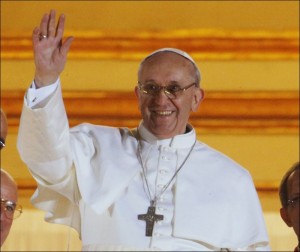
Pope FrancisThere were two things about which I was unaware when I wrote yesterday’s meditation referring to the folk chorus Abba, Father. First of all, I didn’t know that today’s readings would include Paul’s comments to the Romans on that form of addressing God. Secondly, I had no idea that the modern day Romans (in the form of the Papal Conclave) would have elected a new pope by today.

Today the entire world, Protestant, Anglican, and Orthodox Christians, as well as those of other religions, together with the world’s Roman Catholics, are taking stock of the newest successor of St. Peter, trying to figure out who Pope Francis is and what his election means. According to all the news reports I’ve seen, he is a humble man with much concern for the poor and the economically oppressed. On the other hand, he is apparently a doctrinal conservative who has had some pretty negative things to say about contraception, a woman’s right to reproductive choice, and the legalization of abortion, as well as about the LGBT community and the rights of gay, lesbian, and transgendered persons. How this will all shake out in his leadership of the Roman Catholic Church is anyone’s guess.

I hope that he will listen to what Paul has to say in his letter to the Roman church of long ago. I hope that he will acknowledge that “all who are led by the Spirit of God are children of God,” even though that Spirit may be leading them in non-Christian directions. I hope that he will consider the suggestion of his fellow Jesuit, Avery Dulles, who wrote: “On Christian grounds, it may be held that the divine person who appears in Jesus is not exhausted by that historical appearance. The symbols and myths of other religions may point to the one who Christians recognize as the Christ.” (Revelation and the Religions, Quaker Universalist Fellowship: 1999)

It is my understanding of basic Christian doctrine that the Holy Spirit may act wherever and whenever she chooses. If we presume to constrain the activity of the Holy Spirit, if our doctrinal predisposition is to limit God to only our particular religious assumptions, then we are not faithful to the Truth. Christian tradition recognizes a mandate to seek Truth wherever it may be found and to follow the Holy Spirit wherever she may lead, even if that may be into consideration of other religions or non-Christian philosophies. I hope his Holiness will be of the same understanding and seek interfaith dialogue.

Even more, I hope that he will seek common cause with non-Roman Christians, even when our ecclesiologies and theologies may not agree with those of the Holy See. I pray that he will acknowledge that Protestants, Anglicans, and Orthodox Christians are “children of God, and if children, then heirs, heirs of God and joint heirs with Christ.” It was a great disappointment when his predecessor, Benedict XVI, ratified and confirmed a statement that “those Christian Communities born out of the Reformation of the sixteenth century . . . because of the absence of the sacramental priesthood, have not preserved the genuine and integral substance of the Eucharistic Mystery [and] cannot, according to Catholic doctrine, be called ‘Churches’ in the proper sense.” (Responsa Quaestiones, June 29, 2007) As an Anglican, especially, I would dispute the basic assumptions about the priesthood and the Eucharist, but even without regard to that quibble, to deny that any group of Christians is the church seems to me to be an unnecessary stumbling block to ecumenical relations. Hopefully, Pope Francis will be more gracious than his predecessor in acknowledging that “where two or three are gathered in [his] name, [Christ is] there among them.” (Matt. 18:20 NRSV)

Which brings me back to the folk chorus Abba, Father and yesterday’s meditation. The petition of the song is

Mold us, mold us and
Fashion us,
Into the image,
Of Jesus your Son
Of Jesus your Son.
Father, may we be one in you,
May we be one in you,
As he is in you,
And you are in him.

God the potter is constantly molding the church. May Pope Francis’s election be an opportunity not only for the Roman Catholic Church to be molded anew, may it also be an occasion for the whole of the Christ’s universal church, and God’s people of other faiths, to be molded together into a new ecumenical and interfaith cooperation.

====================

A request to my readers: I’m trying to build the readership of this blog and I’d very much appreciate your help in doing so. If you find something here that is of value, please share it with others. If you are on Facebook, “like” the posts on your page so others can see them. If you are following me on Twitter, please “retweet” the notices of these meditations. If you have a blog of your own, please include mine in your links (a favor I will gladly reciprocate). Many thanks!

====================

Father Funston is the rector of St. Paul’s Episcopal Church, Medina, Ohio.

God’s Annoying Accent – From the Daily Office – March 13, 2013

From the Prophet Jeremiah:

The word that came to Jeremiah from the Lord: “Come, go down to the potter’s house, and there I will let you hear my words.” So I went down to the potter’s house, and there he was working at his wheel. The vessel he was making of clay was spoiled in the potter’s hand, and he reworked it into another vessel, as seemed good to him. Then the word of the Lord came to me: Can I not do with you, O house of Israel, just as this potter has done? says the Lord. Just like the clay in the potter’s hand, so are you in my hand, O house of Israel. At one moment I may declare concerning a nation or a kingdom, that I will pluck up and break down and destroy it, but if that nation, concerning which I have spoken, turns from its evil, I will change my mind about the disaster that I intended to bring on it. And at another moment I may declare concerning a nation or a kingdom that I will build and plant it, but if it does evil in my sight, not listening to my voice, then I will change my mind about the good that I had intended to do to it. Now, therefore, say to the people of Judah and the inhabitants of Jerusalem: Thus says the Lord: Look, I am a potter shaping evil against you and devising a plan against you. Turn now, all of you from your evil way, and amend your ways and your doings.

(From the Daily Office Lectionary – Jeremiah 18:1-11 (NRSV) – March 13, 2013.)

Potters Hands at WheelYears ago, my wife and I were active in the Cursillo community in another state. In fact, we met through that community, so it was very important to us. We participated in the three-day weekends; we took part in the reunions; we even had the “De Colores” bumper-stickers on our cars. At that time, folk masses and simple guitar-accompanied choruses were also popular in the Episcopal Church and a lot of the music used in the Cursillo movement spilled over into church on Sundays and at other times. A favorite of many people was a tune which mixed Jeremiah’s potter metaphor with some of Jesus’ language from the Gospels:

Abba, Abba Father
You are the potter
And we are the clay,
The work of your hands
Mold us, mold us and
Fashion us,
Into the image,
Of Jesus your Son
Of Jesus your Son.
Father, may we be one in you,
May we be one in you,
As he is in you,
And you are in him
Glory, glory and praise to you
Glory and praise to you
Forever amen….

I remember sitting with my table groups during the Cursillo weekends and at nearly every one one of the speakers would ask that we sing this song, and then would talk about how God molds each individual into a Christ-like figure. But that isn’t what the song says, at all! Nor is it what Jeremiah prophesies in this pericope! This isn’t about individuals.

The song, following Jeremiah’s lead, speaks of a group being molded: “Mold us . . . Fashion us.” Us not me. God the potter in Jeremiah’s prophecy molds “the house of Israel,” a nation, a kingdom, not the individual residents of that house or nation. Certainly, as a part of that group each member may be, must be changed, but the emphasis is on and the prophecy is about systemic, group-wide change, not individual transformation.

When a potter molds a pot, a drinking vessel, a piece of sculpture, he works with a mass of clay. The mass is made up of molecules, but the potter does not concern himself with these small, constituent bits. He does not work with each molecule. He pushes this way and that on the mass, and the individual molecules, most of which are never directly manipulated by the potter, move and change as the mass moves; most are shoved about not by the potter but by their neighbors. The potter may, from time to time, work with smaller bits, but always with the intention that that bit will add to the value or beauty of the whole. His concern is with the larger work.

Of course, Jesus was concerned about individual people. He loved the one lost sheep separated from the ninety-nine; he searched for the one of ten coins that was missing. His reason for doing so, however, was restoration of the community. The ninety-nine were incomplete without the missing lamb; the “round ten” were not round without the missing coin. He sent the Samaritan women at the well back into her city (John 4); he rescued the woman caught in adultery from being stoned, but sent her back into her community, saying “Go your way” (John 8); he raised a little girl from death, restoring her to her family whom he instructed to nourish her (Mark 5).

Jesus was concerned about individuals, but he was committed to the ideal of community in which there would be a close relationship between members. His disciples were related not just individually to him, but also to one another. He formed them into a group that would give itself mutual support, a community that would reach out to others and invite them in. Yes, he said, the first commandment is to love God, but there is a second, equal commandment — Love your neighbor as yourself. (Matt. 22:37-39 NRSV)

St. Paul used the metaphor of “the body of Christ” to describe the church: “Now you are the body of Christ and individually members of it.” (1 Cor. 12:27 NRSV) God the potter molds the church and each of us get shoved into our proper place as the potter works. At times, the potter may work with an individual bit, but the potter’s attention is on the whole. God the potter’s concern was with “the house of Israel;” God the potter’s concern is with the Body of Christ, the church.

It’s too bad modern English doesn’t have a clearly plural form of the pronoun you. That used to be the plural pronoun and thou was the singular. Perhaps we should create a new plural form or borrow one to use in translating Scripture. We could render God the potter as sounding like a Southerner: ” Can I not do with y’all just as this potter has done?” Or like a Pittsburgher: “Can I not do with youse just as this potter has done?” We might find God’s accent annoying, but at least we would understand what was meant!

====================

A request to my readers: I’m trying to build the readership of this blog and I’d very much appreciate your help in doing so. If you find something here that is of value, please share it with others. If you are on Facebook, “like” the posts on your page so others can see them. If you are following me on Twitter, please “retweet” the notices of these meditations. If you have a blog of your own, please include mine in your links (a favor I will gladly reciprocate). Many thanks!

====================

Father Funston is the rector of St. Paul’s Episcopal Church, Medina, Ohio.

Fanfare for the Common Man – From the Daily Office – March 12, 2013

From the Paul’s Letter to the Romans:

I do not understand my own actions. For I do not do what I want, but I do the very thing I hate. Now if I do what I do not want, I agree that the law is good. But in fact it is no longer I that do it, but sin that dwells within me. For I know that nothing good dwells within me, that is, in my flesh. I can will what is right, but I cannot do it. For I do not do the good I want, but the evil I do not want is what I do. Now if I do what I do not want, it is no longer I that do it, but sin that dwells within me. So I find it to be a law that when I want to do what is good, evil lies close at hand. For I delight in the law of God in my inmost self, but I see in my members another law at war with the law of my mind, making me captive to the law of sin that dwells in my members. Wretched man that I am! Who will rescue me from this body of death? Thanks be to God through Jesus Christ our Lord!

(From the Daily Office Lectionary – Romans 7:15-25 (NRSV) – March 12, 2013.)

Trumpet FanfareSt. Paul wrote some great stuff. He’s treatise on love in the thirteenth chapter of the first letter to the church in Corinth is brilliant! He wrote (or, at least, is blamed for) some incredibly stupid stuff, too: telling women to be silent in the very next chapter of First Corinthians, for example, or sending Onesimus back to Philemon without clearly denouncing the institution of slavery.

But I think nothing may have been as damaging to Christian spirituality and theology than this little bit from the letter to the church in Rome. We don’t know what Paul’s personal problem was – an addiction, a sexual dysfunction, OCD, who knows? – but whatever it may have been he attributes it to his own sinfulness and then (here’s the really damaging thing) he universalizes his experience. He claims that everyone is like him, that every single human being who ever lived and everyone who will come after him has been, is, and will be “captive to the law of sin” and completely unable to do anything about it.

Find something like that in the Gospels! Read every word of the four Gospels and see if there is anything like that coming from Jesus’ mouth! There isn’t. Sure, Jesus suggested that we are all sinners (particularly when he breaks up the execution party and prevents the woman taken in adultery from being stoned in John 7:53-8:11), but he never suggests that we have no power to do anything about our sinful behavior. In fact, quite the opposite. Jesus makes it clear that we have the ability to choose to do good, and again and again he commends that choice to us.

Today is the 70th anniversary of the premier of one of my favorite pieces of music, Aaron Copland’s Fanfare for the Common Man. It was commissioned in 1942 by the Cincinnati Symphony Orchestra and its conductor Eugene Goossens as one of eighteen fanfares to begin the next year’s concert performances as an orchestral support for and tribute to the United States effort in World War II. Copland named to piece after a line in a speech by Vice-President Henry A. Wallace proclaiming the arrival of “the century of the Common Man.” Goossens was surprised by the title and wrote to Copland, “Its title is as original as its music, and I think it is so telling that it deserves a special occasion for its performance. If it is agreeable to you, we will premiere it 12 March 1943 at income tax time”. Copland replied, “I [am] all for honoring the common man at income tax time.”

I find the Fanfare to be stirring and uplifting and full of affirmation of the goodness of everyday human beings, a great musical antidote to Paul’s dreary, pessimistic, and almost self-defeating assessment of his (and everyone else’s) inner nature.

Lent is a time of self-evaluation and, sure, we all have our dysfunctions to be honest about and to work on. But I find it impossible to believe that (as the collect for the third Sunday in Lent puts it, paraphrasing Paul) “we have no power in ourselves to help ourselves.” (BCP 1979, page 218). We do have that power; what we don’t have is the strength of will or the stick-to-itiveness to sustain the effort. That’s how I understand that prayer, not that we asking for some sort of magic pill to give us something we lack, but rather that we are seeking support and help to keep us going through the darkest of times. It’s not simply that we shrug our shoulders and say, “We can’t do this. You take care of it, God.” Instead, we are asking that our own power be supplemented and strengthened by the power, the presence, and the pardon of God, our God who “saw everything that he had made [including humankind], and indeed, it was very good.” (Gen. 1:31)

I, for one, find no help in Paul’s words to the Romans in today’s lesson. But on this anniversary of the first performance of the soaring strains of Copland’s Fanfare for the Common Man, I find in that music the voice of hope, the voice of God urging me on.

====================

A request to my readers: I’m trying to build the readership of this blog and I’d very much appreciate your help in doing so. If you find something here that is of value, please share it with others. If you are on Facebook, “like” the posts on your page so others can see them. If you are following me on Twitter, please “retweet” the notices of these meditations. If you have a blog of your own, please include mine in your links (a favor I will gladly reciprocate). Many thanks!

====================

Father Funston is the rector of St. Paul’s Episcopal Church, Medina, Ohio.

A Community of Fishers – From the Daily Office – March 11, 2013

From the Prophet Jeremiah:

I am now sending for many fishermen, says the Lord, and they shall catch them; and afterwards I will send for many hunters, and they shall hunt them from every mountain and every hill, and out of the clefts of the rocks. For my eyes are on all their ways; they are not hidden from my presence, nor is their iniquity concealed from my sight. And I will doubly repay their iniquity and their sin, because they have polluted my land with the carcasses of their detestable idols, and have filled my inheritance with their abominations.

(From the Daily Office Lectionary – Jeremiah 16:16-18 (NRSV) – March 11, 2013.)

Still from A River Runs Through ItI wonder if Jesus had this prophecy in mind when he called Andrew and Peter and said to them, “Follow me, and I will make you fish for people.” (Matt. 4:19)

When we modern, urban Americans read biblical references to fishermen, I suspect that a majority of us picture someone sitting lazily on the banks of a river with a pole stuck in the soil next to them, a line trailing off to a bobbing float; or perhaps we imagine Tom Skerrit standing in the Blackfoot River casting hand-tied flies trying to snag a large trout. Although hook-and-line fishing was not unknown in the ancient world, it was then, as now, a recreational sort of fishing. When God says through Jeremiah that he is sending fishermen to catch the wayward people of Israel, when Jesus tells his new disciples that they will become fishers of people, the reference is a very different sort of fishing.

The image we should have is of net fishing, probably using either a dragnet or a cast net. The dragnet is one of the oldest of fishing dating from the third millennium B.C. in Egypt. The dragnet, perhaps 250 to 300 yards long, and varing in height from 3 to 8 yards, would be taken out from the shore by boat which would proceed straight out for a distance, then turn parallel to the shore for a bit, and then turn back to the shore. The bottom of the net would be weighted with sinkers, and the top would have cork floats attached. Tow lines attached to each end of the net were hauled in by a teams of sixteen men for large nets, fewer for for smaller nets. This method of fishing is described in the books of Habakkuk, Ezekiel, and Matthew.

A cast net was, as the name suggests, thrown or cast onto the waters by one man either from shore or from a boat. After it had sunk to the bottom, trapping fish within it, the caster and others would dive down to it and either retrieve the fish individually placing them into pouches, or they would gather the footrope of the net, gathering the fish into a sort of purse formed by the net and bring them up together.

In either event, the picture we get is of teamwork. Biblical fishing was a community activity, something that required cooperation to be effective. So, although God promised to send a single shepherd, the Messiah, God in this prophecy of Jeremiah also promised to send a working party.

And, one wonders, who might that be? The church? All the baptized? No doubt. God’s team is made up of the spiritual descendants of the ones to whom Jesus said, “Follow me, and I will make you fish for people.” Midway through Lent as we are, this might be a good time to turn from individual self-examination and consider how well we are doing as a community of fishers.

====================

A request to my readers: I’m trying to build the readership of this blog and I’d very much appreciate your help in doing so. If you find something here that is of value, please share it with others. If you are on Facebook, “like” the posts on your page so others can see them. If you are following me on Twitter, please “retweet” the notices of these meditations. If you have a blog of your own, please include mine in your links (a favor I will gladly reciprocate). Many thanks!

====================

Father Funston is the rector of St. Paul’s Episcopal Church, Medina, Ohio.

God’s Underwear – From the Daily Office – March 9, 2013

From the Prophet Jeremiah:

Thus said the Lord to me, “Go and buy yourself a linen loincloth, and put it on your loins, but do not dip it in water.” So I bought a loincloth according to the word of the Lord, and put it on my loins. And the word of the Lord came to me a second time, saying, “Take the loincloth that you bought and are wearing, and go now to the Euphrates, and hide it there in a cleft of the rock.” So I went, and hid it by the Euphrates, as the Lord commanded me. And after many days the Lord said to me, “Go now to the Euphrates, and take from there the loincloth that I commanded you to hide there.” Then I went to the Euphrates, and dug, and I took the loincloth from the place where I had hidden it. But now the loincloth was ruined; it was good for nothing. Then the word of the Lord came to me: Thus says the Lord: Just so I will ruin the pride of Judah and the great pride of Jerusalem. This evil people, who refuse to hear my words, who stubbornly follow their own will and have gone after other gods to serve them and worship them, shall be like this loincloth, which is good for nothing. For as the loincloth clings to one’s loins, so I made the whole house of Israel and the whole house of Judah cling to me, says the Lord, in order that they might be for me a people, a name, a praise, and a glory. But they would not listen.

(From the Daily Office Lectionary – Jeremiah 13:1-11 (NRSV) – March 9, 2013.)

Cotton BriefsAccording to Wikipedia:

Loincloths are being and have been worn:

  • in societies where no other clothing is needed or wanted
  • as an undergarment or swimsuit
  • by the farmers in paddy fields in Sri Lanka and India, especially when they are working with mud

The loincloth or breechcloth is a basic form of dress, often worn as an only garment. Men have worn a loincloth or breechcloth as a fundamental piece of clothing which covers their genitals – not the buttocks – in most societies throughout human history which disapproved of genital nakedness. The loincloth is in essence a piece of material, bark-bast, leather or cloth, passed between the legs covering the genitals.

As a metaphor for the relationship of God and God’s People, this has to be one of the most bizarre. We can readily understand the spousal metaphor of Hosea, the body metaphor used by Paul in First Corinthians, or Peter’s spiritual house. We’re familiar with shepherds and their sheep, gardeners and their fig trees, vine dressers and their grapevines, hens with their chicks, parents with their children, and princes and their people; they all make sense as ways to understand our relationship to God. But underwear? Seriously? Underwear???

The beat poet Lawrence Ferlinghetti (still going strong at nearly 94 year of age) wrote a poem about underwear (entitled Underwear) published in 1961:

I didn’t get much sleep last night
thinking about underwear
Have you ever stopped to consider
underwear in the abstract
When you really dig into it
some shocking problems are raised
Underwear is something
we all have to deal with
Everyone wears
some kind of underwear
The Pope wears underwear I hope
The Governor of Louisiana
wears underwear
I saw him on TV
He must have had tight underwear
He squirmed a lot
Underwear can really get you in a bind
You have seen the underwear ads
for men and women
so alike but so different
Women’s underwear holds things up
Men’s underwear holds things down
Underwear is one thing
men and women have in common
Underwear is all we have between us
You have seen the three-color pictures
with crotches encircled
to show the areas of extra strength
and three-way stretch
promising full freedom of action
Don’t be deceived
It’s all based on the two-party system
which doesn’t allow much freedom of choice
the way things are set up
America in its Underwear
struggles thru the night
Underwear controls everything in the end
Take foundation garments for instance
They are really fascist forms
of underground government
making people believe
something but the truth
telling you what you can or can’t do
Did you ever try to get around a girdle
Perhaps Non-Violent Action
is the only answer
Did Gandhi wear a girdle?
Did Lady Macbeth wear a girdle?
Was that why Macbeth murdered sleep?
And that spot she was always rubbing—
Was it really in her underwear?
Modern anglosaxon ladies
must have huge guilt complexes
always washing and washing and washing
Out damned spot
Underwear with spots very suspicious
Underwear with bulges very shocking
Underwear on clothesline a great flag of freedom
Someone has escaped his Underwear
May be naked somewhere
Help!
But don’t worry
Everybody’s still hung up in it
There won’t be no real revolution
And poetry still the underwear of the soul
And underwear still covering
a multitude of faults
in the geological sense—
strange sedimentary stones, inscrutable cracks!
If I were you I’d keep aside
an oversize pair of winter underwear
Do not go naked into that good night
And in the meantime
keep calm and warm and dry
No use stirring ourselves up prematurely
‘over Nothing’
Move forward with dignity
hand in vest
Don’t get emotional
And death shall have no dominion
There’s plenty of time my darling
Are we not still young and easy
Don’t shout

There are observations in that poem that help me get into prophet’s metaphor:

“Underwear can really get you in a bind” — God talks about the loincloth clinging. Our relationship with God is to be intimate; we are to be closely bound to our Creator; we are to cling to God tightly.

“Underwear is one thing men and women have in common” — Boxers or briefs or bikini panties, tightie-whities or long-johns, underwear is a shared experience, although for each wearer there are unique peculiarities. Our individual relationships with God, our personal spiritualities, are like that; there is a commonality of experience, but there are also profound differences. We learn about God as we share and discuss those likenesses and unlikenesses.

“Underwear on clothesline a great flag of freedom” — Anglican prayer books include a collect for peace which, in its modern form in the 1979 Book of Common Prayer of the Episcopal Church petitions, “O God, the author of peace and lover of concord, to know you is eternal life and to serve you is perfect freedom . . . .” (pg. 99) The last phrase is derived from the Latin cui servire, regnare est, “whom to serve is to reign,” attributed to St. Augustine. This metaphor as a flag of freedom reminds me that “if we have died with him, we will also live with him; if we endure, we will also reign with him.” (2 Tim. 2:11-12)

While I don’t expect God’s underwear to make it into the next prayer book or the next liturgical supplement the way other biblical metaphors have done, it’s one I could wish had more exposure. It’s certainly startling and thought provoking.

====================

A request to my readers: I’m trying to build the readership of this blog and I’d very much appreciate your help in doing so. If you find something here that is of value, please share it with others. If you are on Facebook, “like” the posts on your page so others can see them. If you are following me on Twitter, please “retweet” the notices of these meditations. If you have a blog of your own, please include mine in your links (a favor I will gladly reciprocate). Many thanks!

====================

Father Funston is the rector of St. Paul’s Episcopal Church, Medina, Ohio.

I Know Who He Was – From the Daily Office – March 8, 2013

From the Psalms:

O that today you would listen to his voice!

(From the Daily Office Lectionary – Psalm 95:7b (NRSV) – March 8, 2013.)

PanhandlerToday we are asked by the Episcopal Church’s Lectionary to use Psalm 95 as the invitatory at the Daily Office of Morning Prayer. Whether we recite the whole psalm or the abbreviated text we call The Venite, we say these words: “Oh, that today you would hearken to his voice!” (as the Prayer Book renders them). Lent is a season that calls us to pay attention to God, to be involved in God’s world, and to be aware of God’s presence.

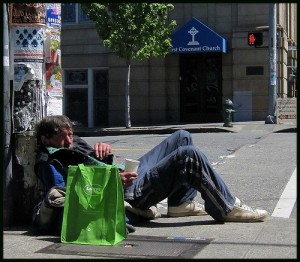
The year I was in residence in Berkeley, California, at Church Divinity School of the Pacific working on a Certificate of Anglican Studies, there was a homeless man who habitually hung out on Euclid Avenue. One often encountered him along the stretch between the seminary and the north gate of the Cal Berkeley campus where there are several businesses including bars and restaurants. Although he would frequently be there panhandling, just about as often one would find him asleep in one of the non-business doorways, his long legs stretched out onto the sidewalk. I can remember stepping over his legs on more than one occasion. When he was awake and begging, he was usually respectable in his asking for handouts, but too often for comfort he could also be rude and offensive. He was clearly disturbed, possibly schizophrenic and also possibly dangerous, as I learned when I tried to engage him in conversation one day. Given that he was of a similar age to me and given the things he yelled at me liberally sprinkled with abusive obscenities, I suspect that he might have been a Vietnam veteran. I never tried to talk with him after that, but if he was panhandling when I passed by, I would give him whatever change was in my pocket, usually around a dollar; I must confess, however, that just about as often (or perhaps more often) I would find some excuse to cross the street before reaching him. What I never did was try to get him help, to find him shelter, or food, or medical care . . . nor, it seemed, did anyone else.

Today on the Episcopal Chuch’s sanctorale calendar is the commemoration of Geoffrey Anketell Studdert Kennedy, an Anglican priest and British army chaplain during World War I. A poet, Studdert Kennedy, wrote a poem entitled Indifference which touches on the admonition of Psalm 95:7b and my Berkeley experience:

When Jesus came to Golgotha, they hanged Him on a tree,
They drove great nails through hands and feet, and made a Calvary;
They crowned Him with a crown of thorns, red were His wounds and deep,
For those were crude and cruel days, and human flesh was cheap.

When Jesus came to Birmingham, they simply passed Him by.
They would not hurt a hair of Him, they only let Him die;
For men had grown more tender, and they would not give Him pain,
They only just passed down the street, and left Him in the rain.

Still Jesus cried, “Forgive them, for they know not what they do,”
And still it rained the winter rain that drenched Him through and through;
The crowds went home and left the streets without a soul to see,
And Jesus crouched against a wall, and cried for Calvary.

I’ve no idea what became of that man on Euclid Avenue in Berkeley, California . . . but I know who he was.

“O that today you would listen to his voice!”

====================

A request to my readers: I’m trying to build the readership of this blog and I’d very much appreciate your help in doing so. If you find something here that is of value, please share it with others. If you are on Facebook, “like” the posts on your page so others can see them. If you are following me on Twitter, please “retweet” the notices of these meditations. If you have a blog of your own, please include mine in your links (a favor I will gladly reciprocate). Many thanks!

====================

Father Funston is the rector of St. Paul’s Episcopal Church, Medina, Ohio.

A Politics of Truth – From the Daily Office – March 7, 2013

From the Gospel according to John:

Jesus said to the Jews who had believed in him, “If you continue in my word, you are truly my disciples; and you will know the truth, and the truth will make you free.”

(From the Daily Office Lectionary – John 8:31-32 (NRSV) – March 7, 2013.)

Crossed Fingers Behind the Back“We hold these truths to be self-evident, that all men are created equal, that they are endowed by their Creator with certain unalienable Rights, that among these are Life, Liberty and the pursuit of Happiness.” There is an undeniable link between truth and autonomy, between authenticity and independence. Those who seek to take away liberty do so by use of falsehood, and most effective untruths are those which are the biggest. Adolph Hitler described the phenomenon:

In the big lie there is always a certain force of credibility; because the broad masses of a nation are always more easily corrupted in the deeper strata of their emotional nature than consciously or voluntarily; and thus in the primitive simplicity of their minds they more readily fall victims to the big lie than the small lie, since they themselves often tell small lies in little matters but would be ashamed to resort to large-scale falsehoods. It would never come into their heads to fabricate colossal untruths, and they would not believe that others could have the impudence to distort the truth so infamously. Even though the facts which prove this to be so may be brought clearly to their minds, they will still doubt and waver and will continue to think that there may be some other explanation. (A. Hitler, Mein Kampf)

Hitler was not here advocating the big lie, though he and his propagandist made very effective use of it. Rather, he was accusing the Jews of founding their existence on “one great lie, namely, that they are a religious community, where as in reality they are a race.” Hitler made effective use of the big lie in his project to eradicate the Jews, but eventually the truth came out and he did not succeed.

Unfortunately, the lie as a political tool continues to rear its ugly head. We can all think of plenty of examples:

“Sadam Hussein was involved in 9/11. Sadam Hussein has weapons of mass destruction. Sadam Hussein is purchasing equipment to refine uranium for weapons.” None of that was true. Thousands of Americans and millions of Iraquis are dead, wounded, or displaced as a result.

“Barack Hussein Obama was not born in the United States.” What a huge waste of time and attention that lie caused.

“Health care reform will include the use of death panels . . . . ” Um, no.

“The government will collapse into chaos if the sequestration is allowed to happen.” We’ve seen some curtailment of programs, some furloughs of government employees, but it all seems rather orderly.

Falsehood is not a very good tool for politics or governance. In fact, it’s an obstacle to both. Falsehood makes it impossible to discuss or debate anything because the productive discourse demands truthfulness. Only if our decision-making processes are based on established facts can we make effective decisions. Actions taken on the basis of falsehood and fantasy are inevitably disastrous.

Truth, on the other hand, as Jesus promised, sets us and our politics free. Free to deal with problems in the real world. Free to find solutions to which all can agree, or which (at least) all can accept. Free to look at the real world in a realistic manner. Free to face facts.

We who are followers of the One who is the Truth, the Way, and the Life, need to rise up and demand of our politicians that they deal in fact, that they live in the real world, that they speak truth to us and to one another. As the now-popular meme puts it, everyone is entitled to their own opinions, but they are not entitled to their own facts. There is one set of facts in the real world in which we all live. Only a politics of truth that faces those facts can solve the problems we have and protect our liberty.

But no politics, not even the most fact-based politics, can truly set us free. Only the Truth can do that.

====================

A request to my readers: I’m trying to build the readership of this blog and I’d very much appreciate your help in doing so. If you find something here that is of value, please share it with others. If you are on Facebook, “like” the posts on your page so others can see them. If you are following me on Twitter, please “retweet” the notices of these meditations. If you have a blog of your own, please include mine in your links (a favor I will gladly reciprocate). Many thanks!

====================

Father Funston is the rector of St. Paul’s Episcopal Church, Medina, Ohio.

Health Is a Human Right – From the Daily Office – March 6, 2013

From the Prophet Jeremiah:

Is there no balm in Gilead? Is there no physician there? Why then has the health of my poor people not been restored?

(From the Daily Office Lectionary – Jeremiah 8:22 (NRSV) – March 6, 2013.)

Good Health SignWhy has the health of the people not been restored? This is God’s question of the leadership of ancient Israel, but it could certainly be the question asked of modern America! Other questions could also be asked, even in the aftermath of the healthcare reform debates, the passage of the Affordable Care Act, and its vindication as constitutional by the U.S. Supreme Court. Why is it that, in the practice of medicine, we do not have equal treatment for everybody? Why is that every American is guaranteed a lawyer, but not a doctor? Why don’t we (even now) have guaranteed health care for everyone?

By an odd coincidence, on the Episcopal sanctorale calendar today is the commemoration of two pioneering physicians and their sons who followed in their footsteps, William W. Mayo and Charles F. Menninger. Among the readings prescribed for their celebration is Sirach 38:8: “God’s works will never be finished; and from him health spreads over all the earth.” Health is an endowment of the Creator to every person; it is a natural right. Why has it been taken from the people, and why has it not been restored?

The human right to good health should mandate a system of preventive health care and medical care for everyone. Every human being should be guaranteed the right to good quality health care, to living conditions that enable each to be as healthy as possible, to adequate food, to good housing, and to a healthy environment. Arguments about reforming our health care and medical treatment delivery system framed in terms of markets, costs, competition, or insurance are red herrings rooted in presumptions that deny this basic truth. A for-profit, market-driven medical care model treats health as a commodity to be bought and sold, and leads to inequities, to severely decreased well-being, and to needless loss of life. The Affordable Care Act is, at best, a stop-gap measure. What is required is a complete re-imagining of our health care system.

Any debate about medical treatment and health care should be structured and waged within the realm of human and civil rights, within the realm of morality and spirituality. A reform of our medical delivery system must take it out of the false model of markets (“competition” in health and medical delivery is a myth!) and place it squarely in the realm of human rights. Good health and medical care are basic rights recognized in the Declaration of Independence’s assertion that “life, liberty, and the pursuit of happiness” are guaranteed by God, protected by the penumbra of the U.S. Constitution, and explicitly spelled out in the United Nations’ Universal Declaration of Human Rights, a statement adopted in 1948 with strong American encouragement.

As Christians, we are called to remember the poor and those less fortunate than ourselves. Assuring that all enjoy their right to health care is basic to honoring life. Those without good preventive care and medical treatment when needed live shorter and sicker lives. Failure to work for universal health care sends the message that only those with the wealth to afford private health care really matter. This is a message squarely opposed by the Gospel of Jesus Christ who made it clear that we are called to care for “the least of these who are members of my family.” (Matthew 25:40 NRSV)

Recently, the Episcopal bishops of the two dioceses in the State of Ohio wrote to the state’s governor and other elected officials in support of the expansion of Medicaid coverage. In their public letter they set out the teaching of our church in this area:

The Episcopal Church affirms the following principles as they pertain to health care:

  • health care, including mental health care, should be available to all persons in the United States;
  • access to health care should be continuous;
  • health care should be affordable for individuals, families, and businesses;
  • national and state health care policy should be affordable and sustainable for society;
  • health care should enhance health and well-being by promoting access to high-quality care that is effective, efficient, safe, timely, patient-centered and equitable; and
  • health care providers should not be expected to assume a disproportionate share of the cost of providing care.

“God’s works will never be finished; and from him health spreads over all the earth.” . . . “Why then has the health of my poor people not been restored?” Good health is not a commodity to be bought and sold. It is a gift of God, and adequate preventive health care and good medical treatment are the right of every human being.

====================

A request to my readers: I’m trying to build the readership of this blog and I’d very much appreciate your help in doing so. If you find something here that is of value, please share it with others. If you are on Facebook, “like” the posts on your page so others can see them. If you are following me on Twitter, please “retweet” the notices of these meditations. If you have a blog of your own, please include mine in your links (a favor I will gladly reciprocate). Many thanks!

====================

Father Funston is the rector of St. Paul’s Episcopal Church, Medina, Ohio.

« Older posts Newer posts »