Occasional thoughts of an Anglican Episcopal priest

Category: Daily Office (Page 44 of 70)

Do I Indulge Some Unknown Sin? – From the Daily Office – February 21, 2013

From the Psalms:

The law of the Lord is perfect and revives the soul; *
the testimony of the Lord is sure and gives wisdom to the innocent.
The statutes of the Lord are just and rejoice the heart; *
the commandment of the Lord is clear and gives light to the eyes.
The fear of the Lord is clean and endures for ever; *
the judgments of the Lord are true and righteous altogether.
More to be desired are they than gold, more than much fine gold, *
sweeter far than honey, than honey in the comb.
By them also is your servant enlightened, *
and in keeping them there is great reward.
Who can tell how often he offends? *
cleanse me from my secret faults.

(From the Daily Office Lectionary – Psalm 19:7-12 (BCP Version) – February 21, 2013.)

"Original Sin" - Artist UnknownEvery time I recite Psalm 19 with its words of praise for the Law, I am caught up short by verse 12. In verses 7-11 we read that the Law is perfect and just, that it provides wisdom and rejoicing, that it is more desirable than gold or honey, and that in keeping it there is enlightenment and reward. Then comes the kicker, “Who can tell how often he offends? Cleanse me from my secret faults.” In other words, despite all the grandeur and wonder of the Law, no one can actually keep it!

The Prayer Book translation of the second part of verse 12 is rather poor. The Hebrew word translated here as “secret” is cathar. A better translation would be “hidden” because the subject is not my faults that I keep secret from others, but rather my offenses of which I am unmindful. The petition of this Psalm is to be cleansed from the sins I commit unawares.

Interestingly, the general confessions in the services of the Episcopal Church make no reference to unknown sins. We confess “things done” and “things left undone”; we confess sins of thought, word, and deed; but we do not confess that there may be (certainly, there are) sins of which we are guilty but of which we have no knowledge, that there are “secret faults.” Perhaps this is a “secret fault” in The Book of Common Prayer. If it is, it is one that can be remedied by recourse to other prayer books and devotionals.

In 1852, a Presbyterian pastor named Elisha Yale (no relation to Yale University), with the assistance of his colleague the Rev. Samuel Cozzens, compiled a devotional entitled, A Select Verse System: For the Use of Individuals, Families and Schools. Fifty-two chapters or “lessons”, one for each week of the year, provided Bible verses to be read each day, and one or more hymns, nearly all by Isaac Watts, to be learnt and sung. Lesson XIX is entitled Examining Ourselves and includes this verse from a two-verse hymn by Dr. Watts:

Lord, search my soul, try every thought;
Though my own heart accuse me not
Of walking in a false disguise,
I beg the trial of thine eyes.

The second verse of the hymn, found in the 1845 Canadian Congregationalist hymnal Church Psalmody: Hymns for Public Worship, is equally instructive.

Doth secret mischief lurk within?
Do I indulge some unknown sin?
O turn my feet whene’er I stray,
And lead me in thy perfect way.

We are encouraged by the Prayer Book to observe “a holy Lent, by self-examination and repentance,” but no amount of self-examination will disclose those “secret sins” which are hidden from ourselves. Our repentance must always include “begging the trial of God’s eyes” and asking, “Do I indulge some unknown sin?” Because the answer is undoubtedly, “Yes.”

====================

A request to my readers: I’m trying to build the readership of this blog and I’d very much appreciate your help in doing so. If you find something here that is of value, please share it with others. If you are on Facebook, “like” the posts on your page so others can see them. If you are following me on Twitter, please “retweet” the notices of these meditations. If you have a blog of your own, please include mine in your links (a favor I will gladly reciprocate). Many thanks!

====================

Father Funston is the rector of St. Paul’s Episcopal Church, Medina, Ohio.

Celebrating Brokenness – From the Daily Office – February 20, 2013

From the Book of Deuteronomy:

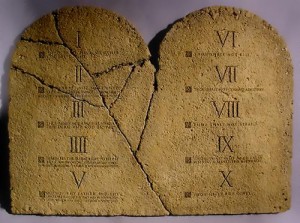
I turned and went down from the mountain, while the mountain was ablaze; the two tablets of the covenant were in my two hands. Then I saw that you had indeed sinned against the Lord your God, by casting for yourselves an image of a calf; you had been quick to turn from the way that the Lord had commanded you. So I took hold of the two tablets and flung them from my two hands, smashing them before your eyes.

(From the Daily Office Lectionary – Deuteronomy 9:15-17 (NRSV) – February 20, 2013.)

Broken Stone TabletsThe Bible tells us that the Tablets of the Law were kept in the Arc of the Covenant which traveled with the Hebrews throughout their forty years in the desert and that it was later housed in the Tabernacle and then in the Temple until lost at or about the time of the Babylonian Exile. According to Rabbinic lore, the Ark contained not only the second, whole Tablets, but the broken fragments of the first Tablets, to which Moses refers in this speech from the Book of Deuteronomy.

The Lubavitcher Rebbe (a very conservative Orthodox Jewish sage) once asserted that the keeping of the broken tablet fragments represented that truth can be crafted not only from the spiritually perfected life, but also from the pieces of a broken human life. This is good news since many, if not all, human lives are broken in some sense.

The Japanese have made art from of fixing broken pottery with a lacquer resin sprinkled with powdered gold. The technique, called kintsugi, renders the piece even more beautiful than it started out. The idea is not to hide the brokenness as ugly, but rather to beautify it using gold to make it shine, to expose and illuminate the damage. Kintsugi repaired vessels are particularly prized for use in the traditional tea ceremony.

Tea-ceremony aesthetics often focus on the beauty of imperfection; in the contemplative atmosphere of the ritual, host and guest appreciate the idiosyncrasies, the flaws, the differences in the glaze that differentiate one vessel from another. The context creates an awareness of transiency, of the way in which all things exist in a fleeting way and are decaying. As with tea vessels, so with human beings.

One of my favorite singer-songwriters is Leonard Cohen. His song Anthem celebrates brokenness:

The birds they sang at break of day
“Start again” I heard them say
Don’t dwell on what has passed away
Or what is yet to be
You can add up the parts
But you won’t have the sum
Strike up the march; there is no drum
Every heart to love will come
But like a refugee
Ring the bells that still can ring
Forget your perfect offering
There is a crack in everything
That’s how the light gets in.

There are no perfect offerings. There are no perfect lives. Everything, the tablets of the Law, tea ceremony vessels, human beings, are all prone to be broken; there is a crack in everything.

This Lent, as you evaluate your life, look for the brokenness that can be repair with the gold of truth, for the cracks where the light can get in.

====================

A request to my readers: I’m trying to build the readership of this blog and I’d very much appreciate your help in doing so. If you find something here that is of value, please share it with others. If you are on Facebook, “like” the posts on your page so others can see them. If you are following me on Twitter, please “retweet” the notices of these meditations. If you have a blog of your own, please include mine in your links (a favor I will gladly reciprocate). Many thanks!

====================

Father Funston is the rector of St. Paul’s Episcopal Church, Medina, Ohio.

“Do Not Say To Yourselves…” – From the Daily Office – February 19, 2013

From the Book of Deuteronomy:

When the Lord your God thrusts them out before you, do not say to yourself, “It is because of my righteousness that the Lord has brought me in to occupy this land”; it is rather because of the wickedness of these nations that the Lord is dispossessing them before you. It is not because of your righteousness or the uprightness of your heart that you are going in to occupy their land; but because of the wickedness of those nations that the Lord your God is dispossessing them before you, in order to fulfill the promise that the Lord made on oath to your ancestors, to Abraham, to Isaac, and to Jacob. Know, then, that the Lord your God is not giving you this good land to occupy because of your righteousness; for you are a stubborn people.

(From the Daily Office Lectionary – Deuteronomy 9:4-6 (NRSV) – February 19, 2013.)

The S.S. Admiral NakhimovWe human beings are so proud, so prone to taking credit we really have no right or basis to claim and, apparently, we’ve been doing it for a long time. Moses’ caution to the Hebrews not to do so, not to think that it is through their own merit that the Promised Land is being given them, is a caution to all of us, for we are all “a stubborn people.” Self-importance and obstinacy are the human condition.

Aristotle once wrote, “Obstinate people can be divided into the opinionated, the ignorant, and the boorish.” (Nichomachean Ethics, Bk. VII) Michel de Montaigne is quoted as saying, “Is there anything so stubborn, obstinate, disdainful, contemplative, grave, or serious, as an ass?” Lent is a time of self-examination and perhaps this Daily Office lesson is a reminder to take a long, hard look out one’s own arrogant tendency to claim credit where none is due, at one’s one obstinacy. There is a link between the two, between pride and stubbornness.

Consider the case of two Russian ships, the Admiral Nakhimov, an aging passenger liner, and the Pyotr Vasev, a large bulk freight carrier. On the night of August 31, 1986, the two collided in the Black Sea near the port of Novorossiysk. The cause of collision was human stubbornness. Both captains were aware of the other ship’s presence nearby. Either could have prevented it, but neither wanted to give way to the other. Arrogance and stubbornness resulted in the deaths of 64 crew and 359 passengers.

As on the seaways, so on the paths of life. In business, in politics, in our personal lives, pride and obstinacy lead to problems, sometimes to disasters. During these days of Lent, remember Moses’ words, “Do not say to yourself, ‘It is because of my . . . whatever.'”

====================

A request to my readers: I’m trying to build the readership of this blog and I’d very much appreciate your help in doing so. If you find something here that is of value, please share it with others. If you are on Facebook, “like” the posts on your page so others can see them. If you are following me on Twitter, please “retweet” the notices of these meditations. If you have a blog of your own, please include mine in your links (a favor I will gladly reciprocate). Many thanks!

====================

Father Funston is the rector of St. Paul’s Episcopal Church, Medina, Ohio.

Wedding Wine, Multiple Universes, Lenten Speculation – From the Daily Office – February 18, 2013

From the Gospel of John:

On the third day there was a wedding in Cana of Galilee, and the mother of Jesus was there. Jesus and his disciples had also been invited to the wedding. When the wine gave out, the mother of Jesus said to him, “They have no wine.” And Jesus said to her, “Woman, what concern is that to you and to me? My hour has not yet come.” His mother said to the servants, “Do whatever he tells you.” Now standing there were six stone water-jars for the Jewish rites of purification, each holding twenty or thirty gallons. Jesus said to them, “Fill the jars with water.” And they filled them up to the brim. He said to them, “Now draw some out, and take it to the chief steward.” So they took it. When the steward tasted the water that had become wine, and did not know where it came from (though the servants who had drawn the water knew), the steward called the bridegroom and said to him, “Everyone serves the good wine first, and then the inferior wine after the guests have become drunk. But you have kept the good wine until now.” Jesus did this, the first of his signs, in Cana of Galilee, and revealed his glory; and his disciples believed in him.

(From the Daily Office Lectionary – John 2:1-11 (NRSV) – February 18, 2013.)

Multiverse by Victor Habbick, ShutterstockSeems strange, doesn’t it, that the lectionary on the first Monday of Lent, this season of self-denial, would have us read a story of Jesus supplying a lot of really good wine for a party? Strange indeed! But I’m used to reading strange things.

Anyone who knows me well knows that there are two sorts of literature that I read for recreation and relaxation: science fiction and theoretical physics. I’ve been reading science fiction (and watching SF movies and TV shows) as long as I can remember. My bachelor’s degree is, officially, in “Contemporary English and American Literature” but, if truth be told, it’s really in science fiction; I went to university that allowed students to design their own major curricula, so that’s what I put in mine.

I might have gotten a degree in physics if I’d been able to understand the math. However, barely passing three courses in integral and differential calculus convinced me that the sciences weren’t going to be my life’s work. They would remain an active interest, but they would never be a career choice. (It always surprises people when I tell them that my first “real” job was as a laboratory assistant to two experimental physicists in the University of California system. It surprises me, too!)

One of the sub-genres of science fiction literature that I have particularly enjoyed over the years is the group of novels that explore the concept of multiple universes or alternate realities. Robert Heinlein’s The Number of the Beast and Glory Road, Roger Zelazney’s Chronicles of Amber, C.S. Lewis’ Chronicles of Narnia, and S.M. Stirling’s Conquistador are of this sort. So, too, is a novel given me by my son and daughter-in-law at Christmas, The Long Earth by Terry Pratchett and Steven Baxter. In the latter novel, people known as “steppers” move among millions or billions or possibly an infinite number of parallel worlds, either by natural ability or by using a simple “step box” powered by a potato (remember, Terry Prachett is a co-author).

This “parallel universe” idea has been a favorite of science fiction authors for years. What’s great fun these days is that it is now gaining some credence with the science fact folks, too! With the advent of superstring theory and then m-theory, the idea of alternative universes, in fact an infinity of them, is finding justification in the mathematics of theoretical physics. Last month, the science website Space.com published an article entitled 5 Reasons We May Live in a Multiverse which began:

The universe we live in may not be the only one out there. In fact, our universe could be just one of an infinite number of universes making up a “multiverse.”

Though the concept may stretch credulity, there’s good physics behind it. And there’s not just one way to get to a multiverse — numerous physics theories independently point to such a conclusion. In fact, some experts think the existence of hidden universes is more likely than not.

By now, I’m sure that anybody reading this is wondering what any of this has to do with Jesus changing water into wine at the wedding in Cana. Well . . . as one of the characters on the British sit-com Miranda is fond of saying, “Bear with! Bear with!” I’m going to make a sideways step for a moment and then pull this together.

Yesterday was the anniversary of the execution of the 16th Century Dominican friar and condemned heretic Giordano Bruno; he was burnt at the stake on February 17, 1600, for among other things suggesting an infinite number of parallel worlds.

Yes, you read that right. A Dominican friar more than four centuries ago proposed as reality a staple of 20th Century science fiction and a theoretical construct of 21st Century physics, and he did so in the context of a theological meditation. In 1584, he published De l’Infinito, Universo e Mondi (“On the Infinite Universe and Worlds”). In it, he argued that there are an infinite number of worlds inhabited by intelligent beings. The universe, he said, reflects God in God’s infinite nature, thus God must exist everywhere, not as a singular remote heavenly deity. Bruno is quoted as writing:

God is omniscient, perfect, and omnipotent and the universe is infinite. If God is all-knowing, he must be able to think of everything, including whatever I am thinking. Since God is perfect and completely actualized, he must create what he thinks. I can imagine an infinite number of worlds like the earth, with a Garden of Eden on each one. In all these Gardens of Eden, half the Adams and Eves will not eat the fruit of knowledge, but half will. But half of infinity is infinity, so an infinite number of worlds will fall from grace and there will be an infinite number of crucifixions. Therefore, either there is one unique Jesus who goes from one world to another, or there are an infinite number of Jesuses. Since a single Jesus visiting an infinite number of earths one at a time would take an infinite amount of time, there must be an infinite number of Jesuses. Therefore, God must create an infinite number of Christs. (Weisstein)

What if Bruno was right? Or at least partially right. What if there are an infinite number of worlds, as m-theory mathematics suggests there are? But instead of a single, unique Jesus needing “an infinite amount of time” to go from world to world, what if that single, unique incarnation of the Godhead had (and has always had) instant access to all of the infinite worlds? (I realize that words like always and instant become problematic when we begin to speculate about infinite parallel universes.) What if Jesus could “step” like the characters in Pratchett’s and Baxter’s The Long Earth, not in the limited way those characters can but in an omnipotent way, instantly from any of the infinite worlds to any other? What if Jesus were able in some way to bring into this disordered universe the proper, unfallen reality of a parallel creation? He could, when coming down from the mountain of the Transfiguration, heal the epileptic boy by bringing the reality of his good health from a parallel world into this world. He could, when feeding the 5,000, reach into an alternate reality of abundance and bring its plenty into this world of scarcity to more than feed the gathered crowd. He could, when the wedding party ran out of wine, supply this world’s need with the overflowing vintage of a parallel existence.

Perhaps that is why the lectionary steers us, at the beginning of Lent, to the contemplation of a wedding reception where the Lord provided an abundance of wine, to considering a story of God’s power and grace that, as Paul wrote to the Ephesians, “can do infinitely more than we can ask or imagine.” (Ephesians 3:20) I’ll admit that this all may be a flight of fancy, a fit of fantasy, but the question of God’s omniscience or omnipotence, attributes that classical theology insists God must have, becomes all the more intriguing if we do live in a multiverse rather than a universe, if creation is multiform rather than uniform. And our Lenten meditations become much more fun!

====================

A request to my readers: I’m trying to build the readership of this blog and I’d very much appreciate your help in doing so. If you find something here that is of value, please share it with others. If you are on Facebook, “like” the posts on your page so others can see them. If you are following me on Twitter, please “retweet” the notices of these meditations. If you have a blog of your own, please include mine in your links (a favor I will gladly reciprocate). Many thanks!

====================

Father Funston is the rector of St. Paul’s Episcopal Church, Medina, Ohio.

It’s Lent: Say “Good-Bye” – From the Daily Office – February 16, 2013

From the Letter to Titus:

Avoid stupid controversies, genealogies, dissensions, and quarrels about the law, for they are unprofitable and worthless. After a first and second admonition, have nothing more to do with anyone who causes divisions, since you know that such a person is perverted and sinful, being self-condemned.

(From the Daily Office Lectionary – Titus 3:9-11 (NRSV) – February 16, 2013.)

GoodbyeSo, I’ve returned to Paul’s letter to the young bishop Titus. This is a bit from near the end of the letter, Paul’s last piece of advice before turning his attention to personal greetings and a invitation to join him in Nicopolis for the winter.

And it’s actually pretty good advice, as difficult as it may be to put into practice. It sometimes seems that stupid controversies and “unprofitable and worthless” conflicts are the stuff of church life.

Paul’s recommendation to quit after two “admonitions,” two tries at overcoming division, is a bit short of the conflict resolution technique advanced by Jesus, however:

If another member of the church sins against you, go and point out the fault when the two of you are alone. If the member listens to you, you have regained that one. But if you are not listened to, take one or two others along with you, so that every word may be confirmed by the evidence of two or three witnesses. If the member refuses to listen to them, tell it to the church; and if the offender refuses to listen even to the church, let such a one be to you as a Gentile and a tax collector. (Matthew 18:15-17)

A bit short of that, but in the same vein. Give it a try, give it another. But don’t waste too much time on this; your energies and your efforts are better spent elsewhere.

The modern church has not learned this, unfortunately. We have spent and still spend too much time trying to satisfy the trouble-makers. We are unwilling to let anyone go; we want everyone to be happy, everyone to stay and be part of a big, happy (but sadly dysfunctional) family. How much better off we, the trouble-makers, and the society in which we minister might be, if we were able to deal with conflict in a healthy way, letting those who are unhappy go (encouraging them, in fact) and find a community in which they could be comfortable.

I think Paul is a bit harsh to condemn them as unprofitable, worthless, perverted, and sinful. Even Jesus is a bit harsh rejecting them as “a Gentile and a tax collector.” But their point is well taken. Those who don’t fit in . . . don’t fit in. Let them go!

Something to consider during Lent . . . are we perpetuating dysfunctional relationships? Are there people in our lives (not just our churches) who would be better off if we could let them go? Are there folk to whom we should simply say, “Good bye”? I suspect there are.

====================

A request to my readers: I’m trying to build the readership of this blog and I’d very much appreciate your help in doing so. If you find something here that is of value, please share it with others. If you are on Facebook, “like” the posts on your page so others can see them. If you are following me on Twitter, please “retweet” the notices of these meditations. If you have a blog of your own, please include mine in your links (a favor I will gladly reciprocate). Many thanks!

====================

Father Funston is the rector of St. Paul’s Episcopal Church, Medina, Ohio.

Simple Invitations: Troubling Questions – From the Daily Office – February 15, 2013

From the Gospel according to John:

The next day John again was standing with two of his disciples, and as he watched Jesus walk by, he exclaimed, “Look, here is the Lamb of God!” The two disciples heard him say this, and they followed Jesus.

(From the Daily Office Lectionary – John 1:35-36 (NRSV) – February 15, 2013.)

InvitationCould it get any simpler? “Look, here is Jesus.” The proclamation of the Good News, the invitation into personal relationship with our Incarnate God, the revelation of what it is to be truly human . . . whatever you want to call it (we’ll steer clear for the moment from the word “evangelism”), it can’t get any simpler than this: “Look, here he is.”

That’s really all the Baptizer is doing. He’s inviting his friends to consider this Jesus whom he, John, has found to be a compelling figure. It’s a simple invitation.

Almost thirty years ago I read the book The Inviting Church by Roy Oswald and Speed Leas (Alban Institute 1987). In fact, I still have two or three copies of it on my office shelves. Right there on page 44 are these statistics about what attracts visitors to churches:

2% by Advertisement
6% by the Pastoral Invitation
6% by organized evangelism campaign
86% by friends or relatives

Guess what? Those statistics still hold true today. Over these three decades they have been confirmed again and again. The personal invitation, “Look, here he is,” is by far the most effective way the message of the Gospel spreads and the church grows.

The sadder statistic, also reported by Oswald and Leas and also still true today, is that half of church members have never invited anyone to church . . . ever. About a third have invited one person sometime during their lives. Fewer than 20% have made more than one invitation.

“What is the mission of the Church?” asks the Catechism in the Book of Common Prayer. The answer is simple: “The mission of the Church is to restore all people to unity with God and each other in Christ.” This mission, says the Catechism, is carried out “through the ministry of all its members.” (Emphasis mine.) The Catechism then teaches us that the ministers of the church are “lay persons, bishops, priests, and deacons.” That’s an awfully wordy way to say “all of us.”

The ministry of the laity, we are taught, is first and foremost “to represent Christ and his Church [and] to bear witness to him wherever they may be.” That’s really the ministry of all orders (lay or ordained), the ministry of every church member. There is no better example of bearing witness to Christ than the one given by the Baptizer in today’s lesson: “Look, here is the Lamb of God!” It’s really just that simple.

That so few do it speaks not of them as persons, but of the church corporately. Instead of asking (as so many clergy do) why people do not invite others, perhaps we should consider why people do invite friends to places or events. What encourages people to issue invitations? Basically, I think that we invite people we value to share with us in the things and communities we value, in the things and events that bring us joy. We invite people into that which is important to us.

And doesn’t that, especially for church leadership during this Lenten season, raise even more questions, more troubling questions, than it answers?

====================

A request to my readers: I’m trying to build the readership of this blog and I’d very much appreciate your help in doing so. If you find something here that is of value, please share it with others. If you are on Facebook, “like” the posts on your page so others can see them. If you are following me on Twitter, please “retweet” the notices of these meditations. If you have a blog of your own, please include mine in your links (a favor I will gladly reciprocate). Many thanks!

====================

Father Funston is the rector of St. Paul’s Episcopal Church, Medina, Ohio.

Happy Valentine’s Day: Cretans Are Liars! – From the Daily Office – February 14, 2013

From the Letter to Titus:

There are also many rebellious people, idle talkers and deceivers, especially those of the circumcision; they must be silenced, since they are upsetting whole families by teaching for sordid gain what it is not right to teach. It was one of them, their very own prophet, who said, “Cretans are always liars, vicious brutes, lazy gluttons.” That testimony is true. For this reason rebuke them sharply, so that they may become sound in the faith, not paying attention to Jewish myths or to commandments of those who reject the truth.

(From the Daily Office Lectionary – Titus 1:10-13b (NRSV) – February 14, 2013.)

Sing of the Cross in Ashes on Purple HeartWell, Happy Valentine’s Day! Doesn’t Paul strike a pleasant note in his admonitions to the young bishop Titus? The ad hominem attack enshrined in Holy Scripture, mixed with a health dose of antisemitism to boot! An ad hominem is considered a logical fallacy because an otherwise potentially valid claim is rejected on the basis of an irrelevant fact about the person presenting the claim. Typically, it involves two steps, both of which Paul demonstrates in this bit of his letter to Titus. First, an attack against the character of person making the claim: “Cretans are always liars.” Second, this personal attack is used as evidence against the argument the person is making. In other words, the ad hominem argument has the following form:

  1. Person A makes claim X: “Rebellious people are teaching things.”
  2. Person B makes an attack on person A: “They are liars, vicious brutes, and lazy gluttons.”
  3. Therefore A’s claim is false: “Their teachings are ‘Jewish myths’.”

However, the character, circumstances, or actions of a person do not have any bearing on the truth or falsehood of the claim they may be making or the quality of the argument they may be advancing: this is why the ad hominem attack is, itself, a fallacy.

Reading these words in the letter to Titus this morning hit me with particularly force because of discussions yesterday of the innovation of “Ashes to Go” – a new practice offered by some in the Episcopal Church (and other traditions, I suppose) of going to public places (street corners, coffee houses, college campuses) and offering the imposition of ashes on Ash Wednesday outside of the context of the full penitential liturgy. Personally, I don’t approve of the practice, but I do appreciate the arguments of those who champion it.

In some of the discussions, both online and in person, arguments were advanced that those on the con side of “Ashes to Go” were “older clergy” whose only concern (apparently because of their age and concern for their pensions) is preservation of a dying institution while those on the pro side were “younger clergy” who (apparently because of their youth) are open to the Holy Spirit doing something new. On the other side, those “younger clergy” were portrayed as killing the church because they fail to appreciate and respect its traditions and by their actions rob them of meaning, while the “older clergy” are the Spirit-filled defenders of the faith.

Hmmm . . . . . . . The division of the church into “older” and “younger” groups (clergy or otherwise) whose age bracket somehow validates or invalidates their positions feels a lot like an ad hominem sort of argument. In the spirit of Paul’s words to Titus, I could almost hear the disputants saying, “Older clergy are always . . . .” and “Younger clergy are always . . . .”

I don’t know whether “Ashes to Go” is a movement of the Holy Spirit or whether it is simply yet another straw being grasped at by a church striving to be “relevant”. Maybe it’s a little bit of both. I do know that, to me, it feels like what Dietrich Bonhoeffer called “cheap grace”:

Cheap grace is the grace we bestow on ourselves. Cheap grace is the preaching of forgiveness without requiring repentance, baptism without church discipline, Communion without confession…. Cheap grace is grace without discipleship, grace without the cross, grace without Jesus Christ, living and incarnate. (The Cost of Discipleship)

Whether it is that or not, however, is not dependent on whether the practice is advanced by “younger clergy” or opposed by “older clergy” (and, for the record, there are proponents and opponents on both sides of the age divide, wherever one draws the line).

This Valentine’s Day – this Lent – let’s make the effort to move away from ad hominem arguments, even if they are enshrined in the Pauline text. Let’s listen to one another carefully and address the issues, not the persons.

====================

A request to my readers: I’m trying to build the readership of this blog and I’d very much appreciate your help in doing so. If you find something here that is of value, please share it with others. If you are on Facebook, “like” the posts on your page so others can see them. If you are following me on Twitter, please “retweet” the notices of these meditations. If you have a blog of your own, please include mine in your links (a favor I will gladly reciprocate). Many thanks!

====================

Father Funston is the rector of St. Paul’s Episcopal Church, Medina, Ohio.

Enduring Enlightenment – From the Daily Office: Ash Wednesday – February 13, 2013

From the Letter to the Hebrews:

Lift your drooping hands and strengthen your weak knees, and make straight paths for your feet, so that what is lame may not be put out of joint, but rather be healed. Pursue peace with everyone, and the holiness without which no one will see the Lord.

(From the Daily Office Lectionary – Hebrews 12:12-4 (NRSV) – February 13, 2013.)

Running the RaceThe author of the Letter to the Hebrews is using an athletic metaphor, and borrowing from the Hebrew Scriptures, to make a point about endurance.

Taking up his own earlier metaphor of “running with perseverance the race that is set before us” (12:1), he echoes the Prophet Isaiah, “Strengthen the weak hands, and make firm the feeble knees. Say to those who are of a fearful heart, ‘Be strong, do not fear! Here is your God.'” (Isa. 35:3-4a) He draws from the Proverbs, “Keep straight the path of your feet . . . .” (Prov. 4:26)

Endurance, also known as “fortitude,” is one of Christianity’s four cardinal virtues. In Freemasonry (yes, I’m a Freemason), this Christian virtue is defined as “that noble and steady purpose of mind, whereby we are enabled to undergo any pain, peril, or danger, when prudentially deemed expedient.” As a subject of preaching, I’m afraid, this virtue gets rather short shrift in today’s church. I suppose that may be because the church reflects the popular culture which, with its emphasis on self-expression and instant gratification, emphasizes a sense of entitlement to ephemeral happiness and comfort.

As we begin Lent, it is well to reflect on this virtue. This period of forty days is meant to be our spiritual union with Jesus in his time of desert testing. If ever there was an example of endurance or fortitude, it has to be those days of temptation in the arid land beyond the Jordan. Endurance is a part of our Christian heritage, going back to Jesus and beyond him into the centuries-long story of the endurance of Israel, God’s chosen people.

Endurance is also one of the four Buddhist virtues, although in that religious tradition it is called “eternity”. It is regarded as a quality of inner being which allows the practitioner to remain unswayed by the ever-changing circumstances of life while confidently challenging him- or herself toward enlightenment. It leads, it is said, to another of the Buddhist virtues, happiness, a kind of contentment that can withstand the ups and downs of human existence including death. This is quite different from the vacuous “happiness” of the modern age, that insipid self-indulgence buoyed by unprecedented affluence and rampant consumerism.

This Lent let us eschew the world’s “happiness” and strive for that eternal happiness common to the Christian and Buddhist faith traditions, that noble and steady purpose of mind, that quality of inner being, that eternal endurance that leads to enlightenment, that leads to God.

====================

A request to my readers: I’m trying to build the readership of this blog and I’d very much appreciate your help in doing so. If you find something here that is of value, please share it with others. If you are on Facebook, “like” the posts on your page so others can see them. If you are following me on Twitter, please “retweet” the notices of these meditations. If you have a blog of your own, please include mine in your links (a favor I will gladly reciprocate). Many thanks!

====================

Father Funston is the rector of St. Paul’s Episcopal Church, Medina, Ohio.

Special Days, Sacred Time – From the Daily Office – February 4, 2013

From Paul’s Letter to the Galatians:

Formerly, when you did not know God, you were enslaved to beings that by nature are not gods. Now, however, that you have come to know God, or rather to be known by God, how can you turn back again to the weak and beggarly elemental spirits? How can you want to be enslaved to them again? You are observing special days, and months, and seasons, and years. I am afraid that my work for you may have been wasted.

(From the Daily Office Lectionary – Galatians 4:8-11 (NRSV) – February 4, 2013.)

Antique ClockWe are still reading through Paul’s correspondence with my Celtic friends of Anatolia. And, again, Paul is exasperated with them. They seem to be backsliding. I must admit, however, to some confusion here. Paul complains that they are “observing special days, and months, and seasons, and years.” What, I wonder, is wrong with that? Certainly the Jews, from whom Paul and Jesus came, observed special times, feasts, and seasons; and I’m pretty certain the earliest Christians observed Sunday as a “special day” – we still do.

Paul’s point, I know, is that the observance of “special days” in and of itself is not a meritorious work earning one salvation. But human beings need holidays — holy days — to mark the passage of time, to give it significance and meaning, to remember and perpetuate momentous events, to honor the cycles of life, not as meritorious acts but as memorials. The observance of “special days” creates a connectedness to other people and gives life events a spiritual meaning.

With some clergy colleagues I’m reading a book about being overly busy, especially as ordained ministers. In it the author includes this quotation (and I’m sorry I don’t know who it’s from): “Time is about God and the universe and all things human. Time is everywhere and it permeates everything: the cosmos, our solar system, the earth’s past, present and future, sociological existence. As such it has suffused knowledge since the dawn of humanity. It has occupied such a central place in the history of ideas and cultural practice because the temporality of being confronts us with the immemorial, existential issues of life and death, origin and destiny.”

While time itself is not sacred, times are redeemed and sanctified as human beings celebrate and participate in the eternal by “observing special days, and months, and seasons, and years.” These sacralized times join us as Christians in the Body of Christ across the generations, draw the worshiping community into a broader union with Christ, and connect us with the world. Sanctified and redeemed time focuses Christians on the great feasts celebrating the events of the life, death, and resurrection of Christ, events which we find echoed in the events of our own lives.

The observance of certain days in not in itself meritorious, but it can be redemptive. We human beings need our special days.

====================

A request to my readers: I’m trying to build the readership of this blog and I’d very much appreciate your help in doing so. If you find something here that is of value, please share it with others. If you are on Facebook, “like” the posts on your page so others can see them. If you are following me on Twitter, please “retweet” the notices of these meditations. If you have a blog of your own, please include mine in your links (a favor I will gladly reciprocate). Many thanks!

====================

Father Funston is the rector of St. Paul’s Episcopal Church, Medina, Ohio.

The Tongue of a Teacher – From the Daily Office – February 1, 2013

From the Prophet Isaiah:

The Lord God has given me
the tongue of a teacher,
that I may know how to sustain
the weary with a word.
Morning by morning he wakens —
wakens my ear
to listen as those who are taught.

(From the Daily Office Lectionary – Isaiah 50:4 (NRSV) – February 1, 2013.)

I Love My Teacher“The tongue of a teacher” is a such a ripe and fruitful image — it calls to mind all those wonderful people who are so formative in our lives. I remember particular teachers from throughout my life who have been and still are forces that formed and form who I am.

I’ve spent the past few days laid up by a case of viral enteritis with all of its unpleasant symptoms and so the first teacher to come to mind is my kindergarten teacher Mrs. Hancock. My most vivid memory of her is from a day when I was similarly ill and my father had to come to school to pick me up; I have other memories of Mrs. Hancock, but I especially remember how gentle and solicitous she was to a sick five-year-old.

In the Sixth Grade my teacher was Miss Upton. I was in love with Miss Upton, but she married during spring break and broke my heart! I think I fell in love with her because of how she dealt with the class the day President Kennedy was assassinated. I’m sure she appreciated the tragedy of the day much more than her group of 11- and 12-year-old students and was probably more upset than we were, yet she was a solid rock of calm and reassurance.

There were many others – Mrs. Weckle and Mr. Sallee in high school – Dr. Dykstra and Dr. Marcuse in college – professors in graduate school, law school, and seminary – and, of course, the many, many informal teachers we all encounter throughout life. All those people who have been given “the tongue of a teacher.” It is not the subjects they teach that makes them memorable; it is the way they taught, the way they lived their lives that infused their teaching.

Yes, teachers teach “subjects” – the nuts-and-bolts of mathematics or literature or property law or koine Greek. But more importantly a good teacher teaches how to learn and how to live. Good teachers foster critical thinking skills so that, given a concept, a student may go beyond the facts of the day and deal with any matter he or she may encounter. Great teachers foster critical living skills so that a student may go deeper than the mere facts and encounter the truth.

I thank God for Mrs. Hancock, Miss Upton, and all those to whom God has given “the tongue of a teacher” in my life.

====================

A request to my readers: I’m trying to build the readership of this blog and I’d very much appreciate your help in doing so. If you find something here that is of value, please share it with others. If you are on Facebook, “like” the posts on your page so others can see them. If you are following me on Twitter, please “retweet” the notices of these meditations. If you have a blog of your own, please include mine in your links (a favor I will gladly reciprocate). Many thanks!

====================

Father Funston is the rector of St. Paul’s Episcopal Church, Medina, Ohio.

« Older posts Newer posts »