Occasional thoughts of an Anglican Episcopal priest

Category: Liturgy (Page 15 of 16)

The Patients of Job: Part One – Sermon for Pentecost 19, Proper 22B – October 7, 2012

====================

This sermon was preached on Sunday, October 7, 2012, at St. Paul’s Episcopal Church, Medina, Ohio, where Fr. Funston is rector.

(Revised Common Lectionary, Proper 22B: Job 1:1; 2:1-10; Psalm 26; Hebrews 1:1-4; 2:5-12; and Mark 10:2-16. These lessons can be read at The Lectionary Page.)

====================
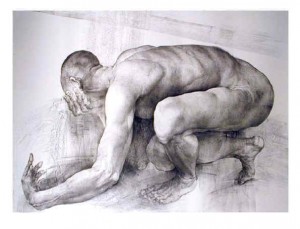
Job's Repentance (Artist Unknown)I know two things today that I didn’t know earlier in the week. First, I know that people read our sign. I got two telephone calls and one email telling me that we had misspelled “patience” on the sign. Second, I know that people won’t believe you when you tell them you did it on purpose. But I really did name this sermon series “The Patients (P-A-T-I-E-N-T-S) of Job” for reasons that I hope will become clear very shortly.

Before diving into that subject this morning, however, a word about the Lectionary. For the next four weeks our lessons from the Old Testament will be from the Book of Job as we follow what is called “Track One” of the Revised Common Lectionary.

Track One is a semi-continuous reading of major Old Testament books. The idea this is that we tend to short-change the Old Testament in our Sunday Eucharistic lectionary, and that we need to hear more of the Old Testament and be more familiar with it. So Track One is set up so that we can see the development of some of the great Old Testament stories over the course of successive Sundays; this gives us peculiar opportunities for preaching series like the one we’re embarking on today. The assumption, of course, is that the congregation each Sunday is made up of who actually come to church every week to hear the unfolding of the Old Testament readings in this way. That’s not always a valid assumption. Many of our people, because of work schedules or whatever, do not make it to church every Sunday and so are likely to miss huge chunks of the story. So each week in these sermon there may be a bit of repetition to bring these folks up to speed; I hope weekly congregants will bear with us on that score. (For those of you who may not be here every week, the sermons and lessons will be on the internet for you.)

There other thing about Track One is that, unlike Track Two, which is a Gospel-related track in which the Old Testament reading is selected because it has some sort of thematic connection to the Gospel reading appointed for the day, there is no specific link between the lesson from the Hebrew Scriptures and the lessons from the Christian Scriptures. For example, today we heard part of the backstory of Job’s suffering (we’ll return to that in a moment), while the Gospel focused on Jesus’ teaching about marriage and divorce. I suppose one could draw a connection between the little spat Job and Mrs. Job have at the end of the Old Testament reading and what Jesus has to say, but I’m not going to go there. So for the next few weeks, please don’t expect much exegesis of the Gospel lessons.

So, now, let me answer the signage critics and explain why I chose to (apparently) misuse the word “patients” on our sign. Obviously it is a play on the familiar statement made of a long-suffering individual that he or she has “the patience of Job”. That’s an odd turn of phrase because, as we shall see, Job is not particularly patient; he is at turns angry, demanding, petulant, and sullenly silent, but he is not patient. Nonetheless, I chose to play with and make a pun on that old concept because the story of Job is one to which we can turn are in need of balm for whatever turns in life may beset us.

The great preacher St. John Chrysostom, in a sermon on the Gospel of John, said of Holy Writ,

The divine words, indeed, are a treasury containing every sort of remedy, so that, whether one needs to put down senseless pride, or to quench the fire of concupiscence or to trample on the love of riches, or to despise pain, or to cultivate cheerfulness and acquire patience – in them one may find in abundance the means to do so. (Hom. 37 On John.)

In a sermon on St. Paul’s letter to the Colossians, he likened the Bible to a medicine chest:

Listen, I entreat you, all that are careful for this life, and procure books that will be medicines for the soul . . . . If grief befalls you, dive into [the Holy Scriptures] as into a chest of medicines; take from there comfort for your trouble, be it loss, or death, or bereavement of relations; or rather do not merely dive into them but take them wholly to yourself, keeping them in your mind.” (Hom. IX On Colossians)

This is especially true of the Book of Job.

This book, as I made mention from this pulpit some weeks ago, is a work of fiction, but that does not stop it from being a work from which we can learn great truth. Or perhaps I should say “great truths” for, more than any other book in the Bible, Job offers what some might call a “post-modern” or pluraform vision of truth. Job, in the midst of his suffering, is visited by his wife, his friends Eliphaz, Bildad, and Zophar, and a fourth man, Elihu (who may just be a passerby). Each of them offers an explanation of why life has treated Job so shabbily and offers advice as to how he should respond. Job’s answer to each of them is basically, “That may be true for you, but it’s not true for me!” The character Job could be the patron saint of our post-modern age, and the Book of Job offers us a variety of remedies, a selection of alternative truths for whatever besets our spirits; it also provides a glimpse at the over-arching meta-truth that sustains our lives, namely the awesome power of God. We all come to this book, as we come to all of Scripture, as patients seeking medicine for the soul; we are all the “patients of Job.”

When we first open this text we are treated to two scenes involving the characters God and Satan. (I put it that way very advisedly, very carefully. Please always remember that this is a work of fiction and so we have a character named “God” and a character named “Satan” who may or may not behave in the ways the Creator and the Adversary actually interact with the world.) In both of these scenes these two characters make and continue a wager regarding Job. In Chapter 1, all the heavenly court appears before God, including Satan whom God asks where he has been. Satan answers that has been “going to and fro on the earth, and from walking up and down on it.” (1:7) God asks if he has seen God’s servant Job who is a good and righteous man. Satan replies that he has, but then challenges God about Job’s virtue suggesting that Job is only righteous because God has provided him a good life. So they make a wager; Satan bets that if Job loses everything he has, he will curse God. God gives Satan authority to strip him of his wealth and possessions, but forbids him to lay a hand on Job. The next thing we know, Job is struck by calamity after calamity all within a very short time. Four servants come to him, one after another, the next coming before the one before has even finished speaking, telling him that Sabaeans have come and stolen his oxen and donkeys, a fire has destroyed his sheep, Chaldean invaders have killed all his servants, and a collapsing house has killed all his sons and daughters. Job is left with nothing; he tears his clothing, shaves his head, and falls to the ground, but the narrator assures us that “in all this Job did not sin or charge God with wrongdoing.” Rather, he blesses the Name of God! (1:20-21)

Which brings us now to our reading for today and the second scene in the heavenly throne room. Again, the court is assembled; again, Satan is there having come “trom going to and fro on the earth, and from walking up and down on it.” (2:2) Again, God asks if Satan has considered Job; and again, Satan makes a bet with God. It’s all well and good that he’s lost everything, but he’s still alive and healthy; “touch his bone and his flesh,” says Satan, “and he will curse you to your face.” (2:5) “Very well,” says God, “you can cause him illness, but do not take his life.” So Satan “inflict[s] loathsome sores on Job from the sole of his foot to the crown of his head.” (2:7) Job’s response is different from his actions in the first chapter; he engages in no new acts of mourning or worship. Instead, he picks up a piece of broken pot, scratches at his sores, and sits down on a pile of ashes. At this point Mrs. Job (she isn’t given her own name in the text) says to her husband, “Do you still persist in your integrity? Curse God, and die.”

One commentary points out that the concept of integrity in the Old Testament has two prongs. First, it “denotes a person whose conduct is completely in accord with moral and religious norms.” Second, it describes someone “whose character is one of utter honest, without guile.” (The New Interpreter’s Bible, Vol. IV, Abingdon Press: 1996, page 356) Mrs. Job seems to sense that for her husband to “persist in his integrity” in this situation, he cannot do both. She seems to be arguing that “if Job holds on to integrity in the sense of conformity to religious norm and blesses God as he did before, . . . he will be committing an act of deceit. If he holds on to integrity in the sense of honesty, then he must curse God and violate social integrity, which forbids such cursing.” (Ibid.)

Job, however, tells her she is being foolish. In fact, the Hebrew here is rather stronger – the commentary notes that a more accurate contemporary translation would be that he tells her she is “talking trash”! Job insists that there is no conflict between religious integrity and personal honesty. We are again assured by the narrator that “in all this Job did not sin with his lips.” (2:10)

This is where our reading this morning ends, but it is not the end of Chapter 2. As the chapter ends, Job’s three friends – Eliphaz the Temanite, Bildad the Shuhite, and Zophar the Naamathite – hearing of all of his troubles meet together to come to console and comfort him. On seeing his state, they tear their own clothes, weep loudly, throw dust upon their own heads, then sit down in the dirt with him. For a week they sit there with him in silence.

So what are we to make of these initial scenes from the story of Job. If St. John Chrysostom is right and there are “medicines for the soul” to be found here, what are they? I suggest there are a couple of things to be learned here which may be of some comfort in our modern age. The first is found in this book’s rejection of the facile answers of an older “wisdom religion” tradition.

I am sure that we have all, at one time or another, faced the death of a loved one, the loss of something or someone precious to us, or some other personal tragedy or difficult situation; or that if we have not, we surely will. And I’m equally sure that in such a situation we are all prone to ask an interior question along the lines of “Why me?” or “What have I done to deserve this?”

That older “wisdom religion” which runs through our faith tradition encourages that sort of thinking. Elsewhere in Holy Scripture, in the Book of Proverbs, for example, we are told:

Walk in the way of the good, and keep to the paths of the just. For the upright will abide in the land, and the innocent will remain in it; but the wicked will be cut off from the land, and the treacherous will be rooted out of it. (2:20-22)

And again:

The Lord’s curse is on the house of the wicked, but he blesses the abode of the righteous. Toward the scorners he is scornful, but to the humble he shows favor. The wise will inherit honor, but stubborn fools, disgrace. (3:33-35)

The message seems clear: “Do good, you’ll be rewarded with good. Do bad, you’ll be punished with bad.” It suggests a sort of post hoc ergo propter hoc (Latin for “after this, therefore because of this”) assumption that if something bad has happened to me, I must have done something bad to deserve it. And it’s not too far to the next thought, “I’ve not only done something bad, I am bad.” But post hoc ergo proper hoc is a logical fallacy and that line of reasoning is just plain wrong, as the story of Job clearly demonstrates.

Although this Book of Job is part of the “wisdom literature” and firmly grounded in the wisdom tradition, it offers a sound critique of that tradition. The character Job, an upright and righteous man, a man of integrity, is visited by loss and calamity through no fault of his own. He does not deserve what happens to him. His story avoids the clicheic simplicity of the older wisdom tradition and rejects that “Why me? What have I done to deserve this?” thinking to which we are all prone. His story “is, in fact, an impassioned assertion of the awareness that the simple moralism of most wise men is hardly enough.” (Jay G. Williams, Understanding the Old Testament, Barrons Educational Series: 1972, page 267)

Stuff sometimes happens in a person’s life, as it does in the story of Job, that he or she does not deserve and for which he or she is not to blame! Stuff sometimes happens in your life that you do not deserve, and you are not to blame for it! That is the first bit of medicine we find in these introductory scenes in the Book of Job. Give up the “Why me? What have I done to deserve this?” thinking, and stop beating yourself up over things you can’t control!

The second bit of “medicine” is the book’s apparent rejection of religious ritual as a touchstone of goodness and integrity. It is important that Job is afflicted with “loathsome sores” because, according to Jewish law in the Book of Leviticus, a person inflicted with a skin disease is ritually impure and an outcast from society. Such an individual is referred to in Hebrew as a metzorah. Jewish law as set forth in the Book of Leviticus requires the metzorah to be shunned; the person must live alone outside the confines of the community. In chapter 13 of Leviticus we read that he or she must show their sores to the local priest, and then

. . . shall wear torn clothes and let the hair of his head be disheveled; and he shall cover his upper lip and cry out, “Unclean, unclean.” He shall remain unclean as long as he has the disease; he is unclean. He shall live alone; his dwelling shall be outside the camp. (Lev. 13:45-46)

Job, however, does none of this; he does not follow any of the Levitical requirements, nor do his friends. Eliphaz, Bildad, and Zophar do not shun him, nor leave him alone outside the community. Integrity, this story assures us, does not rest in conformity to religious norms.

This should come as good news, as balm for our modern and postmodern souls, because, as Emerging Church blogger Drew Tatsuko has pointed out, “religions that make these exclusive claims to Truth demand conformity; religions that demand conformity tend to abuse non-conformists . . . ; and, in history God is [most frequently] revealed among the non-conformists.”

Now this does not mean that, in its rejection of the wisdom tradition, the Book of Job is telling to not live a good and honorable life, or that in its rejection of religious ritual as definitive of personal integrity the book is telling us to abandon our norms of worship and behavior. Rather, what we should take from the story of Job is that life is a set of questions. If there is truth to be found in this book, or in any of the books of the Bible, it is to be found in the process of struggling with those questions. We will wrestle with the questions of Job throughout this month during which our Old Testament readings will be drawn from it. The book has 42 chapters so, clearly, in four weeks of readings we are not going to cover it in depth. But I hope to demonstrate over the course of these sermons that, as my friend Greg Jenks who is Academic Dean at St Francis Theological College, Brisbane, Australia, says, Job “is a biblical text that celebrates the lack of a compelling answer, and instead calls us to faithfulness that sees beyond suffering to a meaning beyond human comprehension.”

I hope you will find, as I said at the beginning of this introductory sermon, that Job is a book which offers us a variety of remedies, a selection of alternative truths for whatever besets our spirits; it also provides a glimpse at the over-arching meta-truth that sustains our lives, namely the awesome power of God.

Shout! Good Liturgy! – From the Daily Office – September 11, 2012

From the Psalms:

Clap your hands, all you peoples;
shout to God with a cry of joy.
* * *
God has gone up with a shout,
the Lord with the sound of the ram’s-horn.
Sing praises to God, sing praises;
sing praises to our King, sing praises.

(From the Daily Office Lectionary – Psalm 47:1,5-6 – September 11, 2012)
 
ShoutI love this Psalm – it’s about liturgy and worship, something dear to my heart!

There’s a children’s song based on this song that we used to sing in the Cursillo movement (maybe they still do – I haven’t been to a Cursillo event in years). Our church school children learned to sing it at Vacation Bible School this year and had a great time doing so. I went surfing through YouTube and found this recording of Pat Boone teaching it to some kids:

The song, like the Psalm, has great energy. I have no idea how the Psalm was performed in the Temple, but how could a Psalm that calls for clapping, shouting, playing trumpets, and singing praises not be vibrant and energetic. That’s how liturgy should be.

It doesn’t have to be all kids’ songs, however. This same Psalm was sat as a choral anthem by Ralph Vaughn Williams. Here’s a YouTube of Williams’ O, Clap Your Hands performed by the Louisville Collegiate Choir.

It, too, is vibrant and energetic, but totally unlike Pat Boone’s children’s tune. Vibrancy and energy is not a matter of “style”; it is an issue of authenticity, of life, in the liturgy.

I love good liturgy! Good liturgy involves clapping, singing, praising, and even shouting done with authenticity and feeling! I love good liturgy!

====================

Father Funston is the rector of St. Paul’s Episcopal Church, Medina, Ohio.

A Prophetic General Convention – Sermon for Pentecost 7, Proper 10B – July 15, 2012

====================

This sermon was preached on Sunday, July 15, 2012, at St. Paul’s Episcopal Church, Medina, Ohio, where Fr. Funston is rector.

(Revised Common Lectionary, Proper 10B: Amos 7:7-15; Psalm 85:8-13; Ephesians 1:3-14; and Mark 6:14-29)

====================

In our lessons today, we have two stories about silencing the prophetic voice. First, a snippet of the not-very-familiar story of the Prophet Amos which is, frankly, cut from its context so badly that some explanation really is necessary. Second, the almost-too-familiar story of the beheading of John the Baptizer.

Amos, as he is at pains to say to the priest Amaziah, is not a professional prophet: “I am no prophet, nor a prophet’s son; but I am a herdsman, and a dresser of sycamore trees.” Nonetheless, Amos was commissioned by God in the middle of the 8th Century before Christ to leave his home in the southern kingdom of Judah, travel to the northern kingdom of Israel, and deliver there a condemnation of Israel, its monarch and its people. In this portion of his story, he tells of God showing him four quick visions, of which the plumb line is the third. First, he is shown a swarm of locusts, illustrating that God will wipe out Israel just as locusts wipe out a crop. Second, he is shown a shower of fire that would “eat up the land.” After each of these, Amos speaks up in defense of Isreal and God relents. Third is the vision we heard in the lesson, the plumb line; Amos, however, does not defend Israel after this vision. Instead, the series of visions is interrupted by the tale of the priest Amaziah and his attempt to silence this prophet.

Amos has delivered his message to Amaziah, a message to the whole of the country, but Amaziah, who is high priest at the king’s shrine at Bethel, has edited it before delivering it to the king. Instead of a message to the whole of society, he has made it sound like nothing more than a personal threat against the king and now, certain of the king’s reaction, he warns Amos to flee, to return to the south to make his living as a prophet there, but never to prophecy again in Israel. This is where Amos protests that he is not a professional prophet, but earns his living in agriculture; and this is where the lectionary reading ends. But it is not where the story ends.

Because of his attempt to silence the prophecy, Amos speaks a word from God for Amaziah, predicting that his family will fall in ruin and dishonor and that he himself will die “in an unclean land.” Amos then tells of the fourth of his visions, a bowl of fresh fruit which God explains illustrates that God’s patience with Israel is at an end. It’s a pun in Hebrew, the word for fruit being qay’its and that for end being qets. In English, I suppose, we would say that God is calling it quits with these people. The story ends with God’s final word to Amaziah, to the all of Israel, and to anyone who would muzzle his prophets: “Be silent!” Those who would interfere with God’s word to God’s people are themselves to shut up or face consequences like those promised Amaziah!

Which brings us to the gospel lesson and the beheading of John the Baptizer. It’s so familiar it hardly needs rehearsing, but let’s just refresh our memories, anyway.

Herod imprisoned John in an attempt to appease his wife Herodias because John had been raling against her and her marriage to Herod, who was her brother-in-law before he was her spouse and, therefore, John considered the marriage adulterous. (Some suggest that Herod did so to prevent Herodias from killing John herself.) At a birthday party he threw for himself, Herod witnessed a dance by his step-daughter and was so taken that he made a rash promise to give her anything she might ask for, up to half his kingdom. Consulting her mother, the girl asks for John’s head on a platter. Hoist on the petard of his public promise, Herod has no choice but to give her what she asks, even though he was quite fearful that John was, indeed, a prophet of God. Not recorded in the Bible is the fact that not too long after the events portrayed in the Gospels, Herod was deprived of his kingdom and all his property, and died in squalid poverty exiled to Gaul. Silencing God’s prophets, again, is obviously a really bad idea!

While I would be the last to suggest that the Episcopal Church or any of its leaders are equivalent to Amos or John the Baptist, I do believe that from time to the Church does speak with a prophetic voice. I believe that, in part, because of Christ’s promise that “where two or three are gathered in my name, I am there among them” (Matt. 18:20) and because it has been the tradition and belief of the church since the very first Ecumenical Counsel that (as some Lutheran bishops recently put it) “we trust that God’s Spirit will form the wisdom of God’s faithful people gathered in deliberative assembly.” (ELCA Conference of Bishops, March 10, 2009)

Over 1,000 Episcopalians on Thursday concluded the bicameral deliberative assembly known as The General Convention of the Episcopal Church: 165 bishops participated as voting members of the junior house; 844 lay and clergy deputies, as voting members of the senior house. They were presented with over 440 pieces of business ranging from courtesy resolutions commending the host hotel’s staff to the adoption of a budget for the next three years to the approval of new liturgies to the election of new leadership. Much of that was done quickly, with little fan-fare and hardly any notice. Much of it was done with the boring, long-drawn-out tedium that careful legislative work often seems to entail, but again with little notice. Some of it has received and will receive the attention of a secular press itching for scandal and sensationalism, eager to sell its advertising by selling the world a picture of a church gone (as Bishop Michael Curry of North Carolina, in fact, urged it in his keynote sermon) crazy! (Of course, Bishop Curry was encouraging the church to go “crazy for Christ,” something the secular press will overlook.) Some of what the church did at the 77th General Convention will, I believe, be seen in years to come to be truly prophetic, in the best sense of that word, speaking God’s Truth to a world in need of hearing it, and I suspect that there will be those who try to silence the Convention’s message or stop its actions as Amaziah and Herodias did those of Amos and John the Baptist.

Of all the work done by the Convention, there were three areas in which I believe its actions are the most important. First, it acted in regard to marriage and the promises couples make to one another when forming life-long, loving, and committed relationships. Second, it affirmed the church’s traditional understanding of the dominical sacraments of Baptism and Eucharist. Third, it committed the church to structural and organic reform.

With regard to life-long interpersonal commitments, the Convention called for an in-depth study and proclamation of the church’s contemporary theology of marriage. This, in my opinion, has been needed for many years. Holy Matrimony is one of the five sacramental rites of the church which our Articles of Religion tell us arise from “states of life allowed in the Scriptures” but which have neither “visible sign [n]or ceremony ordained of God.” (Art. XXV, BCP page 872) Marriage is one of those “Traditions and Ceremonies” that it “is not necessary . . . be in all places one, or utterly like.” (Art. XXXIV, BCP page 874) Since it was first identified as a sacrament in about the 10th Century, marriage practices “have been divers,” and the Articles of Religion assure us “may be changed according to the diversity of countries, times, and men’s manners.” (Ibid.) After a thousand years of monkeying about with marriage willy-nilly, and believe me we have done just that throughout the church’s history, taking a good, hard, methodical look at our theology and practice is a great idea!

In the same area, the Convention approved a provisional rite for the blessing of the committed, life-long relationships of same-sex couples. This is the one action that I am sure will be most discussed and most mischaracterized in the secular press. The Standing Liturgical Commission, which developed this rite, and the deputies and bishops who adopted it, have been quite clear that this is not marriage liturgy; it does not confer the sacrament of Holy Matrimony. Furthermore, it is a provisional rite, which means it may only be used provided certain conditions are met. I confess that I have not read the enabling legislation, but it is my understanding that this liturgy may only be used in those States or foreign jurisdictions where the civil authorities have either made the legal state of marriage open to same-sex couples or have created some other form of legally recognized civil union for such couples. Furthermore, it may only be used with the permission of the local bishop.

The second area of important action was in regard to the Sacraments of Baptism and Holy Communion. There was a motion put forward by the Diocese of Eastern Oregon to change the canons of the church so as to permit, as a regular matter, those who are not yet baptized to receive the Sacrament of the Altar. This would have changed what has been the practice and tradition of the church since its very beginning; there has never been a time when it was not considered necessary that a person be baptized before being invited to partake of the Body and Blood of Christ. While we do not check ID’s at the altar rail or communion station, and while we do now open our communion to all who are baptized in any Christian tradition (no longer restricting the Eucharist to those confirmed in the Episcopal Church), the General Convention was not willing to make that change. Instead, in a substitute resolution, the bishops and deputies affirmed that it is the normative practice and expectation of this church that Baptism precede reception of Holy Communion, and affirming that the Episcopal Church invites everyone to be baptized into the saving death and resurrection of Christ Jesus.

The third and, I believe, most important of what I have called the prophetic actions of the General Convention is to take the first step toward reorganization and restructuring of the Episcopal Church. We have a national, provincial, and diocesan structure which is often top-heavy, unwieldy, and counter-productive. One of the buzz-words of recent Convention was “nimble” – that is not a word that in any way, shape, or form describes the Episcopal Church! It doesn’t even describe one of our parishes let alone the entire national organization! All too often we find ourselves standing in our own way, tripping over our own feet. In passing the resolution to re-imagine and restructure the church and calling for a task force made up of new and younger leaders to do so, the General Convention has said that we will get out of the way; we will get out of the Spirit’s way; we will get out of our own way!

There is much work to be done, but it seems to me that the hardest work will be the letting-go and stepping-aside . . . letting go of old ways of doing and being church, letting go of expectations of how things have always been done and how we think they ought to be done, letting go of office and power by those who have governed the church for generations, letting go of the hurt and pain of change . . . stepping aside to allow those newer, younger leaders to come forward, stepping aside to let the Holy Spirit come in, stepping aside to free the center so that it may be filled with something new and different. I hope that the hard work of letting-go and stepping-aside will get done, although I’m not convinced that it will.

Shortly after adopting that resolution, the House of Deputies was given an opportunity to elect newer and younger leadership. It chose instead to elect as its president someone who has been a General Convention deputy eight times and who has had a seat in the highest councils of the church for years. It elected as its vice-president someone who has been a deputy at every General Convention since 1973. I know both of these individuals and I know that they are faithful, dedicated, and capable, but I have to be honest – these folks are part of the well-entrenched, long-experienced cadre of church governors; this is leadership that is anything but new or young (and it pains me to say that since the new president and I are essentially the same age). Still, I live in hope that they can and will, in fact, facilitate and accomplish the change that is needed, because (as I said earlier) I trust that God’s Spirit forms the wisdom of God’s faithful people gathered in deliberative assembly.

So let me bring us back to our lessons for today. What might they be teaching us about how to respond to the actions of our recently-concluded General Convention?

Well . . . first, I suggest that the story of Amos and Amaziah, and the story of the Baptizer and Herodias, these stories in which someone sought to silence the prophetic word encourage us to be aware of the distortions we may hear from both the religious and the secular media. Just as Amaziah misrepresented and tried to silence Amos’s prophecy when relaying it to King Jeroboam, so too may we find the reports distorting the actual words and actions of the Convention in an attempt to undermine and stop them. Just as Herodias sought to behead John, so too we may find the detractors of our church trying to assassinate the character of our leaders.

Secondly, the defense of prophecy in the Book of Amos with its pronouncement of judgment against Amaziah or the end to which Herod and Herodias came might stand as cautionary tales against our own tendency to silence whatever it is that we find unpalatable in the prophetic voices of our church’s Spirit-led Convention, voices calling us to change in those areas in which we as a church and as individuals may be in the greatest need of reformation.

Finally, we might find encouragement that we, like Amos and John, despite the dangers in doing so, might heed God’s call to exercise our own prophetic voices in our communities, in our workplaces, or among our circles of friends speaking on behalf of our church which welcomes all and proclaims the Good News that God loves everyone, no exceptions.

That’s What It’s All About – Sermon for Trinity Sunday (Year B) – June 3, 2012

====================

This sermon was preached on Sunday, June 3, 2012, at St. Paul’s Episcopal Church, Medina, Ohio, where Fr. Funston is rector. (Revised Common Lectionary Readings for Trinity Sunday, Year B: Isaiah 6:1-8; Canticle 13 [BCP 1979, Page 90]; Romans 8:12-17; and John 3:1-17.)

====================

Did you listen carefully or perhaps even follow along in the Prayer Book when I offered our opening prayer today, the Collect for Trinity Sunday? Listen to it again:
Almighty and everlasting God, you have given to us your servants grace, by the confession of a true faith, to acknowledge the glory of the eternal Trinity, and in the power of your divine Majesty to worship the Unity….

Did that make any sense to you? If not, don’t feel bad. It doesn’t make sense to a lot of people and, frankly, I don’t think it’s supposed to make sense.

Today is different from all other days in the liturgical calendar. Nearly all of our other special feast days commemorate events in the life of Jesus or events in the early history of the church or the lives of special saints, but this day, this one peculiar day, we celebrate a doctrine: the Doctrine of the Trinity. It is a day which, after many years in ordained ministry, many years preaching through the liturgical lectionary, I’ve come to realize strikes terror in the hearts of many clergy. Every year we face the same dilemma: how do we make the Doctrine of the Trinity understandable?

You know that in my sermon preparation one of the things I do is consult with other clergy. I talk with my local colleagues in bible study; I “chat” with clergy friends on the internet; I read commentaries, articles, and essays by other clergy and theologians. On one of the blogs I read pretty regularly, a Lutheran pastor summarized the Doctrine of the Trinity this way:

So let’s get right down to it, shall we? Here we go: God is 3 persons and one being. God is one and yet three. The father is not the son or the Spirit, the son is not the father or the Spirit, the spirit is not the Father or the Son. But the Father Son and Spirit all are God and God is one. …so to review. 1+1+1=1. That’s simple enough. (The Rev. Nadia Bolz Weber)

That’s really about as good a summary as I’ve read: 1+1+1=1 Wrap your head around that!

One of the folks I share things with is a priest known to many of you, Vickie H., who served in this parish a few years back. She sent me a poem that she thought she might use in her sermon entitled Dancing with the Trinity by Raymond A. Foss:

Multiple partners and yet one
all of them ready
for me to let them take the lead
to guide my steps
on the floor, on the journey
when I submit
and let them lead

Dancing with the Trinity
each of them important
all in love
in relationship
needing all
to begin to understand
the mystery that is God

That’s a lovely little bit of verse, but if I had written it the penultimate line would have been different. I wouldn’t have written “to begin to understand the mystery that is God.” One doesn’t actually understand a mystery. One experiences God; one appreciates God; one enters into relationship with God, but finite beings such as ourselves are incapable of understanding in infinite. We cannot wrap our finite heads around an infinite God! With particular regard to the Doctrine of the Trinity, the combative 17th Century Anglican preacher Robert South (who was four times offered episcopal orders and each time turned them down!) wrote, “As he that denies it may lose his soul; so he that too much strives to understand it may lose his wits.” So in Mr. Foss’s poem, I think I would have written that we begin to experience the mystery that is God. I believe that is what the Doctrine of the Trinity is all about.

Those dissidents who object to this doctrine, such as the Unitarians or the Mormons, point out that you can’t find the word “trinity” in the Bible, and they are correct. It’s not there. About the closest one can get to finding it spelled out in Scripture is in Christ’s admonition known as “The Great Commission”:

Go therefore and make disciples of all nations, baptizing them in the name of the Father and of the Son and of the Holy Spirit. (Matt. 28:19)

The revelation of God as Three-in-One and One-in-Three was understood by the church as it struggled during the first three or four centuries of its existence to grapple with questions like “Who was [or, rather, who is] Jesus?” and “What was the meaning of Jesus’ life, death, resurrection, and ascension?” and “What was it that happened to the apostles on the Feast of Pentecost?” and “Who is this Holy Spirit?” and “How does all this relate to the God of the Hebrews revealed in the Old Testament?” As theologians like Basil of Caesarea, his brother Gregory of Nyssa, their sister Macrina, and their friend Gregory of Nazianzan worked out this revelation and sought to understand it, they looked at the Hebrew Scriptures and they noticed that in creation God refers to Godself in the plural: “Let us make man in our image.” They saw that the Hebrew words for God, Elohim and Adonai, are plural nouns. They noticed things like the song of the Seraphim in our lesson from Isaiah today; they saw that the angels sang “Holy” not once but three times. They looked at Genesis and saw that when God visited Abraham and Sarah at the Oaks of Mamre God appeared in the guise of three men. They began to see God as Trinity and how God is One but also Three, how the Three Persons interrelate in a Triune community.

Ever since, theologians have been trying to make this comprehensible. I did a lot of reading in preparation for today’s sermon and I wrote down some quotations from theological articles that I thought I might be able to include in this sermon. Here’s one by a contemporary theologian named Thomas J. Scirghi. His article is entitled The Trinity: A Model for Belonging in Contemporary Society:

In the mutual relationship of the three persons of the Godhead we find the model for a human community. This relationship is characterized by kenosis and “inclusion”. Kenosis connotes the emptying, or total abandonment of oneself for a higher good, as with Jesus emptying himself for the glory of God and for the salvation of humanity (Phil. 2:5-11). “Inclusion” refers to the acceptance of others, joining them with oneself while honouring the diversity among the many, in a unity that does not seek uniformity.

Well . . . OK. But I’m not sure I understand the Trinity any better.

Another article I read was entitled Three Is Not Enough: Jewish Reflections On Trinitarian Thinking by a rabbinic scholar named David Blumenthal. Jews, of course, reject the notion that God is anything other than One. As a critique of the Trinitarian Doctrine, Blumenthal suggested, on the basis of the Jewish mystical writings, the Zohar and the Kabala, which have identified ten attributes of God that, if we’re going to do this One-in-Many Many-in-One thing, why not a “Ten-ity”? (That’s my word, not his.) But there’s a difference between Judaism and Christianity.

For rabbinic Jews, the goal and focus of religion is intellectual understanding of God, knowing God’s Laws and following them as best one can, which requires comprehension of the nature of God and God’s requirements of humankind. There’s nothing wrong with that, but for Christians the goal and focus of religion is something else; it is a personal relationship with God, not necessarily intellectual understanding. Many of us enjoy employing our intellect in that relationship and that’s not to be discouraged, but in the end relationship is not about intellectual understanding. St. Anselm once famously wrote, ” I do not seek to understand that I may believe, but I believe in order to understand.” It is belief, trust, relationship, which is primary in the Christian faith. This is why the Swiss Catholic theologian Hans Urs von Balthasar writes, “In the trinitarian dogma God is one, good, true, and beautiful because he is essentially Love, and Love supposes the one, the other, and their unity.” This is much more helpful that talk of “kenosis” or inclusion; we can begin to experience God as Trinity when we recognize that God is love and that love means relationship.

As the church was working all this out, the Latin speaking theologians settled on the word circuminsessio, which means “abiding or fixed within”, to described the way in which the all three Persons are at work in every action of God; it’s a rather static term. The Greek speaking theologians, on the other hand, chose a word you’ve heard me mention before: perichoresis. This is a much more dynamic concept. Derived from the same root as our English word “choreography”, it means “dancing around.” Isn’t that a lovely image? It’s what that poet, Raymond Foss, was picking up on. In all actions of God the Persons of the Trinity dance about together; in creation, in salvation, in sanctification, in comfort, in love . . . every action of God, every presence of God is a step in a divine dance!

As the church worked out this revelation theologically, it also began to incorporate it liturgically into its worship. In the east, particularly in the oriental orthodox churches they incorporated dance into the liturgy and they sought to act out or embody an understanding of our invitation to join in the perichoresis or heavenly dance of the Trinity. I’d like to teach you a dance still used in some of those ancient churches today.

Let’s everybody get up (those who are able to do so) and move into the aisles since we can’t dance when we’re restrained by pews. OK . . . everybody ready? First step forward with your right foot . . . now bring it back . . . step forward again . . . raise your foot . . . wiggle it about . . . now raise your hands and turn around. Now step forward with your left foot . . . now bring it back . . . step forward again . . . raise your foot . . . wiggle it about . . . now raise your hands and turn around. (The congregation begins to recognize the Hokey Pokey.)

OK . . . you get the idea. I’m having a bit of fun with you; the Hokey Pokey was not invented by the ancient oriental churches. (In fact, nobody really knows its origins.) But it makes a really good theological point. You know how it continues: you put your right arm in, then your left arm, and then various other body parts. How does it end? “You put your whole self in! . . . That’s what it’s all about!”

A few years ago there was a bumper sticker which asked this question: “What if the Hokey Pokey IS what it’s all about?” I want to suggest to you today that that is exactly the message of Trinity Sunday! That is precisely what the Doctrine of the Trinity, what the concept of perichoresis, is saying to us. Putting our whole selves into the divine dance, into which we are invited by God, IS what it’s all about!

Some of you will recall Christopher W. who was our organist here a few years back. Chris was a great fan of the music of the French composer Olivier Messiaen. Suffice to say that Chris and I parted company on that score. Messiaen’s music has never much appealed to me; it’s all very non-rhythmic and a-tonal and, frankly weird. One does not walk out of a Messiaen concert whistling the melodies! But his music is haunting and one piece in particular is amazing. It is entitled Quartet for the End of Time. Messiaen wrote it while a prisoner of the Nazis during World War II. He discovered that there were other musicians in the prison camp and they somehow rounded up a B-flat clarinet, a violin, a cello, and a piano, so he composed for those instruments. It’s a long piece of eight movements lasting about an hour. The interesting thing about it is the way he wrote instructions to the musicians. Usually, composers write things like “play slowly” or “play rapidly” (allegro or adagio in the traditional Italian). Not Messiaen! In the Quartet for the End of Time his tempo markings read “Play tenderly” or “Play with ecstasy” or “Play with love.”

In the end, that is what the Doctrine of the Trinity is all about. It’s not whether we understand it or not. It’s not how fast or how slowly we do things that church teaching may require of us. It’s whether we join the heavenly dance and move with God and the angelic chorus tenderly, ecstatically, and with love. In the end it’s not about understanding; it’s about accepting God’s invitation into the dance, into relationship, and putting our whole selves into it.

Let me shift gears here because I want to offer you something else this morning, as well. Our first lesson today is one of my favorite passages from the Old Testament. It is one of the selections of Scripture that our ordinal offers to those becoming priests for use at their ordinations; I selected it for mine. I can almost recite it from memory, this wonderful vision that Isaiah has of the heavenly throne room filled with awe and majesty, the Seraphim singing God’s praise. This scene was the inspiration for a poem by a Lutheran clergyman from Texas, a pastor named Michael Coffey. I want to leave you today with Coffey’s vision of God, an image of the God who invites us into relationship that is just a little different from those you might be used to. Pastor Coffey’s poem is entitled God’s Bathrobe:

God sat Sunday in her Adirondack deck chair
reading the New York Times and sipping strawberry lemonade
her pink robe flowing down to the ground

the garment hem was fluff and frill
and it spilled holiness down into the sanctuary
into the cup and the nostrils of the singing people

one thread trickled loveliness into a funeral rite
as the mourners looked in the face of death
and heard the story of a life truer than goodness

a torn piece of the robe’s edge flopped onto
a war in southern Sudan and caused heartbeats
to skip and soldiers looked into themselves deeply

one threadbare strand of the divine belt
almost knocked over a polar bear floating
on a loose berg in the warming sea

one silky string wove its way through Jesus’ cross
and tied itself to desert-parched immigrants with swollen tongues
and a woman with ovarian cancer and two young sons

you won’t believe this, but a single hair-thin fiber
floated onto the yacht of a rich man and he gasped
when he saw everything as it really was

the hem fell to and fro across the universe
filling space and time and gaps between the sub-atomic world
with the effervescent presence of the one who is the is

and even in the slight space between lovers in bed
the holiness flows and wakes up the body
to feel beyond the feeling and know beyond the knowing

and even as we monotheize and trinitize
and speculate and doubt even our doubting
the threads of holiness trickle into our lives

and the seraphim keep singing “holy, holy, holy”
and flapping their wings like baby birds
and God says: give it a rest a while

and God takes another sip of her summertime drink
and smiles at the way you are reading this filament now
and hums: It’s a good day to be God

Let’s Just Leave It at That – From the Daily Office – May 21, 2012

Matthew tells this story:

When Jesus entered Capernaum, a centurion came to him, appealing to him 6and saying, “Lord, my servant is lying at home paralyzed, in terrible distress.” And he said to him, “I will come and cure him.” The centurion answered, “Lord, I am not worthy to have you come under my roof; but only speak the word, and my servant will be healed. For I also am a man under authority, with soldiers under me; and I say to one, ‘Go’, and he goes, and to another, ‘Come’, and he comes, and to my slave, ‘Do this’, and the slave does it.” When Jesus heard him, he was amazed and said to those who followed him, “Truly I tell you, in no one in Israel have I found such faith.”

(From the Daily Office Lectionary – Matthew 8:5-10 – May 21, 2012)

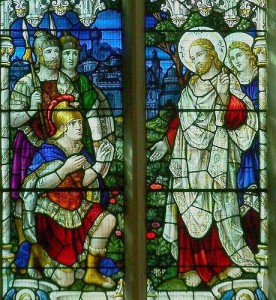
Stained Glass Window of Jesus and the CenturionThe words of the centurion are the root of a prayer spoken by many before receiving Holy Communion: “Lord, I am not worthy to receive you, but only say the word and I shall be healed.” As an Anglo-Catholic Episcopalian, recitation of this prayer used to be a part of my personal practice. But I have ceased to say it because I became uncomfortable about the change in emphasis from the biblical text to the liturgical text. A statement of faith in Christ’s power to heal another has been turned into a purely personal (and one is tempted to say “selfish”) prayer. ~ Paragraph 1386 of the catechism of the Roman Catholic Church explains the rational of the prayer: “Before so great a sacrament, the faithful can only echo humbly and with ardent faith the words of the Centurion: ‘Domine, non sum dignus ut intres sub tectum meum, sed tantum dic verbo, et sanabitur anima mea’ (‘Lord, I am not worthy that you should enter under my roof, but only say the word and my soul will be healed.’)” That’s great, except the quotation from the Centurion is inaccurate! In the Vulgate, the verse reads, “Tantum dic verbo et sanabitur puer meus.” (“Only say the word and my servant [or ‘child’] shall be healed.”) I am troubled reciting a prayer based on a misquotation of scripture. ~ The centurion in the story is about as far from self-centered as one can be. He seeks Jesus’ help not for himself but for his servant. He is unwilling for Jesus to be inconvenienced. It is in that spirit that he speaks these words, explaining that as a military officer he simply gives orders and things are done, so he has faith that One with the power of healing can simply do the same. It is for his selflessness that Jesus’ praises him and his faith. It seems somehow wrong to recite a prayer which turns that on its head! ~ I recall reading a few years ago about a medical brain-function study which demonstrated that selflessness is psychologically healthy and is the neuropsychological foundation of spiritual experience. Selfishness, on the other hand, is unhealthy: other scientific studies have demonstrated that it is impossible for a completely selfish individual to either survive or have a biological future. So I am unwilling to utter a prayer which turns a selfless intercession on behalf of another into a self-centered (one is tempted to say “selfish”) petition. “Lord, I am unworthy to receive you” … let’s just leave it at that.

Grow My Church! – Sermon for the 7th Sunday of Easter – May 20, 2012

Revised Common Lectionary readings for the Seventh Sunday of Easter (Sunday after the Ascension): Acts 1:15-17, 21-26; Psalm 1; 1 John 5:9-13; and John 17:6-19.

This graphic is the work of Matthew Todd Spiel and is used under the terms of a creative commons Attribution-No Derivative Works 3.0 license.The story from the Acts of the Apostles this morning tells us that the apostles, in choosing a replacement for Judas Iscariot, relied on a game of chance. They couldn’t decide between two candidates so, rather than voting, they “cast lots”, drew straws, rolled the dice. Matthias got the short straw. As I was contemplating these lessons, and particularly this story, this week, I was also assaulted by radio and television advertisements for the new Horseshoe Casino in downtown Cleveland. And just like the lessons of the past few weeks, this coincidence of events triggered a memory of childhood. But this week, the memory was not of summers spent with my grandparents, it was of Saturdays spent with my father.

My father, R. York Funston, was a Certified Public Accountant in Las Vegas, Nevada. During the 1940s and 1950s one of the ways the authorities kept tabs on the gaming industry was through weekly audits of the casino records conducted by state-appointed CPAs, of which my dad was one. For some reason, the Gaming Control Board thought Saturday mornings would be the best time for the books to be collected, so that was when he would make the rounds of the five casinos he was responsible for. It was also the day my mother did her housekeeping and she didn’t want me underfoot, so I would accompany my dad as he drove through Las Vegas visiting the casinos.

The Las Vegas of the early 1950s was rather different from the city one visits today. In those days, Las Vegas as about the size of current-day Medina, Ohio. A permanent population of right around 30,000 people, a downtown like that of any other city with a Sears-Roebuck, a Rexall drug store, a locally owned department store called Ronzone’s, a movie theatre that showed double-features, and half-a-dozen or so casinos. We lived near the south edge of town in a post-war housing development called Huntridge. Just a couple blocks south of us was Sahara Boulevard, south of which was the desert and a collection of horse ranches called Paradise Valley.

Dad and I would get up and leave the house at about 6 a.m. on Saturday mornings and drive through Paradise Valley headed for the Tropicana Hotel & Casino to pick up the first set of books. Then we’d hit three other places on the strip and finish up downtown at Binny Binion’s Horseshoe, the casino which eventually became the big publicly-traded corporation now running a casino in Cleveland.

This was not, in terms of miles traveled, a very long trip, but it would take about four or five hours because at each stop my dad would have a cup of coffee and a conversation with the casino managers. At each place, I would get to spend time with a change girl or a cocktail waitress while Dad conducted his business, and sometimes I’d get to meet other people. For example, I met Frank Sinatra and Dean Martin and all the rest of the Rat Pack when I was four years old. But when we got to Binion’s, I got to do something else.

The Horseshoe was on the corner of Fremont, the downtown main street of Las Vegas, and Third Street, and the whole corner of the building was open to the street. Right at the corner, visible for everyone passing by to see, was a big glass box in which, it was said, there was $1,000,000 in U.S. currency in bills of various denominations. On either side of the box stood a uniformed guard carrying a shotgun. Casino patrons could get inside that box with all that money and large fan would blow a whirlwind around them and lift those bills so they were flying all around the person. I’m not sure how long the patron had, maybe a minute, but whatever it was, the idea was that during that period of time whatever bills the person could catch and hold on to, they got to keep. My dad would leave me there at the entrance to Binion’s Horseshoe and let me watch those people trying to catch money while he went inside and got the books. I never saw anybody catch very many bills – that’s really hard to do.

So when the Bible describes a game of chance as the means by which the apostles chose a successor to Judas, and the radio is broadcasting ads for a new casino in Cleveland, I remember those childhood visits to Binion’s Horseshoe and those silly people grabbing at those flying bills.

Luke does not tell us whether Matthias was commissioned in any way for his ministry as Judas’s replacement, but I think we can be fairly certain that he was. Elsewhere in Acts Luke describes acts of laying of hands and prayer to commission people for special ministries, and church historians assure us that from the very earliest days of the church this was the regular practice. Today we are commissioning a group of St. Paul’s members to perform a special ministry as part of what is called a Grow My Church Task Force. The “my” in “Grow My Church” refers to Christ; this title is a paraphrase of Jesus’ “Great Commission” to the Apostles, the commandment given them just before his ascension into heaven. St. Matthew reports it in these words:

Go therefore and make disciples of all the nations, baptizing them in the name of the Father and the Son and the Holy Spirit, teaching them to observe all that I commanded you; and lo, I am with you always , even to the end of the age. (Matt. 28:19-20)

Jesus refers to his intention to do this in today’s gospel from John, in what is called his “high priestly prayer” offered to God on the night of the Last Supper. In fact, this prayer is the Apostles’ commissioning by Jesus for the ministry they will be given:

Sanctify them in the truth; your word is truth. As you have sent me into the world, so I have sent them into the world. And for their sakes I sanctify myself, so that they also may be sanctified in truth. (John 17:17-19)

The word for sending here in the original Greek of the New Testament is apostello and it is from this word that we get our word apostle – an apostle is one who is sent.

In a few minutes, we will formally commission the Task Force, we will make them apostles sent to do a job, but before we do, I want to tell you what the Vestry, our parish governing board, has charged them to do. At its last meeting, the Vestry adopted this resolution:

We, the Vestry of St Paul’s Episcopal Church formally charge the members of the newly formed Grow My Church! Team, which includes Barbara Baird, Shelley Triebsch, Mark Hansen, Joe Mahn, David Muffet, Steve Rucinski, and Ray Sizemore, to help us learn more about our congregation. We commend to you the Grow My Church! course and ask that you exercise all diligence in prayer and study, and return to us with recommendations. Therefore, in the course of your study we formally charge you to develop a Congregational Growth Plan to help reinvigorate our church and better live out our role in The Great Commission. We pledge to review your recommendations, intending to fruitfully apply your work as the Holy Spirit guides us. We expect to hear back from you in four months and pledge to keep everyone involved in our prayers

The Task Force will be meeting on Monday evenings for twelve weeks. Each meeting will address a particular topic:

  1. Organization
  2. Landscape (What are the societal and community factors influencing our church?)
  3. Leadership (How does our governance structure work? How could it be improved?)
  4. Purpose (What is our mission? How well is it known to our members and to non-members?)
  5. Worship (Why we gather on Sunday? What do we do? What should we do?)
  6. Spirituality (What is our church’s relationship with God?)
  7. Service (What are our community outreach ministries? Are there others we should be doing?)
  8. Fellowship (What about the social time we spend together? Can it be improved?)
  9. Generosity (How do we talk about money? How do we raise it, use it, steward it?)
  10. Hospitality (How are we at welcoming the visitor and incorporating the newcomer?)
  11. Invitation (How well do we do at asking others to join us? What can we do to make our invitations more frequent and more effective?)
  12. Growth Plan (Putting it all together with action recommendations reported to the Vestry.)

OK … so that’s who they are, what they’ve been commissioned to do, and how they’re going to go about doing it.

Here’s what I hope they (and we) won’t do.

First, I hope they won’t be like those people in the glass box at Binion’s Horseshoe grabbing at the flying money. I sometimes feel that that is what the church has been doing for the past three or four decades. We have known that church membership has been declining, that Average Sunday Attendance has been going down, but we haven’t known what to do about it, so we stand in the whirlwind and grab at anything that flies by. We’ve had program after program that was supposed to reinvigorate the church and make us grow. We’ve had canned studies called Edge of Adventure, Living the Adventure, Faith Alive, Acts 29, and on and on. We’ve had spiritual experiences like Cursillo, Marriage Encounter, the charismatic movement, and the so-called contemporary worship craze. We’ve done Natural Church Development and we’ve done Unbinding the Gospel.
Some of these things have worked for while; some of these things have taught us lessons we ought to remember; some of these things actually have done harm. But much of it has been “like chaff which the wind blows away” or like the dollar bills flying around in that glass box. I hope this Task Force doesn’t repeat that experience but will be solidly grounded and take from the things we’ve tried and the things they study some good, reliable insights on which to make recommendations to the Vestry and to all of us. I hope that in this study this Task Force will be “like trees planted by streams of water, bearing fruit in due season.”

Second, I hope they won’t feel constrained by the past. I hope they won’t use (or even hear) two sentences. One is “We’ve never done it that way before” and the other is “We’ve always done it that way before.” There are lots of things that we (throughout the church not just in this parish) have not done that we clearly ought to be doing; and there are plenty of things that we’ve done for years that we need to abandon. Someone recently reminded me of an observation made back in the 1990s by Father Robert Farrar Capon, one of the great writers of our church. Fr. Capon, in a book entitled The Astonished Heart: Reclaiming the Good News from the Lost-and-Found of Church History, wrote:

The church can’t rise because it refuses to drop dead. The fact that it’s dying is of no use whatsoever: dying is simply the world’s most uncomfortable way of remaining alive. If you are to be raised from the dead, the only thing that can make you a candidate is to go all the way into death. Death, not life, is God’s recipe for fixing up the world.

As John wrote in today’s epistle, God intends for us to have eternal life, “and this life is in his Son,” and his Son said:

Very truly, I tell you, unless a grain of wheat falls into the earth and dies, it remains just a single grain; but if it dies, it bears much fruit. Those who love their life lose it, and those who hate their life in this world will keep it for eternal life. (John 12:24-25)

I believe that is as true for the church as a community as it is for each of us as individuals, but just as individuals must die to self in order to be born again, the church must die to all the things, the practices, the ways-we’ve-always-done-it that may have worked in the past but that are now holding us back.

Third, I hope that you won’t ignore their work. I hope you will participate in this process. As the Task Force works through these twelve weeks of study, they will be seeking your input. This white board over here will be in the hallway each week with a question or maybe two. There will be inserts in your bulletin for your answers. Please give them and put them on the board with those colored magnets you see. And sign them! The Task Force cannot respond to anonymity – they may want to get more information from you and they will want to respond to you. So give them your thoughts and take ownership of them. Have the courage of your convictions and let the Task Force have your testimony about your church.

Finally, after we commission them, we will hold them responsible for producing an action plan to report to the Vestry within four months pursuant to that resolution. I hope that they won’t just walk away from it. I hope that they, in turn, will hold us responsible to do the things in that plan. They are a Task Force and when their task is done, they will be discharged and their team disbanded, but I hope they will continue to be active in our pursuit of the Great Commission making sure that we do what they determine in this study we need to do.

The liturgy of commissioning the members of the Grow My Church! Task Force is in your bulletins. Would you please pull that out while I ask the members of the Task Force to step forward….

Know – Go – Show: Sermon for the 5th Sunday of Easter, Year B – May 6, 2012

Revised Common Lectionary for the 5th Sunday in Easter, Year B: Acts 8:26-40, Psalm 22:24-30, 1 John 4:7-21, and John 15:1-8

On Thursday of this past week, a client of the food pantry of St. Peter’s Episcopal Church in Ellicott City, Maryland, shot and killed the parish secretary, Brenda Brewington; shot and critically wounded one of the parish priests, the Rev. Dr. Mary-Marguerite Kohn; and then shot and killed himself. His name was Douglas Jones. The cutting short of those lives is not the sort of pruning about which Jesus speaks in today’s gospel lesson, but I could not let go of that image as I thought about and prayed about what happened in Maryland. As you all know, we here at St. Paul’s have our own regular food pantry ministry – the Free Farmers’ Market – and, on occasion, volunteers, including me although I don’t work the Market as often as I used to, have been threatened with violence by clients who have clearly had some cognitive dysfunction. The same has happened on weekdays when needy persons have come to the office seeking assistance; we have had uncomfortable and sometimes scary incidents in the office. I have never taken them very seriously. Perhaps I should. But I do not believe that the murder of church workers, lay or ordained, is the sort of “pruning” Jesus is here talking about. On the other hand, I have no doubt that from this tragedy in Maryland there will come much fruit. I have no doubt because I have heard the resolve in the voice of the bishop of Maryland, in the words of the parish and diocesan spokespeople who have interfaced with the media, in the reactions of clergy and laity throughout the church, and especially in the words of the parish’s rector, Fr. Kirk Kubicek. There will be growth from this horrible event because, while this is not the sort of pruning our Lord describes in this gospel lessons, the determination with which those most affected are facing this heartbreak, is the fruit of the Vine which is Christ, the Vine of which we are also branches. Today, in our prayers, we will pray for repose for those who died and for strength for those left behind.

Well . . . .

I hadn’t really planned to do a sermon series about my childhood summers spent with Edgar and Edna Funston, but these “I am” statements of Jesus from the Fourth Gospel keep taking me back there, so once again . . . a story from Winfield, Kansas, fifty years ago.

It was the summer of 1961, that was the second summer my cousins were there as well. Bob – two years old then me, Randy – 20 months younger, and I decided we wanted to build a tree house. So we asked Granddad if we could do that and he said, “Yes.” He didn’t ask which tree we were thinking of using, and he didn’t give us any direction . . . he just said, “OK.” So we proceeded to build our tree house in his prize pie cherry tree.

My grandmother made wonderful cherry pies from that trees fruit. I think those cherry pies are the reason that’s my favorite kind of pie . . . and why I’m usually disappointed when I order my favorite kind of pie in a restaurant. They were my grandfather’s favorite pies, too.

That’s probably why he got so angry when he saw what we’d done. I’m sure he thought he’d never see another cherry pie from that tree again. Back in 1961 grandfathers could still spank their grandsons . . . and he did. Fifty years later and I still remember it. He also tore down the tree house we’d worked so hard to build.

Fast forward several months to June, 1962. Back in those days the Los Angeles Unified School District ended classes on the last school before Memorial Day (which wasn’t always on a Monday like it is now) and started them on the Tuesday after Labor Day (which always was the first Monday of September). My mom would always arrange to take a week of vacation the second week of June so she could drive me to Kansas, so I’d usually arrive at my grandparents sometime between the 5th and the 10th of June. That just happens to be cherry picking season in southeast Kansas. I usually looked forward to that . . . but not in 1962. Like my granddad, I was sure there would be no cherry harvest, and I was sure that he would again make his displeasure known.

Well, contrary to all expectations, not only was there a cherry harvest, it was the largest harvest from that tree in several years. My grandfather’s first words to me that summer were, “I owe you an apology. I guess that tree needed pruning.” It wasn’t the most attractive and artful job of pruning that Bob and Randy and I had done, but it was effective. We enjoyed more cherry pies that summer than you could imagine! And Grammy canned cherries for weeks.

I learned two things from that episode. One was that an honorable person apologizes when he’s proven wrong. My grandfather was nothing if not honorable. The second was the value of pruning. I’m a terrible gardener. I don’t enjoy it and I usually produce next to nothing useful when I try, but I know (because of that cherry tree) the purpose and value of pruning.

So when Jesus, in this the seventh and last of the great “I am” statements in John’s Gospel, talks about pruning, I know exactly what he is saying. I know what pruning is, I know that pruning can be painful, and I know that pruning produces results.

Last week, you’ll remember, we heard another of the “I am” statements: “I am the Good Shepherd,” Jesus said then. These metaphors that Jesus uses, these agricultural pictures that Jesus paints for us last Sunday and today are graphic reminders of our total dependence upon God, our pitiful inability to flourish with his nurturing. Sheep without a shepherd who (unlike the hired hand) remains with them in danger, even at the cost of his life, stray to solitary deaths. Vines without a a skilled vineyard keeper to prune away superfluous, misguided, and barren branches bear little or no fruit. Jesus didn’t say as much last week, but flocks like vines need to be cut back.

Where I was living in Ireland last summer was a livestock producing area. My cottage was on a cattle farm, not a ranch … they don’t have ranches in Ireland! Anyway, my landlords, John and Marion, would by a dozen or so steer calves each year, fatten them for some several months, and then sell them to be slaughtered for beef. One evening over a beer, John told me that one gets to know the cows; they each have a personality and as one moves them from field to field you get to know them. So when slaughter time comes, it is sort of sad. “But,” he said, “I don’t know how my neighbour does it.” His neighbour had a lambing operation. He was there for the birth of each lamb. His children would name them. The lambs were practically members of the family! And, yet, at various times the neighbouring shepherd would have to make a decision: which lambs to cull, to send for slaughter, which to keep for breeding stock, which to sell to someone else as breeding stock. “I don’t know how you do that,” John said.

Every day I would take a long walk down that road accompanied by the farm dog Buddy and on some days I would see the shepherd out with the sheep and the lambs. One day I could tell by his demeanor that it was that day, that he was selecting among the lambs those who would be taken away for slaughter and those that would be kept for breeding. This was not a large industrial operation; this was a small family-run farm and I am sure that, as Jesus said in last week’s gospel, he knew each of those lambs. But what had to be done had to be done, sad though it might have made that shepherd.

Culling the flock or cutting the vine in the right place are exacting, necessary tasks which the skilled shepherd or vine grower must do. Unpruned, vines grow in wild, unruly ways, exploding with new branches and great leafy cascades, but few grapes. Unwatched, sheep scatter and lose their way, wandering heedlessly into danger; unculled, a flock weakens and all of the sheep suffer.

Flocks of sheep are disorderly and topsy-turvy crowds. Vines and their branches are similarly tangled and messy. With either, it’s just too hard to know what is what. Not only are we dependent on Jesus the Shepherd, on God the Vinedresser, but our lives are uncomfortably tangled up together. The Christian life is a flock-y, vine-y, branch-y, mixed-up mess of us and Jesus and others.

I think only one or two of us may have culled a flock, but I know that all of us have, at one time or another, pruned our suburban hedges or shrubs. You may have experienced, as I have, a feeling of hesitation, that unwillingness to strip away what have been thriving branches for a greater and unseen future good. But what, with all that tangle of branches, are the alternatives?

Over the past several years there has been much hand wringing over the state of the church, its decline in membership, its loss of congregations, the shrinking of parish budgets, and so forth. We’ve looked at statistical graphs, at flow charts, at columns upon columns of figures, and we’ve pointed fingers at one another, at those who left, at the secular world around us, and at all sorts of other things seeking someone or something to blame for it all. In the Episcopal Church, we’ve blamed our loss of membership on new prayer books or on old prayer books, on women in Holy Orders or on failure to receive women in the clergy, on the acceptance (or the lack of acceptance) of gays and lesbians, on old style music or on new kinds of music, never noticing that the same statistical declines were happening in all the mainline denominations where none of those things were issues. We have wrung our hands and cried out to one another, “We’re dying on the vine here!”

I believe that today’s gospel lesson gives us a different way to look at things. We on the Vine, that’s for sure! But we ain’t dying on it. I believe these past several years have been a time of cutting back, that we are the branches that remain after the Vinedresser has done his pruning, the flock that is now smaller after the Shepherd has done his culling. And I believe that means we are on the verge of a time of new and exciting growth, a productive time of bearing fruit, a time of expanding the flock. We have all that we need to do that because we have the promise of the gospel: “Those who abide in me and I in them bear much fruit. . . . If you abide in me, and my words abide in you, ask for whatever you wish, and it will be done for you. My Father is glorified by this, that you bear much fruit and become my disciples.”

We know this! These are the most important words in epistle lesson from First John today: “We know that we abide in him.” Right there in your lesson insert; find those words and read them with me . . . “We know that we abide in him.” Again – “We know that we abide in him.” One more time – “We know that we abide in him.” With feeling! “We KNOW that we abide in him.”

We know that we abide in him. We know that we are loved by God, and so we also must love.

The most important words in the reading from the Book of Acts today are right at the beginning lesson: “An angel of the Lord said to Philip, ‘Get up and go’.” All the rest there, that story about the Ethiopian Eunuch, that’s just an example; it’s window dressing. The important words are “Get up and go!” Can you say those words with me? “Get up and go!” I want you to turn to the person next to you; I want you to be an angel to that person; I want you to say to that person, “Get up and go!” Go on, now! Say to that person next to you, “Get up and go!”

Get up and go! God’s love, our love must send us out, out of the church, out of our comfort zone, into the uncomfortable and unlovable circumstances around us. We must get up and go into places where love is absent; we must get up and go to people to whom love is simply unknown. To abide in Jesus, to be loved by God is to be given a mission, a mission to get up and go with what we know to those who cannot accept it, to the destitute, the broken, the lost, the hopeless; a mission to get up and go, not to tell them what we know, but to show them what we know, through our lives and by our actions. That is how and when we will bear fruit; that is how and when we will grow. Not merely to know that we abide in him, but to show that we abide in him!

We know … so get up and go … and show. Know, go, show! That is how we shall bear fruit and grow.

Let us pray:

Heavenly Father, you know our world is broken, sinful, and shameful, filled with hate and with pain. Because of that brokenness and pain Brenda, and Mary-Marguerite, and Douglas died. Because of that brokenness and pain your Son our Savior Jesus Christ died. But in him you showed us that your love and your life know no bounds, are held back by no obstacles, not even death. Give us the faith to know that we abide in him, the faith to get up and go, the faith to show love even to the least lovable of people, in the least lovable of places, at the least lovable of times; Lord, give us the faith to know, to go, and to show, that we may bear fruit and grow, through Jesus Christ our Lord. Amen.

Have we extinguished our light? – From the Daily Office – May 1, 2012

Jesus said:

You are the light of the world. A city built on a hill cannot be hidden. No one after lighting a lamp puts it under the bushel basket, but on the lampstand, and it gives light to all in the house. In the same way, let your light shine before others, so that they may see your good works and give glory to your Father in heaven.

(From the Daily Office Lectionary – Matthew 5:14-16 – May 1, 2012)

When I joined the Episcopal Church in high school, the last verse of this quotation was the favorite offertory sentence of the parish priest – in the King James Version, of course: “Let your light so shine before men, that they may see your good works, and glorify your Father which is in heaven.” If he didn’t say that one, he said, “Not every one that saith unto me, Lord, Lord, shall enter into the kingdom of heaven; but he that doeth the will of my Father which is in heaven.” (Matt. 7:21 KJV) I memorized those verses not by reading them, but by hearing one or the other at every service as the invitation to make a gift to God. I learned the lesson of an active faith, of being public and “out there” with my beliefs, of doing the will of the Father, from hearing those simple but profound verses at every service. ~ I love the 1979 Book of Common Prayer and its many options for worship, but I wonder whether in our quest for variety in worship we have left behind the wisdom of simple, repetitive teaching. In our current worship practice we are directed by a rubric to offer prayers for the Universal Church, its members, and its mission; for the Nation and all in authority; for the welfare of the world; for the concerns of the local community; for those who suffer and those in any trouble; and for the departed . That’s well and good, but the way in which these prayers are offered is left up to the designers of each service or to the presiding ministers and, in fact, variety seems to be encouraged. On the other hand, in our previous prayer book (and all those that preceded it) there was one prayer “for the whole state of Christ’s church.” Every Sunday, the same prayer was offered; the same lesson of the need for prayer was taught. ~ That standard prayer included the every Sunday petition that God “inspire continually the Universal Church with the spirit of truth, unity, and concord: And grant that all those who do confess thy holy Name may agree in the truth of thy holy Word, and live in unity and godly love.” Is it possible, just the least bit possible, that some of our current discord in the church is because we’ve stopped hearing these words, stopped teaching and learning the lesson of “truth, unity, and concord”, stopped trusting God to support us in agreement, unity, and “godly love”? Have we extinguished our light, have we stopped shining that light before others because we’ve stopped offering and hearing these simple, repetitive lessons? ~ I don’t know. And I love variety in worship. But remembering those every Sunday offertory sentences, those every Sunday petitions for unity, I’m beginning to wonder.
Is Liturgy All Smoke & Mirrors? – From the Daily Office – April 26, 2012

From the Book of Exodus:

When all the people witnessed the thunder and lightning, the sound of the trumpet, and the mountain smoking, they were afraid and trembled and stood at a distance, and said to Moses, “You speak to us, and we will listen; but do not let God speak to us, or we will die.” Moses said to the people, “Do not be afraid; for God has come only to test you and to put the fear of him upon you so that you do not sin.” Then the people stood at a distance, while Moses drew near to the thick darkness where God was.

(From the Daily Office Lectionary – Exodus 20:18-21 – April 26, 2012)

Moses Receiving the Torah from God at Mount Sinai by Marc ChagallThe rest of today’s Daily Office reading from the Hebrew Scriptures sets out the Ten Commandments. My first thoughts were of those and wondering whether the course of world history might have been different if the Lord had laid out those laws in an affirmative rather than a negative style. You know – said something like “You shall hold all life in reverence” rather than “You shall not murder” (Exod. 20:13) or “You will respect your neighbor’s right of possession” rather than “You shall not steal” (Exod. 20:15). But then the ending verses caught my eye and I immediately thought, “Incense!” ~ OK, not immediately … but I did think of incense and liturgy. Smoke and lightning and loud noises and a leader separated from the people to do special things vis-à-vis God (so the people don’t have to do them for themselves, because – God knows! – those things are downright dangerous!). Skip forward several generations and you have the liturgy of the Temple . . . skip forward several more generations and you have the liturgy of the Church. As I thought about today’s Exodus reading, I realized that the liturgy of temple and church is about recreating Sinai; liturgy is an attempt to experience in the here-and-now what the Hebrews experienced in this encounter with God. And I began to ask, “Is this what has put us on the trajectory of irrelevance and disbelief?” ~ The stagecraft of temple and church became the stagecraft of the theatre, of vaudeville, of burlesque, of the stage magician. There is very little difference between staging a good worship service and staging a good theatrical or musical production. Use of “props”, use of lighting, use of stage technique . . . it all started in the temple and the church, and was borrowed by the entertainment stage (in fact, one might argue that the Western European way of staging dramas and other forms of entertainment in some sense originated in the church with medieval “passion plays” and whatnot). And now, today, the flow is in the opposite direction: the staging techniques of the rock concert have replaced the formal liturgy in many independent congregations and so-called megachurches. This is so well-known that there’s even a very funny parody of the situation on YouTube. ~ When these techniques of stagecraft moved from church to secular stage, however, the reason for their use changed. No longer was the intent to recreate an experience of the holy, the numinous, the mysterium tremendum et fascinans, rather the intent was to deceive. Well, that may be overstating the initial change, but truly the secular stage’s use of “smoke and mirrors” is to create a fictional illusion of reality, and when used by magician’s its function is to mislead the observer. It is not without cause that the term “smoke and mirrors” has entered the modern lexicon! ~ So I began to wonder . . . even if we do really great job of staging the liturgy in all its glory – beautiful music, loud “noises” from brass and organ, lovely flowers and candles, the sweetness of incense, the splendor of colorful vestments – is all that stagecraft pointing toward God-at-Sinai, or is it raising a barrier of “smoke and mirrors”? Is a public, which now looks beyond stagecraft and understands that on the secular stage it masks that which is untrue, made skeptical by its use? I have to admit that I don’t know, but I wonder if today’s attitude toward religion, an attitude of disbelief and irrelevance, might not find some of its origin here. (On the other hand, I also have to admit that I don’t intend to stop celebrating the liturgy with as much care and good stagecraft as possible!)
Have You Anything Here to Eat? – Sermon for Easter 3B – April 22, 2012

Revised Common Lectionary for the Third Sunday of Easter, Year B: Acts 3:12-19; Psalm 4; 1 John 3:1-7; and Luke 24:36b-48

From the Gospel according to Luke:

While in their joy they were disbelieving and still wondering, he said to them, “Have you anything here to eat?” They gave him a piece of broiled fish, and he took it and ate in their presence. (Luke 24:41)

Jesus Appears to the Disciples Behind Closed Doors, Duccio di BuoninsegnaI have to admit that I would be hard-pressed to choose one of the many post-resurrection appearances of Christ as my favorite. Each one recorded in Scripture is so full of vivid imagery and meaning that it would be nearly impossible to put one above another … having said that, however, I also have to admit an especial fondness for the one described here by Luke.

There are two things about this one that I really like. First is Luke’s comment that the disciples “in their joy … were disbelieving.” It’s such a great description of what their amazement must have been; it calls to my mind some of the great, little-used emotional descriptors of our language: consternation, bewilderment, perplexity, astonishment, and (my favorite) stupefaction. I think that’s what Luke is saying in this delightful turn of phrase, that the disciples were stupefied! It’s also Luke’s way of describing something that is handled somewhat more harshly in Mark’s telling of the story, which just happens to be the gospel lesson for the Daily Office today.
Mark, with typical economy of expression, describes the scene this way:

Later he appeared to the eleven themselves as they were sitting at the table; and he upbraided them for their lack of faith and stubbornness, because they had not believed those who saw him after he had risen. (Mark 16:14)

In one ancient manuscript of Mark’s gospel that is not accepted in the received version the text continues by describing the apostles’ reply:

And they excused themselves, saying, “This age of lawlessness and unbelief is under Satan, who does not allow the truth and power of God to prevail over the unclean things of the spirits. Therefore reveal your righteousness now” – thus they spoke to Christ. (Codex Washingtonensis or Freer Logion)

I like this recorded post-resurrection appearance, apocryphal though it may be, nearly as much as the one in today’s reading from Luke’s gospel. The fact that “they excused themselves” and that they demanded of Jesus “reveal your righteousness now”. It’s nearly as good as Luke’s description of “joyful disbelief”! I absolutely love this! It’s so darned modern . . . or maybe even post-modern. You can almost hear the eleven saying something like, “Well, Jesus, that resurrection stuff may be true for you, but it’s not true for us!” When we read these to texts together, Luke and Mark, describing this scene in their different ways, we get such a wonderful picture of the apostles. Astonished but still making excuses, perplexed but still making demands, stupefied but still relativizing the situation . . . these men aren’t just First Century Palestinian Jewish fisherman; they are 21st Century Americans; they are us!

The second thing I find absolutely delightful about Luke’s telling of the story is Jesus’ question: “Have you anything here to eat?” If this scene were set in a modern home, I think we could envision it happening in the kitchen, the apostles sitting around the kitchen table, Jesus showing up, saying “Hey!” then going to the refrigerator, opening the door, and looking in like a teenager getting home from school, “Anything here to eat?” They do, as this version of Luke tells us, have that broiled fish handy, and in the King James Version (supported by some ancient manuscripts) Luke also reports that they gave him a piece of honey-comb.

There is a long line of biblical scholarship that tells us that Jesus’ asking for something to eat, and then actually eating it, is his way of proving to the stupefied disciples that he’s not a phantom. The idea is that by consuming it in front of them, Jesus proves that he has not returned as a spirit, or a ghost, or some sort of apparition; a ghost, after all, could not be touched, or have an appetite, or eat things. Lutheran pastor Doug Schmirler put it this way: “It may be Luke’s way of saying: ‘Ghost? Did you ever see a ghost chew? Did you ever see a ghost swallow? Did you ever see a ghost digest? Well, did you?'” That’s certainly a good way to look at this, but this story seen from the combined perspectives of Luke and the Freer Logion addition to Mark speaks to me in a different way.

I prefer the versions that include the honey-comb because that makes Jesus’ eating much more than a mere demonstration of non-ghost-ness; it makes it a meal. Something savory, and something sweet; an entree and a dessert. This is not just a “Look; see, I’m not a spirit”. This is Jesus once again sitting down at the dinner table with his friends, just like he had done in the home of Mary, Martha and Lazarus, just like he did once before in this upper room, just like he did with Cleopas and his companion in the inn on the road to Emmaus. This is the community once again sitting together at the kitchen table.

And just like every family, every community at every dinner table, they are talking and discussing and maybe even getting a little cross with one another if that additional bit to Mark’s Gospel is trustworthy.

There is a restaurant in San Francisco called Credo, which I’m sure you know is simply the Latin word for “creed”. On their walls are painted quotations from all sorts of philosophers, writers, politicians, and so forth. On their menus they have their business credo written out:

At Credo, we believe in nourishing both the body and the mind. Our walls depict the universality of ideas, the clash of conflicting viewpoints and the democratic nature of discussion and debate. We believe that good food and good company go hand-in-hand. We believe in the time-honored tradition of the dinner table debate and the value of impassioned points of view. We believe simple things can be wonderful, like authentic ingredients, genuine creativity and gracious hospitality.

This is what is happening here: dinner table debate, impassioned points of view, genuine creativity, and gracious hospitality. This is the glory and power of Christ’s Resurrection; the creation of community, a new community.

This is why I like this story that Luke and Mark tell from different perspectives so much; it is such a clear vision of the resurrected community. In the very human act eating of a meal, in very human condition perplexity and befuddlement, in the very human process of making excuses and making demands, these eleven, once a dispirited and possibly dying community, are resurrected. These are not simply individuals on a personal spiritual quest; they are joined together into a new community in Christ, crucified with him, now risen with him, given new life and new purpose and new mission because of his resurrection.

This new community is an on-going one, a growing one, a maturing one. As John says in the reading from his first letter this morning:

See what love the Father has given us, that we should be called children of God; and that is what we are. … What we will be has not yet been revealed. What we do know is this: when he is revealed, we will be like him, for we will see him as he is. (1 John 3:1-2)

We do know this: that his eating the fish and the honey-comb revealed him to be a real human being and that that is what we are called to be – real human beings. Carroll Simcox, who edited the Episcopal Church magazine The Living Church for many years, put it this way:

You and I shall be our real, complete selves for the first time ever. We think of ourselves now as human beings. We really aren’t that?not yet. We are human becomings. The fetus conceived only yesterday is a human becoming. If you are living in Christ, believing in him and trying to follow and obey him as the master of your life, you are by his grace, becoming ever more and more like him. (Quoted by Guy Sayle, infra)

But John does not mean that God is making us into clones or exact replicas of Jesus of Nazareth. The wonderful paradox of the Christian faith is that the more we become like Jesus, the more we become our truest selves. The hope of the Christian faith is that we can become as truly human as the Resurrected Christ. Dr. Guy Sayles, a Cooperative Baptist preacher, put it this way:

As we discover deeper dimensions of Christ-likeness, we uncover more and more of our honest-to-God selves.

Jesus is the pattern and the power, the model and the source, of authentic human life. We are meant to have what he had and has:

  • a radical and liberating faith in God;
  • a childlike trust in the grace of God;
  • a trembling wonder before the mystery of life;
  • a durable hope that, because we are in God’s hands, death and sorrow and pain and tears are not the end, but joy and wholeness and laughter are;
  • an astonishing confidence that we and the world are headed, not toward midnight, but toward sunrise; and
  • an undimmed awareness that the heart of all things is unconditional and compassionate love.

Those eleven disciples sitting around that dinner table, confronted by what they at first thought was an apparition, were astonished but still making excuses, perplexed but still making demands, stupefied but still relativizing the situation. They were just like us, but as church history and the Book of Acts shows, in stories like the one we heard today, they became like him, they became their truest selves, and so shall we all. That is the power and promise of the Resurrection.

Alleluia and amen!

« Older posts Newer posts »